PART 2
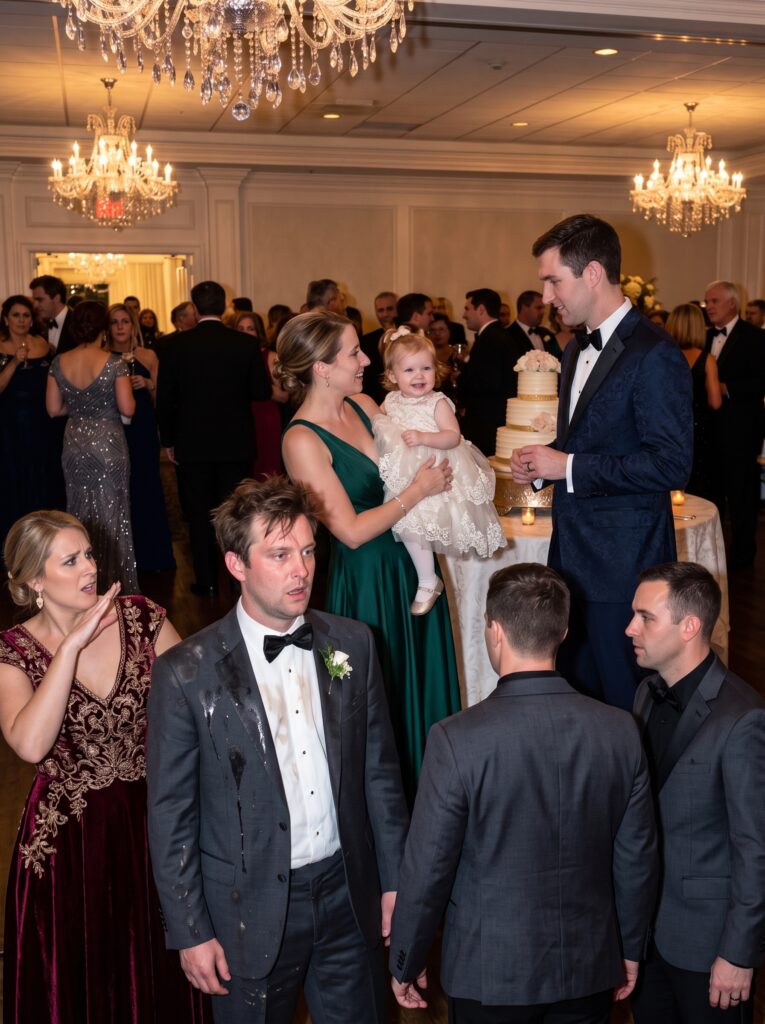
The story of Marcus Mercer’s arrest at a Boston society wedding spread through the city’s financial circles before the wedding cake was even cut, guests already texting screenshots and hushed accounts to colleagues who hadn’t been there to see it themselves.
I didn’t think about any of that on the terrace. I sat with Emma on my lap, feeding her small bites of cake while Julian stood nearby, quietly fielding a phone call from his legal team about the now-collapsed acquisition.
“You okay?” he asked once he hung up, sliding into the seat beside me.
“Surprisingly, yes,” I said. “I thought seeing him again would feel bigger than it did. Instead it just felt like watching the last chapter of something that ended a long time ago.”
“You built this outcome years before tonight,” Julian said. “You just chose the moment. That’s not revenge, Evelyn. That’s patience.”
Over the following weeks, the fallout continued exactly as the compliance audit had predicted. The forensic review Rhodes Capital’s legal team completed confirmed extensive underreporting of assets, both in Marcus’s company filings and in the divorce proceedings from five years earlier, the same offshore accounts he’d used to hide marital funds during our split now forming the backbone of a federal fraud case against him.
My old divorce attorney, once I finally shared the encrypted drive’s contents with her, filed a motion to reopen the original settlement, given the newly uncovered evidence of concealed assets. It took several months, but the court ultimately awarded a significant retroactive settlement, funds that had legally been mine all along, simply hidden well enough that I hadn’t been able to prove it five years earlier.
Chloe distanced herself from Marcus almost immediately, giving interviews to local outlets insisting she’d been “completely unaware” of his financial dealings, though several guests from the wedding later confirmed she’d been present for at least one conversation about the offshore accounts months earlier. Whatever the truth, she vanished from Boston’s social scene within the year, the same instinct for self-preservation that had once drawn her to Marcus now driving her just as quickly away from him.
Marcus’s company folded within six months, the bridge loans defaulting exactly as he’d feared that night in the ballroom. He pleaded guilty to reduced federal charges eventually, avoiding a lengthy trial in exchange for a shorter sentence and full cooperation with investigators, a plea deal that still left him with a felony record and the complete collapse of the empire he’d built partly on money that was never fully his to hide.
Emma, blissfully unaware of any of it beyond “the day Mommy got to see an old friend and then we had cake,” grew into her role as Julian’s daughter in every way that mattered, adopted formally within the year, though she’d called him “Dad” from nearly the moment she could speak, long before either of us made it legal.
A year after the wedding, Julian and I sat on our own porch outside Weston, ironically not far from the house Marcus had once bragged about buying, now sold in the bankruptcy proceedings to a family who had no idea about its previous owner’s downfall.
“Do you ever think about him?” Julian asked one evening, watching Emma chase fireflies across the lawn.
“Less and less,” I said. “I think about what I built instead. You. Her. The life I actually wanted, the one he told me I’d never have because I was ‘broken.'”
Julian took my hand. “For what it’s worth, I think he handed you the best thing that ever happened to either of us the moment he decided you weren’t worth keeping.”
I watched Emma catch a firefly in her cupped hands, her face lit with the same delighted wonder she brought to everything, and thought about how right he was.
PART 3
Two years after Marcus’s arrest, I received a letter I hadn’t expected, from Marcus himself, mailed from the federal facility where he was serving the remainder of his sentence. I almost threw it away unopened, but curiosity, or maybe just the desire for genuine closure, won out.
The letter was shorter than I expected, stripped of the arrogance that had defined every interaction I’d ever had with him.
Evelyn, I don’t expect you to respond to this. I’ve had a long time to think about the things I said, and the things I did, both during our marriage and after. I told you that leaving you was the smartest thing I ever did. I understand now that the smartest thing I ever did was marry you in the first place, and the stupidest thing I ever did was fail to see what I had until it was standing across a ballroom, unbothered by everything I thought would destroy you.
I don’t ask for forgiveness. I only wanted you to know I understand, finally, exactly what I lost.
I sat with that letter for a long time before deciding, ultimately, not to respond. Some acknowledgments don’t require a reply to matter. I filed it away, not out of sentiment, but as a quiet, final marker of a chapter that no longer had any hold over me.
Life outside that letter continued, steadily, warmly, in the way I’d once believed impossible for myself. Emma started kindergarten that fall, marching into her classroom with the same fearless confidence she’d shown racing across that ballroom floor two years earlier. Julian and I welcomed a second child the following spring, a boy we named Theodore, and watching Emma become a fiercely protective older sister filled a part of me that Marcus’s cruel comment about infertility had once tried, and failed, to convince me didn’t exist.
Rhodes Capital, meanwhile, thrived without the Mercer acquisition it had once pursued, Julian’s reputation for uncompromising compliance standards only strengthening in the aftermath of the scandal, several other firms reaching out specifically because of how decisively he’d handled the fraud once it surfaced.
I returned to my own work eventually, not as a compliance attorney working quietly behind the scenes, but as general counsel for a nonprofit supporting women navigating high-conflict divorces involving hidden or concealed marital assets, work that felt less like a career and more like a continuation of the fight I’d waged alone, without resources, five years earlier.
Chloe resurfaced once, unexpectedly, at a charity gala neither of us had realized we’d both be attending. She approached me cautiously near the bar, something humbled in her posture that hadn’t been there the night of the wedding.
“I wanted to say I’m sorry,” she said. “For the things I said back then. I didn’t understand what I was actually part of.”
“I appreciate that,” I said, and meant it, though I felt no particular need to extend the conversation further. Some apologies land as genuine without requiring a friendship to follow them.
She nodded, seeming to understand exactly that, and we parted without any lingering tension between us, simply two women who had once orbited the same destructive man and come out the other side with very different lessons learned.
Marcus was released on parole four years after his sentencing, quietly, without fanfare, moving to a small apartment outside the city, working, according to the little I heard through mutual acquaintances, an entry-level compliance job at a firm that specialized in helping companies avoid exactly the kind of fraud he’d once committed.
I never saw him again after that letter. I didn’t need to.
PART 4 (FINALE)
Ten years after that wedding at the Grand Harrington, I stood on our back porch in Weston, watching Emma, now fourteen, help her little brother Theodore learn to ride a bike without training wheels for the first time, her patience with him a quiet echo of the fierce, joyful girl who had once launched herself into my arms across a crowded ballroom.
“You’re going too fast, Theo, slow down!” Emma called, jogging alongside him with one hand hovering near the back of the bike seat, ready to catch him if he wobbled.
Julian came out with two glasses of iced tea, handing me one as we watched together from the steps.
“Hard to believe it’s been ten years,” he said.
“Sometimes it feels like another lifetime,” I said. “Sometimes it feels like yesterday. That night changed everything, and somehow none of it feels real anymore, except for this.” I gestured toward our children, our home, the ordinary, hard-won peace of an afternoon with nothing more dramatic happening than a bike lesson.
Emma had grown into exactly the kind of person I’d hoped she would, confident without cruelty, sharp without the arrogance that had once defined her biological father, curious about the world in a way that made both Julian and me endlessly proud. She knew, in an age-appropriate way, the basic outline of her origins, that her biological father had made choices that hurt people, that Julian had chosen to be her dad in every way that mattered long before any paperwork made it official. She’d never once seemed to carry it as a wound. If anything, she wore the story the way I eventually learned to wear it myself: not as trauma, but as proof of how thoroughly a bad beginning could be outgrown.
My work with the nonprofit had expanded considerably over the years, from local case support into something closer to a national resource, testifying occasionally before state legislative committees on financial transparency requirements in divorce proceedings, using the exact playbook Marcus had once tried against me to help other women recognize the same patterns before they lost years fighting an opponent who’d hidden the truth from the start.
I thought about Marcus rarely now, and when I did, it was without the sharp edge of old anger, more like recalling a difficult chapter from a book I’d long since finished reading. I heard, secondhand, that he’d eventually remarried, quietly, modestly, a woman entirely outside the social circles he’d once craved so desperately. I hoped, honestly, that he’d found whatever peace came from finally understanding what he’d thrown away, though I no longer needed to know the details to feel complete myself.
Theodore wobbled, caught himself, and let out a triumphant shout as he pedaled three full feet without Emma’s hand anywhere near the seat.
“I did it! Emma, I did it!”
“You did!” Emma cheered, clapping as he wobbled to a stop in the grass, grinning ear to ear.
Julian squeezed my hand, and I leaned into him, watching our children in the golden light of a Saturday afternoon that owed nothing to the ballroom where all of this had technically begun.
Marcus had once told me that leaving me was the smartest thing he’d ever done. He’d meant it as cruelty, a final blow aimed at whatever was left of my confidence after years of feeling small in my own marriage.
He’d been wrong about almost everything that night. But in the strangest, most unintended way, he’d also been right.
Leaving had given me the space to become exactly who I was always capable of being, a chance he never once imagined I’d use to build something so much larger, and so much steadier, than anything he’d ever taken from me.
Some cruelty, given enough time, quietly transforms into the exact opposite of what it was meant to be.
I raised my glass slightly toward the children playing in the yard, a private toast to no one but myself, and let that be enough.
THE AND.