PART 2
The weeks after Patricia’s dramatic exit brought an unexpected quiet to our home, the kind of peace I hadn’t realized I’d been missing until it finally settled in. Daniel took two more weeks of leave from work, insisting he wasn’t leaving me to handle three infants and my own recovery while also bracing for his mother’s next move.
That move came sooner than either of us expected.
Ten days after the mirror incident, a certified letter arrived, addressed to Daniel, from a law firm neither of us recognized. He opened it at the kitchen table while I nursed one of the triplets, and I watched his jaw tighten as he read.
“She’s contesting Dad’s trust clause,” he said finally. “Claims I coerced her out of the house, and that threatening the family trust was ‘undue influence.'”
“Can she actually do that?” I asked, shifting the baby to my other arm.
“She can try,” Daniel said, already reaching for his phone. “But Dad was very specific when he set that clause up. It only activates if there’s documented evidence of cognitive decline or if she engages in behavior that endangers the wellbeing of his grandchildren or their caregivers. I have witnesses. I have you. I have every ridiculous thing she said standing in our living room.”
He called our family attorney, a calm, unshakeable woman named Renata who had handled his father’s estate planning for over a decade before his passing. She listened to the full account, including the mirror, the comments about my body, and Daniel’s subsequent ultimatum, and her response came without hesitation.
“Patricia doesn’t have grounds,” Renata said over speakerphone. “If anything, this letter works against her. It shows a pattern of trying to manipulate family dynamics through threats and guilt, exactly the kind of behavior your father anticipated when he wrote that clause. I’ll respond formally, but Daniel, I don’t think she has any real leverage here.”
Relief settled over Daniel’s face, though I could tell some part of him still carried the old, complicated weight of standing against his own mother, even when she’d made it so easy to justify.
“You okay?” I asked, once he hung up.
“Honestly? Yeah,” he said, sitting down beside me and gently brushing his thumb over our daughter’s tiny fist. “I spent thirty-some years making excuses for the way she talks to people. Watching her do it to you, three weeks after you nearly died bringing our kids into the world, it just flipped something in me. I’m not interested in un-flipping it.”
Two weeks later, Patricia tried a different approach entirely, no lawyers this time, just a handwritten letter delivered by mail, addressed directly to me instead of Daniel.
I almost didn’t open it. Curiosity, and maybe a small, still-healing part of me that wanted to believe people could change, won out.
The letter was short, defensive in places, but it contained, buried beneath several justifications about “trying to help” and “different generations having different standards,” a single line that actually resembled an apology.
I shouldn’t have said what I said about your body. I was wrong to bring the mirror. I hope, in time, you’ll let me be part of my grandchildren’s lives again.
I sat with the letter for a long time before showing it to Daniel that evening.
“It’s something,” I said. “It’s not everything. But it’s something.”
Daniel read it twice, his expression unreadable. “What do you want to do?”
I thought about the triplets sleeping down the hall, about the kind of grandmother I wanted them to have, if such a thing was still possible, and about the fierce, protective man sitting beside me who had never once made me question where his loyalty stood.
“I don’t know yet,” I admitted. “But I know it has to happen on our terms this time. Not hers.”
PART 3
We didn’t respond to Patricia’s letter right away. Daniel and I talked it through over several nights, once the babies were finally settled and the house had gone quiet enough to think clearly, and we agreed on one condition before anything else could move forward: family therapy, together, with a counselor experienced in postpartum dynamics and difficult in-law relationships, someone neutral who wouldn’t let Patricia perform her way back into good standing without actually doing the work.
Renata helped us draft a careful, formal response, laying out exactly what reconciliation would require. No unsupervised visits until trust was rebuilt. No unsolicited comments about my body, parenting choices, or anything else Patricia felt entitled to weigh in on. And critically, an actual apology delivered in person, not through a letter that could be revised and softened from a safe distance.
Patricia agreed, though Daniel and I both suspected it was less about genuine reflection and more about the very real fear of losing access to her grandchildren entirely.
The first session was tense. Patricia arrived polished and composed, clearly having rehearsed what she planned to say, and the therapist, a sharp, patient woman named Dr. Alvarez, gently but firmly redirected every attempt Patricia made to reframe the mirror incident as a misunderstanding rather than the deliberate cruelty it had actually been.
“Patricia,” Dr. Alvarez said, midway through the second session, “I want you to describe, in your own words, what Clara’s body had just been through when you gave her that mirror.”
Patricia hesitated. “She’d had the babies.”
“More specifically,” Dr. Alvarez pressed.
Patricia’s composure faltered slightly. “She’d carried triplets. For eight months. That’s… that’s a lot on a body.”
“And what message do you think a full-length mirror, given three weeks after that, with instructions to ‘get back in shape,’ sends to a woman in that position?”
The silence stretched long enough that even Patricia seemed to feel the weight of her own answer forming before she said it out loud.
“That I thought her body, after everything it did, still wasn’t good enough,” she said quietly. “That I valued how she looked more than what she survived.”
It wasn’t a dramatic breakthrough, no tears, no sweeping declaration of change, but it was the first time I’d heard Patricia articulate the actual harm rather than defend the intention behind it, and something in that small shift told me this might, eventually, be worth the effort.
Over the following months, the sessions continued, slowly unpacking not just the mirror incident but years of Patricia’s ingrained beliefs about women’s worth being tied to appearance, beliefs she’d apparently absorbed from her own difficult relationship with her mother-in-law decades earlier, a cycle she’d never once questioned until Daniel forced her to sit with the consequences of continuing it.
Daniel remained firm throughout, never softening the boundary even as Patricia’s genuine effort became more apparent. “I love you, Mom,” he told her plainly during one session. “But loving you doesn’t mean I’ll let you hurt Clara the way you’ve hurt other people for years and just call it tough love.”
Patricia’s first supervised visit with the triplets happened five months after the mirror incident, brief, careful, held at our house with Daniel present the entire time. She brought no gifts, no unsolicited advice, just quiet, careful attention to three babies who had no idea how close they’d come to growing up without a grandmother in their lives.
“They’re beautiful,” she said, watching them from a respectful distance, letting me set the pace for how close she got.
“They are,” I said. “And they’re going to grow up watching how people treat me. I need you to understand that’s not something I’m willing to compromise on, no matter how long we’ve been doing this therapy.”
“I understand,” she said, and for the first time since that horrible afternoon with the silver-wrapped mirror, I believed she actually meant it.
Three years passed, and the house that once held the echo of Patricia’s cruel words now held the ordinary, joyful chaos of three toddlers learning to talk over each other at the dinner table, each one convinced their story was the most important one being told.
Patricia’s transformation, if it could even be called that, wasn’t dramatic or complete. She still occasionally slipped into old habits, a comment about someone’s weight at a family gathering, an outdated opinion about how children should be raised, but the difference now was that she caught herself, apologized without being prompted, and genuinely tried to do better the next time. Growth, I’d learned through those long months of therapy, rarely looked like a clean before-and-after. It looked like this instead: slow, imperfect, but real.
She’d become, against every expectation I once held, a genuinely present grandmother. She learned each triplet’s individual personality, patient, careful attention that felt earned rather than performed. Mara, the oldest by four minutes, was fiercely independent and hated being told what to do, something Patricia had learned to respect rather than fight after one particularly memorable standoff over broccoli. Owen was the gentle peacemaker of the three, always the first to comfort a crying sibling. And little Josie was the wildest of the bunch, endlessly curious, constantly climbing on things she had no business climbing on, and Patricia, to my genuine surprise, had become remarkably good at redirecting that energy instead of scolding it out of her.
Daniel and I renewed our boundaries regularly, not out of ongoing conflict, but as a kind of maintenance, the same way you’d service something valuable you didn’t want to break down again. Every so often, usually around a holiday when old family patterns tended to resurface, Daniel would quietly check in with his mother beforehand.
“Remember,” he’d say gently but firmly, “no comments about anyone’s body. Not Clara’s, not the kids’, not your own. We build people up in this family. We don’t measure them.”
“I remember,” Patricia would say, and mean it, most of the time succeeding.
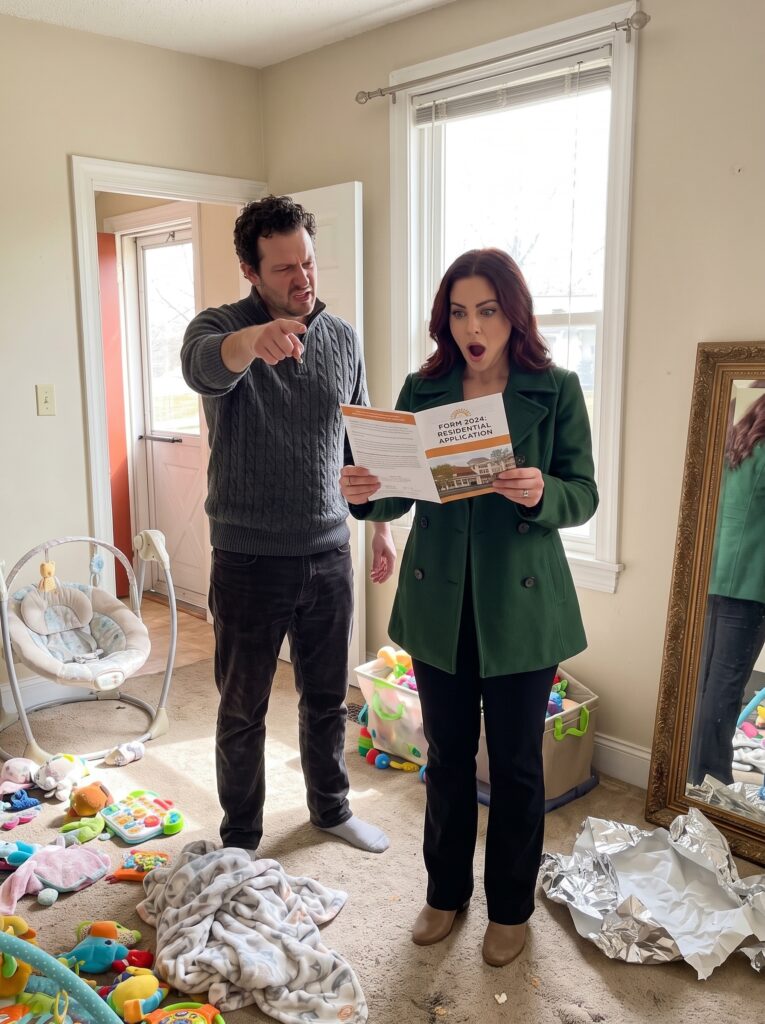
The mirror itself became, oddly, a family joke rather than a wound. Daniel had never actually let Patricia take it home that day, tossing it instead into our garage, and one afternoon, nearly two years after the incident, we finally pulled it out and hung it in the hallway outside the triplets’ room, not as motivation to look a certain way, but simply as a mirror, functional and unremarkable, a place for three small children to make faces at their own reflections and giggle at themselves without a single thought about whether their bodies were good enough.
“You know,” Patricia said one evening, watching Josie stick her tongue out at her own reflection in that same mirror, “I think about that day more than I’d like to admit.”
“What do you think about?” I asked, genuinely curious rather than accusatory at this point in our relationship.
“How close I came to losing all of this,” she said, gesturing toward the sound of Owen and Mara arguing gently over whose turn it was to pick the bedtime story. “Because I couldn’t let go of an idea about what women are supposed to look like after everything they’ve survived. I’m grateful, Clara, that Daniel loved you enough to draw a line I desperately needed drawn for me.”
I thought about that afternoon three years earlier, the silver wrapping paper on the floor, the humiliation burning through me as I pulled my cardigan tighter across my stomach, and the fierce, unwavering way Daniel had stood between me and his own mother without a moment’s hesitation.
“He loved both of us enough to draw that line,” I said. “You just needed longer to understand what he was actually protecting.”
Patricia nodded, and for the first time in three years, I felt the last small knot of old resentment finally loosen completely, not because everything had been forgotten, but because everything had, at last, been genuinely repaired.
That night, after the kids were asleep and Patricia had gone home, Daniel found me standing in that hallway, looking at the same mirror that had once been wielded as a weapon.
“Regret keeping it?” he asked, wrapping his arms around me from behind.
“No,” I said, leaning back into him. “I think it’s exactly where it belongs now. Not a reminder of what I wasn’t. Just a mirror. Nothing more, nothing less.”
He kissed the top of my head, and together we watched our reflection for a moment, a family finally, fully whole, standing in a hallway that no longer carried any weight beyond the ordinary, beautiful mess of everyday life.
THE AND.