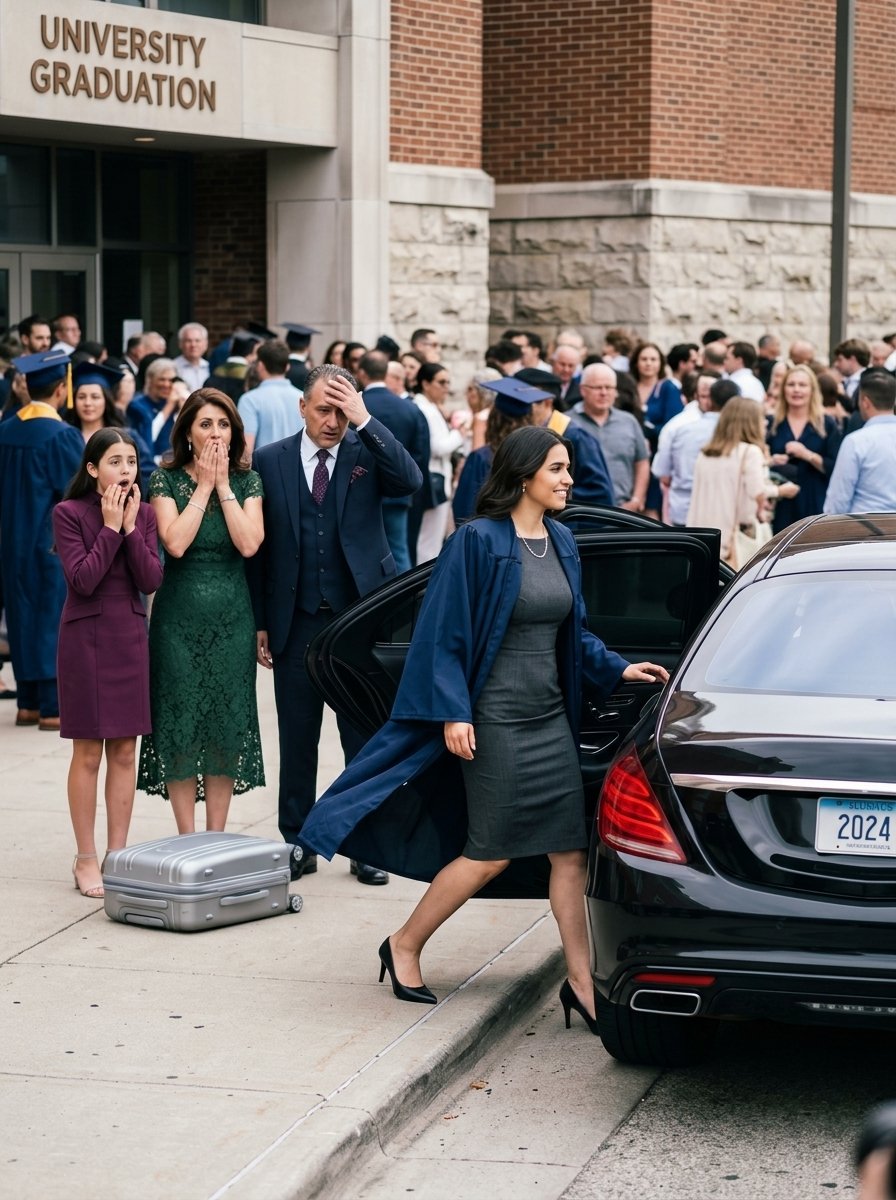
Part 2: The Fallout
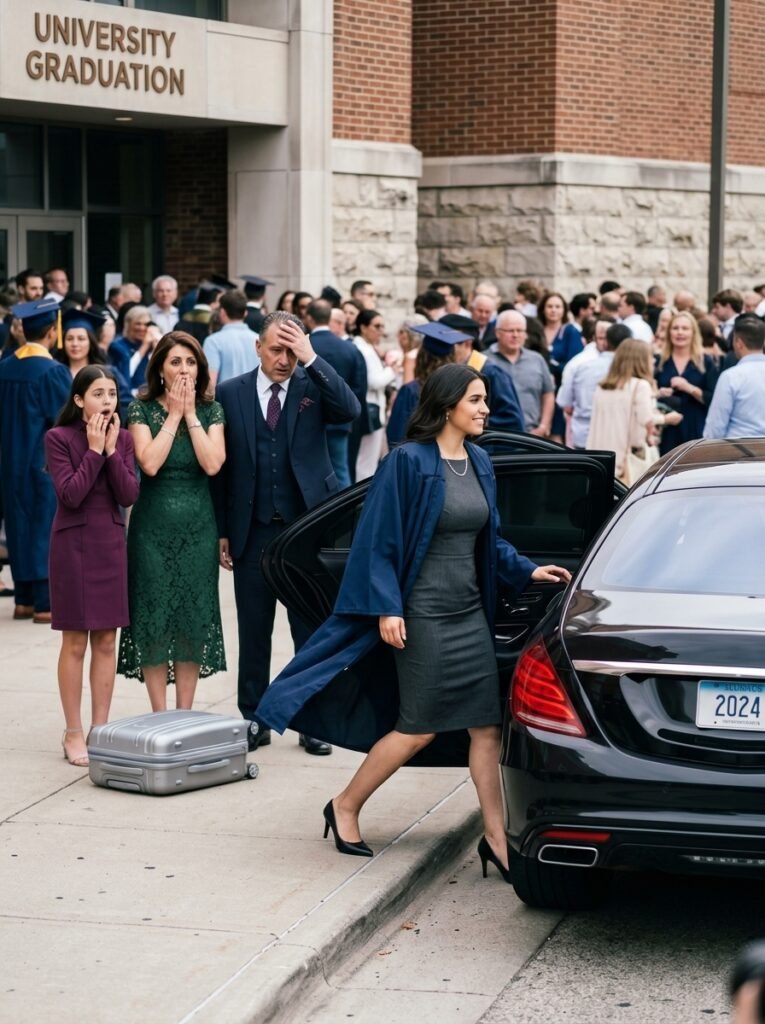
The sedan pulled away from the curb, and through the rear window I watched my mother sink onto the auditorium steps, her scarf still lying where it had fallen. Vanessa stood over her, phone shattered, mouth moving. Dad was already dialing someone, probably a lawyer, or maybe just me.
My phone lit up before we reached the first intersection.
Mom: Claire, please pick up.
Dad: We need to talk about this like a family.
Vanessa: OMG. Is this real?? Call me!!!
I turned the phone face down on the leather seat.
“Ms. Bennett,” my driver said gently, “where to?”
“The office. And Marcus? Thank you for not saying anything this morning.”
“I’ve driven you for two years,” he said with a small smile. “I know how to keep quiet.”
Asteron Labs headquarters occupied the top eleven floors of a glass tower downtown. My chief operating officer, Priya Nair, met me at the elevator with a tablet and a look of barely contained glee.
“The stock on our partner companies jumped nine percent in an hour,” she said. “Three hundred and forty interview requests. Forbes wants a cover. And your parents’ phone numbers have called the front desk fifty-one times.”
“Block them.”
“Already done.” She paused. “Claire, are you sure? There may be a version of this where…”
“There isn’t.”
Priya nodded and didn’t push. That was why I’d hired her.
I stood at the window of my office, looking at a city that had woken up that morning not knowing my name. Now everyone did. I had expected to feel triumphant. Instead I felt tired, and underneath the tiredness, something small and old and stubborn that still wanted my mother to say she was sorry and mean it.
That’s the trap, I reminded myself. Sorry that arrives with a price tag isn’t sorry.
By evening, the internet had done what the internet does.
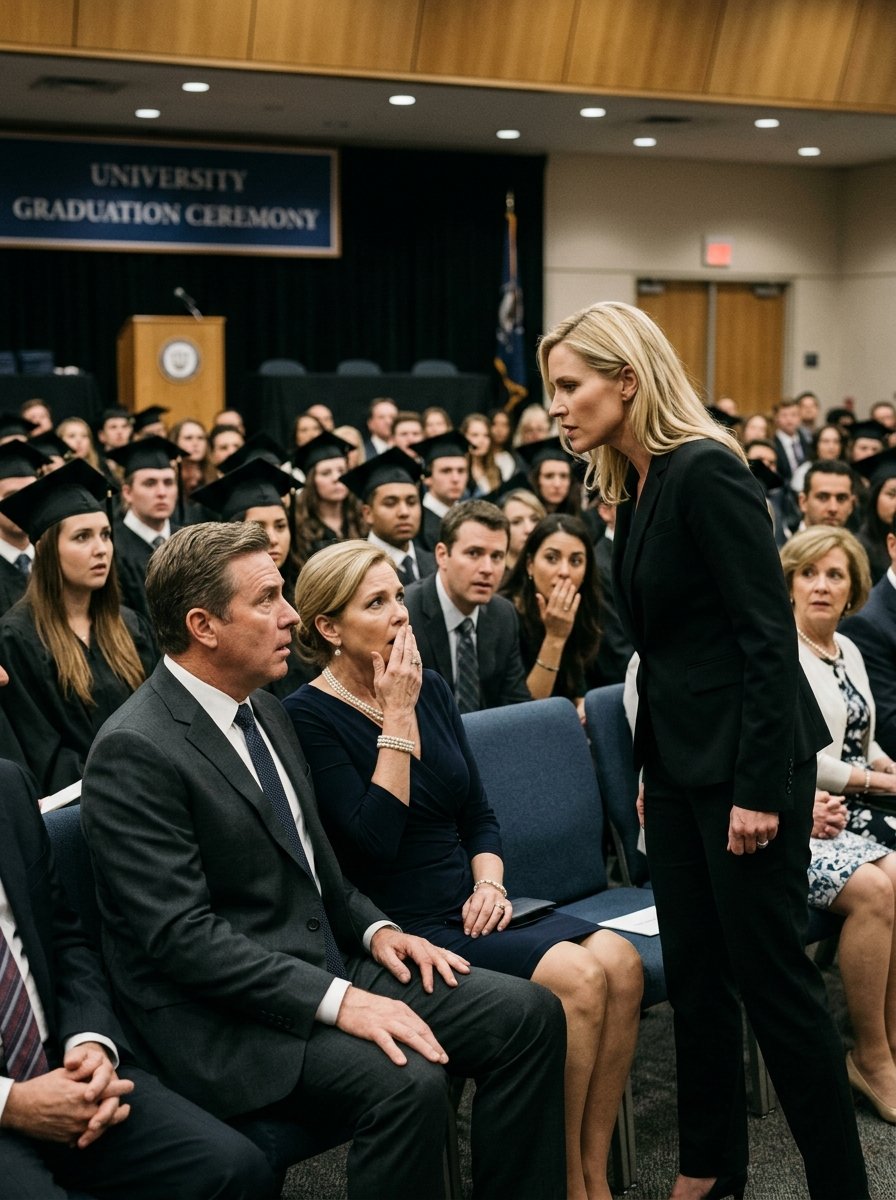
Someone in the auditorium had filmed my parents’ faces. The clip was everywhere: Mom’s scarf sliding to the floor, Dad’s slack jaw, Vanessa’s phone hitting the tile. Under it, the captions were ruthless.
“We’re taking your sister to Europe. Celebrate on your own.” An audience member had overheard my mother’s morning text to me, and somehow, through my aunt’s Facebook, it leaked. Within hours, it had a hashtag.
I didn’t start it. I didn’t promote it. But I didn’t stop it either, and I would be lying if I said the small, petty part of me didn’t watch the numbers climb.
Vanessa’s follower count dropped by twelve thousand overnight. Her brand partnerships evaporated. One of them sent a statement about “values alignment.”
At 11:40 p.m., a message arrived from a number I didn’t recognize.
Unknown: It’s me. Vanessa. Mom took my phone, so I’m using my friend’s. Please don’t hang up. I need to tell you something and I need you to actually hear me.
I stared at it for a long time. Then, against every instinct, I typed:
Me: You have five minutes.
The call came through instantly. Her voice was small, stripped of the sugary tone she used for cameras.
“I didn’t know,” she said. “About any of it. I swear. Mom and Dad never told me you were building something. They told me you were ‘struggling with the whole tech thing.'”
“Vanessa, you’ve lived in the same house as me for twenty years. You never once asked.”
The silence stretched.
“No,” she admitted. “I didn’t.”
“Why are you calling?”
“Because…” I heard her swallow. “Because there’s something you need to know before you see Mom and Dad again. And you will see them, Claire. They’re not going to stop. They’ve already hired a private investigator to find where you live.”
My stomach tightened. “How do you know?”
“I heard Dad on the phone. And that’s not the worst part.” Her voice dropped to a whisper. “Two weeks ago, Dad asked me if I knew what your Social Security number was. He said it was for ‘a family financial thing.’ I thought it was weird. I didn’t think about it until today.”
My blood went cold.
“Vanessa. Did you give it to him?”
“No! I don’t know it! But Claire, I found something in his desk this morning while they were packing. A folder. It had your name on it.”
“What was in the folder?”
“I took pictures.” Her breath hitched. “I’m sending them now.”
The phone buzzed. I opened the first image.
It was a document with my name printed at the top and a signature line at the bottom, a signature that looked almost exactly like mine. Beneath it, in bold letters, one word made my hands go numb:
GUARDIANSHIP PETITION.
I scrolled to the next photo. A medical evaluation form, blank, addressed to a psychiatrist I had never met. On the third, a handwritten note in my father’s cramped script:
If she’s declared unfit, we control everything. Timeline: before she goes public. Dr. Hollis says 30 days.
The room tilted.
They hadn’t been surprised at all.
They had known about the money before the graduation. Somehow, some way, they’d found out. And the trip to Europe hadn’t been an insult. It had been a cover, a way to look like careless parents while they moved quietly toward taking everything I had built.
“Vanessa,” I said, my voice barely steady, “why are you telling me this?”
She was crying now, quietly, honestly. “Because for the first time in my life, I looked at my family and I didn’t like what I saw. And because you’re my sister, even if I never acted like it.”
I closed my eyes.
Then my office phone rang. Priya’s voice, urgent:
“Claire, a courier just delivered a sealed envelope to the lobby. It’s from a law firm, and it’s addressed to you. They say it’s a court summons, emergency filing, hearing set for Monday morning.”
I opened my eyes and looked at the photos on my screen.
Timeline: before she goes public.
They had filed anyway. Even now. Even after the whole world had seen me stand on that stage.
“Priya,” I said, “call Elena Reyes. Tell her I need her here in an hour.”
“The litigator?”
“The best one we have.” I stood, my reflection pale in the dark glass, the city blazing behind it. “My family wants a fight. They’re about to learn exactly who they’re fighting.”
Part 3: The Emergency Hearing
Elena Reyes arrived in fifty-two minutes, wearing a navy suit and carrying a battered leather briefcase that looked like it had survived several wars. She was forty-eight, silver at the temples, and had once made a senator cry on the stand. She did not waste time on small talk.
“Show me everything.”
I slid my phone across the conference table. She scrolled through Vanessa’s photos slowly, and by the third image, her mouth had flattened into a thin line.
“A guardianship petition,” she said. “Emergency, ex parte, hearing Monday. They’re claiming you lack capacity and that you’re being exploited by, quote, ‘unknown corporate interests.'” She tapped the note in my father’s handwriting. “This is the best thing that could have happened to us.”
“It doesn’t feel like it.”
“Claire, your father wrote down a timeline, a target date, and the name of a doctor willing to certify you. That isn’t a family worried about your welfare. That’s a plan.” She looked up. “And plans leave paper.”
Priya set a fresh coffee in front of me. “Their filing says you’ve been ‘isolated’ and ‘financially manipulated.’ They’re arguing a twenty-two-year-old can’t possibly run a fifteen-billion-dollar company without being a puppet.”
“They’re not entirely wrong to be surprised,” Elena said dryly. “But surprise isn’t incapacity. Do you have documentation of your role? Board minutes, filings, anything with your name on it?”
I almost laughed. “Elena, I wrote the first encryption protocol at seventeen. My name is on nine patents.”
“Then we’re going to bury them in paper.” She stood and clicked her briefcase shut. “Priya, I need every board resolution, every patent filing, every signed contract from the last five years. Devon, get me a forensic document examiner by morning.”
“What about Vanessa?” I asked. “She risked a lot sending those.”
Elena’s expression softened by a fraction. “She’s your strongest witness, and I’ll need a sworn statement from her. But be careful. People change sides for many reasons. I’d like to know hers before I put her on a witness list.”
I thought of my sister’s voice on the phone, small and stripped of performance. “I believe her.”
“Belief is nice,” Elena said. “Verification is better.”
We worked through the night. By dawn, the conference room looked like a paper avalanche, but a story had emerged from it, and it was devastatingly clear.
Priya found the first crack at 4:15 a.m.
“Claire. Look at the signature on the guardianship petition.” She laid it beside a signed board resolution. “The one on their filing is supposed to be yours, consenting to an evaluation.”
I compared them. At a glance they were nearly identical. Then I noticed what my father hadn’t.
“I don’t cross my sevens,” I said slowly. “I’ve never crossed them. I stopped in middle school because Vanessa teased me about it. But he crossed it.” I pointed. “That’s his handwriting habit. He forged my signature and forgot his own tell.”
Elena looked at the two pages for a long time, and then, for the first time since she’d walked in, she smiled.
“Forgery on a court filing,” she said. “That’s not a family dispute anymore. That’s a crime.”
Sunday afternoon, my mother showed up at my building.
Security called up. “Ms. Bennett, your mother is in the lobby. She says she’ll wait as long as it takes. She’s, uh, crying pretty hard.”
I stood at the window of my penthouse, looking down at the tiny figure by the revolving door. Even from twenty floors up I recognized the posture, shoulders curled, one hand pressed to her chest, the same performance she’d used at every school play, every funeral, every occasion where sympathy was useful.
Elena had warned me. Do not meet her alone. Do not say anything you wouldn’t say under oath.
But there was a small, stubborn part of me that needed to see it for myself.
“Send her up,” I said. “Two guards at the door. And Elena on speaker.”
Mom came in wearing sunglasses and a wrinkled cream sweater, no jewelry. The absence was deliberate. She looked like a woman who had lost everything overnight, which was of course the point.
“Claire.” Her voice broke on my name. “Oh, my baby. Look at you. Look at all this.”
“Sit down, Mom.”
She sat, dabbing her eyes. “I know you’re angry. I know we made mistakes. But sweetheart, this hearing, it’s just a misunderstanding. Your father got scared. We didn’t know how to reach you. Everyone kept saying you were being used, and we panicked.”
“Who’s everyone?”
A flicker. “Just… concerned people.”
“Dr. Hollis?”
Her hands went still.
“You could drop it, you know,” she said carefully. “The petition. If you’d just agree to a small arrangement, a trust, something to keep everything safe, we could withdraw it and put this whole ugly mess behind us. Family should be able to look after each other.”
“You want me to sign over control of my company to you.”
“Not control. Oversight. Your father has so much experience…”
“Dad sells insurance, Mom.”
“He’s family,” she snapped, and for one second the mask slipped, and I saw what had always been underneath. Not grief. Calculation. She caught herself and reached for my hand. “Claire, please. We’re your parents.”
I looked at her fingers on mine. I had spent twenty-two years wanting that touch to mean something.
“Where were you Thursday morning?” I asked quietly.
“What?”
“When you told me to celebrate on my own. Where were you going?”
“Europe, honey, you know that…”
“Vanessa’s phone tracked your flight,” I said. “You never booked one. Not for the day you claimed, not for any day that month. The suitcase was empty.”
My mother said nothing.
“You didn’t leave me alone on graduation day because you preferred her,” I said. “You left because you needed me alone. No family. No witnesses. So when Dr. Hollis’s associates arrived at my apartment that morning with their clipboards, there’d be no one to stop them.”
Her face went gray.
“They found the apartment empty,” I said. “Because I’d already left for the office. Because a security guard named Marcus doesn’t let strangers in.”
Elena’s voice came through the speaker, calm as a blade. “Mrs. Bennett, I’d advise you to stop speaking now.”
My mother stood so fast the chair tipped. Her tears were gone. What replaced them was pure, cold fury.
“You ungrateful little…” She bit it off. “We gave you everything.“
“You gave me a place to sleep and a lecture about being antisocial.” I stood too. “Get out.”
She went, but at the door she turned, and her smile made my skin crawl.
“Monday, Claire. Let’s see how brave you are in front of a judge.”
Monday morning, the courtroom was packed. Reporters lined the back rows. My father sat at the petitioner’s table in a suit that didn’t fit anymore, next to a lawyer sweating through his collar. Mom sat behind them, tissue in hand, already crying for the gallery.
Judge Marguerite Caldwell entered, a stern woman in her sixties with reading glasses and no patience. She read the petition in silence. Then she read it again.
“Counsel,” she said, “this filing alleges the respondent is incapacitated. Yet the respondent, as I understand it, addressed an auditorium of thousands on Friday and announced a two-billion-dollar endowment.”
“Your Honor,” Dad’s lawyer said, “that is exactly the concern. A young woman suddenly making decisions of this magnitude…”
“Sit down, Mr. Pruitt.” Judge Caldwell turned to Elena. “Ms. Reyes, your response.”
Elena rose, buttoning her jacket. “Your Honor, we’ll be brief. Exhibit A is a handwriting analysis showing the signature on this petition was forged by the petitioner, Mr. Bennett. Exhibit B is a handwritten note in his own hand, laying out a timeline to have my client declared unfit before she goes public, so that he and his wife could seize control of her assets. Exhibit C is a sworn statement from the respondent’s sister, who discovered these documents in her father’s desk.”
A murmur rolled through the gallery.
“And Exhibit D,” Elena said, “is an email from a Dr. Charles Hollis to Mr. Bennett, dated three weeks ago, agreeing to certify the respondent as incompetent in exchange for a percentage of the recovered estate.”
Dad’s head snapped up. “That’s impossible. That was deleted…”
He stopped.
The courtroom went dead silent.
Judge Caldwell removed her glasses and looked at my father over the bench for a very long time.
“Mr. Bennett,” she said, “I’d advise you to stop talking. And I’d strongly advise you to find a criminal defense attorney.” She turned to the bailiff. “Please contact the district attorney’s office.”
Behind my father, my mother made a small, broken sound. Not theatrical this time. Real.
Then, from the back of the courtroom, the doors opened.
Vanessa walked in alone, in a plain gray dress with no makeup, her chin lifted. She walked the entire length of the aisle, past the reporters, past our mother’s outstretched hand, and took the seat directly behind me.
“I’m here to testify,” she told the judge, her voice shaking but clear. “And there’s one more thing none of you know. Something about the money my parents were planning to use, and where it was already going.”
She took an envelope from her bag and held it up.
“They didn’t just want Claire’s company,” she said. “They already owed someone. Someone dangerous. And that person is sitting in this courtroom right now.”
Every head turned.
Part 4: The Ending
Every head turned, and every eye found the same man.
He sat in the third row of the gallery, half hidden behind a reporter’s shoulder. Fifties, heavyset, a good gray suit, the pleasant expression of someone who attended courtrooms the way other people attended church. I had noticed him when I came in and assumed he was press.
“Mr. Alden Croft,” Vanessa said, her voice steadier now. “He’s the reason for all of this.”
Croft didn’t move. He only smiled slightly, like a man being introduced at a dinner party.
“Ms. Bennett,” Judge Caldwell said, “explain yourself. Carefully.”
Vanessa opened the envelope with trembling fingers. “Two weeks ago, I found Dad’s folder. But I didn’t tell Claire everything at first, because I didn’t understand it. There were loan documents underneath the guardianship papers. Personal guarantees. Our house, Dad’s business, Mom’s jewelry. All of it pledged to a company called Croft Meridian Capital.” She swallowed. “Six hundred and forty thousand dollars, past due, with penalties. And a letter from Mr. Croft’s attorney, dated last month.”
She handed a page to the bailiff. Judge Caldwell read it, and her jaw tightened.
“Read the relevant line into the record, Ms. Reyes,” she said, passing it to Elena.
Elena scanned it. “‘Should the borrower’s daughter Claire Bennett be placed under a conservatorship controlled by the borrower, this firm will accept a structured settlement from her assets in full satisfaction of the debt, with a consulting fee of ten percent of recovered funds payable to Croft Meridian.'”
The gallery erupted. The judge’s gavel cracked twice.
“Ten percent of a fifteen-billion-dollar empire,” Elena said into the noise. “Your Honor, this was never a family concern. It was a plan to take over a young woman’s company by declaring her incompetent, and a private lender was funding the operation.”
Croft rose slowly and buttoned his jacket. “Your Honor, I’m a spectator. Nothing in that letter connects me to…”
“Sit down, Mr. Croft,” Judge Caldwell said. “You’ll have every opportunity to explain your letterhead to someone with a badge.”
Two men in plain clothes had already moved down the side aisle. One of them touched his jacket to show a shield. Croft looked at them, then at me, and for the first time the pleasant expression cracked. What lay behind it was not fear but contempt, the look of a man who had bet on the wrong daughter.
“You were supposed to be the quiet one,” he said, almost to himself.
“So was she,” I said, nodding at Vanessa.
The hearing dissolved into procedure after that. Judge Caldwell dismissed the petition with prejudice, referred the forgery and conspiracy evidence to the district attorney, and ordered Dr. Hollis’s emails preserved and his license reported to the state medical board. My father tried to speak once. His lawyer physically pulled him back into his seat.
When the gavel fell for the last time, my mother stood up. She didn’t run at me or cry. She only looked at me across the rail, and I understood that she was doing the arithmetic of a woman who had lost the bet and hadn’t yet figured out what remained.
“Claire,” she said. “Sweetheart.”
“Not here, Mom.”
“We’re your parents.”
“You were,” I said, and I said it without heat, because the heat had burned out somewhere around the forged seven. “Now you’re witnesses.”
The bailiff stepped between us. Behind her, my father was being asked to accompany two officers to a side room, and I watched him go, smaller than I had ever seen him, a man in a suit that no longer fit.
I felt something I hadn’t expected. Not triumph. Grief, plain and clean, the kind you feel when a door you’ve been leaning on for years finally opens and there’s nothing behind it.
Vanessa stood beside me in the emptying courtroom, gray dress wrinkled, mascara-free and blotchy.
“I’ll understand if you never want to see me again,” she said.
I looked at my sister, who had spent twenty years being applauded for nothing and, in one week, had done something that deserved real applause.
“You walked down that aisle alone,” I said. “In front of everyone. Mom reached for you, and you kept going.”
“I almost didn’t.”
“Almost doesn’t count. You did.”
She started crying again, and this time I let myself put an arm around her. It was awkward, both of us out of practice. She smelled like cheap drugstore shampoo instead of designer perfume, and I thought it was the most honest she had ever smelled.
The next months were long and unglamorous, the way justice mostly is.
The district attorney charged my father with forgery, fraud on the court, and conspiracy. Dr. Hollis surrendered his license and cooperated in exchange for a reduced plea, handing over four years of emails that implicated two other families he had done business with. My mother, who had signed nothing and forged nothing but had sat in every meeting, accepted a plea of her own. Probation, restitution, and a court order to stay two hundred feet from me and from my company.
Alden Croft was the surprise. Beneath the pleasant manner was a small empire of predatory lending, built on desperate families with assets to pledge. When investigators opened his files, they found forty-one other borrowers. Seven had lost their homes. Two had lost more than that. The state attorney general held a press conference, and I watched it from my office with the sound off, because I didn’t need to hear it. His name was on the screen next to the word indicted, and that was enough.
“Do you want a statement from the company?” Priya asked.
“Just one line. Asteron Labs cooperated fully and thanks the authorities.“
“That’s it?”
“I’ve said enough about my family for one lifetime.”
Asteron did not slow down. If anything, the revelation accelerated us. The AI research facility at Westbridge broke ground in the fall, and I attended the ceremony in my old black hoodie under a tailored coat, to the amusement of the trustees. A photographer asked me to hold a golden shovel. I let him take one picture, then handed it to the youngest student volunteer and told her to dig in.
But I did one more thing that year, and it was the thing I was proudest of.
I created a foundation and named it for the person I had been at sixteen: the Quiet Builders Fund. It covered tuition, equipment, and mentorship for kids from families that didn’t understand what they were building, kids who wore the same hoodie until the elbows faded, who ate dinner staring at code because no one at the table asked what they were making. Every recipient got a private number they could call, any hour, from someone who would say the sentence I never heard growing up.
I see what you’re building. Keep going.
Vanessa asked if she could help. I hesitated, and she noticed.
“Not with money,” she said quickly. “I know I haven’t earned that. I mean actual work. Stuffing envelopes. Answering phones. Whatever’s needed.”
“You’d be answering phones for people who don’t care about your followers.”
“That sounds like exactly what I need.”
She started in October, in the mailroom of the foundation’s small office, in jeans and a plain sweater. Her old social accounts stayed frozen. Within a month she was sitting with the teenage recipients at the long table in the back, helping a shy fifteen-year-old with a robotics project she barely understood, asking questions she had never once asked her own sister.
I watched her from the doorway one afternoon. She looked up, caught my eye, and lifted a hand in an awkward little wave.
I waved back.
On the first anniversary of my graduation, I drove myself to Westbridge, alone, in a used car I’d bought just because I wanted to drive one. I parked outside the auditorium and walked up the same steps where my mother had once collapsed.
The building was empty. I found the front row, the reserved one, and sat in the seat where I had once waited to be introduced to my own life.
My phone buzzed. Vanessa.
Vanessa: Where are you?
Me: At the auditorium.
Vanessa: Stay there.
Twenty minutes later the side door opened, and she walked in carrying two paper cups and a small white box tied with string.
“I called Priya to find out where you’d be,” she said, sitting beside me. “Don’t be mad.”
“I’m not mad.”
She handed me a cup. Inside was a very ordinary cocoa with too much whipped cream. Then she opened the box. It held a slightly lopsided cupcake with a single candle, which she lit with a lighter she pulled out of her purse.
“You didn’t get a celebration last year,” she said. “I know it’s not Europe. It’s not even a ballroom. But it’s a start.”
I stared at the little flame, and my throat tightened in a way it hadn’t when I stood before thousands of people and the Bloomberg cameras.
“You remembered,” I said.
“I’ll remember every year,” said my sister. “That’s the whole point of being family. You show up in the empty room when nobody’s watching.”
I blew out the candle.
The auditorium was silent, and sunlight fell through the tall windows in long gold bars across the empty seats. Somewhere in the building, faintly, students were practicing for a new graduation, a new class, a whole new set of quiet people about to step into the light.
“What did you wish for?” Vanessa asked.
“You’re not supposed to tell.”
“Fine. Was it a good one?”
I thought about the twenty-two-year-old who had watched a car drive away and refused to beg. I thought about the sixteen-year-old with the scholarship letter and the father who told her not to become one of those people. I thought about all the quiet children in all the quiet rooms, building things in the dark.
“Yes,” I said. “It was a really good one.”
We sat there for a long time, two sisters in an empty hall, sharing a cupcake with plastic forks, while the world outside kept spinning, and the empire I had built in silence hummed on without me for one perfect afternoon.
I had been alone on the biggest day of my life. It turned out I hadn’t needed a crowd. I had only needed one person to show up eventually and stay.
The End.