Part 2: The Advocate
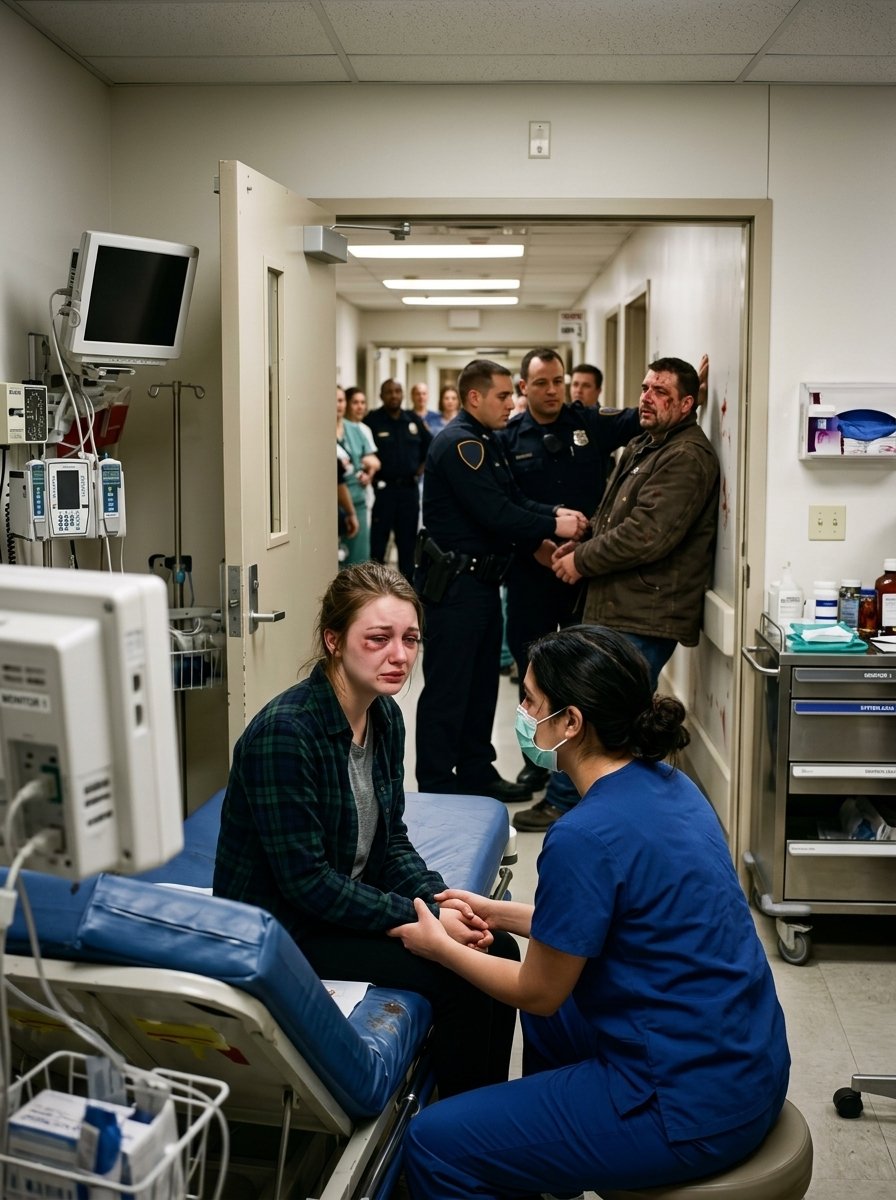
The advocate arrived twenty minutes later. Her name was Dana, and she had a lanyard, a canvas tote bag, and the kind of quiet voice that makes a room feel smaller and safer.
“You don’t have to talk right now,” she said, pulling a chair close to my bed. “I’m not here to make you relive anything. I’m here to make sure that every decision from this moment forward is yours.”
Yours. I didn’t know what to do with the word. For three years, my decisions had been reviewed and corrected like homework.
“Can I ask you one thing?” My voice came out thick and wet through my broken face. “Is he still here?”
“He was taken out through the ambulance bay in handcuffs. Two officers are with him, and he’s not coming back through those doors.” She paused. “But I know that a fact and a feeling are two different things. So we’ll take this one hour at a time.”
Sarah returned with a wheelchair. “CT scan first. Then the surgical team wants to look at that orbital fracture.” She squeezed my shoulder. “I’ll be right here on this floor. Dana goes where you go.”
The scan machine hummed and clicked around my head, and for the first time in years I lay perfectly still without listening for footsteps.
The results came back within the hour. A fractured nasal bone, a displaced orbital floor fracture, a hairline crack along the cheekbone. The surgeon, a brisk woman with tired eyes, explained the repair plan and how the muscle around my eye had been pinched by the break. Then she looked at me a little longer than the chart required.
“I’ve seen a lot of steering-wheel injuries,” she said. “This isn’t one. Whatever you decide to tell the police, I’ll put exactly what I see in my report. I want you to know that.”
I nodded, and a tear slid sideways into my hair.
Dana stayed until they wheeled me into pre-op. At the last door she leaned close.
“When you wake up, someone will be here. I promise.”
I woke to a dim room, a dull throb behind my eyes, and the taste of metal. A gauze dressing covered half my face. The clock on the wall said 3:12 a.m.
Dana was asleep in the armchair, coat folded across her lap. Sitting on the windowsill, awake and drinking terrible vending machine coffee, was Sarah, still in her scrubs.
“Your shift ended hours ago,” I croaked.
“Shifts end,” she said. “Doesn’t mean I go home.”
Before I could answer, a soft knock came at the door. A woman in a gray blazer stepped in, badge at her belt, notepad tucked under one arm.
“Detective Amara Osei,” she said, keeping her voice low. “I’m sorry to come at this hour. I’ll only ask if you’re ready, and I’ll stop the moment you want me to.”
Dana stirred awake. “Her call,” she said, and squeezed my hand.
I looked at the ceiling for a long moment. Then I told the truth.
I told her that it hadn’t started with a punch. It started with jokes at my expense, then rules about who I could see. He controlled the money, then my phone, then the car keys. The first time he hit me, he cried and bought me flowers, and I told myself it would never happen again. It happened again. Each time the story got smaller and I got smaller with it.
Tonight, the argument had been about nothing. A text from my sister that he decided was a betrayal. He’d driven us to a dark stretch of road and stopped the car.
I told her the rest. I said it slowly, and she wrote it all down without once looking away from my eyes.
When I finished, the room was silent.
“Thank you,” Detective Osei said. “That took more courage than you know.” She closed her notebook. “I’m going to be honest with you, because you deserve honesty. Your statement, the hospital records, and the physical evidence in the car are strong. But he has a lawyer already, a good one, and he’ll be arraigned this morning. Bail is possible.”
My whole body went rigid. “He could get out?”
“It’s possible. But I’m going to ask the judge for a no-contact order and a hold on his access to the vehicle. And Dana will help you file for an emergency protective order today, before he ever sees a courtroom.” She hesitated. “Do you have somewhere safe to go after discharge? Not your apartment.”
My apartment. The one with his name first on the lease. The one where my passport lived in a drawer only he opened.
“My sister,” I said. “Lena. She lives four hours away. He doesn’t know exactly where. He never let me visit.”
“Then that’s where you’ll go,” Dana said gently. “We’ll arrange it.”
By noon, the swelling had bloomed into a purple that made me flinch at my own reflection in the window. But something had shifted in my chest. It was small and shaky, like a match in a cold room.
Dana laid out a folder on my tray table. Emergency protective order paperwork, a safety plan, a list of numbers, a pre-paid phone still in its packaging.
“We’re going to change your passwords, and I’d like to check your phone,” she said. “Some abusers install monitoring software, or share accounts without the person knowing. It’s more common than people realize.”
“He set up my phone,” I said, and the memory of how proud he’d been of it turned my stomach. “Two years ago. He said it was a gift.”
Dana didn’t answer. She just held out her hand. I passed it over, and she began scrolling through settings with the patience of a bomb technician.
Ten minutes in, her face changed.
“Nora,” she said quietly. “There’s an app here that isn’t listed on your home screen. It runs in the background. It’s been recording your location every few minutes, and I think… I think it’s been forwarding your messages.”
My mouth went dry. “Forwarding them where?”
“To a cloud account.” She turned the screen toward me. “Which means he’s known about your sister for a long time.”
Before I could speak, the phone buzzed in her palm.
A new message. No name, just a string of digits that Dana had already flagged as unfamiliar.
Unknown: Nice try, Nora. Turn your location back on. I’ll be waiting where you least expect it.
Dana and I stared at each other. I felt every drop of color leave my face, even under the bruises.
“Detective Osei said he’s still in custody,” I whispered. “He can’t have…”
“He can’t,” Dana said, already dialing the detective with her other hand, her voice suddenly hard. “Which means this isn’t him.”
She looked at me.
“Someone else is helping him.”
Part 3: The Accomplice
Detective Osei arrived in eleven minutes, and she did not knock.
“Nobody touch that phone,” she said, crossing the room in three strides. She pulled an evidence bag from her blazer and held it open, and Dana dropped the phone inside like something hot. “Nora, I need you to tell me who else has ever had access to that device. Anyone who set it up, fixed it, borrowed it.”
I tried to think through the fog of painkillers and swelling. “Just him. He set it up himself. But…” I stopped. “There was his brother. Caleb. He works in IT. Two years ago, when the phone was new, Caleb came over one night to help transfer my contacts. He was there for hours.”
“Caleb what?”
“Voss. Caleb Voss. Same last name.” My voice wobbled. “Caleb is the one who always brought me tea when I was sick. He used to say I was too good for his brother.”
Detective Osei’s pen paused over her notebook. “Did he ever say it when your boyfriend was in the room?”
I thought about it. “No. Only when we were alone.”
“Sometimes that’s the tell,” she said quietly. “Some men learn that being the kind one is the best way to stay close to the person being hurt.”
The thought turned my stomach in a slow circle. All those small kindnesses, the tea, the whispered sympathy, and the whole time each one might have been a check-in.
Twenty minutes later, the detective returned with two officers and a tablet.
“The message came from a prepaid phone,” she said. “Bought for cash, activated six days ago. But it pinged a tower within a mile of this hospital about ten minutes before it sent.” She turned the screen toward me. “And the cloud account that’s been receiving your data is registered under an email address tied to a business called Voss Digital Solutions.”
Dana exhaled through her teeth.
“He didn’t even bother with a fake name,” Osei said. “Men like that assume nobody will ever look. Which is exactly why they get comfortable.”
“Is he here?” I whispered. “Caleb?”
“We think he’s in the parking structure.” She glanced at the officers. “Patrol units are already moving. I need to ask you not to leave this room until I tell you. Sarah’s arranged for security outside your door.”
“Sarah’s here?”
“She’s been here all night, apparently.” A small, dry smile crossed the detective’s face. “I don’t think anyone has successfully sent that woman home.”
I did not stay calm. That’s the truth. When the door closed behind them, I sat in the hospital bed with my hands pressed flat over my knees to keep them still, and every sound in the corridor became footsteps. A gurney rattled by. A phone rang at a nurses’ station. Somewhere a man laughed, and my heart tried to climb out through my throat.
Dana pulled her chair against the bed and took my hand.
“Breathe out slowly,” she said. “Longer than you breathe in. Your body has spent three years preparing for danger. It doesn’t know yet that things are changing.”
“What if they don’t get him?”
“Then we make a plan for that too. But Nora, look at what you did this morning. You said no to a script that had held you for years. That doesn’t disappear because someone sends a text.”
I tried to breathe out slowly. In the doorway, quiet as a cat, Sarah appeared with a small paper bag.
“Toast,” she said. “Dry, because of the nausea meds. You don’t have to eat it. I just wanted you to know there’s a person out here who thought about it.”
I laughed, a thin cracked sound that hurt my whole face, and then, to my horror, started crying again.
“Good,” Sarah said, sitting on the edge of the bed. “Let it out. The body keeps count.”
The call came at 1:47 p.m. Detective Osei’s voice was crisp, and underneath it ran something tight and fast.
“We have Caleb Voss in custody. Patrol found him in a gray sedan on level three of the parking garage with a laptop open on the passenger seat. It was logged into your cloud account, watching your phone’s last known location. The screen was still counting down a timer, Nora. He’d set it to wipe everything at two o’clock.”
“Wipe it?” Dana said, leaning toward the speaker. “So the evidence…”
“We got there with eleven minutes to spare. Digital forensics has imaged the laptop. Two years of recordings, messages, location data. It’s all there, in his own account, under his own business name.”
Something in my chest cracked wide open. Not relief, exactly. Something bigger and more frightening. The feeling of a door left open by someone who had never planned to be caught.
“Is he talking?”
“He asked for a lawyer, which is his right. But he’s looking at stalking, unlawful surveillance, witness tampering, and conspiracy, on top of whatever he’s tied to. His brother’s bail hearing was at one o’clock.” She paused. “Nora, the judge denied bail.”
I closed my eyes.
“The no-contact order was granted too. Both of them, in fact. Neither can come within five hundred feet of you, your sister, or your workplace.” Her voice gentled. “You should hear this next part from me. In the recorded messages, there’s a lot of evidence about what your boyfriend did and how he planned it. Some of it is very hard to listen to. You never have to hear it unless you choose to.”
I looked at the ceiling.
“Did he plan it?” I asked. “Tonight?”
“I think it went past planning tonight,” Osei said. “He panicked when you started pulling away. Caleb has messages from the past three weeks warning him you were talking to Lena. It’s likely what set him off.”
Three years, I thought. Three years of thinking it was my fault that I couldn’t do anything right, when the truth was that I had been watched, tracked, and managed by two men who had built an entire system around me.
“Thank you,” I said. It sounded absurdly small.
“Thank yourself,” said Osei. “You made the decision that opened the door. We just walked through it.”
That evening they moved me to a quieter wing on the sixth floor, a corner room with a window facing a stand of oaks. Dana went over the safety plan with me one last time, item by item, and I actually listened, because it wasn’t a script someone was forcing on me. It was something I was allowed to edit.
“New phone number,” she said. “New email. A trusted-contact word with your sister, so she knows a message is really from you. And a lawyer from our legal clinic for the divorce, since he had a joint lease and you’re not married.”
“Not married,” I said, and a strange lightness spread through me. “I never signed anything. He always said next year.”
“He always says next year,” Dana said gently. “It’s another form of control.”
Around eight, my new pre-paid phone buzzed. It was the first thing I’d touched all day that belonged only to me.
I dialed Lena’s number from memory, the one I’d never been allowed to keep saved.
It rang. And rang. And rang.
Voicemail. Lena’s cheerful recorded voice, the one she’d used since college. “Hey, it’s Lena! Leave me a message and I’ll call you back, unless it’s a telemarketer, in which case, no.”
I hung up and tried again. Voicemail. Again.
“She’s probably at work,” I said. Dana didn’t answer. “She works nights sometimes. She’s a veterinary tech. She has to silence her phone around the animals.”
“Try texting,” Dana said, but I saw her glance at the clock, and I saw the way her hand went to her own phone.
I typed the word we’d used as kids, the one that meant call me right now, I mean it.
Me: Marigold.
We waited. One minute. Five. Ten.
Nothing.
Dana was already standing, already dialing Detective Osei, her face composed in the deliberate way of someone who had learned never to show fear to a person who didn’t need it yet.
Then my own phone lit up in my hand.
Not from Lena. From a number I had never seen before, with a message I read three times before it made sense.
Unknown: This is Caleb’s wife, Priya. Please don’t be scared. I didn’t know about any of this until tonight. But there’s something in Caleb’s storage unit that you need to know about, and it involves your sister. He told me not to tell anyone. I think it’s why she isn’t answering.
The room seemed to tilt.
Unknown: Please meet me. Alone. I’ll be at the hospital chapel in ten minutes. If I’m wrong, I’m sorry. If I’m right, she doesn’t have much time.
I looked at Dana, who was mid-call, who hadn’t seen it yet.
Then I looked at the window, at the dark oaks, at the reflection of a woman with half her face wrapped in gauze who had spent three years learning not to trust anything that arrived in a soft voice.
Alone, the message said.
It was exactly the word he would have used.
Part 4: The Ending
I did not go alone.
It was the first thing I did that night that no one had scripted, and it was the hardest. Every instinct I had said alone meant obedience. But the woman who had said “No” to a nurse that morning could say it to a text message too.
“Dana,” I said. “Look at this.”
She read the screen once, and her whole body changed. She lowered her phone from her ear. “Detective, hold on. We have a new development.” She put Osei on speaker and read the message aloud.
“Do not go to the chapel,” Osei said instantly. “Not alone, and not on their timeline. If Priya Voss is genuine, she’ll agree to meet with us. If she isn’t, she won’t.”
“How do I know which she is?”
“You ask her to come to you, with officers present. Someone who’s afraid for your sister will say yes. Someone running a trap will find a reason to say no.”
My hands were shaking, but I typed with both thumbs on the new phone.
Me: I’ll meet you. But not alone. I’ll be in my room with a detective and an advocate. If you’re telling the truth, you’ll come up.
The reply took eleven seconds. I counted them.
Priya: Okay. I understand. I’m in the lobby. I’m coming up. Please tell them I’m unarmed and I’m sorry.
Priya Voss was small, thirty, with the wrecked posture of someone who had not slept in a day. She came in with her hands visible and her purse held out to an officer before he asked. Her wedding ring was on a chain around her neck, not on her finger.
“I found the storage unit key tonight,” she said, and her voice shook. “Caleb was arrested and the police came to our house. While they searched, I saw a key taped inside a drawer. There was a rental agreement in his desk. It had a receipt for a unit paid three months ago.” She looked at me with red, stricken eyes. “I went there before I came here. I’m sorry. I know I shouldn’t have. I needed to know what my husband was.”
Osei’s expression didn’t change. “What did you find?”
“A wall.” Priya swallowed. “One wall covered in printouts. Pictures of you. Pictures of a woman I think is your sister. Maps. Her address, her work schedule, her car. And a folder labeled with her name.” She turned to me. “Lena. There was a date circled on the calendar. Tonight.”
The room went silent. Dana’s hand closed around mine so hard it hurt.
“And there was a second name,” Priya said. “Dale. Beside a note that said, ‘Watch until he calls.’ I don’t know who that is. Caleb has a friend called Dale Merrin who does contract work. He was at our wedding. He drove a white pickup.”
Osei was already moving. She had a radio at her mouth before Priya finished.
“I need units to a residence four hours north,” she said, and she recited an address I recognized only because I had memorized it years ago and never once been allowed to say it. “Possible hostile approaching a female resident. And get me the county sheriff. Now.”
The next forty minutes were the longest of my life.
I sat in a hospital bed with half my face bandaged and watched the clock. Dana held my hand. Sarah, who had somehow appeared in the doorway again, wordlessly set a warm blanket over my knees and didn’t leave. Priya sat in the corner with a police officer, silent, her hands shaking.
“Talk to me,” Dana said softly. “Tell me about Lena.”
So I did. I told them that Lena had taught me to ride a bike on a gravel driveway. That she’d once driven six hours in a snowstorm to bring me a birthday cake because I’d said, offhandedly, that I never had one anymore. That the last time she visited, he’d been so cold to her that she’d left in tears, and I had told her, because he told me to, that I didn’t want to see her.
“She still sent me a card every month,” I said. “I never got them. He must have thrown them away. I found out from the messages tonight.”
“She never stopped trying,” Dana said.
“No.” My throat closed. “She never did.”
At 3:04 a.m., Osei’s phone rang.
She listened. She said nothing. She closed her eyes.
Then she opened them, and I saw her smile before I heard a word.
“She’s fine,” she said. “Nora. Lena is fine. She’s completely fine.”
The sound that came out of me wasn’t a sob and wasn’t a laugh. It was both, and it tore through my ribs.
“Sheriff’s deputies arrived at her house at two-fifty,” Osei said. “A white pickup was parked half a block away with its lights off. The man inside was Dale Merrin. He ran when he saw the cruiser, and they got him at the end of the street. He had a phone in his hand, with Caleb’s number pulled up to call.” She took a breath. “Lena was inside, asleep. She’d worked a double shift, her phone was in her locker at the clinic, and she didn’t know anything about it. She’s on her way to a safe location right now, under escort. The deputy said she cried when he explained. She kept asking if you were alive.”
“Tell her yes,” I said, the words tumbling. “Tell her yes. Tell her I’m alive, and I’m sorry, and I’m coming.”
“I’ll have her on the phone in ten minutes,” said Osei. “She’s insisting.”
Priya covered her face with both hands. Even the officer beside her looked away, giving her the privacy of that moment.
Lena’s voice, when it finally came through the speaker, was rough with exhaustion and tears.
“Nor? Nor, is that you?”
“It’s me,” I said. “It’s really me.”
“I’m so sorry,” she said. “I’m sorry, I should have come, I should’ve pushed, I should have broken down that door…”
“Lena.” I pressed the phone against my cheek, on the side that didn’t hurt. “You sent me a card every month for three years.”
The line was quiet.
“I found out tonight,” I said. “I never got one. But I’m reading them now, in my head. Every single one. I know what they said.”
“What did they say?” Her voice was tiny.
“That the door is always open.”
She made a sound I had not heard since we were children, small and helpless and full of love.
“Then walk through it,” said my sister. “I’m keeping the porch light on.”
The rest of it was not a movie. Justice is slower than a story wants it to be.
The trial was fourteen months away. My ex, Grant, first tried to plead not guilty, then tried to blame Caleb, then tried to blame me. His lawyer floated the theory of a “mutual altercation” until the prosecutor played eleven hours of recordings from his brother’s servers. In the courtroom, I watched him hear his own voice on the tape, the calm, patient voice that had trained me to be afraid. His face went gray. He never looked at me.
The surgeon’s report was unambiguous. Sarah’s notes were unambiguous. The steering wheel had no blood on the side he claimed.
He took a plea in the second week, before the jury could decide. Eleven years. Caleb took nine, plus a permanent ban from working in any field involving other people’s data. Dale Merrin took four and testified against both men in exchange.
I didn’t say much at sentencing. Dana had prepared me, and I read one sentence from a card in my hand.
“I used to think surviving meant being quiet enough that it didn’t happen again,” I said. “I was wrong. Surviving means being loud enough that it can’t.”
Grant looked at the floor.
I looked at him. I held his gaze until he could no longer hold mine, and this time no one had to help me do it.
Priya Voss testified too. She divorced Caleb within the year. Afterward she wrote me a letter, two pages, no excuses, no request for forgiveness. She said only that she’d spent her marriage never asking a single question, and that she’d learned what it costs to be comfortable with not knowing. I kept the letter. I did not write back, and I did not need to. Some stories end without a bow.
But I did send her a card, months later, with one line inside.
You came up to the room. That mattered.
My face healed slowly and imperfectly. There’s a faint ridge along my cheekbone where the plate sits, and a subtle asymmetry near my left eye that only I notice. The first time I saw myself without bandages, I stood at the mirror for a full ten minutes, waiting to feel ashamed.
I felt something else instead. It was the strange, tender recognition of a person I hadn’t met in years.
There you are.
I moved into Lena’s spare room, which had a quilt she’d made from old scrubs and a dog named Biscuit who slept on my feet. I got a new phone, a new number, a new email. I got a job at a small animal rescue’s front desk, in a room full of barking and laundry and people who did not look at me like I was breakable. I learned to say no to small things first. No to a second helping. No to a meeting I didn’t want. No to an invitation I didn’t feel like accepting. Each one felt like lifting a stone off my ribs.
Dana came to dinner every few months. Detective Osei sent a card every Christmas. And Sarah, who refused to be thanked, once texted me a photo of a plate of dry toast with the caption Preventative care.
On the second anniversary of the night, I drove four hours to the hospital by myself.
I hadn’t planned to. I’d woken up that morning with the strange certainty that I needed to go back. So I went, in Lena’s old hatchback with Biscuit shedding on the passenger seat, and I parked in the lot outside the emergency entrance.
The registration desk was the same. The clipboard was the same. Somebody new sat behind the glass, and a man stood at the counter, filling out a form for a woman beside him who sat very still.
I watched from the doorway.
I watched the nurse who came out, a young one I didn’t recognize. I watched her look at the man, then at the woman. I watched her ask a gentle question, and I watched the man answer before the woman could open her mouth.
Then I watched the nurse do what Sarah had done.
She turned to the woman and said, “I’d like to hear it from you.”
I don’t know what happened after that. I stayed only long enough to see the woman look up, just slightly, as if someone had opened a window in a room she’d forgotten had one.
Someone tapped my shoulder.
“You’re not here for anything wrong, are you?” said a familiar voice.
I turned. Sarah, older by two years, with a few more gray strands and the same steady eyes, stood behind me with two paper cups.
“You keep coming back to this waiting room,” I said.
“Somebody has to.” She handed me one of the cups. It was terrible vending machine coffee, exactly the way I remembered. “How are you?”
I thought about it, truly thought, the way I had learned to do. Not the answer I’d rehearse, but the real one.
“I’m okay,” I said. “I’m really okay.”
Sarah smiled, and behind her the automatic doors slid open, letting in the smell of rain and cold air and a long, ordinary afternoon.
“That’s the best thing I’ve heard all week,” she said.
We stood side by side in the waiting room, two women drinking bad coffee, watching a stranger take her first small step toward the same door I’d once walked through. The air tasted like freedom then, and it does now.
Outside, my dog barked once from the car window.
I laughed, and went home.
The End.