PART 2
The divorce filing hit Ethan’s email inbox before he’d even finished sweeping up the sawdust and drywall fragments left behind from the removal. Nathan Brooks wasn’t my attorney this time, but my own lawyer, a methodical woman named Renee Castellano who’d handled my premarital asset documentation from the very beginning, precisely because I’d learned, long before meeting Ethan, that marrying into a family business meant protecting yourself before you ever needed to.
“You built this file for two years before the wedding,” Renee reminded me during our first post-separation meeting, flipping through the binder of receipts, contractor agreements, and the conditional chattel rider I’d insisted on before a single cabinet was installed. “Most people don’t think this far ahead. You did.”
“I grew up watching my aunt lose everything in a divorce because she never kept a single receipt separate from her husband’s name,” I said. “I promised myself I’d never make that mistake.”
The Mercer family’s response to the divorce filing came fast and messy. Diane called three times in one afternoon, alternating between tearful apologies and thinly veiled accusations that I’d “humiliated the family” by bringing contractors to strip the apartment in front of the neighbors. Tessa, predictably, said nothing directly to me, funneling her outrage instead through a series of increasingly unhinged voicemails to Ethan, all somehow blaming him for “letting” me walk away with what was legally, unambiguously, mine.
Ethan himself sent a single long text message two days after the walkout, one I read carefully, twice, before deciding how to respond.
Claire, I know I don’t deserve you to answer this, but I need you to know I didn’t help draft that notice. Tessa and Mom put it together without telling me the specifics until that morning. I should have stopped it the second I found out. I didn’t, because I’ve spent my whole life letting Tessa run things in that family, and I didn’t know how to stand up to her even when I knew it was wrong. That’s on me, not you. I’m sorry.
I sat with that message for a long time before responding, mostly because some part of me wanted to believe there was a version of Ethan capable of the accountability that message gestured toward.
I believe you didn’t write the notice, I finally wrote back. But you knew before Tessa walked into that kitchen, and you let me stand there without a single word of warning. That’s the part I can’t get past. Not the money. The silence.
He didn’t respond to that, and I didn’t expect him to. Some truths don’t have a comeback, only an uncomfortable quiet where the excuse used to be.
Renee moved the divorce through with the same efficiency she’d shown reviewing my contractor agreements, and because there had been no commingling of assets, no joint accounts, no shared property beyond a marriage that had lasted exactly ninety-four days by the time the papers were filed, the settlement was almost mechanically simple. I asked for nothing from Ethan beyond the dissolution itself. I didn’t need anything from him. I’d made sure of that months before I ever said “I do.”
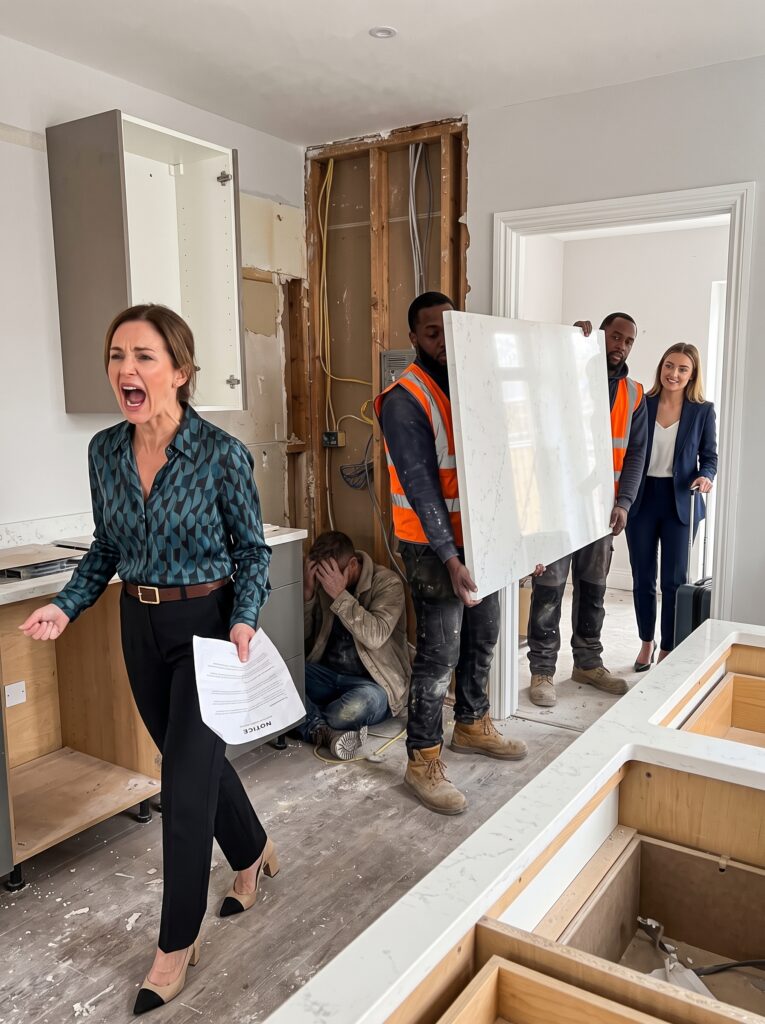
The apartment, gutted and half-demolished, became something of a local landmark in the following weeks, more than one neighbor mentioning to Frank, who still did occasional work in the area, that they’d heard “the whole crazy story” about the bride who’d hauled a moving crew back in to strip a kitchen bare in front of her furious sister-in-law.
Diane, to her credit, or perhaps simply out of financial necessity, ended up renting the stripped unit to a young couple for far less than the thirty-five hundred a month Tessa had once bragged about, the bare drywall and dangling wires making clear exactly how much value had walked out that door in Frank’s moving trucks.
I moved fully back into my Elm Street loft, the space feeling more like home in its familiar, unrenovated imperfection than the pristine apartment I’d poured forty-five thousand dollars and ten weeks of my life into ever had.
Three weeks after the divorce finalized, I sat at my own kitchen island, the same secondhand countertop I’d once considered too outdated to keep, and realized something had shifted permanently in how I understood the phrase Ethan had once used to convince me to spend my savings.
Our home.
It had never been ours. It had only ever been an investment Ethan’s family assumed I’d make without ever asking what I’d get to keep in return.
PART 3
Six months after the divorce finalized, I’d settled fully back into my Elm Street loft and into a rhythm of life that felt, for the first time in over a year, entirely my own. I’d taken on a promotion at the architecture firm where I worked as a project manager, overseeing renovation budgets for commercial properties, a role that felt almost ironic given how thoroughly I’d just navigated, and won, a very personal renovation dispute of my own.
My boss, a sharp, no-nonsense woman named Patricia Nguyen, had actually heard a garbled version of the story through a mutual acquaintance and asked me about it directly over lunch one afternoon.
“So it’s true,” she said, stirring her coffee. “You really had a crew rip out an entire kitchen renovation and haul it away in front of your husband’s family?”
“Every fixture I paid for,” I said. “Down to the last cabinet pull.”
Patricia laughed, genuinely delighted. “Claire, that’s not petty. That’s just good contract law. Remind me to have you review every vendor agreement we sign from now on.”
The professional recognition felt good, but what mattered more was the quiet, steady rebuilding of trust in my own judgment, something Ethan’s family had nearly convinced me to abandon in the space of one blindsiding morning.
I crossed paths with the Mercers again unexpectedly, nearly eight months after the walkout, at a home goods store of all places, standing in the kitchen fixtures aisle comparing cabinet hardware for a friend’s renovation project.
Diane spotted me first.
“Claire,” she said, her voice tentative, none of the tearful hysteria from those early phone calls remaining. “I wasn’t expecting to see you here.”
“Diane,” I said, keeping my tone civil but neutral. “How are you?”
“Managing,” she said. “The apartment’s rented again, finally. We had to redo the whole kitchen ourselves, obviously.” A flicker of something, embarrassment maybe, crossed her face. “It cost considerably more than the thousand dollars a month Tessa thought she’d be collecting.”
“I imagine it did,” I said, not unkindly, simply factual.
Diane hesitated, glancing down at the cabinet pulls in my hand before looking back up at me. “For what it’s worth, I never should have let Tessa handle things the way she did. I knew it was wrong the moment she printed that notice, and I didn’t say anything, because it was easier to let her run the family the way she always has.”
“That seems to be a pattern in your family,” I said. “Letting Tessa run things, and everyone else quietly going along with it.”
Diane’s expression tightened slightly, not with anger, but with the particular discomfort of hearing an accurate observation you’d rather not confront.
“Ethan’s doing better, if you’re curious,” she offered. “He moved out of the building entirely. Got his own place across town. I think losing you made him realize how much he’d let Tessa and me make decisions for him his whole life.”
“I’m glad he’s figuring that out,” I said, and meant it, in the distant, dispassionate way you mean well for someone whose growth no longer has anything to do with you. “I hope it serves him better in whatever comes next.”
Diane nodded, seeming to understand there wasn’t more room in the conversation for reconciliation or nostalgia, and we parted ways in the fixtures aisle, polite but final.
I never heard from Tessa directly again. Through the same mutual acquaintance who’d relayed the story to Patricia, I eventually learned that Tessa’s attempt to manage the family’s remaining rental properties had grown increasingly contentious with Diane, the fallout from the failed “occupancy payment” scheme apparently exposing cracks in the family’s financial management that had existed long before I ever walked through their door.
Two years after the divorce, I bought my own small building outside the city, an old converted mill with three rental units, using the very lessons I’d learned from the Mercer family’s mismanagement, and my own hard-won understanding of how quickly good intentions collapse without clear, documented agreements, to run it properly, fairly, and profitably.
I thought, sometimes, about that first morning in the renovated kitchen, coffee in hand, admiring quartz countertops I’d believed represented the foundation of the next twenty years of my life.
They had, in the end, just not with the person I’d expected.
Three years after that morning in the Mercer kitchen, I stood in the lobby of my own converted mill building, watching a new tenant sign her lease at a small desk I’d set up near the entrance, the late afternoon light catching the exposed brick walls I’d deliberately chosen to preserve rather than cover over with something more polished.
“You did all this yourself?” the tenant, a young graphic designer named Priya, asked, glancing around at the careful renovations, the original ironwork left intact, the new wiring and plumbing hidden thoughtfully behind restored original details.
“With a lot of help from people I trust,” I said. “And a lot of lessons I learned the hard way about what happens when you don’t put things in writing.”
She laughed, not knowing the full story behind that comment, and signed her lease, one of six tenants now occupying the building, each of them holding contracts I’d drafted personally, careful, thorough documents that left no ambiguity about who owned what, who was responsible for what, and what happened if any party failed to hold up their end of the agreement.
The building had become more than an investment. It had become proof, tangible and steady, that everything I’d learned from the Mercer family’s betrayal could be turned into something constructive rather than simply something I’d survived.
I still worked at the architecture firm, now managing a team of my own, but the mill building had become my genuine passion project, evenings and weekends spent overseeing repairs, meeting with tenants, slowly building a small, well-run property that reflected exactly the values I wished the Mercer family had shown me from the start: transparency, fairness, and respect for what people actually invested, financially and emotionally, into a shared space.
I’d started seeing someone new by then, a structural engineer named Marcus who’d consulted on the mill’s foundation work, patient and steady in a way that felt entirely unlike the rushed, performative romance Ethan had once offered me. He knew the story, of course, most of my new social circle did by then, the tale having taken on a life of its own among people who worked in construction and renovation, retold with a kind of admiring disbelief usually reserved for particularly satisfying cautionary tales.
“I still can’t believe you had a crew rip out an entire kitchen in one afternoon,” Marcus said one evening, helping me review a lease renewal for one of the mill units.
“I can’t either, some days,” I admitted. “But I think that morning taught me something I needed to learn eventually, one way or another. Love doesn’t excuse you from protecting yourself. If anything, the people who truly love you should want you protected, not vulnerable.”
Ethan, I heard through the same slow trickle of secondhand updates that eventually reaches everyone in a story like this, had indeed moved out of the family building entirely, taking a modest apartment across town and, according to Diane’s brief, occasional messages that I no longer felt obligated to respond to, slowly working to establish more independence from Tessa’s control over family decisions. Whether that growth was genuine or simply circumstantial, born of losing the one relationship that had finally forced a reckoning, I would likely never know for certain, and had stopped needing to.
Tessa, notably, never contacted me again, not even the brief, awkward run-in Diane and I had shared. I imagined she’d simply filed the entire episode away as an inconvenience rather than a lesson, the kind of person who moves forward by refusing to examine what went wrong rather than by growing from it.
On the third anniversary of that morning in the Mercer kitchen, I stood at the window of my mill building’s top floor, the one I’d kept for my own living space, and looked out over the small courtyard I’d added between the two wings, string lights already glowing faintly in the early evening.
I thought about the version of myself who had once believed forty-five thousand dollars in quartz and cabinetry represented the foundation of a shared future.
She hadn’t been wrong to hope for that future. She’d simply needed to learn, in the most abrupt and clarifying way possible, that a foundation only holds if everyone standing on it is honest about what they’re actually building, and who it actually belongs to.
I’d built something real since then, something entirely, unambiguously mine, brick by brick, lease by lease, lesson by hard-won lesson.
And this time, nothing about it needed anyone else’s permission to stay standing.
THE AND.