My father told me that if I didn’t change my wedding date to accommodate my sister’s vacation to Europe, he and my mother wouldn’t attend.
He believed seeing two empty chairs in the front row would teach me a lesson in respect.
I didn’t change a single thing.
And on my wedding day, I walked down the aisle alone.
But that evening, in front of nearly two hundred guests, my husband pulled a folded sheet of paper from his suit jacket and read words my father never imagined anyone would have the courage to repeat in public.
My name is Mariana Vance, and I was thirty-one years old when I finally realized a family doesn’t need to throw you out of the house to make you feel like you never belonged. Sometimes, two empty chairs are all it takes.
My wedding to Daniel had been planned for fourteen months. We had booked an estate in Charleston, paid the photographer, the band, the caterer, and placed non-refundable deposits for hotel rooms for relatives traveling from all across the country. Everything was set.
Then, three months before the wedding, my younger sister, Chloe, dropped a message into our family group chat:
“Finally booked! Girls’ trip to Italy! Amalfi Coast, Rome, and Milan. 12 days!”
I stared at the dates. I thought I had misread them. Her flight was scheduled to depart two days before my wedding.
Chloe had known my wedding date since the day Daniel proposed. I texted her privately.
“Chloe, did you mix up the dates?”
She replied six minutes later. “No. It’s the only week that works for everyone.”
I waited for her to add that she would reschedule her flight. She didn’t.
That same evening, my mother called.
“Mariana, we need to talk about the wedding.”
I felt a pit form in my stomach before she even finished the sentence. “What happened?”
“Chloe already paid for her trip. We were thinking maybe you could push your wedding back a few weeks.”
I looked over at Daniel sitting across the kitchen island. “Mom, it’s three months away.”
“Exactly. There’s still time.”
I let out a dry laugh. “Time for what? To lose tens of thousands of dollars in non-refundable deposits?”
“Money comes and goes, sweetie.”
“The venue has been booked for over a year.”
I heard my father’s voice in the background. “Put me on speaker.”
My mother complied.
“Mariana,” my father said, his tone authoritative. “A real family knows how to make sacrifices for one another.”
“Great,” I replied. “Then Chloe can reschedule her vacation.”
Silence hung on the line. Then my father snapped, “Don’t be childish.”
Those three words stung deeper than I expected. “Childish? Dad, it’s my wedding.”
“And your sister’s trip could be vital for her career.”
Chloe worked as a social media content creator. One of the women traveling with her knew an executive at a European hotel chain, and my father had somehow reframed a luxury vacation as a crucial diplomatic mission.
“She could secure major brand deals,” he insisted. “You can’t just think about yourself.”
“I’m getting married.”
“A wedding is just a few hours.”
Daniel slowly raised his head, watching me. I felt something break inside my chest.
“So tell me one thing, Dad,” I said quietly. “Is my wedding worth less than Chloe’s twelve-day vacation?”
“Don’t twist my words.”
“I’m asking a simple question.”
My mother stepped in. “We just want you to be flexible, Mariana.”
“I am not changing the date.”
My father responded without hesitation: “Then your mother and I won’t be attending.”
At first, I thought it was an empty threat spoken out of frustration. “What did you just say?”
“Perhaps seeing the consequences of your stubbornness will teach you a little humility.”
My breath hitched. “Are you really going to miss your daughter’s wedding over Chloe’s vacation?”
“We’re going to teach you that actions have consequences.”
I waited for my mother to correct him. Instead, she whispered, “Think carefully about this, Mariana.”
Then they hung up.
Daniel stood up, walked around the counter, and pulled me into his arms. I didn’t cry. Not yet.
Over the following weeks, my family acted as though I were the one ruining the family. Chloe even sent me a voice note: “I don’t get why you’re making such a big deal out of this. You can get married any Saturday.”
I didn’t reply. I kept the date.
I also kept my parents’ names on the seating chart. When our wedding coordinator asked if she should remove their place cards, I shook my head. “Leave them.”
A foolish part of me still believed they would show up.
On the morning of the wedding, I woke up at 5:40 AM and checked my phone. Nothing. At 8:00 AM. Nothing. At 11:30 AM. Nothing. Not a call. Not a text.
When I arrived at the venue, my maid of honor, Sarah, helped me into my dress. “You can cry if you need to,” she said softly.
“Later.”
“Mariana—”
“Later.”
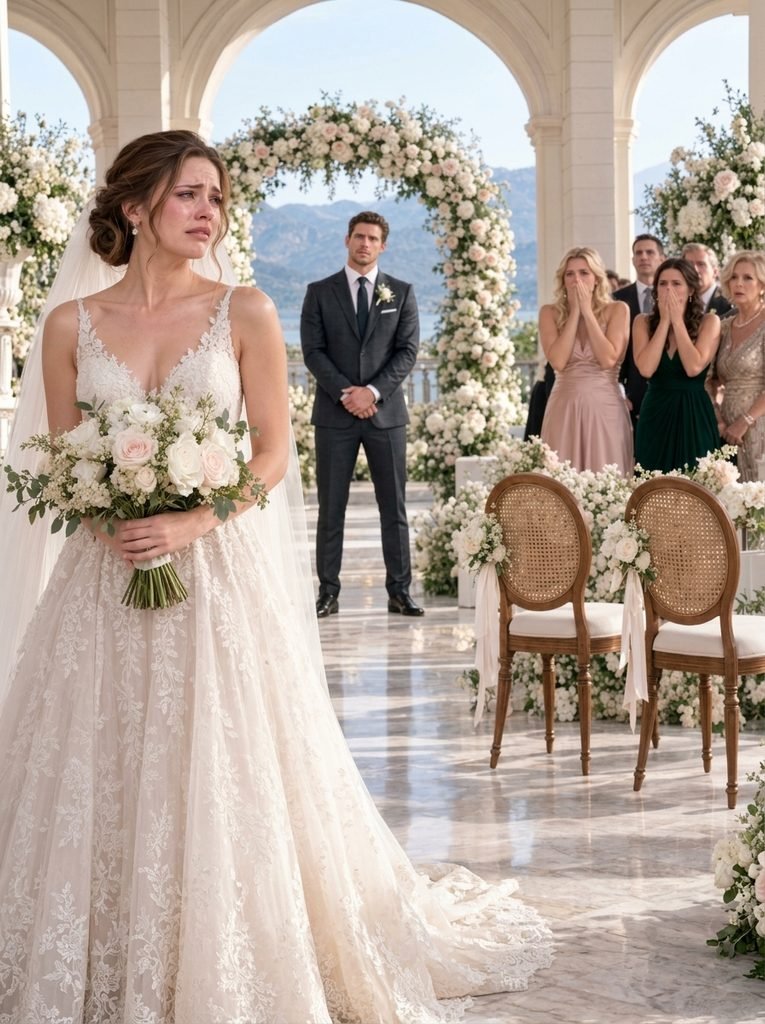
At 5:15 PM, the ceremony music began. The doors opened, and there they were.
Two chairs in the very front row. Empty. Marked with small, elegant place cards that read:
Laura Vance
Robert Vance
My hands trembled. Then I lifted my head.
Daniel was waiting for me at the end of the aisle in a dark navy suit, carrying an expression I will never forget. He didn’t look sorry for me. He looked furious for me.
I walked down the aisle alone, taking every step without looking at those two chairs. I thought that would be the most painful part of the night.
I was wrong.
Because during dinner, Daniel stood up, tapped a spoon gently against his glass, and said:
“Before I toast to my wife, I want to explain why there are two empty seats at the head table tonight.”
He reached into his jacket pocket and pulled out a folded sheet of paper.
The reception hall went completely silent.
I stared at Daniel, entirely unaware of what he was doing. A week earlier, I had begged him not to get involved. I was exhausted; I didn’t want to turn our wedding day into a battlefield.
But Daniel, a corporate attorney who never acted on raw impulse, unfolded the paper with deliberate calm. This was planned.
“Five days ago, I received an email from Mr. Robert Vance,” Daniel announced.
A cold shiver ran down my spine. My father.
Guests at surrounding tables began glancing at one another.
“In that email,” Daniel continued, “he asked me to convince Mariana to move our wedding date.”
I had no idea my father had reached out to him.
Daniel held up the paper. “He also explained why he and his wife decided not to attend tonight.”
My stomach dropped.
Daniel began to read aloud. My father had written that I had always struggled to accept that the world didn’t revolve around me, that Chloe had a legitimate professional opportunity in Europe, and that our wedding was an extravagant expense for a party lasting only a few hours.
Then came the sentence that destroyed any remaining excuse I might have made to defend him.
Daniel read:
“Perhaps when Mariana has to walk down the aisle and see her parents’ seats empty, she will finally understand that she is not more important than her sister.”
Gasps rippled across the room. My Aunt Patricia covered her mouth with her hand. Sarah burst into tears. I couldn’t move.
For years, I had known Chloe was the favorite. But knowing it in private was one thing; hearing the proof broadcast in front of nearly two hundred guests was another.
Daniel folded the letter slightly. “I thought that was enough,” he said. “Until I received a follow-up message.”
He pulled out his phone. “This one was sent by Mrs. Laura Vance.”
My mother.
Daniel read her words—how she asked him to bring me to my senses, claiming Chloe would lose a career-defining opportunity if she canceled Italy, whereas I would only be losing a single evening with my parents present.
My hands began to shake uncontrollably.
Daniel set his phone on the table and placed a steady hand on my shoulder. “Mariana has spent most of her life shrinking herself so that others could occupy all the space in the room.”
He looked directly at the empty chairs in the front row. “That ends tonight.”
Silence hung in the air for two long seconds.
Then my Aunt Patricia stood up and began to clap. Then Sarah. Then Daniel’s parents. My cousins followed. Table by table, nearly the entire room rose to their feet in a standing ovation.
I covered my mouth, not out of victory, but because for the first time in my life, someone had validated out loud what I had spent thirty-one years trying to deny.
Suddenly, my phone vibrated repeatedly against the tablecloth.
Mom.
I declined the call.
It rang again immediately.
Dad.
Daniel leaned down to me. “You don’t have to answer.”
I looked at my father’s name flashing on the screen. My whole life, I had been terrified of disappointing him. Tonight, something had shifted permanently.
I picked up the phone, walked to the center of the room, and hit answer.
“Hello, Dad.”
His voice exploded through the receiver. “What the hell is Daniel doing?!”
I hit the speakerphone button. The room fell dead silent once more.
“Dad, I have a question.”
“Tell him to stop reading private messages! He is humiliating this family!”
I looked toward the two empty chairs. “Did you write that email?”
Silence.
“Mariana, you are taking things entirely out of context—”
“Did you write it?”
Before he could answer, my mother’s voice cut in through the background. “Give me the phone.”
A rustle of static, and then her frantic voice came through. “Mariana, please. Your guests have no business hearing private family matters.”
“Private?”
“This is between us.”
I took a deep breath. “You chose to use my wedding day to teach me a lesson. Now everyone is hearing the full lesson.”
“We never intended to hurt you—”
“Dad literally wrote that he wanted me to see your empty chairs.”
My mother fell silent. Then she deployed the phrase she had used my entire life: “Don’t destroy this family over a simple disagreement.”
And right then, I saw the trap clearly.
They could ignore me. They could compare me. They could choose Chloe. They could skip my wedding. But the moment I stopped accepting their treatment in silence, I became the villain destroying the family.
My father took the phone back. “If you continue with this stunt, Mariana, there will be permanent consequences.”
I looked at Daniel. I looked at my friends. I looked at every occupied chair in that room.
“The consequences are already here, Dad,” I said softly. I paused, letting my voice carry across the quiet hall. “Only this time, they aren’t for me.”
I hung up.
But there was still one more revelation waiting—one that no one in that room expected. Not even me.
Part 3
After ending the call, I thought the confrontation was over. It wasn’t.
As the music resumed, my Aunt Patricia approached my table, her eyes red. “I need to tell you something, Mariana.”
“What is it, Aunt Pat?”
She glanced around before speaking quietly. “We all saw it.”
My chest tightened. “Saw what?”
“How differently they treated you. Ever since you girls were little.”
Her words hit me with an unexpected weight. For years, I had questioned whether I was simply overly sensitive, whether I was exaggerating, or whether Chloe just genuinely required more support.
Aunt Patricia took a deep breath. “Your father always had a logical excuse ready, your mother backed him up, and the rest of us convinced ourselves it wasn’t our place to intervene.”
Then more stories surfaced. A cousin recalled when my parents redirected funds meant for a summer course I wanted to take to pay for a resort vacation for Chloe. Another aunt recalled a birthday party of mine that was canceled because Chloe had just gone through a breakup and “couldn’t handle a celebration.”
My entire childhood reframed itself in an instant. They weren’t isolated incidents. It was a calculated pattern.
At 11:40 PM, another text arrived—this time from Chloe. She had seen video clips of the reception uploaded by relatives.
“Congratulations. I hope you’re happy after turning the entire family against us.”
I read the message twice, then blocked her number.
Three weeks later, Chloe began posting photos from Italy—infinity pools, high-end restaurants, private yachts, designer dresses against the coastline. On one photo, she captioned: “Protecting my peace from toxic people who don’t respect boundaries.”
However, several relatives didn’t hold back in the comments.
My cousin Chris wrote: “Was peace included in missing your sister’s wedding?”
Another relative commented: “Hope the career move was worth those two empty chairs.”
Chloe deleted the comments and turned off the option to reply.
My parents called me eleven times over two days. I didn’t answer.
Finally, they sent a four-page email claiming Daniel had manipulated me, that he had escalated a simple family disagreement into a public feud, and that my core issue was deep-seated resentment toward Chloe.
I read the email, archived it, and sent no response.
Two months later, my mother showed up at my office reception desk.
I was wrapping up a meeting when the receptionist called my line. “Mariana, there’s a woman here asking for you.”
I walked out to the lobby. My mother stood there looking smaller than I remembered.
“I need to talk to you,” she said.
“Not here.”
“Then give me ten minutes outside.”
I agreed. We walked to a quiet coffee shop down the street. My mother ordered a water; I ordered nothing.
“Your father is furious,” she began.
“That’s nothing new.”
“The family has practically stopped inviting us to gatherings.”
“I don’t control who they invite.”
“Your aunts and uncles are taking sides.”
“Perhaps because they finally know the truth.”
My mother pursed her lips. “Chloe is suffering, too.”
I looked at her. Of course. She hadn’t come for me. She had come for Chloe.
“What do you want from me, Mom?”
“I want you to post something online. Say it was all a big misunderstanding.”
I let out a short laugh. “You want me to lie?”
“I want our family back.”
“No,” I corrected her. “You want your reputation back.”
Her face hardened. “You have no idea how difficult this has been for your father.”
For the first time in my life, I felt no guilt. “My wedding day was difficult for me, too.”
“We made a mistake, Mariana.”
“It wasn’t a mistake,” I said, leaning in slightly. “A mistake is mixing up a date. You had three months to change your minds. Dad wrote an email explicitly detailing what he wanted to achieve by leaving those chairs empty.”
My mother lowered her gaze. “He was angry.”
“And you supported him.”
She didn’t answer.
I stood up to leave, but she said something that made me pause. “Maybe I should have defended you more.”
I turned back around. It was as close to an apology as my mother had ever offered in my thirty-one years. But it came far too late.
“Yes,” I said gently. “You should have. When I was eight. When I was fifteen. When I was twenty-two. And three months before my wedding.”
Her eyes filled with tears. “So this is forever?”
I thought for a moment before answering. “I don’t know. But for the first time, I am not making my decisions based on how uncomfortable my answers make you feel.”
I picked up my bag and walked away.
Six months passed. Daniel and I celebrated our first holiday season as a married couple with his family in North Carolina.
No one rescheduled dinner because another family member had better plans. No one turned an invitation into a test of obedience. No one told me I needed to be “the bigger person” simply because I was older.
It was refreshing, simple, and entirely peaceful.
One evening, while helping my mother-in-law clear the table, she looked at me warmly. “Do you know what I love about having you here, Mariana?”
I smiled. “What?”
“You don’t have to earn your place at this table.”
I had to look away so she wouldn’t see the tears welling in my eyes.
For thirty-one years, I had believed the exact opposite—that family love was a contract I had to continuously earn. If I was responsible enough, they would love me. If I didn’t complain, they would love me. If I deferred to Chloe, they would love me. If I endured enough, someday they would choose me.
It was a finish line that kept moving. And when I finally stopped running toward it, I realized there were people who had already chosen me just as I was.
A few months later, Daniel and I took a trip to the coast. One morning, we walked barefoot along the quiet beach before the crowds arrived.
Daniel took my hands. “I want to do something.”
“What’s that?”
“Marry you again.”
I laughed. “You’re already married to me.”
“I want to renew our vows,” he said, looking around the empty shoreline. “No guests. No phones. No empty chairs.”
I felt a warm swell in my chest. “I’d love that.”
We stood by the water and repeated the promises we had made to each other in Charleston. When we finished, Daniel kissed me, then asked, “Do you still have the seating chart from the wedding?”
“Yes,” I admitted.
“I thought you threw it away.”
“I almost did.”
I had kept it tucked inside a memory box with our wedding photos. For months, I thought about destroying it because those two empty seats seemed to encapsulate a lifetime of neglect. But over time, I began to see it differently.
On that chart, there were two empty chairs. But there were nearly two hundred occupied ones—two hundred people who drove for hours, bought flights, took time off work, brought gifts, danced, toasted, and chose to be present.
My parents wanted me to stare at their empty seats to teach me that I didn’t matter. Instead, they inadvertently taught me an entirely different lesson:
To stop counting who walked away, and start cherishing the ones who chose to stay.