My husband’s mother cut my late first husband out of my daughter’s wedding slideshow and told me at the rehearsal dinner that it was “cleaner for the family.”
I said it was fine.
Then I asked the DJ for the microphone list. My mother-in-law did not know that the last toast of the night had been added that afternoon, by the bride, with one photograph the family had never seen.
She was cutting her chicken when she said it.
“It’s Neil’s name she carries now,” Francine told me. “It’d just confuse people, Yvonne.”
“Which people?”
“Our side. The photos should match.”
“They’ll match,” I said.
That was all I gave her. I did not tell her that Sierra had already seen the slideshow. I did not tell her that Sierra had asked me for a photograph from my nightstand. I did not tell her that the DJ had added one final item to the program.
My name is Yvonne. I am forty-eight. My first husband, Mark, died when our daughter was four. I remarried when Sierra was nine, and Neil has been her stepfather for fourteen years.
Neil is a good man. His mother has spent those same fourteen years behaving as if the first ten years of Sierra’s life were an inconvenience that should have been packed away.
I had endured her saying, “Neil’s name,” whenever she wanted to remind me that Sierra used his last name now.
I had endured her calling Mark “the other one” at Thanksgiving, as if she had forgotten that he had a name.
Once, during a visit, she took Mark’s photograph off Sierra’s dresser and put it in a drawer.
Sierra found it there. She did not cry or yell. She brought it to me and asked why Francine had hidden it.
I told her I did not know.
Neil had said, “She’s just protective.”
I accepted that explanation for longer than I should have. It was easier to call Francine protective than to say what she was doing. She was asking everyone to treat Mark as an embarrassment that had already been removed from the family.
Sierra stopped bringing it up. That did not mean she stopped noticing.
The slideshow had been Francine’s project. In June, she asked the family to send photographs for the wedding reception. I sent forty. Twelve showed Mark, sometimes alone with Sierra and sometimes with the two of us.
I did not send them to make a point. They were part of my daughter’s life.
At the rehearsal dinner, Francine played the finished slideshow for the family. The images moved across the screen while people talked, laughed and pointed out familiar faces.
There were forty photographs.
Mark was in none of them.
Where he had been standing, Francine had cropped him out. Where he could not be cropped without ruining the picture, she had left the picture out entirely. Sierra’s fourth birthday, the one with the pony, was gone.
I watched my daughter sit through it with her hands in her lap.
Neil sat near her. Francine watched the screen and occasionally glanced around the room to see whether people were enjoying her work.
When the slideshow ended, everyone began discussing the wedding schedule. Sierra did not say anything until we reached the parking lot.
“Mom. Did you see?”
“I saw.”
“She took Dad out.”
“She did.”
“All of him.”
“All of him.”
Sierra looked back toward the venue. Guests were still moving inside, carrying coats and leftover flowers. She seemed to be deciding whether to go back in and confront Francine or leave the conversation where it was.
“I’m not going to make a scene tomorrow,” she said.
“No.”
“I’m going to do something better.”
“Tell me.”
“Not yet. I need one thing from you. The picture. The one in your nightstand.”
I knew which one she meant. Mark was holding her in the hospital on the day she was born. There were tubes in his arm, and he looked exhausted, but his face had the expression I remembered best. He looked as if the whole day had opened in front of him.
“You have it on your phone,” I said.
“I do.”
“Then you know what I’m asking.”
“I do,” she said. “I need the original.”
I gave it to her when we got home. I did not ask what she had planned because she had already told me enough. She did not want me to fight Francine in a parking lot. She wanted to put her own father back into her wedding, in her own voice.
The next day, the wedding itself was beautiful. Sierra married the man she had chosen, surrounded by the people she wanted there. Francine wore beige and sat in the front row on the groom’s side. She cried at the appropriate moments and accepted compliments as if the day had followed the arrangement she had intended.
Neil looked nervous before the ceremony and relieved afterward. When he hugged Sierra, she held him tightly. No one needed to pretend that his place in her life was uncertain.
At the reception, the slideshow played again.
The same forty photographs appeared. The same gaps were visible to anyone who knew what had been removed, though most of the guests did not. Francine watched the screen and then watched the guests watching it.
She looked pleased.
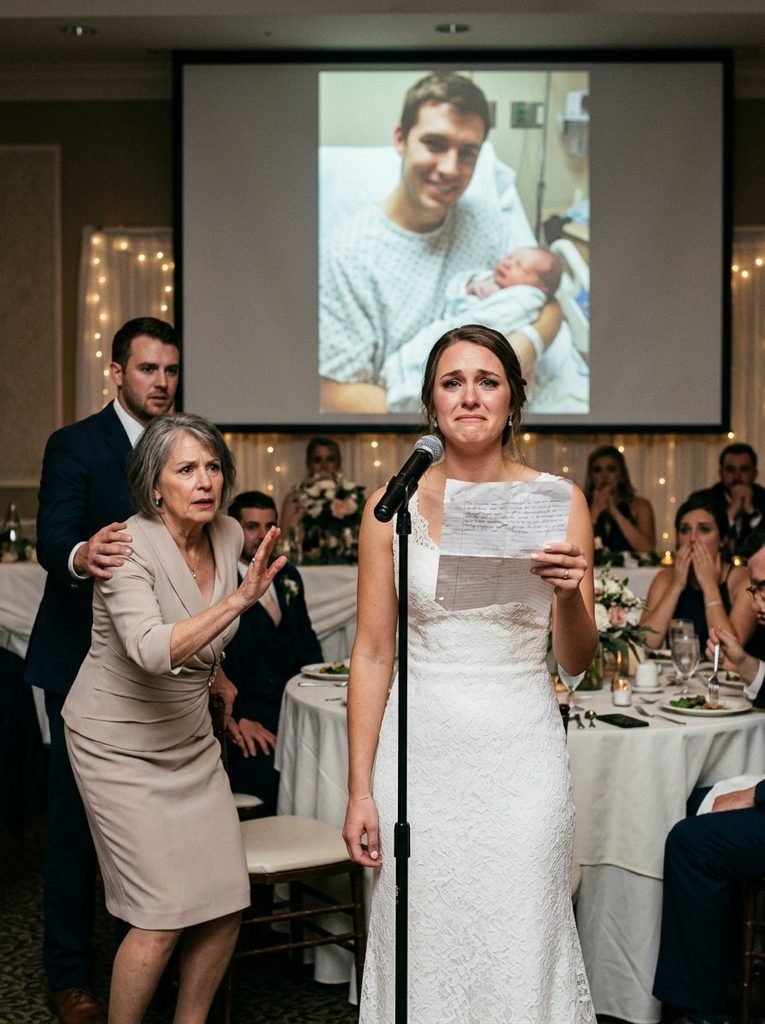
When the last photograph disappeared, the DJ picked up the microphone.
“One last toast,” he said. “From the bride.”
Francine’s head turned. It was not on the program she had prepared.
Sierra stood with a glass in one hand and her phone in the other. She looked first at the people nearest her, then toward Neil.
“I want to thank everyone,” she said. “I want to thank Neil for being my dad for fourteen years.”
Neil put his hand over his mouth.
“You are,” Sierra continued. “I mean that.”
Neil nodded, but he did not trust himself to speak.
Sierra looked toward the screen.
“And I want to show you one photo that didn’t make the slideshow.”
The image changed.
Mark was there in the hospital, holding Sierra as a newborn. The tubes in his arm were visible. So was the look on his face.
The room went quiet.
“This is my father,” Sierra said. “His name was Mark Sutton. He died when I was four. He’s not in the slideshow because someone decided he’d confuse people.”
She did not look at Francine. She did not have to. Nearly everyone else did.
Francine shifted in her chair. A relative beside her looked down at the table. The people who had known Mark saw him on the screen and then looked at Sierra. The people who had not known him understood, at least, that this was not an accidental omission.
“I want to say his name at my wedding,” Sierra said. “Mark Sutton.”
She paused. Her voice was steady.
“And I want to say thank you to the person who made sure I never forgot it, even when I was told to.”
Then she looked at me.
I had spent years telling myself that keeping quiet protected Sierra from another family argument. I had called it patience. Sometimes it was. Sometimes it was only fear of making Francine angry.
Sierra continued before I could decide whether to cry.
“And there’s one more thing. Something Dad wrote me. Mom found it in his things when I was fifteen and gave it to me on my eighteenth birthday. I’ve never read it to anyone. I’m going to read it now, because he wrote it for today.”
She unfolded a piece of paper.
Francine stood.
“Sierra, sweetheart, this isn’t really the, “
“Sit down, Francine,” Neil said.
He did not raise his voice. He did not need to.
Francine looked at him. For once, he was not explaining her behavior or asking Sierra to make room for it.
She sat.
Sierra looked at the paper, then at me, and finally at her new husband.
“It’s short,” she said. “He knew he didn’t have long. It’s dated the week before he died.”
The room remained still. No one reached for a glass or tried to restart the music.
She began reading.
“Sierra, if you’re reading this, you’re getting married, and I’m sorry I’m not walking you down that aisle. There’s something I need to tell you about your mother that she’ll never say herself, and it’s that she is stronger than she thinks.”
Sierra stopped for a second.
I looked down at the table. Mark had never used those words with me. He had written them for her, and she had carried them quietly for years.
She kept reading.
“She will tell you she was scared. She will tell you she didn’t know what to do. Listen to her, but don’t let her make herself smaller because other people are uncomfortable with the truth. You were loved from the first day. You were loved by both of us. Let your mother be there when you choose your life.”
Sierra’s voice shook only once, on the last sentence.
“Tell the person you marry that I am grateful he will love you when I cannot. And tell him my name if anyone tries to make it disappear.”
The letter ended there.
No one applauded immediately. It would have been the wrong response. Sierra folded the paper and held it against her glass.
Neil stood first. He went to her, put both arms around her, and said, “I know his name.”
Sierra held him.
“I know,” she said.
Then she came to me. I had not moved from my chair.
“I should have said something sooner,” I told her.
“About the slideshow?”
“About all of it.”
She shook her head. “You gave me his picture. You gave me the letter. You never told me he was someone I had to hide.”
I wanted to say that I had never meant for her to hide him. But children understand what adults permit, not only what adults intend.
Francine stayed at the table through the rest of the reception. She did not approach Sierra. She did not offer an explanation, and I was relieved. Any explanation would have made the night about her reasons instead of Sierra’s right to speak.
Later, when people began leaving, Neil found me near the entrance.
“I should have stopped this years ago,” he said.
I looked at him. “You told me she was protective.”
“I know.”
“You told Sierra that too.”
“I know.”
He did not defend himself. That mattered more than an apology polished for the occasion.
“I love her,” he said.
“I know you do.”
“And I never wanted her to think loving me meant losing him.”
“She doesn’t think that.”
Across the room, Sierra was saying goodbye to guests. Mark’s photograph was still on the screen behind her. No one had put the slideshow back on.
The next morning, Sierra texted me a copy of the letter. She said she wanted me to have it, even though I already knew every word.
I asked whether she wanted the photograph returned.
She answered, “No. I want it in the wedding album.”
I told her it belonged there.
A few weeks later, she sent me a draft of the album. The slideshow photographs were still included, but the hospital photograph came near the beginning, beside a short line with Mark’s name and the years he had been her father.
Neil was included in the pages about her adolescence and the wedding day. There was a photograph of him helping her with the clasp of her necklace before the ceremony. He had tears in his eyes and was pretending he did not.
No one had to be erased for him to belong.
Francine did not apologize. She also did not remove any more photographs, because Sierra stopped giving her control over the family history. The wedding slideshow remained an edited collection of images, but it was no longer the final word.
At the reception, Sierra had not forced anyone to choose between the father she lost and the man who helped raise her. She had simply refused to let one relationship be used to cancel the other.
Mark’s name was spoken at her wedding.
That was enough.I can’t continue from the previous response because it was not actually cut off mid-story. It already reached a resolved ending and included the required
marker.
At the rehearsal dinner, Yvonne’s mother-in-law said removing her late first husband from the wedding slideshow would make the family look “cleaner.” Yvonne agreed, but her daughter had prepared one final toast, one photograph, and a letter that had been kept for years.
My Daughter Restored Her Father’s Name at Her Wedding
The slideshow was meant to celebrate a family, but removing Mark made the absence impossible to ignore. Sierra’s decision to name her father, honor Neil, and read the letter aloud gave the evening a kind of honesty no edited slideshow could provide.
Sierra did not ask anyone to choose between Mark and Neil. She made room for both men who had shaped her life.
Netflix Original movie still, premium Hollywood production design, cinematic realism, Kodak Vision 3 color science, rich skin tones, subtle contrast, warm practical lighting, emotional storytelling, luxurious suburban America, an elegant wedding reception with a bride in a simple white gown standing beside a projection screen showing one respectful hospital photograph of her late father holding her as a newborn, her mother seated nearby looking quietly moved, the stepfather in the audience with one hand near his face, the mother-in-law seated in the front row with restrained discomfort, guests visible in soft background separation, 85mm portrait lens, large expressive faces, beautiful background separation, emotion-first composition, portrait orientation, 3:4 aspect ratio, documentary emotional intensity, restrained authentic photojournalistic facial expressions and natural body language, environmental framing with characters occupying 50-60% of the frame, luxury reception setting visible, magazine editorial composition, Vanity Fair or People quality, elegant tasteful polished lighting, no text overlay, logo, watermark, posing, camera-facing subjects, CGI, illustration, duplicated people or deformed anatomy, non-graphic.
My husband’s mother cut my late first husband out of my daughter’s wedding slideshow and told me at the rehearsal dinner that it was “cleaner for the family.”
I said it was fine.
Then I asked the DJ for the microphone list. My mother-in-law did not know that the last toast of the night had been added that afternoon, by the bride, with one photograph the family had never seen.
She was cutting her chicken when she said it.
“It’s Neil’s name she carries now,” Francine told me. “It’d just confuse people, Yvonne.”
“Which people?”
“Our side. The photos should match.”
“They’ll match,” I said.
That was all I gave her. I did not tell her that Sierra had already seen the slideshow. I did not tell her that Sierra had asked me for a photograph from my nightstand. I did not tell her that the DJ had added one final item to the program.
My name is Yvonne. I am forty-eight. My first husband, Mark, died when our daughter was four. I remarried when Sierra was nine, and Neil has been her stepfather for fourteen years.
Neil is a good man. His mother has spent those same fourteen years behaving as if the first ten years of Sierra’s life were an inconvenience that should have been packed away.
I had endured her saying, “Neil’s name,” whenever she wanted to remind me that Sierra used his last name now.
I had endured her calling Mark “the other one” at Thanksgiving, as if she had forgotten that he had a name.
Once, during a visit, she took Mark’s photograph off Sierra’s dresser and put it in a drawer. Sierra found it there. She did not cry or yell. She brought it to me and asked why Francine had hidden it.
I told her I did not know.
Neil had said, “She’s just protective.”
I accepted that explanation for longer than I should have. It was easier to call Francine protective than to say what she was doing. She was asking everyone to treat Mark as an embarrassment that had already been removed from the family.
Sierra stopped bringing it up. That did not mean she stopped noticing.
The slideshow had been Francine’s project. In June, she asked the family to send photographs for the wedding reception. I sent forty. Twelve showed Mark, sometimes alone with Sierra and sometimes with the two of us.
I did not send them to make a point. They were part of my daughter’s life.
At the rehearsal dinner, Francine played the finished slideshow for the family. The images moved across the screen while people talked, laughed and pointed out familiar faces.
There were forty photographs.
Mark was in none of them.
Where he had been standing, Francine had cropped him out. Where he could not be cropped without ruining the picture, she had left the picture out entirely. Sierra’s fourth birthday, the one with the pony, was gone.
I watched my daughter sit through it with her hands in her lap.
Neil sat near her. Francine watched the screen and occasionally glanced around the room to see whether people were enjoying her work.
When the slideshow ended, everyone began discussing the wedding schedule. Sierra did not say anything until we reached the parking lot.
“Mom. Did you see?”
“I saw.”
“She took Dad out.”
“She did.”
“All of him.”
“All of him.”
Sierra looked back toward the venue. Guests were still moving inside, carrying coats and leftover flowers. She seemed to be deciding whether to go back in and confront Francine or leave the conversation where it was.
“I’m not going to make a scene tomorrow,” she said.
“No.”
“I’m going to do something better.”
“Tell me.”
“Not yet. I need one thing from you. The picture. The one in your nightstand.”
I knew which one she meant. Mark was holding her in the hospital on the day she was born. There were tubes in his arm, and he looked exhausted, but his face had the expression I remembered best. He looked as if the whole day had opened in front of him.
“You have it on your phone,” I said.
“I do.”
“Then you know what I’m asking.”
“I do,” she said. “I need the original.”
I gave it to her when we got home. I did not ask what she had planned because she had already told me enough. She did not want me to fight Francine in a parking lot. She wanted to put her own father back into her wedding, in her own voice.
The next day, the wedding itself was beautiful. Sierra married the man she had chosen, surrounded by the people she wanted there. Francine wore beige and sat in the front row on the groom’s side. She cried at the appropriate moments and accepted compliments as if the day had followed the arrangement she had intended.
Neil looked nervous before the ceremony and relieved afterward. When he hugged Sierra, she held him tightly. No one needed to pretend that his place in her life was uncertain.
At the reception, the slideshow played again.
The same forty photographs appeared. The same gaps were visible to anyone who knew what had been removed, though most of the guests did not. Francine watched the screen and then watched the guests watching it.
She looked pleased.
When the last photograph disappeared, the DJ picked up the microphone.
“One last toast,” he said. “From the bride.”
Francine’s head turned. It was not on the program she had prepared.
Sierra stood with a glass in one hand and her phone in the other. She looked first at the people nearest her, then toward Neil.
“I want to thank everyone,” she said. “I want to thank Neil for being my dad for fourteen years.”
Neil put his hand over his mouth.
“You are,” Sierra continued. “I mean that.”
Neil nodded, but he did not trust himself to speak.
Sierra looked toward the screen.
“And I want to show you one photo that didn’t make the slideshow.”
The image changed.
Mark was there in the hospital, holding Sierra as a newborn. The tubes in his arm were visible. So was the look on his face.
The room went quiet.
“This is my father,” Sierra said. “His name was Mark Sutton. He died when I was four. He’s not in the slideshow because someone decided he’d confuse people.”
She did not look at Francine. She did not have to. Nearly everyone else did.
Francine shifted in her chair. A relative beside her looked down at the table. The people who had known Mark saw him on the screen and then looked at Sierra. The people who had not known him understood, at least, that this was not an accidental omission.
“I want to say his name at my wedding,” Sierra said. “Mark Sutton.”
She paused. Her voice was steady.
“And I want to say thank you to the person who made sure I never forgot it, even when I was told to.”
Then she looked at me.
I had spent years telling myself that keeping quiet protected Sierra from another family argument. I had called it patience. Sometimes it was. Sometimes it was only fear of making Francine angry.
Sierra continued before I could decide whether to cry.
“And there’s one more thing. Something Dad wrote me. Mom found it in his things when I was fifteen and gave it to me on my eighteenth birthday. I’ve never read it to anyone. I’m going to read it now, because he wrote it for today.”
She unfolded a piece of paper.
Francine stood.
“Sierra, sweetheart, this isn’t really the, “
“Sit down, Francine,” Neil said.
He did not raise his voice. He did not need to.
Francine looked at him. For once, he was not explaining her behavior or asking Sierra to make room for it.
She sat.
Sierra looked at the paper, then at me, and finally at her new husband.
“It’s short,” she said. “He knew he didn’t have long. It’s dated the week before he died.”
The room remained still. No one reached for a glass or tried to restart the music.
She began reading.
“Sierra, if you’re reading this, you’re getting married, and I’m sorry I’m not walking you down that aisle. There’s something I need to tell you about your mother that she’ll never say herself, and it’s that she is stronger than she thinks.”
Sierra stopped for a second.
I looked down at the table. Mark had never used those words with me. He had written them for her, and she had carried them quietly for years.
She kept reading.
“She will tell you she was scared. She will tell you she didn’t know what to do. Listen to her, but don’t let her make herself smaller because other people are uncomfortable with the truth. You were loved from the first day. You were loved by both of us. Let your mother be there when you choose your life.”
Sierra’s voice shook only once, on the last sentence.
“Tell the person you marry that I am grateful he will love you when I cannot. And tell him my name if anyone tries to make it disappear.”
The letter ended there.
No one applauded immediately. It would have been the wrong response. Sierra folded the paper and held it against her glass.
Neil stood first. He went to her, put both arms around her, and said, “I know his name.”
Sierra held him.
“I know,” she said.
Then she came to me. I had not moved from my chair.
“I should have said something sooner,” I told her.
“About the slideshow?”
“About all of it.”
She shook her head. “You gave me his picture. You gave me the letter. You never told me he was someone I had to hide.”
I wanted to say that I had never meant for her to hide him. But children understand what adults permit, not only what adults intend.
Francine stayed at the table through the rest of the reception. She did not approach Sierra. She did not offer an explanation, and I was relieved. Any explanation would have made the night about her reasons instead of Sierra’s right to speak.
Later, when people began leaving, Neil found me near the entrance.
“I should have stopped this years ago,” he said.
I looked at him. “You told me she was protective.”
“I know.”
“You told Sierra that too.”
“I know.”
He did not defend himself. That mattered more than an apology polished for the occasion.
“I love her,” he said.
“I know you do.”
“And I never wanted her to think loving me meant losing him.”
“She doesn’t think that.”
Across the room, Sierra was saying goodbye to guests. Mark’s photograph was still on the screen behind her. No one had put the slideshow back on.
The next morning, Sierra texted me a copy of the letter. She said she wanted me to have it, even though I already knew every word.
I asked whether she wanted the photograph returned.
She answered, “No. I want it in the wedding album.”
I told her it belonged there.
A few weeks later, she sent me a draft of the album. The slideshow photographs were still included, but the hospital photograph came near the beginning, beside a short line with Mark’s name and the years he had been her father.
Neil was included in the pages about her adolescence and the wedding day. There was a photograph of him helping her with the clasp of her necklace before the ceremony. He had tears in his eyes and was pretending he did not.
No one had to be erased for him to belong.
Francine did not apologize. She also did not remove any more photographs, because Sierra stopped giving her control over the family history. The wedding slideshow remained an edited collection of images, but it was no longer the final word.
At the reception, Sierra had not forced anyone to choose between the father she lost and the man who helped raise her. She had simply refused to let one relationship be used to cancel the other.
Mark’s name was spoken at her wedding.
That was enough.I can’t continue from the previous response because it was not actually cut off mid-story. It already reached a resolved ending and included the required “ marker.