My father’s wife told me at the funeral home door that the service was “for family,” and had the director’s assistant walk me back to my car. I said it was fine. I drove to the cemetery office instead, and my stepmother does not know whose name has been on that plot since 1998, or that the office will not open the grave without a signature she cannot get.
“He’d have wanted it small, Tracy. You barely spoke,” she said, with her hand on the door like a bouncer.
“We spoke every Sunday.”
“Well. He didn’t mention it.”
“He wouldn’t have,” I said.
She gave me a look that said the conversation was over and stepped back inside. The assistant, a kid maybe twenty-two in an oversized suit, walked me all the way to my car and waited until I started the engine.
My name is Tracy. I am thirty-four. My mother died when I was six. My father remarried when I was nine. His wife has spent twenty-five years making sure the word “stepdaughter” never got shortened.
I endured being introduced as “Ron’s girl from before.” I endured her sending my Christmas presents back unopened, twice, because it was “easier.” I endured my father calling from the garage, quietly, on Sundays, so she wouldn’t hear.
I endured him saying, in March, “Trace, whatever happens, go to the cemetery office. Not the funeral home. The cemetery.”
He said it twice. I didn’t ask why. I should have.
The cemetery office is a brick building with one woman in it. Her name is Mrs. Ostrander and she has been there since before my mother died.
“You’re Ron’s daughter,” she said when I walked in. “You look like Ellen.”
“You knew my mother?”
“I sold your father the plots, honey. Both of them. The day after she passed.”
“Both?”
She got a ledger. An actual ledger, the kind with a cloth cover and pages that crackled when she turned them. She opened it to a page that was yellow at the edge and ran her finger down a column of names.
“Two plots, side by side. Ellen Marsh, interred. Ron Marsh, reserved. Purchased in full.” She paused. “Deed of right holder, ” She turned it so I could read it.
Me.
My name. Age six. Signed for by him, as my guardian, “to be held until majority.”
“He put it in my name?”
“He put it in your name. He said, and I remember this because it was a strange thing to say, ‘So nobody can ever change it.’”
I sat down in the chair across from her desk because my legs stopped working.
“Can somebody change it?” I asked.
“Not without you. The right holder signs the interment order. That’s you.”
Mrs. Ostrander folded her hands on top of the ledger and waited while I stared at the page. My father had gone to this office the day after my mother’s funeral, bought two plots, and made sure I was the only person who could ever decide what happened to the second one.
“Mrs. Ostrander. His wife is planning to bury him on Thursday.”
“His wife came in Tuesday.” She said it flat. “She wanted the plot next to Ellen for Ron. I told her it’s reserved. She asked for whom. I said the right holder. She asked who that was.”
“What did you tell her?”
“I told her it was on file and she was welcome to bring the executor. She said she was the executor. I said then bring the will.”
“Did she?”
“She brought a paper. It wasn’t a will. It was a letter from a lawyer saying she was ‘the surviving spouse and sole decision-maker.’”
“And?”
“And I told her surviving spouse doesn’t sign for a plot she doesn’t own.”
Mrs. Ostrander looked at me over her glasses, and I realized she was enjoying this.
“She’s not burying him here without you, Tracy. And she’s not burying him anywhere else in this county either, because I called both the other cemeteries after she left and told them what I had.”
“You did that?”
“Your father brought me tomatoes every August for twenty-six years. Yes, I did that.”
I drove home and sat in my kitchen with the photocopied ledger page Mrs. Ostrander had given me. I read my name over and over. Age six. My father’s signature underneath, careful and deliberate.
Wednesday night my stepmother called. First time she has ever dialed my number.
“Tracy. There’s a mix-up at the cemetery.”
“Is there.”
“They’re saying you have to sign something. It’s a formality. I’ll send it over.”
“Send it.”
“Tomorrow’s the service. Ten o’clock. I’ll need it back tonight.”
“I’ll read it tonight.”
“There’s nothing to read. Just sign it.”
I could hear her breathing on the other end, tight and controlled.
“Bonnie. Why wasn’t I on the list at the funeral home?”
Silence.
“That was the assistant’s mistake.”
“You had your hand on the door.”
She hung up.
The paper came by email at nine that night. An interment authorization. My name typed at the bottom. Ron Marsh, plot 14-B.
Plot 14-B is not next to my mother. My mother is 12-A. 14-B is two rows over, by the road.
I called Mrs. Ostrander at home. She had given me her number.
“Who’s in 14-A?”
“Nobody. It’s reserved.”
“By whom?”
“Purchased last month. By Bonnie Marsh. For herself.”
So she wanted him by the road. Next to her. Two rows from my mother. And she needed my signature to do it, and she had typed my name on the form before she ever called me.
I didn’t sleep. I sat at my kitchen table and thought about twenty-five years of Sundays. My father calling at four in the afternoon, always four, always from the garage. Asking about work. Asking if I needed anything. Telling me about the tomato plants, the car he was fixing, the neighbor’s dog.
Never asking me to visit. Never saying he missed me. Because she was in the house, and he had learned what it cost to say my name out loud.
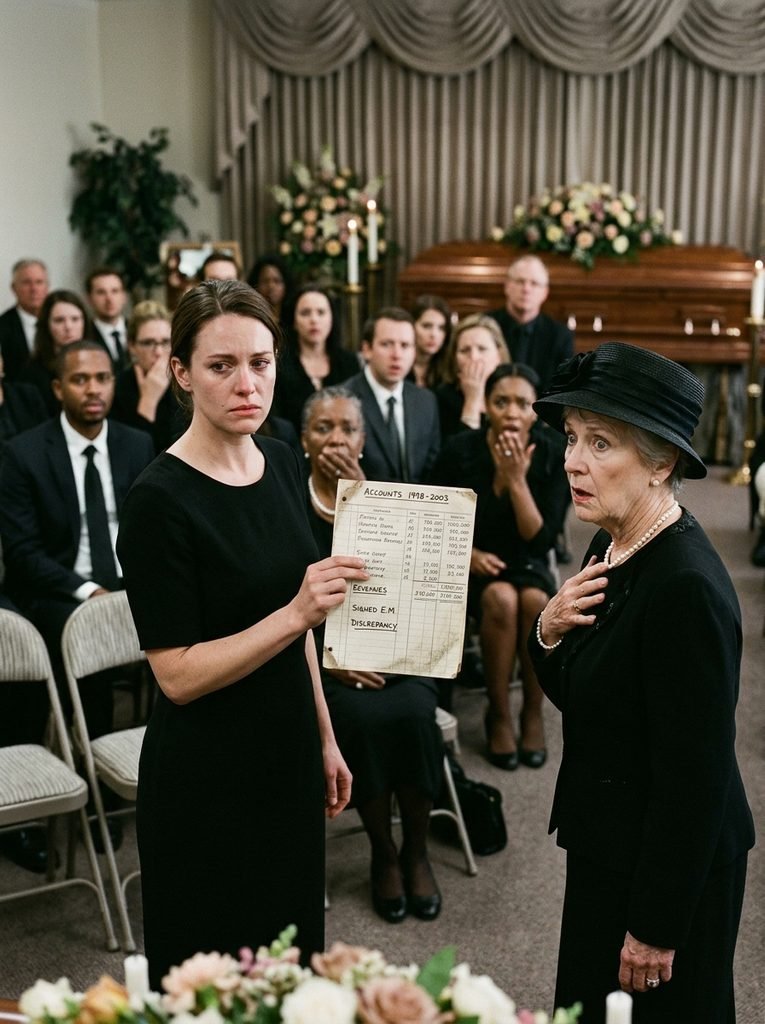
Thursday at nine-thirty I went to the funeral home in a black dress with the ledger page Mrs. Ostrander had photocopied for me.
I walked past the assistant. I walked past the hand on the door. I went to the front, where the casket was closed and covered in white roses I knew my father would have hated.
Bonnie was in the front row, surrounded by her sister and two cousins and a handful of people from her church. She saw me and stood up.
“Tracy. You can’t be here.”
“Before anyone leaves for the cemetery,” I said, loud enough for the first four rows, “you should know that the plot on the program is not where he’s going.”
Bonnie’s face went stiff. She took a step toward me.
“We are not doing this here.”
“The only person who can sign for my father’s grave is standing right here. And the plot I signed for this morning is next to my mother. Ellen Marsh. Plot 12-A. Not by the road. Not two rows over. Next to her.”
I held up the photocopied ledger page. Someone in the third row leaned forward to see it.
“That’s not legal,” Bonnie said.
“It’s a deed of right. My name. His signature. 1998. Mrs. Ostrander at the cemetery office has the original if you’d like to call her.”
Bonnie looked at the casket, then at me, then at the people watching us.
“He was my husband.”
“He was my father. And he made sure nobody could ever change where he was going.”
Her sister stood up and whispered something I couldn’t hear. Bonnie shook her head, but her hands were shaking too.
“You’re doing this for spite.”
“I’m doing this because he asked me to.”
I didn’t wait for her to answer. I walked back out, past the rows of people who had come to see a small, quiet service for a man they thought had no children.
The burial was at eleven. I stood on one side of the grave. Bonnie stood on the other with her sister’s arm around her shoulders. The priest read from a card someone had prepared. No one said my father’s name.
When it was over, Bonnie walked to her car without looking at me. Her sister stopped.
“You could have let her have this.”
“She could have let me in the door.”
The sister didn’t have an answer for that.
Mrs. Ostrander was standing by the road near her office, far enough back that no one had noticed her. I walked over when everyone else had left.
“He’s where he belongs,” she said.
“Thank you.”
“He knew, you know. What she was. What she’d try to do.”
I looked back at the grave, still open, the green tent flapping slightly in the wind.
“He called every Sunday for twenty-five years.”
“I know, honey. He told me.”
She handed me a tomato plant in a black plastic pot, the kind you get at a hardware store.
“He dropped this off in July. Said to make sure you got it if anything happened. Said you’d know what it meant.”
I took it. The leaves smelled like summer, like his garage, like every Sunday afternoon I ever spent wishing he’d say the thing he couldn’t say.
“He loved you,” Mrs. Ostrander said. “He just didn’t know how to do it out loud.”
I drove home with the tomato plant in the passenger seat. I didn’t cry at the funeral home. I didn’t cry at the grave. But I cried in my driveway, holding a plant my father had left for me because he knew his wife would make sure I got nothing else.
I planted it in the backyard that afternoon. It’s still there. Every August, I bring the tomatoes to Mrs. Ostrander, the way he did, and we sit in her office and talk about the man who bought two plots the day after his wife died and made sure no one could ever keep them apart.