Part 2
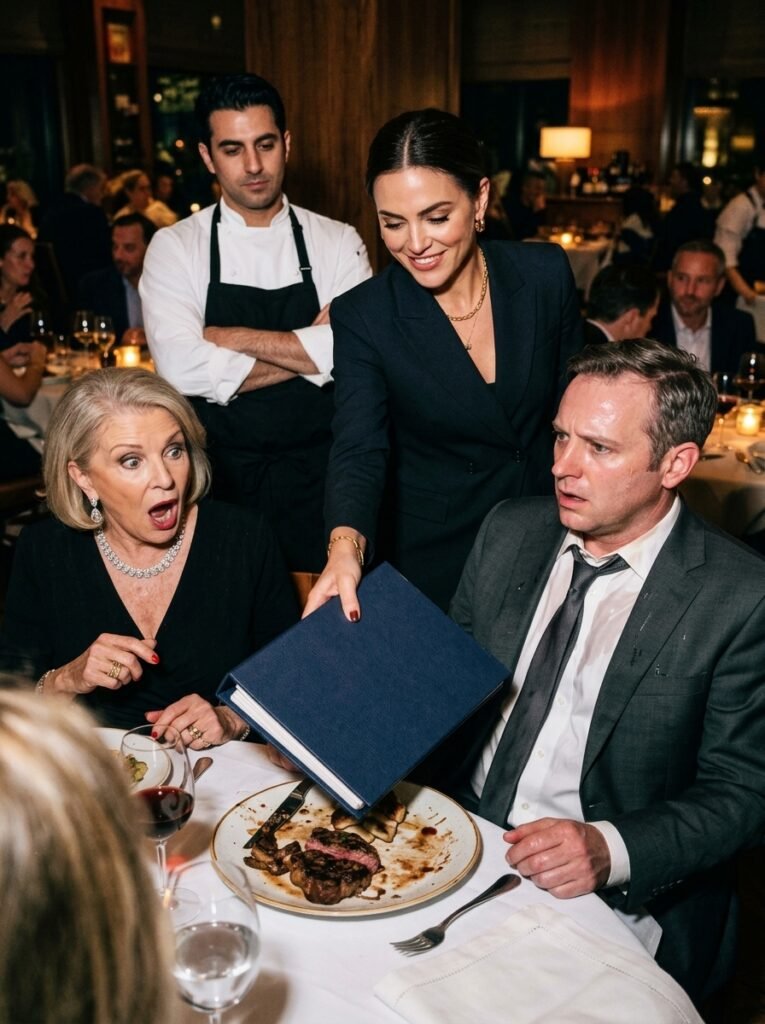
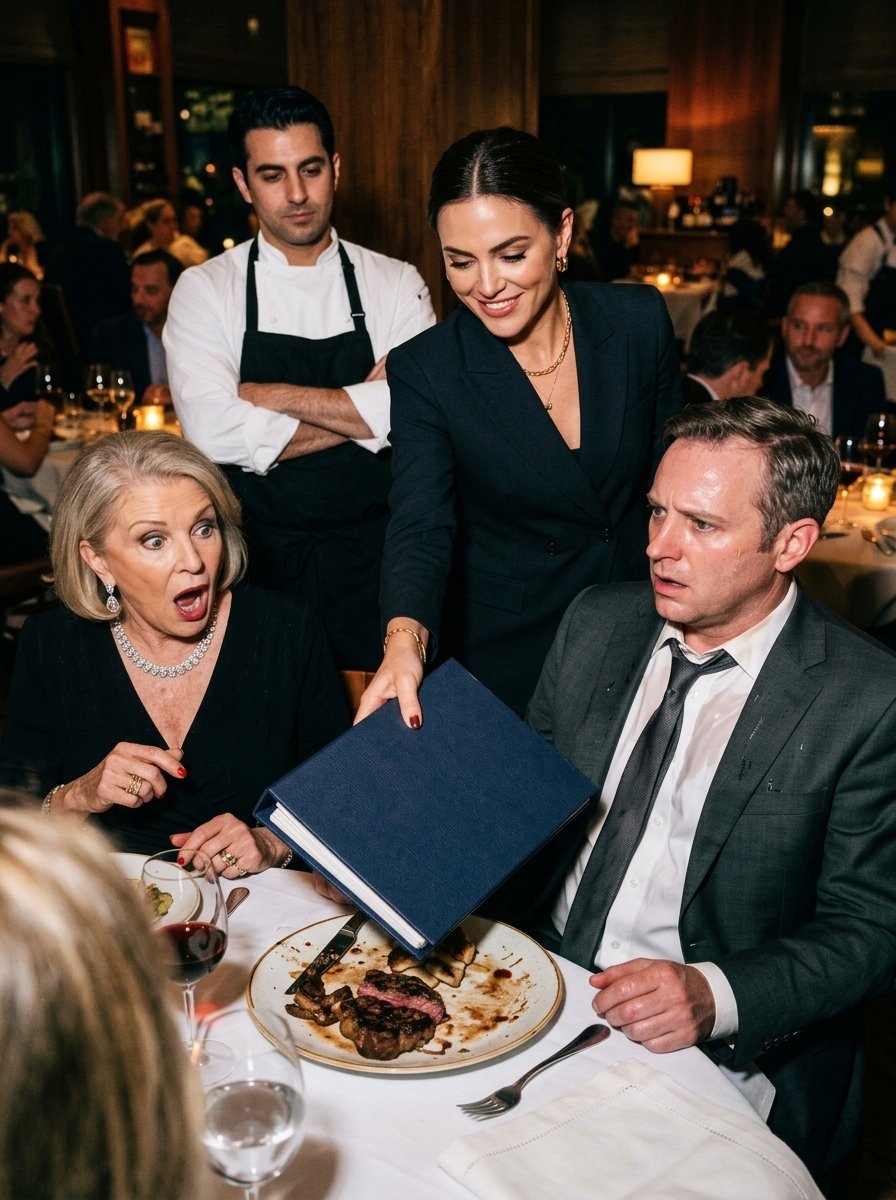
The private dining room at Sen had one long walnut table, a wall of wine, and a door thick enough to swallow the sound of a family unraveling on the other side of it.
Mr. Sterling waited until the door closed before he spoke.
“Ms. Exley, I’m going to be direct. Howerin does not enjoy surprises.”
“Neither do I,” I said. “Which is why I’d like to give you every document in that folder’s twin.” I slid a second navy folder across the walnut. Francis had made two sets that morning. Some lessons you learn in kitchens: always keep a backup of the thing you can’t afford to lose. “Operating agreement, capital records, the LOI, and the corporate resolutions. Your counsel can verify all of it tonight.”
He read for a long time. The other four executives passed pages hand to hand, quiet as a jury. Declan hovered near the door with a bottle of the good Barolo, the way a man hovers when he wants to hear everything and pretend he isn’t.
Finally, Sterling looked up.
“Our diligence team was told Mr. Marsh had signing authority.”
“He did, for a limited set of operational contracts, under a resolution I can revoke at any time. I revoked it at six o’clock.” I kept my voice even. “The people you spoke with in Atlanta, the architect, the zoning consultant, the financial model, were mine. Daniel attended the second dinner. He was very charming.”
A woman at the end of the table, Priya Nandakumar, Howerin’s head of development, let out a short breath that was almost a laugh.
“He was charming,” she said. “He also couldn’t explain the sensitivity analysis on page nineteen.”
“Because I wrote page nineteen.”
“Yes,” said Priya. “We wondered.”
Sterling closed the folder. “Ms. Exley, my concern isn’t who owns the company. My concern is whether that scene out there is a sign of instability.”
It was a fair question. It deserved an honest answer, not a performance.
“It’s a sign that I stopped protecting people from consequences,” I said. “That’s all. Keystone has forty-one employees, zero litigation, and a retention rate our competitors envy. The people who work for me have never had to wonder who’s in charge, because I’ve never hidden it from them. The only people who were confused tonight were people who never asked.”
Sterling studied me. Then, slowly, he smiled.
“Declan,” he said without turning, “I believe we’ll take that Barolo.”
We finished at eleven. The deal wasn’t signed, and it shouldn’t have been, but Sterling shook my hand at the door and said something I wrote down in my phone in the car.
“We were going to partner with a family. I think I’d rather partner with a company.”
I sat in the back seat of the ride I’d called and let my hands shake for the first time all night. Not from fear. From the quiet aftermath of adrenaline, the way your legs feel after carrying something for years and finally setting it down.
My phone had been silent on purpose. Now I turned it over.
Sixty-three notifications.
Daniel: fourteen calls, nine texts.
Whitney: three texts, escalating in punctuation.
An unknown number, which I recognized as Diane’s landline: two voicemails.
I played the first one on speaker, low.
“Athena. This is Diane. I think we all got carried away tonight, and I’m willing to overlook the tone you took with me. Call Daniel. He’s very upset. Family should be able to sort these things out privately.”
I listened to it twice, purely to admire it. She had managed to offer forgiveness for being humiliated in a restaurant she’d humiliated me in. There was a kind of craftsmanship to it.
I deleted nothing. Francis had told me not to. I forwarded both voicemails to her and typed: Family sorting things out privately, apparently.
Her reply arrived before the car reached my street: Do not engage. I’ll call you at 7.
The house was dark when I got home, except for the kitchen light.
Daniel was sitting at the island in his shirtsleeves, tie loosened, the navy folder open in front of him. Someone had clearly driven it over. Declan, probably, or one of the servers, because I’d left it on his plate and hadn’t gone back.
He looked up. He had been crying, and had stopped, and hadn’t washed his face.
“Nine years,” he said.
“Nine years.”
“You could have told me. Any time.”
“I did tell you. I told you in the first year when you signed the operating agreement. I told you at the second renewal. I said, ‘Daniel, read the acknowledgment,’ and you said, ‘I trust you.'” I set my bag down. “That wasn’t trust. It was convenience. You didn’t want to know, because knowing would have obliged you to act differently.”
“That’s not fair.”
“Isn’t it?”
He was quiet.
“My mother said…”
“Your mother said I was staff. She said it in front of a photographer, and you told me later it was a joke. You’ve said a lot of things were jokes.” I pulled out a stool but didn’t sit. “Daniel, I’m not angry the way you think I am. I did a lot of my angry years ago, in the walk-in cooler at two in the morning, where nobody could see it. What I feel now is closer to… accounting.”
“Accounting.”
“You have to close the books on things that aren’t working.”
He flinched.
“I’m not going to make this a war,” I said. “I could. I have the group chat, the recordings from the second Atlanta dinner, and a very clear breach clause. But that’s not the point of me being here.”
“Then what is?”
I thought about how to say it in a way that was neither cruel nor cowardly.
“I’d like you to look at that folder and understand what you were part of. Not to feel guilty. To see it. I spent nine years building something and you spent nine years standing next to it, letting your mother believe you’d built it. Every time she said ‘Daniel’s company,’ you nodded. I want you to sit here tonight and picture what it cost me to watch you nod.”
He didn’t answer. His shoulders were shaking again, quietly, the way a man cries when he’s ashamed to.
I put a hand on the counter, near his, but not on it.
“Francis is drafting a separation agreement. It’ll be fair. You won’t be destitute. You’ll have the house equity we built together, and a severance figure that’s more generous than the contract requires. But you will not work for Keystone, and you will not speak for it, and you will not present yourself as its founder. Ever.”
“And my mother?”
“Your mother will get a letter from Francis about the invoice for tonight’s dinner.” I almost smiled. “I wasn’t kidding about the corporate card.”
He gave a wet, broken laugh.
Then, very quietly: “Did you ever love me? Or was it always… a strategy?”
The question landed somewhere tender. I was glad he’d asked it honestly.
“I loved you,” I said. “I loved who I thought you’d become if someone believed in you long enough. That was my mistake. I confused potential with character.”
He nodded slowly and looked down at the folder.
“I’m going to stay at Whitney’s,” he said. “I’ll come for my things this weekend.”
“Francis will coordinate it.”
At the door, he turned, one hand on the frame.
“Athena. For what it’s worth. You were never staff.”
“I know,” I said. “That was never the question.”
The story reached the industry before breakfast.
I hadn’t leaked anything. I didn’t have to. Fourteen people had been in that dining room, five of them senior executives at a company that talks to every other company, and one of them, Declan, had, I later learned, told the whole kitchen before the last plate was cleared. By ten a.m., three restaurateurs, a commercial lender, and a hotel broker had texted me variations of the same message: Is it true?
I answered exactly one, from a woman named Rosalind Park who ran a competing group and had never once returned my calls.
It’s true. Coffee this week?
Tuesday, she wrote. I’m buying. I owe you an apology for underestimating you.
I set the phone down and looked at the small stack of things on my desk. A revised term sheet from Howerin, arriving early. A note from Declan, in his chef’s block handwriting: Table’s yours whenever you want it. Always was. And, from the mail that had come the day before, something I’d forgotten to open.
A photograph.
It was the old one, from Diane’s birthday, the family portrait with everyone gathered on the lawn. Someone had mailed it anonymously with a single yellow sticky note.
On the photograph, in the corner, half cut off by the frame, I was visible, the one figure walking away toward the kitchen with a tray.
The note read: You were the only one working. Thought you’d want this.
I turned it over. No name, no return address. Just a woman in the far background of a family portrait she’d been told she didn’t belong in, carrying the tray that kept the party alive.
I put it in the top drawer of my desk. Not because it was a trophy. Because I wanted to remember what invisibility had felt like, so that I would never be the kind of boss who built it for someone else.
Diane arrived at Keystone’s office on Thursday, unannounced.
The receptionist, a nineteen-year-old named Tomas who had been trained by me personally, stood up when she came through the glass doors and said, with perfect courtesy:
“Good morning, ma’am. Do you have an appointment?”
“I am Diane Marsh. I’m here to see my daughter-in-law.”
“Of course. May I tell Ms. Exley what this is regarding?”
I watched through the glass wall of my office as Diane’s mouth thinned. She had walked into this building for six years as the mother of the man on the business cards. She had been waved through. She had been offered coffee. She had never once been asked what she wanted, because nobody here had ever needed to ask.
“It’s a family matter,” she said.
“I understand. One moment, please.”
Tomas picked up the phone and called my desk, and I let it ring twice before answering, because I wanted, just briefly, to see the shape of her waiting.
“Send her in,” I said.
She swept into the office wearing pearls and a pale blue suit and the expression of a woman on a diplomatic mission to a hostile country. She looked around at the framed awards, the blueprints on the wall, the certificate from the city naming Keystone Small Business of the Year. She had never looked at them before. I don’t think she’d known they were there.
“Athena,” she said, and paused, because the next word was harder. “Sit down.”
“It’s my office, Diane. You sit.”
A long, taut moment.
She sat.
“I’m here,” she said carefully, “because I believe there’s been a serious misunderstanding, and I think we can fix it like adults.”
“Please.”
“Daniel is devastated. He hasn’t eaten. Whitney is furious with him. And Brad, well, Brad has had some difficulty explaining to his firm why he was discussing another company’s operations in a family group chat.” Her lips pressed together. “You must understand how this looks. To our friends. The club.”
“I do understand,” I said. “How it looks is the thing you’ve always cared about most.”
Her cheek twitched.
“I’ll be brief. You’ve made your point. It was cruel to do it in public, but you’ve made it. Now I think a sensible woman would consider what’s best for the family. Daniel could return in an advisory role. Brad is willing to step aside. We can issue a statement that this was a restructuring.”
I looked at her for a long time.
Somewhere in the building, a phone rang. Someone laughed in the hallway. The ordinary noise of forty-one people doing good work, a sound Diane had never once considered.
“Diane,” I said, “I’m going to tell you something, and I want you to hear it as information, not as an insult. You are not a villain to me. You are a woman who decided at the beginning of my marriage that I was a threat, and you spent six years managing that threat by making me smaller. That was your strategy. And it worked, for a while, because I let it.”
“I never…”
“Please don’t tell me you never. I have the photo. I was there.”
She closed her mouth.
“What I’m saying is that I don’t need anything from you. Not an apology. Not a retraction. Not a statement. The restructuring isn’t a story. It’s just what happened, and people can draw their own conclusions.” I folded my hands. “The only thing I’d ask is that you stop calling this company Daniel’s. In public, in private, at the club. It isn’t.”
“That’s all?”
“That’s everything.”
Her jaw worked. I watched her search for another angle, another lever, and find none. It was a curious thing to see, someone reaching for a tool that had always been in her hand and finding the hand empty.
“And if I don’t?”
“Then people who ask will be told the truth,” I said. “Politely.”
She rose slowly, smoothing her skirt. At the door, she stopped.
“You were always going to leave him, weren’t you?”
“No,” I said honestly. “I was always going to stay, as long as he stood beside me. He never did.”
Diane held the doorknob for a moment longer, then left without a word. Tomas held the glass door open for her and said, “Have a lovely afternoon, ma’am.”
She didn’t answer.
That evening I stayed late, the way I always had. The floor emptied. The cleaning crew came through. I stood at the window watching the city go amber and gray.
Declan called at seven.
“Table’s ready,” he said. “I mean it. Eat something. Bring nobody, if you want.”
“I’ll bring myself.”
“Best guest I could ask for.”
I hung up. Then I opened the top drawer, took out the photograph, and looked at it once more. The woman with the tray. The one nobody had noticed until someone, somewhere, decided to say I saw you.
I still don’t know who sent it. A cousin, maybe. A server from that afternoon. Someone who had watched a family perform a hierarchy for years and decided, quietly, to leave a small piece of evidence on my doorstep.
I like to think about the fact that not everyone in that world was blind.
I turned off the lights, walked out past Tomas’s empty desk, and rode the elevator down. In the lobby, the night guard nodded.
“Late again, Ms. Exley.”
“Always,” I said.
Outside, the evening air was warm and smelled like rain. My table was waiting three blocks away, in a restaurant I had helped build, in a company I had built, in a life that had never needed anyone’s permission to exist.
I stepped onto the sidewalk and started walking.
Nobody was holding a chair for me.
I’d never needed one.
Part 3
The Howerin deal closed on a Tuesday in November, in a conference room in Atlanta with a view of the skyline and a carafe of coffee nobody touched.
Priya Nandakumar slid the last signature page across the table, and I signed my name, Athena Exley, Managing Member, in the blue ink I’d carried in my bag since the first day I opened Keystone’s account. It had never once been a superstitious choice. It was just a pen that worked.
“Congratulations,” Mr. Sterling said, and this time the handshake was warm. “For what it’s worth, my board asked me last week whether we were making a mistake, given the… circumstances.”
“What did you tell them?”
“That we’d watched two companies at that dinner. One of them was fourteen people at a table. The other one walked into the private room and answered every question in under a minute.” He smiled. “We chose the second one.”
I flew home that night and slept the whole flight, which I hadn’t done in years.
Growth, it turns out, is mostly logistics wearing a nicer coat.
Within three months, Keystone needed a second floor of office space, a real HR director, and a chief operating officer, a role I had been quietly performing on top of everything else for nine years. I posted the job myself. I read every résumé. I interviewed nine candidates, and on the fourth day of interviews, a woman named Marguerite Solis walked in, sat down, and said before I’d asked anything:
“I looked you up. I read about the dinner. I’m not here because of it. I want you to know that I would’ve applied anyway, because your retention numbers are the best in the mid-market, and I want to know how you did it.”
“How do you think I did it?”
“You didn’t make people feel like staff.”
I stared at her.
“Sorry,” she said quickly. “Too much?”
“No,” I said. “That’s exactly it.”
I hired her that afternoon.
The separation agreement was signed in December, in Francis Doyle’s office, at a table so plain it felt almost unfair to the occasion.
Daniel arrived early. He’d lost weight. His suit was the same navy, but it hung differently, the way clothes do when the person inside them has been forced to become smaller and more honest at once. He was alone. No Whitney, no lawyer besides the one Francis had insisted he hire.
He read every page. All of them. I watched him do it, his finger tracing the lines, lips moving slightly on the longer clauses.
“You’re reading it,” I said.
“I should have been reading things for nine years.”
He signed. Then he set down the pen and looked at me.
“I’ve been going to counseling,” he said. “Whitney found someone. The first three sessions were mostly me explaining why everything was my mother’s fault. The fourth, the therapist asked me to describe one time I’d said no to her. Just one. Any time in my life.”
“And?”
“I couldn’t think of one.” He rubbed his eyes. “I’m forty-one years old, Athena.”
I let that sit. I could have offered comfort. I could have offered a lecture. Neither felt honest.
“What did you do?” I asked instead.
“I went home and I told her I wouldn’t be attending Sunday dinner. Not forever. Just that week. She cried, and then she got angry, and then she hung up on me.” A small, disbelieving laugh. “It was the hardest phone call of my life. And it was about a dinner.”
“It was never about the dinner.”
“No.” He looked at his hands. “I don’t expect you to say anything kind. But I wanted you to know I’m trying.”
I considered him for a moment, this man I’d once believed in so completely that I’d built a company around the belief.
“I hope you keep trying,” I said, and meant it. “Not for me. For whoever you end up being next.”
He nodded, stood, and shook Francis’s hand. At the door he paused, as he had that night in the kitchen.
“The photograph,” he said. “The one from my mother’s birthday. Did you get it?”
I went still.
“You sent it?”
“No.” His face was unreadable. “But I know who did. And I think you should ask her yourself.”
He left before I could ask a single follow-up question.
It took me two weeks to find her.
I didn’t have to look far, as it turned out. The answer had been in my own kitchen, in a manner of speaking. I’d walked past her at every Marsh family dinner for six years.
Rosa Delgado had been the Marsh family’s housekeeper for eleven years. She was sixty-three, quiet, and moved through rooms so efficiently that people forgot she was in them. At Diane’s birthday party, she had been the one holding the camera, the second camera, the one nobody remembered, the one that caught the whole lawn including the woman in the corner carrying a tray.
I found her at a small bakery in Decatur, where she’d taken a part-time job after Diane let her go in October. No severance, no notice. Diane had said the household was “downsizing.”
She was arranging pastries in the window when I walked in.
“Mrs. Delgado?”
She turned, and I saw the moment she recognized me. Not fear. Something gentler and more guarded, like a woman who’d been carrying a small secret and had just been told it was safe to set down.
“Mrs. Exley.”
“It’s just Athena. Did you send me the photograph?”
She wiped her hands slowly on her apron. “I kept a copy,” she said. “Of all of them, actually. Eleven years of family portraits, and you were in the corner of every one, doing something for someone. I thought, one day somebody should know she was there.”
My throat tightened.
“Why me? Why then?”
“Because I saw you laugh,” she said. “At the restaurant. I was in the kitchen, helping my nephew with a delivery. He works there. I saw you laugh, and I thought, finally. I have watched that woman swallow so much for so long, and there she is, laughing at the whole ridiculous thing. I went home and found the photograph.”
I couldn’t speak for a moment.
“Mrs. Delgado, I’d like to offer you a job.”
She blinked. “I don’t need charity.”
“It isn’t charity. Keystone is opening a new hospitality training program, front-of-house, back-of-house, the works. I need someone to run the household of the operation. Someone who notices what nobody else does. Someone who understands that the people carrying trays are the reason the party lasts.”
She stared at me. Then, slowly, she smiled.
“That’s a lot of trays.”
“Twelve locations by next year.”
“Well,” she said, untying her apron. “I suppose I should learn where they all keep the good napkins.”
Whitney called on a Friday in January.
I almost didn’t pick up. But I’d learned that silence isn’t always strength, sometimes it’s just avoidance in nicer clothes.
“Athena.” Her voice was thinner than I remembered. “I want to say something and I need you to let me finish.”
“Go ahead.”
“Brad was let go from his firm. Not because of the group chat, or not only. They found out he’d been padding expenses. It was going on for years. It came out during the review.” A sharp breath. “I’m not asking for anything. I’m telling you because I spent six years watching my mother treat you like furniture and I laughed along, and I want to say I’m sorry.”
I sat down slowly.
“Why now?”
“Because I watched what happened to Daniel,” she said. “And because I looked at my own life and realized I’d built it out of someone else’s approval too. Brad, the house, the club. I thought that was success. It was just a performance with better lighting.”
“That’s a hard thing to see.”
“It’s unbearable,” she said, half-laughing. “Anyway. I don’t expect anything. I wanted you to hear it from me.”
“Thank you, Whitney. That took courage.”
“Does it get easier?”
I thought about the walk-in cooler at two in the morning. About the family portrait. About the boat I’d built and the people who’d stood on its deck.
“It does,” I said. “But only if you stop asking the wrong people for permission.”
In March, Keystone opened its tenth location, a warm, brick-walled restaurant in Savannah, with an open kitchen and a long communal table at the center. There were no head-of-table chairs. I’d insisted.
Declan cooked the opening menu, flown in from Sen for the week, grumbling about Georgia humidity and bringing three crates of his own knives. Marguerite ran the floor. Rosa Delgado, in a crisp new Keystone jacket, greeted every guest at the door by name, having memorized the entire reservation list over the weekend.
At seven o’clock, I stood at the back and watched the room fill: couples, families, a table of nurses on their night off, an old man dining alone with a paperback. The sounds were the sounds I’d built my life to hear, forks on plates, glasses touching, laughter that didn’t need permission.
Priya Nandakumar found me near the kitchen door.
“You realize,” she said, “that Howerin is going to want to cut the ribbon on the flagship in front of about two hundred people, and half of them will expect you to give a speech.”
“I hate speeches.”
“You gave a very good one at Sen.”
“That wasn’t a speech. That was a folder.”
She laughed. “Then bring a folder.”
I looked out at the communal table. At the eleven strangers passing a bread basket. At a woman who’d just been seated at the very end, alone, glancing around uncertainly the way people do when they’re not sure they belong.
Rosa was already there. She pulled out a chair, said something warm, and the woman smiled and sat.
Nobody told her she was staff.
Nobody told her to wait.
“You know what?” I said to Priya. “I think I’ll give a speech.”
“What will you say?”
“I’ll keep it short.” I watched Rosa refill the woman’s water glass. “I’ll say that every seat at every table in every one of our restaurants is reserved. For whoever walks in.”
Priya nodded slowly. “That’s a very good speech.”
“I’ve been working on it for nine years.”
The flagship opened that September.
Two hundred guests. A ribbon. A bottle of champagne. Mr. Sterling, Priya, and the whole Howerin team lined up in the front row. Francis Doyle, in a sensible gray suit, sat beside Declan. Marguerite stood with the new hires. Tomas, the nineteen-year-old receptionist, now a junior operations coordinator, held the scissors.
And somewhere in the middle of the crowd, half-hidden behind a pillar, I saw a woman in a pale blue suit.
Diane.
She hadn’t been invited. She hadn’t announced herself. She stood very straight, hands clasped, watching me the way you watch a building you once thought you owned.
I walked to the podium. I didn’t use notes.
“Nine years ago, I opened a company with a folding table and a rented phone line,” I said. “I’ve been asked how we got here. The honest answer is that we built a place where nobody has to earn a chair.”
I paused. I let my eyes rest on the pillar. On the woman beside it.
“So every seat in this building is open tonight,” I said. “For everyone who wants one.”
I didn’t point. I didn’t have to.
The applause rose, warm and long. When I looked again, the pillar was empty.
But on the far side of the room, near the back, there was a single chair pulled out from a table, and a woman in pale blue sitting very quietly in it, hands folded in her lap, watching the ribbon get cut.
She stayed through the toast. She stayed through the first course. When the plates were cleared, she stood, adjusted her jacket, and walked to the door.
Rosa was holding it open.
“Good evening, Mrs. Marsh,” Rosa said, with perfect courtesy.
Diane paused. For a long moment, the two women looked at each other, the one who’d been dismissed and the one who’d done the dismissing.
“Thank you,” Diane said quietly. “For the evening.”
It was the first time in eleven years she’d said those words to Rosa.
Rosa nodded once, the smallest gesture, and let her go.
That night, after the last guest left and the staff had gathered for a late supper at the long communal table, I found myself standing at the head of the room out of habit.
Then I remembered there was no head.
Declan pulled out a chair and pointed. “Sit.”
“Which one?”
“Any one. That’s the point, isn’t it?”
I laughed. I sat.
Marguerite passed the bread. Rosa poured wine. Tomas told a story about a lost reservation that made Priya laugh so hard she had to put her fork down. Francis leaned over and murmured, “Nine years ago, I told you the provision was unnecessary.”
“I told you it was unnecessary,” I said.
“You were wrong.”
“I was.”
“It happens rarely,” she said. “Enjoy it.”
I looked around the table at the faces that had been strangers, then colleagues, then something closer to family, the kind you choose, the kind that doesn’t need a portrait to prove it.
Somewhere in a drawer at home, a photograph waited. A woman in the corner of a lawn, carrying a tray.
I’d taken it out one last time that week and turned it over. On the back, in pencil, in a hand I’d finally recognized as Rosa’s, was a line I hadn’t noticed before.
She was the one who made the party possible.
I’d carried that sentence for months without knowing it was written for me.
The room hummed around me. Outside, the city glowed. And I sat at a table with no head and no foot and no assigned seats, in a company that was mine, among people who had chosen to be here.
Nobody was holding a chair for me.
They’d each pulled out their own, and left one open beside them, in case I wanted to sit.
Part 4: Every Seat
Two years after the flagship opened, Rosa Delgado’s training program had a name, a waiting list, and a building of its own.
She refused to let me call it the Delgado Fellowship. “Too grand,” she said. “Call it what it is.” So the sign over the door in Decatur read The Tray Program, in plain white letters. Inside were a teaching kitchen, a mock dining room, and forty-two trainees a year: dishwashers who wanted to be line cooks, line cooks who wanted to run kitchens, single parents who needed a schedule that bent, and a few teenagers who reminded me uncomfortably of myself at sixteen, with grease burns already blooming on their forearms.
Rosa taught the first lesson herself, every cohort, always the same.
“Before you learn to cook or pour or plate,” she’d say, “learn to notice. Who hasn’t been served water? Who is sitting alone? Who is pretending not to need anything? The person who notices runs the room. The title comes later.”
I sat in the back for one of those lessons, a Tuesday in early spring, and watched a boy of maybe seventeen scribble the words into a spiral notebook. His name was Luis. He had a burn scar across his wrist, and he wrote as though he were afraid the sentence might get away.
Afterward, Rosa found me by the coffee urn.
“You’re crying,” she observed.
“I’m not.”
“You’re doing something with your face.”
“Allergies,” I said.
“Mm.” She handed me a napkin. “The good napkins, you’ll notice.”
Daniel’s name came up rarely, and when it did, it arrived sideways.
Marguerite mentioned it first, casually, during a budget meeting. A friend of hers had eaten at a small place in Athens, Georgia, a twelve-table restaurant with a handwritten menu, where the dishwasher was a forty-three-year-old man who’d been there fourteen months and never once asked to be called anything else.
“Tall, glasses, quiet,” she said. “He apparently stays after close to scrub the hood vents. Nobody asked him to.”
I didn’t say anything. Marguerite, who had learned in two years exactly when I didn’t need to, moved on to the next line item.
But that night I drove to Athens.
I didn’t go in. I sat in the parking lot across the street with a coffee going cold and watched the kitchen through the back window: the steam, the shouting, the rhythm of hands. Near the sinks, in a stained apron with his sleeves shoved past his elbows, was a man I had once watched sign paperwork without reading it.
He was scrubbing a sheet pan, and he was doing it well. Not the way you do a task you resent. The way you do one you’ve finally decided to learn.
The owner, a broad woman with flour on her cheek, said something to him. He laughed. It was a startled, real laugh that I hadn’t heard in years, possibly ever.
I finished my coffee and drove home.
Two weeks later, an envelope arrived at the Keystone office, forwarded through Francis. Inside was one index card, in handwriting I knew.
I’m not asking for anything. I just wanted you to know I learned to wash a dish properly. It turns out there’s a technique. — D.
I pinned it to the corkboard behind my desk, next to a photograph of Rosa’s first graduating class.
I never wrote back. It didn’t seem to need an answer.
Whitney called on my birthday, which surprised me.
“I’m not calling to ask for anything,” she said, which had become our traditional opening.
“I know.”
“I’m calling to tell you I got my real estate license.”
“Whitney, that’s wonderful.”
“It’s small. I sell condos to first-time buyers. Mostly young couples who are terrified and pretending not to be.” She paused. “I hold their hands through the paperwork. Apparently I’m good at it. Nobody’s ever told me I was good at anything, except hosting.”
“You were always good at hosting,” I said. “You were just doing it for the wrong audience.”
A long breath on the line. “Brad and I are divorced. Did you know?”
“I heard.”
“It’s fine. It’s actually fine.” She laughed, and it was lighter than I’d ever heard her. “I have a small apartment. A cat. A very ugly couch that I love. Athena, nobody has ever eaten dinner in this apartment except me and the cat, and I’ve never felt more like a person.”
“That sounds like a good dinner party.”
“It is,” she said. “You should come.”
I did, a month later. The couch was ugly, and she was right to love it. We ate takeout on paper plates, and she asked me nothing about the company, which I found I could not remember the last time someone had managed.
The letter from Diane came in October.
It was handwritten, on cream stationery, and it wasn’t addressed to me.
It was addressed to Rosa, care of the Tray Program. Rosa brought it to my office herself, holding it between two fingers as though it might be warm.
“I don’t know what to do with this,” she said.
“Do you want to read it?”
“I read it. I read it four times.” She sat down in the chair across from my desk, which she almost never did. “Would you like to?”
She had given me permission, so I read it.
Dear Mrs. Delgado,
I am writing to apologize for the way I ended your employment, and for the eleven years before that. I did not notice you. I have thought about that a great deal lately, that a person can stand in another person’s home for over a decade, and the homeowner can fail to learn one true thing about her.
I do not know the name of your sister. I do not know if you have children. I did not know you took the second camera at my birthday. I learned this only recently, from my daughter, who has been unexpectedly honest with me.
I am enclosing a check for the wages and severance you should have received. I know it does not repair anything. It is not meant to. It is only arithmetic, which is the one thing I have always been good at.
I have also begun volunteering, two afternoons a week, at a community kitchen in Marietta. They put me in the dish pit on the first day. I understand now that this was not an accident.
You do not have to reply.
Diane Marsh
I set the letter down carefully.
“The check?” I asked.
Rosa shrugged. “Eighty-one thousand dollars. She calculated it herself. Down to the cent, including interest.” A dry smile. “It’s actually correct.”
“What will you do with it?”
She looked out the window at the glass front of the training building.
“I think I’ll start a scholarship,” she said. “For the people who carry the trays. Every graduating class, one person gets their first month’s rent paid.”
“Rosa…”
“Don’t say anything sentimental, Athena. I’m too old for it.” She stood and smoothed her jacket. “And I’ll write her back. Two lines. Maybe three.”
“What will you say?”
She considered.
“That I hope the dish pit is teaching her what it taught you.”
We celebrated Keystone’s tenth anniversary in the place where the story had turned.
Sen, on a Thursday, closed to the public. Declan had insisted, and for once, I hadn’t argued. He’d redone the private dining room with a single long table and no place cards. When I asked why, he just tilted his head in a way that meant you know why.
Everyone came. Marguerite in a green dress, with her hand comfortably on the small of her husband’s back. Tomas, now twenty-five and a regional operations director, giving a toast that made Francis Doyle cry into her napkin and deny it. Priya Nandakumar and Mr. Sterling, now retired, who insisted on being seated in the middle of the table, “where the conversation is.” Whitney, with the cat’s picture on her phone, which she showed to anyone who stood still.
And the Tray Program graduates, forty of them. Luis, the boy with the scar, had a sous chef’s jacket on for the first time, and he kept touching the embroidered name over his heart as though checking that it was still there.
Rosa sat at the end of the table, in no particular seat, with a glass of wine she’d been nursing since six.
Near the end of the meal, the door of the dining room opened.
I saw her before anyone else did. Diane, in a plain gray dress, stood at the threshold with her hands clasped, as she had at the flagship. Behind her, half in shadow, was the tall man in the glasses.
Nobody spoke. Forty conversations went quiet in the space of a breath.
“I wasn’t invited,” Diane said. Her voice was steady, but small. “I know that. Daniel drove me. He said he’d wait in the car, and I said I’d only be a minute.” She looked down the long table. “I wanted to thank Mrs. Delgado. In person. And Ms. Exley, for…”
She stopped. Her mouth worked.
“For not doing what I would have done,” she finished.
The silence held.
Then Rosa Delgado set down her glass and stood.
She walked the length of the table, past forty of her students, past the chef and the executives and the lawyer, until she stood facing the woman who had once dismissed her over a phone call.
“Mrs. Marsh,” she said. “Have you eaten?”
Diane blinked. “I… no. I didn’t think…”
“Then you’ll eat.” Rosa turned to a server. “Two more places, please. One for Mrs. Marsh, one for her son, who is standing in the parking lot like a fool.”
She looked back at Diane.
“There is no head of the table here. Sit where you like.”
Diane’s eyes filled. She didn’t speak. She only nodded, once, and Luis, the boy with the scar, stood up from the middle of the table and pulled out a chair for her.
She sat.
Daniel came in a moment later, awkward and hesitant, and stopped when he saw me. I lifted a hand, a small gesture, half greeting, half permission. He sat at the far end, next to Whitney, who slid a bread basket toward him without a word.
That was all. There was no speech, no reckoning, no scene. Just a woman in gray eating soup at a table where nobody had assigned her a place, and being passed the salt by a stranger, and saying, quietly, “Thank you.”
I watched it from my seat in the middle of the room. It wasn’t triumph. Triumph would have felt like the walk out of Sen on the first night, heels clicking, a family behind me in ruins.
This was quieter.
This was what remained after the fire, when you finally let people come and sit near the ashes.
Later, after the toasts, after the last dessert, I stood alone near the kitchen door, the way I always did, the way I’d stood at sixteen with soap up to my elbows.
Declan came out, wiping his hands on a towel.
“You okay?”
“I think so.”
“That was…” He searched. “A lot.”
“It was.”
“You want me to say something wise?”
“Please don’t.”
“Good. I’ve got nothing.” He leaned against the doorframe beside me. “I’ll tell you one thing, though. Ten years ago you walked into my kitchen with a dream, a folder of projections, and a rented van full of chairs.”
“It was a very good van.”
“It was a terrible van.” He grinned. “But you bought every chair in that restaurant before I’d finished my first menu. You said, ‘Everyone who walks in is going to have somewhere to sit.’ I thought you were insane.”
“I remember.”
“You weren’t.”
I looked back at the long table, at the paper napkins and half-empty glasses and forty faces flushed with warmth. Diane was talking to Luis, of all people, asking him something about knife skills, listening with an expression I had never once seen on her face in six years.
Daniel was helping clear plates. Nobody had asked him to.
Whitney was laughing, bright and unguarded.
And Rosa was at the head of the table. Except it was not the head, because there wasn’t one, and she’d only taken the chair nearest the kitchen because it let her hear the room best.
I took the photograph from my bag then, the one from the lawn, the one with the woman in the corner carrying the tray. I’d brought it for a reason I hadn’t quite articulated even to myself. I walked across the dining room and handed it to Rosa.
“For the wall,” I said. “At the Tray Program. Right by the entrance, where the new ones will see it.”
She held it in both hands, tilting it toward the light, studying the small figure in the background.
“She looks tired,” Rosa said.
“She was.”
“She looks like she doesn’t know anyone has noticed her.”
“She didn’t.”
Rosa turned the photograph over and read the pencil line she’d written on the back two years ago. Then she looked up at me, and her eyes were bright.
“You know,” she said, “I wrote that for you. But I think it was also for me.”
“For you?”
“The one who took the second camera.” She smiled. “The one who noticed. It turns out you can be the person in the corner and the person who sees her. Both at once. I didn’t know that until you.”
I sat down beside her. I didn’t choose the chair. It was just there, open, pulled out slightly from the table, the way they all were.
Across the room, Luis was showing Diane how to hold a chef’s knife properly. She was gripping it awkwardly, and he was correcting her, patiently, with the gentle authority of someone who had learned to teach by being taught well. Diane laughed at her own clumsiness, a brief, surprised sound.
Nobody looked at Daniel. Nobody needed to. He was drying glasses at the bar, and he looked, for the first time I could remember, like a man who was exactly where he’d chosen to be.
I let my head rest for a moment against the back of the chair.
Ten years. Forty-one employees had become four hundred. One restaurant had become twenty-three. A boat I’d built alone had become a fleet, crewed by people who had each, at some point, been told they were staff, and had decided to become something else.
I thought of the girl I had been at sixteen, standing at a dish pit with burned forearms and a fierce, unspoken hope. I wished I could tell her that the fierce, unspoken hope was right.
That the table was real.
That it would be long.
That she would build it herself, plank by plank, chair by chair, and that when it was finished, nobody would need to hold a seat for her, because there would be enough seats for everyone.
“Athena,” Rosa said quietly.
“Yes?”
“You’re doing the thing with your face again.”
I laughed. It was a real one, the first real one I’d had all evening, warm and unguarded and entirely my own.
“Allergies,” I said.
“Of course,” said Rosa, and passed me the good napkin.
Outside, the city glowed. Inside, a long table full of people held its dinner late into the night, passing bread and stories back and forth, the plates never quite emptying, the chairs never quite filling.
Somewhere along it, a seat stood open.
Nobody had reserved it.
It was for whoever walked in next.
The End.