I packed carefully, not just uniforms and civilian clothes, but gifts I’d spent weeks choosing. A leather-bound journal for my father, the kind he used to keep before arthritis took his handwriting from him. A cashmere scarf for my mother, the deep red she always said she loved but never bought for herself.
I packed books and art supplies for my brother’s kids, children I hadn’t seen grow an inch in three years because deployments don’t wait for family. And tucked into the inside pocket of my coat was a check made out to my parents for the roof repair they’d been putting off since spring—money I’d been setting aside from every paycheck for the last year, never mentioning it, never asking for credit.
Emma sat beside me on the flight home, drawing snowmen on the fogged-up window and asking me every twenty minutes if Grandma’s house would have a real fireplace.
I told her yes.
I told her it would be the best Christmas we’d had in years.
I believed it when I said it.
My family had never understood what I did. To them, the Army was always something lesser. Not a calling, not a sacrifice, just a strange detour I’d taken instead of settling down properly.
My brother Jason had built his identity on being the successful one, even though he hadn’t held a steady job in almost six years and still lived off our parents’ goodwill in the house where he’d grown up. He had opinions about everything and responsibility for nothing.
I used to hope that would change.
By that Christmas, I’d stopped hoping.
I’d just stopped mentioning it.
Dinner started well enough. The table was set with my mother’s good china, the set that only came out twice a year. Emma sat between my parents, glowing under their attention, and for twenty minutes I let myself relax into something close to peace.
Then Jason opened his second beer and started in.
“So, how’s the Army treating you, Abby? Still playing soldier?”
He smiled like it was a joke between friends, not an insult wrapped in sugar.
I said nothing. I just passed the potatoes.
He kept going.
“Must be nice ditching your kid for months at a time and calling it patriotism.”
My mother’s fork paused halfway to her mouth.
My father said nothing.
I looked at Emma, who had gone very quiet, very small in her chair, and I felt something old and tired settle over me. It was the exhaustion of defending a life I never should have had to defend at my own family’s table.
“I’m not ditching her,” I said quietly. “I’m serving my country. There’s a difference.”
Jason laughed, short and mean.
“Sure. Meanwhile, your kid’s growing up without a dad and barely sees her mom. Real hero move.”
I felt my jaw tighten, but I held it.
Eight years of losing Marcus had taught me how to carry grief without letting it show on my face in public. I could carry this, too.
I told myself I just had to get through dinner. For Emma. For the fragile idea of family I still wanted to believe in.
Then Jason reached for the wine bottle.
In one deliberate motion, he tipped it toward the chair beside him, toward my duffel bag, still packed with my dress uniform for the drive back.
Red wine bled across the canvas, soaking into the fabric and dripping onto my mother’s hardwood floor.
He smirked at me as though he’d won something.
I stood.
I didn’t raise my voice.
I simply said, “That was uncalled for.”
That was when my father rose from his chair, red-faced and furious—not at Jason, but at me.
“You’ve been sitting there with that attitude all night,” he snapped. “If you can’t respect your brother in this house, then take your daughter and go.”
The room went silent.
My mother didn’t move.
Jason didn’t say a word in my defense.
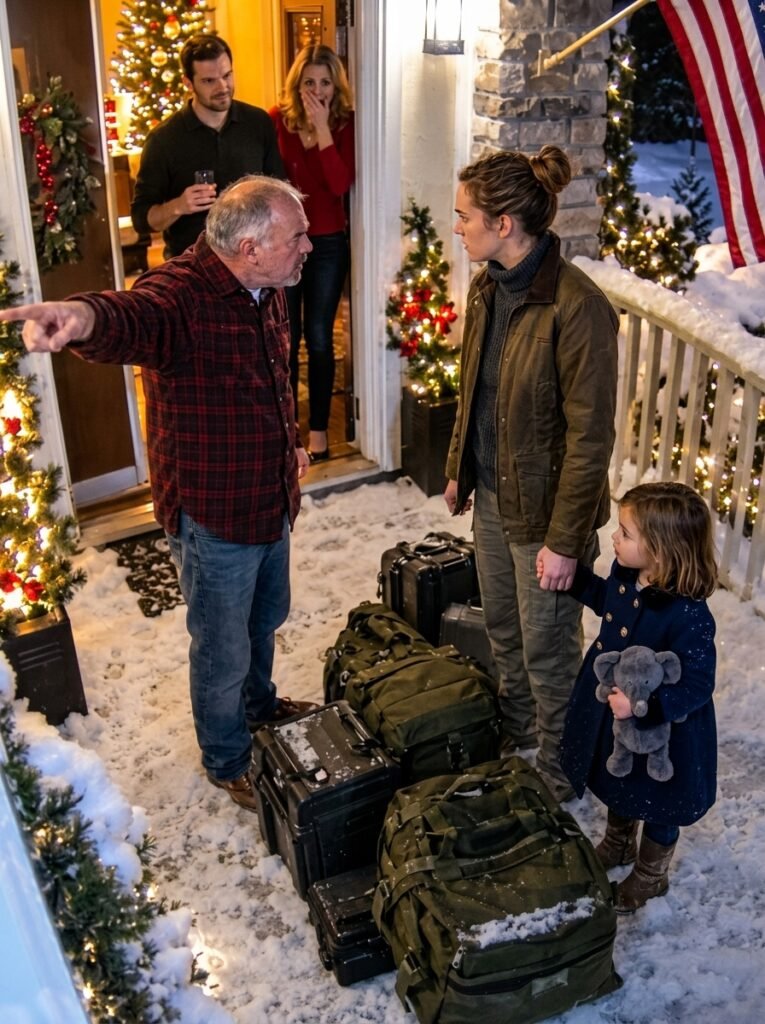
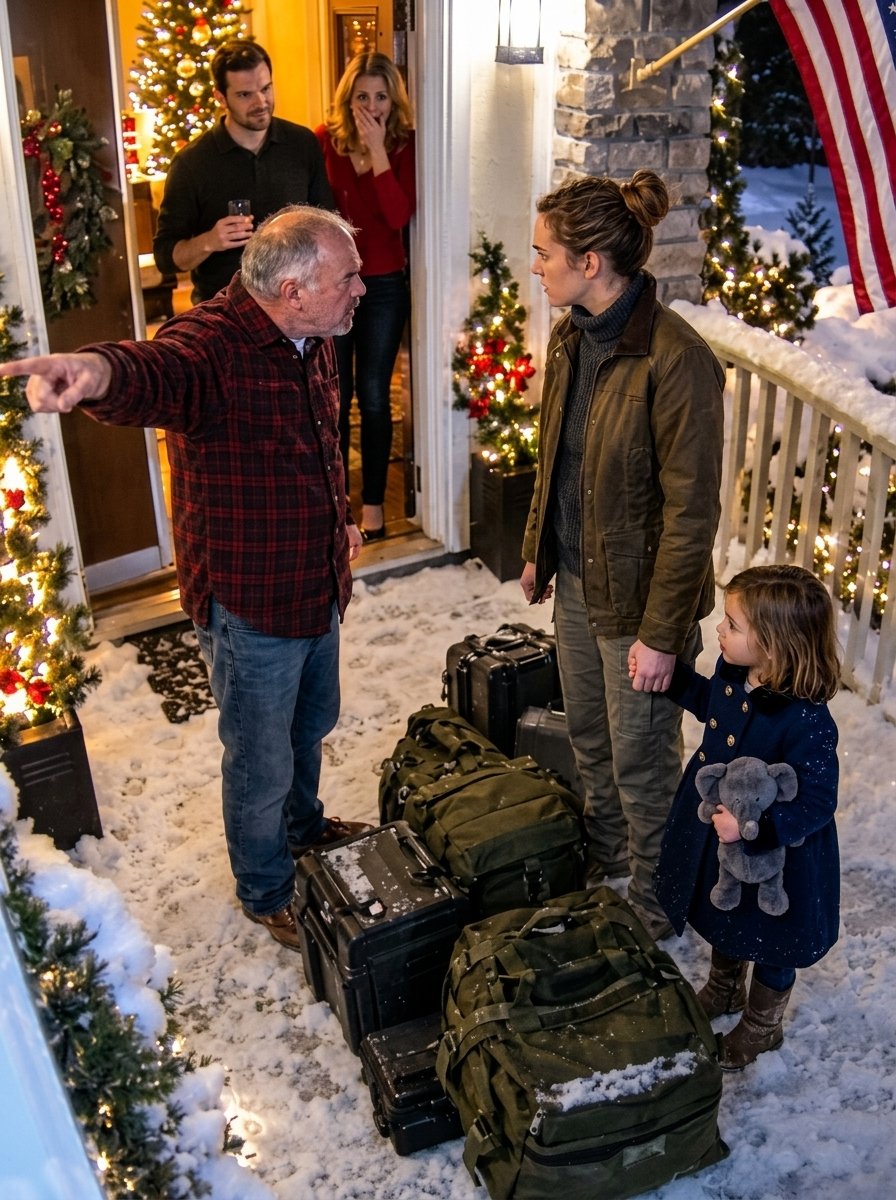
My father walked to the front door, threw it open, and one by one hauled my bags out into the snow-covered yard, tossing them as if they meant nothing—as if eighteen years of service, sacrifice, and showing up for people who never showed up for me weighed less than his pride.
That was when Emma started crying, confused and frightened, asking why Grandpa was so angry.
I didn’t answer her.
I couldn’t. Not without my voice breaking.
I walked outside into the cold, knelt in the snow, and gathered my bags one by one. The wine-soaked duffel felt heaviest of all.
Then I took my daughter’s hand and, without looking back at the house or the family standing frozen in the doorway, I walked us both to the car.
Behind me, the door closed.
Ahead of me, the road was dark, and the snow was falling harder.
I didn’t know yet that in less than twelve hours, the whole country would know my name—and my family would finally understand exactly who they had thrown out into the cold.
The motel sign buzzed pink and blue against the snow, half its letters burned out so that it read only HOTEL VACANCY.
It wasn’t much, but it was warm, and warm was all I needed after the night we’d had.
I checked us into a room at the end of the row, away from the highway noise. Emma sat on the edge of the bed, still wearing her good Christmas dress, her small shoulders shaking with the kind of crying that comes after a child has held it in for too long.
I sat beside her and pulled her into my lap, even though at eight she insisted she was too big for that most days.
Tonight, she let me.
I smoothed her hair back from her face and waited for her breathing to slow before she finally spoke.
“Mom, does Grandpa hate you?”
The question hit somewhere deep, somewhere I usually kept armored.
I thought about lying to her, softening it into something easier to carry. But Emma had grown up around honesty, around briefings and debriefings, and around a mother who told her the truth even when it was hard.
I owed her the same now.
“No, baby. He doesn’t hate me. He’s just angry. And sometimes angry people say and do things that hurt the people they love most.”
I didn’t fully believe my own words, but I needed her to believe them, at least for that night.
She nodded slowly, wiped her nose on her sleeve, and asked if we could still have Christmas, just the two of us.
I told her we would.
I promised her hot chocolate from the vending machine and a movie on the ancient motel television. And for a little while, we found something like peace in that small rented room, wrapped in blankets that smelled like bleach and cheap detergent, the heater rattling in the corner like an old friend.
She fell asleep around nine, curled against my side, one hand still fisted in the fabric of my sleeve as though she was afraid I might disappear, too.
I lay there in the dark for a long time, staring at the water-stained ceiling and running through the night’s events like an after-action report.
I cataloged it clinically, the way I’d been trained to catalog chaos: Jason’s comments, my father’s fury, the wine on my uniform, the snow on my duffel bags.
Because if I let myself feel it instead of file it, I wasn’t sure what would happen.
My phone buzzed against the nightstand at 11:47 p.m.
I almost let it go to voicemail.
I almost told myself that whatever it was could wait until morning, that I had earned one night without duty pulling at me.
But eighteen years of service doesn’t let you ignore a call at that hour.
Not really.
I answered on the second ring, keeping my voice low so I wouldn’t wake Emma.
It was my executive officer, and his voice had the particular tightness that meant something had already gone wrong and was still going wrong.
A National Guard helicopter running a night training exercise near the mountains had gone down in whiteout conditions. Two crew members were confirmed alive but injured. Coordinates were unstable, and the weather was worsening by the hour.
They needed someone experienced in mountain rescue coordination, someone who had run joint operations before, someone who could stand in the middle of chaos and make it make sense.
They needed me.
I didn’t hesitate.
Not because I didn’t feel the pull of the sleeping child beside me, but because I’d built my entire adult life around a simple truth: when people are trapped in the dark and the cold, waiting for someone to come find them, you do not let personal circumstances stand between you and getting to them.
I’d lost Marcus to a mission that went wrong in ways no one could have prevented.
I was not going to lose two more soldiers to a night I could have helped fix.
I woke Emma gently and explained as simply as I could that Mommy had to go help some people who were in trouble, the same way I always had.
She nodded with the strange, practiced maturity of a military kid who understood duty before she understood most things.
I made calls in the parking lot while she got dressed, arranging for her to stay with the Ramirez family, old friends from my previous posting. They were people I trusted with her life without question, people who had taken her in on short notice more than once before.
I drove her there myself through the snow, the roads nearly empty, my headlights the only light for long stretches of highway.
At their door, Emma hugged me tightly around the neck and whispered, “Go help them, Mom. I’ll be okay.”
Something in my chest cracked open at that.
My daughter, eight years old, comforting me on my way out the door to save strangers’ lives.
I changed into a fresh uniform in the car, leaving the wine-stained one behind in the motel room, and drove straight to the staging area, where a task force was already assembling beneath floodlights and falling snow.
No one there knew about the dinner.
No one there knew my father had thrown my bags into a snowbank six hours earlier.
Out there, none of that mattered.
Out there, I was only Lieutenant Colonel Turner, and there were two soldiers on a mountainside who needed someone to bring them home.
I climbed into the command vehicle, pulled up the terrain maps, and got to work.
Whatever my family thought of me, whatever they believed about who I was and what my service meant, none of it changed what I had to do next.
Somewhere on that mountain, in that whiteout, people were waiting.
I wasn’t going to let them wait long.
By four in the morning, the command post was a controlled storm of activity. Radios crackled. Headlamps cut through the dark. Snow chains were fitted onto trucks that would carry rescue teams as far up the mountain as the roads allowed.
I hadn’t slept.
I hadn’t eaten.
I hadn’t thought about anything except grid coordinates, wind speeds, and the two names on the manifest that mattered more than anything else in the world right then.
Corporal Diaz and Specialist Whitfield.
Twenty-three and twenty-six years old.
Both with families waiting beside phones somewhere, just like mine had been hours before.
I’d run enough operations to know the difference between organized chaos and real danger.
This was real danger.
Visibility was under fifty feet in places. Temperatures were dropping into the single digits. The terrain was unforgiving even in daylight, let alone in a whiteout with two injured soldiers unable to move far from the wreckage.
I made the calls that needed making, splitting teams, coordinating with the National Guard aviation unit for a weather window, and maintaining constant contact with Diaz, who was conscious, terrified, and doing an admirable job keeping his voice steady over a radio that kept cutting in and out.
Somewhere around dawn, a local news van appeared at the perimeter of the staging area, drawn by scanner traffic about a downed aircraft.
I barely registered it.
I had a job to do, and reporters were the least of my concerns.
I stood at the hood of the command vehicle in my cold-weather gear, my breath fogging in the air, directing teams up the ridgeline while a cameraman I never even looked at captured every minute of it from a distance.
I didn’t know until much later that the footage had gone out live on the local morning broadcast—a woman in Army fatigues standing calm and unshaken in the middle of a blizzard, calling out coordinates with the kind of authority that made grown men move without question.
I didn’t know that a producer at the affiliate station, hungry for a Christmas morning story with heart, had pulled my name from a public affairs release and put it on-screen in bold white letters.
I didn’t know that within two hours, a national network had picked up the footage because rescue stories on Christmas morning are exactly the kind of thing that makes people stop scrolling and start watching.
I was three hundred yards away, kneeling in the snow beside Specialist Whitfield’s stretcher and checking a splint one of my medics had set when all of that was happening.
I had no idea my face was on television screens across the country.
I had no idea that in a warm, quiet living room decorated with the same ornaments I’d hung as a child, my family was staring at that same screen in stunned silence.
My mother told me later that she’d turned on the news out of habit, some Christmas morning ritual older than any of us, expecting nothing but weather and parade coverage.
Instead, she saw me.
Filthy, frostbitten at the edges, unmistakably in command, my name displayed beneath the footage in letters too large to argue with:
Lieutenant Colonel Abigail Turner, U.S. Army — Leading Rescue Operation.
She said my father set down his coffee cup so hard it cracked the saucer.
Jason apparently said nothing at all for almost a full minute, which, for a man who always had something to say, was its own kind of confession.
My mother told me his exact words once he found his voice again.
“That’s not… that can’t be the same Abby.”
As if the sister he’d mocked at the dinner table the night before couldn’t possibly be the same woman commanding a mountainside rescue on national television.
As if the two versions of me were so incompatible that his mind simply refused to hold them both at once.
I don’t know exactly what passed between my parents and my brother in that living room while I worked.
I can only imagine it—the slow, sick recognition creeping over each of them as the anchor described my service record, my rank, and my role in coordinating what was quickly becoming a successful, high-profile rescue.
I imagine my father’s hands shaking.
I imagine my mother crying, not from pride exactly, not yet, but from the horrifying arithmetic of what they’d done the night before to the woman now being called a hero on national television.
By the time we brought both soldiers down off that mountain alive—hypothermic, injured, but alive—my phone, still sitting untouched in the console of my truck, had already begun filling with missed calls.
I wouldn’t see them for hours.
I was too busy making sure Diaz and Whitfield got into the medevac helicopter, too busy debriefing my team, too busy being exactly who I’d always been, whether anyone in my family had ever bothered to notice or not.
When I finally climbed into the truck as the sun broke weakly over the ridgeline, exhaustion hit me all at once. The adrenaline drained out, leaving something hollow and heavy behind.
I picked up my phone out of habit, more from muscle memory than curiosity.
Forty-three missed calls stared back at me.
Every single one from my family.
I didn’t call back.
Not yet.
I drove instead toward the Ramirez house, toward my daughter, toward the only Christmas morning that actually mattered to me.
Whatever was happening back at my parents’ house, whatever they were feeling now as they watched and realized, none of it changed what they had already done.
It just meant they finally understood who they had done it to.
I picked Emma up from the Ramirez house a little before noon, and the first thing she did was throw her arms around my neck and ask if the people on the mountain were okay.
“Yes,” I told her. “All of them.”
I felt her entire body relax against mine.
She didn’t know yet that the rest of the country had spent the morning watching her mother on television.
Neither did I, not fully.
Not until I finally sat down in my truck, Emma buckled in beside me eating a granola bar, and looked at my phone again.
The missed calls had climbed past fifty by then.
Voicemails I hadn’t listened to.
Texts stacking up faster than I could read them.
My mother’s messages moved from confused to frantic to something close to hysterical, each one timestamped closer to the last.
Abby, call me.
Abby, is that you on the news?
Abby, please. I need to hear your voice.
My father hadn’t texted at all. He wasn’t the type. But he’d called eleven times himself, which told me more than any message could have.
I didn’t answer right away.
Not out of spite, though I understood later why some people assumed that.
I didn’t answer because I was exhausted in a way that went beyond sleep, and because some part of me needed a few more hours where I was simply Emma’s mother, driving toward a diner for pancakes, before I became whatever I was about to become to the rest of my family.
We ate breakfast at a little roadside place that was miraculously open on Christmas Day.
Emma told me about the Ramirez kids, about the puzzle they’d finished at midnight, about how Mrs. Ramirez had let her stay up late because, according to Emma, “Christmas basically has its own midnight celebration anyway.”
I listened, grateful for the ordinary rhythm of her voice, and let my phone sit facedown on the table between us.
It was Emma who finally noticed the television mounted above the counter.
She tugged my sleeve.
“Mom, look. It’s you.”
She said it with the same tone she might have used to point out a cartoon character.
I turned.
There I was, replayed on a loop on the midday news, unmistakable in my gear, my voice audible over the anchor’s commentary as I called out coordinates through the wind.
The caption beneath the footage read:
HERO OFFICER LEADS CHRISTMAS DAY RESCUE.
I felt strange watching myself like that, detached, almost the way you feel reviewing surveillance footage of someone who looks like you but isn’t quite you.
Emma just grinned.
“You look cool, Mom.”
More than anything else that day, that made me laugh for the first time in over twenty-four hours.
Back home, I would learn later, the reaction had taken on a life of its own.
My mother told me the phone in their house hadn’t stopped ringing since nine that morning.
Neighbors. Church friends. My aunt in Ohio. People my parents hadn’t spoken to in years.
All calling to say they’d seen me on the news.
All asking some version of the same question.
“Why didn’t you tell us your daughter was a hero?”
My mother, by her own admission, had no answer for that.
What could she say?
That they had thrown their “hero daughter’s” bags into the snow twelve hours earlier over spilled wine and a jealous son’s wounded pride?
Jason apparently tried, at first, to minimize it.
My mother told me he’d sat on the couch with his arms crossed, muttering that I was probably just doing it for the cameras, that the timing was suspicious, that I’d always had a flair for making myself look good.
But even as he said it, the phone kept ringing and the segments kept airing.
By early afternoon, an official defense briefing had specifically mentioned my unit’s actions in the mountain rescue, praising the coordination and speed that had brought two soldiers home alive on Christmas morning.
There is a particular kind of silence that falls over a room when a lie a family has told itself for years finally becomes impossible to maintain.
My mother described it to me later as the quietest their house had been in decades.
Not peaceful.
Suffocating.
Thick with the specific horror of realizing you have deeply misjudged someone you were supposed to know better than anyone.
My father didn’t say much, according to my mother.
He mostly sat in his recliner, staring at the muted television as it replayed the footage.
I imagine he was hearing every word he’d said to me the night before.
“If you can’t respect your brother in this house, then take your daughter and go.”
Those words must have sounded very different to him in the light of what the rest of the country now knew about the daughter he’d thrown out into the snow.
By evening, my mother said even the pastor from their church had called, asking if the family wanted to be recognized during the Christmas service for having such a distinguished officer among them.
My father took that call standing in the kitchen.
When he hung up, he didn’t say a word.
He simply sat down at the table and put his head in his hands.
I still hadn’t called back.
I was driving with Emma, the radio playing quietly, my daughter humming off-key to a song she barely knew.
For those few hours, I let myself have that instead.
An ordinary drive.
An ordinary daughter.
An ordinary kind of peace my family had never once seemed to value in me.
They would have to sit with what they’d done a little while longer.
I wasn’t ready to make it easier for them yet.
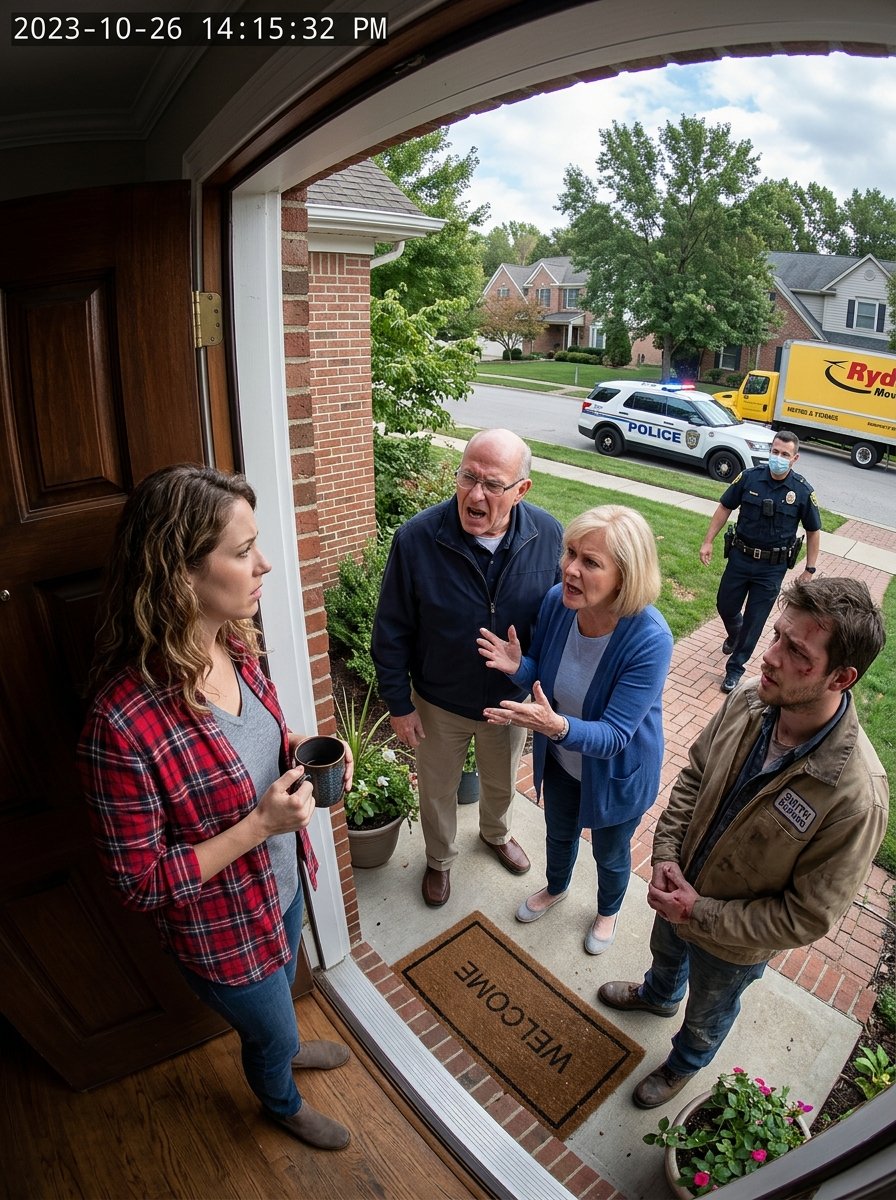
Three days after Christmas, while I was still finishing after-action reports at base and slowly working my way through the missed calls I could finally stomach returning, a man named Walter Hensley knocked on my parents’ front door.
He introduced himself as an estate and trust attorney, set a slim leather briefcase on their kitchen table, and asked if they had a few minutes.
My mother assumed at first that it had something to do with my father’s aging parents, some overlooked paperwork from years back.
She had no idea it was about me.
I hadn’t planned for it to come out this way.
Truthfully, I hadn’t planned for it to come out at all.
Not like this.
Not with an attorney and a folder of documents laid out across the same table where I’d eaten dinner as a child.
But eight years earlier, after Marcus died and the life insurance settlement came through, I had made a decision I never told anyone about.
Not even my parents.
Especially not my parents.
I set up a trust quietly and deliberately, structured so that certain bills got paid without anyone ever needing to know where the money came from.
Walter had been managing that trust since the beginning.
Under the terms I’d established, there was a clause requiring notification to beneficiaries in the event of my death, incapacitation, or at my explicit request.
He was there that day because I’d asked him to be.
I made the request the morning after the rescue, in a five-minute phone call from the command post before I had even changed out of my snow gear.
I hadn’t done it out of anger.
I want to be clear about that, even now.
I did it because something in me had finally run out of patience for being invisible in my own family’s eyes.
My mother told me later, her voice still unsteady weeks afterward, that Walter opened the folder and began reading through eight years of transactions.
Calmly.
Methodically.
The way attorneys do when they know the content itself will do all the emotional work for them.
The homeowner’s insurance on my parents’ house had been paid annually without fail since the year after Marcus’s funeral, back when my father’s small business had gone under and they had nearly lost the place.
Then there were my father’s medical bills after his heart attack four years earlier, the ones my mother had always assumed were covered by his insurance, when in reality nearly forty percent of the balance had been quietly absorbed by the trust.
There was the private-school tuition for both of Jason’s children, paid every semester for the past five years and arranged so the checks came from an educational fund bearing no name anyone in the family recognized.
And perhaps most damning of all, there was a personal loan Jason had taken out three years earlier against a promise to repay it within a year.
A loan he never repaid.
A loan he never once mentioned to our parents.
A loan whose interest I had quietly been covering ever since so his credit wouldn’t collapse and drag the rest of the family into another crisis.
Walter read every line.
My mother said she stopped breathing somewhere around the tuition payments.
My father, she said, put both hands flat on the table as if he needed something solid to hold on to.
“Colonel Turner asked that this remain confidential,” Walter told them as he closed the folder. “She didn’t want gratitude. She wanted the people she loved to be taken care of without conditions attached.”
He paused before adding, more quietly, “She was very specific about that phrase. No conditions.”
My mother asked him, her voice barely above a whisper, “Why now? Why reveal it now, after everything?”
Walter’s answer, as she repeated it to me, has stayed with me ever since.
“She didn’t ask me to reveal it to hurt anyone. She asked me to bring it forward because she said—and I’m quoting her directly—that she was tired of being loved conditionally by people she had never once loved with conditions of her own.”
Jason, my mother said, sat frozen through the entire reading.
He didn’t interrupt.
He didn’t offer his usual commentary.
When Walter finally packed his briefcase and left, Jason remained at the table long after our parents had gotten up, staring at nothing.
Running through, I imagine, every insult he had ever thrown at me over the years.
Every “playing soldier” comment.
Every implication that I contributed nothing real to this family while he sat unemployed in the house I was quietly helping keep afloat.
I wasn’t there for any of it.
I heard the story secondhand, pieced together from my mother’s shaking voice on the phone and Walter’s brief professional summary afterward.
But I could picture it easily enough.
The kitchen where I’d once believed, foolishly, that presence and sacrifice would eventually be enough to earn plain respect.
I didn’t do any of it for a reckoning.
I did it because it was right at the time—to protect people I loved, even when they made it difficult to love them back.
But now they knew.
And knowing changes things.
It always does.
The real conversation, the one that mattered, was still ahead of us.
I agreed to see them during the second week of January, once my leave was formally extended and the mountain rescue paperwork had finally cleared my desk.
I chose neutral ground: a quiet conference room at the base’s family services building.
Not their house.
Not mine.
Nowhere either of us could claim as home turf.
I brought Emma to a friend’s house for the afternoon. This wasn’t a conversation for an eight-year-old to sit through.
My mother arrived first, her eyes red-rimmed in a way that told me she had been crying on and off for days.
My father came in behind her, looking somehow older than he had two weeks earlier, his shoulders carrying a weight I didn’t remember seeing on him before.
Jason came last.
Even before he sat down, I could read his posture—arms crossed, jaw set, a man bracing for an argument rather than walking in ready for an honest conversation.
My mother spoke first.
The words tumbled out quickly, half apology and half disbelief.
She said she hadn’t slept properly since Christmas. She said she kept replaying that dinner in her head, wondering how they hadn’t known, how they had let it go on as long as it had.
My father said less, but what he did say landed heavier.
It was a quiet, broken admission that he had spent thirty years measuring my worth by a yardstick that had never once applied to me—and that the yardstick had been wrong from the beginning.
I listened to both of them without interrupting.
I’d had two weeks to prepare for that moment, and I wasn’t interested in scoring points off my parents’ genuine grief.
Then Jason spoke.
Everything in the room shifted.
“So what? You did all this just to make us feel guilty?”
His voice carried the same practiced condescension I’d been hearing my entire life. Only now it sounded thinner, more desperate, like a man trying to hold on to a version of events that had already collapsed around him.
“Eight years of secret payments, and now suddenly it all comes out right after Dad throws you out. Convenient timing, Abby.”
I felt my mother flinch beside him.
My father said nothing, staring down at his hands.
I didn’t raise my voice.
I had learned a long time ago that volume was rarely the most effective weapon in a room like that.
Instead, I reached into my bag and set a thick folder on the table between us.
Bank statements.
Insurance records.
Tuition receipts.
Loan documentation.
Eight years of quiet, unglamorous proof laid out in black and white.
“This isn’t about guilt, Jason,” I said. “This is what actually happened, in case you’d rather argue with paper than with me.”
I slid the folder toward him.
“Every payment is dated. Every bill is itemized. None of it was timed around Christmas. None of it was timed around anything except when the bills came due.”
He didn’t open it.
He just stared at it as if it might bite him.
I kept going because he needed to hear all of it, not just the parts that were comfortable.
I told him about the loan.
His loan.
The one he had taken out three years earlier, promising repayment within twelve months.
The one he had never once mentioned to our parents.
The one I had been quietly covering the interest on so it wouldn’t destroy his credit and, by extension, become another crisis our parents had to absorb.
I watched something in his face crack slightly as I said it aloud.
It was the specific shame of hearing your secrets recited back to you by someone you had spent years underestimating.
“I did all of this,” I said, “not because I wanted credit. Not because I wanted anyone to owe me anything. I did it because that’s what family is supposed to mean. You take care of the people you love, especially when they don’t know they need it, and you don’t hold it over their heads.”
I paused and let that settle before continuing.
“But apparently, in this family, love only flows one direction. You can mock what I do for eighteen years. You can call it playing soldier. You can accuse me of abandoning my daughter for serving my country. And the moment the whole country sees me differently, suddenly I’m the villain for not telling you I was quietly helping keep this family financially afloat the entire time.”
My mother started crying again, softer this time, more resigned.
My father finally looked up and met my eyes.
For the first time in longer than I could remember, I saw something in his expression that wasn’t disappointment.
It looked instead like shame.
Real shame.
The kind that doesn’t come from getting caught, but from finally understanding what you’ve actually done.
“This is the last time,” I told them, my voice steady even as the words cost me something to say. “The trust ends today. I’m canceling the insurance payments, the tuition fund, and Jason’s loan support. Not out of spite. Because I need my family to build something real on your own instead of something propped up by a daughter you were embarrassed to claim.”
Jason’s face went pale in a way I hadn’t expected.
Whatever bravado he had walked in with evaporated completely, replaced by something closer to panic.
It was the look of a man realizing for the first time exactly how much of his life had been quietly held together by someone he had spent years tearing down.
I stood, gathered my folder, and left the room before anyone could respond.
Some conversations end better in silence than in argument.
That was one of them.
The weeks after the family meeting unfolded exactly the way I had expected them to, which is to say painfully and without any of the drama Jason had probably imagined I wanted.
I didn’t call to check on anyone.
I didn’t send updates.
I simply lived my life, returned to my post, picked Emma up from school, and let the silence do what silence does best: reveal exactly what had been holding a family together.
Jason lost his car within six weeks.
Without the quiet interest payments I had been covering, his loan ballooned past what he could manage, and the bank came calling in ways that couldn’t be ignored or explained away with charm.
My mother told me about it in a voice that had lost its usual defensiveness on his behalf.
She wasn’t gloating.
She just sounded tired, like a woman finally seeing her son clearly after years of choosing not to.
He moved into a small apartment across town, the kind of place he used to make jokes about, the kind of place that had always been beneath the version of himself he performed at every family dinner.
He didn’t call me.
I didn’t expect him to.
Some people need to hit the floor before they understand there was ever a ceiling holding them up.
My mother called often during those first few months, her voice threading between apology and quiet desperation.
She asked more than once if I would consider coming back, not just to visit, but to let things go back to how they were.
I understood what she meant, even if she never said it directly.
Back to a version of family where I quietly gave and no one quietly noticed.
I told her gently but firmly that I loved her, and that love didn’t mean pretending the previous eighteen years hadn’t happened.
It was my father who surprised me most.
Three months after the family meeting, he showed up unannounced at my house on a Saturday afternoon.
He stood on my porch in his good coat, his hands shoved deep into his pockets as if he wasn’t sure they belonged to him.
He didn’t ask to see me first.
He asked if he could see Emma.
I let him in.
I watched from the kitchen doorway as he knelt in my living room at eye level with his granddaughter and said words I never thought I would hear from him.
He told her he was sorry.
He told her he had been wrong.
He told her the woman on television that Christmas morning was the same woman he should have been proud of every single day before that, not just the day the whole country told him to be.
Emma, with the easy forgiveness of an eight-year-old, hugged him without hesitation.
I watched my father cry for the first time in my adult life, his shoulders shaking silently over my daughter’s small frame.
Something in my own chest loosened, something I hadn’t realized I had been holding so tightly for so long.
I forgave him.
Not instantly.
And not because his apology erased years of feeling like the least important child in that house.
I forgave him because carrying that particular weight forever wasn’t a punishment for him.
It was one for me.
I had spent enough of my life carrying things that weren’t mine to carry.
But forgiveness, I’ve learned, doesn’t require reconstruction.
It doesn’t mean handing someone the keys to hurt you the same way twice.
I bought a house that spring, small and simple, with a yard big enough for Emma to build snowmen in the following winter.
I invited my parents to visit whenever they wanted.
They came carefully at first, then more naturally as the visits stopped feeling like negotiations and started feeling like what they should have been all along.
My father learned to ask about my work instead of dismissing it.
My mother learned to simply listen.
It wasn’t perfect.
It never will be.
But it was honest.
And honest was more than I’d had in years.
Jason and I never fully repaired things, not in the way people hope for in stories like this.
He reached out once months later.
It wasn’t quite an apology, more an acknowledgment that he had been wrong about a lot of things.
I accepted it for what it was.
I didn’t reopen the trust.
Some doors, once closed, are meant to stay that way—not out of anger, but out of self-respect.
The following Christmas, our tree stood in the corner of my new living room, its lights catching in Emma’s eyes as she hung the last ornament near the top.
At one point, she turned toward me, thoughtful in the way children get when they’re working through something bigger than they usually say aloud.
“Mom,” she asked, “are you still mad at Grandpa?”
I thought about how to answer that honestly.
“No, baby. I’m not mad at him anymore.”
I knelt beside her and adjusted an ornament she had hung slightly crooked.
“But forgiving someone doesn’t mean going back to a place where they can hurt you the same way again. It just means you stop letting the hurt control you.”
She nodded slowly, the way she does when something settles into her the right way, then turned back toward the tree, humming softly to herself.
Outside, snow drifted quietly past the window, the kind of soft, steady snow that doesn’t threaten anything, that simply makes the world feel a little more still.
For the first time in longer than I could remember, our home felt entirely, peacefully ours.
If this story moved you, I’d love to know where it found you tonight. Leave a comment below and let me know.
Stories like Abigail’s remind us that quiet strength often speaks louder than any argument ever could, and that real family isn’t about who raises their voice the loudest, but who shows up again and again without needing to be asked.
We share stories like this every single day, so if it touched something in you, consider subscribing so you never miss the next one.
Thank you for walking this journey with us.