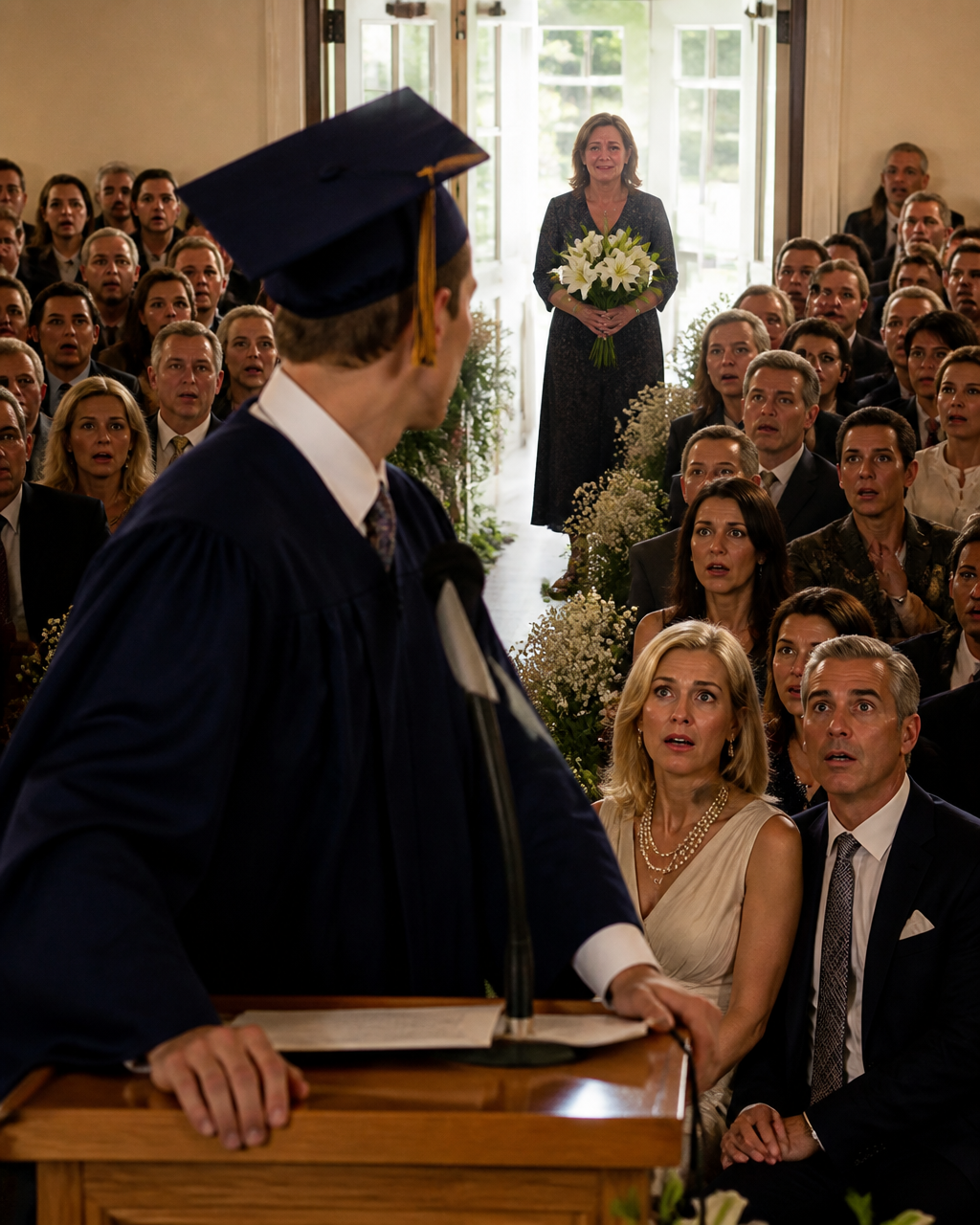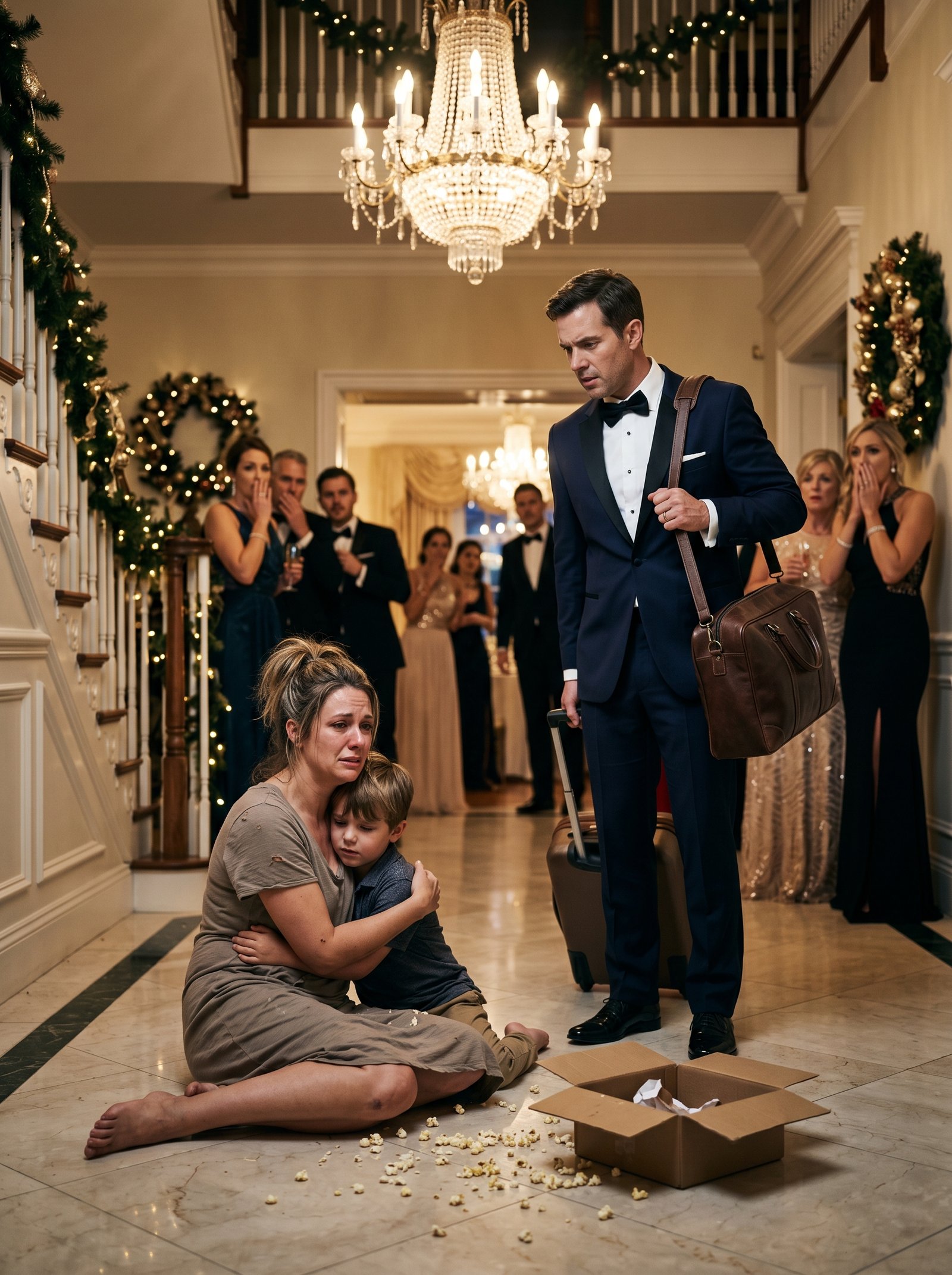
My thirteen-year-old son sold his prized electric guitar to buy a specialized wheelchair for a girl in his class. Early the next morning, two armed police officers showed up at our front door. What they told me was that the chair Julian had bought for Maya had been reported stolen.
The guitar had been a custom Fender Stratocaster, the most expensive gift Julian’s father and I had ever saved up to buy him. He treated it carefully and practiced every day after school. I knew the sound of it from the far end of the house, even when I was sorting the laundry or trying to finish something else.
So when I walked into his room with a basket of folded clothes and saw the stand empty, I knew it wasn’t where it was supposed to be. I checked under the bed, looked in the closet, and went back out into the hall. It wasn’t anywhere in the house.
Julian came in through the back door a few minutes later. I asked him directly.
“Honey, where’s your Fender?”
He kept his eyes on his sneakers. “I sold it, Mom.”
I set the basket down. “You what? Julian, why would you do that?”
He swallowed and looked up at me. His eyes were glassy. “Because Maya needed a new wheelchair.”
I knew Maya from school drop-offs. She was a sweet girl in Julian’s eighth-grade class, and she had been paralyzed from the waist down since elementary school.
I didn’t know how bad her chair had become until Julian told me.
“It’s old,” he said. “The front wheels keep jamming, and the seat’s torn. She gets stuck in the hallway.”
“How long has that been happening?”
“I don’t know. A while.” He rubbed his sleeve over his face. “She missed lunch twice last week. It took forever to get across the building.”
He told me some kids had started making snickering remarks about her. He didn’t repeat what they had said, and I didn’t ask him to. He was watching my face, waiting to see whether I would be angry about the guitar.
“Her family is drowning in medical bills, Mom,” he said. “They can’t afford another chair. I had the money sitting right there.”
“What did you buy?”
“A light-frame motorized one. I found somebody selling it. It’s new. I thought it would work for her.”
I was caught between the fact that he had sold something precious without talking to us and the reason he had done it. I pulled him into a hug. I was proud of him. I was also worried he had taken on a problem he didn’t understand.
“Did Maya’s family know you were doing this?”
He hesitated. “I told Maya.”
“That isn’t what I asked.”
“They’ll know when I bring it.”
I should have stayed with that answer. Instead, I told myself a thirteen-year-old had done a remarkable thing and that the rest could be sorted out afterward. I was relieved not to be angry with him. I was relieved enough not to ask more.
The wheelchair was in our entryway, where Julian had left it. He said he had picked it up the day before. He had paid for it with the money from the guitar and planned to take it to Maya. I assumed he had found a proper seller. I didn’t ask for a receipt, or how he had found the chair, or why it had been available to a boy his age.
At seven the next morning, pounding on the front door brought us both into the entryway. Two uniformed city police officers stood outside. Their sidearms were visible. The lead officer glanced at his notepad.
“Ma’am, are you Sarah Vance?”
“Yes,” I said. My voice shook.
Julian had stepped in behind me. When he saw the badges, his face changed. I reached back and took his hand.
“Ma’am, we need you and your son to step outside right now,” the officer said.
“What’s going on? What did my boy do?”
The officer looked at Julian, then back at me. “I don’t think your son gave you the full picture about yesterday.”
“What are you talking about?”
“The wheelchair,” he said. “It was reported stolen from a medical equipment supplier. We’re trying to establish how it got to your home.”
Julian’s fingers tightened around mine. I turned toward him, but he was staring at the floor.
“Is he in trouble?” I asked.
“We need to speak with him about the purchase,” the officer said. “We’re not asking you to guess for him.”
The second officer stayed near the door while the first explained that they had traced the chair to the person who bought it.
He asked whether they could look at it. I said yes, though I still didn’t understand how a chair Julian had paid for could be stolen.
“What did you tell them when you bought it?” I asked him.
Julian’s mouth opened, but no sound came out.
“Please answer her,” the officer said, not sharply.
“He said it was from a clinic that had closed,” Julian said.
“Who said that?”
“The man selling it.”
“Did you know the man?”
“No.”
“Did you ask where it came from?”
Julian shook his head.
I looked at the officer. “He’s thirteen. He thought he was buying a chair for his classmate.”
“I understand,” he said. “We still need to document what happened and recover the equipment.”
The chair had a mark on its frame that matched the description the officers had. They told us it had been reported stolen, and they took it with them. There was no shouting and no dramatic accusation. That didn’t make the morning easier. I watched the chair leave the entryway and saw Julian’s face as the officers carried it out.
After they left, he stood where the chair had been.
“Is Maya going to think I lied?” he asked.
I wanted to tell him she wouldn’t. I didn’t know that. I also wanted to say he’d done nothing wrong, but the story he had given the seller and the story he had given me were both missing something.
“You did lie to me,” I said. “You left out how you found it.”
“I didn’t know it was stolen.”
“I believe you didn’t know that. But you didn’t know it was safe, either.”
“I just wanted to help her.”
“I know. You still had to tell us the truth.”
He looked down. “I thought you’d stop me.”
That was the sentence I could not answer quickly. I probably would have stopped him from handing over all the money he had for a chair from a stranger. He had guessed that. He had decided his good reason mattered more than our permission.
“I might have,” I said. “And you should have let me.”
He went quiet, then asked if we could tell Maya before she heard anything from someone else. I said yes. We called her family, and I asked if we could come over. I explained that the chair had been recovered by police because it had been reported stolen. I told them Julian had paid for it believing the seller’s explanation, and that I was sorry I hadn’t checked where it came from before letting him bring it to them.
Maya’s mother listened without interrupting. When I finished, she said, “We thought he’d found a way to help. We didn’t know where the chair came from.”
“I should have asked,” I said.
Maya was there. She looked at Julian, not at me.
“You told me it was yours to give,” she said.
“I thought it was,” he replied. “I’m sorry. I should’ve checked.”
“You said it would be new.”
“It was new,” he said, then stopped. “But I didn’t know if it was really his to sell.”
Maya’s mother put a hand on her daughter’s shoulder. “We can’t keep something that might belong to somebody else.”
“I know,” Julian said.
Maya didn’t tell him it was fine. She didn’t have to. The old chair was still a problem. Her family was still trying to manage the costs of her care, and a stolen chair was not a solution they could accept. Julian had expected his decision to end with Maya having something better. Instead, she had to give it up, and he had to stand there while she was disappointed.
On the way home, Julian asked if the police thought he had stolen it.
“They know what you told them,” I said. “And they know you bought it. You need to tell the truth if they ask you anything else.”
“I will.”
“Even if it makes you look bad?”
He stared out the window. “Yes.”
For a while, I didn’t speak. I was still proud that he had noticed what other kids were making jokes about and wanted to help. I was also angry that he’d trusted an unknown seller because the story sounded convenient. Those things sat together. I didn’t want him to learn that kindness meant ignoring every warning, or that I would praise him so much for having a good heart that I stopped asking what he had done.
The officers spoke with him again so they could understand how the purchase had happened. I stayed with him, but I let him answer. He told them what the seller had said and admitted he hadn’t asked for anything to prove where the chair came from. The officers explained that they were still dealing with the reported theft. They didn’t tell us the chair could be returned to Maya, and they didn’t offer a substitute. Their job that morning was to recover the equipment and record how it had changed hands.
Afterward, Julian said, “I should’ve told you before I sold the guitar.”
“Yes.”
“I thought if I waited, I could just show you the chair.”
“I know.”
“I didn’t want you to say no.”
“I might have said no to that seller,” I told him. “I wouldn’t have said no to helping Maya.”
He looked at me then. “You would’ve helped?”
“I would have listened. We could have talked to her family together. You don’t have to do everything alone just because something is wrong.”
He nodded. He didn’t apologize again, and I didn’t ask him to. He had already said it to Maya. What mattered now was whether he understood the difference between helping someone and deciding, by himself, that the first opportunity was safe enough.
Maya’s family and I spoke again after the police had taken the chair. They were not ready to accept another offer from a stranger, and I couldn’t blame them. We agreed to talk with the school about the trouble Maya was having with her existing chair and the comments from other students. I didn’t promise that a replacement would appear. I could promise to help ask for support and to make sure the problem wasn’t treated as something Maya had to quietly put up with.
Julian came with me when we spoke to the school. He listened while I explained what he had told me: the wheels jammed, the seat was tearing, and Maya had been delayed in the hallway. He added that some students had been making remarks. He didn’t name anyone or embellish it. He just described what he had seen.
Maya’s family handled the decisions about her chair. The school addressed the students’ behavior and helped the family look at legitimate ways to get her equipment repaired or replaced. It took longer than Julian had hoped. There was no single quick answer, and we did not pretend there was.
The guitar was gone. The money from its sale had gone to the seller, and the chair had been taken away as stolen property. Julian had given up something he loved and still had to face that his choice had put Maya and her family in a difficult position. I hated that for him. I also knew I couldn’t make the consequences disappear just because his intention had been kind.
We kept talking about it in plain terms. If he wanted to help someone, he could come to us first. If an adult offered him something expensive with a story he couldn’t check, he should walk away and ask for help. Julian didn’t argue. He knew he had skipped those steps because he was afraid we’d slow him down.
Maya’s family eventually found a legitimate way forward with the school’s help. Her needs were not solved by Julian’s guitar, and they were not solved overnight. What changed was that the adults knew how serious the trouble with her chair had become, and her family was no longer left to manage it without support.
Julian still missed his guitar. He had sold it because he wanted Maya to have something better, and there was no getting that exact choice back. He told her the truth. He told the police the truth. He told me why he had hidden the details.
I was proud of his kindness. I was not proud of the way he handled it. Both were true.