The door handle rattled hard, then Julian’s fist hit the wood.
“Mom, open this door right now.” His voice had lost all its practiced calm from the past few months, the calm that had trained me to believe I was the unreasonable one. “You don’t understand what’s happening. Chloe is very sick, she needs to be handled carefully—”
“She needs a hospital,” I said through the door, keeping my voice as steady as I could while Chloe trembled against my chest. “She’s alive, Julian. I know she’s alive.”
Silence on the other side, just long enough to tell me everything.
“Mom, please,” he said, quieter now, almost pleading. “Just let me explain. It’s not what it looks like.”
“Then explain it to the paramedics,” I said. “They’re already on their way.”
I heard him step back from the door, and then Victoria’s voice joined his, low and urgent, the two of them arguing in hushed, frantic tones I couldn’t fully make out. A moment later, something heavy scraped against the hallway floor, furniture, maybe, being dragged toward the laundry room door.
“Grandma,” Chloe whispered, her small hand fisting in the fabric of my shawl. “Are they going to put me back?”
“No, sweetheart,” I said, pressing my lips to her feverish forehead. “No one is putting you anywhere. I promise you that.”
I kept the dispatcher on the line, describing the situation in short, clipped sentences while Chloe’s breathing rattled weakly against my collarbone, too shallow, too slow, in a way that made every instinct in my body scream to get her outside, into fresh air, away from whatever chemical fog seemed to be clouding her small mind.
“Ma’am, officers are two minutes out,” the dispatcher said. “Stay on the line. Do not open that door until they arrive unless you feel your safety is at immediate risk.”
Outside the laundry room, the arguing stopped abruptly. Then Julian’s voice came again, closer to the door now, quieter, almost broken.
“Mom, you don’t know what we’ve been dealing with. The costs. The specialists. Nobody would help us anymore. We didn’t have a choice.”
I closed my eyes, holding my granddaughter tighter, trying to make sense of words that explained nothing and excused less.
“There’s always a choice, Julian,” I said. “You just made the wrong one, over and over, for months, while I sat in your living room being told I didn’t understand.”
Red and blue light finally swept across the small laundry room window, flickering through the blinds, and I heard car doors, radios crackling, footsteps moving fast up the front walk.
“Police! Open the door!”
The commotion in the hallway shifted immediately, Julian’s voice rising in protest, Victoria’s dissolving into something closer to panic, and then the pounding on the laundry room door stopped as the officers’ attention pulled toward the front of the house instead.
I unlocked the door myself the moment I heard a female officer identify herself through the wood, stepping out with Chloe wrapped tightly in my arms, her small body shaking, her breathing faint but present, undeniably, miraculously present.
The officer’s face changed the instant she saw us.
“Get EMS in here now,” she said into her radio, already reaching for Chloe. “We have a live child.”
The paramedics moved fast, easing Chloe from my arms onto a gurney in the hallway, checking her pupils, her pulse, sliding an oxygen mask gently over her small face while she whimpered and reached for me.
“Stay close,” one of them told me. “She’s responding better with you near her.”
I walked beside the gurney, holding her hand, while behind us I heard the officers separating Julian and Victoria into different rooms, their voices no longer arguing with each other but instead giving clipped, defensive answers to questions I couldn’t fully hear.
“Grandma,” Chloe murmured from behind the mask, her eyes struggling to stay open. “Am I in trouble?”
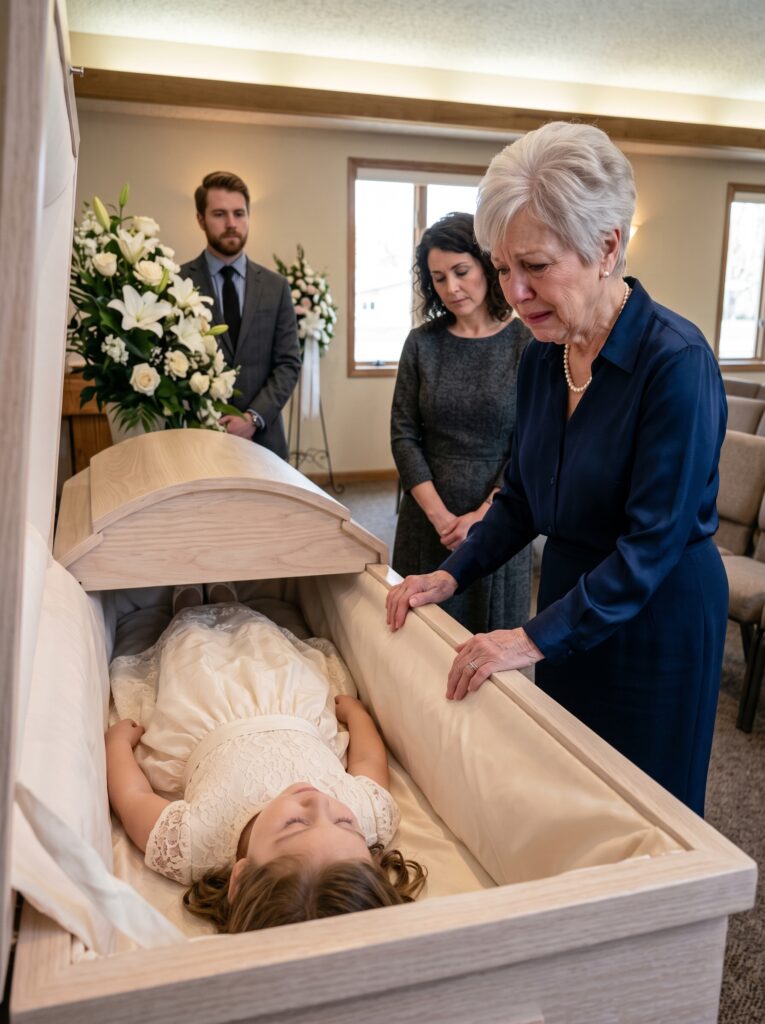
“No, baby,” I said, my voice breaking for the first time since I’d opened that casket. “You did nothing wrong. Nothing at all.”
At the hospital, doctors worked quickly once they heard the details relayed by EMS, running bloodwork, checking her vitals, treating her for dehydration and fever. Within an hour, toxicology results confirmed what I’d already feared, a sedative in her system, at a level far beyond anything appropriate for a six-year-old, consistent with repeated dosing rather than a single incident.
A detective named Officer Reyes found me in the family waiting area a few hours later, notebook in hand, her expression careful but direct.
“Mrs. Whitfield, I need to ask you some questions about the last few months. Anything unusual you noticed, any pattern in how Chloe was being cared for.”
I told her everything. The excuses. The doctor visits I was never allowed to attend. The days Chloe was suddenly “sleeping” whenever I stopped by unannounced. The steady stream of remarks about “boundaries” and “respecting their choices” that had made me feel, at every turn, like the difficult one for asking too many questions.
“We’re going to need all of that in a formal statement,” Reyes said. “It’s going to matter. Especially since your son and daughter-in-law are currently telling us Chloe has a rare, undiagnosed illness that made all of this necessary, that they were trying to ‘manage her condition privately.'”
“There’s no illness,” I said. “I raised Julian. I know what desperation for money looks like on him, and I know what performing grief looks like too. Whatever this is, it’s not about a diagnosis.”
Reyes’s investigation moved quickly from there. A search of Julian and Victoria’s home uncovered pharmacy records for medication never prescribed to Chloe, along with messages between the two of them discussing a substantial life insurance policy taken out on her just eight months earlier, one that would have paid out significantly upon her documented death.
The funeral director who’d prepared Chloe’s “body” was brought in for questioning as well, and it quickly became clear he’d been deceived just as thoroughly as the rest of us, given falsified paperwork from a private physician Julian had paid to sign off on a cause of death without ever actually examining the child in person.
“This wasn’t panic,” Reyes told me during a follow-up conversation two days later, once Chloe was finally stable enough for me to sit beside her hospital bed without a monitor beeping every few minutes. “This was planned. Meticulously. The casket modifications, the sedation schedule, the insurance policy, the fake medical documentation. It all points to intent, not desperation.”
I sat there holding Chloe’s small hand while she slept, finally in a real, dreamless sleep instead of whatever chemical fog they’d kept her under for months, and thought about every moment over the past year I had doubted myself for worrying.
I hadn’t been the difficult mother-in-law.
I had been the only one who never stopped asking questions.
The case against Julian and Victoria moved through the courts over the following year, and what began as a horrifying discovery in a living room outside Chicago became, eventually, a story about accountability catching up to two people who had planned very carefully and still hadn’t planned carefully enough.
The evidence was overwhelming by the time it reached trial. The falsified death certificate, signed by a physician who was later stripped of his medical license and separately charged with fraud. The pharmacy records showing months of unauthorized sedative doses. The insurance policy, applied for quietly, with a payout structured to activate the moment Chloe’s death was formally recorded. And beneath it all, the modified casket itself, retrofitted with restraints and an air source disguised within the padded lining, entered into evidence as proof this had never been panic or poor judgment, but calculated intent.
Julian tried, on the stand, to frame it as a plan gone wrong, insisting they meant to “revive her privately” once the insurance settled and their debts were cleared, as if that distinction made any difference to the six-year-old who had spent months believing that waking up would “ruin everything.”
The jury didn’t see a difference either. Both Julian and Victoria were convicted, Julian on multiple counts including child endangerment, fraud, and conspiracy, Victoria on similarly severe charges reflecting her role in planning and executing the scheme alongside him. Neither would be returning to any home Chloe might one day call hers.
I was granted emergency custody the week Chloe was released from the hospital, and full legal guardianship was finalized eight months later, once the criminal proceedings no longer stood in the way.
Chloe’s recovery wasn’t instant. There were nights she woke up gasping, certain she was back in the dark, certain the quiet meant something was wrong instead of something being safe. A child psychologist worked with her twice a week for the first year, slowly helping her separate stillness from danger, quiet from punishment, sleep from the thing she’d been taught to fear.
I moved us into a small house with big windows and a garden out back, nothing that echoed the house outside Chicago in any way, and I made sure every door in it opened easily, every room stayed bright, and every promise I made to her, I kept, without exception.
On the first anniversary of the night I lifted that casket lid, Chloe and I planted a small tree in the backyard together, her hands covered in dirt, her laugh finally sounding like the laugh I remembered from before everything went quiet in that house.
“What kind of tree is it, Grandma?” she asked, patting the soil down around its roots.
“It’s called a redbud,” I told her. “It blooms every spring, even after a hard winter.”
She thought about that for a moment, the way six-year-olds do when they’re turning something over that feels bigger than they can quite name yet.
“Like me,” she finally said.
“Exactly like you,” I said, pulling her into a hug.
I never stopped asking questions after that night, not about anything, not about anyone. I learned the hard way that the cost of staying quiet to keep the peace can be far higher than anyone imagines, and that sometimes the person everyone calls difficult is simply the only one still paying attention.
Chloe is eight now. She still gets nervous around closed doors, still sleeps with a small nightlight shaped like a star, but she laughs more than she used to, runs faster than she used to, and every spring, she checks the redbud tree in our backyard for the first blooms, proof, she says, that hard winters do eventually end.