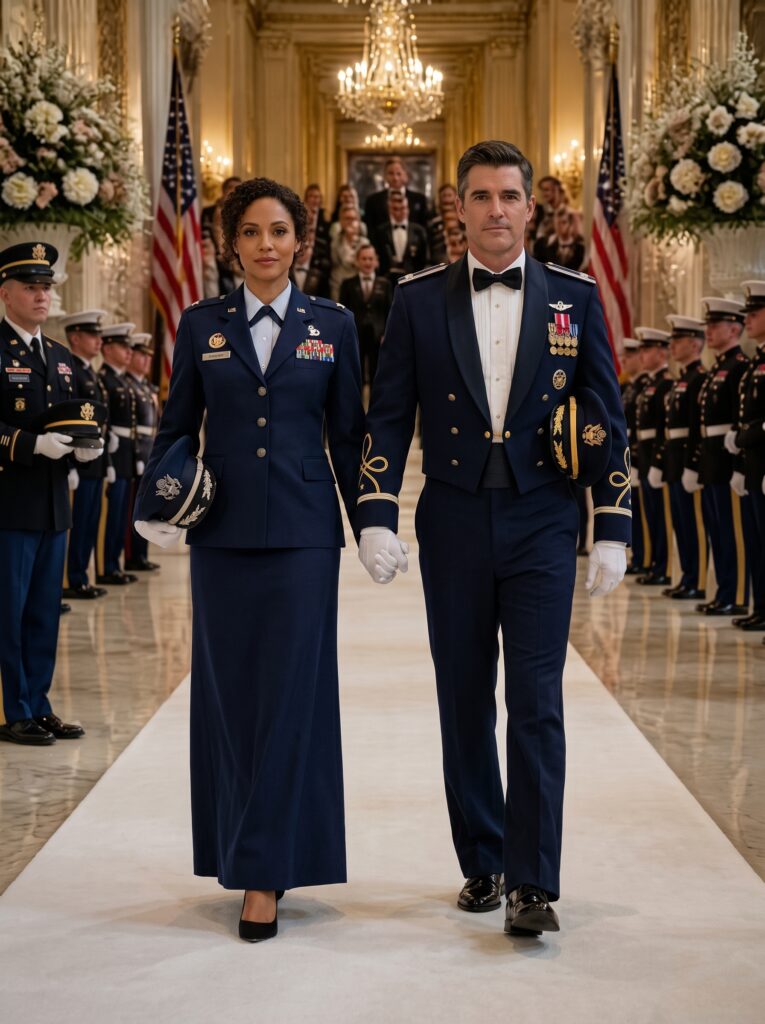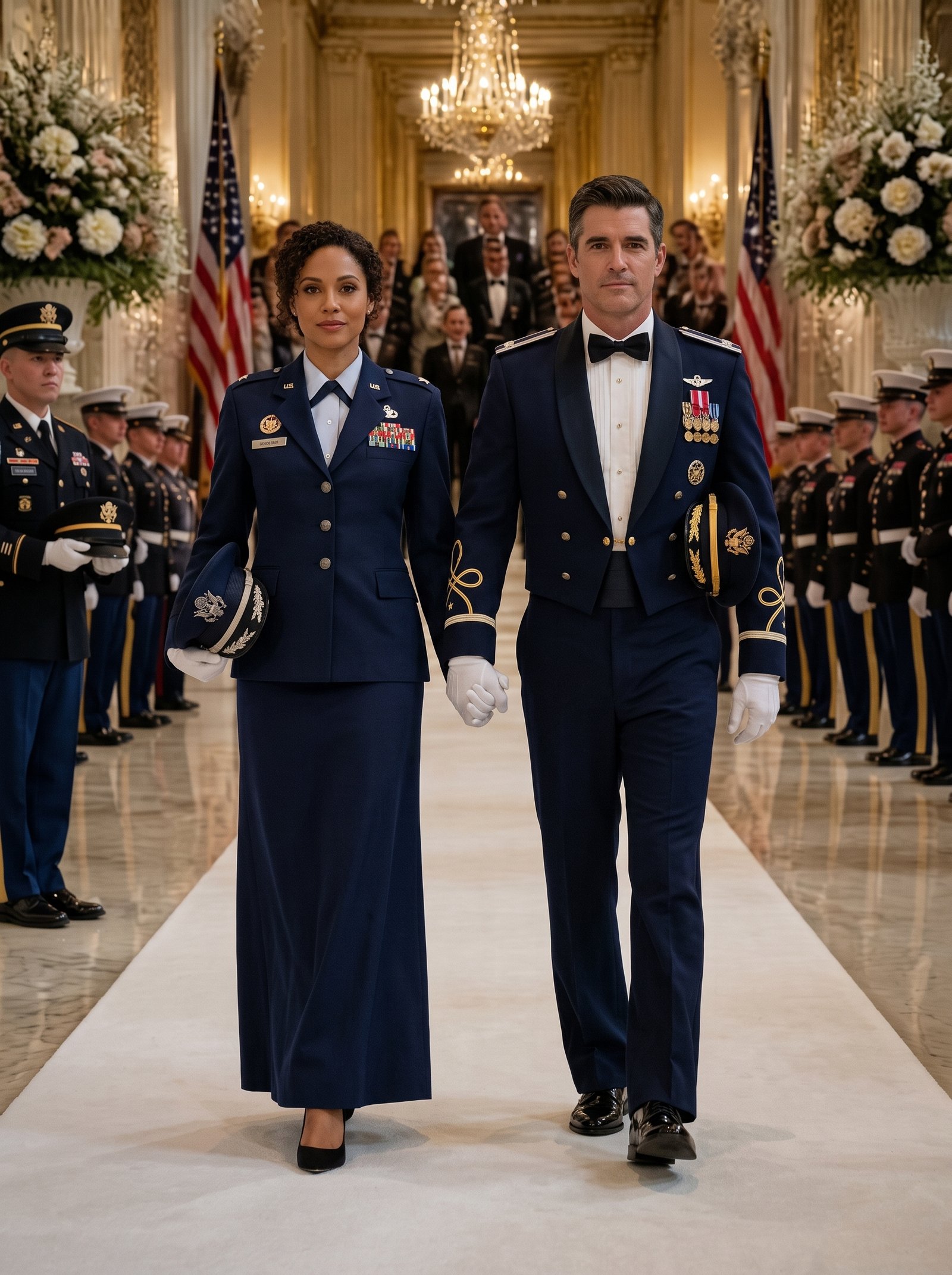
I stood in that restroom for exactly six minutes, watching the water drip from my ruined dress into the sink, before I felt steady enough to walk back out into a ballroom that thought it had already won.
The text I’d sent had one reply within thirty seconds.
On my way. Fifteen minutes.
I’d kept Marcus a secret for three years, not out of shame, but out of self-preservation. My family had a talent for taking anything good in my life and finding a way to make it smaller, to twist it into something they could mock or take credit for. I had watched them do it to every job promotion, every friendship, every small victory I’d ever tried to share at a family dinner. So when Marcus and I got married quietly eighteen months ago, in a small courthouse ceremony with two witnesses we’d met that same morning, I decided some things were mine to protect.
He didn’t know I still hadn’t told my family. He only knew tonight, at Sophie’s wedding, I’d finally decided it was time.
I reapplied my lipstick, smoothed down the black dress, and walked back into the ballroom just as the band was starting a slow song for the newlyweds’ first dance. Heads turned as I entered, the whispers rippling outward the way they always did whenever I did something unexpected.
My mother intercepted me near the bar, her voice pitched low, urgent. “Clara, what were you thinking, storming off like that? Your father was just having fun.”
“He shoved me into a fountain in front of four hundred people,” I said. “I don’t think that’s fun for anyone except him.”
“You’re making a scene,” she said, glancing nervously toward Sophie, who was dancing, oblivious, wrapped up in her new husband’s arms. “Tonight isn’t about you.”
“It never is,” I said, and walked past her.
I found a seat near the edge of the room, close enough to watch the doors, and waited. My father caught my eye from across the room once, that same smug half-smile still on his face, like he expected me to slink back to my table and disappear into the wallpaper the way I always had.
I smiled back at him instead, and something in his expression faltered again, uncertain this time, like he sensed the ground shifting beneath him but couldn’t yet name why.
At exactly 9:47, the ballroom doors opened.
Marcus walked in wearing a charcoal suit, tall and composed in the way he always was, the same quiet confidence that had first caught my attention three years earlier in a coffee shop where neither of us had planned to strike up a conversation. He scanned the room once, found me immediately, and started walking straight toward our table without hesitation, without needing directions, like he belonged there.
Conversations near the entrance stumbled to a halt. I watched the whispers spread outward in a wave, guest to guest, table to table, until even the band seemed to notice something was happening and the newlyweds’ first dance quietly wound down early.
My father set down his champagne glass, his eyes narrowing as Marcus crossed the room.
“Clara,” Marcus said warmly, leaning down to kiss my cheek before turning to face the table, to face my father, to face the entire Hart family staring at him like he’d materialized out of thin air. “Sorry I’m late. Traffic.”
My mother’s mouth opened, then closed again, no sound coming out.
My father finally found his voice, though it came out smaller than the one he’d used on that microphone twenty minutes earlier.
“Who exactly are you?”
I reached for Marcus’s hand, laced my fingers through his, and looked at my father with the same stillness I’d found at the bottom of that fountain.
“This is my husband,” I said. “We’ve been married for eighteen months. You’ve just spent twenty minutes humiliating me in front of four hundred people for being ‘unable to find a date.'”
The silence that followed was louder than any applause the fountain had gotten.
For a long moment, no one at the table moved. My father’s champagne glass sat forgotten in front of him, and my mother’s carefully composed wedding-guest smile had completely dissolved into something closer to panic.
“Eighteen months,” my father repeated, like the words themselves didn’t make sense to him. “You’ve been married for eighteen months, and you never said a word?”
“Why would I?” I asked. “The last time I told this family about something good in my life, you spent an entire Thanksgiving dinner explaining to Aunt Rosalind why my promotion ‘wasn’t really that impressive’ compared to Sophie’s new house. I learned a long time ago that the things I care about aren’t safe here.”
Sophie had made her way over by then, still in her wedding dress, confusion and something that looked uncomfortably like guilt crossing her face as she took in the scene, Marcus standing beside me, our hands still laced together, our father visibly shrinking under the weight of two hundred curious stares now aimed at our table instead of the dance floor.
“Clara,” Sophie said quietly. “Is this true? You’re actually married?”
“Yes,” I said. “This is Marcus. My husband. We got married at the courthouse eighteen months ago, and I kept it quiet because I wanted at least one good thing in my life that Dad couldn’t turn into a punchline.”
My father’s face flushed, embarrassment curdling fast into anger, the only emotion he’d ever really been fluent in. “Don’t twist this around like I’m the villain here. You embarrassed yourself tonight, showing up alone—”
“I didn’t show up alone,” I said. “I chose to. Because some part of me still hoped that maybe, just once, you’d treat me decently without needing proof that someone else valued me first. I was wrong. You didn’t need proof. You needed a joke, and you found one, at my expense, in front of everyone Sophie invited to celebrate her happiest day.”
Marcus’s hand tightened gently around mine, steady, grounding, the same quiet support he’d offered every time I’d come home from a family dinner smaller than I’d left it.
“Mr. Hart,” Marcus said evenly, “I don’t know you well, and after tonight, I’m not sure I want to. But I do know that a father who pushes his adult daughter into a fountain for entertainment doesn’t get to act confused about why she didn’t rush to introduce you to the people she loves.”
My father opened his mouth to respond, but for the first time in my entire life, no words came out. Around us, I could see phones lowering slightly, guests who’d been filming the earlier humiliation now capturing this moment instead, the tables fully turned in a way none of them had expected when they’d laughed along with him twenty minutes earlier.
My mother reached for my arm. “Clara, please, let’s not do this here. Think about your sister’s night—”
“I thought about Sophie’s night for thirty-two years,” I said, gently but firmly pulling my arm free. “Every family event has been about making sure nothing overshadowed someone else’s moment. Tonight, for the first time, I decided my own dignity mattered more than keeping the peace.”
Sophie, to her credit, didn’t try to smooth things over the way our mother had. She looked at our father with an expression I hadn’t seen from her before, something between disbelief and disappointment.
“Dad,” she said quietly, “you shoved her into a fountain at my wedding. Everyone clapped. I didn’t say anything either, and I should have.”
The admission seemed to cost her something, and for a moment, the sister I’d spent years quietly resenting for being the golden child looked, instead, like someone finally seeing the pattern for what it was.
My father, cornered on every side now, straightened his jacket and tried one last time to reclaim the room. “This is absurd. I was having fun. It’s a party.”
“It was cruelty with a smile on it,” I said. “The same kind you’ve been serving me since I was a teenager. Tonight’s just the first time I didn’t let you get away with it quietly.”
I turned to Marcus. “I think we’re done here.”
He nodded, and as we walked toward the exit together, I felt something I hadn’t felt in that ballroom in over three decades: the complete absence of the need to shrink myself for anyone else’s comfort.
Behind us, I heard my father’s voice rise again, defensive, indignant, insisting to anyone still listening that he’d “done nothing wrong,” but for the first time, the room wasn’t laughing along with him.
It was watching him instead, the way people watch someone finally being seen clearly for who they really are.
The video from Sophie’s wedding surfaced online within days, someone’s phone footage of the fountain incident stitched together with the moment Marcus walked through those ballroom doors, and the internet did what it does best: it picked a side, loudly.
“Father humiliates daughter at sister’s wedding, gets exposed hours later” trended in local social circles for nearly a week. Comments poured in from strangers who recognized the particular cruelty of a parent who mistreats one child to elevate another, and for the first time in my life, people I’d never met were saying the words I’d waited three decades to hear from my own family: that wasn’t okay, and you didn’t deserve it.
My father called four times in the two days after the wedding. I let all four go to voicemail. His messages moved from indignant to defensive to, by the fourth one, something that almost resembled an apology, though it was so wrapped in justification and blame that it barely qualified.
“Clara, I think we overreacted to each other. Your mother’s upset. Can we just move past this?”
Moving past it, in my family’s language, had always meant returning to silence and pretending nothing had happened. I didn’t call back.
Sophie was the one who eventually reached out properly, three weeks after her wedding, once the honeymoon was over and the reality of what happened that night had apparently settled in for her too.
“I keep thinking about what I said,” she told me over coffee, twisting her wedding ring nervously. “I should have said something the first time he made a joke like that, not just the last time.”
“You were a kid too, once,” I said. “We both learned the same lesson. Just from different sides of it.”
“I don’t want to be like them,” she said. “With my own kids, someday. I don’t want anyone in this family to ever feel the way you felt in that fountain.”
It wasn’t a full repair, not yet, but it was the first honest conversation Sophie and I had ever had that wasn’t managed or softened for our parents’ comfort, and I found myself, cautiously, willing to build on it.
My mother took longer. She showed up at my apartment unannounced two months later, standing awkwardly in the hallway until I let her in, and finally admitted something I’d waited my whole life to hear.
“I always told myself staying quiet was keeping the peace,” she said, sitting stiffly at my kitchen table while Marcus made tea in the next room, giving us space. “But I think I was just protecting myself from having to admit what your father was actually like. I let it cost you, and I’m sorry.”
I didn’t forgive her that day, not fully. But I let the door stay open a little, because an apology, even a late one, was more than I’d ever gotten before.
My father never truly apologized. Not really, not without immediately following it with an excuse about how “sensitive everyone had become” or how he’d “meant it as a joke.” Eventually, I stopped waiting for him to. I set the terms myself: no contact unless he could offer an actual apology, not a performance of one, and until that happened, I simply stopped attending family events where his behavior had never once carried consequences before.
Marcus and I hosted our own small dinner a few months later, just the two of us, my mother, and Sophie and her husband, a quiet evening with none of the performance or cruelty that had defined every Hart family gathering I could remember. Sophie brought a bottle of wine and, halfway through dinner, raised a toast.
“To actually knowing the people we love,” she said, glancing at Marcus, “instead of just performing family for an audience.”
I thought about the woman I’d been in that ballroom bathroom mirror, soaked and humiliated, deciding in that exact moment that she was done disappearing quietly for anyone’s comfort.
She hadn’t disappeared. She’d finally been seen, on her own terms, by the people who actually mattered.
And for the first time in thirty-two years, that was enough.