PART 1: THE EMPTY CASKET
My husband chose a white casket for me.
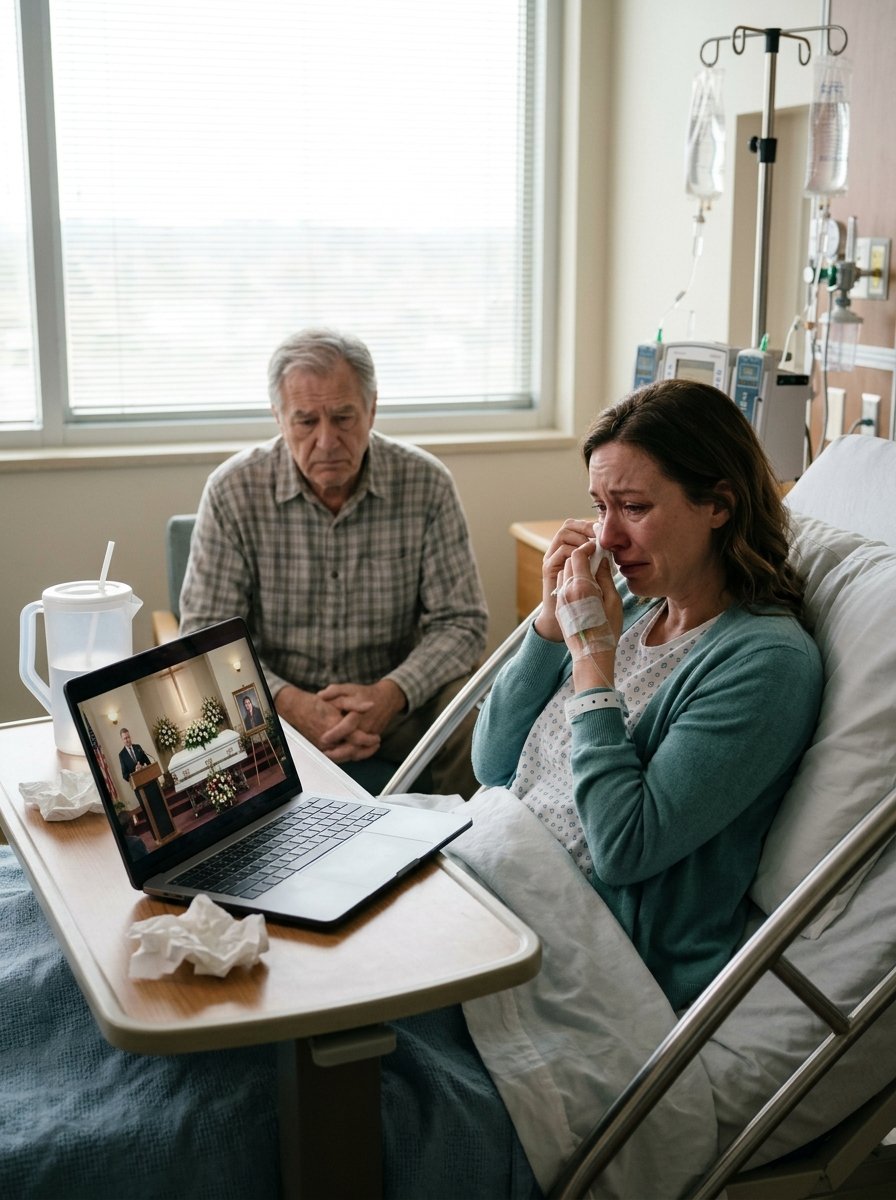
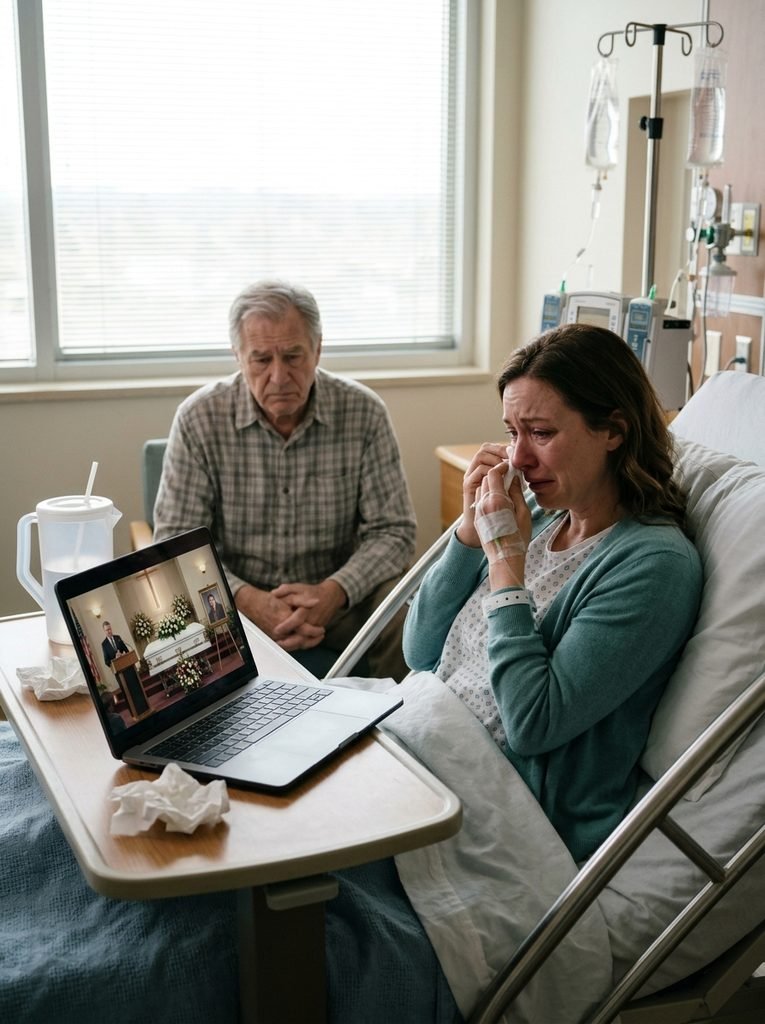
I learned that from a hospital bed, watching the livestream test for my own memorial.
Grant stood beside it while someone adjusted a microphone. He wore the black suit I had bought him for our fifth anniversary.
“Can we move her photograph closer?” he asked.
A woman shifted the frame.
In the picture, I was seven months pregnant, smiling with his hand resting on my stomach.
My son was now one floor below me, learning how to breathe without help.
Grant believed we were both gone.
Six nights earlier, he had driven me to Cedar Ridge, my mother’s old cabin outside Bozeman.
“One quiet weekend before everything changes,” he’d said.
I was thirty-five, exhausted, and weeks away from giving birth. I wanted to believe we could spend two days talking about something other than Northstar, the air-medical transport company my mother had left me.
While Grant unloaded the car, I noticed the narrow pantry door.
Behind it was the old hillside shelter and its second exit. As a child, I had hated my mother making me walk that route every summer.
“You don’t need to be frightened,” she used to say. “You need to know where you’re going.”
At 2:17 that morning, I woke to smoke.
Grant’s side of the bed was empty.
I reached the front door, turned the handle, and pushed.
It wouldn’t move.
Neither would the kitchen door.
Through the side window, I saw Grant near the SUV. Brooke Ellis, his colleague from Northstar, stood beside him.
I hit the glass.
He looked directly at me.
Brooke reached toward the house.
“Grant, she’s there.”
“Get in the car.”
He opened the passenger door.
Then they drove away.
I went back toward the pantry, one hand beneath my stomach.
By the time I reached the outside hatch, I could barely lift my head.
A light swept across the snow.
Someone called to me, then knelt beside me and wrapped a blanket around my shoulders.
“What’s your name?”
“Lena. Lena Morgan.”
“Who can we call?”
My husband’s name rose automatically.
Then I caught the rescuer’s sleeve.
“Not him. Please don’t call my husband.”
PART 2: THE PEOPLE WHO KNEW I WAS ALIVE
When I woke, I reached for my stomach.
A nurse caught my hand before I pulled at a line.
“Your baby is alive,” she said.
I began crying before she told me anything else.
His name was Noah. I had chosen it months earlier, lying awake while Grant slept beside me.
Now a stranger was saying it in a hospital room.
Noah had been delivered by emergency cesarean. He was premature and needed support, but he was receiving care in the NICU.
The nurse explained things slowly. She repeated herself when I couldn’t hold on to the words.
I had smoke inhalation, burns on my hands, and a body that seemed to hurt everywhere at once.
Later, when they took me to see my son, I expected to feel only relief.
Instead, I felt afraid to touch him.
He was so small beneath the equipment.
One hand rested near his cheek, fingers opening and closing as though he were trying to find something.
“You can put your hand here,” his nurse said, showing me.
I did.
“Hi, Noah.”
My voice sounded rough and unfamiliar.
He moved beneath my palm.
I stayed until I needed to return to my room.
Sheriff Elena Shaw came that afternoon, after my medical team agreed I was ready for a short conversation.
She sat where I could see her without turning.
“We can stop whenever you need to,” she said.
I told her about the doors.
The window.
Grant looking at me.
Brooke beside the car.
When Shaw asked whether I had seen either of them start the fire, I said no.
When she asked what I had heard, I gave her the words I remembered.
She didn’t fill in the gaps for me.
Grant had told authorities he had driven into town for medication and returned to find the cabin burning.
He had reported me missing.
“Does he know where I am?”
“We have not disclosed your location to him,” she said. “The hospital has restricted information about you, and we’re coordinating security.”
She didn’t promise that nobody could ever find out.
She told me who would be allowed to visit and how I could ask for help.
That mattered more.
The next morning, the nurse asked whether I wanted to see the man who had found me.
“His name is Nathan Cole.”
I remembered his voice in the snow.
I said yes.
He entered wearing a clean flannel shirt and carrying nothing.
Silver hair. Weathered hands. A face that looked as though he hadn’t slept.
“I’m glad you’re awake,” he said.
He explained that he led the local mountain-response team. An independently monitored alarm at Cedar Ridge had brought crews to the property.
While firefighters approached the cabin, his team searched the outbuildings and the downhill side.
That was where he had found me.
“My mother arranged that monitoring,” I said.
He nodded.
“Evelyn was careful about remote properties.”
I looked at him.
“You knew her?”
He glanced toward the chair.
“May I sit?”
I nodded.
For a moment, he seemed unable to begin.
“Your mother and I were together when we were young. Before you were born.”
I watched his hands.
“She told me she had lost the baby.”
The room became very quiet.
“What are you saying?”
“A few weeks before she died, she contacted me. She told me that wasn’t true. She said she’d had a daughter. She said you were our daughter.”
My mother had been dead for almost two years.
She had told me my father was gone long before I was old enough to remember him.
“And you waited until now?”
His face tightened.
“I tried to reach you after the funeral. Through the company office first, then through the contact I was given for your family. I sent letters. I was told you didn’t want contact.”
Grant had managed so much during my mother’s illness.
Calls. Visitors. Mail.
I had thanked him for it.
“I need proof,” I said.
“I understand.”
“And time.”
“Yes.”
He didn’t move closer.
Before leaving, he placed a card on the table and told me I could ask the nurse to send him away at any point.
That evening, I learned Grant was organizing a memorial.
No remains had been recovered. Officials had not confirmed my death.
Grant was telling people there could be no other explanation.
He had also asked Northstar’s board to give him broader authority during what he called the transition.
My mother had started Northstar with two helicopters and a rented hangar. I owned the controlling stake she had left me. Grant was the chief financial officer.
Marriage had not made those responsibilities interchangeable.
I asked to speak with the independent attorney who handled my ownership documents.
“He can tell them I’m gone,” I told her. “He cannot keep making decisions in my name.”
PART 3: WHAT SURVIVED THE FIRE
I had asked Grant about the consulting payments eleven days before Cedar Ridge.