PART 1: ONE SANDWICH, TWO BOYS
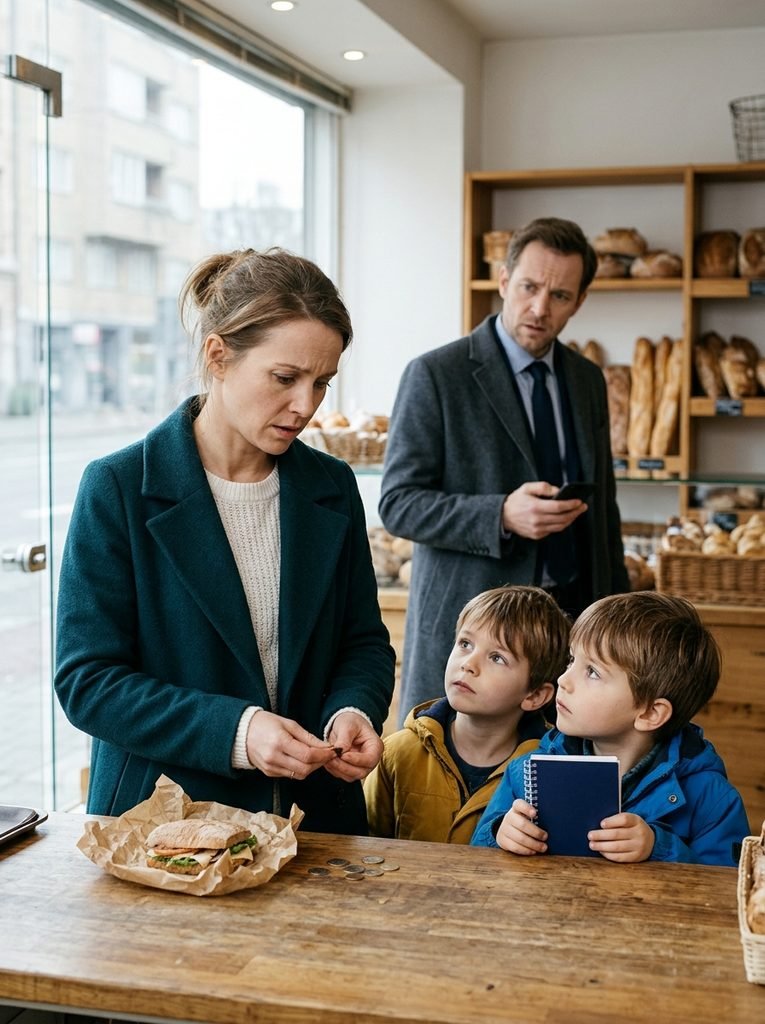
“Mom, one is enough. Eli and I can share.”
I heard the little boy before I saw his mother.
I had stepped into a bakery on Chicago’s South Side after touring a building my company was considering renovating. My phone was vibrating with messages about a transaction worth more than I wanted to think about that afternoon.
Then the woman at the counter turned slightly.
Naomi.
My ex-wife.
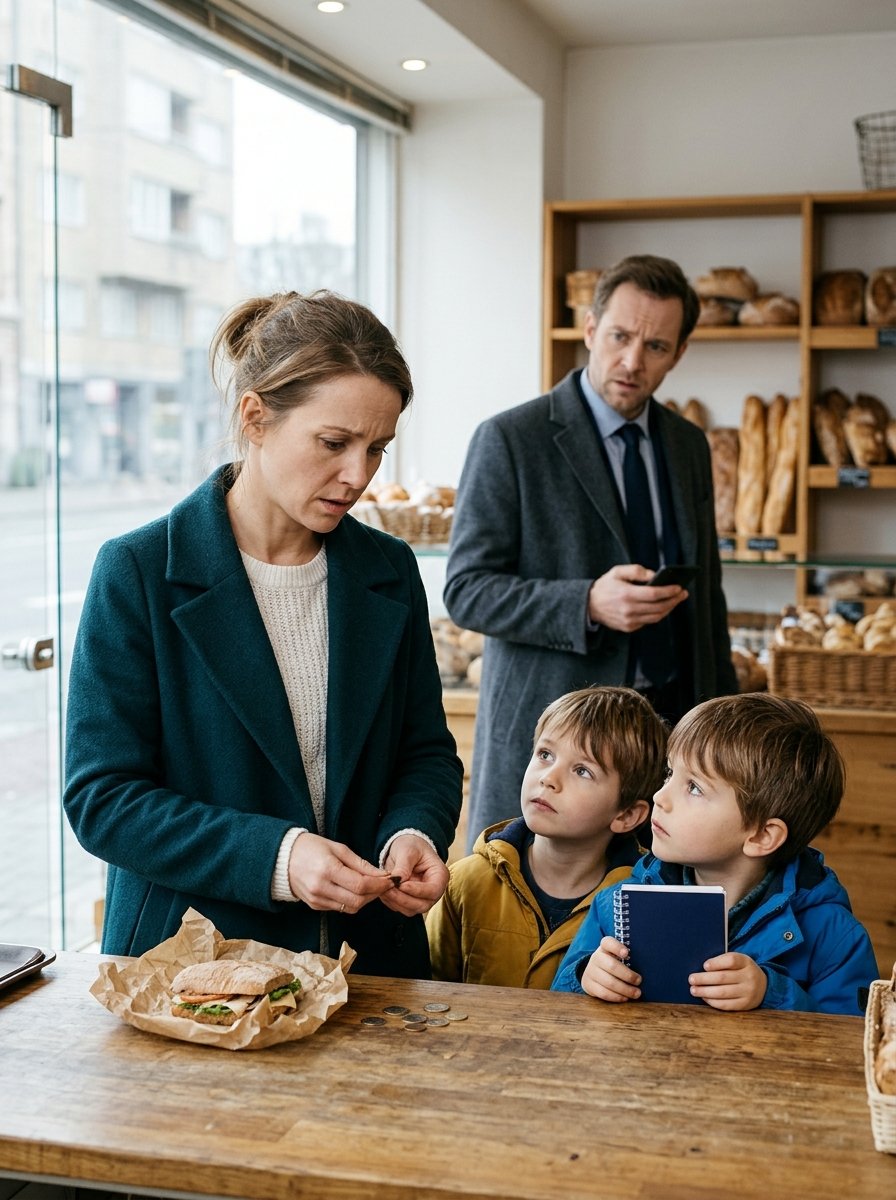
She was counting coins beside two identical little boys.
One leaned against her coat. The other held a notebook covered in planets.
“You don’t have to worry about that, Theo,” she said. “Let me check my other pocket.”
The baker reached beneath the counter.
“I made an extra turkey sandwich. Take it before I eat another lunch.”
“Frank—”
“You can help me with that school website again. We’ll call it even.”
She smiled, but her fingers stayed closed around the coins.
I hadn’t seen her in almost five years.
The last time, she had stood in our bedroom in Lake Forest while I explained why teaching science was no longer practical for the wife of a man in my position.
She had asked whether I could hear myself.
I had told her that if she couldn’t support my life, she could leave it.
Now one of the boys looked up.
He had a crooked left eyebrow.
So did I.
That proved nothing. I knew that.
Still, I forgot how to breathe.
Naomi saw me.
Her face changed before I said her name.
“Can we talk?” I asked.
She glanced at the boys.
“Not here.”
I took out a business card, then turned it over and wrote my personal number.
She accepted it without touching my hand.
That evening, I called Martin, my attorney.
“I need my old divorce file. Correspondence too. Everything Gordon handled.”
“That will take some time,” he said.
For once, I didn’t tell someone to work faster.
At nine that night, an unfamiliar number sent me the address of a coffee shop and a time.
Then a second message arrived.
“Before you ask why I never told you, understand that I tried.”
PART 2: THE ANSWER SOMEONE GAVE FOR ME
Naomi was already at the coffee shop when I arrived.
She had chosen a table near the window. A blue folder rested beside her cup.
I sat down, and for several seconds neither of us spoke.
“How old are they?”
“Four. They’ll be five in the spring.”
I looked at the folder.
“Are they mine?”
Her expression tightened.
“There wasn’t anyone else, Preston.”
“I didn’t mean—”
“I know what you meant. We can arrange whatever confirmation we need. I want this handled properly.”
The boys had been born roughly seven months after we separated.
She had discovered she was pregnant shortly after leaving.
I remembered those months differently. Meetings. Airports. My mother telling me Naomi wanted distance. Gordon telling me communication should go through the lawyers.
I had been angry enough to accept all of it.
Naomi opened the folder.
The first document was a copy of a letter.
Preston, I’m pregnant. I would like to speak with you directly before other people begin making decisions for us.
I read it twice.
“I never saw this.”
She placed a delivery receipt beside it.
My mother’s name was written in the recipient field.
“Constance was staying at the house while you were away,” Naomi said. “I sent another copy to your office.”
The next page was a response from Gordon Pierce.
It said all further correspondence should go through his office and that I did not wish to resume personal contact.
“I didn’t authorize this.”
Naomi watched me.
“That may be true. It isn’t what I was told.”
She described trying my old number, leaving messages with my assistant, and eventually speaking with my mother.
Constance had said I was moving on.
She had also said that if Naomi intended to use a pregnancy to pull me back, she should consider how a dispute with the Calloway family might end.
“She talked about lawyers,” Naomi said. “About the kind of home you could provide. About everything she thought I couldn’t.”
I felt my jaw tighten.
“She had no right.”
“I understand that now.”
“Why didn’t you—”
I stopped.
She waited.
“Go ahead,” she said. “Ask why I didn’t do more.”
I looked down at the letter.
“I’m sorry.”
Her fingers rested on the folder.
“I called again from the hospital when the boys came early. Gordon’s office told me the same thing. All communication through them. No personal contact.”
Theo had come home first.
Eli had needed longer.
Naomi told me about arranging rides, learning feeding schedules, and trying to understand medical updates while she was still recovering herself.
“I knew there were legal options,” she said. “I also knew I was exhausted, frightened, and being told you wanted me gone. I stopped trying to get a personal answer from you. Then weeks became months.”
She didn’t tell the story proudly.
She told it like someone describing decisions made with too little sleep and too much fear.
“Joanne helped,” she continued. “Frank brought food. I went back to teaching when I could. There were years when we managed better than others.”
The money from our settlement had helped at first. Reduced work, childcare, and costs connected to Eli’s care had worn it down.
“Yesterday, I’d paid for a prescription and discovered my debit card wasn’t where I thought it was,” she said. “We had food at home. We’d been out longer than I planned.”
I thought about the coins.
I had built an entire picture of her life from thirty seconds at a counter.
“I want to help.”
“The boys need support. We’ll arrange that.”
“Whatever they need.”
“And we’ll discuss how you meet them separately.”
I nodded too quickly.
“Of course. And your school—my foundation could help with the science program. A lab, equipment—”
“Don’t call my principal.”
I went quiet.
“You don’t get to enter every part of my life because you’ve finally found one part you missed.”
I leaned back.
She gathered the papers.
“I’m not asking you to prove you have money. I already know that.”
Before she left, I said my mother had taken years from us.
Naomi looked at me for a long moment.
“Your mother’s story worked because you had already taught me what to expect from you.”
That afternoon, I remembered more than our final argument.
I remembered missing her students’ science exhibition because a dinner invitation had seemed more useful.
I remembered telling her that nobody needed to hear about her classroom at a fundraiser.
I remembered how often she had begun a sentence and then decided not to finish it.
My mother had kept information from me.
I had given Naomi reasons to believe I didn’t want it.
PART 3: THE MAN IN THE OLD PICTURE
Confirmation came through the process Naomi and I arranged together.
Theo and Eli were my sons.
I read the results alone in my office.
Then I called Naomi.
“I’ve seen them,” she said before I could speak.
“What happens now?”
“We do this carefully.”
We spoke with a family professional about introducing me. Naomi wanted the boys to receive a simple, truthful explanation before I appeared in their living room.
I wanted to arrive with everything they had ever wanted.
She asked me to arrive with myself.
Two weeks later, I stood outside her apartment at the agreed time with a packet of plain paper in my hand.
It was the only thing she had suggested I bring.
Theo opened the door with Naomi standing behind him.
“You’re Preston.”
“I am.”
“Mom said you’re our dad.”