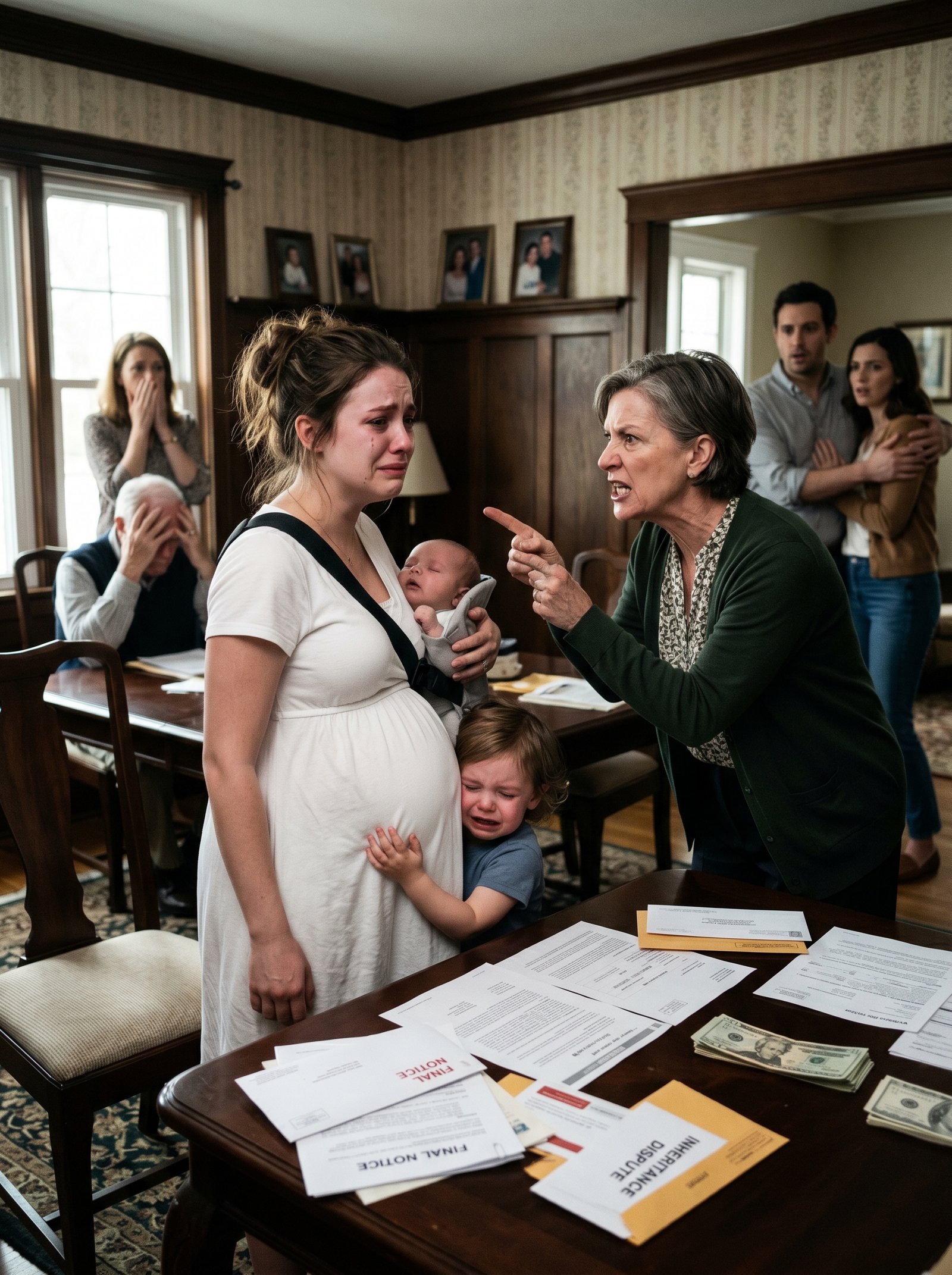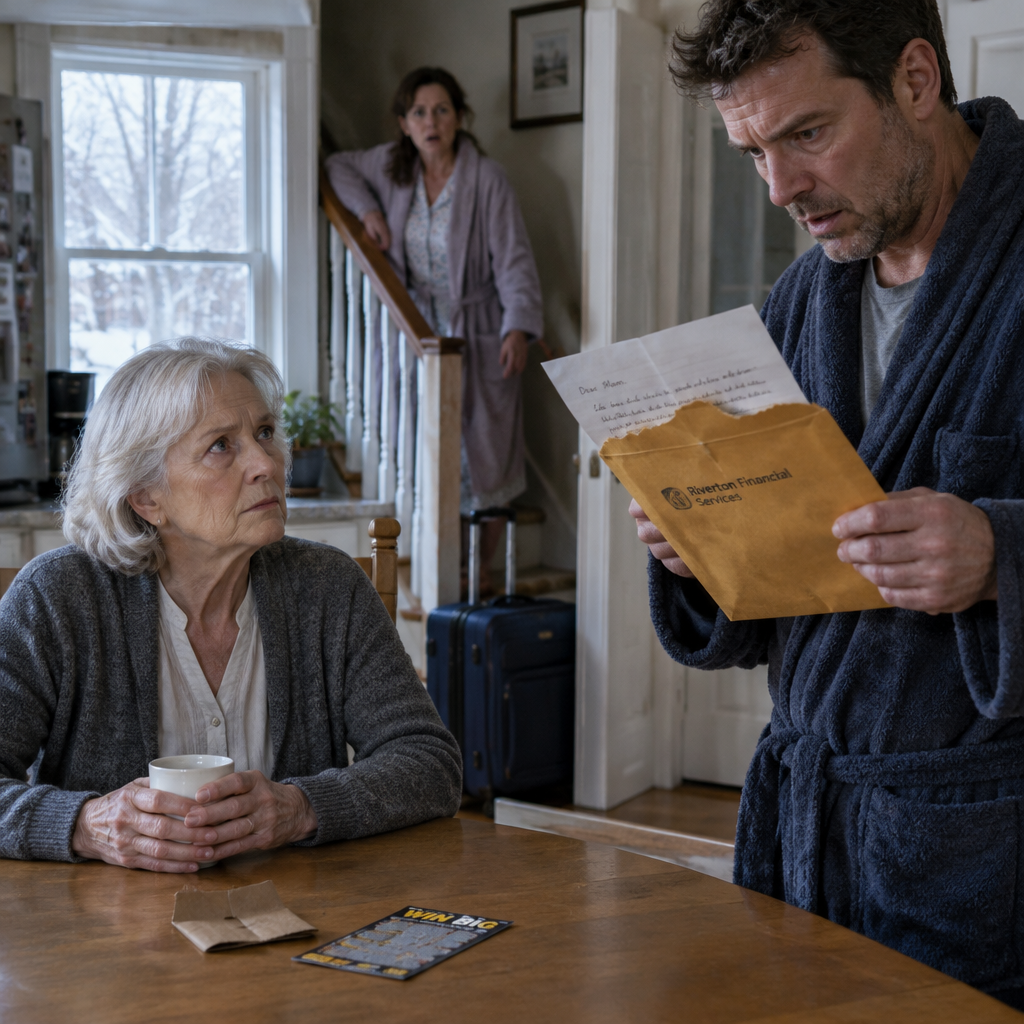
Colin bent down and picked it up.
I recognized the cream-colored stationery immediately.
My letter.
His eyes moved to the first line.
He froze.
Jessica noticed.
“What?”
He didn’t answer.
“Colin, what does it say?”
Still nothing.
Then he looked at me.
Not casually.
Not like a son looking across the kitchen at his elderly mother.
He looked at me like a man who had just realized there might be a locked room inside a house he thought he knew completely.
“Mom?”
“Yes?”
His voice became quiet.
“Why is there a letter from you inside this envelope?”
Jessica stopped moving.
For the first time that morning, the entire kitchen became silent.
Even the refrigerator seemed too loud.
I folded my hands on the table.
“Read it.”
Colin swallowed.
Then he unfolded the letter.
“Dear Colin and Jessica,” he began.
His voice was already different.
“For four years, I have lived under your roof and tried to convince myself that being useful was the same as being loved.”
Jessica’s face hardened immediately.
“Oh, come on.”
Colin kept reading.
“I cooked your meals. I watched your children. I cleaned your home. I rearranged my days around your emergencies. I did those things because I loved my family, not because I expected repayment.”
Jessica crossed her arms.
“This is ridiculous.”
“Keep reading,” I said.
She looked at me sharply.
Colin continued.
“But over time, I began hearing the way you spoke about me when you believed I could not hear you. I learned that my presence had become a burden. I learned that my bedroom mattered more than my dignity. And finally, I learned that plans for the final years of my life could apparently be made without including me in the conversation.”
Colin lowered the paper slightly.
“Mom—”
“Finish it.”
He looked back down.
“So I have made a decision of my own.”
Jessica suddenly walked closer.
“What decision?”
Colin read the next sentence silently first.
His face drained of color.
“What?” Jessica demanded.
He looked at me again.
Then he read aloud.
“A&M Property Holdings belongs to me.”
Jessica laughed.
Not because she found it funny.
Because sometimes disbelief comes out sounding like laughter.
“That’s impossible.”
Colin didn’t laugh.
He knew those initials.
I saw the exact moment the memory finally reached him.
A&M Outdoor Supply.
Arthur and Margaret.
His father’s little shop.
The cardboard boxes.
The invoices.
The sign over the old storefront.
His knees seemed to weaken.
“You…”
I said nothing.
“You bought this house?”
“Yes.”
“When?”
“Months ago.”
Jessica grabbed the letter from him.
“You bought our house?”
“No,” I corrected gently. “I bought the house you rent.”
Her face flushed bright red.
“That’s the same thing.”
“No, Jessica. It really isn’t.”
Colin pulled out a chair and sat down.
I had rarely seen my son speechless.
As a little boy, he had always talked himself out of trouble.
Broken window?
He had an explanation.
Missing homework?
Explanation.
Dent in his father’s truck?
A very long explanation.
But there are moments in life when excuses finally meet a locked door.
This was one of them.
“How?” he asked.
I tilted my head.
“How what?”
“How could you afford this?”
There it was.
Not why.
Not whether I was hurt.
Not whether we could repair what had happened between us.
Money.
I almost smiled.
Jessica caught it.
“Margaret, where did you get enough money to buy a house?”
I stood.
“Does it matter?”
“Yes!” she snapped.
“Why?”
“Because you live here!”
“Not after this morning.”
Colin’s head snapped up.
“What?”
I pointed toward the hallway.
“My suitcase is packed.”
“Where are you going?”
“To the airport.”
“Airport?”
“I bought another house.”
Jessica stared.
“Another house?”
“Yes.”
“Where?”
“South Carolina.”
Colin looked genuinely stunned now.
“South Carolina?”
“Near Aunt Helen.”
“You bought a house in South Carolina and never told me?”
“You selected a senior facility for me and never told me.”
His lips parted.
Nothing came out.
I walked toward the counter and picked up my handbag.
Jessica followed me.
“No. Wait. This is insane. You cannot just walk out and leave us with thirty days to move.”
I stopped.
“You planned for me to move on January first.”
“That’s different.”
“How?”
She struggled for an answer.
“It just is.”
I looked directly into her eyes.
That answer told me everything.
When my life was being packed into boxes, it was logistics.
When theirs was, suddenly it was cruelty.
Colin rubbed both hands over his face.
“Mom, please. Can everyone just calm down?”
“I am calm.”
“That’s the problem!” Jessica shouted.
The grandchildren appeared at the top of the stairs.
Lucas stood there in his school uniform, backpack hanging from one shoulder.
His younger sister, Emma, stood behind him.
“What’s happening?” Lucas asked.
Jessica turned quickly.
“Go upstairs.”
“But—”
“Now.”
The children disappeared.
That part hurt.
Whatever anger I had toward Colin and Jessica, the children were innocent.
They had laughed at my birthday because adults had taught them the moment was funny.
Children learn cruelty the same way they learn table manners.
By watching.
Colin noticed me looking toward the stairs.
“Mom, think about the kids.”
“I have.”
“Then how can you do this?”
I turned back to him.
“Do what?”
“Put them through this.”
For the first time that morning, something inside me sharpened.
“Colin, did you think about me when you toured Oakridge without me?”
He looked down.
“Did you think about me when you chose which room I would live in?”
Silence.
“Did you think about me when you chose my moving date?”
Still nothing.
“Did you think about me when you decided Lucas deserved my bedroom more than I deserved a voice in my own future?”
Jessica interrupted.
“Nobody was throwing you into the street.”
“No. You were putting me somewhere neat, clean, and convenient so you could feel respectable while doing it.”
“That is not fair.”
“Neither was discovering that my family had been planning my removal for months.”
Colin’s eyes filled with something I had not expected.
Shame.
For one second, I saw my little boy again.
The child who used to run through Arthur’s shop with fishing lures hanging from his shirt.
Then he asked the question I knew was coming.
“How much money do you have?”
Jessica turned toward him.
“Colin!”
“What? You’re thinking it too.”
I almost laughed.
There it was.
The question underneath every other question.
I picked up my coat.
“Enough.”
“Enough for what?”
“For the rest of my life.”
“That doesn’t answer me.”
“It wasn’t meant to.”
Jessica stepped closer.
“Was it an inheritance?”
“No.”
“Did Dad leave something we didn’t know about?” Colin asked.
“No.”
“Investments?”
“No.”
Jessica suddenly went still.
Her eyes narrowed.
“The ticket.”
Colin turned toward her.
“What ticket?”
“My birthday ticket.”
Jessica stared at me.
My silence confirmed everything.
Her hand flew to her mouth.
“No.”
Colin looked between us.
“What is she talking about?”
“The scratch-off,” Jessica whispered.
He frowned.
Then remembered.
The birthday cake.
The joke.
No bus fare.
His face went pale again.
“Mom…”
I buttoned my coat.
“How much did you win?”
I smiled.
“Enough for bus fare.”
Jessica looked almost sick.
“That ticket won?”
“Yes.”
“How much?”
I walked past them toward the hallway.
Jessica followed me again.
“How much, Margaret?”
Colin stood.
“Mom, just tell us.”
I stopped beside my suitcase.
For ten months, I had imagined this moment.
Sometimes I imagined shouting.
Sometimes I imagined throwing bank statements onto the table.
Sometimes I imagined telling them exactly how many millions had landed in my account.
But standing there, I realized the number was the least important part.
So I said only:
“Enough to learn who I could trust before anyone knew I had it.”
Neither of them spoke.
That sentence hurt them more than any number could have.
The doorbell rang.
I checked the clock.
9:04.
Earlier than the taxi.
Colin looked toward the door.
“Who is that?”
“I’m expecting someone.”
Jessica whispered, “Your lawyer?”
“No.”
I opened the front door.
Helen stood there.
My sister was seventy years old, five feet two inches tall, wearing red lipstick, oversized sunglasses, and the expression of a woman who had spent her entire life waiting for an opportunity to say I told you so.
She looked at me.
Then at my suitcase.
Then past me at Colin and Jessica.
“Ready?”
“I am.”
Helen smiled.
“Good.”
Colin stepped into the hallway.
“Aunt Helen?”
She lowered her sunglasses.
“Hello, Colin.”
“You knew?”
“About which part?”
His expression almost made her laugh.
“The money?”
“Yes.”
“The house?”
“Yes.”
“South Carolina?”
“Yes.”
He looked betrayed.
“You knew all of this and said nothing?”
Helen shrugged.
“It wasn’t my secret.”
Jessica suddenly pushed past Colin.
“This is unbelievable. The whole family has been lying to us.”
Helen’s expression changed.
“No, sweetheart. Margaret stopped explaining herself to people who had already decided what her life should look like. There’s a difference.”
Jessica went silent.
I loved my sister.
Helen grabbed the suitcase handle.
“Taxi?”
“Coming.”
Colin stepped toward me.
“Mom, wait.”
I turned.
His face had changed again.
The anger was gone.
Now there was fear.
Real fear.
Not about the house.
Not entirely.
Something deeper.
The fear of realizing that your mother can leave you.
“I don’t want you to go like this,” he said.
My throat tightened.
“Neither did I.”
“Then don’t.”
I looked at him for a long moment.
“Give me one reason.”
He opened his mouth.
Nothing.
Jessica answered for him.
“Because we’re family.”
I looked at her.
“Family should have mattered before this envelope arrived.”
She looked away.
Colin stepped closer.
“We can fix this.”
“Maybe.”
Hope appeared in his eyes.
“But not today.”
His face fell.
“I need distance, Colin.”
“For how long?”
“I don’t know.”
“What about Christmas?”
“I don’t know.”
“What about the kids?”
“I will call them. They can visit me whenever arrangements are made properly.”
He nodded slowly.
Then he whispered, “Are you really selling the house?”
“Yes.”
“Can we buy it from you?”
Jessica looked at him sharply.
I almost admired how quickly survival instincts appeared.
“If you can afford the market price, your attorney may speak to mine.”
Jessica’s face tightened.
“You know we can’t afford this house at market price.”
“Yes.”
“So where are we supposed to go?”
I lifted my handbag.
“That is a decision adults normally make for themselves.”
The words landed exactly where they needed to.
A horn sounded outside.
Helen opened the door.
Before leaving, I walked toward the staircase.
“Lucas? Emma?”
Two faces appeared above the railing.
I opened my arms.
They came running.
Emma reached me first.
“Grandma, where are you going?”
“To my new house.”
“You have a new house?”
“I do.”
“Is it far?”
“A little.”
“Can we visit?”
I looked at Colin.
Then Jessica.
Then back at her.
“Of course.”
Lucas hugged me next.
He was getting tall now.
Almost to my shoulder.
“I’m sorry about your room,” he whispered.
I pulled back.
“What?”
He looked embarrassed.
“I told Dad I wanted your room. But I didn’t know they were making you leave.”
My heart cracked just a little.
“Oh, sweetheart.”
“I thought you wanted to go.”
I looked over his shoulder at his parents.
Neither met my eyes.
That was another truth uncovered.
They had even made the children believe it was my choice.
I kissed Lucas’s forehead.
“You did nothing wrong.”
“Are you mad at me?”
“Never.”
He hugged me again.
When I finally stepped outside, the morning air was cold enough to sting.
Helen put my suitcase into the trunk.
I looked back at the house once.
Four years of my life existed behind those windows.
Arthur’s framed photograph in my bedroom.
Birthday mornings.
School pickups.
Burned pancakes.
Flu medicine.
Christmas stockings.
Quiet humiliations.
Small joys.
A thousand things that were neither completely good nor completely bad.
That is what people rarely understand about leaving.
You do not only leave the pain.
You leave pieces of happiness too.
I climbed into the taxi.
Colin came outside without shoes.
“Mom!”
I lowered the window.
He stood on the driveway holding my handwritten letter.
“There’s another page.”
I said nothing.
“What does this mean?”
I knew exactly which sentence he had reached.
The final paragraph.
He read it aloud.
“I hope someday you understand that this notice is not your punishment. It is simply the first decision I have made in years without asking whether it makes your life easier.”
His voice broke.
Then he looked at the final line.
“But if you want to know what really happened to the lottery money, ask Richard about the trusts.”
Jessica appeared behind him.
“What trusts?”
Colin stared at me.
I rolled up the window.
The taxi started moving.
In the side mirror, I watched Jessica grab the letter from his hands.
I watched Colin remain completely still.
Then my phone rang.
Richard Sterling.
I answered.
“Good morning, Margaret.”
“Good morning.”
“I assume the package arrived.”
“Oh, yes.”
He chuckled.
“There is one more matter.”
“What matter?”
“The education trusts for Lucas and Emma are finalized.”
I smiled.
“Wonderful.”
“But that isn’t why I’m calling.”
I looked out the window as Colin’s house disappeared behind the trees.
Richard continued.
“You remember the old insurance policy Arthur purchased about twenty-five years ago?”
My smile vanished.
“Yes.”
“We finally received the archived beneficiary records you asked me to investigate.”
Something in his voice made me sit straighter.
“And?”
There was a pause.
“Margaret, Arthur changed the beneficiary six months before he died.”
My fingers tightened around the phone.
“To whom?”
Richard exhaled slowly.
“That is exactly why I think you should see the document yourself.”
Helen turned toward me.
“What happened?”
I barely heard her.
Because Richard’s next words changed everything.
“The name on that beneficiary form is not yours.”
I stared through the taxi window.
Arthur had been gone for four years.
Four years.
And suddenly, on the morning I thought I was finally leaving my old life behind, my dead husband had left one final secret waiting for me.
“Richard,” I whispered, “whose name is on it?”
He hesitated.
Then said:
“Your son’s.”
And for the first time since scratching that lottery ticket, I wondered whether Colin had been keeping a secret from me too.
TO BE CONTINUED…
PART 3 — THE SECRET ARTHUR TOOK TO HIS GRAVE
For several seconds, I could not speak.
The taxi kept moving.
Traffic lights changed.
People crossed sidewalks.
Someone on a bicycle laughed as he passed us.
The whole world continued normally while one sentence sat inside my chest like a stone.
Your son’s.
I pressed the phone harder against my ear.
“Colin was the beneficiary?”
“Yes,” Richard said.
“For Arthur’s life insurance?”
“Yes.”
“How much?”
There was a pause.
“Just over one million dollars.”
Helen’s head snapped toward me.
I closed my eyes.
One million dollars.
Arthur and I had spent forty-six years together.
We had shared bills, illnesses, mortgages, bad winters, good summers, and every quiet middle-class worry in between.
And six months before he died, he had redirected a million-dollar policy to our son without telling me.
“Richard,” I said carefully, “did Colin receive the money?”
“That’s where this becomes strange.”
I opened my eyes.
“What do you mean?”
“The policy was never paid.”
“Why?”
“Because no claim was filed.”
I frowned.
“That doesn’t make sense.”
“I agree.”
“If Colin was the beneficiary, wouldn’t the insurance company contact him?”
“Not necessarily. Beneficiaries often have to initiate a claim.”
“But Colin knew his father died.”
“Yes.”
“So either he didn’t know about the policy…”
“Or he knew and never claimed it.”
I stared at the back of the taxi driver’s seat.
Neither possibility felt right.
Arthur had been meticulous.
Painfully meticulous.
He labeled extension cords.
He saved receipts for ten years.
He kept warranty papers for appliances we no longer owned.
A man like Arthur would not quietly change a major beneficiary without a reason.
“Do you have the actual form?” I asked.
“A scanned copy.”
“Send it.”
“I already did.”
My phone buzzed.
I opened the email.
There it was.
Arthur’s signature.
His handwriting.
His policy number.
And beneath the words NEW PRIMARY BENEFICIARY:
COLIN VANCE.
Relationship: Son.
One hundred percent.
I enlarged the image.
Helen leaned closer.
“Is that Arthur’s signature?”
“Yes.”
“You’re sure?”
“I watched that man sign checks for almost half a century.”
Then I noticed the date.
May 14.
Six months before Arthur died.
My stomach tightened.
I remembered that week.
Arthur had supposedly gone fishing with Colin.
Three days at a cabin near Lake Harrison.
He came home unusually quiet.
I had assumed father and son had argued over something trivial.
Arthur had brushed it off.
“Nothing worth carrying home,” he had told me.
But now I wondered what he had actually carried home.
I returned the phone to my ear.
“Richard, I want everything connected to that policy.”
“I’m already requesting it.”
“Application history. Change forms. Correspondence. Phone logs.”
“Yes.”
“And I want to know whether Colin was ever notified.”
“I’ll find out.”
Helen looked at me.
“Margaret, are you okay?”
“No.”
That was the first completely honest answer I had given that morning.
I had been prepared to leave my son angry with me.
I had been prepared to leave him shocked.
I had not been prepared to wonder whether my husband had trusted him with something he did not trust me to know.
Richard spoke again.
“There’s something else.”
Of course there was.
“What?”
“The signature changing the beneficiary was witnessed.”
“By whom?”
Another pause.
“Jessica.”
The taxi suddenly felt too small.
I looked at Helen.
She saw my expression.
“What now?”
I lowered the phone.
“Jessica witnessed it.”
Helen’s mouth opened.
“The daughter-in-law?”
I nodded.
Her entire face changed.
“That little snake.”
“Helen.”
“What? I’m seventy. I’ve earned vocabulary.”
Despite everything, I almost smiled.
Then the meaning settled back in.
Jessica knew.
At least she knew Arthur had changed something.
Maybe not the amount.
Maybe not every detail.
But she had been there.
Six months before my husband died, Jessica had watched him sign a document naming Colin as beneficiary of a million-dollar life insurance policy.
And she had never once mentioned it to me.
Not at the funeral.
Not during probate.
Not when I sold our old house.
Not when I moved into their home.
Not when I cooked their dinners.
Not when she called me a burden.
I put the phone back to my ear.
“Richard.”
“Yes?”
“Do not contact Colin.”
“I wasn’t planning to.”
“Or Jessica.”
“Understood.”
“I want to know what happened before they know I’m asking.”
“That is exactly what I would recommend.”
I ended the call.
Helen watched me carefully.
“You’re thinking of going back.”
“No.”
“You’re lying.”
“I am not going back to confront them.”
“That was not what I said.”
I looked out the window.
She knew me too well.
I was not going back.
But I was no longer simply leaving.
I was investigating.
By the time we reached the airport, Colin had called twelve times.
Jessica had called eight.
Lucas had sent one text.
Grandma, are you okay?
That was the only message I answered.
I’m okay, sweetheart. None of this is your fault. I love you.
Then I turned off my phone.
Helen and I checked our bags and walked through security.
At the gate, she bought coffee and two muffins.
I barely touched mine.
“Tell me about the fishing trip,” she said.
I looked up.
“What?”
“You said the beneficiary form was signed around the time Arthur and Colin went away together.”
“Yes.”
“Anything unusual happen after?”
I thought.
Arthur had come home tired.
Quiet.
For several days, he had spent more time than usual in his garage workshop.
He had also begun locking the small filing cabinet beside his desk.
That cabinet had always been unlocked.
I remembered asking him about it.
“What are you hiding, state secrets?”
He had smiled.
“Probably less exciting.”
After his death, the key had never been found.
I told Helen.
She stopped chewing.
“The key disappeared?”
“Yes.”
“And the cabinet?”
“I donated the desk and filing cabinet.”
She stared at me.
“You what?”
“I didn’t know.”
“Margaret.”
“I was grieving.”
She softened immediately.
“I know.”
I stared at the coffee cup in my hands.
Arthur’s death had happened quickly.
Pancreatic cancer.
Diagnosis to funeral in eleven weeks.
Everything after that had been fog.
Paperwork.
Flowers.
Food from neighbors.
People telling me to be strong when I did not want strength.
I wanted my husband.
Colin had handled many of the practical details.
He had helped clean the garage.
He had sorted documents.
He had taken boxes to shredding.
My heart started pounding.
“Helen.”
“What?”
“Colin cleaned Arthur’s office.”
She froze.
I remembered him telling me not to worry.
Mom, you don’t need to deal with all of Dad’s papers.
I’ll handle it.
At the time, I had been grateful.
Now I felt cold.
The boarding announcement sounded.
Helen stood.
“Come on.”
I did not move.
She touched my shoulder.
“Margaret.”
“What if Colin knew?”
“Then you find out.”
“What if Arthur told him something he never told me?”
“Then you find that out too.”
“What if my son has been lying to me for four years?”
Helen looked directly into my eyes.
“Then at least you stop living inside the lie.”
That sentence carried me onto the plane.
Three hours later, we landed in Charleston.
The moment I turned my phone back on, forty-three notifications appeared.
Most were from Colin.
Two were from Jessica.
One was from Richard.
CALL ME.
I called him while Helen waited for our luggage.
He answered immediately.
“I found something.”
“Already?”
“My researcher located correspondence in the insurer’s archived records.”
My stomach tightened.
“What correspondence?”
“A letter sent to Colin roughly three weeks after Arthur died.”
“So they notified him?”
“Yes.”
“Was it delivered?”
“Certified mail. Signed for.”
I closed my eyes.
“By Colin?”
“No.”
“Who?”
“Jessica.”
I gripped the phone.
Richard continued carefully.
“The letter explained that Colin was listed as beneficiary and included instructions for filing the claim.”
“So they knew.”
“At least Jessica did.”
“Did Colin ever respond?”
“No claim was filed.”
“Why would someone ignore a million dollars?”
“That is the question.”
I thought about Jessica.
Designer handbags.
Kitchen renovations.
Vacations they complained were too expensive.
Private school tuition discussions.
A million dollars would have changed their lives.
There was no logical reason for them to ignore it.
Unless claiming it would expose something worse.
“Richard,” I said, “could the beneficiary change have been invalid?”
“Possibly.”
“How?”
“Undue influence. Fraud. Forgery. Lack of capacity. Improper execution.”
“But Arthur’s signature looks real.”
“It does.”
“And Jessica witnessed it.”
“Yes.”
“What if Jessica shouldn’t have been the witness?”
“That depends on the policy requirements and state law. I’m checking.”
My mind raced.
“Could Arthur have changed it again afterward?”
“Not according to the insurer’s current record.”
“Could he have tried?”
There was silence.
“What made you ask that?”
“Because Arthur never left important things unfinished.”
Richard paused.
“I’ll search for rejected or incomplete change requests.”
We ended the call.
Helen appeared carrying both suitcases.
“Well?”
“They knew.”
Her jaw tightened.
“Both?”
“Jessica definitely did.”
“And Colin?”
“I don’t know yet.”
We drove to my yellow cottage.
Under different circumstances, arriving there would have felt like a celebration.
The rose bushes.
The porch.
The sunlight through the kitchen windows.
My blue sofa.
My oak table.
The little brass lamp beside the reading chair.
Everything was exactly as I had chosen it.
And yet I walked through the rooms like a guest.
Arthur’s secret had followed me across state lines.
Helen poured two glasses of wine.
We sat on the porch until sunset.
At 7:12, my phone rang again.
Colin.
I stared at the screen.
Helen said nothing.
I let it ring.
Then it rang again.
And again.
Finally, I answered.
“Hello?”
“Mom.”
His voice sounded exhausted.
“Where are you?”
“South Carolina.”
There was silence.
“You actually went.”
“Yes.”
“Can we talk?”
“We are talking.”
“No, I mean really talk.”
I looked out at the darkening yard.
“What do you want to talk about?”
He exhaled.
“The house. The letter. Everything.”
“Everything?”
“Yes.”
I waited.
He did not say Arthur.
He did not say insurance.
He did not say beneficiary.
Interesting.
“Mom, Jessica and I have been going through our finances.”
“I imagine you have.”
“We can’t move in thirty days.”
“You can.”
“Not somewhere the kids can stay in the same school district.”
“That is unfortunate.”
He went quiet.
Then he said, “You’re enjoying this.”
I straightened.
“No.”
“Come on.”
“No, Colin. Revenge would have been enjoying your fear. I don’t. I know exactly what housing insecurity feels like. Your father and I nearly lost our first home when you were three.”
“Then why are you doing this?”
“Because if I rescue you from every consequence, you will learn nothing.”
He breathed heavily.
“Can you at least extend the lease?”
“No.”
“Sixty days?”
“No.”
“Ninety?”
“No.”
“Jesus, Mom.”
Then Jessica’s voice sounded faintly in the background.
“Ask her about the money.”
I heard it clearly.
So did Colin.
Silence.
I almost laughed.
He moved farther from her.
“Mom.”
“Yes?”
“How much did you actually win?”
“That is not your concern.”
“I’m your son.”
“And?”
“And families don’t keep secrets like this.”
I closed my eyes.
There it was.
The opening.
I could have asked him immediately.
Then explain your father’s insurance policy.
But I didn’t.
I wanted to hear how comfortable he was accusing me of secrecy.
“You’re right,” I said.
His voice softened.
“Thank you.”
“Families should not keep major financial secrets.”
“Exactly.”
“Especially involving dead parents.”
Silence.
Absolute silence.
I knew.
He knew.
Maybe he had not known before today.
But he knew now what I meant.
“Mom…”
My heartbeat accelerated.
“Yes, Colin?”
“What are you talking about?”
His voice was too careful.
I almost admired the attempt.
“Think about it.”
“I honestly don’t know.”
“Then you have nothing to worry about.”
“Mom.”
“I have to go.”
“Wait.”
I ended the call.
Helen stared at me.
“Well?”
“He lied.”
“You’re sure?”
“Yes.”
“How?”
“Because my son has always overexplained when he is innocent.”
I looked at the dark phone screen.
“That time, he barely breathed.”
The next morning, Richard called before breakfast.
This time his voice was different.
Sharper.
“Margaret, I found the missing piece.”
I stood immediately.
“What?”
“There was a second beneficiary change request.”
My pulse jumped.
“After the one naming Colin?”
“Yes.”
“When?”
“Thirty-two days before Arthur died.”
“To whom?”
“You.”
I gripped the edge of the kitchen counter.
“Arthur changed it back to me?”
“He tried.”
“Tried?”
“The insurer rejected the form.”
“Why?”
“It was incomplete.”
“What was missing?”
“A witness signature.”
I sat down hard.
“Who prepared the form?”
“It appears Arthur did.”
“Was Colin involved?”
“No indication.”
“Jessica?”
“No.”
“So why wasn’t I notified after Arthur died?”
“Because the last valid beneficiary designation remained Colin.”
I stared across the kitchen.
Arthur had changed his mind.
That much was clear.
First, he named Colin.
Then weeks before dying, he tried to put me back.
But the form failed.
Why?
And did Colin know?
“Richard, was there any note attached?”
“Yes.”
My heart hammered.
“What note?”
“A handwritten message was scanned with the incomplete form.”
I stood again.
“What did it say?”
“I’m sending it now.”
My email chimed.
I opened the attachment.
Arthur’s handwriting filled the screen.
Only six lines.
Margaret,
If this reaches you late, forgive me.
I made a mistake trying to protect Colin.
He is in deeper trouble than he told us.
Jessica knows more than she admits.
Do not give them access to your accounts.
Do not sign anything Colin brings you.
And if anything happens to me, look inside the red tackle box.
I stopped breathing.
The red tackle box.
Arthur’s old metal fishing box.
The one he had owned since the 1980s.
The one with chipped paint and a broken silver latch.
I knew exactly where it had been after his death.
Colin had taken it.
He said he wanted something of his father’s to remember him by.
I had given it to him without hesitation.
I called Richard back.
“My son has the tackle box.”
There was a long silence.
Then Richard said, “Margaret, do not confront him alone.”
“Why?”
“Because we still don’t know what Arthur meant by deeper trouble.”
I looked toward the window.
My phone buzzed.
A text from Colin.
Mom, I need to tell you the truth about Dad.
My blood went cold.
Another message appeared.
But not over the phone.
Then a third.
Please come back before Jessica finds out I contacted you.
I stared at the words.
Helen walked into the kitchen.
“What is it?”
I handed her the phone.
She read the messages.
Then looked at me.
“Margaret…”
Before she could finish, another message arrived.
This time it was a photograph.
A photograph of Arthur’s red tackle box.
Open.
Inside were old fishing lures, receipts, a small black notebook, and a sealed envelope.
My name was written across the front in Arthur’s handwriting.
MARGARET — ONLY OPEN IF COLIN TELLS YOU THE TRUTH.
And beneath the photograph, Colin had written one final message.
Mom, Dad knew what Jessica and I did.
And I think that’s why he changed the insurance.
I stared at Colin’s final message until the words blurred.
Mom, Dad knew what Jessica and I did.
My first instinct was to call him.
My second was stronger.
Wait.
Arthur had warned me about signing things.
He had warned me about my accounts.
And now Colin was telling me Jessica could not know he had contacted me.
None of that sounded like a family misunderstanding anymore.
Helen put my phone on the kitchen table.
“You are not flying back there without knowing what this is.”
“I wasn’t planning to.”
“You were thinking about it.”
“I was thinking.”
“That is exactly what worries me.”
My phone rang.
Colin.
I let it ring twice before answering.
“Hello.”
“Mom?”
His voice was low.
Almost a whisper.
“Where are you?”
“In the garage.”
“Why are you whispering?”
“Jessica is upstairs.”
I sat down.
“Tell me the truth.”
“I’m trying.”
“No, Colin. You’re trying to control how much truth I receive at one time.”
Silence.
“Start with the box.”
“I found it this morning.”
“You’ve had that box for four years.”
“I know.”
“And you only opened it today?”
“No.”
That answer came too quickly.
My hand tightened around the phone.
“When did you first open it?”
“After Dad died.”
“What was inside?”
“Different things.”
“Stop.”
He went quiet.
“I am seventy-three years old. Do not speak to me like a child you’re trying not to frighten.”
“I’m sorry.”
“What was inside?”
“A notebook. Some old receipts. Bank documents. The letter.”
“The letter addressed to me?”
“Yes.”
“And you kept it?”
“Yes.”
Four years.
My own son had kept a letter from my dying husband for four years.
I closed my eyes.
“Why?”
“I panicked.”
“That is not an answer.”
“Because of what Dad wrote.”
“Read it to me.”
“Mom—”
“Read it.”
Paper rustled through the phone.
Colin breathed slowly.
Then he started.
“Margaret, if you are reading this, then either I ran out of time or I lost my courage.”
I pressed my lips together.
Arthur.
Even hearing his words through my son’s voice hurt.
Colin continued.
“I need you to understand that Colin came to me because he was frightened. He and Jessica made a financial mistake. A serious one.”
My heart began pounding.
“What mistake?”
“I’m getting there.”
He continued reading.
“They used money that did not belong to them.”
I stood.
Helen saw my face.
“What?”
I raised one finger.
Colin kept reading.
“They told themselves they would replace it before anyone noticed. That is how people usually begin lying to themselves.”
My stomach turned.
“What money?”
Colin stopped.
“Mom.”
“What money?”
His voice broke.
“Your money.”
Everything inside me went quiet.
“What do you mean my money?”
“Dad had access to one of your investment accounts.”
“Yes.”
“It was part of your retirement savings.”
“I know that.”
“Jessica convinced me we could borrow against it temporarily.”
I could barely speak.
“You stole from me?”
“No.”
I laughed once.
Coldly.
“Do not insult me twice in the same conversation.”
“We intended to repay it.”
“That sentence has sent people to prison.”
“Mom, please.”
“How much?”
He hesitated.
“How much, Colin?”
“One hundred eighty thousand.”
Helen actually gasped.
I gripped the kitchen counter.
“One hundred and eighty thousand dollars?”
“Yes.”
“When?”
“About five years ago.”
Before Arthur died.
Before I moved in with them.
Before they started calling me a burden.
“What did you do with it?”
Colin exhaled.
“Jessica wanted to invest in a commercial property project.”
“Jessica wanted to?”
“I agreed.”
“That is not what I asked.”
“We put money into a development deal.”
“With my retirement money.”
“Yes.”
“Without my permission.”
“Yes.”
“And you lost it.”
Silence.
“You lost it.”
“Yes.”
The room tilted.
Not physically.
Emotionally.
That strange feeling when your memories change shape while you are still standing inside them.
Five years ago, Arthur had suddenly become strict about our spending.
He canceled a vacation.
He postponed replacing our car.
He told me the market had been disappointing.
I trusted him.
Of course I trusted him.
“Arthur knew?”
“Yes.”
“How?”
“Dad noticed the withdrawal.”
“Did he help you take it?”
“No. I had access to documents at your house. Jessica knew how to submit the transfer request.”
The shame in his voice did not comfort me.
“What happened when Arthur found out?”
“He came to my house.”
I remembered.
The fishing trip.
Except perhaps there had never been a fishing trip.
“He told you to repay it.”
“Yes.”
“And you couldn’t.”
“No.”
“Then why didn’t he tell me?”
Colin’s voice dropped.
“Because I begged him not to.”
I closed my eyes.
There it was.
Arthur had protected his son.
And in doing so, he had lied to his wife.
“What did your father do?”
“He said he would give me one chance.”
“To repay me?”
“Yes.”
“With the insurance policy?”
“That came later.”
“Explain.”
Colin took a long breath.
“Dad was furious. But then he found out Jessica and I had other debt.”
“How much?”
“A lot.”
“Numbers.”
“About three hundred thousand total.”
Helen mouthed, What?
I shook my head.
“Credit cards?”
“Some.”
“What else?”
“Business loans. Personal loans. Tax debt.”
My heart sank deeper with every word.
“You were drowning.”
“Yes.”
“So Arthur changed his insurance beneficiary to you.”
“Yes.”
“Why?”
“He said if he died before we repaired the damage, the policy could wipe out our debts and replace what we had taken from you.”
I sat down slowly.
Suddenly, the change made terrible sense.
Arthur had not chosen Colin over me.
He had tried to repair the damage quietly.
Wrongly.
But perhaps lovingly.
“And then he changed his mind.”
“Yes.”
“Why?”
Another silence.
“What happened?”
“Dad discovered Jessica had done something else.”
My skin prickled.
“What?”
“She opened a line of credit.”
“In whose name?”
Colin said nothing.
I knew before he answered.
“Mine?”
“No.”
“Arthur’s?”
“Yes.”
Helen muttered something under her breath that I will not repeat.
“How much?”
“Seventy-five thousand.”
“Without his permission?”
“Yes.”
“And you knew?”
“Not at first.”
“But later?”
“Yes.”
“And you stayed with her.”
“I had children.”
“That is not an answer.”
“I was scared.”
“So was your father.”
“I know.”
“No, Colin. I don’t think you do.”
I stood again and walked toward the porch window.
The roses outside moved gently in the breeze.
Such a peaceful little house.
Such an ugly conversation.
“What did Arthur do when he found out?”
“He told Jessica he was going to the police.”
My stomach dropped.
“And?”
“She begged him not to.”
“I assume you did too.”
“Yes.”
“Of course.”
Colin started crying.
Not loudly.
That almost made it worse.
“I’m sorry, Mom.”
“Continue.”
“Dad told us we had forty-eight hours to confess to you.”
“And did you?”
“No.”
“Why?”
“Because before the forty-eight hours were over, Dad collapsed.”
My knees weakened.
Arthur’s first hospitalization.
I remembered it clearly.
Pain.
Weight loss.
Tests.
Then the diagnosis.
Pancreatic cancer.
“So his illness saved you.”
Colin said nothing.
“What happened next?”
“He stopped talking about the police.”
“Because he was dying.”
“Yes.”
“And he tried to change the insurance back to me.”
“Yes.”
“How did you know that?”
“Dad told me.”
That surprised me.
“He told you?”
“Yes. He said, ‘You had your chance. I will not punish your mother for your choices.’”
My eyes filled with tears.
That sounded exactly like Arthur.
Not perfect.
Not always right.
But Arthur.
“What about the incomplete beneficiary form?”
“I didn’t know it failed.”
“So you believed I would receive the policy.”
“Yes.”
“Then why didn’t you tell me about the policy after he died?”
“Because Jessica received that certified letter.”
My jaw tightened.
“She knew the beneficiary was still you.”
“Yes.”
“What did she say?”
“She said it was fate.”
I nearly laughed from disgust.
“Fate?”
“She said Dad had obviously intended for us to have it.”
“You knew that was not true.”
“Yes.”
“And you still did nothing.”
“I was weak.”
“At least that part is true.”
He cried harder.
I waited.
Then I asked the question that mattered most.
“Why didn’t you claim the million dollars?”
The crying stopped.
Silence.
Long silence.
“Colin.”
“Because we couldn’t.”
“Why?”
“Dad had anticipated that.”
My heartbeat accelerated.
“What did he do?”
“There was something in the box.”
“What?”
“A recording.”
I froze.
“What kind of recording?”
“Dad recorded himself.”
Helen moved closer.
Colin continued.
“He said if I claimed that insurance money without first confessing everything to you, the recording would be delivered to the police and the insurer.”
“How?”
“He gave copies to someone.”
“Who?”
“I don’t know.”
“Richard?”
“No. I don’t think so.”
“Then who?”
“Dad never told me.”
Arthur had created leverage.
Even while dying.
Even while weak.
That man had found one final way to force his son toward honesty.
And Colin had still chosen silence.
“So you never claimed the policy because you were afraid the recording would expose you.”
“Yes.”
“And instead you simply let me believe Arthur had left everything normally.”
“Yes.”
I looked at Helen.
She looked furious enough to board a plane by herself.
“Is the recording still in the box?”
“Yes.”
“Send it to me.”
“I can’t.”
“Why?”
“Because it’s gone.”
I straightened.
“What?”
“I opened the hidden compartment this morning. The recorder was there.”
“And?”
“Then Jessica came into the garage.”
My mouth went dry.
“Did she see it?”
“Yes.”
“What happened?”
“She asked what I was doing.”
“And?”
“I told her I had contacted you.”
I closed my eyes.
“You idiot.”
“I know.”
“What did she do?”
“She grabbed the recorder.”
“Where is she now?”
“Upstairs.”
“With the recorder?”
“Yes.”
“Why are you still in that house?”
“It’s my house.”
“No, Colin. It is my house.”
He went silent.
I continued.
“And right now I am less worried about property than I am about evidence.”
“Evidence?”
“Yes. You just confessed that Jessica committed identity theft, financial fraud, and stole from my account.”
“Mom, please don’t call the police yet.”
There it was again.
Protect Jessica.
Protect Colin.
Protect everyone except Margaret.
I spoke slowly.
“Your father spent his final weeks trying to protect me from what you did.”
“I know.”
“And after his death, you protected Jessica.”
“I know.”
“And now you are asking me to protect both of you.”
“I’m asking for time.”
“You have had four years.”
Silence.
Then I heard something through the phone.
A door.
Footsteps.
Colin whispered, “I have to go.”
“Colin?”
“I’m sorry.”
Then Jessica’s voice came through the background.
“Who are you talking to?”
The call ended.
I immediately dialed Richard.
He answered on the second ring.
“I need you to listen very carefully.”
I told him everything.
He did not interrupt once.
When I finished, he said, “Do you have Colin’s confession recorded?”
“No.”
“Texts?”
“Yes.”
“Keep everything.”
“I will.”
“Do not delete any messages.”
“I won’t.”
“And Margaret?”
“Yes?”
“We need to consider law enforcement.”
I stared at the floor.
My own son.
My daughter-in-law.
Police.
Fraud.
The words felt unreal.
“I need proof first.”
“Agreed.”
“What about the insurer?”
“I can obtain the archived records legally.”
“And Arthur’s recording?”
“If Jessica destroys it, that may create additional problems for her depending on what she knows and what proceedings follow.”
My phone buzzed while he spoke.
Unknown number.
A text.
I opened it.
Mrs. Vance, my name is Samuel Reed. I was a close friend of Arthur’s. He asked me years ago to contact you only if Colin failed to do something important.
My heart stopped.
Another message arrived.
I believe that time has come.
Then a third.
Arthur gave me a copy of the recording.
I sat completely still.
Helen read over my shoulder.
Her mouth dropped open.
Richard was still talking.
“Margaret?”
I interrupted him.
“Richard.”
“Yes?”
“I think I know who Arthur trusted.”
I called the number.
An older man answered.
“Mrs. Vance?”
“Samuel Reed?”
“Yes.”
“How did you know to contact me today?”
A long pause.
“Because Colin called me this morning.”
My eyes narrowed.
“What did he say?”
“He told me he finally confessed.”
“And?”
“He asked me to destroy Arthur’s recording.”
The room went cold.
“Did you?”
“No.”
I gripped the phone.
“Why not?”
“Because Arthur made me promise something before he died.”
“What?”
Samuel’s voice softened.
“He told me, ‘If my son ever asks you to destroy the truth, that is exactly when Margaret needs to hear it.’”
Tears filled my eyes.
“When can I hear it?”
“Immediately.”
A file appeared in my messages.
Audio recording.
Twenty-seven minutes.
I pressed play.
Static.
A chair scraping.
Then Arthur’s voice.
Weak.
Breathless.
But unmistakably his.
“My name is Arthur Vance.”
My hand flew to my mouth.
“If Margaret is hearing this, then I was not able to fix what our son did before I died.”
Helen sat beside me.
Arthur continued.
“Margaret, first, I am sorry.”
I started crying.
“I should have told you immediately. I thought protecting Colin would protect our family. Instead, I helped him hide something from you.”
I closed my eyes.
Arthur’s voice continued.
“But the missing money is not the worst of it.”
My eyes opened.
Helen looked at me.
Arthur coughed in the recording.
Then said the words that changed the entire story again.
“Jessica believes the seventy-five-thousand-dollar credit line was the only account opened using my identity.”
A pause.
“She is wrong.”
I stopped breathing.
“I found four more.”
Helen whispered, “Oh my God.”
Arthur continued.
“And one of them was opened after I entered hospice.”
My entire body went cold.
After he entered hospice.
Arthur was barely conscious then.
Sometimes he did not know what day it was.
He could not have signed anything.
The recording continued.
“I believe someone forged my signature.”
Another cough.
“And Colin, if you are listening to this too, there is something you need to know.”
Arthur’s voice became firmer.
“Jessica did not act alone.”
I stared at the phone.
Helen grabbed my arm.
Arthur continued.
“I found the second person’s name.”
Then the recording suddenly stopped.
I looked at the screen.
Twenty-seven minutes.
But only six minutes had played.
The audio file was corrupted.
I called Samuel immediately.
“Where is the original?”
“In a safe deposit box.”
“Can you access it?”
“Yes.”
“When?”
“Tomorrow morning.”
“Samuel, I need the rest.”
“I understand.”
I ended the call.
Then another message arrived.
This time from Colin.
Two words.
Mom. Run.
My blood turned cold.
Then another.
Jessica knows about the recording.
And a final message appeared.
She knows where you live.
TO BE CONTINUED…
PART 5 — THE NAME ARTHUR WAS TRYING TO REVEAL
I stared at Colin’s message.
She knows where you live.
Helen read it over my shoulder.
Her face changed immediately.
“Lock the doors.”
I looked toward the front entrance.
“Helen—”
“Margaret. Lock the doors.”
She was already moving.
She checked the front door.
Then the back.
Then every window downstairs.
I called Colin.
No answer.
Again.
No answer.
A third time.
Straight to voicemail.
I texted him.
What does that mean?
No response.
Where are you?
Nothing.
Is Jessica still with you?
Still nothing.
Helen came back into the kitchen.
“Call the police.”
“Not yet.”
“Margaret.”
“I have a vague text message. That is not enough.”
“It is enough for me.”
I looked at Arthur’s corrupted recording on my phone.
He found four fraudulent accounts.
One opened after he entered hospice.
Jessica did not act alone.
Someone forged his signature.
And now Jessica knew where I lived.
I called Richard.
He answered quickly.
“Margaret?”
“I received a message from Colin.”
“What message?”
I told him.
Richard did not speak for several seconds.
Then he said, “You need to document it.”
“I already took screenshots.”
“Good.”
“Do you think she would actually come here?”
“I don’t know Jessica well enough to answer that.”
“Neither do I, apparently.”
“Do not open the door for anyone unexpected.”
Helen mouthed, Exactly.
Richard continued.
“And I strongly recommend contacting local law enforcement if you feel threatened.”
“I will.”
“Also, Samuel should not retrieve that recording alone.”
I had not thought of that.
“Why?”
“Because if the recording contains evidence of financial crimes, the fewer unnecessary risks we take, the better.”
“I’ll call him.”
“And Margaret?”
“Yes?”
“If Colin contacts you again, do not coach him. Let him speak freely.”
“Understood.”
I ended the call and called Samuel.
He answered almost immediately.
“Mrs. Vance?”
“Do not go to the bank alone tomorrow.”
There was a pause.
“Why?”
“Jessica knows about the recording.”
He became silent.
Then:
“I see.”
“Does anyone else know where you keep it?”
“No.”
“Are you certain?”
“As certain as a man can be about anything after learning what we’ve learned.”
I did not like that answer.
“Can the bank release the box only to you?”
“Yes.”
“Then meet Richard there.”
“I will.”
“And Samuel?”
“Yes?”
“Arthur trusted you.”
His voice softened.
“He did.”
“Why?”
A long silence.
Then Samuel said, “Because I knew what happened before you did.”
I sat straighter.
“What happened?”
“Not over the phone.”
My frustration surged.
“I am tired of everyone deciding what I should hear and when.”
“You’re right.”
That surprised me.
Samuel exhaled.
“I’m sorry.”
“Then tell me.”
“Arthur came to me after discovering the first fraudulent account.”
My heart pounded.
“He showed me statements.”
“When?”
“About seven months before he died.”
“Before the fishing trip?”
“Yes.”
“What did he think had happened?”
“At first, he thought Colin was being manipulated.”
“By Jessica.”
“Yes.”
“And later?”
“Later he stopped being sure Colin was only a victim.”
My stomach tightened.
“What changed?”
“Arthur found emails.”
“Between Colin and Jessica?”
“And another person.”
I gripped the edge of the table.
“Who?”
“I never saw the full name.”
“Samuel.”
“I’m telling you the truth. Arthur blacked it out when he showed me the copies.”
“Why?”
“He said he needed to confirm something first.”
“What?”
“He never told me.”
I closed my eyes.
Another almost-answer.
Another locked door.
“Did the person work with Jessica?”
“I believe so.”
“Did Arthur know them?”
“Yes.”
“How?”
Samuel hesitated.
Then said, “Through the family.”
I felt cold.
“Whose family?”
“Yours.”
My hand froze.
Helen noticed.
“What?”
I shook my head.
“Samuel, explain that.”
“I can’t. I genuinely don’t know more.”
“Was it Helen?”
Helen’s eyes widened.
Samuel answered immediately.
“No.”
“Another relative?”
“I don’t know.”
“Someone connected to Colin?”
“Possibly.”
“Arthur?”
“Possibly.”
That word frustrated me more than silence.
Before I could continue, my phone buzzed.
A security notification.
MOTION DETECTED — FRONT PORCH.
I looked toward the door.
Helen saw my expression.
“What?”
I opened the camera feed.
A delivery van.
A driver walked toward the porch carrying a white box.
Helen exhaled.
“Probably nothing.”
The driver placed the package down, photographed it, and left.
I almost laughed from relief.
Then I noticed something strange.
There was no shipping label.
Only my name.
MARGARET VANCE.
Written by hand.
Helen leaned closer.
“Do not touch it.”
I agreed.
I called the local non-emergency police number.
Twenty minutes later, two officers arrived.
They examined the box.
No wires.
No suspicious sounds.
No obvious threat.
One officer opened it outside.
Inside was a stack of photocopied documents.
Nothing else.
He brought them in after determining the package was harmless.
The first page was a bank statement.
Arthur’s name.
A line of credit.
$43,500.
The next document:
$62,000.
Then:
$28,750.
Then:
$91,000.
Four accounts.
Exactly as Arthur had said.
Helen whispered, “Someone wanted you to see this.”
I kept turning pages.
Applications.
Signatures.
Photocopies of identification.
Addresses.
Phone numbers.
Then one page made me stop.
AUTHORIZED REPRESENTATIVE.
A second person’s name appeared under Jessica’s.
I read it once.
Then again.
My mind refused to accept it.
Helen leaned closer.
“What?”
I moved my finger from the line.
She read the name.
Her face went pale.
“No.”
The name was:
MARK VANCE.
My husband’s younger brother.
Arthur’s brother.
Colin’s uncle.
My brother-in-law.
The man who had stood beside Colin at Arthur’s funeral.
The man who had hugged me and said:
“If you ever need anything, Margaret, you call me.”
I sat down.
Helen whispered, “Mark?”
I could barely breathe.
Mark had always been charming.
Too charming, Arthur used to say.
He had started three businesses.
All failed.
He borrowed money often.
Arthur stopped lending to him years ago.
They loved each other, but their relationship was difficult.
Mark was the younger brother who always had a scheme.
A property deal.
An investment.
A “guaranteed opportunity.”
Arthur never trusted his money.
And apparently, he had been right.
I picked up the next page.
There was an email printout.
From Jessica.
To an address beginning with MVance.
Mark.
The subject line:
NEW APPLICATION.
The message was short.
A needs to sign this week.
C says he can’t ask again without raising questions.
Can you handle it?
My stomach turned.
A.
Arthur.
C.
Colin.
I read it again.
Can you handle it?
Helen whispered, “Colin knew.”
I did not want to believe her.
But the email made it difficult not to.
Another page.
Mark replied:
Leave it with me. I’ve copied the old signature enough times.
My hands started shaking.
There it was.
Forgery.
Not suspicion.
Not inference.
A written admission.
I immediately called Richard.
“Someone sent me documents.”
“What documents?”
I told him.
He became very quiet.
“Do not handle them any more than necessary.”
“I already did.”
“That’s okay. Put them back in the box carefully.”
“Richard, Mark was involved.”
“Arthur’s brother?”
“Yes.”
“And there are emails?”
“Yes.”
“Photocopies?”
“Yes.”
“Anything that appears original?”
“I don’t know.”
“Photograph everything.”
“I will.”
“And call the officers back before they leave.”
“They’re still outside.”
“Good. Tell them the package may contain evidence of identity theft and financial fraud.”
I did.
One officer returned inside.
His expression changed as he skimmed the documents.
“This may need to be turned over to investigators.”
“Take whatever you need.”
He asked:
“Do you know who sent the package?”
“No.”
“Were you expecting it?”
“No.”
“Anyone with reason to send you these?”
Too many people.
Colin.
Samuel.
Richard.
Mark himself.
Jessica.
Someone Arthur trusted.
“I don’t know.”
The officer nodded and documented everything.
Before leaving, he gave me a case number.
Then he looked directly at me.
“Mrs. Vance, if anyone arrives unexpectedly, do not confront them.”
“I won’t.”
When the door closed, Helen crossed her arms.
“You are staying at my house tonight.”
“No.”
“Yes.”
“Helen.”
“Margaret, your dead husband uncovered a fraud ring involving your son, daughter-in-law, and brother-in-law, and somebody just dropped evidence on your porch like a spy movie. You are staying with me.”
She had a point.
A strong one.
I packed an overnight bag.
Before we left, I checked my phone.
Still nothing from Colin.
I sent one final message.
Call me now.
Five minutes passed.
Then ten.
Nothing.
We were halfway to Helen’s house when my phone rang.
Unknown number.
I answered carefully.
“Hello?”
A man’s voice.
Older.
Familiar.
“Margaret.”
Every muscle in my body tightened.
“Mark.”
Helen glanced at me.
His voice sounded exactly as it always had.
Warm.
Casual.
As if he were calling to ask about Thanksgiving dinner.
“I hear you’ve been asking questions.”
“Who told you?”
“That isn’t important.”
“It is to me.”
He sighed.
“Arthur always said you were stubborn.”
“And Arthur always said you were dishonest.”
Silence.
Then a small laugh.
“Still sharp.”
“What do you want?”
“To help.”
“You have an unusual definition of help.”
“You don’t know the whole story.”
“Then tell me.”
“Not over the phone.”
I almost laughed.
“Apparently every liar in this family attended the same training course.”
“Margaret, listen to me.”
“No. You listen to me.”
My voice hardened.
“I have copies of documents bearing your name. I have emails referring to forged signatures. I know accounts were opened using Arthur’s identity.”
He stopped sounding amused.
“Who sent you those?”
That question told me something immediately.
He had not sent them.
“I won’t answer that.”
“Margaret.”
“Did you forge Arthur’s signature?”
“No.”
“Did you assist Jessica?”
“No.”
“Then why is your name on the paperwork?”
Another silence.
Finally:
“Because I was trying to clean up what Colin had done.”
My heart jumped.
“Colin?”
“Yes.”
“You’re blaming him.”
“I’m telling you the truth.”
“Prove it.”
“You want proof?”
“Yes.”
“Then ask your son where the missing two hundred and forty thousand dollars went.”
My breath caught.
“What two hundred and forty thousand?”
Mark went silent for a beat.
Then he chuckled darkly.
“Oh.”
“What?”
“Colin didn’t tell you everything.”
My fingers tightened around the phone.
“What didn’t he tell me?”
“The one hundred eighty thousand from your account wasn’t the first money he took.”
Helen stared at me.
I whispered, “What?”
Mark continued.
“Arthur found out about another account years earlier.”
“How much?”
“Two hundred and forty thousand.”
“Whose money?”
“Arthur’s business.”
My stomach dropped.
A&M Outdoor Supply.
Arthur and Margaret.
The shop Colin had grown up in.
The business Arthur eventually sold.
“Colin stole from his father’s business?”
“That’s what Arthur believed.”
“And Jessica?”
“She wasn’t involved in that one.”
“When did this happen?”
“Before Colin married her.”
That changed everything.
For years, I had slowly built a story in my head:
Jessica had pushed Colin.
Jessica had manipulated him.
Jessica had brought him into financial trouble.
But if Mark was telling the truth, Colin’s dishonesty began before Jessica.
“Why didn’t Arthur tell me?”
“Because Colin was his son.”
That answer hurt because I believed it.
“What happened to the money?”
“I don’t know.”
“You expect me to believe that?”
“No. I expect you to investigate.”
“Why help me now?”
Mark became quiet.
Then:
“Because Jessica is trying to make me take the fall.”
I looked at Helen.
“And should you?”
“No.”
“Did you forge signatures?”
“I helped with paperwork.”
“That isn’t what I asked.”
“Margaret—”
“Yes or no?”
Silence.
Then:
“Yes.”
Helen closed her eyes.
Mark continued quickly.
“But I did not create the scheme.”
“Who did?”
“Jessica.”
“Colin says Jessica opened accounts.”
“Some.”
“Some?”
“Not all.”
My chest tightened.
“Then who opened the others?”
Mark said:
“Colin.”
I pressed the phone harder against my ear.
“You’re lying.”
“Ask him.”
“He confessed to stealing from me.”
“Did he tell you he had been doing it for almost ten years?”
My mouth went dry.
Ten years.
Before Arthur’s illness.
Before Jessica supposedly dragged him into trouble.
“Why would Colin steal from us?”
“Because he had a problem.”
“What kind of problem?”
“I’m not telling you that over the phone.”
I nearly screamed.
“Enough!”
Helen put a hand on my arm.
Mark became silent.
I forced my voice lower.
“No more riddles.”
“All right.”
“Tell me.”
He exhaled.
“Colin gambled.”
The words hit me like a physical blow.
“What?”
“Sports betting. Private card games. Online accounts. Whatever he could access.”
“No.”
“I watched Arthur cover for him twice.”
“No.”
“Margaret.”
“My son never gambled.”
“He hid it.”
“I would have known.”
“Arthur said the same thing.”
I stopped breathing.
That hurt.
Mark continued.
“Colin borrowed from friends. Then credit cards. Then business accounts. Then family.”
I whispered, “Why didn’t Arthur tell me?”
“Because Arthur believed he could fix his son.”
The same mistake.
Over and over.
Men protecting men.
Father protecting son.
Brother protecting brother.
Everyone deciding Margaret could be spared the truth.
“And Jessica?”
“She found out after they married.”
“What did she do?”
“At first, she tried to stop him.”
That surprised me.
“Then?”
“Then she realized financial fraud could hide gambling losses.”
My stomach turned.
Mark continued.
“And once she crossed that line, she started taking money for herself too.”
A perfect storm.
A gambling son.
An ambitious wife.
A dishonest uncle.
A dying father trying desperately to contain the damage.
“And the insurance policy?”
Mark said, “Arthur hoped it would replace what Colin had stolen.”
“That part I know.”
“Do you know why he changed it back?”
“Because he stopped trusting Colin.”
“Partly.”
“What else?”
Mark hesitated.
Then said:
“Because Arthur found out Colin was waiting for him to die.”
The world seemed to stop.
“What did you just say?”
“I said Colin knew the policy was worth more if Arthur died before certain changes were finalized.”
My throat tightened.
“Be very careful, Mark.”
“I am.”
“Are you accusing my son of hurting his father?”
“No.”
“Then what are you saying?”
“I’m saying Arthur heard Colin say something he could never forget.”
“What?”
“Colin told Jessica, ‘Once Dad is gone, all of this disappears.’”
My stomach twisted.
“That doesn’t mean—”
“I know.”
Mark’s voice softened.
“It doesn’t mean he wanted Arthur dead.”
“Then why tell me?”
“Because Arthur heard it.”
I closed my eyes.
Imagine dying.
Imagine knowing your son was discussing what became easier after you were gone.
Even if Colin meant debts.
Even if he meant paperwork.
Even if he meant nothing more sinister.
Arthur had heard those words while facing death.
No wonder he changed the beneficiary back.
“Why did Arthur trust you with any of this if you were involved?”
Mark sighed.
“Because brothers can hate what each other does and still love each other.”
That sounded painfully true.
Then he said:
“But Margaret, there is something else.”
Of course.
“What?”
“Someone is going to contact you.”
“Who?”
“The person who sent you the documents.”
“You know who it was?”
“I have an idea.”
“Who?”
Before he answered, another call appeared on my screen.
Colin.
“I have to go.”
“Margaret, wait.”
I ended the call and answered Colin.
“Where have you been?”
He was breathing hard.
“Mom, are you safe?”
“Yes.”
“Did anyone come to the cottage?”
“A package did.”
Silence.
“You opened it?”
“The police did.”
“Oh God.”
“You knew about it?”
“No.”
“You sound like you did.”
“I knew someone had copies.”
“Who?”
“Mom, listen to me.”
“No. You listen. Did you steal two hundred and forty thousand dollars from your father’s business?”
Nothing.
Not even breathing.
My heart broke before he answered.
“Yes.”
One word.
One terrible word.
“Did you gamble it?”
His voice cracked.
“Yes.”
Helen turned away.
I closed my eyes.
“How long?”
“Years.”
“How many?”
“I don’t know.”
“You know.”
“Eleven.”
Eleven years.
Eleven years of lies.
I whispered, “You were gambling while your father was covering your debts?”
“Yes.”
“While I was living under your roof cooking your food?”
His breathing became ragged.
“Yes.”
“While Jessica called me a burden?”
“I stopped gambling.”
“When?”
“Three years ago.”
“Why?”
“Dad.”
“What about him?”
Colin started crying.
“The recording.”
“What recording?”
“Not the one Samuel has.”
My eyes opened.
“There’s another?”
“Yes.”
“What is on it?”
“Dad talking to me.”
“When?”
“Two weeks before he died.”
“Where is it?”
“In the tackle box.”
“You said Jessica took the recorder.”
“She took the wrong one.”
I froze.
“What?”
“There were two.”
“Where is the second?”
“I have it.”
My pulse accelerated.
“Bring it to the police.”
“No.”
“Why not?”
“Because it contains something else.”
“What?”
His voice dropped.
“Dad names the person who helped us.”
“Mark?”
“No.”
My stomach tightened.
“Then who?”
Colin began breathing faster.
“Mom, the person who sent you those papers is trying to make Mark look like the mastermind.”
“Who sent them?”
“I think I know.”
“Tell me.”
Before he could answer, I heard a loud crash through the phone.
Then Colin shouted.
“Jessica!”
Another crash.
The line filled with movement.
“Colin?”
No answer.
“Colin!”
I heard Jessica screaming in the background.
“Give me the phone!”
Colin shouted:
“Mom, call the police!”
Then the call disconnected.
I immediately dialed emergency services.
As I gave Colin’s address, another message appeared.
Not from Colin.
Not from Jessica.
From an unknown number.
It contained one photograph.
Arthur.
Sitting in his hospice bed.
Colin standing beside him.
And behind Colin, partially visible in the doorway, was another person.
The timestamp was three days before Arthur died.
I enlarged the image.
My heart stopped.
Because I recognized the person instantly.
It was not Mark.
It was not Jessica.
It was someone I had trusted for more than thirty years.
Someone who had been inside my home hundreds of times.
Someone who knew every detail of Arthur’s finances.
Arthur’s former accountant.
David Mercer.
And beneath the photograph was a message:
Ask Colin why David was there the night Arthur signed the final papers.
I enlarged the photograph until the pixels began to blur.
David Mercer.
There was no mistake.
He was older now than I remembered him in that picture, but the posture was unmistakable.
Straight back.
Silver-framed glasses.
Dark tie even in casual settings.
David had handled Arthur’s business books for decades.
He prepared our taxes.
He knew our investments.
He knew which bank held our savings.
He knew when A&M Outdoor Supply was sold.
He even knew about the life insurance policy.
And three days before Arthur died, he had been standing in the doorway of his hospice room.
I whispered, “Why were you there?”
Helen leaned over.
“You said he was Arthur’s accountant?”
“For thirty-two years.”
“That makes him more dangerous than Mark.”
I looked at her.
“Why?”
“Because Mark sounds like a fool who got involved. Accountants don’t usually stumble into financial paperwork by accident.”
The emergency dispatcher was still asking questions in my other ear.
I gave Colin’s address.
I explained there had been shouting.
I explained he had told me to call the police.
When the dispatcher said officers were being sent, I ended the call.
Then I stared again at the unknown message.
Ask Colin why David was there the night Arthur signed the final papers.
Final papers.
What papers?
I texted back.
Who are you?
No answer.
What final papers?
Nothing.
Helen pointed at my phone.
“Call David.”
“No.”
“Why?”
“Because I want to know what he says when he doesn’t know I suspect him.”
“You’re learning.”
“I’ve had a difficult week.”
Despite everything, she smiled.
I called Richard.
“Do you know David Mercer?”
“Yes.”
That surprised me.
“How?”
“He is listed in several of Arthur’s archived financial records.”
“Did you know he was at the hospice?”
“No.”
I sent him the photograph.
A few seconds later, he said:
“This changes things.”
“What do you mean?”
“Look at the date.”
“I did.”
“Three days before Arthur died.”
“Yes.”
“According to the insurance records, Arthur’s incomplete beneficiary change was submitted four days before he died.”
My skin prickled.
“So David may have been there when Arthur tried to change it.”
“Possibly.”
“Could he have prepared the form?”
“Possibly.”
“Could he have deliberately left off the witness signature?”
Richard paused.
“That would be speculation.”
“But possible.”
“Yes.”
“Why?”
“I don’t know.”
I paced the kitchen.
“David knew our finances.”
“Yes.”
“He knew Arthur was dying.”
“Yes.”
“He knew Colin had debt.”
“Likely.”
“He may have known about Jessica.”
“Likely.”
“And if he prepared paperwork incorrectly, Colin stayed beneficiary.”
“That is correct.”
I stopped walking.
“Who benefited from that?”
“Potentially Colin.”
“And anyone Colin owed.”
Richard did not answer immediately.
That silence told me he had reached the same conclusion.
“Richard.”
“Yes?”
“Find out whether David had any financial connection to Colin.”
“I will.”
“Loans. Investments. Business interests. Anything.”
“Understood.”
“And check Mark too.”
“I’m already doing that.”
I ended the call.
Then my phone rang.
Jessica.
Helen saw the name.
“Do not answer.”
I did.
“Hello?”
Jessica was crying.
“Margaret.”
“What happened?”
“Colin is gone.”
My heart stopped.
“What do you mean gone?”
“He ran out of the house.”
“Where?”
“I don’t know.”
“What happened before that?”
“He attacked me.”
I froze.
“Colin attacked you?”
“Yes.”
“What did he do?”
“He grabbed me.”
“Why?”
“Because of that stupid recording.”
“Did you destroy it?”
“No.”
“You tried.”
“I was scared!”
“Of what?”
“Everything.”
I heard sirens faintly through the phone.
“Police are there.”
She inhaled sharply.
“You called them?”
“Colin asked me to.”
“You had no right.”
“My son screamed for help.”
“He was being dramatic.”
“Then explain the crashing.”
“I dropped something.”
“And why did he run?”
“He thinks everyone is against him.”
“Are they?”
Silence.
I changed direction.
“Jessica, why was David Mercer at Arthur’s hospice room three days before he died?”
Nothing.
Not a word.
That was answer enough.
“You know.”
She whispered, “Who told you?”
“Why was he there?”
“Margaret, listen—”
“No. You’ve had years to talk. Why was David there?”
“He was helping Arthur organize documents.”
“What documents?”
“Estate stuff.”
“What estate stuff?”
“I don’t remember.”
“You remember.”
“No.”
I leaned against the counter.
“Did David prepare Arthur’s final beneficiary change?”
Silence.
“Jessica.”
“I don’t know.”
“Did David know about the accounts opened in Arthur’s name?”
Another pause.
Then she said:
“Yes.”
Helen’s eyes widened.
“How long?”
“He found out near the end.”
“Did he report you?”
“No.”
“Why not?”
“I don’t know.”
“You do.”
She started crying harder.
“Because he was already involved.”
There it was.
I felt no surprise.
Only disappointment.
“Involved how?”
“He helped move money.”
“From where?”
“Different places.”
“Use real words.”
She breathed shakily.
“Lines of credit. Transfers. Business accounts.”
“Why?”
“To cover losses.”
“Colin’s gambling?”
“Yes.”
“Your spending?”
She hesitated.
“Yes.”
“Mark’s debts?”
Another pause.
“Yes.”
“And David?”
Silence.
“Did he take money?”
“I don’t know.”
“You’re lying.”
“I don’t know everything.”
That sounded almost true.
Almost.
“Why was David at the hospice?”
“He wanted Arthur to sign something.”
My pulse jumped.
“What?”
“A settlement.”
“What settlement?”
“Arthur had threatened to report all of us.”
“All of you.”
“Yes.”
“Who is all?”
“Me. Colin. Mark. David.”
Helen closed her eyes.
A four-person circle.
A family fraud held together by shame and fear.
“What did David offer?”
“If Arthur stayed quiet, David would help replace the missing money.”
“With whose money?”
“I don’t know.”
“You never ask where money comes from, do you?”
“That’s not fair.”
I nearly laughed.
“Fair ended years ago.”
She went quiet.
Then I asked:
“Did Arthur sign the settlement?”
“No.”
“Are you sure?”
“I think he refused.”
“You think?”
“I wasn’t in the room the whole time.”
“Who was?”
“David.”
“And Colin?”
“Yes.”
“Mark?”
“No.”
“Did Arthur sign anything that night?”
“I saw him sign one paper.”
My heart pounded.
“What paper?”
“I don’t know.”
“Jessica.”
“I swear.”
“What happened to it?”
“David took it.”
I looked at Helen.
The photograph.
David in the doorway.
Arthur weak in bed.
Colin nearby.
One final paper.
“Did Arthur understand what he was signing?”
“I don’t know.”
“He was medicated.”
“Yes.”
“Was he lucid?”
“Sometimes.”
That answer terrified me more than a simple yes or no.
I lowered my voice.
“Did David pressure a dying man to sign financial documents?”
Jessica started crying again.
“Margaret, everything was out of control.”
“That is not an answer.”
“No.”
“What does no mean?”
“No, Arthur did not want to sign.”
My hand tightened.
“What happened?”
“David kept explaining it.”
“And?”
“Arthur told him to leave.”
“And?”
“Colin asked Dad to hear him out.”
I closed my eyes.
My son.
Even at his father’s bedside.
“And Arthur?”
“He got angry.”
“What did he say?”
Jessica hesitated.
“Tell me.”
“He said, ‘You’re not getting one more dollar from me.’”
My chest tightened.
That sounded like Arthur.
Then:
“He said something else.”
“What?”
“He told David, ‘Margaret will know everything by morning.’”
I went cold.
“But I never knew anything.”
“No.”
“Why?”
Jessica went silent.
“Why, Jessica?”
“Because Arthur became unresponsive that night.”
I stopped breathing.
“That night?”
“Yes.”
“He was talking.”
“Yes.”
“Then he became unresponsive?”
“Yes.”
“When?”
“After David left.”
My mind raced.
Arthur had deteriorated rapidly near the end.
I remembered the hospice nurse calling.
I remembered rushing back.
I remembered being told medications had been adjusted for comfort.
I remembered holding Arthur’s hand while he slept.
I had never questioned it.
Until now.
“Was David alone with Arthur?”
“Yes.”
“For how long?”
“Maybe twenty minutes.”
My skin went cold.
I said:
“Jessica, are you suggesting David hurt Arthur?”
She gasped.
“No!”
“Then why tell me this?”
“Because Colin thinks he did.”
My heart slammed against my ribs.
“What?”
“Colin has believed it for years.”
“Why?”
“Because of what was in the second recording.”
I stood completely still.
“What did Arthur say?”
“I don’t know.”
“You knew there was a second recording.”
“Yes.”
“And you tried to take it.”
“Yes.”
“Because?”
“Because Colin said if anyone heard it, everything would collapse.”
“Everything already collapsed.”
“Not like this.”
I gripped the phone.
“Where is Colin?”
“I told you, I don’t know.”
“Does he have the recording?”
“Yes.”
“Does David know?”
Silence.
Then:
“Yes.”
My heart stopped.
“How?”
“David called this morning.”
“Why?”
“He heard Samuel had contacted you.”
“How would he know that?”
“I don’t know.”
“That phrase is becoming your favorite.”
“Margaret, please.”
“What did David say?”
“He said we needed to recover anything Arthur left behind.”
Recover.
Such a clean word.
For stealing evidence.
“Did David tell you where Colin went?”
“No.”
“Did he threaten him?”
“I don’t know.”
“Jessica.”
“I heard him say something.”
“What?”
“He told Colin, ‘You should have left the dead buried.’”
My blood turned cold.
Helen heard that.
Her face changed.
At that exact moment, another call came through.
Richard.
I told Jessica:
“Do not leave the house.”
“Why?”
“The police are already there.”
Then I hung up and answered Richard.
“Margaret.”
His voice was urgent.
“What did you find?”
“David Mercer had a financial connection to Colin.”
“How much?”
“More than I expected.”
“Explain.”
“David created a private LLC roughly nine years ago.”
“For what?”
“On paper, consulting.”
“And in reality?”
“Money moved through it from several accounts linked to Colin.”
“Gambling?”
“Some transfers correspond to known payment processors and cash withdrawals.”
“How much?”
“Over six hundred thousand dollars across several years.”
Helen mouthed six hundred?
I nodded.
“And Mark?”
“Payments to him too.”
“Jessica?”
“Yes.”
“So David was central.”
“It appears that way.”
“Could he have been laundering money?”
“I cannot make that legal conclusion yet.”
“But money moved through him.”
“Yes.”
Then Richard said:
“There’s more.”
“What?”
“David also served as trustee for an old business reserve account Arthur created.”
I frowned.
“I don’t remember that.”
“Arthur created it years ago for tax liabilities and emergencies.”
“How much?”
“At its peak, nearly nine hundred thousand.”
“What happened to it?”
“It was drained gradually.”
My mouth went dry.
“By whom?”
“David had signing authority.”
“Did Arthur?”
“Yes.”
“Colin?”
“No.”
“Where did the money go?”
“To multiple entities.”
“Connected to?”
“David. Mark. And one company that appears linked to Jessica’s former law firm colleague.”
I sank into a chair.
This was not a desperate family borrowing money anymore.
This was organized.
“How much is missing?”
“Approximately seven hundred and eighty thousand dollars.”
I whispered, “Almost another million.”
“Yes.”
Helen sat down beside me.
Richard continued.
“And Margaret, I found something about the photograph.”
“What?”
“The metadata suggests it was taken by a phone registered to David’s assistant at the time.”
“Who was his assistant?”
A pause.
“Rachel Mercer.”
“His daughter?”
“Yes.”
I remembered Rachel.
Bright.
Polite.
Mid-twenties back then.
She had worked in David’s office while studying accounting.
“Why would Rachel photograph Arthur?”
“I don’t know.”
“Can you find her?”
“I already did.”
“And?”
“She left her father’s firm shortly after Arthur died.”
“Where is she now?”
“Savannah.”
My heart jumped.
Only a couple hours away.
“Did she stay in accounting?”
“No.”
“What does she do?”
“She works for a nonprofit that assists elderly victims of financial exploitation.”
I said nothing.
Helen said softly:
“That is not a coincidence.”
No.
It did not feel like one.
Then another thought struck me.
“Richard, could Rachel be the person sending me documents?”
“I wondered the same thing.”
My phone buzzed.
Unknown number.
A new message.
You’re finally looking in the right direction.
I showed Helen.
Another message appeared.
My father will lie until someone puts the original ledger in front of him.
I stood.
Then:
Arthur gave me the ledger the night before he died.
My fingers trembled.
I typed:
Rachel?
The reply came immediately.
Yes.
I looked at Helen.
“She’s the one.”
Then Rachel sent:
I’m sorry I waited.
I wrote:
Why now?
Her answer:
Because Colin called me today asking for help.
My stomach tightened.
Help with what?
Three dots appeared.
Then vanished.
Then appeared again.
Finally:
He has Arthur’s second recording.
David knows he has it.
And Colin thinks David is following him.
My pulse jumped.
Where is Colin?
Her answer came:
He called from a gas station outside Columbia about forty minutes ago.
South Carolina.
He was coming toward me.
Toward Margaret.
Then Rachel sent one more message.
He said if anything happened to him, I had to tell you where Arthur hid the original ledger.
I typed:
Where?
Her reply:
Not in the tackle box.
Not in the bank.
Arthur hid it somewhere David would never willingly go.
I stared at those words.
Then I remembered something.
A place Arthur avoided for almost thirty years.
A place tied to the worst argument he and David ever had.
The old A&M Outdoor Supply warehouse.
Abandoned now.
Sold years ago.
But before Arthur died, he had kept one private storage room there under a separate lease.
I whispered:
“The warehouse.”
Helen looked at me.
“What?”
“Arthur hid it at the warehouse.”
My phone rang.
Colin.
I answered instantly.
“Colin?”
No voice.
Only breathing.
Then:
“Mom.”
He sounded terrified.
“Where are you?”
“I can’t tell you.”
“Are you hurt?”
“No.”
“Is David following you?”
Silence.
“Colin.”
“I saw his car.”
“Where?”
“On the highway.”
“Are you sure?”
“Yes.”
“Call the police.”
“I can’t.”
“Why?”
“Because the recording implicates me too.”
“I don’t care.”
“I do.”
“Your safety matters more.”
He started crying.
“Mom, Dad was right about everything.”
“Then give me the recording.”
“I will.”
“When?”
Another silence.
Then he said:
“I’m going to the warehouse.”
My heart stopped.
“No.”
“Dad told me years ago that if things ever got worse, the truth was there.”
“Colin, do not go there alone.”
“I have to.”
“No, you don’t.”
“Mom—”
“I know about the ledger.”
Silence.
“How?”
“Rachel.”
His breathing stopped for a second.
“She contacted you?”
“Yes.”
“Then she told you about David.”
“Yes.”
“Colin, where are you?”
He ignored me.
“There’s something else in Dad’s recording.”
“What?”
“He names the person who helped David drain the reserve account.”
“Mark?”
“No.”
“Jessica?”
“No.”
“Then who?”
Colin’s voice dropped to almost nothing.
“You.”
My entire body froze.
“What?”
“Not knowingly.”
I could barely speak.
“Explain.”
“Dad said David used your signature.”
My stomach dropped.
“Forged?”
“No.”
“Then what?”
“Blank documents.”
My blood ran cold.
I remembered signing tax packets.
Investment authorizations.
Business paperwork.
Stacks of forms David would place in front of us every year.
“David used pages I signed?”
“Yes.”
“How?”
“I don’t know everything.”
Arthur’s warning suddenly echoed in my head:
Do not sign anything Colin brings you.
Not because Colin alone was dangerous.
Because signatures had become currency.
My identity.
Arthur’s identity.
Our trust.
All stolen one sheet at a time.
Then Colin whispered:
“Mom, I have to go.”
“No.”
“I’m almost there.”
“Colin, listen to me.”
A horn blasted through the phone.
Tires screeched.
Colin shouted.
The line went dead.
“COLIN!”
Nothing.
I called back.
Straight to voicemail.
Again.
Voicemail.
Helen was already grabbing her keys.
“Where is the warehouse?”
“Northwest of the city.”
“We call the police first.”
“Yes.”
I called emergency services and gave every detail I had.
Possible pursuit.
Possible financial crime.
My son driving toward the old warehouse.
A former accountant named David Mercer.
Then Rachel called.
“Mrs. Vance?”
“Rachel, Colin’s line just went dead.”
“I know.”
“How?”
“He called me too.”
“Where is he?”
“I think I know which road.”
“Tell the police.”
“I already did.”
Then her voice changed.
“Mrs. Vance, there is something you need to know before anyone reaches that warehouse.”
“What?”
“My father knows about the ledger.”
I went cold.
“How?”
“Because he has been looking for it for four years.”
“Why hasn’t he found it?”
“Arthur left him one clue.”
“What clue?”
Rachel hesitated.
Then said:
“Arthur told him, ‘You’ll find the truth where Margaret first saved my life.’”
I stopped breathing.
Helen looked at me.
“What does that mean?”
I knew exactly what it meant.
Thirty-eight years earlier, before A&M became successful, Arthur had suffered a severe allergic reaction while working in the warehouse.
He collapsed beside the old loading bay.
I found him.
I called the ambulance.
I kept him breathing until help arrived.
Afterward, Arthur jokingly painted a tiny red heart on the concrete column where I had found him.
That column was still there when the business closed.
I whispered:
“The loading bay.”
Rachel said:
“Yes.”
Then another call appeared.
Unknown number.
I answered.
A man spoke.
Calm.
Measured.
Familiar.
“Margaret.”
David Mercer.
I said nothing.
“I believe Colin is heading somewhere dangerous.”
“You mean somewhere dangerous for you.”
He sighed.
“You’ve been speaking to Rachel.”
“Yes.”
“She is confused.”
“No, David. She finally stopped protecting you.”
His voice hardened slightly.
“Arthur made mistakes.”
“So did you.”
“Things were more complicated than he understood.”
“Then explain them to investigators.”
Silence.
Then:
“You should not go to that warehouse.”
My heart pounded.
“Why?”
“Because there is nothing there worth risking your family over.”
I almost laughed.
“You spent four years searching for nothing?”
He went silent.
That was enough.
Then he said:
“Margaret, some truths destroy more than lies ever could.”
I looked at Helen.
At my phone.
At the darkening road outside.
And I answered:
“Then maybe they deserve to.”
I hung up.
Helen grabbed her coat.
“We are not going there.”
I looked at her.
“Yes, we are.”
“No. Police are already going.”
“My son is there.”
“And you are seventy-three.”
“I noticed.”
“That was not a compliment.”
I picked up Arthur’s old key ring from my handbag.
One key remained from the business years.
A warehouse utility key.
I had kept it because I never throw away keys.
Helen stared at it.
“You cannot be serious.”
I closed my fingers around the key.
“For four years, everyone in this family decided what Margaret should know.”
I opened the door.
“That ends tonight.”
Forty minutes later, police lights were flashing ahead of us.
The warehouse stood dark behind a rusted fence.
One vehicle had crashed into a drainage ditch.
Colin’s.
My heart stopped.
I jumped from Helen’s car before she could stop me.
An officer shouted:
“Ma’am, stay back!”
“Is my son inside?”
“Stay behind the vehicle.”
“Is my son inside?”
Then I saw someone emerging from the warehouse.
Colin.
Bleeding from his forehead.
Two officers beside him.
Alive.
I nearly collapsed.
“Mom.”
I ran to him.
He hugged me like he had not hugged me since he was a child.
“I’m sorry.”
I held him.
For one second, everything else disappeared.
Then an officer walked toward us carrying a sealed evidence bag.
Inside was a black digital recorder.
The second recording.
But there was no ledger.
I pulled away from Colin.
“Where is it?”
He looked at the warehouse.
“Gone.”
“What?”
“The hiding place was empty.”
My heart sank.
“David got there first?”
“I don’t know.”
Then a voice behind us said:
“No.”
We turned.
Rachel stood beside an unmarked car.
She looked pale.
Terrified.
But determined.
“My father never found the ledger.”
I stared at her.
“Then who took it?”
She held up an old envelope.
Arthur’s handwriting covered the front.
MARGARET.
Rachel said:
“Arthur moved it before he died.”
“Where?”
“He gave it to me.”
My heart stopped.
“You had it?”
“For four years.”
“Why didn’t you tell me?”
“Because he made me promise I would only give it to you after Colin told the truth.”
Colin lowered his head.
Rachel stepped closer.
Then she handed me the envelope.
Inside was a single note.
Margaret,
If you are reading this, Colin finally chose honesty over fear.
That means there may still be hope for him.
The ledger is not paper.
David can burn paper.
He can alter files.
He can deny signatures.
So I made something he cannot change.
Ask Rachel for the blue drive.
I looked at her.
Without speaking, she reached into her coat.
A small blue USB drive rested in her palm.
Arthur’s final record.
Every transfer.
Every forged document.
Every name.
Every date.
Everything.
Colin stared at it.
Then whispered:
“That will destroy all of us.”
I looked at my son.
“No.”
I took the drive.
“The lies did that.”
And as police lights flashed across the old warehouse where Arthur and I had built our life from nothing, I finally understood what my husband had been trying to do before he died.
He was not leaving me revenge.
He was leaving me the truth.
And somewhere behind us, another officer suddenly shouted:
“We found someone!”
Everyone turned.
Two officers emerged from the far side of the warehouse.
Between them walked a man in handcuffs.
Silver-framed glasses.
Dark coat.
Blood on one sleeve.
David Mercer.
He looked directly at me.
Then at the blue drive in my hand.
For the first time in more than thirty years, David Mercer looked afraid.
But just before the police placed him in the car, he smiled.
And said:
“Margaret, you still don’t know who started it.”
My stomach tightened.
I stepped closer.
“Who?”
His smile widened.
“Ask Helen.”
I turned slowly.
My sister stood behind me.
Completely pale.
And for the first time that night, Helen could not look me in the eye.
TO BE CONTINUED…
PART 7 — THE SECRET HELEN KEPT FOR THIRTY YEARS
I turned toward my sister.
Helen stood under the flashing police lights with both hands pressed against the front of her coat.
She looked smaller somehow.
Not physically.
But like a person whose strength had suddenly been stripped away.
“Helen?”
She did not answer.
David laughed softly from beside the patrol car.
One officer pushed him forward.
“Keep moving.”
But David twisted his head toward me.
“Ask her about 1996.”
My heart began pounding.
Helen closed her eyes.
David smiled.
Then the officer forced him into the back seat.
The door slammed.
I turned back toward Helen.
“What happened in 1996?”
“Margaret…”
“No.”
My voice came out sharper than I intended.
“No more ‘Margaret.’ No more waiting until the right time. No more protecting me from things everyone else already knows.”
Colin stood nearby with blood drying along his forehead.
Rachel was several feet away.
Even the officers seemed to understand this was something they should not interrupt.
Helen looked at me.
“I wanted to tell you.”
“When?”
She had no answer.
“Last week?”
Silence.
“Last year?”
Nothing.
“Thirty years ago?”
Her eyes filled with tears.
I felt my stomach drop.
“Helen.”
“It wasn’t supposed to happen the way it did.”
“What wasn’t?”
She looked toward the old warehouse.
Then she whispered:
“Arthur almost lost the business.”
I stared at her.
“In 1996?”
“Yes.”
I remembered that year.
Barely.
Colin had been young.
Money had been tight.
Arthur worked constantly.
But he never told me we were close to losing everything.
“How bad was it?”
“Very.”
“Why didn’t I know?”
“Because Arthur didn’t want you to.”
I laughed once.
Bitterly.
Of course.
Another secret kept for Margaret’s own good.
Helen continued.
“A&M had taken on too much inventory. Two suppliers collapsed. Arthur had loans coming due and not enough cash.”
“How much?”
“Almost four hundred thousand dollars.”
My mouth went dry.
“That much?”
“Yes.”
“Where did he get the money?”
Helen looked away.
That was the answer David wanted me to ask for.
“From you?”
She nodded.
I felt something strange.
Not anger.
Not yet.
Confusion.
“You had four hundred thousand dollars?”
“No.”
“Then where did you get it?”
Helen breathed slowly.
“I borrowed it.”
“From whom?”
She did not answer.
I already knew I was going to hate the answer.
“Helen.”
“David.”
My heart dropped.
“David Mercer?”
“Yes.”
I stared at her.
“You borrowed money from Arthur’s accountant?”
“Yes.”
“Why?”
“Because Arthur was desperate.”
“And why would David lend you that much?”
Helen wiped her face.
“He didn’t lend it to me personally.”
“Then explain.”
She looked toward Rachel.
Then toward Colin.
Finally she said:
“David created an investment arrangement.”
“What arrangement?”
“He said he had clients looking for private returns. He said the money could be structured as bridge financing.”
“That sounds like him.”
“Yes.”
“And Arthur accepted it?”
“Eventually.”
“Eventually?”
“He said no at first.”
“Why?”
“Because the interest was high.”
“How high?”
“Much higher than a bank.”
I felt cold.
“So David helped save A&M.”
“Yes.”
“But that isn’t enough to explain why he told me to ask you.”
Helen began crying.
“Because the money was not clean.”
Everything inside me went still.
“What does that mean?”
She whispered:
“I didn’t know at first.”
“Know what?”
“That David was moving money through shell companies.”
I thought about the LLC Richard had found.
The missing reserve funds.
The false credit lines.
The years of transfers.
The fraud did not begin with Colin.
It began earlier.
Much earlier.
“How long had David been doing it?”
“I don’t know.”
“But you found out.”
“Yes.”
“When?”
“About a year later.”
“How?”
“Arthur discovered discrepancies.”
“Did he confront David?”
“Yes.”
“What happened?”
“David said the irregularities were temporary. He promised to fix them.”
I laughed bitterly.
Everyone in this story promised to fix things.
No one ever did.
“Did Arthur report him?”
“No.”
“Why not?”
Helen looked ashamed.
“Because reporting David would have exposed the financing that saved A&M.”
“And that would have exposed you.”
“Yes.”
I stared at her.
“So Arthur stayed silent.”
“Yes.”
“And David learned he could use that silence.”
“Yes.”
That was it.
The beginning.
Not Colin.
Not Jessica.
Not Mark.
Arthur.
Helen.
David.
A secret compromise made decades ago.
One bad choice that created the perfect weapon for a dishonest man.
I turned toward Rachel.
“Did you know this?”
She shook her head.
“No.”
Helen looked at her.
“Your father kept most things compartmentalized.”
Rachel’s jaw tightened.
“That sounds like him.”
I looked back at Helen.
“What exactly did you sign?”
“Guarantees.”
“What kind?”
“I didn’t understand all of them.”
“Did Arthur?”
“Yes.”
“Did you both know David was doing something improper?”
“At first, no.”
“Later?”
Helen closed her eyes.
“Yes.”
That hurt more.
Not because my sister had been part of a crime.
Because she had spent thirty years sitting across tables from me.
Christmas.
Birthdays.
Funerals.
Coffee.
Wine.
A thousand ordinary conversations.
And never told me.
“Why?”
“I was afraid.”
“Of David?”
“Yes.”
“Of prison?”
“Partly.”
“Of losing money?”
“Yes.”
“Of me?”
Her eyes filled again.
“Mostly.”
That answer stopped me.
“Why were you afraid of me?”
“Because you thought Arthur was incapable of hiding things from you.”
I said nothing.
“You loved him completely, Margaret.”
“I did.”
“And he loved you.”
“That does not answer me.”
“He made one terrible decision.”
“One?”
She flinched.
“You know what I mean.”
“No. Apparently I don’t.”
Helen stepped closer.
“When Arthur realized David was using dirty money, he wanted to unwind everything.”
“Then why didn’t he?”
“Because the business would have collapsed.”
“So?”
“So he had employees.”
“That does not make fraud acceptable.”
“I know.”
“Did he know?”
“Yes.”
“And he still stayed quiet?”
“Yes.”
I looked toward the warehouse.
The building suddenly felt different.
I had thought of it as the place where Arthur built our life.
Now I wondered what else had been built there.
Fear.
Compromise.
Debt.
Silence.
“What happened after that?”
“Arthur paid everything back over several years.”
“To David?”
“To the entities David controlled.”
“Then why did David still have leverage?”
“Because he kept records.”
“Of the original arrangement?”
“Yes.”
“Did Arthur know?”
“Yes.”
“Did he ever try to get them?”
“He spent years trying.”
“And failed.”
“Yes.”
Now I understood why Arthur had distrusted David but continued using him.
Why would he keep an accountant he suspected?
Because leaving would not erase the past.
It might expose it.
I looked at Rachel.
“Is that why your father stayed close to Arthur?”
She nodded slowly.
“Possibly. He liked control.”
Helen whispered:
“And Arthur hated being controlled.”
I thought about the final years of my marriage.
Arthur had become more private.
More rigid.
More anxious around paperwork.
I had blamed age.
Business stress.
Health.
Maybe I had been watching fear and never recognized it.
Colin finally spoke.
“Mom.”
I turned toward him.
His face was pale.
“What?”
“I think that’s why Dad protected me.”
My stomach tightened.
“Explain.”
“He told me once that people deserve one chance to fix a terrible mistake.”
I looked at Helen.
Then at the warehouse.
Arthur had been talking about himself.
Not just Colin.
His own compromise in 1996 had haunted him.
So when Colin stole money, Arthur saw something familiar.
A bad decision.
A desperate justification.
A promise to fix it later.
Arthur had given his son the mercy he once wished someone had given him.
And Colin had wasted it.
I looked back at Helen.
“What else?”
“What do you mean?”
“What haven’t you told me?”
“Margaret—”
“Everything tonight has had another layer. So tell me now.”
She trembled.
Then she said:
“David did not just finance A&M.”
I waited.
“He financed me.”
“What?”
“I started a business in 1998.”
“I remember.”
Helen had run a small interior design company.
It lasted maybe five years.
“You told me you closed because you were tired.”
“That wasn’t why.”
“Why did you close?”
“David used my company.”
“For what?”
“To move money.”
My chest tightened.
“Did you know?”
“Not at first.”
“And later?”
“Yes.”
“Did you profit?”
She hesitated.
That hesitation told me enough.
“How much?”
“Not as much as you think.”
“Helen.”
“About ninety thousand dollars.”
I closed my eyes.
My sister had taken money.
Maybe not millions.
Maybe not at first knowingly.
But eventually knowingly.
“How old were you?”
“Forty-two.”
“Old enough to know.”
“Yes.”
“Why didn’t you return it?”
“I spent it.”
There was no excuse in her voice.
Only shame.
“What on?”
“Debt. The business. Life.”
I laughed bitterly.
Life.
Such a simple word for so many bad choices.
“Did Arthur know?”
“Yes.”
“Did he cover for you too?”
“Yes.”
I looked toward the patrol car carrying David.
That man had spent decades collecting people’s worst decisions.
Then using those decisions like chains.
Arthur’s.
Helen’s.
Mark’s.
Colin’s.
Jessica’s.
Maybe even mine.
I looked at the blue drive in my hand.
“Does this contain all of it?”
Rachel nodded.
“I believe so.”
“You’ve seen the files?”
“Some.”
“Is Helen’s name there?”
“Yes.”
Helen lowered her head.
“Arthur’s?”
“Yes.”
“Mine?”
Rachel hesitated.
My stomach tightened.
“Say it.”
“Yes.”
My heartbeat stopped.
“How?”
“I don’t know yet.”
“What do you mean?”
“There are signed documents bearing your name.”
“Forged?”
“Some appear genuine.”
I immediately remembered what Colin had said.
Blank forms.
Tax packets.
Signature pages.
Documents I trusted David to prepare.
“How much money passed under my name?”
Rachel looked uncomfortable.
“A lot.”
“Number.”
“More than one million dollars.”
Helen gasped.
I felt physically sick.
“One million?”
“Across many years.”
“Did I receive any of it?”
“No.”
“Then where did it go?”
“Mostly through business entities.”
“Controlled by David?”
“Some.”
“Who controlled the others?”
Rachel looked at Colin.
Then at Helen.
Then back at me.
“One was controlled by Arthur.”
The world seemed to stop.
“My husband?”
“Yes.”
“Arthur had a company I didn’t know about?”
“Yes.”
“What was it called?”
“MV Heritage Holdings.”
MV.
Margaret Vance.
My initials.
I almost laughed from disbelief.
“He named it after me.”
“Yes.”
“What did it do?”
“On paper, investment management.”
“And in reality?”
“I’m still reconstructing it.”
“But?”
“It appears Arthur used it to recover money.”
“Recover?”
“From David.”
Helen stared.
“How?”
Rachel explained.
“Arthur eventually discovered enough about my father’s hidden transactions to pressure him.”
“What kind of pressure?”
“He diverted money back into accounts that benefited your family.”
“So Arthur stole from David?”
Rachel shook her head.
“Not exactly. It appears he reclaimed money he believed David had misappropriated.”
“Without telling me.”
“Yes.”
“Using my name.”
“Yes.”
That hurt.
Even if Arthur believed he was protecting me.
Even if the money was ours.
He had still used my identity as part of his secret war with David.
I looked at Helen.
“Did you know about MV Heritage?”
“No.”
Rachel said:
“Very few people did.”
“Who did?”
“My father.”
“Arthur.”
“Yes.”
“Anyone else?”
“Possibly Mark.”
Colin spoke.
“Dad mentioned MV once.”
I turned on him.
“When?”
“Years ago.”
“And you never told me.”
“I didn’t know what it was.”
I almost shouted.
But then I stopped.
That pattern was killing us.
Everyone knew fragments.
No one knew the whole.
Fragments created excuses.
Fragments allowed every person to believe they were less guilty than the next.
I looked at Rachel.
“Can the blue drive prove where every dollar went?”
“Yes.”
“All of it?”
“Arthur built a ledger.”
“Digital?”
“Yes.”
“He kept supporting documents too?”
“Scans, statements, emails, voice notes.”
“Voice notes?”
Rachel nodded.
“Hundreds.”
My chest tightened.
Arthur’s voice.
Hundreds of recordings.
His final months.
Maybe years.
I did not know whether I wanted to hear them.
Then an officer approached.
“Mrs. Vance?”
“Yes?”
“We need to ask you and the others some questions.”
“Of course.”
He looked at Colin.
“And your son is being transported to the hospital for evaluation.”
I turned.
“What?”
“I’m fine,” Colin said.
“You have blood running down your head.”
“It’s nothing.”
“Go.”
“Mom—”
“Go.”
He looked like a boy again.
“Will you come?”
I almost said yes automatically.
Then stopped.
“I’ll come later.”
His face fell.
But he nodded.
That mattered.
For the first time, I did not rearrange myself around Colin’s crisis.
He walked toward the ambulance.
Before stepping inside, he turned.
“Mom.”
“Yes?”
“I really am sorry.”
I looked at him.
“I believe you’re sorry.”
Hope appeared.
Then I added:
“That does not erase what you did.”
He nodded.
“I know.”
Maybe for the first time, he actually did.
After the ambulance left, Helen and I gave statements.
Rachel turned over copies of several files.
Police secured the warehouse.
David was taken away.
Mark was asked to come in for questioning.
Jessica was already speaking with officers back home.
By midnight, Helen and I returned to her house.
Neither of us spoke during the drive.
Inside, she made tea.
Old habits survive even when trust doesn’t.
She placed a cup in front of me.
I did not touch it.
“Are you angry with me?” she asked.
“Yes.”
She nodded.
“Do you hate me?”
“No.”
That surprised her.
I looked at her.
“But I don’t trust you right now.”
Her eyes filled.
“I understand.”
“Good.”
“I wish I had told you.”
“When?”
“Years ago.”
“Then why didn’t you?”
“Because every year made it harder.”
That was perhaps the most truthful thing anyone had said all night.
Secrets become heavier with time.
But admitting them also becomes harder.
She sat across from me.
“I loved Arthur.”
“I know.”
“He loved you more than anything.”
“I know.”
“He was not a bad man.”
“I know.”
She started crying.
I finally touched my tea.
“You keep saying things I already know.”
“I don’t know what else to say.”
“Then say what you don’t want to say.”
She looked up.
“What?”
“The thing you are still hiding.”
Her face changed.
Very slightly.
But I saw it.
“Helen.”
“I told you everything.”
“No.”
“Yes.”
“You looked exactly like Colin looked when he lied.”
She became pale.
“What else happened in 1996?”
Nothing.
I leaned forward.
“What else?”
She whispered:
“Margaret, please.”
“No.”
My voice was calm now.
That was worse than shouting.
“Tell me.”
Helen’s hands trembled around her cup.
Then she said:
“The money that saved A&M did not come only from David.”
My heart started pounding again.
“Who else?”
She looked directly at me.
“Me.”
“You already said you borrowed it.”
“No.”
She shook her head.
“I gave Arthur money too.”
“How much?”
“One hundred twenty thousand.”
“From where?”
She closed her eyes.
And suddenly I knew this secret would hurt differently.
“Helen.”
“It belonged to you.”
The room went completely silent.
“What?”
“You had an account.”
“No, I didn’t.”
“Yes.”
“What account?”
“Our parents left money after Dad died.”
“I received my inheritance.”
“Not all of it.”
I stared at her.
“What do you mean?”
“Mom had another account.”
My mother.
Our mother had died when I was thirty-nine.
“What account?”
“A trust.”
“For whom?”
“For you.”
My throat tightened.
“Why didn’t I know?”
“She created it quietly.”
“How much?”
“About one hundred fifty thousand at the time.”
I stood.
“Helen.”
“She made me trustee.”
“You were trustee of money left to me?”
“Yes.”
“And you gave Arthur one hundred twenty thousand dollars of it?”
Tears ran down her face.
“Yes.”
“Without telling me?”
“Yes.”
The betrayal landed deeper than everything else.
My mother.
My inheritance.
My sister.
My husband.
Everyone had participated in decisions about money that belonged to me.
“How much is that worth today?”
“I don’t know.”
“Did you ever replace it?”
“Some.”
“How much?”
“Thirty thousand.”
“So most of it was never returned.”
“No.”
I felt sick.
“Did Arthur know it was mine?”
“Yes.”
That was the worst answer.
I sat back down.
“He took my inheritance.”
“He intended to repay it.”
I laughed.
There it was again.
The family motto.
We intended to repay it.
Colin.
Jessica.
Helen.
Arthur.
Different decades.
Same excuse.
I looked at Helen.
“And David knew.”
“Yes.”
“So that was his first leverage.”
“Yes.”
“Arthur saved the business using money stolen from me.”
Helen started sobbing.
“I’m sorry.”
I did not answer.
The blue drive sat on the table between us.
Suddenly it represented something much larger than fraud.
It was thirty years of people treating my trust like a resource.
My signature.
My money.
My loyalty.
My forgiveness.
Always assumed.
Always available.
Always taken.
Then my phone rang.
Richard.
I almost ignored it.
But I answered.
“Margaret.”
“What now?”
He paused.
Then said:
“I reviewed the first directory on the blue drive.”
“And?”
“There is a folder with your name.”
My stomach tightened.
“What is in it?”
“Documents related to the trust your mother created.”
I looked directly at Helen.
She covered her mouth.
“So Arthur documented it.”
“Yes.”
“Did he repay it?”
Richard hesitated.
My pulse jumped.
“Richard.”
“According to the ledger, yes.”
Helen’s head lifted sharply.
“What?”
I stood.
“How?”
“Arthur repaid the original amount plus decades of investment growth.”
My heart stopped.
“Where?”
“That’s the surprising part.”
“What?”
“He placed it into a separate trust.”
“For me?”
“Yes.”
“How much?”
Richard paused.
“Approximately two point seven million dollars at the most recent valuation.”
Helen began crying harder.
I could barely speak.
“When?”
“Arthur completed the funding about eight months before he died.”
“Why didn’t I know?”
“The trust had a delayed disclosure provision.”
“What does that mean?”
“It was designed to be disclosed only under a particular condition.”
“What condition?”
Richard took a breath.
“When the financial investigation surrounding David Mercer became active.”
I stared at the blue drive.
Arthur had known.
He knew someday the past might surface.
He had not erased what he did.
He had prepared restitution.
But money did not repair trust.
It only proved he knew there was something to repair.
“Anything else?”
“Yes.”
My stomach tightened.
“What?”
“There is a video file.”
“From Arthur?”
“Yes.”
“Title?”
Richard read it aloud.
“FOR MARGARET — AFTER SHE LEARNS WHAT I DID.”
I stopped breathing.
“Have you watched it?”
“No.”
“Why?”
“It is addressed to you.”
I looked at Helen.
At the drive.
At thirty years of secrets finally collapsing.
Then I said:
“Send it.”
A file arrived.
Arthur’s face appeared in the thumbnail.
Thin.
Ill.
Sitting in his study.
I pressed play.
Arthur looked directly into the camera.
For several seconds, he said nothing.
Then:
“Margaret, if you’re watching this, then I finally failed at keeping the past buried.”
My eyes filled immediately.
He continued:
“And before you forgive me, I need you to know one thing.”
I leaned closer.
“You should not forgive me too quickly.”
Helen began crying beside me.
Arthur looked exhausted.
But clear.
Then he said:
“I stole something from you that money cannot replace.”
My breath caught.
“Your right to choose.”
I covered my mouth.
He continued:
“I decided you could not handle the truth. Helen decided the same. Later Colin did too. We called it love because that sounded better than control.”
Tears rolled down my face.
Arthur’s voice softened.
“We were wrong.”
I could barely breathe.
Then:
“And Margaret, there is one final thing I never told anyone.”
The video flickered.
Arthur looked toward someone off camera.
Then back at the lens.
“The person who first introduced David Mercer to our family…”
He paused.
“…was you.”
I froze.
Helen froze.
Arthur continued:
“But you do not remember him the way he remembers you.”
My heart started pounding.
“What does that mean?” Helen whispered.
Arthur looked straight into the camera.
And said:
“Before David Mercer was my accountant, Margaret, he knew you under another name.”
Then the screen went black.
TO BE CONTINUED…
PART 8 — THE NAME I HAD BURIED BEFORE I MET ARTHUR
The screen went black.
I did not move.
Neither did Helen.
Arthur’s last sentence seemed to remain in the room after his face disappeared.
Before David Mercer was my accountant, Margaret, he knew you under another name.
Helen whispered first.
“What other name?”
I stared at the frozen screen.
“I don’t know.”
“That doesn’t make sense.”
“I know.”
“You’ve always been Margaret.”
“Yes.”
“Margaret Vance after Arthur. Margaret Collins before that.”
“Yes.”
Helen frowned.
“So what was he talking about?”
I pressed replay.
Arthur appeared again.
Thin.
Tired.
Looking directly into the camera.
The person who first introduced David Mercer to our family was you.
But you do not remember him the way he remembers you.
Before David Mercer was my accountant, Margaret, he knew you under another name.
Black screen.
Again.
Same words.
No explanation.
I called Richard.
He answered immediately.
“You watched it.”
“Yes.”
“I assumed.”
“What did Arthur mean?”
“I don’t know yet.”
“Is there another file?”
“I’m checking.”
“Check faster.”
“I am.”
Helen stood and began pacing.
“You ever use a different surname?”
“No.”
“A nickname?”
“Maggie.”
“Anything at work?”
I shook my head.
Then stopped.
A memory brushed against me.
Not clear.
Just a name.
Mary.
My stomach tightened.
Helen noticed.
“What?”
“I remembered something.”
“What?”
“When I was young, I worked somewhere before I met Arthur.”
“Of course. The hotel.”
“No.”
She frowned.
“What do you mean no?”
“I worked at the Riverside Hotel after college.”
“Yes.”
“But before that…”
I pressed my fingers to my temple.
A little office.
Metal desks.
Green filing cabinets.
Carbon paper.
Coffee that always tasted burned.
I could almost see it.
“I had another job.”
Helen sat down.
“Where?”
“I don’t remember the company name.”
“How can you not remember?”
“Because it was more than fifty years ago.”
“Who were you working for?”
“I don’t know.”
Then another image returned.
A man.
Young.
Dark hair.
Too confident.
Laughing beside a copy machine.
A name.
Danny?
No.
David.
I stood suddenly.
“Oh my God.”
Helen’s face changed.
“You remember him.”
“Not Mercer.”
“What?”
“I knew a David.”
“When?”
“When I was nineteen.”
Helen stared.
“You never told me that.”
“You were sixteen. I barely told you anything then.”
“What company?”
“I’m trying to remember.”
I closed my eyes.
There had been a temporary agency.
My mother had insisted I find summer work.
I had been hired to type invoices for a financial services company downtown.
The office was on the sixth floor of an old brick building.
And one of the junior clerks was named David.
He was maybe twenty-two.
He flirted with every woman in the office.
He wore cheap cologne.
He always seemed to know things he should not know.
Accounts.
Salaries.
Who was getting divorced.
Who owed money.
I opened my eyes.
“I knew him.”
Helen whispered:
“David Mercer?”
“I don’t know if he used Mercer.”
“What name did he use?”
I tried to pull it from memory.
Then it came.
“David Miller.”
Helen stared at me.
“Miller?”
“Yes.”
“That’s what Arthur meant.”
Maybe.
But why would Arthur know?
Why had David changed his name?
And why had I forgotten him?
My phone rang.
Richard.
“I found another video.”
My heart jumped.
“Send it.”
“It is locked.”
“With what?”
“A password.”
“Can you see the hint?”
“Yes.”
“What is it?”
He paused.
“Mary Bell.”
My chest went cold.
Helen saw my face.
“What?”
I barely heard her.
Mary Bell.
I knew that name.
I had not heard it in more than fifty years.
“That was me.”
Helen frowned.
“What do you mean?”
I sat down.
“When I worked at that office, I didn’t use Margaret Collins.”
“Why?”
“My mother didn’t want me using the family name.”
“Why?”
“Because our father knew the owner.”
Helen looked confused.
“So?”
“Dad had gotten me the interview. I wanted the job on my own.”
“And Mary Bell?”
“Mary was my middle name.”
“And Bell?”
“Our grandmother’s maiden name.”
Helen slowly sat beside me.
“So David knew you as Mary Bell.”
“Yes.”
The pieces suddenly connected.
Arthur’s sentence.
You do not remember him the way he remembers you.
Maybe I remembered a junior clerk named David Miller.
David remembered Mary Bell.
I called Richard back.
“The password may be MaryBell.”
“I’ll try.”
A few seconds passed.
“No.”
“Mary Bell 1971?”
“Trying.”
Nothing.
“Riverside?”
“No.”
Then Helen asked:
“What year did you work there?”
“1971.”
Richard tried:
MARYBELL1971.
The file opened.
My heart began pounding.
“Send it.”
A new video arrived.
I pressed play.
Arthur appeared again.
Same room.
Different shirt.
He looked stronger in this recording.
“Margaret, if you found this file, then you remembered Mary Bell.”
I covered my mouth.
Arthur continued.
“That matters because David built much of his life around something that happened before you ever met me.”
I leaned closer.
“You once worked for a company called Allied Financial Services.”
The name hit me.
Yes.
Allied.
That was it.
I remembered the gold lettering on the office door.
Arthur continued.
“David worked there too.”
Helen whispered:
“Miller.”
Arthur said:
“Back then he called himself David Miller.”
My stomach tightened.
“His full legal name was David Mercer Miller. He later dropped Miller professionally.”
So it had been him.
The young man at the copy machine.
The one who always knew too much.
Arthur continued.
“You may remember that Allied Financial Services closed suddenly.”
I did.
One Friday we were told not to return Monday.
The company had collapsed.
Nobody explained much.
Arthur said:
“You were told the owner had committed accounting fraud.”
I nodded unconsciously.
Yes.
That was the rumor.
“And you were told David had disappeared before investigators arrived.”
I remembered that too.
People joked that he had run away.
Then Arthur said:
“That part was true.”
Helen and I looked at each other.
“But there was something you were never told.”
My heartbeat quickened.
“You were the reason investigators found the fraud.”
I stared at the screen.
“What?”
Arthur continued.
“You discovered a set of duplicate payment records while filing invoices.”
A memory opened.
A folder.
Two sets of numbers.
One invoice marked paid.
Another bearing the same number.
I remembered asking my supervisor why.
I remembered being told:
“Put it back.”
Then I remembered doing something else.
I had copied the pages.
Arthur continued:
“You mailed copies anonymously to a state financial investigator.”
I whispered:
“I did.”
Helen stared at me.
“You reported them?”
“I had forgotten.”
Not completely.
But almost.
It had been one frightened decision by a nineteen-year-old girl.
I mailed copies in an envelope.
No return address.
Then went on with my life.
Arthur said:
“The investigation exposed hundreds of thousands in stolen funds.”
My stomach tightened.
“Several employees were implicated.”
Then Arthur’s expression hardened.
“One of them was David.”
I stopped breathing.
“David believed Mary Bell had destroyed his future.”
Helen whispered:
“Oh God.”
Arthur continued.
“He never knew Mary Bell was actually Margaret Collins until decades later.”
I felt cold.
“How did he find out?”
Arthur answered as if he heard me.
“I introduced you.”
Of course.
Arthur hired David years later.
By then I was Margaret Vance.
David had become Mercer.
Neither of us recognized the other immediately.
Arthur continued.
“But David eventually did.”
I leaned forward.
“When?”
“He found an old personnel file while handling a tax dispute for A&M.”
My blood ran cold.
“It contained your Social Security records, prior employment history, and the name Mary Bell.”
That explained everything.
Arthur continued.
“I believe that was when his relationship with our family changed.”
Helen shook her head.
“He targeted you.”
Arthur’s voice seemed to answer.
“At first, I did not understand it. David became more helpful. More involved. He offered financing when A&M struggled. He handled increasingly private matters.”
I felt sick.
Everything David had done had seemed helpful.
Loans.
Taxes.
Advice.
Saving the business.
Maybe none of it had been generosity.
Maybe it had been access.
Arthur continued:
“Years later, I learned what Allied investigators believed David had done.”
My heart pounded.
“He did not simply process false payments.”
A pause.
“He created them.”
Helen muttered:
“So he was doing this before any of them.”
Yes.
Before Colin.
Before Jessica.
Before Mark.
Before Arthur ever compromised himself.
David already knew how to move money.
Arthur continued:
“And when you exposed him, he lost his job, his professional license application was delayed, and his father disowned him.”
My throat tightened.
“He blamed you for all of it.”
That was insane.
He had committed fraud.
But people like David rarely blame themselves.
Then Arthur said:
“I believe he spent years convincing himself that anything taken from us was repayment.”
I leaned back.
More than fifty years.
Could resentment survive that long?
Apparently.
Arthur continued:
“He once told me something during an argument that I did not understand until much later.”
The video shifted slightly.
Arthur lowered his voice.
“He said, ‘Your wife took my first life. One day I’ll take the one you built together.’”
Helen covered her mouth.
My skin prickled.
Arthur continued:
“I thought he was speaking metaphorically.”
His eyes filled with regret.
“I was wrong.”
The video ended.
For several seconds neither Helen nor I spoke.
Finally she whispered:
“So the loans…”
“Were a trap.”
“The financing.”
“Access.”
“The signatures.”
“Access.”
“Colin’s gambling.”
I swallowed.
“An opportunity.”
That did not excuse Colin.
It did not excuse Jessica.
It did not excuse Mark or Arthur or Helen.
But David had found the cracks.
Then widened them.
One person at a time.
My phone rang.
Rachel.
I answered.
“Rachel?”
“I think you should come to the hospital.”
My heart jumped.
“Colin?”
“He’s okay.”
“What happened?”
“He asked me to come.”
“Why?”
“He remembered something about my father.”
“What?”
“He will only tell you.”
Helen was already grabbing her coat.
We reached the hospital forty minutes later.
Colin was sitting upright in a small treatment room with six stitches above his eyebrow.
He looked exhausted.
When he saw me, his eyes filled.
“Mom.”
I closed the door behind us.
Rachel remained outside.
Helen stayed near the wall.
I pulled a chair beside the bed.
“Tell me.”
Colin looked at Helen.
Then me.
“I heard Dad and David arguing.”
“When?”
“The hospice night.”
“The night in the photograph?”
“Yes.”
“What did they say?”
“I only heard part of it.”
“Tell me anyway.”
Colin took a breath.
“Dad said, ‘She was nineteen.’”
My skin prickled.
“And David said, ‘Old enough to destroy me.’”
Helen closed her eyes.
Colin continued.
“Dad told him you had only reported what you saw.”
“And David?”
“He said you had cost him everything.”
I stared at my hands.
Colin continued.
“Then Dad told him something else.”
“What?”
“He said, ‘You’ve spent fifty years punishing a woman who doesn’t even know what you did.’”
That sounded like Arthur.
“What did David say?”
“He laughed.”
My stomach tightened.
“Then?”
“He said, ‘She knows now.’”
I frowned.
“Knows what?”
“I never understood.”
“Until?”
“Until today.”
Colin reached into the bag beside his bed.
He took out his phone.
“I listened to Dad’s second recording.”
My heart jumped.
“All of it?”
“Yes.”
“What did he say?”
Colin looked terrified.
“He said David had sent you something before he died.”
“What?”
“A letter.”
“I never received anything.”
“I know.”
“When did he send it?”
“About a month before Dad died.”
“What was in it?”
“Dad didn’t know.”
“Then how did he know about it?”
“David told him.”
Helen crossed her arms.
“What did David say?”
Colin swallowed.
“He said, ‘Once Margaret reads what I sent, she’ll understand what she started.’”
My skin went cold.
“But I never got it.”
“No.”
“Who intercepted it?”
Colin stared at me.
“I did.”
The room became completely still.
“What?”
“I took it.”
My voice came out almost inaudible.
“You stole another letter from me?”
“Yes.”
“Why?”
“Dad told me to watch the mail.”
“Arthur told you?”
“Yes.”
“Why?”
“He was afraid David would send something threatening.”
“So you took it.”
“Yes.”
“And opened it?”
“No.”
I did not believe him.
“You expect me to believe that?”
“I was scared.”
“That has been your explanation for half your life.”
“I know.”
“Where is the letter?”
“I still have it.”
Helen stared.
“After four years?”
“Yes.”
“Why?”
“I couldn’t throw it away.”
“Where?”
“At the house.”
My pulse quickened.
“Jessica’s there.”
“Police are still involved. She cannot destroy everything.”
“Where exactly?”
“Dad’s old tackle box has a false bottom.”
I almost laughed from disbelief.
“Another compartment?”
“Yes.”
“Is the letter there?”
“Yes.”
I stood.
“I want it.”
“Mom, wait.”
“What?”
Colin looked at Helen.
Then back at me.
“There’s one reason I never opened it.”
“What?”
“It wasn’t addressed to Margaret Vance.”
My stomach tightened.
“What name?”
He whispered:
“Mary Bell.”
Helen inhaled sharply.
I sat down again.
David had written to the nineteen-year-old version of me.
Not Margaret.
Mary.
The girl who exposed him.
“Did you recognize the name?”
“No.”
“Then why keep it?”
“Because Dad wrote something on the back.”
“What?”
Colin opened a photograph on his phone.
The envelope.
Old.
Yellowed slightly.
MARY BELL written across the front.
On the back, in Arthur’s handwriting:
COLIN — IF YOU TAKE THIS FROM YOUR MOTHER, YOU BECOME PART OF DAVID’S LIE.
I looked at my son.
He started crying.
“I took it anyway.”
“Yes.”
“I’m sorry.”
“I know.”
That did not mean forgiveness.
Not yet.
Maybe someday.
Rachel entered the room quietly.
“There’s another problem.”
I turned.
“What?”
“My father has requested an attorney.”
“That is normal.”
“Yes.”
“But the attorney he requested is not a criminal defense lawyer.”
“What kind?”
“Estate attorney.”
Richard’s world.
“Why?”
“I don’t know.”
Then my phone buzzed.
Richard.
I answered.
“Margaret, we found something else on the blue drive.”
“What?”
“A legal document.”
“What legal document?”
“A trust agreement.”
My stomach tightened.
“Whose?”
“David’s.”
“Why would Arthur have David’s trust documents?”
“Because Arthur apparently discovered that David had created a trust using assets connected to the fraud.”
“How much?”
Richard paused.
“Current estimated value is around fourteen million dollars.”
Helen gasped.
Fourteen million.
I could barely process it.
“Who is the beneficiary?”
“That’s the problem.”
“What problem?”
“The beneficiary is listed under a name that should not exist.”
My skin prickled.
“What name?”
Richard read it slowly.
“Mary Bell.”
I stopped breathing.
David had created a multimillion-dollar trust in the name I had used at nineteen.
A name almost nobody knew.
A name connected to the woman he had blamed for destroying his life.
“Why would he leave money to me?”
“I don’t think he intended to leave it to you.”
“What do you mean?”
“The trust identifies Mary Bell with a different Social Security number.”
My heart pounded.
“So there’s another Mary Bell.”
“Legally, yes.”
“Who?”
“We’re trying to identify her.”
Then Rachel went completely pale.
I noticed.
“Rachel?”
She did not answer.
“What is it?”
Her lips trembled.
“My middle name.”
“What?”
“My full name is Rachel Mary Bell Mercer.”
Nobody spoke.
Richard heard her through the phone.
“Who said that?”
“Rachel.”
There was a long silence.
Then Richard said:
“Margaret…”
“Yes?”
“The Social Security number on the trust belongs to Rachel.”
Rachel staggered backward.
“No.”
Her face drained of color.
“No, that’s impossible.”
But Richard continued.
“Then David’s fourteen-million-dollar trust is hers.”
Rachel started shaking.
“My father told me he had nothing.”
Helen stared at her.
“He hid fourteen million dollars for you?”
Rachel shook her head.
“I don’t want it.”
I looked at her.
“Rachel, we don’t even know whether it is legally his money.”
Then my phone chimed.
An email.
From David Mercer.
Sent automatically through a scheduled service.
Subject:
TO MARY BELL — WHEN THE TRUTH FINALLY REACHES YOU.
I opened it.
Only three sentences.
Margaret,
You spent your life believing you stopped me in 1971.
You didn’t.
You helped me become what I became.
And if Rachel is standing beside you when you read this, ask her who her mother really was.
Rachel stopped breathing.
I looked at her.
She whispered:
“My mother died when I was a baby.”
Then another attachment appeared.
A scanned birth certificate.
Rachel Mercer.
Father:
David Mercer.
Mother:
Mary Elizabeth Bell.
Helen grabbed my arm.
Rachel stared at the document.
Then at me.
Because Mary Elizabeth Bell was not my name.
But I knew exactly whose name it was.
Our mother.
My mother.
Helen’s mother.
Rachel whispered:
“What does this mean?”
I looked at Helen.
Her face had gone completely white.
And in that moment, I knew she understood before I did.
“Helen?”
She began crying.
“No.”
“What?”
She backed away.
“No, no, no.”
“Helen, tell me.”
She looked at Rachel.
Then at me.
And whispered:
“Our mother had another daughter.”
The room went silent.
Rachel stared at her.
“What?”
Helen covered her mouth.
“Our mother gave birth to a baby girl before Margaret was born.”
My heart stopped.
“She told me once. I thought the baby died.”
Rachel whispered:
“What was her name?”
Helen looked directly at her.
“Mary.”
Rachel stared at Helen.
The color had completely drained from her face.
“Our mother?”
Her voice barely came out.
Helen was crying now.
Not quietly.
Not with the controlled tears I had seen from her before.
This was different.
This was panic mixed with memory.
I stood.
“Helen, explain.”
She pressed both hands against her mouth.
“Helen.”
“I thought she died.”
“Who?”
“The baby.”
Rachel took one step backward.
“My mother?”
Helen nodded.
The room seemed to tilt.
I looked at the birth certificate again.
Mary Elizabeth Bell.
That had been our mother’s full name before marriage.
Not mine.
Not Rachel’s.
Our mother’s.
I turned to Helen.
“How could our mother have another daughter before me?”
“She was young.”
“How young?”
“Seventeen.”
My stomach tightened.
“And you knew?”
“Not until years later.”
“How?”
“She told me once.”
“When?”
“After Dad died.”
That stunned me.
“You knew this after Dad died and never told me?”
“She made me promise.”
I laughed bitterly.
Of course.
Another promise.
Another secret.
Another woman deciding silence was safer than truth.
“What exactly did she tell you?”
Helen sat down heavily.
“She said she got pregnant before she met Dad.”
“By whom?”
“She never told me.”
“Did she give the baby away?”
Helen nodded.
“She said her parents forced her.”
Rachel looked like she might collapse.
I pulled a chair toward her.
“Sit.”
She did.
Her hands were shaking.
“I was told my mother died after giving birth to me.”
Helen looked at her.
“Who told you?”
“My father.”
“David?”
“Yes.”
That changed the room.
If David had told Rachel her mother died giving birth to her, but the birth certificate named our mother, then either David had lied…
Or the certificate itself was part of something larger.
I said:
“When were you born?”
Rachel gave the year.
I stared at her.
That did not fit.
Not even close.
Our mother would have been much older by then.
Helen realized it too.
“That can’t be right.”
Rachel looked at me.
“What?”
I sat beside her.
“Our mother could not have given birth to you at that time without any of us knowing.”
Helen nodded.
“She was living three streets away from me.”
“So the certificate is false?”
Rachel whispered.
“I don’t know.”
I looked at the scan again.
Then something bothered me.
“This is not an original birth certificate.”
Richard, still on speakerphone, answered:
“No.”
“What is it?”
“A delayed registration copy.”
My pulse jumped.
“What does that mean?”
“It was filed years after Rachel’s birth.”
Rachel looked horrified.
“Years?”
“Yes.”
“How many?”
“Almost nine.”
Helen whispered:
“Oh my God.”
I asked:
“Who filed it?”
Richard paused.
“David Mercer.”
Rachel closed her eyes.
I continued:
“What documentation supported it?”
“I’m checking.”
Helen said:
“If David created that certificate, then he chose our mother’s name.”
“Yes.”
“But why?”
That was the question.
Why Mary Elizabeth Bell?
Why not a random name?
Why deliberately connect Rachel to our mother?
Then I remembered Arthur’s wording.
You helped me become what I became.
And if Rachel is standing beside you when you read this, ask her who her mother really was.
David wanted us to find this.
Not hide it.
That meant the birth certificate was not simply a forged document.
It was a message.
I looked at Rachel.
“What did David ever tell you about your mother?”
“Very little.”
“Anything at all.”
“He said she was kind.”
“What else?”
“She loved music.”
Helen inhaled sharply.
I turned.
“What?”
“Our mother played piano.”
“That proves nothing.”
“I know.”
Rachel continued.
“He said she had dark hair.”
“So did millions of women.”
“He said she hated thunderstorms.”
My stomach tightened.
Our mother had been terrified of thunder.
Not mildly.
Terrified.
She used to unplug every appliance in the house during storms.
Helen looked at me.
“That’s too specific.”
Maybe.
Or David had known our family well enough to collect details.
I asked:
“Anything else?”
Rachel hesitated.
“He gave me a necklace.”
“What kind?”
“A small silver locket.”
Helen stood so fast her chair scraped the floor.
“What does it look like?”
Rachel stared at her.
“Why?”
“Tell me.”
“Oval. Tiny flower engraved on the front.”
Helen went completely pale.
“Do you have it?”
“Yes.”
Rachel reached inside her blouse.
A thin chain appeared.
At the end hung a worn silver locket.
Helen covered her mouth.
I recognized it too.
Our mother owned one exactly like it.
No.
Not exactly like it.
That one.
I had seen it in childhood photographs.
“Where did David get that?”
Rachel whispered:
“He said it belonged to my mother.”
Helen began crying again.
I stared at the locket.
Our mother had told me she lost it years before.
Apparently she had not.
I said:
“Open it.”
Rachel did.
Inside were two tiny photographs.
One was Rachel as a baby.
The other…
My breath stopped.
Our mother.
Young.
Maybe seventeen.
Rachel stared at me.
“That’s her?”
“Yes.”
She touched the picture with one trembling finger.
“I’ve been looking at that face my whole life.”
Helen sat beside her.
“But that still doesn’t mean she gave birth to you.”
Rachel nodded slowly.
“I know.”
Then Richard spoke.
“I found the supporting affidavit.”
“What does it say?”
“The delayed birth registration included a sworn statement from a woman claiming to be present at Rachel’s birth.”
“Name?”
Richard read it.
“Eleanor Bell.”
Helen whispered:
“That was Grandma.”
Our maternal grandmother.
I felt cold.
So David had not simply invented the connection.
Our grandmother had signed something.
“Was the affidavit notarized?”
“Yes.”
“When?”
“Eight years after Rachel’s birth.”
“Was Grandma alive then?”
“Yes.”
“Would she have known David?”
Helen looked at me.
“Possibly.”
Our grandmother had been alive when I worked at Allied Financial.
She knew where I worked.
She knew I used Mary Bell.
Maybe she knew David too.
I asked Richard:
“Any other supporting documents?”
“Yes.”
“A baptism record.”
“Church?”
“Yes.”
“Name of mother?”
“Mary Bell.”
“Father?”
“Blank.”
Rachel whispered:
“So maybe it was true.”
I shook my head.
“The dates still don’t fit.”
Then Helen said something quietly.
“What if Rachel’s birth date is false too?”
Nobody moved.
Richard said:
“That is possible if the delayed registration itself is inaccurate.”
Rachel stared at us.
“You’re saying I might not even know when I was born?”
No one answered.
That silence was cruel enough.
Rachel stood.
“I need air.”
She walked out of the room.
I followed.
She stopped in the hospital corridor and pressed her back against the wall.
“I thought tonight was about my father being a criminal.”
I stood beside her.
“And now you don’t know who your mother was.”
She laughed once.
It sounded broken.
“I don’t know who I am.”
I looked at her.
“You are still you.”
She shook her head.
“That sounds nice.”
“It is also true.”
She looked at me.
“What if your mother was mine?”
“I don’t know.”
“Would that make you my sister?”
“Possibly.”
Her eyes filled.
“Or aunt.”
“Yes.”
“Or nothing.”
“Yes.”
She closed her eyes.
“I hate this.”
“So do I.”
For a moment, we stood together in silence.
Then she said:
“My father used to call me Bell.”
“What?”
“Never Rachel. Not when we were alone.”
My skin prickled.
“He called you Bell?”
“Yes.”
“Since childhood?”
“Yes.”
“Why?”
“He said it was a family name.”
Helen appeared behind us.
“It was.”
Rachel looked at her.
“Our grandmother’s name.”
Helen nodded.
“And Mom’s maiden name.”
Rachel touched the locket.
“So David wanted me connected to your family.”
“Yes.”
“But why?”
I knew only one person who might have answered that.
David.
And he was sitting in custody.
I called Richard.
“Can we speak to David?”
“Not directly if he is represented, unless his attorney permits it.”
“Then I want his attorney to know I have questions.”
“I can communicate through counsel.”
“Do it.”
“What questions?”
I looked at Rachel.
“One.”
“Which?”
“Who was Rachel’s mother?”
There was a long pause.
“I’ll ask.”
We returned to Colin’s room.
He was sitting silently.
When he saw Rachel, he frowned.
“You okay?”
“No.”
That answer surprised him.
Maybe because our family had spent years pretending to be okay.
I looked at him.
“Did Dad ever mention Rachel’s mother?”
Colin shook his head.
“No.”
“David ever mention our grandmother?”
“No.”
Then Colin’s expression changed.
“What?”
“I remembered something.”
“What?”
“Dad had a photograph.”
“Of whom?”
“I don’t know.”
“Describe it.”
“An older woman holding a baby.”
My heart jumped.
“Where?”
“In his desk.”
“When did you see it?”
“After he died.”
“Did you keep it?”
“No.”
“Who took it?”
“Mark.”
Of course.
Another person.
Another piece.
I called Mark.
He answered after four rings.
“Margaret.”
“Do you have a photograph from Arthur’s desk showing an older woman holding a baby?”
Silence.
“Mark.”
“Yes.”
Rachel closed her eyes.
“Who is the woman?”
“I don’t know.”
“Bring the photograph.”
“Where?”
“The hospital.”
“Now?”
“Yes.”
“Margaret—”
“Now.”
I hung up.
Thirty-five minutes later, Mark arrived.
He looked terrible.
Unshaven.
Tired.
Older than he had a week ago.
He carried a manila envelope.
He looked at Rachel.
Then froze.
That reaction told me something.
“You know her.”
Mark shook his head.
“No.”
“Yes, you do.”
“I’ve seen pictures.”
“From David?”
“No.”
“Arthur?”
He hesitated.
“Yes.”
Rachel stepped closer.
“Pictures of me?”
Mark looked away.
“Some.”
My pulse quickened.
“Why did Arthur have photographs of Rachel?”
Mark swallowed.
“He was investigating.”
“What?”
“David.”
“Why Rachel?”
“Because Arthur thought Rachel was the key.”
“To what?”
Mark handed me the envelope.
Inside was the photograph Colin remembered.
An elderly woman.
Our grandmother.
Holding a baby.
On the back, in our mother’s handwriting:
MARY’S LITTLE GIRL.
No date.
No name.
Rachel began crying.
Helen whispered:
“That’s Grandma.”
I nodded.
“And that looks like Mom’s handwriting.”
“Yes.”
Rachel stared at the baby.
“Is that me?”
Mark answered:
“I don’t know.”
I turned on him.
“Then why did Arthur have it?”
“Because he found it among David’s records.”
My stomach tightened.
“David had our family photograph?”
“Yes.”
“Where?”
“In a private file.”
“What else was in the file?”
Mark looked uncomfortable.
“Letters.”
“Whose letters?”
“Your mother’s.”
“To David?”
“No.”
“To someone named Daniel.”
Helen frowned.
“Daniel?”
I had no idea.
“What did the letters say?”
“I only saw parts.”
“Tell me.”
“They talked about a baby.”
Rachel’s face changed.
“What baby?”
“Mary’s daughter.”
“Did they name her?”
“No.”
“Who was Daniel?”
Mark shook his head.
“I don’t know.”
I looked at Helen.
“Mom ever mention Daniel?”
“No.”
Then Richard called.
I answered.
“Did David respond?”
“Yes.”
“What did he say?”
“His attorney relayed one sentence.”
“What sentence?”
Richard paused.
“Rachel’s mother was not Mary Elizabeth Bell.”
Rachel closed her eyes.
I asked:
“Then why is her name on the certificate?”
“David’s answer was: Because Mary promised she would protect the child.”
I stared at the photograph.
“So Mary was protecting someone else’s baby.”
“It appears so.”
“Who?”
“David refused to answer.”
Rachel looked furious.
“Of course he did.”
Then Richard added:
“But he did provide one name.”
My pulse jumped.
“What name?”
“Daniel.”
Mark looked at me.
Helen looked at me.
Rachel froze.
I said:
“Who is Daniel?”
“David claims Daniel was Rachel’s biological father.”
Rachel whispered:
“My father wasn’t David?”
Richard said:
“According to David, no.”
Everything shifted again.
I asked:
“Last name?”
“Bell.”
Helen gasped.
“There was a Daniel Bell.”
I turned.
“Who?”
“Our mother’s brother.”
I stared at her.
“Uncle Daniel?”
“You barely knew him.”
That was true.
He had left before I was old enough to remember much.
“What happened to him?”
Helen’s voice dropped.
“He disappeared.”
“When?”
“Early seventies.”
My skin prickled.
“1971?”
She nodded slowly.
The same year I worked at Allied.
The same year I exposed David.
The same year David disappeared.
I looked at Rachel.
Her face had become almost expressionless.
I asked:
“Could Uncle Daniel have been your father?”
Helen whispered:
“I don’t know.”
Mark said:
“Arthur thought so.”
Everyone turned.
“What?”
Mark continued.
“Arthur spent years tracing Daniel.”
“Why didn’t he tell me?”
“Because he never proved anything.”
“Did he find him?”
Mark shook his head.
“No.”
“But he found something else.”
“What?”
“A death certificate.”
Rachel went pale.
“For Daniel?”
“Yes.”
“When did he die?”
Mark looked at me.
“1972.”
One year after Allied collapsed.
“How?”
“Officially?”
“Yes.”
“Car accident.”
“Unofficially?”
Mark swallowed.
“Arthur believed it was staged.”
My chest tightened.
“By David?”
“He never proved it.”
Rachel whispered:
“If Daniel was my father, then who was my mother?”
No one answered.
Then Mark reached back into the envelope.
“There’s one more thing.”
A second photograph.
A young woman standing beside Daniel Bell.
Pregnant.
Her face partially turned away.
I stared at the picture.
Helen stared too.
Rachel touched the edge.
“Who is she?”
Mark said:
“Arthur wrote a name on the back.”
I flipped it over.
One word.
ELIZABETH.
Helen whispered:
“Mom’s middle name was Elizabeth.”
But I shook my head.
“That isn’t Mom.”
I recognized the woman.
Not from family.
From somewhere else.
Then memory hit me.
The office.
Allied Financial.
The receptionist.
Quiet.
Blonde.
Always sitting near David’s desk.
Her name had been Elizabeth.
I whispered:
“I knew her.”
Rachel looked at me.
“Who?”
“Elizabeth Shaw.”
Mark’s face changed.
That confirmed it.
“You know that name.”
“Yes.”
“What happened to her?”
He looked at Rachel.
Then said:
“She vanished the same week Allied Financial shut down.”
Rachel stopped breathing.
I asked:
“Did Arthur think Elizabeth was Rachel’s mother?”
“Yes.”
Helen whispered:
“And Daniel was her father.”
“Yes.”
“Then why did David raise Rachel?”
Mark looked at me.
“That was Arthur’s biggest question.”
Rachel shook her head.
“No.”
Her voice cracked.
“David was my father.”
Mark said gently:
“Maybe legally.”
She stared at him.
“What does that mean?”
Before he could answer, my phone buzzed.
A message from an unknown number.
One photograph.
A younger David Mercer.
Holding a newborn baby.
Standing beside a hospital bed.
In the bed lay Elizabeth Shaw.
Alive.
Weak.
Looking directly at the camera.
And beside her stood Daniel Bell.
My uncle.
On the back of the scanned photograph were four handwritten words:
IF DAVID HAS THE BABY, RUN.
Rachel whispered:
“Who sent that?”
A second message appeared.
From Samuel Reed.
Arthur left me one final envelope.
I did not know when to open it.
Now I do.
Then he sent:
Rachel Mercer was not abandoned.
She was taken.
TO BE CONTINUED…
PART 10 — THE BABY DAVID MERCER TOOK
Rachel stared at the message.
Taken.
One word.
One impossible word.
Her lips parted, but no sound came out.
I looked at Samuel’s message again.
Rachel Mercer was not abandoned.
She was taken.
Helen whispered:
“Call him.”
I already was.
Samuel answered on the first ring.
“Mrs. Vance.”
“What do you mean she was taken?”
He exhaled slowly.
“I was hoping I would never have to tell you this.”
“I am done hearing that sentence from people.”
“You’re right.”
“Then talk.”
Rachel stood beside me.
I put the phone on speaker.
Samuel continued.
“Arthur gave me an envelope shortly before he died. He told me not to open it unless the truth about David’s financial crimes began coming out.”
“And now?”
“Now I opened it.”
“What’s inside?”
“Copies of old letters. A police report. A hospital record.”
Rachel gripped the edge of the table.
“What police report?”
Samuel hesitated.
“A missing-child report.”
Rachel stopped breathing.
I said:
“Whose child?”
“Elizabeth Shaw’s.”
Silence.
Samuel continued.
“The baby disappeared two days after birth.”
Rachel whispered:
“Me?”
“I believe so.”
Her knees weakened.
I pulled a chair behind her.
She sat.
Helen covered her mouth.
“What did the report say?”
Samuel read:
“Infant female. Temporary name listed as Baby Shaw.”
Rachel closed her eyes.
“What happened?”
“The hospital believed a relative collected the baby.”
“What relative?”
“A man claiming to be the father’s brother.”
“Daniel’s brother?”
“Yes.”
Helen whispered:
“Daniel didn’t have a brother.”
Exactly.
Samuel continued.
“The man signed the release papers.”
“Name?”
There was a pause.
“David Miller.”
My stomach turned.
David.
Before Mercer.
Before the accountant.
Before the respectable suits.
David Miller.
Rachel whispered:
“He took me from the hospital?”
Samuel said:
“That is what Arthur believed.”
“Why?”
“I don’t know yet.”
I interrupted.
“What happened to Elizabeth?”
Samuel’s voice became quieter.
“She reported the baby missing.”
“Then why wasn’t David arrested?”
“Because he disappeared.”
Of course.
The same week Allied Financial collapsed.
The same year the fraud investigation began.
The same time Daniel vanished.
One man running from everything at once.
“What about Daniel?”
“According to the police report, he disappeared before officers could interview him.”
Helen whispered:
“And then he supposedly died in 1972.”
“Yes.”
Rachel stared at the floor.
“So David stole me, disappeared, changed his name, then raised me as his daughter.”
No one answered.
She looked up.
“Say it.”
I said:
“That is what the evidence suggests.”
Her eyes filled with tears.
“Why?”
That was the question hanging over everything.
Why steal a baby?
Revenge?
Control?
Protection?
Something worse?
Samuel said:
“There’s more in Arthur’s envelope.”
I closed my eyes.
“Of course there is.”
He continued.
“There is a letter from Elizabeth.”
“To whom?”
“Your mother.”
My heart jumped.
“Mary?”
“Yes.”
“Read it.”
Paper rustled.
Then Samuel read:
“Mary, if anything happens to me, please find the baby.”
Rachel began crying silently.
Samuel continued:
“Daniel says David is angry and believes we betrayed him. I do not know what he is capable of anymore.”
Helen sat down.
Samuel read:
“He keeps saying the baby is the only thing Daniel cares about.”
Rachel covered her face.
“He threatened the baby.”
Samuel continued:
“Please, Mary. You are the only person I trust who knows enough to understand.”
I whispered:
“Enough about what?”
Samuel paused.
“The next page explains.”
“Read it.”
“David and Daniel had been partners.”
Helen frowned.
“Partners in what?”
“Allied’s fraud.”
The room went still.
Rachel looked up.
“My biological father was involved too?”
Samuel said:
“According to Elizabeth, yes.”
There it was.
Another person I had imagined as possibly innocent.
Another complication.
Samuel continued reading.
“Daniel helped David create false invoices and move money.”
I felt sick.
Our uncle.
Our mother’s brother.
Another link to the fraud.
“Then what changed?”
“Elizabeth found out.”
Rachel whispered:
“My mother?”
“Yes.”
“She threatened to expose them?”
“According to the letter.”
And suddenly the old story shifted again.
I had believed my anonymous envelope to investigators had exposed David.
Maybe I had only accelerated something already collapsing.
Samuel said:
“Elizabeth wanted Daniel to leave David and confess.”
“Did he?”
“She believed he was going to.”
“That would explain David’s anger.”
“Yes.”
Rachel wiped her face.
“So David lost the money, his partner, and then thought my father betrayed him.”
Samuel replied:
“That seems likely.”
I thought back to Arthur’s video.
Your wife took my first life.
Maybe David blamed me because my report helped destroy the operation.
But perhaps his hatred had become mixed with Daniel’s betrayal too.
“Why steal Rachel?”
Samuel said:
“There is a note Arthur wrote beside the letter.”
“What does it say?”
Samuel read:
“David did not take the baby because he wanted a daughter. He took the baby because he wanted Daniel to suffer.”
Rachel looked physically ill.
Helen whispered:
“Oh my God.”
Samuel continued:
“Arthur believed David intended to use the child as leverage.”
“What happened to Elizabeth?”
“There is another record.”
“What record?”
“A death certificate.”
Rachel froze.
“When?”
“1973.”
“How?”
Samuel hesitated.
“Overdose.”
Rachel looked down.
I hated that word.
Not because it told us everything.
Because it told us almost nothing.
Accident?
Despair?
Foul play?
We did not know.
“And Daniel?”
“His death certificate still says car accident in 1972.”
I asked:
“Did Arthur believe either death was suspicious?”
“Yes.”
“Could he prove anything?”
“No.”
Rachel whispered:
“So both my biological parents died while David had me.”
“Yes.”
She laughed once.
It sounded empty.
“And then he raised me.”
I put my hand over hers.
This time she did not pull away.
Samuel said:
“There is one last letter.”
“From whom?”
“Daniel.”
Rachel looked up.
“My father?”
“Yes.”
“When?”
“Dated three weeks before his supposed death.”
“Read it.”
Samuel hesitated.
Then:
“Mary, I made the worst mistake of my life trusting David.”
Helen closed her eyes.
“He said that?”
“Yes.”
Samuel continued:
“I helped him steal because I convinced myself the company had enough money and no one would be hurt.”
The same justification.
Different generation.
Different decade.
The same lie.
Samuel read:
“Then Elizabeth became pregnant, and I wanted out.”
Rachel started crying again.
“David said there was no out.”
My skin prickled.
Samuel continued:
“He told me if I confessed, he would destroy everyone I loved.”
Helen whispered:
“That means Elizabeth.”
“And the baby,” I said.
Samuel read:
“I believe he knows Margaret mailed the documents.”
My heart stopped.
Rachel looked at me.
Samuel continued:
“He is obsessed with her.”
I felt cold.
“In what way?”
Samuel read:
“He says she thinks she is innocent because she only mailed papers. He says she does not understand what she started.”
There it was.
The root.
David had decided a nineteen-year-old temporary clerk was responsible for his downfall.
Not his fraud.
Not Daniel.
Not Elizabeth.
Me.
Samuel continued:
“If I disappear, tell Margaret she did the right thing.”
Tears filled my eyes.
I closed them.
A man I barely remembered had written that about me more than fifty years ago.
Samuel read:
“The fault was ours.”
My throat tightened.
“And then?”
“That’s where the letter ends.”
No signature needed.
The truth was enough.
Rachel whispered:
“So my father knew.”
“Yes.”
“He knew David might come after me.”
“Yes.”
“And he still disappeared.”
Samuel said gently:
“We don’t know exactly what happened to him.”
Rachel looked at me.
“But David does.”
Maybe.
Or maybe David had spent fifty years rewriting his own memories until he believed them.
I asked Samuel:
“Where are the originals?”
“With me.”
“Do not move them alone.”
“I understand.”
“I want Richard involved.”
“Yes.”
“And law enforcement.”
“Yes.”
I ended the call.
For a while, no one spoke.
Then Rachel said:
“I want a DNA test.”
Helen looked at her.
“To confirm Daniel?”
“Yes.”
I nodded.
“That makes sense.”
She looked at me.
“If Daniel was my father, you and Helen would be my cousins.”
“Yes.”
She gave a tiny, broken smile.
“Not sisters.”
“No.”
“But family.”
“Yes.”
That word felt strange.
Family had become both the wound and the bandage in this story.
Then Colin spoke from the bed.
“Mom.”
I turned.
He looked devastated.
“What?”
“I need to tell you something before someone else does.”
I almost laughed.
“Apparently that is tonight’s theme.”
He looked down.
“I met David before Dad died.”
“I know.”
“No. I mean privately.”
My stomach tightened.
“When?”
“A few months before.”
“Why?”
“He came to me.”
“What did he want?”
“To help with my gambling debts.”
Helen muttered:
“Of course.”
I asked:
“What did he offer?”
“Money.”
“How much?”
“Enough to clear everything.”
“And what did he want?”
Colin swallowed.
“Access.”
“To what?”
“Dad’s business records.”
I felt cold.
“So you gave it to him.”
“Yes.”
“Why?”
“Because I was desperate.”
“That answer is wearing thin.”
“I know.”
“What records?”
“Old banking files. Tax returns. Corporate documents.”
“The documents he later used?”
“Some.”
Rachel looked furious.
“You helped my father get access?”
Colin looked at her.
“I didn’t know what he was doing.”
“That doesn’t make it better.”
“I know.”
I asked:
“Did David ever mention Rachel?”
“No.”
“Mary Bell?”
“Yes.”
My heartbeat jumped.
“When?”
“He asked me if Dad ever talked about that name.”
“What did you say?”
“No.”
“And then?”
“He told me if I ever found anything marked Mary Bell, I should give it to him.”
“Did you?”
Colin looked away.
My stomach dropped.
“What did you give him?”
“One envelope.”
My throat tightened.
“What envelope?”
“I found it in Dad’s study.”
“Was it addressed to me?”
“Yes.”
I stood.
“Another letter?”
“Yes.”
“From whom?”
“I don’t know.”
“You didn’t open it?”
“No.”
“Did David?”
“I assume so.”
“When did you give it to him?”
“About three months before Dad died.”
“What was written on the front?”
Colin whispered:
“MARY BELL — PERSONAL.”
My anger rose.
“You handed David mail addressed to me.”
“Yes.”
“For money?”
“Yes.”
I closed my eyes.
There are moments when anger becomes too large for shouting.
It simply sits.
Heavy.
Cold.
Final.
“How much did he pay you?”
“Twenty thousand.”
Helen inhaled sharply.
I looked at my son.
“You sold my private letter for twenty thousand dollars.”
He started crying.
“I’m sorry.”
“That phrase is becoming meaningless.”
“I know.”
Rachel stood.
“My father bought it because he was scared of what was inside.”
Probably.
I looked at Colin.
“Did David say anything after reading it?”
“Yes.”
My pulse quickened.
“What?”
“He called me three days later.”
“And?”
“He asked if Dad knew about Elizabeth.”
Rachel froze.
My skin prickled.
“What did you say?”
“I didn’t know who Elizabeth was.”
“What else?”
“He said, ‘Your father has been digging in graves that should stay closed.’”
That phrase again.
The dead buried.
David had been terrified of Arthur uncovering the past.
Maybe more terrified than we understood.
Then Richard called.
I answered immediately.
“What did you find?”
“The trust documents.”
“Rachel’s trust?”
“Yes.”
“What about them?”
“There is something unusual.”
“Tell me.”
“The fourteen million did not originate entirely from David.”
Rachel stepped closer.
“Where did it come from?”
Richard said:
“Roughly six million came from accounts traceable to David.”
“And the rest?”
“Eight million came from another source.”
“Whose?”
“That is what surprised me.”
I braced myself.
“Arthur’s.”
The room went silent.
I whispered:
“My husband funded Rachel’s trust?”
“Partially.”
“Why?”
“The transfers began about ten years ago.”
Rachel looked stunned.
“Arthur knew about me that long ago?”
“Apparently.”
My mind raced.
Arthur had investigated David for years.
Arthur had found Rachel.
Maybe he had also discovered how she came into David’s life.
“What did the trust instructions say?”
Richard paused.
“There is a memorandum.”
“Read it.”
He did.
“Rachel is not responsible for the sins of the men who came before her.”
Rachel covered her mouth.
Richard continued:
“If I cannot restore what was taken from her family, I can at least ensure she never depends on David Mercer again.”
Rachel began crying.
Arthur had quietly protected the daughter of the man he feared.
Not because David deserved anything.
Because Rachel did not deserve to pay for him.
Richard continued:
“There is more.”
“What?”
“Arthur wrote that the funds represented recovered assets connected to Allied Financial and later Mercer transactions.”
“So Arthur recovered money David had stolen.”
“Yes.”
“And placed some into Rachel’s trust.”
“Exactly.”
Rachel whispered:
“Why me?”
I looked at her.
“Maybe because he knew what David had stolen from you was bigger than money.”
Her entire childhood.
Her identity.
Her parents.
Her history.
Money could not repair that.
But perhaps Arthur had tried anyway.
Then Richard said:
“There is one more beneficiary.”
I frowned.
“On Rachel’s trust?”
“No. A companion trust.”
“For whom?”
He hesitated.
“Elizabeth Shaw.”
Rachel’s face changed.
“But she’s dead.”
“Yes.”
“So what happens to it?”
“That depends.”
“On what?”
“The trust says if Elizabeth is deceased, the assets pass to her surviving children.”
Rachel whispered:
“Me.”
“Possibly.”
“How much?”
“Approximately nine million dollars.”
Nobody spoke.
Fourteen million.
Nine million.
Numbers so large they barely felt real.
But then Richard added:
“There is a problem.”
“What?”
“The trust lists two children.”
Rachel froze.
“Two?”
“Yes.”
“One is Rachel.”
“And the other?”
Richard gave us the name.
“Jonathan Shaw.”
Rachel stared at him through the phone.
“I don’t know anyone named Jonathan.”
Neither did I.
Helen shook her head.
But Colin looked strange.
Very strange.
I noticed immediately.
“You know that name.”
“No.”
“Yes, you do.”
“Mom—”
“Colin.”
His face collapsed.
“I saw it once.”
“Where?”
“In Dad’s files.”
“What was beside it?”
He swallowed.
“An address.”
“Where?”
“South Carolina.”
My pulse jumped.
“Where in South Carolina?”
“Charleston.”
Helen stared at me.
My new home.
Charleston.
I felt cold.
“What address?”
Colin recited it slowly.
I stopped breathing.
Because I knew it.
It was less than three miles from my yellow cottage.
Rachel whispered:
“Who is Jonathan?”
No one answered.
Then my phone buzzed.
Unknown number.
One message.
Margaret Vance, my name is Jonathan Shaw.
I believe we need to talk about Elizabeth.
A second message followed.
And about why Arthur bought you that house in Charleston.
I stared at it.
Arthur bought me the house?
No.
I bought it.
At least I thought I had.
Then Jonathan sent one final message.
You think you chose that cottage.
You didn’t.
Arthur chose it years before you ever saw it.
I stared at Jonathan Shaw’s message.
You think you chose that cottage.
You didn’t.
Arthur chose it years before you ever saw it.
My first reaction was disbelief.
My second was anger.
I had toured that cottage myself.
I had walked through the yellow kitchen.
I had stood on the porch.
I had decided where the blue sofa would go.
No one had forced me to buy it.
No one had even suggested it.
At least that was what I believed.
I typed:
Explain.
Jonathan replied:
Not over text.
Of course.
Apparently secrets in my life required dramatic meetings.
I wrote:
Tomorrow. Public place.
He sent the name of a small waterfront café in Charleston.
Ten in the morning.
I agreed.
Rachel looked at me.
“You’re really meeting him?”
“Yes.”
“What if he’s connected to David?”
“Then I’ll learn that too.”
Helen crossed her arms.
“You’re not going alone.”
“I expected that.”
Colin shifted in the hospital bed.
“Mom, don’t trust him.”
I looked at my son.
“Right now, Colin, trust is something everyone has to earn.”
His eyes dropped.
The next morning, Helen and I arrived at the café early.
Rachel came too.
She said she wanted answers about Elizabeth.
I could not blame her.
At exactly ten o’clock, a man entered.
Mid-fifties.
Tall.
Gray hair at the temples.
He scanned the room once, then walked directly toward us.
“Margaret Vance?”
“Yes.”
He looked at Rachel.
His face changed.
Not surprise.
Recognition.
Rachel stood.
“You know me?”
Jonathan swallowed.
“I know your face.”
“How?”
He sat.
Then reached into a leather folder.
“Because you look like our mother.”
Rachel froze.
Our mother.
Not my mother.
His.
And hers.
Elizabeth Shaw.
Jonathan placed a photograph on the table.
Elizabeth.
Older than in the picture with Daniel.
Holding a little boy.
Jonathan.
Rachel touched the photograph.
“She lived long enough to raise you?”
“Yes.”
“But the death certificate said 1973.”
“It was false.”
Helen leaned forward.
“Who falsified it?”
Jonathan looked at me.
“David.”
My stomach tightened.
“Why?”
“To erase her.”
Rachel whispered:
“Why would she let him?”
“She didn’t.”
Jonathan took a breath.
“Elizabeth survived.”
“Where did she go?”
“South Carolina.”
“Why?”
“To hide.”
“From David?”
“Yes.”
“And Daniel?”
Jonathan’s expression darkened.
“Daniel tried to get Rachel back.”
Rachel stopped breathing.
Jonathan continued.
“He discovered where David had taken her.”
“Then why didn’t he?”
“Because David threatened Elizabeth.”
“With what?”
“With murder charges.”
I frowned.
“Murder?”
Jonathan nodded.
“Allied Financial had another partner.”
“Who?”
“A man named Robert Kane.”
I did not know the name.
“Robert discovered the fraud.”
Rachel whispered:
“Like Margaret.”
“Yes. But unlike Margaret, Robert confronted them directly.”
“What happened?”
“He disappeared.”
Helen went pale.
“David killed him?”
Jonathan shook his head.
“No one ever proved that.”
“But?”
“Daniel believed David did.”
The story was darker than I had imagined.
Jonathan continued.
“David threatened to frame Daniel and Elizabeth for Robert’s disappearance if they went to police.”
“So Daniel ran.”
“Yes.”
“And Elizabeth?”
“She stayed hidden.”
“Why didn’t she come for Rachel?”
Jonathan’s voice softened.
“She tried.”
Rachel’s eyes filled.
Jonathan opened the folder again.
Letters.
Dozens.
Some addressed to hospitals.
Police departments.
Attorneys.
Private investigators.
All asking about a missing infant girl.
Rachel covered her mouth.
“She looked for me.”
“For years.”
Rachel began crying.
“She didn’t abandon me.”
“No.”
Jonathan shook his head.
“She never stopped looking.”
That changed something in Rachel’s face.
Not healing.
But the beginning of it.
I asked:
“How did Arthur find you?”
Jonathan looked at me.
“About eleven years ago.”
“And you told him everything?”
“Not immediately.”
“Why not?”
“Because I didn’t trust him.”
“Smart.”
He almost smiled.
“Eventually he proved he was trying to expose David.”
“What did Arthur do?”
“He helped my mother.”
Rachel looked up sharply.
“She was still alive?”
Jonathan nodded.
“Until six years ago.”
Rachel closed her eyes.
She had lost her biological mother only six years earlier.
Without ever meeting her.
Jonathan continued.
“Arthur visited her three times.”
“Why?”
“He wanted to understand David’s history.”
“And the trust?”
“Arthur created it after meeting her.”
Rachel whispered:
“Why didn’t he bring us together?”
Jonathan looked pained.
“He wanted to.”
“Then why didn’t he?”
“Elizabeth refused.”
Rachel stared.
“Why?”
“She was afraid David would know.”
“But she was dying.”
“Yes.”
“She still chose fear.”
Jonathan looked directly at her.
“She chose what she thought would keep you alive.”
That did not make it fair.
But it made it human.
I understood that now.
People called control love.
People called silence protection.
People called fear responsibility.
And years later, the people they loved were left sorting through the wreckage.
I asked:
“What does this have to do with my cottage?”
Jonathan looked at me.
“Arthur bought it.”
“No.”
“Yes.”
“I purchased it through my own attorney.”
“You purchased it from a trust.”
My heart tightened.
“What trust?”
“MV Heritage Holdings.”
I stared at him.
Arthur’s secret company.
Jonathan continued.
“Arthur bought the cottage nine years ago.”
“Why?”
“For Elizabeth.”
Rachel gasped.
“What?”
“She lived there.”
The room went completely silent.
I saw the yellow kitchen in my mind.
The wraparound porch.
The roses.
The reading chair.
My peaceful little escape.
Elizabeth had lived there.
Rachel’s mother.
Jonathan continued.
“She moved out shortly before she died.”
“Where?”
“With me.”
“And Arthur kept the house.”
“Yes.”
“Why?”
“Because Elizabeth asked him to.”
“For whom?”
Jonathan looked at me.
“For you.”
I stopped breathing.
“For me?”
“She knew who you were.”
“How?”
“Arthur told her.”
“Why would she care about me?”
Jonathan smiled sadly.
“Because Daniel talked about you.”
“My uncle?”
“Yes.”
“He said his niece Margaret had done what he had been too afraid to do.”
“Report David.”
“Yes.”
Jonathan slid another letter across the table.
It was from Elizabeth.
Addressed to Arthur.
If Margaret ever needs a place to begin again, give her the yellow house.
She helped end David once without ever knowing me.
Maybe this house can become one good thing that survives all of us.
My vision blurred.
Arthur had known.
Elizabeth had known.
And when I asked Richard to find me a cottage near Helen, he had quietly shown me that one first.
Not forcing me.
Not giving it to me.
Simply placing it in my path.
I whispered:
“Richard knew.”
Jonathan nodded.
“Only enough to follow Arthur’s instructions.”
I almost laughed.
Even in death, Arthur had manipulated the path.
But this time, something was different.
He had not ordered me.
He had not signed for me.
He had not chosen my furniture or my future.
He had simply opened one door.
I had walked through it.
Rachel asked:
“Why is my name on the fourteen-million-dollar trust?”
Jonathan answered:
“Because Elizabeth wanted restitution.”
“From David?”
“Yes.”
“For what he stole?”
“Not just the money.”
Rachel looked at him.
“My life.”
Jonathan nodded.
Then he reached into the folder again.
“One more thing.”
A sealed envelope.
RACHEL.
Her hands trembled as she opened it.
Inside was a letter from Elizabeth.
Rachel read silently at first.
Then her face crumpled.
She handed it to me.
I read aloud:
My darling girl,
If you ever find this, I need you to know one thing before anything else.
I did not give you away.
I searched until searching became the shape of my whole life.
I am sorry I was not brave enough to come out of hiding sooner.
Do not mistake my fear for lack of love.
Rachel covered her face.
Jonathan put his hand over hers.
For several minutes, no one spoke.
Then my phone rang.
Richard.
I answered.
“Margaret.”
“What now?”
“We have a development.”
“What kind?”
“David wants to negotiate.”
I almost laughed.
“With whom?”
“Prosecutors.”
“Why?”
“The blue drive changed everything.”
“Good.”
“He is offering full cooperation.”
“In exchange for?”
“Reduced charges.”
“Of course.”
“There is something you should know.”
“What?”
“He has offered to identify every person involved in the financial schemes.”
Rachel stared at me.
“Including Colin?”
I asked.
“Yes.”
My chest tightened.
“Jessica?”
“Yes.”
“Mark?”
“Yes.”
“Helen?”
There was a pause.
“Yes.”
Helen closed her eyes.
“And Arthur?”
Richard said carefully:
“Arthur is deceased, but his actions will be documented.”
I nodded.
No more protecting the dead simply because they were loved.
“What about me?”
“Your signatures appear to have been misused. Current evidence supports you as a victim, not a participant.”
I exhaled.
Then Richard added:
“David made one unusual request.”
“What?”
“He wants to speak to you.”
“No.”
“He expected that.”
“Then why mention it?”
“Because he said if you refuse, he will send you a recording instead.”
“What recording?”
“He would not say.”
I looked at Rachel.
At Jonathan.
At Helen.
At another room full of people whose lives had been rearranged by David Mercer.
“Tell him to send it.”
That evening, the recording arrived.
David’s face appeared.
No suit.
No office.
No control.
Just an old man sitting beneath harsh fluorescent light.
“Margaret.”
His voice sounded tired.
“For fifty-five years, I have told myself you ruined my life.”
I watched without blinking.
“You mailed papers.”
He almost smiled.
“Such a small thing.”
Then:
“But those papers cost me everything I believed I deserved.”
I felt no sympathy.
David continued:
“I spent years thinking I would prove you were no better than I was.”
There it was.
The entire architecture of his revenge.
Not money.
Not even hatred.
Justification.
“If I could make Arthur compromise himself, then you were not special.”
He looked down.
“If I could corrupt Colin, then your family was no better than mine.”
My hands tightened.
“If I could use your signature, your money, your name…then maybe the girl who exposed me was a hypocrite too.”
I whispered:
“You coward.”
David continued:
“But there was one problem.”
He looked into the camera.
“You never knew.”
I understood.
His revenge required me to feel defeated.
But for most of my life, I had simply lived.
Loved my husband.
Raised my son.
Baked birthdays.
Worked.
Laughed.
Grieved.
Moved forward.
He had spent decades obsessed with a nineteen-year-old girl who had almost forgotten his face.
David said:
“That was the part I could never forgive.”
Then he laughed bitterly.
“I destroyed pieces of your life, and you did not even know I was doing it.”
He leaned closer.
“So I want you to know now.”
I waited.
“Arthur loved you.”
My throat tightened.
“He also lied to you.”
“Yes.”
“Colin loves you.”
I almost laughed.
“He also stole from you.”
“Yes.”
“Helen loves you.”
I looked at my sister.
“She also betrayed you.”
Helen lowered her eyes.
“Yes.”
David smiled faintly.
“And now you must decide whether love matters when trust is gone.”
The recording ended.
I sat in silence.
He thought that was the final wound.
He still did not understand me.
PART 12 — WHAT FORGIVENESS DOES NOT MEAN
Three weeks passed.
Then four.
Investigators moved quickly once the blue drive was authenticated.
David Mercer’s network began collapsing.
Accounts were frozen.
Records were seized.
Former clients were interviewed.
Old financial transactions were reconstructed.
The crimes reached further than any of us had known.
David had not spent decades targeting only my family.
There were other elderly clients.
Other manipulated signatures.
Other quiet transfers.
Other people who trusted the wrong man.
Rachel joined investigators voluntarily.
She turned over everything she had.
Mark hired an attorney and admitted his role in forged documents.
Jessica did the same.
And Colin…
My son finally stopped running.
He entered treatment for gambling addiction.
Not because I ordered him.
Because I refused to rescue him.
He also agreed to cooperate with investigators and repay what he could from every asset legally available to him.
The eviction continued.
I did not cancel it.
He and Jessica moved into a rented townhouse.
Smaller.
Less impressive.
The children changed bedrooms.
Nobody died.
Nobody’s life ended.
The catastrophe they feared turned out to be inconvenience mixed with consequences.
Funny how often those things are confused.
One afternoon, Colin called.
“Mom.”
“Yes?”
“Can I come see you?”
I looked around my yellow kitchen.
My kitchen now.
Not Arthur’s plan.
Not Elizabeth’s gift.
Not Richard’s arrangement.
Mine.
“Yes.”
He flew to Charleston two days later.
He came alone.
When I opened the door, he looked older.
Maybe consequences age people.
Maybe honesty does.
He stood on the porch holding no flowers.
No gifts.
No dramatic apology.
Good.
“I didn’t know what to bring.”
“Nothing was the right choice.”
He almost smiled.
We sat on the porch.
For a while, neither of us spoke.
Finally:
“Jessica and I are separating.”
I looked at him.
“Because of this?”
“Because of everything.”
“Are you blaming her?”
“No.”
That mattered.
“I spent years blaming her.”
He looked down.
“It was easier.”
“For you.”
“Yes.”
“I gambled before I met her.”
“I know.”
“I stole before she did.”
“I know.”
“I lied to Dad.”
“Yes.”
“I lied to you.”
“Yes.”
He looked at me.
“I don’t know how to fix that.”
“You might not.”
His eyes filled.
“I expected you to say something hopeful.”
“I can give you hope without giving you fantasy.”
He nodded.
“What is the hope?”
“That people can become better even when they cannot undo what they did.”
He swallowed.
“And us?”
“I don’t know.”
His face fell.
“That’s fair.”
I studied my son.
For years, I had confused unconditional love with unlimited access.
They are not the same.
“I love you.”
He began crying.
“I love you too.”
“But loving you does not mean trusting you with money.”
“I understand.”
“It does not mean letting you move back into my life exactly as before.”
“I know.”
“It does not mean lying for you.”
“Yes.”
“It does not mean protecting you from prosecution.”
He closed his eyes.
“I know.”
I leaned back.
“If we have a relationship again, it will be built from the beginning.”
He nodded.
“Okay.”
“Slowly.”
“Yes.”
“With boundaries.”
“Yes.”
“And if you lie to me again, I will leave the conversation.”
He looked at me.
“I deserve that.”
“This isn’t about what you deserve.”
He frowned.
“It is about what I require.”
That was different.
Much different.
I had spent most of my life asking what other people needed.
Now I knew the value of asking what I required.
Before Colin left, he stood in the kitchen.
“Mom?”
“Yes?”
“The lottery.”
I raised one eyebrow.
He smiled faintly.
“I’m not asking how much.”
“Good.”
“I just wanted to say…I’m glad you won.”
That surprised me.
“Why?”
“Because if you hadn’t, I think you might still be living with us.”
I thought about it.
He was probably right.
“And maybe none of this would have come out.”
“Maybe.”
He hugged me.
I hugged him back.
Not because everything was fixed.
Because not everything had to be fixed before love was allowed to exist.
After he left, Helen came over.
Our relationship had changed too.
She no longer let herself into my cottage.
She knocked.
A tiny thing.
A huge thing.
I opened the door.
She held a folder.
“What is that?”
“Everything I owe you.”
“Helen—”
“Please.”
We sat at the kitchen table.
She had calculated the old trust money.
Interest.
Growth.
Every repayment Arthur had already made.
Every dollar she had ever taken.
“I want to return my share.”
“You cannot afford all this.”
“I know.”
“So what is this?”
“A repayment plan.”
I stared at her.
“You’re seventy.”
“So are you.”
“Seventy-three.”
“Show-off.”
I laughed despite myself.
Then she became serious.
“I know money doesn’t fix it.”
“No.”
“But I want my actions to match my apology.”
That sentence mattered.
I closed the folder.
“Make the first payment.”
Her eyes widened.
“You’re accepting?”
“Yes.”
“All of it?”
“We’ll see.”
She started crying.
“Margaret.”
“Do not make this dramatic.”
She laughed through tears.
Then I reached across the table.
I took her hand.
Not forgiveness.
Not yet.
But movement.
Rachel visited often.
So did Jonathan.
DNA testing confirmed what Arthur had suspected.
Daniel Bell was Rachel’s biological father.
Jonathan was her half-brother through Elizabeth.
Rachel and I were cousins.
Not sisters.
Not strangers.
Family.
A strange new branch growing from an old damaged tree.
The trusts were reviewed by courts and investigators.
Money connected to fraud was separated from legitimate recovered assets.
Rachel refused anything that could not be legally justified.
So did Jonathan.
Eventually, restitution funds were established for other victims of David’s schemes.
Rachel insisted on it.
“That money ruined enough lives,” she told me.
“It should repair some.”
I liked her.
More importantly, I respected her.
Then came the hearing.
David accepted a plea agreement involving financial crimes, identity theft, forgery, and other offenses investigators could prove.
The old disappearance cases involving Daniel and Elizabeth were reopened, but too much time had passed and too much evidence was gone to prove David had physically harmed either of them.
That frustrated Rachel.
It frustrated me too.
But truth and proof are not always the same thing.
In court, David looked smaller.
He turned toward me once.
Just once.
I met his eyes.
He expected hatred.
Maybe triumph.
I gave him neither.
Afterward, outside the courthouse, a reporter approached.
“Mrs. Vance, do you forgive David Mercer?”
I almost kept walking.
Then I stopped.
“No.”
The reporter looked surprised.
“Do you think you ever will?”
“I don’t know.”
“Are you angry?”
“Yes.”
“What would justice look like to you?”
I thought about it.
Then said:
“Justice is not me spending the rest of my life thinking about him.”
That evening, I sat alone on my porch.
For the first time in months, nobody called with another secret.
No mysterious envelope.
No hidden account.
No unknown number.
Just cicadas.
Wind.
The creak of the porch swing.
Peace.
Then Richard called.
I almost laughed.
“Please tell me you’re calling about something boring.”
He chuckled.
“Very boring.”
“Wonderful.”
“The sale of Colin’s former rental property has closed.”
I exhaled.
“Good.”
“There is a substantial gain.”
“Put it into the restitution fund.”
“All of it?”
“After taxes.”
“For David’s victims?”
“Yes.”
Richard paused.
“Margaret, you don’t have to do that.”
“I know.”
That was exactly why I wanted to.
The money from my lottery win had already given me freedom.
The house sale did not need to give me more.
Richard continued:
“There is something else.”
I groaned.
He laughed.
“Not a secret.”
“Good.”
“Arthur’s final trust for you is fully cleared.”
The $2.7 million.
The repayment of my stolen inheritance.
“What do you want to do with it?”
I looked at the yellow roses.
Then I knew.
“I want to create something.”
“What?”
“A foundation.”
“For?”
“Older people being financially exploited by family.”
Richard became quiet.
Then:
“That feels appropriate.”
“No.”
I smiled.
“It feels useful.”
There was a difference.
PART 13 — FINAL PART — THE TWO-DOLLAR TICKET
One year later, I turned seventy-four.
This time, I did not bake my own cake.
Rachel brought one.
Helen brought flowers.
Jonathan brought wine.
Lucas and Emma came with Colin.
Colin looked healthier.
Not perfect.
Not magically transformed.
But present.
Accountable.
One year without gambling.
Nine months without asking me for money.
Those numbers mattered more to me than any lottery jackpot.
Jessica was not there.
She and Colin had divorced.
She had accepted responsibility for her role in the fraud and was still dealing with legal consequences.
I did not hate her.
I also did not invite her into my home.
Forgiveness, I had learned, does not require proximity.
Lucas had grown taller.
Emma ran through the cottage like it had always belonged to her.
Maybe someday it would.
Not because she expected it.
Because I chose it.
After dinner, Lucas placed a tiny envelope in front of me.
“Grandma.”
“What’s this?”
He smiled nervously.
“A birthday present.”
I opened it.
Inside was a two-dollar scratch-off ticket.
Everyone froze.
Then Helen burst out laughing.
“Oh, you did not.”
Lucas looked confused.
“What?”
Colin covered his face.
“Son, there’s a story.”
I held the ticket between two fingers.
A two-dollar ticket.
Such a ridiculous little thing.
One year earlier, another ticket had changed my life.
But not because it made me wealthy.
Money did something much more important.
It gave me enough distance to see clearly.
I had believed my greatest discovery was that I had millions.
It wasn’t.
My greatest discovery was that I could leave.
I could say no.
I could ask questions.
I could stop making myself smaller just to keep other people comfortable.
Emma handed me a coin.
“Scratch it!”
Everyone laughed.
I scratched the silver coating.
Nothing.
Not even five dollars.
Lucas groaned.
“Sorry, Grandma.”
I smiled.
“Don’t be.”
I placed the losing ticket beside my plate.
“This one is worth more.”
He frowned.
“How?”
“Because this time nobody laughed at me while I scratched it.”
Colin looked down.
His eyes filled.
I reached across the table and squeezed his hand.
Not to rescue him.
Just to remind him I was still there.
After cake, we walked outside.
A small brass plaque had been installed beside the garden path earlier that week.
THE ARTHUR AND MARGARET VANCE FOUNDATION
Protecting dignity, independence, and financial safety in later life.
Arthur’s name belonged there.
Not because he was perfect.
He wasn’t.
He had loved me.
He had lied to me.
He had protected me.
He had controlled me.
He had spent his final years trying to repair decisions he should never have made for me in the first place.
People are complicated enough to be loved and held accountable at the same time.
I finally understood that.
Helen stood beside me.
“He would have liked this.”
“Yes.”
“Think he’d complain about the font?”
I laughed.
“Absolutely.”
Colin walked over.
“Mom?”
“Yes?”
“I found something when we cleared the last storage unit.”
He handed me a small cardboard box.
Inside was one of Arthur’s old fishing lures.
Under it sat a folded piece of paper.
My heart tightened.
“Another secret?”
Colin shook his head.
“No.”
I unfolded it.
Arthur’s handwriting.
Margaret,
If you ever find yourself building a life without me, please do not build it around what I would have wanted.
Build what you want.
I spent too many years believing love gave me the right to make decisions for you.
It didn’t.
If I get one final request, it is this:
Choose yourself without feeling guilty.
I read the note twice.
Then folded it carefully.
For once, Arthur had left me no mystery.
No account.
No warning.
No instructions.
Only permission I no longer needed.
I looked at the people gathered in my yard.
Helen.
Rachel.
Jonathan.
My grandchildren.
My son.
Not the family I thought I had.
Not the perfect family I once pretended we were.
The real one.
Damaged.
Complicated.
Changed.
Still capable of becoming something better.
Later that night, after everyone left, I sat alone on the porch.
I thought about the morning the courier arrived.
Colin standing in his bathrobe.
Jessica reading the eviction notice.
My suitcase beside the door.
I had believed I was leaving because they no longer wanted me.
I was wrong.
I was leaving because I finally wanted myself back.
That difference changed everything.
On the porch table sat two objects.
Arthur’s note.
And the losing two-dollar scratch-off ticket Lucas had given me.
I picked up the ticket.
Then I laughed.
A year earlier, I had hidden a winning ticket because I was afraid people would treat me differently if they knew what I had.
Now I understood something much simpler.
Money reveals people.
But boundaries reveal you.
The first ticket bought houses, attorneys, security, and freedom.
The second ticket bought nothing.
And somehow, I treasured it more.
Because when I scratched that one, I did not need to hide what was underneath.
I did not need to pretend.
I did not need anyone’s permission.
I was Margaret Vance.
Seventy-four years old.
A mother.
A grandmother.
A widow.
A sister.
A survivor of other people’s secrets.
And finally, the author of my own life.
I looked toward the dark garden and whispered:
“Arthur, I chose myself.”
The wind moved softly through the roses.
No answer came.
I smiled anyway.
Some endings do not need an answer.
They only need a woman who finally understands that walking away is not always losing a family.
Sometimes it is how you stop losing yourself.
And somewhere inside my kitchen, taped to the refrigerator beside photographs of my grandchildren, was an old losing scratch-off ticket worth exactly two dollars.
I never threw it away.
Not because I thought it might somehow become valuable.
But because it reminded me of the most expensive lesson of my life:
Never measure your worth by how useful you are to people who refuse to see you.
Never confuse silence with peace.
Never confuse being needed with being loved.
And never wait until someone else decides where the rest of your life belongs.
Because the most powerful fortune Margaret Vance ever won was not eleven million dollars.
It was the morning she finally realized:
Her life was still hers.
THE END.