“Your sister earned everything on her own,” he laughed, looking straight at me. “Unlike you.” My sister smiled like a saint, my mother looked down at the gravy, and something in me finally snapped. For fifteen months, I had been secretly wiring $4,000 a month to Caroline so she could hand it to my parents and protect Dad’s pride. I put my glass down and said quietly, “Then I’ll stop sending you money.” The fork fell from Caroline’s hand—and the dining room went silent…
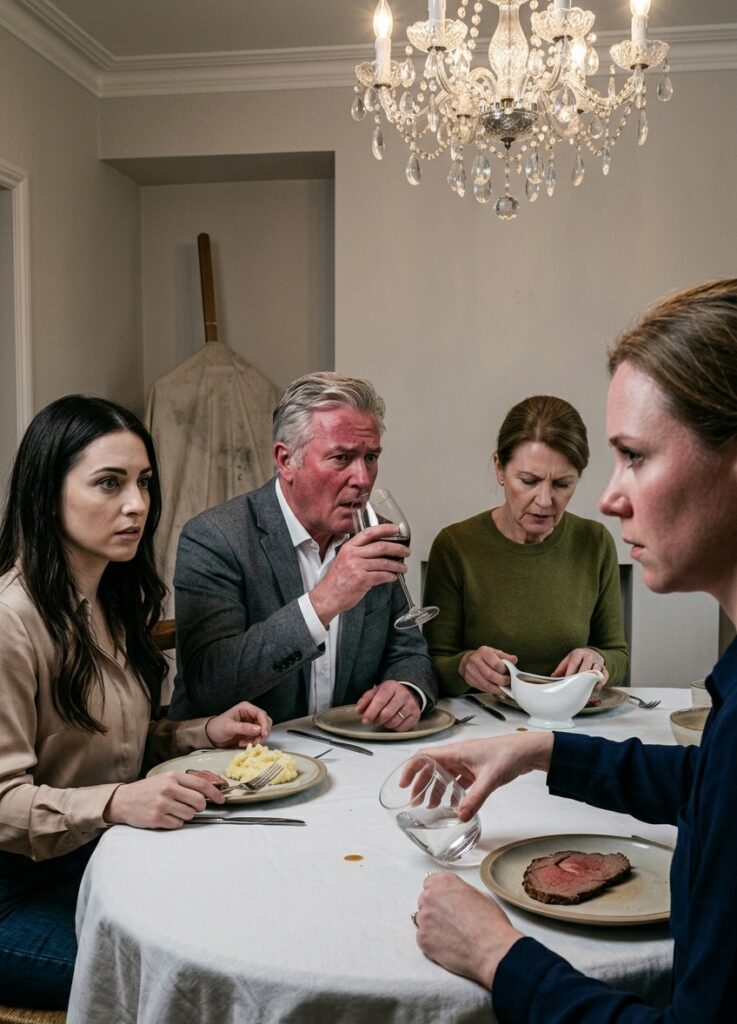
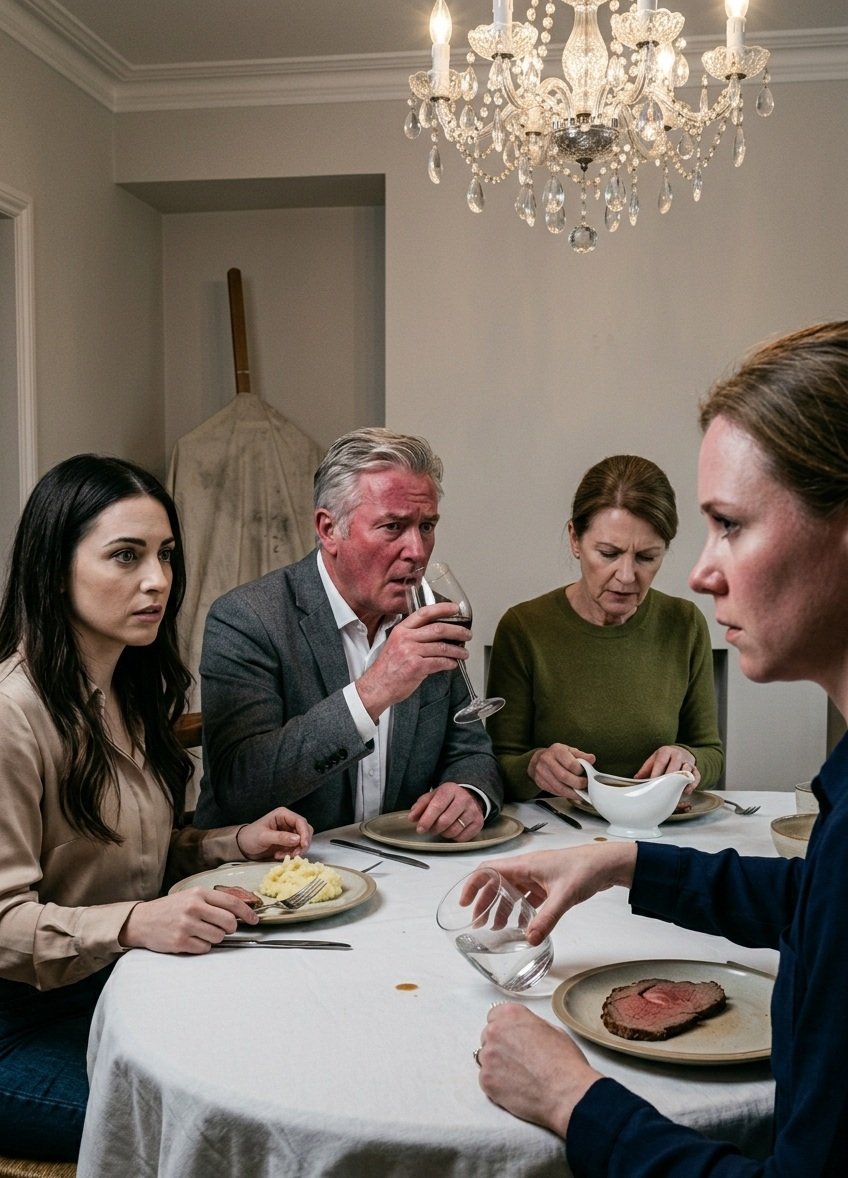
The night my father toasted the wrong daughter, I was sitting at the dining room table with a fork in my hand, a smile on my face, and sixty thousand dollars’ worth of silence burning behind my ribs. The roast beef had gone dry on my plate, the wine in my father’s glass was catching the chandelier light, and my sister Caroline was glowing like she had personally held our family together through the worst year of our lives. She sat there in her new silk blouse, her hair falling in perfect waves over one shoulder, her rings flashing every time she lifted her water glass, and she wore the soft, modest smile of a woman waiting to be praised for a sacrifice she had never made. My mother watched my father with that careful, nervous expression she always wore when he was in a mood big enough to fill a room, and I watched all of them, wondering how many times a person could swallow the truth before it started poisoning her.
My father raised his glass as though he were standing before a boardroom instead of sitting at his own dinner table, and the entire room bent toward him out of habit. That was how it had always been in the Cole house. When Richard Cole spoke, the rest of us listened; when he laughed, the rest of us smiled; when he judged, the rest of us learned where we stood. That night, his face was flushed with pride and red wine, and for the first time in months, he looked like the man he had always pretended to be: strong, successful, untouchable. He turned toward Caroline, his golden daughter, and said that she had saved them, that she had managed the mortgage, handled the finances, carried the family through disaster with grace and intelligence. Then he laughed, looked across the table at me with a pity so casual it felt like a slap, and added, “Your sister earned everything on her own, unlike you.”
For a moment, the words did not hurt because I could not feel them yet. They simply floated there above the mashed potatoes and gravy, too familiar to shock me, too cruel to ignore. My mother’s smile stiffened, but she did not correct him. Caroline lowered her eyes in the exact way she did when she wanted to look humble, though I saw the little upward twitch at the corner of her mouth. I had seen that smirk all my life. It was the expression she wore whenever she took something of mine and convinced everyone it had belonged to her all along. The old Madison would have looked down, swallowed the insult, and reminded herself that peace mattered more than pride. The old Madison would have told herself that my mother’s house was safe, my father’s dignity was intact, and my sister’s lies were a private tax I had chosen to pay. But something had changed inside me during those fifteen months, something quiet and exhausted that had finally turned hard. I placed my water glass on the table, slowly enough that it made no sound, and said, “Then I’ll stop sending money.”
The silence that followed was so sudden it felt physical, like a door slamming inside the walls. My mother’s hand trembled over the gravy boat, and a brown drop landed on the white tablecloth she had ironed that afternoon. Caroline’s fork slipped from her fingers and struck the edge of her plate before falling into her lap. My father stared at me with the puzzled irritation of a man who had just heard a servant speak out of turn. “What money?” he asked, and there it was—the first crack in the beautiful lie. He did not know. For all his arrogance, for all his praise of Caroline, for all the careless cruelty he had poured over me like cheap wine, he truly did not know that the daughter he had mocked was the only reason his house still had lights, heat, and a roof over his head.
I wish I could say I felt triumph. I wish I could say the moment tasted sweet, that after thirty-one years of being the quiet daughter, the responsible daughter, the shadow standing just outside the family photograph, I finally enjoyed watching the truth pull everyone into the light. But the truth did not feel like victory. It felt like a floor giving way beneath all of us at once. Caroline turned white, my mother began whispering my name as if she could pull the words back into my mouth, and my father’s confusion sharpened into suspicion. He looked from my face to Caroline’s, and for the first time in my life, I saw him study her not as his perfect child but as a stranger who might have deceived him. The roast cooled, the wine sat untouched, and the perfect Cole family began unraveling in the dining room my mother had polished for years to make our lives appear clean.
Before that night, before the glass finally cracked, people thought they knew us. From the outside, we were the family on the Christmas cards, the ones in matching sweaters beneath soft white lights, smiling like love had never been complicated. We lived in a handsome two-story house in a quiet Dallas neighborhood where the lawns were trimmed, the mailboxes matched, and people waved from sidewalks because everyone knew everyone just enough to pretend that knowing meant understanding. My mother planted flowers every spring, my father washed his car in the driveway every Saturday morning, and Caroline and I appeared at barbecues dressed neatly, speaking politely, standing close enough to pass for sisters who trusted each other. The neighbors called us ideal, and maybe from their windows, we were. They never saw what happened when the front door closed and the smiles loosened around our mouths like masks removed after a performance.
Inside our house, love was organized around my father’s moods. Richard Cole did not simply lead our family; he administered it. Every dinner felt like a quarterly review, every holiday like a public relations event, every failure like evidence entered into a permanent record. He believed in winners and losers, in strength and weakness, in the kind of success that announced itself loudly through expensive watches, polished shoes, new cars, and the admiration of other men at restaurants where the waiters remembered his name. He had built his career in commercial real estate, selling office buildings and negotiating leases with the theatrical confidence of a man who believed a firm handshake could bend reality. He was charming when he wanted to be, generous when witnesses were present, and impossible to please when no one was watching. His approval was not love, exactly; it was a currency he controlled, and in our family, Caroline was rich while I learned to survive on scraps.
My mother, Susan, was the person who softened the sharp edges he left behind. She was gentle in the way people become gentle when they spend years absorbing impact. She knew how to lower her voice before he raised his, how to change the subject before a dinner turned, how to excuse a cruel comment before the wounded person had time to react. When Dad told me my accounting firm sounded more like a hobby than a business, Mom found me later and said he was just worried about me. When he ignored a promotion, a new client, or a hard-won milestone I had worked months to reach, she squeezed my hand and insisted that he was proud, only busy, only distracted, only bad at showing feelings. She had spent so long translating his arrogance into concern that I wondered whether she still knew the difference. There had once been color in her. I knew because I had found an old easel under a sheet in the attic, along with dried tubes of paint and canvases covered in bright unfinished landscapes. By the time I was old enough to ask why she stopped, she had already become the woman who apologized for other people’s damage…
(I know you’re curious about the next part, so please be patient and read on in the comments below.