Part 2: Row 1
The jet bridge smelled like cold metal and jet fuel, and my father walked down it like a man returning to a house he had once lived in.
I followed a half step behind, carrying his bag and my own confusion. Twenty years I had known this man as the guy who fixed my bicycle chain and hummed off-key while he watered his tomatoes. Now I was watching flight attendants straighten their scarves as he passed.
“Mr. Whitaker,” said the lead attendant, a tall woman named Renata with silver in her braid. Her voice caught. “My father was a mechanic in Denver in 1990. He kept a newspaper clipping in his wallet until the day he died. It never had your name in it. Just the flight number.”
Dad squeezed her hand. “Then he knew what mattered.”
She led us to Row 1, and I sat beside him at the window. He looked out at the tarmac for a long moment, his fingers resting on the armrest as though testing an old friend.
“You okay?” I asked.
“Haven’t sat this close to the front in a while,” he said. “Habit still looks for the instruments.”
The engines spooled up, and I felt his hand tighten. Not fear. Attention. His eyes moved with the sound, listening the way some people listen to music.
“Number two is running a touch rough,” he murmured.
I laughed. “Dad, you haven’t flown in twenty years.”
“Doesn’t matter.” He didn’t smile. “Tell the flight attendant.”
I almost brushed it off. But something in his voice, quiet and certain, made me press the call button. Renata arrived in seconds, and I felt ridiculous relaying it, an old man’s ear against a machine built by thousands of engineers.
She didn’t laugh. She held his gaze for one second, then walked straight to the cockpit.
We did not take off on time.
Captain Miller himself came out of the cockpit, still buttoning his jacket. He crouched beside Dad’s seat, and the whole cabin went quiet, because people had figured out by then who was in Row 1.
“Thomas,” he said softly. “Maintenance ran the diagnostics. Nothing showing.”
“I’d expect not,” Dad said. “It won’t show until it’s already too late. Listen for the harmonic on spool-up. It should be smooth, and it lags on the second engine. Have them look at the fuel control unit.”
Miller studied him for a long second. Then he stood, said something into his radio, and disappeared toward the front.
I leaned close. “Dad. What if you’re wrong? They’ll have made everyone wait for nothing.”
He turned those steady gray eyes on me. “If I’m wrong, we lose forty minutes. If I’m right and say nothing, we lose a great deal more.” He patted my hand. “I spent my whole life deciding which of those two mistakes I could live with.”
Twenty-five minutes later, a maintenance crew in orange vests was standing at the wing, and one of them held up a component and waved it at the cockpit, gesturing at a hairline crack running through it. A ripple went through the cabin. Phones came out. Someone whispered fuel control unit, and someone else whispered he called it.
When the crew replaced the part and Miller announced we’d depart in fifteen minutes, the applause started again. Dad only closed his eyes and shook his head, embarrassed.
“I told you,” he muttered. “A circus.”
The flight to Denver was smooth, and somewhere over Nebraska he finally started talking.
“Your mother knew,” he said, watching clouds slide by like slow white mountains. “Everything. She held me through the nightmares for two years afterward. I never told you kids because I didn’t want to hand you that weight.”
“What kind of nightmares?”
He was quiet so long I thought he wouldn’t answer. “I see the faces of every one of them. The people in the seats. I didn’t fly that plane alone, you know. There was a flight attendant, Marguerite, who held the co-pilot steady for forty minutes. A boy of about twelve who volunteered to read me the airspeed off a broken gauge. I owe them a great deal more than they ever owed me.”
“Did you ever see them again?”
“Once. A reunion, ten years after. I stood in the parking lot for an hour and drove home.” He gave a small, rueful smile. “I told myself I didn’t deserve the gratitude.”
I looked at his hand, worn and spotted and steady on the armrest. “Dad, that’s not humility. That’s grief.”
He turned to look at me, and something moved behind his eyes. “When did you get so wise?”
“I had a good teacher,” I said. “He just never told me his qualifications.”
He laughed, a real one, loud enough that the passenger across the aisle turned and smiled.
We were an hour out from Denver when Renata returned, kneeling beside his seat and speaking low.
“Mr. Whitaker, I have something for you. It’s from a passenger in coach. She asked me to deliver it in person and said she’d understand if you didn’t want to read it.”
She handed him a folded piece of airline stationery. Dad put on his reading glasses and unfolded it slowly. I watched his lips move, watched the color leave his face.
“Dad?”
He handed the note to me without a word.
Captain Whitaker, I don’t know if you’ll remember a twelve-year-old boy in seat 23C who read you numbers off a broken gauge. My name is Daniel Reyes, and I’ve spent thirty-four years trying to find you. I’m on this flight by coincidence. My wife says there’s no such thing. I’ve been telling my own son your story since he could walk. He’s seated beside me, and he’d like to shake your hand.
But there’s something else you should know. I never told anyone this. When we landed, I found something in the cockpit that wasn’t in any report. I’ve carried it for three decades, and I think it belongs to you.
I looked up. Dad’s hands were trembling.
“Dad, what could he have found?”
He didn’t answer. He was staring past me, down the long aisle of the plane, where a gray-haired man in a wrinkled blue shirt had risen from a seat in coach and was walking slowly toward Row 1, holding something small in his closed fist.
Part 3: What Daniel Carried
The man stopped at the curtain between coach and first class. Up close, he looked like someone who had been holding his breath for thirty-four years and had only just been told he could exhale. His eyes were wet, and the closed fist he held against his chest was trembling.
Beside him stood a teenage boy, maybe sixteen, with the same jaw and the same wide, frightened eyes.
“Captain Whitaker,” Daniel Reyes said. “I’m sorry. I know this is an intrusion.”
Dad removed his glasses and folded them slowly. “Son, you read me airspeed through a blizzard with your voice steady the whole time. You have never once been an intrusion.”
Daniel let out a sound that was half laugh and half sob. He crouched beside Row 1 so they were eye to eye, and the teenager hovered behind him, unsure where to put his hands.
“This is my son, Mateo,” Daniel said. “Mateo, this is the man from the stories.”
“Sir.” Mateo’s voice cracked. “I wrote a school report about you. I didn’t think you were real. I mean, I thought you were real, but like… a legend. Like a person from a book.”
“I’m mostly a man with a bad hip,” said Dad, and he extended his hand. Mateo shook it with both of his own.
Daniel opened his fist.
In his palm lay a small, scratched, brass-colored object, the size of a thumbnail. It took me a moment to recognize it as a key, a tiny one, the kind that opens a lockbox or a briefcase.
“When we landed,” Daniel said, “they evacuated us down the slides in the dark. I was last, because I wouldn’t leave my seat until the flight attendant, Marguerite, told me I could. She was hurt. She’d been holding the co-pilot’s head for forty minutes. On the way out, I passed the cockpit door, and it was open, and you were gone. Already out. Checking the gear, I think.” He swallowed. “This was on the floor beside the pilot’s seat. It had slid under the rudder pedal. I picked it up without thinking. I was twelve. Then the paramedics grabbed me, and by the time I remembered, the investigators had sealed everything.”
“Why didn’t you give it to anyone?” I asked.
“I tried.” Daniel looked embarrassed. “I called the airline the following week. A man told me the case was closed and thanked me for my concern. Then I saw that the hearing had already blamed the crew’s incapacitation on de-pressurization debris and closed it. I was a kid. I figured it didn’t matter. And then years passed, and the key became something I couldn’t throw away, and I couldn’t explain.”
Dad picked the key up between two fingers. He turned it slowly under the reading light. His face had gone still in a way I had only seen once before, at my mother’s funeral.
“Dad,” I said. “Do you know what it opens?”
“I do.” His voice was very quiet. “It’s the lock on a flight data case. A personal one. I kept my own notes in it, back then, in the Air Force. Test pilots do. Little things the official recorders don’t capture.” He closed his hand around the key. “I thought I lost it in the crash. I told myself it burned.”
“What was in it?”
He looked at me, and then at Daniel, and something like fear crossed his features. It was the first fear I had seen in him all day, and it was far worse than anything I had witnessed at the security line.
“Not the case,” he said. “The case would be in the wreckage vault. But I know what I wrote in it the night before that flight. And I know why I never wanted anyone to open it.”
The seatbelt sign chimed. We were descending into Denver, the Rockies rising in the window, white and enormous. I remembered that somewhere in those mountains, on a night in 1990, my father had held two hundred lives in his hands.
Daniel and Mateo returned to their seats. Renata brought Dad a glass of water, and he didn’t drink it. He watched the peaks slide by, the key still hidden in his fist.
“Tell me,” I said quietly.
For a long time, he said nothing. Then, without looking at me:
“The night before Flight 418, I was in Denver. Off duty, working my maintenance job. I inspected that airframe at the hangar. Number three hydraulic line. I found a chafe in the housing. Small. Within limits on paper, but I didn’t like it.” He paused. “I wrote it up. My supervisor signed it off as acceptable. He said the schedule couldn’t afford a delay. I argued. He overruled me.”
My stomach dropped. “Dad.”
“I wrote it all down that night, in my own notebook, in that case. Time, tail number, the supervisor’s name, what he said. Then I went to sleep. And the next morning I boarded that plane as a passenger, because I was traveling to see your mother’s parents, and I told myself it was fine.”
“And when the hydraulics failed…”
“I knew before anyone else did.” His jaw worked. “I knew exactly what had happened and exactly whose decision had caused it. The investigation blamed debris. It was easier. It kept the airline’s insurance clean and a supervisor’s career intact.” He finally looked at me. “I had a notebook that could have changed the finding. And I let it burn, because I thought it had. And because a small, ashamed part of me was relieved. If I’d come forward, I’d have been the man who wrote the warning and boarded anyway.”
“You saved everyone on that plane.”
“After I could have prevented the plane from needing saving.” He said it flatly, the way a man reads a sentence handed down long ago. “That’s the weight I carried, sweetheart. Not the crash. The choice before it.”
I put my hand over his. It was all I had.
The wheels touched down in Denver with barely a bump. Passengers clapped, and Dad didn’t hear it. He was looking at the tiny brass key.
At the jet bridge, someone was waiting.
Not an airline official. Not a photographer. A woman, in her seventies, gray hair pinned up, standing very straight with a cane of her own. Beside her was a younger man in a dark suit holding a slim leather folder.
When Dad appeared in the doorway, her hand flew to her mouth.
“Thomas,” she said. “Oh, Thomas.”
“Marguerite,” said my father.
They stood there for a long moment across ten feet of carpeted floor. Then she crossed it and threw her arms around him, cane clattering to the ground, and I watched my eighty-one-year-old father, the man who never cried, hold on to a woman he had last seen in a parking lot thirty-four years ago and finally let go.
When they separated, she wiped her eyes and looked at the man in the suit.
“This is Ethan Cole,” she said. “He’s an attorney with the National Transportation Safety Board. Thomas, he came to me last month. A reopened inquiry. New documents have surfaced from the airline’s archive. Someone finally leaked them.” She took a breath. “They say the supervisor’s sign-off on that hydraulic housing was backdated.”
Dad went absolutely still.
Ethan stepped forward and opened the folder. Inside was a photocopy of a handwritten page, brittle and yellowed, its top corner scorched at the edge. The ink was faded, but I could read the heading, and I recognized my father’s blocky capitals.
TAIL 7-1-4. HYD LINE 3. CHAFE AT HOUSING. RECOMMEND GROUND.
“Captain Whitaker,” said Ethan gently, “this was recovered from the archived personal effects of the deceased maintenance supervisor. His family found it in a safe-deposit box after he passed. He kept your original notebook page for thirty-four years. He never destroyed it.”
My father stared at his own handwriting from a lifetime ago.
“He kept it,” Dad whispered. “Why would he keep it?”
Ethan turned the page over. On the back, in a shaky hand, was a single line written much later, in different ink.
He was right. I let it go. God forgive me. If anyone ever finds this, tell Thomas Whitaker I’m sorry.
The jet bridge was silent. Behind us, passengers were still filing off the plane, murmuring, slowing as they passed.
Marguerite took my father’s hand. Daniel Reyes stood a few feet away with his son, tears running openly down his face.
“The NTSB has a formal proposal,” Ethan said. “A corrected finding. The record would show the failure was preventable, that it was a maintenance sign-off, and that the flight was saved by the crew and passengers, with Captain Whitaker at the controls.” He hesitated. “It would also name you as the man who flagged the defect. Publicly. It would end thirty-four years of silence.”
I watched my father’s face. All those years of avoiding the reunion, the medals, the cameras. I understood it now, that it had never been humility. It had been a wound he didn’t want anyone to touch.
“Thomas,” said Marguerite softly. “You’ve been carrying a debt that was never yours. Let them take it off you.”
He looked at the key in his hand. Then at Daniel and Mateo. Then at me.
“Your daughter’s wedding is tomorrow,” he said, his voice hoarse. “I’d meant to walk her down the aisle and go home.”
“You can still do that, Dad.”
“And after?” He gave a strange, helpless smile. “After, I suppose I’d have to stand in front of a room full of cameras and tell the truth.”
“You told it today,” I said. “At every step. To a nurse who wanted the truth from someone and a stranger who cut in line.”
He blinked, then laughed, cracked and startled.
“That’s not the same story,” he said.
“It’s exactly the same story,” I said. “Somebody has to tell the truth out loud, even if their voice shakes. Especially then.”
Dad closed his eyes. For a long moment he stood in the jet bridge with two hundred strangers slowly pooling behind him, and I watched thirty-four years of silence settle and begin to lift.
Then he opened his eyes and turned to Ethan Cole.
“Before I answer,” he said, “I need to ask you one thing. The supervisor who backdated that sign-off. You said he’s deceased.”
“Yes, sir. Nine years ago.”
“Who was he?”
Ethan hesitated, glancing at the folder. Then he said the name.
I didn’t recognize it. But Dad did. I saw it hit him like a physical blow, and Marguerite’s grip tightened on his arm.
“That’s impossible,” my father said. “That man was my best friend. He was the best man at my wedding. And he was standing in the back row at my daughter’s baptism.”
He turned slowly to face me, and in his eyes was a question I couldn’t yet answer.
“Which means,” he said, “that tomorrow, at your daughter’s wedding, I’m going to be sitting across from his son.”
The rehearsal dinner was that night, in a rented restaurant with strings of lights across the patio and the Rockies going purple behind it. My daughter Hannah was radiant. Her fiancé, Ben, kept looking at her as though he couldn’t believe his luck. And at the far end of the long table sat Paul Hale, Ben’s father, a tall, soft-spoken man in his fifties who had been kind to my family for two years and had never once mentioned his own father’s name.
That was the piece I’d missed. Paul had taken his mother’s maiden name after his parents divorced. I had only ever known his father as “Uncle Walt,” the man who taught me to skip stones at the lake when I was seven. It never occurred to me that Uncle Walt had a son who would someday marry into my family.
Dad said nothing through the salad course. He ate slowly, one hand resting near his cane, the little brass key back in his pocket. Marguerite had gone to her hotel, and Ethan Cole had promised to give us the night. When the plates were cleared, Dad set his napkin on the table and stood.
“Paul,” he said. “Would you walk with me?”
Paul’s face went the color of paper. He rose without a word.
I followed them at a distance to the edge of the patio, where a stone wall looked out over the city lights. I told myself I was only worried about Dad’s balance. Really, I was afraid of what I’d hear.
“You knew,” Dad said. It wasn’t a question.
Paul gripped the wall with both hands. “I found it four months ago. After Dad’s house sold, there was a safe-deposit box nobody had opened. I saw my father’s handwriting on the back of your page.” His voice shook. “I read it, and I couldn’t breathe. I sat in the bank parking lot for two hours.”
“You sent it to the NTSB.”
“Anonymously. I couldn’t put my name on it. I thought if I did, you’d look at Ben and Hannah and think…” He stopped. “I thought you’d think the family was rotten, and you’d stop the wedding. And I couldn’t bear to be the reason. Ben doesn’t know. Nobody does.”
Dad was quiet for a long moment. The wind lifted the edge of his jacket, and the silver wings caught the string lights.
“Paul,” he said. “How old were you in 1990?”
“Twenty-one.”
“Old enough to be told nothing, young enough to be afraid of your father.” Dad shook his head slowly. “I’ve spent thirty-four years angry at a man I loved. When Walt died, I didn’t go to the funeral, because I couldn’t stand in the room and grieve someone I’d never confronted. That’s my failing. Not yours.”
“He kept your page,” Paul whispered. “Thirty-four years. He couldn’t destroy it and he couldn’t confess. I think it ate him alive.”
“I think it did.” Dad’s voice roughened. “He was my best friend, Paul. I could have called him a thousand times. He could have called me. Two proud fools, each waiting for the other to speak first.” He reached out and set a weathered hand on Paul’s shoulder. “You did the brave thing. You handed the truth to strangers, and that’s how it finally reached me. I won’t have you carrying his debt either.”
Paul bowed his head, and his shoulders began to shake. My father, who had never learned how to be thanked, simply stood there with his hand on the man’s shoulder until the crying ran its course.
When Paul finally looked up, wiping his face, he managed a broken laugh. “Ben’s going to ask why I’m a wreck.”
“Tell him the truth,” Dad said. “All of it. Tomorrow, after the ceremony. Nobody should learn a thing like this from the news.”
The next morning, Ethan Cole came to our hotel with a small case in his arms.
It was scorched along one edge and dented on the corner, its lid discolored by decades in a federal evidence vault. The NTSB had found it in the wreckage archive, logged as personal effects and never opened. When Dad saw it, he sat down heavily on the hotel bed.
“They kept it,” he said. “All this time.”
He fitted the tiny brass key into the lock. It turned with a small click, and Hannah, who had come to sit beside him in her robe, curlers still in her hair, took my hand.
Inside were three things: a notebook with a cracked leather cover, a folded Air Force patch, and a photograph of my mother, young and laughing, on the beach at Galveston.
Dad turned the notebook’s pages carefully. He stopped at the last entry, dated the night before the crash, and read it aloud in a low voice.
Told Walt again about line 3. He says he’ll push it through after the holiday rush. He looked tired. I trust him. If anything goes wrong, it won’t be from lack of trying on either side. Going to bed. Early flight to see Ruth’s folks. I hope it’s a quiet one.
He closed the notebook.
“I’ve spent thirty-four years believing I wrote that page as a case against him,” Dad said. “But look at it. I wrote it as a note to myself from a man who trusted his friend.” He looked at me, and his eyes were clear for the first time in three days. “I was wrong about what I was carrying. It was never a weapon. It was a record of how much I believed in him.”
Hannah leaned her head on his shoulder. “Grandpa. It’s okay to forgive him.”
“I think I already have,” he said. “I just needed somebody to hand me the paper.”
The wedding was at four, in a garden with a view of the mountains and an arch woven with white roses. Hannah wore my mother’s pearls.
Dad walked her down the aisle. He set his cane aside and took her arm, and every guest saw a man of eighty-one walk without it, straight-backed, slow and steady, like a pilot on a long approach he’d flown a thousand times. Halfway down, Hannah whispered something to him, and he laughed, and the sound carried across the garden.
At the arch, he lifted her veil, kissed her forehead, and placed her hand in Ben’s. Then he took his seat in the front row, beside Marguerite, who had come in a lavender dress with her cane hooked over her arm.
Across the aisle sat Paul Hale, gripping his program, staring straight ahead. Dad looked over, caught his eye, and gave him one small nod.
Paul’s whole face crumpled, and then, slowly, he smiled.
At the reception, Dad was asked to say a few words. He’d told me privately that he would keep it short.
He stood at the head of the long table, the mountains turning gold behind him, and tapped his glass once.
“I’m not much for speeches,” he began. “I spent most of my life making sure nobody noticed me. Turns out, that’s a poor way to live.”
A quiet rolled through the tent.
“Yesterday, a woman told me I should learn how airports work.” Laughter rippled, and Dad smiled. “She wasn’t wrong. I’ve been avoiding the terminal for thirty-four years. I hid in a backyard with a tomato garden, and I told myself it was for my children’s sake. It was partly true. But mostly I was afraid that if anyone looked too closely, they’d see how much I wished I could go back and do one thing differently.”
He looked toward Paul, and then toward Hannah.
“Here’s what I learned this week. A life isn’t a single mistake and a single rescue. It’s a long chain of people who trusted each other, and failed each other, and forgave each other. A twelve-year-old read me numbers in a blizzard. A friend kept my handwriting in a box for three decades. A stranger cut in line and taught my daughter to speak up.” He raised his glass. “None of us gets through alone. To Hannah and Ben. May you fail each other gently, forgive each other quickly, and never wait thirty-four years to say what needs saying.”
“To Hannah and Ben,” said two hundred voices.
Then Paul Hale stood, crossed the tent, and embraced my father. Neither of them said anything. Ben, standing beside his new wife, watched with a stunned face, and Hannah leaned over and whispered, I’ll explain later. By midnight, the whole family knew, and nobody left.
The NTSB corrected the record three months later.
It was a quiet hearing, no cameras, a conference room in Washington with a plain wooden table. A federal board read out the finding, that the loss of hydraulic pressure on Flight 418 had resulted from a chafed line that a maintenance technician had flagged and a supervisor had cleared under schedule pressure, and that the aircraft’s survival was due to the extraordinary actions of the crew and of passengers, notably Thomas Whitaker, who had flagged the defect and later flown the aircraft to safety.
The airline issued a formal apology. It named Marguerite, and Daniel Reyes, and the flight attendants, and every one of the hundred and eighty-four.
Afterward, there was a small ceremony in the lobby. Someone handed Dad a plaque. He took it with both hands, said “thank you,” and passed it to Daniel’s son, Mateo, who stared at it as if it might vanish.
“You should keep it,” Mateo said.
“You wrote the school report,” Dad said. “You keep it. I already have everything I need.”
He never gave a press conference. Some things stay private, and I’ve learned to respect that. But he did agree to one thing.
Twice a year, he flew.
Not as a hero, and not in the front row. He flew as an old man with a cane, in a middle seat in coach, in a cardigan Hannah knitted him. He visited the mountain towns in Colorado and Wyoming, and he spoke to groups of young mechanics, apprentices, maintenance crews, the people who work in hangars and rarely get thanked.
I went with him once. He stood in front of forty young technicians in coveralls and said one thing I’ve never forgotten.
“If your gut says something’s wrong, write it down. Then say it out loud. Then say it again. The paperwork doesn’t get to overrule your conscience.”
They gave him a standing ovation. He thanked them and sat down, blushing, and muttered to me, “I told you. A circus.”
But he was smiling.
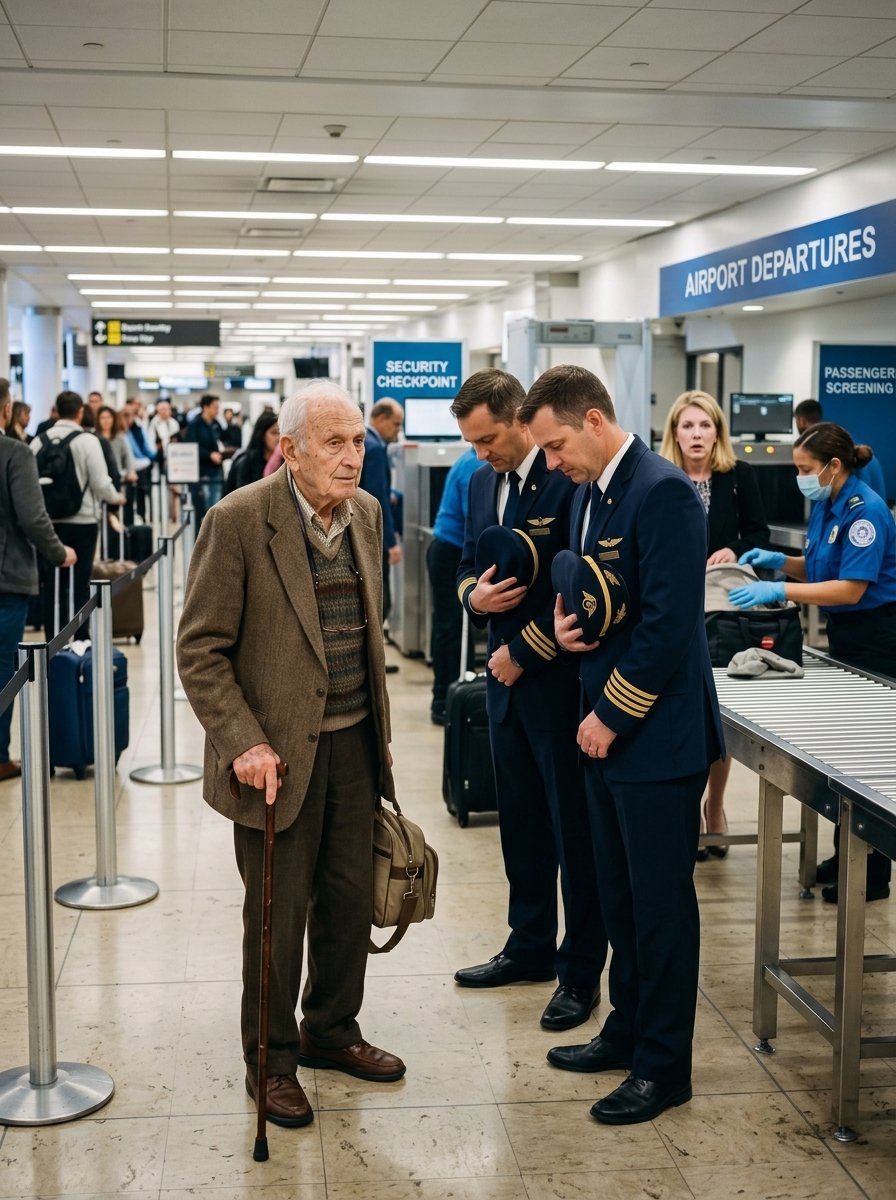
The last time I saw him board a plane, he was eighty-three. The security line was long, and we were somewhere in the middle of it. A young man in front of us, in a rumpled shirt, was struggling with his laptop. Dad tapped him on the arm.
“Take your time, son,” he said. “We’ve got all day.”
The man turned, startled, and then flashed a grateful, embarrassed grin. “Thanks, sir. Sorry. I’m the slow one.”
“Everyone’s the slow one sometimes,” said my father. “That’s why we wait for each other.”
We stepped forward. The line moved. Far ahead, past the metal detectors, a pair of pilots in dark uniforms walked by, glancing at Dad’s jacket. One of them, a young woman with a brisk stride, slowed for a moment, and I saw her eyes catch on the small silver wings pinned inside his lapel.
She didn’t stop. She didn’t remove her cap. She only smiled, touched two fingers to her brow in the quietest salute, and kept walking.
Dad lifted his cane in reply.
Then he took my arm, warm and steady, and we walked down the terminal toward the gate. The windows showed a wide blue sky, a runway shimmering in the morning light, and a plane waiting for its passengers.
“Ready?” I asked.
My father looked out at the sky the way he’d looked at it his whole life, with a pilot’s respect and an old man’s peace.
“Always,” he said.
The End.