I found $18,940 hidden inside Mama’s flour tin three days after her funeral.
My brother Russell said it was probably money she had forgotten about. Nearly nineteen thousand dollars, and he thought she just forgot. I didn’t say anything. I just stared at the bundles of cash sitting where flour should have been, rubber bands brittle with age, and tried to understand why Mama had forbidden us to touch that tin for my entire life.
Then I found the note underneath the last bundle.
The first line said, “I’m sorry, Linda.”
The second line mentioned my stepfather Wayne.
The third line told me to take the sealed envelope to First County Bank before I spoke to anyone else.
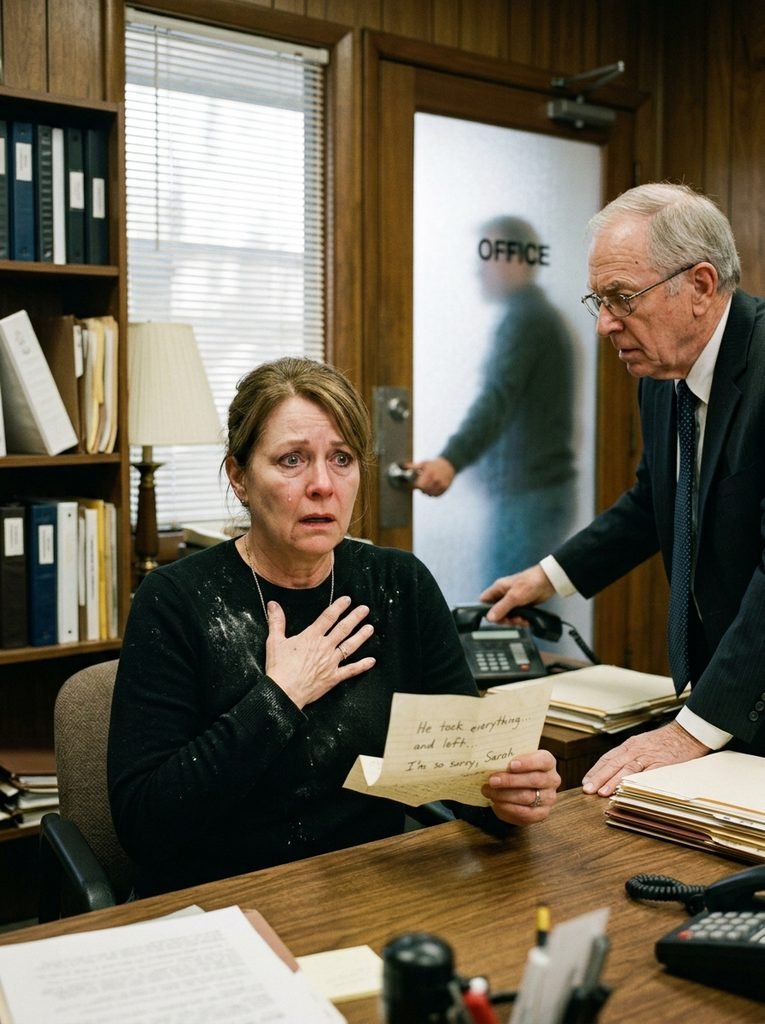
At five that afternoon, I walked into the bank with flour still dusted across my black sweater. The branch manager saw my name on the envelope and immediately locked the office door. That was when I realized Mama had not been saving this money. She had been hiding it because she was afraid of someone.
Mama’s pantry was barely wider than a hallway, but she treated it like a vault. Canned vegetables were arranged by expiration date. Sugar sat in an old glass jar. Coffee filters stayed in the same yellow container she had owned since I was a teenager. And on the highest shelf sat a white enamel flour tin with blue chips around the rim.
We were never allowed to touch that tin.
When I was twelve, I reached for it because I wanted to make biscuits. Mama slapped my hand away so quickly that I dropped the mixing spoon. She apologized later. She made me hot chocolate and kissed my forehead. But she still put the tin back on the highest shelf.
“Never open that,” she said.
I thought it was one of those strange rules children accept without understanding. After Mama died at seventy-eight, I finally understood that some rules are not about the object. They are about what the object contains.
Russell wanted the house emptied within two days. He kept checking his phone and complaining about his camper payment. He said he needed to get back to Memphis. So while he wrapped the television remote in newspaper, I took the kitchen.
The house smelled exactly like Mama. Cinnamon, dust, lemon oil. Every drawer contained something she had saved because she believed someone might need it someday. I filled one box with things for donation. Eleven cans of beets nobody wanted. A cracked measuring cup. Three jars of buttons. A stack of grocery coupons from six years earlier.
Then I reached for the flour tin.
It was heavier than it should have been. I set it on the counter. Russell walked in and looked at the tin, then at me, then at the tin again.
“What’s that?”
“I don’t know.”
I opened it. There was no flour. Just bundles of cash. Twenties, fifties, hundreds. I counted it twice. $18,940.
Russell stared at the money. Then he laughed. “Probably grocery money she forgot.”
Forgot. Nearly nineteen thousand dollars inside a flour tin she had forbidden us to touch for decades.
I reached underneath the last bundle and found an envelope. My name was written across the front. Linda. Not Russell. My hands began shaking.
Russell stepped closer. “What’s that?”
I pulled it toward me. “It’s mine.”
He stopped. I opened it. The first sentence made my stomach drop.
*I’m sorry, Linda.*
The next sentence made me sit down.
*I should have told you what Wayne did with your settlement.*
Wayne had been my stepfather. He died six years earlier. For years, I believed he had been the one adult in our family who knew how to handle money. That belief lasted until I was seventeen, the summer a delivery truck hit me outside a grocery store. I spent nine weeks in a cast, then almost a year learning how to walk without pain.
There had been a settlement. Not a fortune, but enough to change my life.
Wayne told me the medical bills had consumed almost all of it. Mama cried when he explained it. I assumed she was crying because she was worried about me. I never questioned the money again.
Until that afternoon.
Russell saw my face. “Don’t start digging up old stuff.”
“Why?”
He shrugged. “Because he’s dead.”
“That doesn’t answer my question.”
Russell reached for the envelope. I pulled it away. His expression hardened.
“Linda.”
“What do you know?”
“Nothing.”
“You just told me not to investigate.”
“Because Mama’s gone and you’re upset.”
“No.” I looked down at the note. “I’m upset because she left this for me.”
The envelope contained three pages. The first explained the accident. The second explained the settlement. The third was sealed separately. Mama had written across it in large letters: *READ THIS AT FIRST COUNTY BANK. NOT IN THE HOUSE.*
Russell stared at the sealed page. “Open it.”
“Why?”
He hesitated. Then he said something that told me more than he intended. “Because whatever’s in there, it’s probably nothing.”
I folded the page. “You don’t sound very sure.”
He walked away. I watched him leave, then put the cash back into the flour tin. I took the envelope and put the sealed page inside my purse.
The bank lobby was nearly empty when I arrived. A woman behind the counter smiled politely.
“How can I help you?”
I gave her my driver’s license and placed Mama’s envelope on the counter. “I need to speak with the branch manager.”
She looked at the envelope. Her expression changed. She picked up the phone.
“Mr. Bennett, I have a Linda Carter here with a sealed envelope from Margaret Carter.” A pause. “Her daughter.” Another pause. “Yes, sir.”
She hung up. “Please follow me.”
I walked through a locked door into a small office. The branch manager stood beside his desk. He was an older man with silver hair and a tie that looked too formal for a Friday afternoon. He looked at my identification, then at the envelope, then back at me.
“Did you open the sealed page?”
“No.”
“Good.” He closed the office door. “Your mother came here twelve years ago.”
I sat down. “Why?”
“She asked us to hold several documents.”
He reached into a cabinet and placed a thick file on the desk. My name was written on the tab. Linda Carter.
“I’ve never seen that.”
“I know.”
He opened the file. Inside were settlement records. Bank transfers. Copies of checks. Account statements. And one document that made my hands go numb.
The settlement had not been spent on my medical bills. Almost none of it. Most of the money had been transferred into an account I had never known existed. The account had been opened in Wayne’s name, but there was another authorized signer.
Mama.
I looked at the manager. “She knew?”
“She knew eventually.”
“Why didn’t she tell me?”
He lowered his eyes. “Because she was afraid.”
“Of Wayne?”
He nodded. “Your mother came here after discovering that the settlement money was gone.”
“Why did she wait so long?”
“She didn’t.” He turned another page. “She came here six months after your accident.”
I stared at the date. Six months. Not years. Not decades. Six months. Mama had known almost immediately and had spent the next fifty years carrying the secret.
The manager slid another document toward me. “This is why she asked us to keep the file.”
I read the sentence. *If anything happens to me, give this to Linda.*
“Did she know something was going to happen?”
“No.” He paused. “She believed Wayne would eventually come looking for the money.”
“Most of the settlement was gone.”
He shook his head. “Not all of it.” He pointed to another account. My mother’s name. “Your mother deposited small amounts here over many years.”
I stared at the balance. $18,940. The exact amount inside the flour tin.
She had been rebuilding what Wayne had taken. Twenty dollars at a time. Fifty dollars. Sometimes a hundred. Whatever she could save without him noticing. The money in the flour tin was not forgotten grocery money. It was restitution. Mama had spent decades trying to return something she believed she had stolen from me by staying silent.
I wiped my eyes. Then I remembered Russell.
“Why did my brother know?”
The manager became quiet. “I can’t answer that.”
I closed the file. “Can you answer one other question?”
“Yes.”
“Was Russell ever listed on this account?”
He looked at the paperwork, then slowly nodded. “Yes.”
My stomach dropped. “When?”
“Eight years ago.”
“Why?”
He turned the page. “He requested a withdrawal.”
“Of how much?”
The manager looked directly at me. “$18,940.”
I stopped breathing. The flour tin. The exact amount. Russell had not been surprised because he thought Mama had forgotten the money. He had recognized it. He knew exactly what it was.
I looked at the sealed page in my purse. Suddenly, I did not want to open it.
The manager watched me. “Your mother told me something else.”
“What?”
“She said if you ever came here with that envelope, you were supposed to be told the truth before reading the final page.”
“What truth?”
He hesitated. “Wayne did not steal your settlement alone.”
My entire body went cold. “Who helped him?”
The manager looked at the clock, then toward the locked office door. “I think you already know.”
My phone began vibrating. Russell. I stared at his name. The manager glanced at the screen.
“Don’t answer.”
“Why?”
“Because your mother specifically instructed us to call the police if Russell came to this branch after you arrived.”
The phone stopped, then started again. This time, a text appeared. *Linda, come home. We need to talk.*
I opened the sealed page. Only four lines were written inside.
*Linda, if the bank showed you the account, then Russell has already asked for the money. Do not trust him. And whatever he tells you about Wayne, remember this: He was there the night I found out where your settlement went.*
My hands went numb. Because Russell had told me for fifty years that he was asleep that night.
The branch manager looked at my face. “What did she write?”
I slowly lowered the paper. “My brother was there.”
Then the office door handle moved. Someone outside tried the locked door. Once. Twice.
The manager stood. “Stay here.”
A man’s voice came through the glass. “Linda.”
Russell. His voice was calm now. Too calm.
Then he said the one thing that made the branch manager reach for the phone. “Your mother didn’t hide that money from me. She hid it from you.”
I looked at Mr. Bennett. He was already dialing. I heard him speak quietly to someone on the other end, giving the address, asking for an officer.
Russell knocked again. “Linda, I know you’re in there. Just let me explain.”
I wanted to open the door. I wanted to hear what explanation could possibly make sense of fifty years of silence. But I looked down at Mama’s handwriting again. *Do not trust him.*
“Ma’am,” Mr. Bennett said quietly, “the police are three minutes away.”
Russell’s voice changed. “She was going to tell you eventually, Linda. That money was supposed to go to both of us. Wayne promised.”
I stood up. I walked to the door but did not unlock it. “You were seventeen, Russell. I was the one who got hit.”
Silence.
Then, quieter: “I know.”
“So why?”
“Because he said we were family. He said family shares everything.” His voice cracked. “I was seventeen and stupid and he made it sound like the right thing to do.”
“And Mama?”
Another long silence. “She found out six months later. She was going to leave him. She was going to tell you. But he said if she did, he’d make sure you never saw a dime. He’d say she took it. He’d make her look like the thief.”
I pressed my hand against the door. “So she stayed.”
“She stayed.”
“And you let her.”
“I was a kid, Linda.”
“You were old enough to take money that wasn’t yours.”
I heard him exhale. “I tried to pay it back. Eight years ago, I asked the bank for a withdrawal. I was going to give it to you. Tell you everything.”
“But you didn’t.”
“Because Mama wouldn’t let me. She said it had to come from her. She said she was the one who owed you the truth, not me.”
Mr. Bennett touched my shoulder and shook his head. He mouthed, *Wait for the police.*
But I needed to hear the rest. “Why now, Russell? Why did she wait until she was gone?”
“Because she was ashamed.” His voice broke. “Because she spent fifty years hating herself for choosing him over you, and she couldn’t look at you and say it out loud.”
I leaned my forehead against the door. For fifty years, Mama had carried the weight of a choice she made to protect me from a man who had already taken everything. And I had never known.
Two police officers arrived four minutes later. They took Russell outside. They asked him questions I could not hear. Mr. Bennett gave them copies of the account records, Mama’s letter, the withdrawal request from eight years ago. I sat in the office and stared at the file with my name on it.
One of the officers came back inside. “Ma’am, we’d like to ask you a few questions.”
I nodded.
“Did your brother threaten you?”
“No.”
“Did he try to take anything from you?”
“No.” I looked up. “He tried to explain.”
The officer wrote something down. “Your mother left instructions with the bank. She was concerned about your safety if your brother discovered the money before you did.”
“Is he going to be arrested?”
“Not tonight. But we’ll need to investigate the original settlement situation. If there was fraud involved, there may be charges.”
I thought about Russell standing outside, fifty years older than the kid who made one terrible choice. I thought about Mama, saving twenty dollars at a time for decades. I thought about Wayne, who had been dead for six years and still managed to ruin everything.
“I don’t want to press charges,” I said.
The officer looked at me. “Ma’am, this is a significant amount of money.”
“I know.” I picked up the flour tin money, still bundled in Mama’s rubber bands. “But my mother already gave me what I needed.”
The officer left. Mr. Bennett walked me to my car. The sun was setting, and the bank parking lot was empty except for Russell’s truck and the police cruiser.
Russell was sitting on the curb. He looked up when he saw me.
I stopped a few feet away. For a long moment, neither of us spoke.
Finally, he said, “I didn’t know what else to do.”
I nodded. I didn’t have anything else to say either.
The officer walked over. “Ma’am, you’re free to go.”
I looked at Russell one more time. He looked smaller than I remembered, sitting there on the curb with his hands between his knees. For fifty years, we had both been living inside Mama’s secret, neither of us knowing the other was there.
I got in my car. I put the flour tin on the passenger seat. And I drove home with $18,940 that my mother had saved twenty dollars at a time, trying to give back what she thought she had stolen by staying silent.
She had been wrong about that. She hadn’t stolen anything from me. She had given me fifty years of not knowing how much it cost her to stay.