For illustrative purposes only
Disappearance doesn’t usually begin with a slammed door.
It begins with small surrenders—one swallowed sentence, one missed call you tell yourself you’ll return later, one holiday you “reschedule” because you can’t stand the look on their faces. It begins quietly, almost politely, until one day you realize the space you meant to take for a weekend has turned into a decade.
I never planned to disappear from my children’s lives. I didn’t wake up and decide to be the kind of father they talk about in therapy, the kind they love in spite of. I became him by inches, the way rust eats metal.
It started the year I turned twenty-five, in a small Ohio town where everyone knew my name and still misunderstood my story.
Rachel and I married young—nineteen, technically adults, practically kids who had discovered what it felt like to be chosen. Love was loud then. The future looked like something you could outrun if you ran fast enough. We rented a cheap apartment above a pawn shop and called it “our place” like the words could make it sturdy. We bought rings on credit and held our hands up in every photo, proud of the shine, proud of the idea that we were doing what adults did.
We promised forever the way teenagers do—without imagining how long that word actually is.
By twenty-five, we had three kids.
Jason was first. He came into the world with fists curled and eyes wide, like he had questions from day one. When he learned to talk, he never stopped. He wanted to know why the sky changed colors at sunset, why dogs didn’t talk, why the neighbor’s truck made a different sound than mine. He could take apart a toy in ten minutes and put it back together wrong but improved. I used to call him my little engineer.
Emily followed two years later, softer around the edges, observant in a way that made adults careful. She’d sit on the couch with a book and look up at the exact moment a conversation turned tense. She noticed when my smile was forced, when Rachel’s laugh didn’t match her eyes. She would ask, “Are you okay?” at the worst possible time, like she could smell honesty.
Sarah came last, small and bright, always reaching for someone’s finger as if she could anchor herself to love. She was the kid who waved at strangers in grocery stores and made old ladies smile. She learned to walk by holding the coffee table and my hand in alternating turns, wobbling like a baby deer, giggling like the world was safe.
From the outside, we looked like a family built the right way: young parents, three kids, a little rental house with a squeaky porch step and a secondhand minivan. People at church would squeeze Rachel’s arm and say, “You’re blessed.” Men at my job would clap my shoulder and joke, “Man, you’re outnumbered.”
Inside, something had already started to crack.
At first I blamed money. I blamed exhaustion. I blamed the way adulthood keeps moving even when you ask it to slow down. We were always calculating—diapers, groceries, rent, a surprise doctor bill that ate our savings. I worked at an auto parts warehouse, forklift in the morning, overtime when it was offered, because the kids needed shoes and the van needed brakes and the future didn’t care about my sleep.
Rachel picked up shifts at a local clinic. She was good with people—warm voice, practiced smile. She came home tired and sometimes irritable, but that felt normal. We were building a life. Life is heavy when you’re building it.
Then Rachel changed in ways I couldn’t name at first.
A phone turned face down. A passcode that changed. “Late shift” texts that arrived with too much perfume on the words. She started taking her showers right when she got home, as if she needed to rinse off the day before she could talk to me. She laughed at messages she wouldn’t show me, then said, “Oh, it’s nothing,” too quickly.
I told myself marriage was supposed to be work. I told myself suspicion was a flaw in me. I swallowed it like bitter coffee and kept going.
Then one night, the truth came apart in my hands.
Jason was asleep down the hall in superhero sheets. Emily and Sarah shared a room that smelled like baby shampoo and crayons. Rachel went to shower after “another long shift” and left her phone on the counter like she’d forgotten it existed. I didn’t plan to touch it. I wasn’t the kind of man who looked.
But the screen lit up.
You still thinking about last night?
My stomach tightened as if someone had punched me. I picked up the phone like it might burn me. I should have put it down. I should have walked away and pretended I never saw it. Instead, I scrolled.
It wasn’t just flirting. It was plans. Hotels. Times. Pet names she had never used with me. Little jokes that weren’t ours. Hearts and winks and a kind of intimacy that made my throat dry. The affair wasn’t a rumor; it was a calendar.
When Rachel stepped out of the bathroom, towel on her head, she saw the phone in my hand and didn’t gasp. She didn’t cry. She sighed—relieved, almost.
“Don’t,” she said quietly.
“What is this?” My voice didn’t sound like mine.
She set the towel down with careful slowness, like sudden movements might trigger an explosion. “It’s what you think,” she said.
“Since when?” I asked, and the question came out like a whisper.
“A while,” she admitted.
“A while,” I repeated, tasting the word like rust.
“I felt invisible,” she said, like that explained the wreckage. “I didn’t know how to stop. I didn’t want to hurt you.”
I wanted to laugh. I wanted to throw the phone through the kitchen window. I wanted to wake the kids and hold them and tell them their world had shifted. Instead, I heard my own breathing and understood one thing: the life I thought we had was already over. It wasn’t ending. It was gone. I was just the last person to arrive at the funeral.
The divorce moved fast after that, the way collapse does when gravity finally wins. Lawyers, signatures, custody schedules printed on paper like someone could manage love with a calendar. Rachel insisted the kids were too young to know why we were splitting.
“The truth will confuse them,” she said. “It’ll poison them. They need stability.”
She said it with that careful sadness she used when she wanted something to sound moral. I agreed because I thought silence was kindness. I thought shielding their mother would shield them too.
I didn’t realize that when you hide the truth, you don’t erase it—you leave space for someone else to write a story in its place.
So when Jason asked why I wasn’t coming home anymore, I said, “Grown-up problems.” When Emily cried and asked what she did wrong, I told her she did nothing, and I held her until she stopped shaking. When Sarah reached for me at the door, I held her too long, then left anyway because the court order said it was time and my pride said I should not break down in front of Rachel.
The truth stayed locked in my throat, and something ugly took its place.
Without an explanation, the kids filled in the blanks themselves. Slowly, painfully, they decided I was the reason everything broke. Rachel never had to say it outright—at least not in front of me—but she didn’t have to. She had mastered implication.
The sighs when she handed me their backpacks. The way she said, “They miss you,” with softness that framed her as the one still holding the family together. The way she looked tired around them, like their questions were heavy, and like my leaving had made her carry everything.
Birthdays turned stiff. Holidays became transactions. I showed up with gifts and a smile that felt glued on and left feeling like a guest who overstayed. Jason’s eyes hardened; he started calling me by my first name when he was angry, like “Dad” was a privilege I’d lost. Emily stopped returning calls. Sarah learned to leave early, hiding behind Rachel’s leg like it was safer than my arms.
I was still paying support. Still showing up. On paper, I was a father. Emotionally, I was fading.
And the worst part was how quiet it was. No dramatic argument, no final blowup. Just the accumulation of years of being unwanted by the people I loved most.
The lowest point came on an ordinary night.
I sat alone in my apartment with the TV on mute and a glass of whiskey that tasted like regret. The silence felt heavier than furniture. I stared at a photo on my phone—Jason with missing teeth, Emily with pigtails, Sarah holding my thumb like it was her favorite toy—and I couldn’t hear their voices anymore. Not clearly. Like time had turned them down.
I didn’t swallow pills to make a statement. I swallowed them to stop the noise in my head—the noise that said I was failing at the only thing that mattered. I chased them with whiskey because I wanted sleep without dreams.
I woke up in a hospital with fluorescent lights and a mouth so dry it felt like sandpaper. A nurse asked my name like it mattered. A monitor beeped steady, annoyed at my attempt to vanish. My boss, Tom, sat in a chair beside the bed with his arms crossed.
“You’re not allowed to die on my watch,” he said.
I tried to joke. It came out as a cough.
Tom leaned forward. “I’ve got an opening in Colorado,” he said. “Better pay. Fresh start. You need somewhere no one knows your worst day.”
“My kids,” I croaked.
Tom’s expression didn’t soften, but it wasn’t cruel. It was practical. “Your kids need you alive first,” he said. “Figure the rest out after.”
I should have fought harder. I should have stayed in Ohio and clawed my way back into my children’s hearts. But the truth is, I was exhausted. I was tired of showing up to be hated. Tired of driving home with my hands shaking from holding back tears in parking lots. Tired of hearing my mother say, “Maybe you should give them space,” like absence was a gift.
So I took the job.
I told my mother to stop updating me about the kids. I packed what little I owned and drove west until cornfields became mountains. Colorado didn’t heal me overnight, but it gave me space. Therapy. Work. Sleep. A new routine where I didn’t have to drive past places that remembered my failure.
I stopped drinking. I started running, not for fitness, but because my body needed to feel like it could move forward. I sat in therapy sessions and learned the difference between guilt and shame. Guilt says you did something wrong. Shame says you are something wrong. I carried both.
Then I met Anna.
She didn’t try to fix me. She listened. She believed my pain without asking for proof. She didn’t flinch when I said I had three kids back in Ohio and that they hated me. She didn’t ask for details like it was entertainment. She just said, “That sounds painful.”
With Anna, I learned how to breathe again.
We married. We had two kids—Noah and Lily—and for the first time in years my house sounded like laughter instead of regret. Noah was a tornado, always moving, always hungry, always asking “why” the way Jason used to. Lily was cautious, her eyes watching everything the way Emily’s used to. On their birthdays, I promised myself I would not repeat the cycle. I would not vanish. I would not let silence do the damage. I would show up even when it was hard.
Ten years passed.
I was happy. Not pretending. Actually happy.
For most of those ten years, “happy” didn’t mean “unburdened.” It meant I could sleep through the night without waking up convinced I’d ruined everyone I loved. It meant I could go an entire day without replaying the moment Sarah’s fingers slipped from mine at the doorway. It meant I could laugh at the dinner table and not feel like the sound was stolen.
But the past never fully stayed put. It waited in ordinary places: a grocery aisle when I saw a boy who looked like Jason at fifteen, tall and broad-shouldered; a school play when Emily’s age should have been on stage; a toddler’s hand wrapped around my thumb the way Sarah’s used to. Every time, my chest would tighten, and I’d tell myself, You chose distance. You chose survival. You don’t get to act surprised by the cost.
I kept a cardboard box in the top of my closet, taped shut. Inside were three birthday cards I never sent—one for each of my Ohio kids—each written and rewritten until the ink bled through the paper. There were photos my mother had mailed before I begged her to stop: Jason’s first day of middle school, Emily holding a science fair ribbon, Sarah missing a front tooth and grinning like she’d won the lottery. I told myself I didn’t want updates, but the truth was I wanted them too much. I wanted proof my absence hadn’t ruined them. I wanted evidence they still existed in a world where I was no longer allowed.
Therapy in Colorado taught me to stop treating my pain like a courtroom where I was always guilty. My therapist—a blunt woman named Dr. Patel—made me name what I’d done without hiding behind “reasons.” “You left,” she’d say. “Say it out loud.” When I did, my throat would burn. Then she’d make me name why. Not to excuse it, but to understand the wiring. She said my silence during the divorce wasn’t kindness; it was self-protection dressed up as virtue. “You were trying to be the good guy,” she told me, “and you let your kids pay for the script.”
Anna knew about the box. One night, years before Emily’s call, she found me on a step stool, holding it, staring at the tape like I was considering opening a bomb. She didn’t touch it. She didn’t pry. She just said, “You don’t have to pretend that part of you is dead.” Then she kissed my shoulder and went back downstairs to check on Noah.
Noah and Lily grew up hearing the words “your brother Jason” and “your sisters Emily and Sarah” the way kids hear stories about faraway places. They didn’t know details. I didn’t want to poison their innocence with my shame. But Noah would ask questions anyway, blunt and relentless. “Why don’t we see them?” he asked once at eight, swinging his legs under the dinner table. I swallowed and said, “Because I made mistakes and I’m still trying to fix them.” Noah considered that, then said, “Okay. Are you gonna fix them forever?” It was the kind of question that doesn’t have a comfortable answer.
Sometimes I drove past the post office and wondered if my name still lived in the same mailbox slots back home. Sometimes, late at night, I’d start typing an email to Jason or Emily or Sarah and delete it before sending. Silence had become my habit, and habits are hard to kill.
So when the wedding invitation arrived, it didn’t just bring fear. It brought rage—at myself, at Rachel, at the way years had calcified into a reality where an invitation felt like a threat. I stared at the embossed letters and thought, I’m still acting like a man who’s not allowed in the room.
Then the past knocked.
An invitation arrived through my mother, despite my boundaries. Cream envelope. Embossed. Heavy. Emily’s wedding.
I stared at it for hours. Anna found me at the kitchen counter, staring at the envelope. She didn’t tell me what to do. She asked, “Do you want to go?”
I didn’t know. I couldn’t imagine walking into a room where my daughter wore white and looked through me like glass. I couldn’t imagine being introduced as an obligation. I put the invitation in a drawer and closed it like a wound.
Months later, my phone rang. Ohio area code.
I answered without thinking.
“Dad?”
The word hit me like a physical blow. The room tilted. My throat closed. Panic took over and dragged my voice into a lie.
“You have the wrong number,” I said.
Then I hung up.
When the calls came again, I blocked the number. I told myself it was self-preservation. The truth was uglier: I was terrified of reopening doors I had barely survived closing.
After I hung up on Emily, I didn’t feel relief. I felt like I’d just shoved my hand through a window and pretended the blood wasn’t mine. I paced the living room, checking on Noah and Lily like their sleeping faces could excuse my cowardice. Then I stood in the dark kitchen and realized my worst fear wasn’t Emily yelling at me. My worst fear was Emily sounding calm, because calm would mean she’d already mourned me. Calm would mean I wasn’t a father anymore, just a chapter.
The next day I went to work and functioned on autopilot. I signed forms, answered emails, smiled at coworkers, all while my phone sat heavy in my pocket like a live grenade. Twice I unlocked it just to stare at the blocked number, thumb hovering. I didn’t unblock her until Anna looked me in the eye and said, “If you want a different ending, you have to do something different.”
That night, I wrote Emily’s name on a sticky note and put it on my bathroom mirror. Not as pressure. As proof that she was real and I was still capable of choosing.
That night, Anna sat beside me after the kids were asleep. “Who was it?” she asked gently.
I stared at my hands. “Emily,” I whispered. “She called me Dad.”
Anna’s eyes softened. “And you hung up.”
I nodded, ashamed.
She didn’t scold. She took my hand. “You don’t have to jump back into fire,” she said. “But you also don’t have to live in fear of it.”
Therapy helped me slow down. My therapist suggested boundaries, not walls. Email instead of calls. Time instead of reactions. A way to communicate without drowning.
With Anna beside me, I unblocked the number long enough to send an email address. My hands shook as I typed it, like I was handing out a piece of my skin.
Emily wrote back quickly. She didn’t start with anger. She started with a fact.
She was pregnant.
She wanted her child to know their grandfather.
I read the email three times before it made sense. Joy and fear collided in my chest so hard it hurt. A grandfather. The word felt like a door opening in a house I’d boarded up.
Then my brother called with another piece of news: Jason was in rehab. He was fighting addiction. He was trying to get his life back.
Guilt crashed in waves. I started writing him letters. Paper felt safer than voices. In letters you can breathe. You can pause. You can choose words that won’t explode.
Jason wrote back two weeks later with shaky handwriting and a sentence that punched me in the ribs.
I don’t know if I hate you or miss you.
I cried over that line alone in my garage while Noah’s bike leaned against the wall and the smell of cut grass drifted in. That sentence was honest. And honesty is the first tool you need to rebuild something broken.
Emily and I started with email. Then short calls with time limits. Then she asked, “Can we meet?”
I drove to Ohio alone, because I needed to face my daughter without hiding behind the woman who had saved me. We met at a small café that smelled like cinnamon and old wood. Emily walked in looking older than the last photo I’d seen—confident in posture, careful in eyes. She stopped a few feet away as if distance was safety.
“Hi,” she said.
“Hi,” I answered, and my voice shook.
We stared at each other like strangers with shared blood.
Then she sat and said, “I’m pregnant.”
I smiled automatically, then stopped because I wasn’t sure I deserved joy. “That’s wonderful,” I said softly.
Emily’s eyes filled. “I want my kid to know where they come from,” she whispered. “And I’m tired of pretending I don’t care.”
We cried in public with our hands wrapped around coffee cups like anchors. Emily asked why I left—not why I moved to Colorado, but why I stopped fighting for them.
I told the truth. I told her about the messages I found. The affair. The decision to stay silent to protect her mother. The way silence became a weapon used against me. The overdose I never wanted my children to know about. I told her I left because I was drowning and I thought distance would keep the pain from infecting them.
Emily listened, jaw tight, tears spilling. “Mom told us you didn’t love us,” she said.
“I loved you so much it hurt,” I whispered. “I still do.”
We argued. Not screaming, but the kind of argument where every sentence has weight. Emily didn’t forgive me in one conversation. She didn’t owe me that. But when we stood to leave, she hugged me first—awkward, stiff, then real.
“Don’t disappear again,” she said into my shoulder.
“I won’t,” I promised, and this time it wasn’t a teenager word. It was an adult vow with scars behind it.
Jason’s recovery was not a straight line. Some days he sounded hopeful. Other days he sounded like he was chewing glass. I learned not to fix, not to lecture, not to drown him in regret. I learned to show up in small ways. Letters turned into calls. Calls turned into visits. Each step felt earned.
The first time I saw him after ten years, he looked thinner, older, his eyes tired. We met for coffee in a strip-mall café because rehab rules required public places. Jason sat across from me with his hands wrapped around a paper cup, knuckles white.
“I don’t know what to say,” he admitted.
“Then don’t,” I replied. “Just sit.”
We sat. The silence was heavy at first, then shared. When he finally looked up, he said, “I used to tell myself you left because you didn’t want us.”
“I left because I didn’t know how to survive being hated,” I said. “And because I was weak.”
Jason’s eyes flickered. “That’s the first honest thing you’ve ever said.”
It hurt. It was true. Then he said, quietly, “I’m trying to be honest now too.”
We built from there, slowly, like rehab itself: one day, one conversation, one small proof.
Then Rachel reached out.
The email came from an address I didn’t recognize, but the name at the bottom was unmistakable. Rachel Hartman. Two lines.
I’m sick. Seriously sick. I need to talk.
Ten years of resentment rose like bile. Ten years of imagining what I’d say if she ever apologized, if she ever admitted she watched the kids turn against me and let it happen. Anna found me staring at the screen.
“You don’t have to answer,” she said. “But you also don’t have to carry this forever.”
I met Rachel in a public place with boundaries. No shouting. No rewriting history. Just truth.
Rachel looked smaller—dimmed. Illness had hollowed her cheeks and made her eyes too large. “Thank you for coming,” she said.
“Why now?” I asked.
“Because I don’t have much time,” she admitted. “And I can’t leave things like this.”
“Like you letting our kids believe I abandoned them?” I asked, and my voice came out harsher than I wanted.
Rachel stared down at her hands. “I was ashamed,” she whispered. “And angry. And I couldn’t admit what I’d done. So I let the story become whatever it needed to be so I didn’t have to face myself.”
She apologized. Not with excuses this time. She said she was sorry for the affair, sorry for how she handled the divorce, sorry for letting the kids blame me, sorry for never correcting it. I didn’t absolve her. I told her the truth: she broke something in me, and it took years to stop bleeding. But I also told her I refused to carry the hatred any longer.
We parted with a strange kind of peace—two people standing in the ashes without throwing more fire.
Blending families was harder than I imagined. Noah and Lily were curious about their older siblings the way kids are curious about thunder: fascinated, cautious. Jason and Emily were careful around my younger kids, afraid of doing something wrong. Anna moved through it all with patience I will never fully understand. She never asked to be chosen. She simply showed up.
The first family dinner in Colorado felt like a staged play with no script. Jason sat stiff, staring at his plate. Emily smiled politely, but kept glancing at the door like an exit. Noah talked too much because he was nervous. Lily hid behind Anna’s arm. I kept thinking: I wanted this so badly. Why does it feel like walking on glass?
Then Noah asked Jason if he liked video games. Jason blinked, surprised, then nodded. Emily laughed at something Lily whispered and Lily smiled shyly. Anna served spaghetti like she’d been feeding this exact group forever. The room didn’t heal in one meal, but it softened.
Forgiveness, I learned, wasn’t a moment. It was a practice. So was self-forgiveness, and that was harder. I had to face the fact that I did disappear. Even if I told myself I had reasons, my kids experienced it as abandonment. Repair meant accepting their feelings without arguing them away.
Sarah—my youngest from Ohio—stayed distant longer, understandably. She had been the smallest when everything collapsed; her memories were more feeling than story. She didn’t call me Dad. She wrote one email: I don’t know you.
I replied: I don’t know you either. But I want to. When you’re ready, I’ll be here.
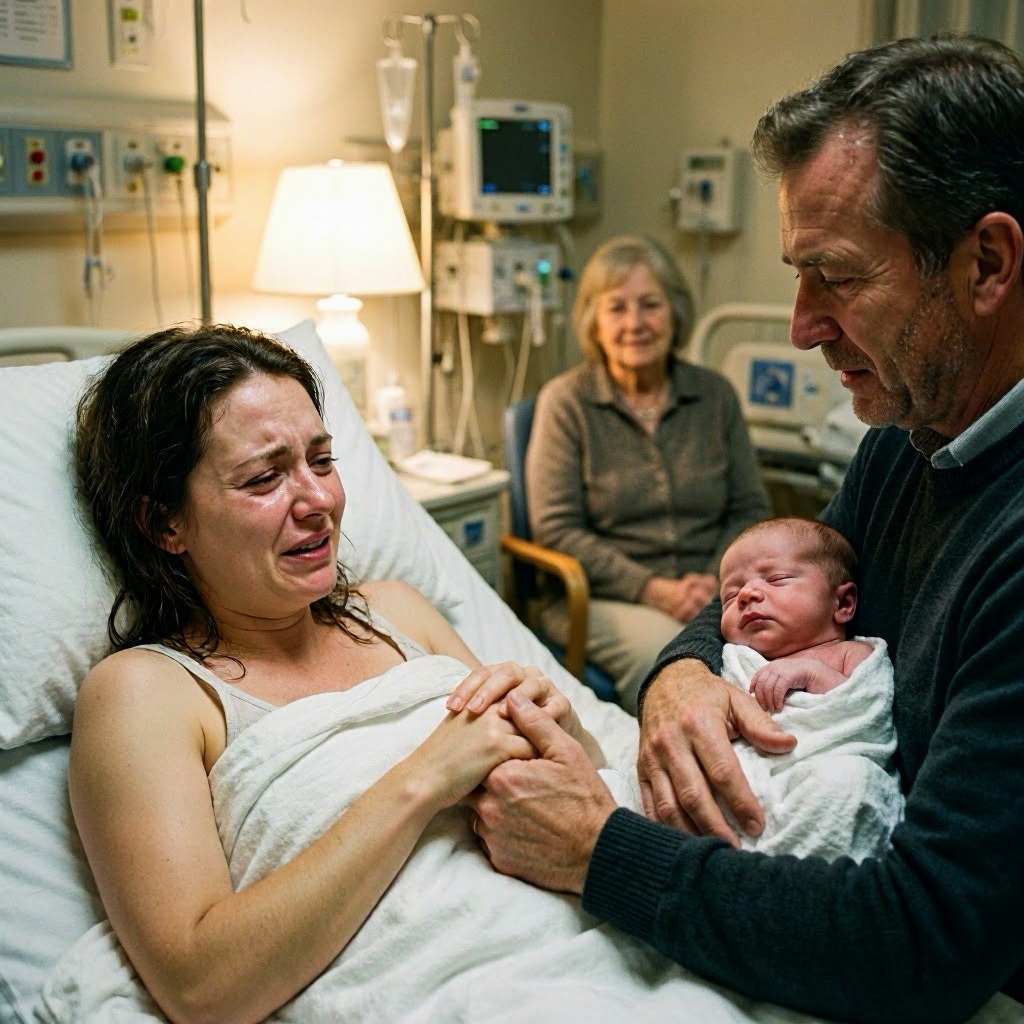
When Emily went into labor, I flew back to Ohio with Anna. We didn’t bring Noah and Lily; the moment was already crowded with history. Emily gripped my hand during contractions and cursed with impressive creativity. When the nurse offered to call Rachel, Emily shook her head. “Not now,” she whispered. “I need you.”
I didn’t deserve that sentence. But I held her hand anyway, because sometimes the only way to earn a gift is to accept it carefully.
My granddaughter arrived red and furious and perfect. Emily sobbed. A nurse placed the baby in my arms for a brief moment while Emily rested. The weight of that tiny body settled something in my chest that therapy had only loosened. This child didn’t know the past. She only knew warmth, heartbeat, and the fact that someone was holding her.
I was a father again.
And now, a grandfather.
Jason visited the next day, pale, hands shaking. He stared at the baby and whispered, “I don’t know how to be good at this.”
“You practice,” Anna said gently. “That’s how.”
Jason looked at me. “You practicing now?” he asked, half bitter.
“Yes,” I said. “Every day.”
He nodded once, and for the first time it didn’t feel like he was looking through me. It felt like he was seeing me as a flawed man instead of a villain.
Sarah arrived later that week, standing in the doorway of Emily’s house like she wasn’t sure she belonged. She looked at me, then at the baby, then back. Her eyes filled, and she whispered, “I remember your hands.”
It was the first thing she’d said to me in years. I stepped forward slowly, careful not to spook her.
“I’m here,” I said.
“I’m not ready to forgive you,” she admitted.
“That’s okay,” I said. “I’m not asking you to rush.”
She nodded, relieved, and held the baby with trembling arms. I watched her face soften despite herself. Love is stubborn. It grows even in scorched places.
Rachel died in late spring. The call came from Sarah. Her voice was steady but thin. “She’s gone,” she said. I closed my eyes and felt an unexpected wave of grief—not for the marriage, but for the years we lost to pride and silence.
At Rachel’s funeral, I stood beside my children, not as a guest, not as a villain, but as a man who survived long enough to return. We didn’t rewrite the past. We didn’t pretend everything was fine. We simply stood together, and that was enough.
Back in Colorado, Noah ran into my arms and asked if I brought him a souvenir. I laughed and said I brought him a story. Lily fell asleep on Anna’s shoulder. The house was loud and alive.
Every story has a moment where the direction changes. Mine wasn’t the divorce, the move, or even the overdose. It was the decision to answer instead of hide, to listen instead of assume, to stay instead of run.
I don’t pretend the damage never happened. I carry it with awareness instead of shame. Some scars remain. Jason still has hard weeks. Emily still flinches at certain words. Sarah still needs space. But the difference is this: I don’t interpret distance as rejection anymore. I interpret it as a boundary, and boundaries can exist inside love.
Presence isn’t a performance. It’s a choice you make daily, especially when you’re afraid.
And every morning, I choose it again.
THE END