I didn’t know a GoFundMe could feel like a weapon until my niece crawled into my guest room and asked, in a voice barely louder than a whisper, if she was going to be “in trouble” for eating cereal.
My name is Daniel Hayes. I’m forty, I work in IT security, and I live in Tacoma, Washington, with my wife, Marissa, and our three kids. We’re not rich. We’re comfortable in the boring way: mortgage, minivan, soccer cleats by the door, Costco runs on Saturday. The kind of life you think is too small to hold a scandal—until family brings one into your kitchen.
My youngest sister Rachel is twenty-five. Eight months ago she escaped a marriage that bruised more than her skin. She showed up at our older sister Jillian’s house in Oregon with a suitcase, a diaper bag, and her daughter Katrina—seven years old, all elbows and anxious eyes.
Jillian is thirty-four, married to Trent, with two kids of her own: Mia, two, and Owen, five. She’s the sister who always looked put-together online, the one who posted “grateful” captions under photos of perfect dinners. When Rachel arrived, Jillian turned it into content.
“Helping my sister rebuild,” she wrote. “Any support is appreciated.”
A GoFundMe went up. Friends shared it. Coworkers donated. People Rachel hadn’t spoken to since high school sent twenty bucks with heart emojis. I donated a thousand dollars that night because Rachel is my baby sister and because I’d spent too many years telling myself that “someone else will handle it.”
Rachel called me twice a week at first. Sometimes it was FaceTime, her hair wet from a shower, Katrina leaning into frame with a shy smile. Jillian’s house looked bright and clean behind them, the kind of place with matching throw pillows.
“How’s it going?” I’d ask.
“Good,” Rachel would say quickly. “We’re fine. Jill’s been… amazing.”
Katrina would nod like she’d practiced.
Once, I noticed Rachel’s hands were red and rough.
“Dish soap,” she said with a laugh that didn’t reach her eyes. “It’s fine.”
I believed her because I wanted to. Because a safe story is easier to hold than the truth.
Then, two months ago, Rachel called me at 11:48 p.m.
Her voice was tight, like she was holding it together with her teeth. “Danny… are you awake?”
I sat up in bed, heart already sprinting. “What’s wrong?”
There was a pause, and I heard a sound behind her—quiet footsteps, a door clicking shut. Then she whispered, “Can I stay with you? Just for a little while.”
Marissa rolled over, blinking. “What is it?”
I put the call on speaker. “Rach, of course. What happened?”
Another pause. “Jillian and Trent… they kicked us out.”
I didn’t understand the words at first. Kicked out. Like a landlord. Like strangers.
“Why?” I asked. “What do you mean?”
Rachel exhaled, shaky. “They said we couldn’t pay rent anymore.”
“Rent?” My voice rose before I could stop it. “Rachel, they offered to take you in.”
“They did,” she said. “But they also… they used the GoFundMe. All of it. They said it was for ‘expenses.’ They made me pay them. Every month.”
Marissa covered her mouth. I could feel my spine turning to ice.
Rachel kept going, the confession spilling now that the dam was cracked. “They had us sleeping on the floor in the playroom. Katrina’s blanket was… one of Owen’s old Paw Patrol ones. I didn’t want to bother anyone, so I— I just kept saying it was fine.”
My throat tightened. “Rachel, why didn’t you tell me?”
“Because Jillian said if I complained, she’d tell everyone I was ungrateful,” Rachel whispered. “And because Katrina finally started smiling again and I was scared of losing even that.”
In the background, Katrina made a small sound, like a hiccup swallowed.
“Hi, baby,” I said gently. “It’s Uncle Danny. You okay?”
Katrina didn’t answer right away. Then, so softly, “Mommy says we’re going to an airplane.”
Marissa was already out of bed. “We’ll book flights,” she said. “Tomorrow.”
I didn’t sleep. I sat at the kitchen table with my laptop open, not for work, but for logistics: flights from Portland to Seattle, a rental car, an extra twin mattress. I kept replaying the video calls where Rachel had insisted everything was fine. All that brightness in Jillian’s background suddenly looked like a set.
The next morning, I called Jillian.
She answered on the second ring, voice sunny. “Hey, big bro! What’s up?”
I didn’t bother with greetings. “Why did you kick Rachel out?”
Silence. Then a sigh, dramatic and annoyed. “Daniel, don’t start. We tried. It was expensive having them here.”
“Expensive?” I said. “She was watching your kids full time.”
“She helped,” Jillian corrected. “We all pitch in.”
“She paid you rent,” I said. “And you took the GoFundMe money.”
Jillian clicked her tongue like I’d misread a receipt. “That money was for getting her back on her feet. But we had extra groceries, extra utilities. Trent missed overtime to fix the playroom. And Rachel needed structure.”
“Structure?” I repeated. “Sleeping on the floor is structure?”
Jillian’s tone shifted. Defensive now. “You don’t know what it’s like, Dan. Having someone in your house 24/7. Katrina’s loud. Rachel’s emotional. My kids were affected.”
“Your kids had a nanny,” I said, the words tasting like acid. “Rachel.”
“She’s their aunt,” Jillian snapped. “She should want to help.”
I gripped the phone so hard my fingers ached. “I gave you a thousand dollars.”
Jillian’s breath hitched. “Okay, and? That was your choice.”
“It was my choice to help Rachel,” I said. “Not to fund your mortgage.”
“Wow,” Jillian said, voice rising into outrage. “So now I’m a villain for keeping my family afloat? You don’t think Trent and I have bills? You don’t think childcare costs money?”
“You didn’t pay for childcare,” I said quietly. “Rachel did. With her labor.”
Jillian went silent for a beat, then tried a softer angle. “Dan, you’re being dramatic. Rachel stayed six months. We gave her a roof.”
“A floor,” I corrected. “You gave her a floor.”
Marissa touched my shoulder, a silent reminder not to explode. I forced my voice to steady. “I want my money back.”
Jillian laughed, short and brittle. “Are you serious? I already spent it.”
“Then figure it out,” I said. “Because if you don’t return my donation, I will tell the family exactly what you did.”
Her voice sharpened into a hiss. “How dare you threaten me. I have kids.”
“And Rachel doesn’t?” I said. “Katrina is your niece.”
That landed. Jillian inhaled, furious. “Fine. I’ll send it. But you’re a monster, Daniel. Taking money from my children.”
“Send it,” I repeated, and hung up.
Two days later, a transfer hit my account: $1,000. The memo line read, FOR YOUR PEACE.
Marissa stared at it, then at me. “She’s going to make you the bad guy.”
“She already is,” I said.
Rachel and Katrina flew in on a rainy Thursday. I spotted them at Sea-Tac by baggage claim—Rachel with a backpack too heavy for her shoulders, Katrina clutching a stuffed elephant with one torn ear.
Rachel tried to smile. It fell apart halfway. I hugged her anyway, the way you hug someone you should have protected sooner.
Katrina stood behind her mother, eyes wide, scanning the airport like it might punish her. I crouched to her level. “Hey, K. I’m really glad you’re here.”
She didn’t hug me. She didn’t step away either. She just studied my face for a long time, then asked, “Do we have to whisper at your house?”
My chest tightened. “No, sweetheart. You can talk. You can laugh. You can be loud.”
Katrina nodded like she was taking notes.
At home, Marissa set up the guest room with clean sheets, a lamp shaped like a moon, and a small basket of snacks. Our kids—Ava, Noah, and Ben—hovered in the doorway, curious and careful.
Katrina stared at the bed like it was a trick. When I stepped out to grab her suitcase, I heard her whisper to Rachel, “Is it okay to sit on it?”
Rachel’s voice cracked. “Yes, baby. It’s okay.”
That first evening, Katrina ate slowly, eyes darting whenever a chair scraped. When Noah reached across the table for a roll, Katrina flinched like an arm movement could mean anger. After dinner she followed Rachel down the hall and kept one hand on Rachel’s shirt like a tether.
Later, after the kids were asleep, Katrina padded into the guest room, saw the snack basket, and froze. She looked up at Marissa and whispered, “Am I allowed to take one?”
Marissa didn’t hesitate. “You’re allowed to take two,” she said softly.
Katrina picked a granola bar with shaking fingers and then asked the question that started this whole story in my head: “Am I going to be in trouble for eating cereal?”
Marissa’s eyes filled. Rachel turned away, ashamed by reflex, like her daughter’s fear was her fault.
That night, Rachel told us everything. Not in one neat speech. In pieces, the way truth comes out when someone has been trained to minimize it.
She told us about the first week at Jillian’s house, when Jillian hugged her at the door and posted a smiling selfie online—FAMILY TAKES CARE OF FAMILY—then handed Rachel a “little list” taped to the fridge. Breakfast, laundry, pickups, dinner, vacuuming. It read less like help and more like a job description.
The GoFundMe, Jillian said, was “handled.” Rachel never had access.
Two weeks later, “rent” appeared.
Trent came home, stepped over toys, and said, “We need to talk about expectations.” Jillian stood beside him like a manager. “We can’t support extra people for free,” she said. “We’ll use the GoFundMe for rent so you’re building habits.”
Rachel believed that was logic. She didn’t understand it was a trap.
The rent started at $500. Then came “utilities.” Then “food.” Jillian would text numbers like invoices. Rachel paid because Jillian kept repeating, “If you don’t learn responsibility now, you’ll never stand on your own.”
Rachel paused on my couch, fingers twisting a napkin. “She said it like she was helping me,” she whispered.
She told us about the playroom.
The guest room was “storage,” so Rachel and Katrina were given a corner of the playroom. Jillian smiled like it was cute. “It’s like camping,” she said.
Camping doesn’t last six months.
Rachel cooked, cleaned, ran errands, and watched Jillian’s kids “so Jillian could breathe.” Jillian called it family. Rachel called it survival. When Jillian and Trent went out on weekends, Rachel stayed home again. Katrina learned to stay quiet. She asked permission to sit on a couch.
When Rachel asked if she could use some GoFundMe money for an apartment deposit, Jillian said, “Not yet. You’re not stable. You’ll mess it up.”
The eviction week was the ugliest.
Trent started complaining about money. Jillian handed Rachel a typed notice: RENT INCREASE EFFECTIVE IMMEDIATELY—$900/month. Rachel said she couldn’t. Jillian shrugged. “The GoFundMe’s basically gone,” she said. “That’s not my problem.”
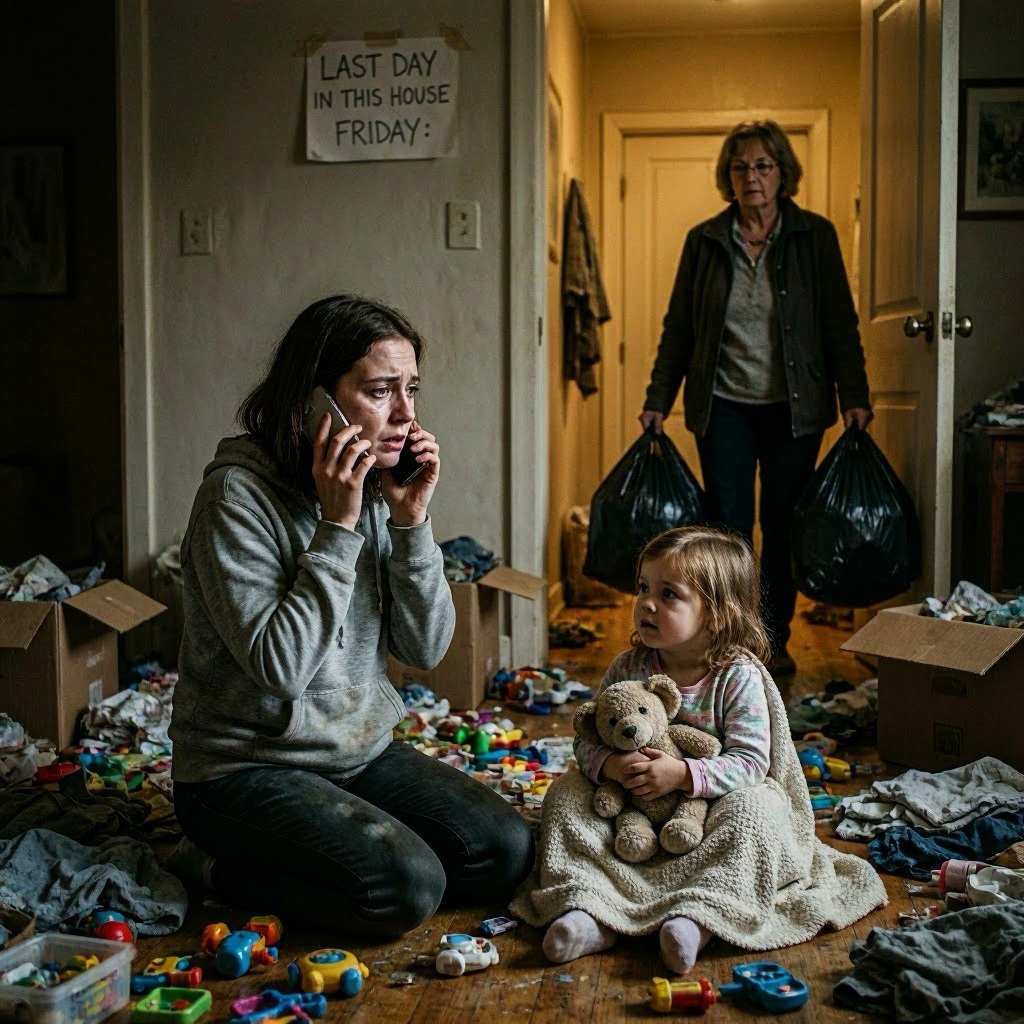
Two days later, the handwritten notice appeared on the playroom door:
LAST DAY IN THIS HOUSE: FRIDAY.
Friday came with rain. Jillian stood in the doorway with trash bags. “Pack your stuff,” she said. “We need the space.”
Rachel asked where she was supposed to go. Jillian’s mouth tightened. “Maybe call Daniel.”
Rachel did. From the bathroom. Whispering into the fan like she was committing a crime.
When Rachel finally said the number out loud, it felt unreal. “The GoFundMe raised eighteen thousand four hundred,” she said. “Jillian told me it was ‘almost gone’ and gave me a hundred dollars like it was mercy.”
Marissa exhaled through her teeth. “That’s not mercy,” she said. “That’s hush money.”
I opened my laptop and did what I do when something feels wrong: I made a timeline. GoFundMe created. Donations raised. Monthly rent texts. Transfers from Rachel’s account. The day the money “ran out.” The day Rachel called me.
Seeing it in rows made my stomach turn. Jillian hadn’t just taken advantage. She’d run a system.
And systems can be dismantled.
The next morning, I messaged Jillian in the family group chat.
I kept it short. “Jill, confirm when you’re transferring the remaining GoFundMe funds to Rachel for housing and legal fees.”
Within minutes, my phone exploded.
My mom texted privately: WHAT IS GOING ON?
My dad called, voice tight: “Daniel, stop airing this out.”
Jillian replied in the group chat with three angry paragraphs: “Daniel is attacking me. He demanded money from my kids. Rachel lived with us for free. People don’t understand how expensive that is. Rachel is manipulating him.”
Rachel read it over my shoulder, face crumpling. “See?” she whispered. “She’ll make me the bad guy.”
I typed one line back. “Rachel paid you $3,100 in rent over six months and provided full-time childcare, cooking, and cleaning. Katrina slept on the floor. If you disagree, say so.”
Jillian went silent.
Not because she was ashamed.
Because she was calculating.
Marissa’s cousin Denise, a social worker, came by that afternoon. She watched Katrina’s shoulders tighten every time a voice rose in the kitchen.
“She’s hypervigilant,” Denise told us. “Like she’s waiting for punishment.”
Rachel nodded, tears on her cheeks. “Jillian used to say Katrina was ‘too much.’”
Denise’s expression hardened. “That’s emotional abuse.”
Rachel flinched at the word. Abuse. Like it was too heavy to hold.
By evening, Jillian was calling relatives, framing me as a bully “taking money from her kids.” My mother’s voicemail began with, “Daniel, what are you doing?”
We scheduled a family video call for Sunday.
Jillian joined late, hair perfect, sitting in her car. Trent sat beside her, arms crossed. Our parents looked exhausted. Rachel sat on my couch, Katrina curled into Marissa’s side like a cat.
Mom opened with her favorite line: “I just want peace.”
Jillian nodded dramatically. “Me too. Daniel attacked me. Rachel lived with us for free. He’s punishing my children.”
I kept my voice even. “I’m going to share my screen.”
I pulled up the spreadsheet and read the GoFundMe description aloud—help Rachel get back on her feet—then the amount raised. I showed Rachel’s rent transfers. I showed photos of the playroom floor. I showed texts with monthly “utility” invoices.
Trent scoffed. “We had expenses.”
“You had a full-time nanny,” Marissa said calmly. “For free.”
Rachel finally spoke, voice shaking but clear. “I didn’t offer to sleep on the floor,” she said. “I did what you told me because you said we’d be homeless if I didn’t.”
The call went quiet.
Mom whispered, “Jillian… is that true?”
Jillian’s eyes darted. “I used it for bills,” she said fast. “Groceries—”
“And did Rachel ever get money to move out?” I asked.
Jillian didn’t answer.
Dad’s voice came out low. “That wasn’t your decision.”
I didn’t argue tone. I set the boundary.
“Jillian, you have two options. You return the remaining funds to Rachel, or we report the misuse to GoFundMe with documentation and we tell the family the full story. That’s it.”
Jillian tried, “You wouldn’t.”
“I would,” I said. “Because Katrina deserves better than a family that protects theft.”
Jillian logged off. Trent followed. Mom cried. Dad stared at the blank screen like he’d learned a new language.
Afterward, Dad texted me: I’m disappointed. Not in you.
Rachel read it and shook with relief.
That night, Katrina asked Marissa, “Are we in trouble because Mommy told?”
Marissa held her face gently. “No. You’re safe because Mommy told.”
The next day, I called Jillian again, this time with Rachel beside me.
“You heard the options,” I said. “Pick one.”
Jillian’s voice sounded smaller on the phone. “I don’t have that kind of money,” she said.
“Then you pay it back,” I replied. “All of it.”
Jillian exhaled hard. “Fine. A payment plan. Twelve months.”
“Five percent interest,” I said. “And it’s paid to Rachel, not me.”
Jillian sputtered. “Interest? You’re insane.”
“You stole from strangers,” Marissa said. “Interest is generous.”
Jillian went quiet, then hissed, “Fine.”
Denise helped Rachel open a separate account. We drafted a simple agreement with dates and amounts. If Jillian missed two payments, we would report the misuse.
Jillian made the first payment within forty-eight hours.
The first deposit notification made Rachel stare at her phone like it might evaporate.
“It’s there,” she whispered, voice disbelieving.
Katrina watched her mother’s face like she was reading weather. “Does that mean we can stay?” she asked.
Rachel pulled her close. “We can stay as long as we need,” she promised. “No one’s kicking us out.”
Katrina’s body went stiff at the word kicking. Rachel repeated, “Never again,” until Katrina’s shoulders softened.
We didn’t stop at getting one payment. Marissa and I helped Rachel do something she hadn’t done in months: look at the numbers herself.
We pulled up the GoFundMe page. Jillian’s cheerful updates were still there—”fresh starts,” smiling photos, comments thanking donors. The donation total sat at the top like a trophy Rachel never got to touch.
Rachel stared at the screen. “I never saw any of this,” she whispered.
“Because she didn’t want you to,” Marissa said.
Rachel scrolled through the donor list—coworkers, neighbors, strangers who’d sent twenty dollars because they believed a young mother deserved a chance. Her shoulders shook. “They thought they were helping me.”
“You didn’t scam them,” I said. “Jillian did.”
Denise explained what “reporting” would mean. “GoFundMe can freeze accounts and demand documentation,” she said. “It’s not an empty threat.”
Rachel swallowed. “I don’t want Jillian arrested.”
“I don’t want Katrina traumatized again,” Denise replied gently. “Sometimes accountability is the only thing that stops harm.”
Jillian tried calling Rachel anyway. When Rachel declined, the texts started.
I can’t believe you’re doing this to me.
After everything I did for you.
Rachel stared at the screen, jaw tight. “I hate that part of me still wants her approval.”
“That part is grief,” Marissa said. “Let it exist. Don’t let it drive.”
Jillian’s second payment arrived on the first of the next month, right on schedule. She didn’t attach a message. Just the money. Later that night, she sent Rachel a single line: You ruined my reputation.
Rachel handed me the phone. I deleted it without replying.
Because the only reputation that mattered now was Katrina’s sense of safety. And Jillian didn’t get to charge rent on that anymore.
My parents came around in their own messy way.
My mother called Rachel first, voice soft and shaken. “I didn’t know,” she said, and the words sounded like both an apology and a defense.
Rachel’s shoulders hunched. “I didn’t want to cause problems,” she whispered.
My mother exhaled. “You shouldn’t have had to protect us from the truth.”
The next weekend, Mom drove up to Tacoma. She walked into the guest room and stopped when she saw the twin mattress on the floor beside the bed—Katrina’s “backup,” in case she couldn’t sleep alone.
Mom turned to Rachel, eyes filling. “She slept on the floor?” she asked.
Rachel nodded, ashamed by reflex.
Katrina peeked from behind Rachel’s leg and asked, “Grandma, are you mad?”
Mom crouched down, hands trembling. “Oh, honey,” she said. “I’m not mad at you. I’m mad at the adults.”
Rachel exhaled like she’d been holding her breath for months.
My dad didn’t apologize the way people want apologies to sound. He called me, voice tight, and said, “Your sister used you.”
Then he added, “And she used Rachel worse.”
For my father, it mattered.
Rachel rebuilt in ordinary steps.
She updated her resume. She practiced interview answers with Marissa after the kids went to bed. She learned to say, “I’m looking for stability,” without sounding like she was begging for it. She laughed once at something Noah said, then covered her mouth like she’d done something wrong.
“You’re allowed to laugh,” I told her.
Rachel’s eyes filled. “I forgot,” she whispered.
Rachel’s first day at the firm was quiet and brave. She wore a thrift-store blazer Marissa steamed and came home with ink on her fingers from taking notes too fast. “I forgot what it felt like to be good at something,” she said, half laughing, half crying. When her first paycheck hit, she didn’t spend it. She printed the stub, highlighted the totals, and tucked it into her notebook like proof. That weekend, Katrina climbed into the bed without asking permission and fell asleep with the lamp on. Rachel watched her and didn’t correct her.
Therapy began to work the way it often works: slowly, then suddenly.
Katrina started speaking in full sentences again. At first she told stories about cartoons. Then, one evening, she said, “Aunt Jill didn’t like when I laughed.”
Rachel froze. “What do you mean?”
Katrina shrugged. “She said laughing was disrespectful.”
Another day Katrina admitted, “I used to count how many times she walked past the playroom door. If it was a lot, it meant she was mad.”
Denise nodded when Rachel told her. “Hypervigilance,” she said. “Katrina was trying to predict danger.”
Rachel started leaving doors open at night in our house on purpose, proving doors didn’t mean punishment here.
The school district helped too. Katrina got gentle check-ins, a counselor, and extra help through her classroom. When Rachel had to step out, our nanny sat with Katrina for an hour or two, and Katrina slowly learned that adults can leave and still come back.
Jillian kept paying, and she kept spinning. She told relatives Daniel “threatened” her. She told a cousin Rachel was “unwell.” Every message centered Jillian’s pain, like Katrina’s fear was a footnote.
Marissa finally said, “Stop reading her words like they’re facts.”
So we did.
Marissa and I sat with Rachel the next morning and talked through the plan like it was a safety briefing.
“One missed payment doesn’t mean failure,” Marissa said. “It means we respond the same way every time.”
Rachel nodded, but fear still lived in the small movements of her hands. Jillian had trained her to believe that asking for fairness was aggression.
Denise suggested we treat the repayment plan like any other agreement: clear deadlines, written receipts, and no side conversations. “Abusers love private channels,” she said. “They love fog. Keep everything in the light.”
Rachel exhaled. “I hate that we have to talk about my sister like she’s a stranger.”
I answered quietly, “She acted like a stranger when she taped a move-out notice to a child’s bedroom door.”
That night, Jillian sent another text to Rachel, softer than the last, coated in sugar.
You know I’m stressed. Trent is furious. This is tearing my family apart. We did our best.
Rachel stared at it. Old Rachel would have apologized. She would have offered to make it easier.
New Rachel typed one sentence and showed it to Marissa before sending: Please keep all communication about payments in writing. Any personal messages will be ignored.
Jillian replied with a single word: Wow.
The next day, Trent called me.
I didn’t answer. When the voicemail came through, his voice was hard. “You think you’re a hero, Dan? You want to ruin my kids because you feel guilty? You’re not coming between my wife and her family.”
I saved the voicemail. Not because I wanted revenge. Because I was done pretending threats were “family tension.”
Two weeks later, Jillian tried a different move. She contacted our mother and asked her to “mediate.” Mom called me, voice pleading. “Just talk to your sister. She’s scared.”
“Rachel was scared,” I said. “Katrina was scared. Jillian didn’t care then.”
Mom went quiet. “I know,” she whispered. “I just… I don’t know how to hold this.”
I softened, because my mother was not Jillian. “Hold Katrina,” I said. “Hold Rachel. The rest can burn.”
After that, my mother stopped calling for peace and started asking for facts. She asked Rachel what months the rent was paid. She asked for screenshots. She asked for the GoFundMe link. Watching my mom shift from discomfort to clarity was like watching someone wake up from a long nap.
At the end of the month, Jillian made the next payment on time. Then she missed the following one by a day.
Rachel spiraled instantly. “She’s punishing me,” she whispered. “She wants me to panic.”
I opened the agreement. “If she misses twice, we report,” I said. “One day late is a warning, not an ending.”
The money arrived the next afternoon. The memo line read: RENT.
Rachel stared at it. “She wants us to feel what she felt,” she said.
Marissa shook her head. “She wants you to feel powerless,” she corrected. “Don’t give it to her.”
Rachel’s job started in early September. The firm was small, clean, and quiet, with managers who said “thank you” like they meant it. The first week, Rachel came home exhausted, not from fear, but from using her brain for something that wasn’t survival.
I blinked. “Already?”
Rachel smiled, surprised by her own pride. “I guess I’m good,” she said, like she was meeting herself again.
Katrina’s therapy sessions continued. The therapist, Ms. Patel, used games and drawings to pull words out gently. One session, Katrina drew a house with a big door and a tiny stick figure on the floor.
Ms. Patel asked, “Is that you?”
Katrina nodded.
Ms. Patel asked, “Why are you on the floor?”
Katrina stared at the page. “Because I wasn’t allowed to make noise,” she said. “If you make noise, people get mad.”
Rachel squeezed her daughter’s hand so tightly Katrina looked up.
Ms. Patel leaned forward. “In your uncle’s house, what happens if you make noise?”
Katrina thought for a long time. Then she said, “Ava laughs.”
That sentence hit all of us harder than any accusation Jillian had ever thrown. Because it was proof of what Katrina had been denied: normal childhood sound.
The school counselor helped too. Katrina got a quiet corner in class she could go to if she felt overwhelmed. She got a sticker chart for “brave moments” that wasn’t punishment, just encouragement. At first her brave moments were tiny: raising her hand once, asking to sharpen a pencil, telling a classmate her favorite color.
One afternoon, she came off the bus and said, “I told my teacher I like pancakes.”
Rachel laughed, tears in her eyes. “That’s huge,” she said.
Katrina blinked, confused. “It’s just pancakes.”
Rachel kissed the top of her head. “Exactly,” she whispered.
By October, the payment plan became routine enough that Rachel stopped checking her account every hour. The money still mattered, but it no longer controlled her mood. That, more than anything, felt like healing.
Jillian kept trying to pull Rachel back into the old dynamic. She sent photos of the cousins. She wrote, We miss Katrina. She wrote, Family is family. She never wrote, I’m sorry.
Rachel showed the messages to Ms. Patel, who said, “An apology is not a photo.”
Rachel didn’t respond.
In November, Trent filed for a temporary adjustment to the payment schedule, claiming “financial hardship.” Denise helped Rachel draft a response: provide documentation or keep the agreement. Jillian didn’t provide anything. The request disappeared. It was another bluff that died in daylight.
Thanksgiving was awkward. My parents came to Tacoma, nervous and quiet. Rachel offered to cook a side dish and then immediately apologized for “being in the way.”
My dad looked at her and said something I never thought I’d hear him say to a child he’d once lectured about “personal responsibility.”
“You were used,” he said. “And I’m sorry I didn’t ask better questions.”
Rachel stared at him, stunned. Then she nodded once, like she was accepting a gift she didn’t know how to hold.
Katrina, meanwhile, played in the living room with Ava, Noah, and Ben. At one point, Katrina shrieked with laughter when Ben pretended a stuffed elephant was a superhero.
Everyone froze for half a second, waiting for an adult to snap.
No one did.
Katrina looked around, startled, then laughed again—louder.
Marissa caught my eye across the room. Her expression said, This is what safety looks like.
By the time winter arrived, Rachel had saved enough for her own apartment. Not a fancy place, but a small two-bedroom ten minutes from us. We helped her move on a Saturday. Katrina carried her stuffed elephant like it was a sacred object.
When we set up Katrina’s room, she asked, “Do we have to sleep on the floor here too?”
Rachel knelt and met her eyes. “No,” she said. “We don’t sleep on floors anymore.”
Katrina nodded slowly, then climbed onto the bed and bounced once, testing joy like it might break.
Rachel signed the lease with shaking hands. Afterward, she sat on the living room floor anyway—not because she had to, but because she could. She looked around at empty walls and said, “This is mine.”
I felt a tightness in my throat. “You earned it,” I said.
Jillian’s payments continued, routed now straight into Rachel’s account. Each deposit was less a gift and more a reminder: you can’t call yourself a rescuer while cashing other people’s mercy.
On New Year’s Day, Rachel texted me a photo. Katrina was at their new table, eating cereal from a blue bowl, milk dripping down her chin, grinning wide.
Caption: No whispering.
I stared at the photo for a long time.
Then I opened my beige folder labeled CIVILIAN WARFARE and wrote a new word on the cover, right under the old one.
RECOVERY.
Because this wasn’t just about money.
It was about what happens when a family learns the difference between helping and harvesting.
And this time, the truth didn’t stay buried in polite silence. It moved into the light, one receipt, one payment, one safe night at a time.
THE END