Nine days after my fiancé put a ring on my finger, he shipped out with the Army. His mother later wrote that he was gone. For fifty-eight years, I believed Danny Wirth had died. Then a teenage boy brought wildflowers to my door, and the card tucked into them was signed with the name Danny had made up for me.
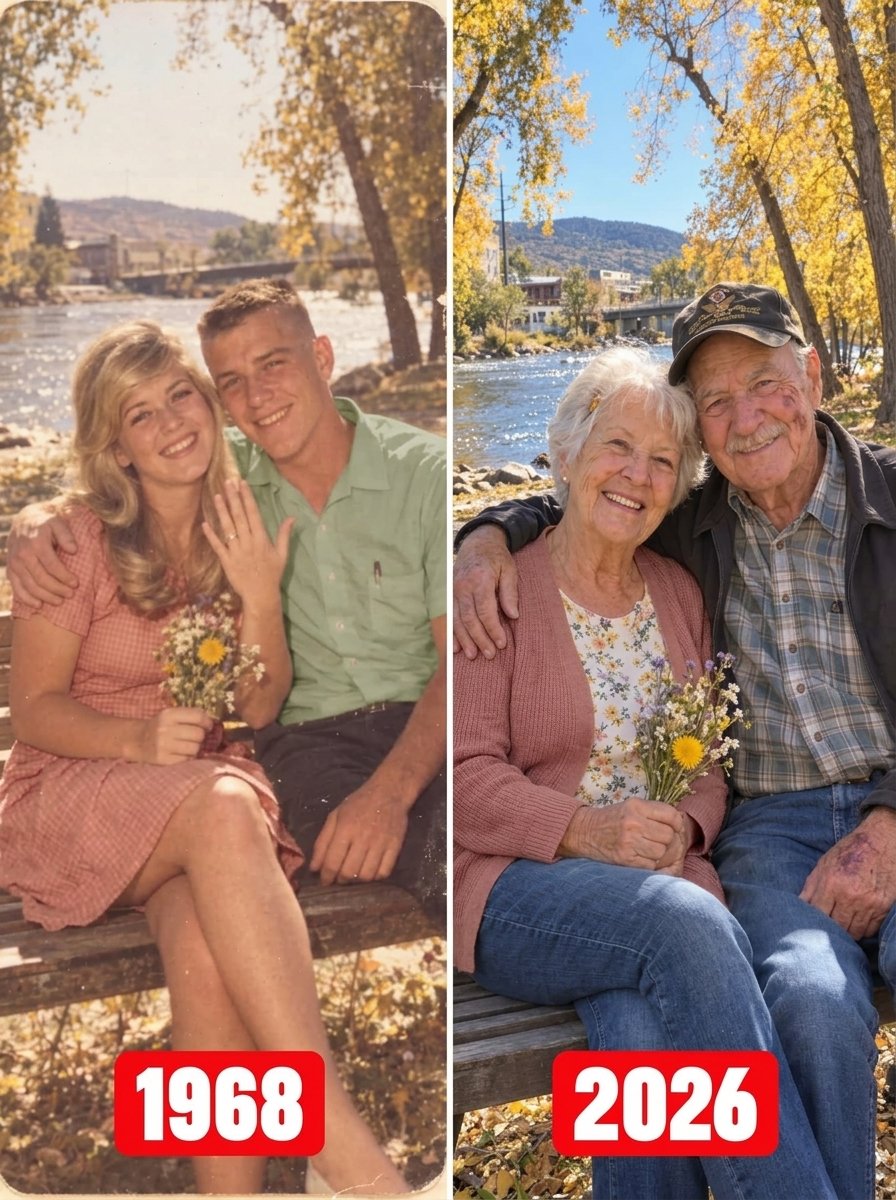
I was eighteen the night Danny asked me to dance. I had on a yellow dress, and after that he called me Dandelion. He spelled it Dandylion every time. I never corrected him. Everybody else in Reno called me Sukey, as they had since I was a girl. My real name is Susan, but Danny had his own name for me, and I loved it.
He gave me a ring in October of 1968, on a bench by the river downtown. It was a chip of a diamond. By Christmas, it had turned my finger green.
Nine days after he gave it to me, he was on a bus to the Army. We were young, and I thought the letters would be enough to keep us close while he was away. He wrote thirty-one. I kept every one in a Whitman’s candy box, moving it from under my bed to my closet and, eventually, to my cedar chest.
His capital D always leaned over like it was tired. I could recognize it before I knew what a letter said.
In the spring of 1969, the letters stopped. In June, I got a letter from his mother. She said she had gone down to Texas to be near him, that he had been badly burned overseas and sent to a hospital in San Antonio. He hadn’t made it, she wrote. They had buried him in her family’s plot in Ohio.
“Don’t come,” she wrote. “There’s nothing left to see. Remember him how he was.”
I was nineteen. I didn’t have bus fare to Ohio. I didn’t even think to ask which town. I lay down on my bed in my mother’s house and didn’t get up for a week.
Two years later, I married Ted Haldane. Ted was a good man. I want to say that plainly. He sold insurance, and then I sold it with him for thirty years. We had two children and four grandchildren. We had a house off the freeway with a lemon tree that never made a lemon.
I was happy with Ted. I also felt guilty about being happy, about marrying so quickly, and about keeping Danny’s letters in my cedar chest for all those years. I can admit that now. At the time, I told myself the letters were just part of my past. I wasn’t going to throw away a young man’s words just because life had gone on.
Ted died three years ago this month. I still keep a pencil behind my ear out of habit, from all those years filling out policies. There’s a casserole in my freezer for emergencies. My life is small now, but it is mine.
Last Saturday, the doorbell rang. A teenage boy from a florist downtown stood outside holding a mason jar of wildflowers: black-eyed Susans, little blue ones, and a dandelion in the middle.
“Ma’am? These are for Susan.”
A little white card was tied into the ribbon. I saw the capital D and knew the handwriting before I read the name.
Dandylion.
I had to sit down on my front step. My first thought was that somebody was playing a mean trick on an old woman. My second was that nobody alive knew that name but me.
I called the florist. I got the number wrong twice before I reached them.
“An older gentleman came in Thursday and paid cash,” the girl told me. “He filled the card out himself. He had a hard time holding the pen.”
“Did he leave a name?”
“Just D. Wirth. And a phone number.”
It was a 530 number, up in California. I called. A woman answered. I started to say, “My name is Susan Haldane, and I’m looking for, ”
She hung up.
My grandson found the address on his phone in about two minutes. It was in Susanville, two hours north. That night I told my daughter where I was thinking of going.
She looked at me as if I’d lost my marbles. “Mom, you’re seventy-seven. You’re going to drive two hours to chase a ghost?”
“He’s not a ghost if he can buy flowers.”
“Somebody could be scamming you. Please don’t make a fool of yourself.”
“I don’t know what it is,” I said. “But I have to find out.”
She didn’t agree with me. She also knew there was no point pretending she could talk me out of it. I didn’t sleep. I took Danny’s letters out of the Whitman’s box and read them at the kitchen table, one after another. I had not read all thirty-one in years. His handwriting changed a little from letter to letter, but the leaning D was there.
The next morning, I drove north. I stopped at the Raley’s on the way out of town for gas and sat in the parking lot for a long time. I was thinking that my daughter might be right, and that I was a lonely old woman chasing a dead boy across two states.
Then I put the car in drive.
The address was a little green house on a quiet street, with a ramp leading up to the porch. A pair of old men’s work boots sat beside the door, polished. I knocked.
A woman about fifty opened it. She had gray at her temples and was still in scrubs from a night shift. She looked at me, and I could tell she knew who I was.
“You’re her,” she said. “The Dandelion. I’m his daughter.”
“Is he here? Is Danny here?”
Her eyes filled. She held the door with both hands. “He wanted you to have the flowers. He never meant for you to come.”
“Then why did he send them?”
“He doesn’t want you to see him like this,” she said. “Please go.”
She started to shut the door.
From inside the house, a man said, “Selena. Wait.”
I would have known his voice anywhere. It was older and rougher, but it was Danny’s.
Selena stopped. The door opened wider. By the front window sat a man in a wheelchair, holding a candy box like the one I had kept. One side of his face was covered in old scars. His eyes were Danny’s blue eyes.
He looked at me for a long time.
“Dandelion,” he said. “I was standing across the street the day you married Ted.”
I held on to the doorframe. “You were alive.”
“Yes.”
“Your mother told me you died.”
“I know.” He looked down at the box in his lap. “I asked her to tell you I was dead.”
Selena turned toward him. “You said she knew you were injured. You never told me you asked your mother to say that.”
“I didn’t tell you all of it,” he said. “I didn’t tell Susan, either.”
I had come to ask whether he was Danny. Now he had answered a different question, the one I had carried since I was nineteen.
“Why?” I asked.
He took a breath, then stopped. “I was burned. I couldn’t face you. I thought if you knew I was alive, you’d wait. I told my mother to make sure you didn’t.”
“And she wrote that you were buried in Ohio.”
“She wrote it. I asked her to say I was gone. I’m not going to pretend I didn’t know what that meant.”
Selena looked from him to me. “Dad, you let her believe you were dead for all these years?”
“I did.”
He didn’t blame the Army or the hospital or the way his face had healed. He didn’t tell me his mother had misunderstood. He said he was ashamed, and that he had been young enough to think disappearing was kinder than letting me choose what to do with the truth.
I wanted to tell him he had no right to make that choice for me. The words came up, but for a moment I couldn’t get them out. I looked at his face, then at the candy box in his lap.
“You watched me marry Ted,” I said.
“I did.”
“And you still didn’t come over.”
“No.” His voice dropped. “I thought you looked happy. I told myself leaving you alone was the last decent thing I could do.”
“It was too late to call that decent.”
“I know.”
Selena glanced at him. “You told me you sent flowers because you wanted her to know you were still here.”
“I did.”
“You didn’t think she’d drive up?”
“I didn’t think she would.” He looked back at me. “I hoped you might call. I was afraid you would.”
I sat in the chair Selena offered. My legs had started to tremble, and I didn’t want either of them to mistake that for an answer. I had driven two hours to see him. That did not mean I could forgive fifty-eight years in one sitting.
“Why now?” I asked.
He rubbed the edge of the box with his thumb. “I kept putting it off. I had reasons every time. None of them were good enough. I thought the flowers might say what I couldn’t get myself to say.”
“They said you knew my name.”
“I never forgot it.”
“That’s not the same thing.”
“No,” he said. “It isn’t.”
I stayed long enough for the first questions, but not long enough to make the visit into a reunion either of us could explain away. Selena offered to call me when I got home. I thanked her and drove back without promising anything.
My daughter answered when I called that evening.
“Was it him?” she asked.
“Yes.”
“Did he tell you what happened?”
“He did. I’m going back, but I want you to come with me.”
She was quiet for a moment. “All right.”
A few days later, we returned to the green house. I brought the Whitman’s box and the letter from Danny’s mother. I had spent years keeping them separate from the rest of my life. This time, I wanted his daughter and mine to see what I had been told and what Danny had written before he left.
Selena let us in. Danny was in the same chair by the front window. He looked at the box I carried.
“You kept them,” he said.
“All thirty-one,” I replied. “And this.”
I took out his mother’s letter. My daughter stood beside me, reading over my shoulder. Selena leaned in, too. I placed the letter beside one of Danny’s old letters, then set the flower card beside them.
There were three pieces of handwriting in front of us: Danny’s old letters, the card he had sent, and his mother’s message saying he had died.
Danny looked at the letter for a long time.
“My mother wrote that,” he said. “But I gave her the reason.”
My daughter’s voice was tight. “You told her to say he was dead?”
“I told her to make sure Susan didn’t wait for me. I knew what I was asking her to do.”
“You could have written yourself,” my daughter said.
“I could have.”
“Or let her decide.”
“I could have done that, too.”
Selena picked up the flower card and studied the crooked D. “Why didn’t you tell me this before I called her?”
“I was ashamed.”
“That’s what you said about Susan.”
“It’s still true.”
I looked at him. “You didn’t protect me. You took the choice away.”
He nodded once. “Yes.”
There wasn’t a good excuse tucked behind the first one. He didn’t say he had meant to come back after a year, or that some official had stopped him, or that he had written letters that never arrived. He had been alive. He had been able to tell me. He had asked his mother to tell me he was dead, and then he had kept silent.
My daughter turned to me. “Mom, you don’t owe him anything.”
“I know,” I said.
Danny didn’t ask her to take it back. He sat with his hands resting on the candy box and let the answer stand.
I looked at the old letters. I had kept them because they belonged to the young man who wrote them. They were evidence of something real, but they did not erase what he had chosen later.
“I’m not going to pretend those years didn’t happen,” I said. “And I’m not going to promise we can go back to anything.”
“I understand,” he said.
“I haven’t said I forgive you.”
“I know.”
I waited for him to argue. He didn’t.
“I came because I wanted the truth,” I said. “I’ll come again if I decide I want to. Not because you sent flowers and not because you’re in that chair.”
“I’d like that,” he said. “But you decide.”
That was the consequence he could not talk away. He had wanted to choose what I knew, and he had done it for almost six decades. This time, he had to leave the next choice to me.
My daughter and I left together. I took Danny’s mother’s letter home, along with the old letters. I didn’t throw any of them out, and I didn’t put them back as if nothing had changed.
I went back to see him once more. I won’t call what followed a return to the life we might have had. Ted had been my husband, and Danny had been part of my first love and a lie I had believed for most of my life. Both things were true.
The flowers had not brought my youth back. They had brought the truth to my door.
Danny was alive. His mother had written the letter at his request. I went to see him because I chose to. That was enough.