My son’s wife told me Thanksgiving would be at her mother’s this year and I was “on rolls,” then asked to borrow my dining table for it. I said it was fine. I let two boys load it into her mother’s truck, leaf and all, and her mother does not know what my late husband wrote under that leaf, or who the table actually belongs to.
“It seats fourteen and mine seats eight, Pam. It’s just for the day.”
“Of course.”
“You can drop the rolls off around eleven. We eat at one.”
“Around eleven,” I said.
My name is Pam. I am 64. I have hosted Thanksgiving for thirty-one years, at that table, in the house my son grew up in. I have never once been “on rolls.”
I endured “it’s just easier at Tiffany’s mom’s.” I endured being seated at the card table with the children the one year I did go to hers. I endured her calling my stuffing “the bread one.” I endured my son saying, “Mom, it’s not a competition,” which is what men say when their wives have already won it.
The table was my husband’s father’s. Hand built. Oak. When my husband got sick, he took a marker and wrote something on the underside of the center leaf and told me not to read it until I needed to. I have never needed to. I read it anyway, the week after his funeral. I put the leaf back and said nothing.
Tuesday Tiffany called.
“Mom’s saying the table doesn’t match her chairs. Do you have the chairs too?”
“I have the chairs.”
“Could you, “
“The chairs stay,” I said.
“That’s kind of petty, Pam.”
“Noted.”
I have been “Pam” to her for six years. Not “Mom.” Not even when my husband was dying and she came to the house exactly twice.
Wednesday morning I drove to the bakery. I do not bake rolls. I ordered four dozen and paid cash. On the way home I stopped at the county building. Not for anything to do with Thanksgiving. For something my husband asked me to do “when the time came,” which I had put off for two years.
The clerk was a woman about my age. She looked at the paper, looked at me, and stamped it.
“You need copies?”
“Just the one,” I said.
It took nine minutes.
Wednesday night my son came by alone. He stood in the kitchen the way he used to when he was in high school and needed to borrow the car.
“Tiffany’s stressed.”
“I’m sure.”
“Her mom’s making a big deal about the table. She keeps saying it’s an antique and it should stay in a family that uses it.”
“Does she.”
He looked at the floor. “She said something about maybe buying it. After.”
“After what?”
“After… you know. Eventually.”
“You mean after I die.”
“Mom.”
“Is that what you mean?”
“Tiffany said you’d get upset.”
“I’m not upset, honey. I’m just clarifying. Sharon wants to buy my table after I’m dead.”
He opened the refrigerator, closed it. “She didn’t mean it like that.”
“How did she mean it?”
He left twenty minutes later without answering.
Thursday at eleven I brought four dozen rolls to a house I have been inside once. Tiffany’s mother met me at the door. Her name is Sharon. She has a laugh that comes before the joke and a way of touching your arm that makes you feel like you’ve already agreed to something.
“Pam! The roll lady!”
“Sharon.”
“Come see. It looks so good in here. Like it was always mine.”
It was in her dining room with a cloth over it that did not fit. Fourteen places set. My name card was at the end, by the kitchen door, next to a child who looked about seven.
“Where’s the leaf?” I said.
“Oh, we didn’t need it. We took it out. It’s in the garage.”
“You took the leaf out of my table and put it in your garage.”
“It’s fine, Pam. We’ll put it back.
My daughter-in-law asked to borrow my dining table for Thanksgiving at her mother’s house. I said yes. What I didn’t mention was what my late husband wrote under the leaf before he died, or what I’d just filed at the county courthouse the day before.
I Let My Daughter-In-Law Borrow My Table. She Had No Idea What Was Written Underneath.
The part about being “on rolls” after hosting for thirty-one years would have been enough for me. But taking the leaf out and leaving it in the garage? That’s when I would’ve lost it too. What do you think the husband wrote?
Thirty-one years of hosting and suddenly she’s “on rolls.” I felt that in my soul.
Netflix Original movie still, premium Hollywood production design, cinematic realism, Kodak Vision 3 color science. A dignified woman in her mid-sixties stands in a suburban garage, holding a large wooden table leaf vertically so the underside faces the camera. Her expression is calm and resolute. Behind her, a younger blonde woman in her thirties looks stunned, hand covering her mouth. Soft natural light from the garage door illuminates the scene. The wooden leaf shows visible handwritten text in permanent marker. The setting is an upscale American suburban garage with organized storage. 85mm portrait lens, shallow depth of field, faces sharp and emotionally clear, warm practical lighting. Environmental composition, characters occupy 60% of frame. Documentary emotional intensity, restrained and photojournalistic. Portrait orientation, 3:4 aspect ratio. Magazine editorial quality, sophisticated and tasteful.
My son’s wife told me Thanksgiving would be at her mother’s this year and I was “on rolls,” then asked to borrow my dining table for it. I said it was fine. I let two boys load it into her mother’s truck, leaf and all, and her mother does not know what my late husband wrote under that leaf, or who the table actually belongs to.
“It seats fourteen and mine seats eight, Pam. It’s just for the day.”
“Of course.”
“You can drop the rolls off around eleven. We eat at one.”
“Around eleven,” I said.
My name is Pam. I am 64. I have hosted Thanksgiving for thirty-one years, at that table, in the house my son grew up in. I have never once been “on rolls.”
I endured “it’s just easier at Tiffany’s mom’s.” I endured being seated at the card table with the children the one year I did go to hers. I endured her calling my stuffing “the bread one.” I endured my son saying, “Mom, it’s not a competition,” which is what men say when their wives have already won it.
The table was my husband’s father’s. Hand built. Oak. When my husband got sick, he took a marker and wrote something on the underside of the center leaf and told me not to read it until I needed to. I have never needed to. I read it anyway, the week after his funeral. I put the leaf back and said nothing.
Tuesday Tiffany called.
“Mom’s saying the table doesn’t match her chairs. Do you have the chairs too?”
“I have the chairs.”
“Could you, “
“The chairs stay,” I said.
“That’s kind of petty, Pam.”
“Noted.”
I have been “Pam” to her for six years. Not “Mom.” Not even when my husband was dying and she came to the house exactly twice.
Wednesday morning I drove to the bakery. I do not bake rolls. I ordered four dozen and paid cash. On the way home I stopped at the county building. Not for anything to do with Thanksgiving. For something my husband asked me to do “when the time came,” which I had put off for two years.
The clerk was a woman about my age. She looked at the paper, looked at me, and stamped it.
“You need copies?”
“Just the one,” I said.
It took nine minutes.
Wednesday night my son came by alone. He stood in the kitchen the way he used to when he was in high school and needed to borrow the car.
“Tiffany’s stressed.”
“I’m sure.”
“Her mom’s making a big deal about the table. She keeps saying it’s an antique and it should stay in a family that uses it.”
“Does she.”
He looked at the floor. “She said something about maybe buying it. After.”
“After what?”
“After… you know. Eventually.”
“You mean after I die.”
“Mom.”
“Is that what you mean?”
“Tiffany said you’d get upset.”
“I’m not upset, honey. I’m just clarifying. Sharon wants to buy my table after I’m dead.”
He opened the refrigerator, closed it. “She didn’t mean it like that.”
“How did she mean it?”
He left twenty minutes later without answering.
Thursday at eleven I brought four dozen rolls to a house I have been inside once. Tiffany’s mother met me at the door. Her name is Sharon. She has a laugh that comes before the joke and a way of touching your arm that makes you feel like you’ve already agreed to something.
“Pam! The roll lady!”
“Sharon.”
“Come see. It looks so good in here. Like it was always mine.”
It was in her dining room with a cloth over it that did not fit. Fourteen places set. My name card was at the end, by the kitchen door, next to a child who looked about seven.
“Where’s the leaf?” I said.
“Oh, we didn’t need it. We took it out. It’s in the garage.”
“You took the leaf out of my table and put it in your garage.”
“It’s fine, Pam. We’ll put it back. You’re acting like I broke it.”
I set the rolls down on the counter. Tiffany was arranging something on a platter, wouldn’t look at me.
“Tiffany,” I said.
“We’ll put it back, Pam. It’s not a big deal.”
I went to the garage.
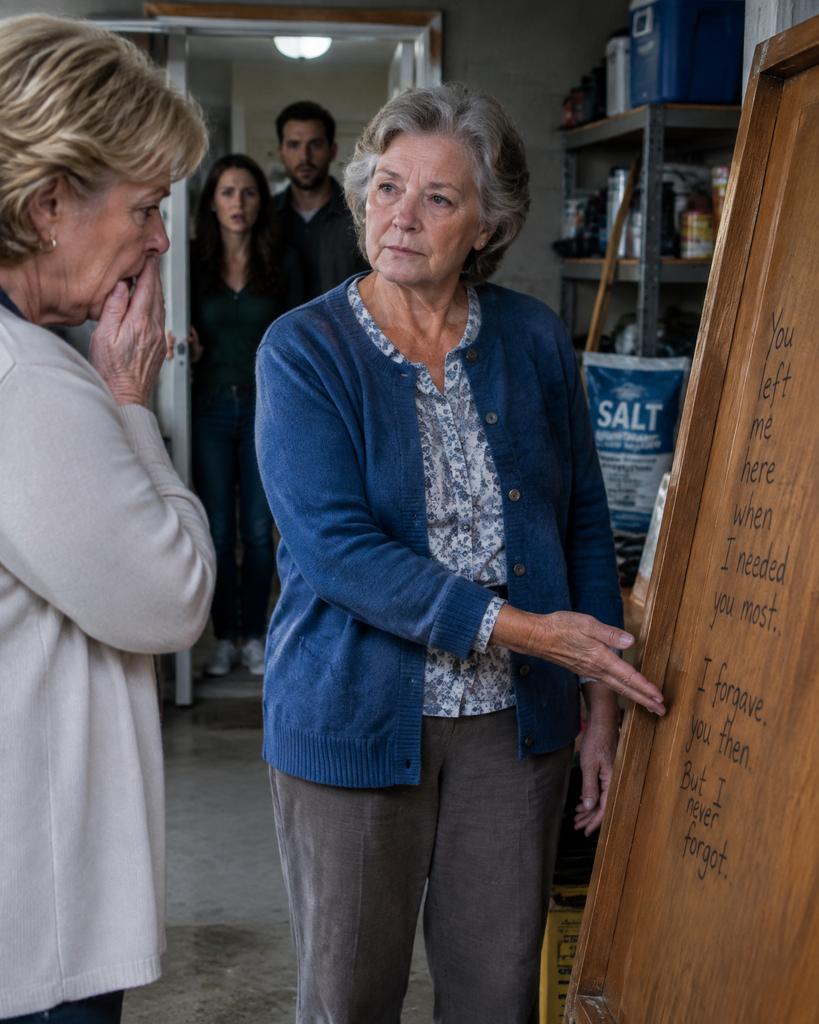
The leaf was against the wall, next to a bag of salt and a bin of Christmas lights. Underside out. My husband’s handwriting, in marker, forty inches long, the way I left it two years ago.
Sharon had followed me. She read it over my shoulder. I heard her breathing change.
“What is that?”
“That’s a message from my husband.”
She leaned closer, reading. Her voice went up. “That’s, that’s not legal. That’s just marker.”
“You’d be surprised what’s legal,” I said, “when you have it notarized and filed at the county on a Wednesday.”
“Filed what?”
“The paper that says who this table goes to. And the house it goes back to. And the reason.”
Tiffany was in the doorway now. My son behind her, looking like he wanted to be anywhere else.
“Pam, what did you do.”
“I brought rolls,” I said. “And I’d like everyone to sit down, in the dining room, at my table, because before anybody eats, I’m going to read the underside of this leaf out loud, all of it, including the last line, the one with Sharon’s name in it.”
“You’re being insane,” Sharon said.
“I’m being clear.”
I carried the leaf into the dining room. Set it on the table. Turned it over so everyone could see.
My husband had terrible handwriting, but he took his time with this. You could read every word from six feet away.
“This table was built by my father, George Howell, in 1967, for his family. It belongs to my wife, Pamela Jean Howell, for as long as she lives, and to our son, Michael Howell, after that. It does not belong to anyone who did not sit at it when it mattered. It does not belong to anyone who thinks generosity is the same as weakness. And it does not belong to Sharon.”
There was more, but that was the part that landed.
Sharon’s face went red, then white. “He didn’t even know me.”
“He knew enough,” I said.
My son looked at me. “When did he write this?”
“Two weeks before he died. He was very specific about the filing.”
“You filed this?”
“Yesterday.”
Tiffany’s voice was thin. “You planned this.”
“I planned to bring rolls,” I said. “Everything else is just clarity.”
Sharon left the room. Tiffany followed her. I heard a door close, then raised voices I couldn’t make out. My son stood there with his hands in his pockets, looking at the table.
“You could’ve just said no,” he said.
“I did. Six years ago, and the year before that, and the year before that. You didn’t hear it.”
“She’s my wife.”
“I know. And I’m your mother. And this is my table.”
He looked at the leaf again. At his father’s handwriting. “Did he really write that about Sharon?”
“He wrote it about people like Sharon. He just happened to guess her name.”
“That’s not fair.”
“Neither is putting me at the kids’ table. Neither is ‘on rolls.’”
He didn’t argue with that.
Sharon came back without Tiffany. She had her purse. “I want that table out of my house.”
“I’ll need the boys who brought it,” I said. “And the truck.”
It took them forty minutes to load the leaf, reassemble the table in my dining room, and leave. Tiffany stayed in the car. My son helped carry it in, didn’t say much. When they were gone I made myself a sandwich and sat at the table, same seat I’ve sat in for thirty-one years.
My husband was right about a lot of things. He was right about this.
Friday my son called. “Tiffany wants an apology.”
“For what?”
“For embarrassing her mother.”
“Tell Tiffany I’ll apologize the same day her mother apologizes for trying to buy my table out from under me while I’m still alive.”
“Mom.”
“I mean it. I didn’t start this.”
He was quiet a long time. “Dad really wrote that?”
“Every word.”
“He was kind of an asshole sometimes.”
“He was. But he loved me, and he knew I’d need to hear it someday.”
“I love you too,” he said.
“I know you do, honey.”
We hung up. I don’t know if there will be a Thanksgiving next year, or where it will be. I don’t know if Tiffany will come around, or if Sharon will ever speak to me again. I don’t know if my son understands yet that I didn’t do this to hurt anyone. I did it because thirty-one years of hosting, of cooking, of welcoming people into my home, should mean something more than being “on rolls.”
The table is back where it belongs. The leaf is in place. And if I ever need to remember that I’m not the one who’s petty, or small, or wrong for wanting to be treated like I matter, I know exactly where to look.