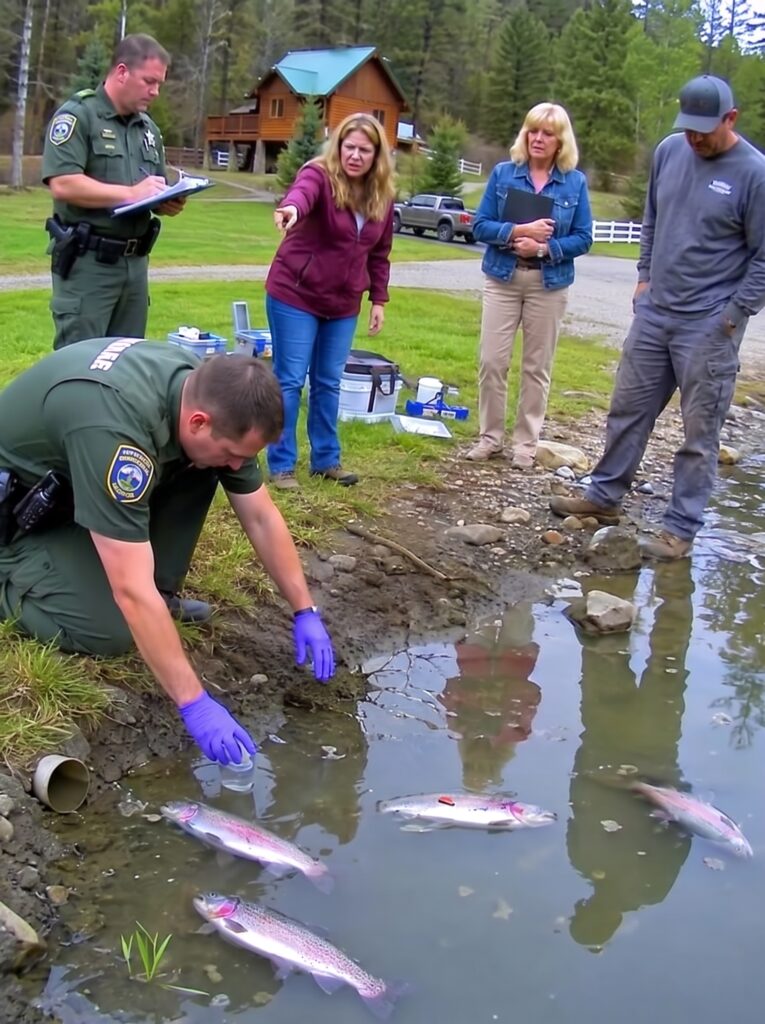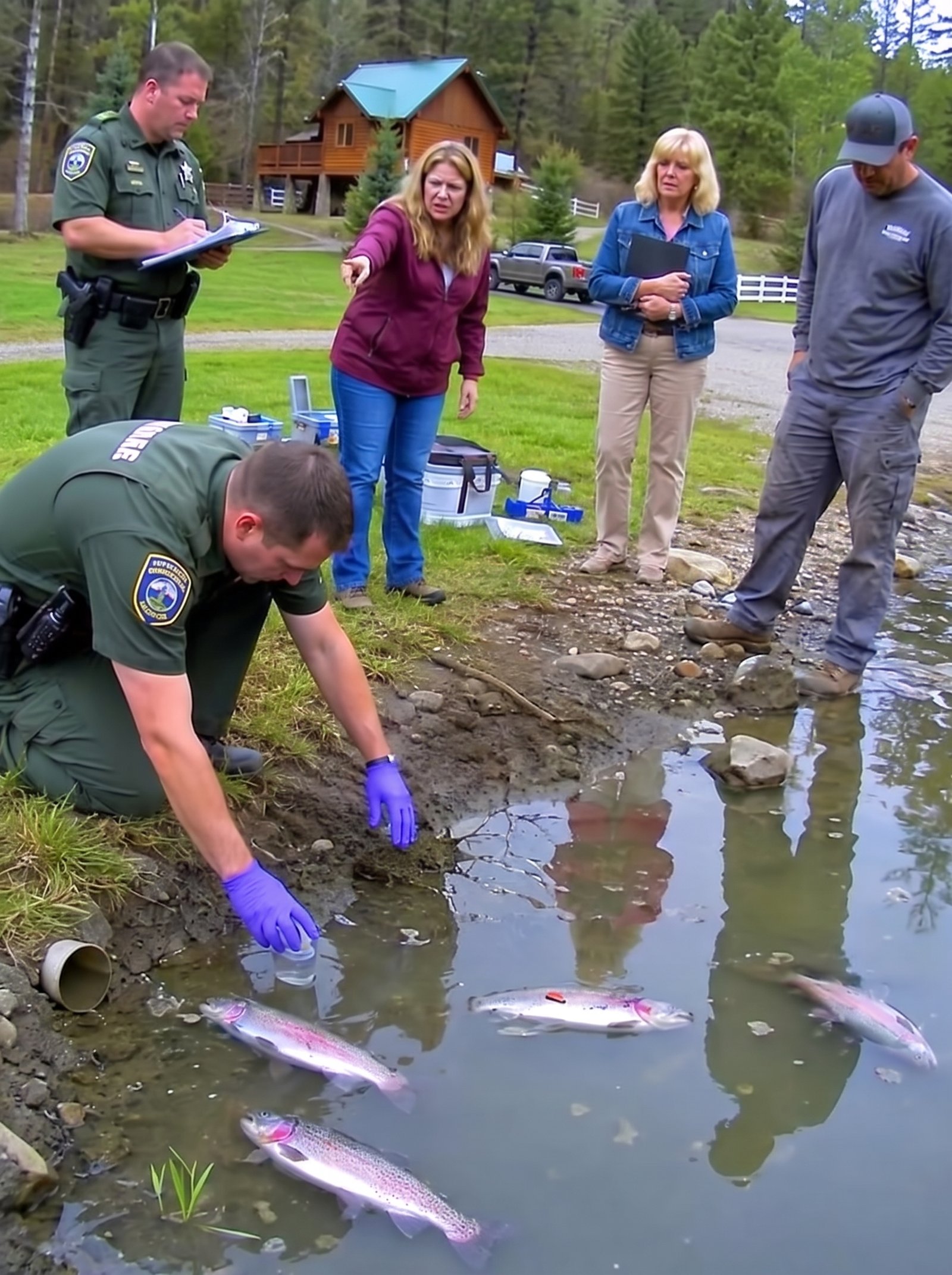
The first trout hit the surface at 6:12 in the morning, white belly up, its gills opening and closing like a door that could no longer find air.
By 6:18, more than two hundred fish were twisting in poisoned water, and Patricia Harrow stood on my dock in spotless white tennis shoes telling me I should thank her for fixing “that disgusting smell.”
Then she smiled and handed me a laminated HOA notice authorizing the chemical treatment of a pond the HOA did not own.
I read the first three lines.
Ridgeview Commons Homeowners Association.
Emergency nuisance abatement.
Approved by unanimous board consent.
Behind Patricia, two men in gray coveralls were dragging a green hose toward a silver utility truck. The truck had no company name on the doors. Someone had peeled the lettering away, leaving pale rectangles in the dust.
One of the men was rinsing a plastic tank.
The runoff from the hose curled through the grass toward my pond.
“Shut that water off,” I said.
The man looked at Patricia.
Not at me.
Patricia folded her arms across a white quilted vest. Her blond hair was tied back with a blue silk scarf, the kind of outfit people wear when they want to look casual without risking the appearance of actual work.
“The treatment is already complete,” she said. “There’s nothing left for you to interfere with.”
The surface of the pond rolled behind her.
A mature rainbow trout broke the water, struck the dock post with its head, and disappeared beneath a layer of pale foam.
Patricia winced.
Not because the fish was dying.
Because a drop of water had landed on her shoe.
I didn’t raise my voice.
I didn’t touch Patricia.
I didn’t step into the water.
I didn’t let the contractor rinse a single hose.
I didn’t tell anyone that Wildlife Officer Mara Velez was due at my gate in eleven minutes.
Instead, I pulled out my phone and started recording.
“State your name,” I said.
Patricia laughed.
“You know my name, Cole.”
“For the recording.”
Her smile thinned.
“Patricia Harrow. President of Ridgeview Commons.”
“And you authorized the discharge into Mercer Pond?”
“I authorized a licensed treatment for a documented nuisance.”
“Who performed the treatment?”
She glanced toward the men.
The taller one dropped the hose.
“LakeBright Environmental,” Patricia said.
There was no LakeBright logo on the truck.
No license number.
No chemical placard.
No treatment flag posted at the shoreline.
I angled my phone toward the tank in the truck bed. Its translucent sides were streaked blue-green. A stack of empty white jugs lay under a canvas tarp.
The shorter contractor moved to pull the tarp over them.
“Leave it,” I said.
He kept moving.
I walked past Patricia and closed the steel gate across my service road. The chain went through the latch. The padlock clicked.
The two contractors stared at me.
Patricia’s laugh came out harder this time.
“You can’t imprison people on private property.”
“No one is imprisoned. The pedestrian gate is open. You’re free to leave. The truck stays until the sheriff tells me otherwise.”
“You have no authority to hold that vehicle.”
“You drove it through a locked gate.”
“The gate was open.”
“It was locked at ten last night.”
The shorter man looked at the taller one.
That tiny look told me more than Patricia had.
I turned my phone toward the cut chain lying in the weeds beside the entrance.
Patricia’s face changed.
Only for a second.
But cameras catch seconds.
She stepped closer and lowered her voice.
“You are making this much more serious than it needs to be.”
I looked past her toward the pond.
The water was usually clear enough to see the gravel beds near the eastern bank. That morning it had the cloudy color of tarnished silver. Trout crowded the inlet where cold spring water entered, fighting for the last strip of breathable water.
Some of those fish carried tiny electronic tags beneath their skin.
Patricia didn’t know that.
She also didn’t know the tags belonged to a state and federal recovery program.
“You’re right,” I said. “It is serious.”
Her eyes narrowed.
“The smell has been affecting our residents for months.”
“The smell is not coming from this pond.”
“Our environmental committee disagrees.”
“Your environmental committee is three real estate agents and a man who sells patio furniture.”
“The board relied on professionals.”
“Which professionals?”
“You’ll receive the report through proper channels.”
A truck engine sounded beyond the trees.
Patricia looked toward the road.
A dark green state vehicle turned through the outer gate and rolled toward us. The gold wildlife emblem on the door caught the early sun.
Officer Mara Velez parked twenty feet from the silver utility truck.
She stepped out wearing field pants, a dark jacket, and the expression of someone who had noticed too many dead fish before both boots hit the ground.
Mara had been assigned to inspect the pond that morning because the first group of restoration trout was due for a tag survey. We had scheduled it three weeks earlier.
Patricia had chosen the worst possible morning to poison my water.
Mara looked at the pond.
Then she looked at the contractors.
Then she looked at me.
“Tell me nobody touched the inlet,” she said.
“Nobody has entered the water since I arrived.”
“When did you arrive?”
“Six twelve.”
“When did they?”
“Before that.”
The taller contractor took two steps toward the pedestrian gate.
Mara held up one hand.
“Sir, remain where you are.”
He stopped.
Patricia moved forward with the laminated notice raised like a passport.
“Officer, I’m Patricia Harrow, president of the Ridgeview Commons HOA. We arranged a legal pond treatment after repeated odor complaints. Mr. Mercer is upset because we were forced to act without his cooperation.”
Mara did not take the notice.
“How much product did you discharge?”
Patricia’s mouth stayed open for half a beat.
“That question should go to the contractor.”
Mara looked at the taller man.
“How much?”
He rubbed his palms on his coveralls.
“We applied according to the work order.”
“What product?”
“Aquatic treatment.”
“What product?”
He looked toward the truck.
Mara followed his eyes.
“What is in those containers?”
“Empty product jugs.”
“Don’t move toward them.”
“I wasn’t.”
“You were about to.”
Patricia stepped between them.
“This feels unnecessarily aggressive.”
Mara looked past her at a trout floating beside the dock.
A small yellow tag protruded near its dorsal fin.
Mara’s face went still.
She walked to the edge, crouched, and extended a net beneath the fish. When she lifted it, water streamed through the mesh.
She turned the trout gently.
The yellow tag carried a six-digit code.
Mara read it once.
Then again.
She looked at me.
“Is this from the spring release?”
“Yes.”
“How many tagged fish are in here?”
“Two hundred forty-six from the first group. Another eighty native brood fish in the upper basin.”
Patricia’s eyes shifted between us.
Mara laid the fish inside a clean evidence tray from her vehicle.
“Ms. Harrow,” she said, “you and your contractors are now involved in an active wildlife mortality investigation. Do not remove the truck, containers, hoses, paperwork, electronic devices, or any other materials from this property.”
Patricia blinked.
“This is a private civil dispute.”
“It stopped being only civil when protected recovery stock began dying.”
“I was told these were ordinary farm fish.”
Mara looked at her.
“Who told you that?”
Patricia pressed her lips together.
The shorter contractor whispered something to the taller man.
Mara heard it.
“So you do know what you used.”
Neither answered.
Mara called dispatch.
Her voice remained level as she requested a second wildlife officer, the county sheriff, an environmental response unit, and a state water-quality investigator.
Then she walked to the spring inlet.
She removed glass sample bottles from a sealed case, pulled on gloves, and began collecting water.
Patricia stood on the dock with the laminated notice hanging at her side.
For the first time that morning, she no longer looked like the person in charge.
My name is Cole Mercer.
I was forty-two years old that summer, and Mercer Pond sat on forty-seven acres my family had owned since my grandfather bought an abandoned trout hatchery in 1968.
The property lay outside the town of Bellwether, Colorado, where the foothills rose sharply enough to catch snow before the plains did.
My house was a cedar-sided place above the western bank. The old hatchery building stood below it, close to the springs. Three narrow channels connected the upper nursery pools to the main pond and then to Silver Creek.
The water entered our land cold, clear, and steady all year.
My grandfather raised trout for restaurants.
My father turned the hatchery into a conservation facility after disease nearly wiped out a native cutthroat population in the upper watershed.
I spent my childhood repairing screens, counting fingerlings, and learning the difference between healthy water and water pretending to be healthy.
Healthy water carried insects.
Healthy water moved differently around stone.
Healthy water smelled like iron, moss, and cold soil.
The odor Ridgeview residents had complained about was sweet, rotten, and chemical.
It appeared mostly after midnight.
It came strongest from the northeast culvert, where Ridgeview’s stormwater system crossed beneath an old county easement and passed within seventy yards of my pond.
For five months, I had been telling Patricia the odor did not originate on my property.
For five months, she had been insisting I drain the pond.
Ridgeview Commons had not existed when I was a child.
The land east of us had once been a hay farm owned by a man named Vernon Pike. When Vernon died, his children sold eight hundred acres to a development company.
The first Ridgeview homes appeared twelve years later.
Stone entrances.
Artificial waterfalls.
Identical mailboxes.
Street names borrowed from animals no one had seen there in decades.
Elk Crossing.
Fox Hollow.
Wolf Ridge.
The development’s marketing materials called Mercer Pond a “scenic natural water feature adjacent to the community.”
That wording vanished when I refused to grant the HOA shoreline access.
After that, the pond became a nuisance.
Then an eyesore.
Then a health hazard.
Then, apparently, something Patricia believed she could poison before breakfast.
The county deputies arrived at 6:43.
By then, the number of dead fish had doubled.
Deputy Caleb Moss walked first to Mara, listened for less than a minute, and then separated everyone.
Patricia requested a phone call with the sheriff.
Caleb told her she could call anyone she wanted, but the truck was not leaving.
The contractors identified themselves as Wade Pritchard and Simon Clegg.
Wade was the taller one.
He claimed to own LakeBright Environmental.
Simon said he was only a seasonal employee.
When Caleb asked for a treatment license, Wade searched the truck cab for almost five minutes.
He found a business card.
Nothing else.
At 7:05, a state environmental response van arrived.
At 7:18, the county fire department placed absorbent barriers around the rinse-water channel.
At 7:26, Mara found the work order.
It was folded beneath the driver’s seat.
The document listed Ridgeview Commons HOA as the client.
The service description said ODOR CONTROL AND ALGAE REMOVAL.
The treatment location said COMMUNITY RETENTION POND.
The parcel number belonged to me.
The quantity field had been left blank.
The authorization signature belonged to Patricia Harrow.
Mara placed the paper inside an evidence sleeve.
Patricia watched from beside the dock.
“This is administrative confusion,” she said.
Mara ignored her.
At 7:41, a second wildlife officer arrived carrying aeration equipment. We ran emergency pumps into the spring inlet, trying to create an oxygen refuge.
I opened the upper bypass channel to increase flow from the nursery basin.
For several minutes, the water level dropped too quickly.
Then the current strengthened.
A cluster of trout moved toward it.
Some recovered enough to hold themselves upright.
Others rolled in the current and struck the screen.
I stood in knee-high rubber boots beside Mara, lifting survivors into clean transport tanks.
A fourteen-inch cutthroat lay across my palms.
Its sides flashed copper and green.
A thin red slash marked the underside of its jaw.
The fish moved once.
Then stopped.
Mara scanned it with a handheld reader.
The machine beeped.
“Female,” she said. “Four-year brood line.”
I knew the fish.
Not personally, the way people know a dog.
But I knew her history.
She had survived a fungal outbreak two winters earlier. She had produced the eggs used in a successful release above Redstone Falls.
My father had selected that bloodline before he died.
I placed her in the mortality tray.
No speech.
No dramatic promise.
I just recorded the tag number.
That was how I kept from doing something Patricia’s attorney could use later.
By nine o’clock, local residents had gathered outside my fence.
Some filmed through the trees.
A few wore bathrobes beneath winter coats.
Bellwether was a town where people complained about privacy while standing close enough to count what their neighbors carried from the grocery store.
Ridgeview’s private Facebook group had already posted an announcement.
I saw the screenshot on my phone.
EMERGENCY REMEDIATION ACTIVITY AT MERCER WATER FEATURE.
The message claimed the HOA had responded to “an escalating public-health concern” after the property owner refused to address “dangerous biological decay.”
It advised residents to keep children away from the area.
It did not mention the cut chain.
It did not mention the unmarked truck.
It did not mention the fish.
At 9:17, Patricia’s attorney arrived in a black SUV.
His name was Gordon Pike.
No relation to the family who had once owned the land.
Gordon wore a navy suit and shoes too expensive for the muddy bank. He spent six minutes speaking with Patricia in whispers.
Then he approached Deputy Moss.
“I represent Ms. Harrow and Ridgeview Commons,” he said. “My client would like to leave.”
“She can leave,” Caleb said.
“And the contractors?”
“They can leave on foot.”
“The vehicle?”
“Evidence hold.”
“Under whose authority?”
Caleb nodded toward Mara.
Gordon turned.
Mara was photographing dead trout arranged beside tag cards.
He watched her for a moment.
“What exactly is being alleged?”
“Nothing yet,” Mara said. “We are documenting a wildlife mortality event involving suspected unauthorized chemical discharge.”
“My client relied on a licensed vendor.”
Mara glanced at Wade.
“His license expired fourteen months ago.”
Gordon’s jaw tightened.
Wade looked at the ground.
Patricia stepped forward.
“I was told he was fully certified.”
“By whom?” Mara asked.
Patricia did not answer.
Gordon touched her elbow.
It was a small movement.
A warning.
The environmental team opened the rear tank on Wade’s truck at 9:32.
The smell reached us before the lid was fully raised.
Metallic.
Sharp.
Wrong.
One technician stepped back.
Another checked the air with a meter.
The tank contained several inches of blue-green liquid.
Wade said it was rinse water.
The technician collected samples.
Inside the cab, they found two purchase receipts, a handwritten mixing note, and a printed map of my property.
The map included the spring inlet, the nursery basin, the main pond, and the outlet to Silver Creek.
A red circle had been drawn around the inlet.
That mattered.
A person trying to treat surface algae would have applied product around the pond edge.
A person trying to distribute chemicals through the entire water system would target the inlet.
Mara held the map by one corner.
“Who marked this?”
Wade said nothing.
Simon sat on a cooler with both hands over his face.
Patricia looked at Gordon.
Gordon looked at the truck.
Then Simon raised his head.
“She gave it to us.”
Every person within earshot turned toward him.
Patricia’s face hardened.
“Do not speculate,” she said.
Simon pointed at her.
“You gave Wade the map yesterday.”
“I have never met you before this morning.”
“You were at the clubhouse loading dock.”
“Simon,” Wade said.
Simon stood.
“You said it was HOA water. You said the rancher was holding up permits. You said the county wanted it done before the inspection.”
Patricia walked toward him.
Gordon caught her arm.
“Stop talking,” he said.
Simon’s voice grew louder.
“I’m not taking the fall for this.”
Mara stepped between them.
“No one is asking you to take anything. You will each have an opportunity to make a formal statement.”
Wade stared at Simon.
Something silent passed between them.
Fear.
Anger.
Maybe both.
Simon looked at the dead fish again.
Then he whispered, “We weren’t supposed to see fish.”
That sentence stayed with me.
We weren’t supposed to see fish.
Not ordinary farm fish.
Not protected fish.
Maybe no fish at all.
By noon, the pond looked like a battlefield after the noise had stopped.
White bellies lined the reeds.
Foam clung to the dock supports.
Aerators churned the center basin, throwing poisoned mist into the sunlight.
We saved seventy-three trout in temporary tanks.
More than six hundred died that first day.
The final count would be higher.
Mara remained until after dark.
Before she left, she stood with me outside the hatchery building.
Her jacket was damp at the shoulders.
“You need to prepare for them to blame you,” she said.
“They already are.”
“I mean officially. They may argue the fish were unhealthy before treatment.”
“I have weekly oxygen readings, temperature logs, feeding records, veterinary reports, and yesterday’s camera footage.”
“You have camera footage?”
“Three angles.”
Her eyebrows lifted.
“Cloud backup?”
“Two services.”
“Good.”
One camera faced the inlet.
Another covered the service road.
The third had been installed inside an old bluebird box after someone repeatedly entered the property at night.
At 5:48 that morning, the cameras showed Wade’s silver truck stopping outside my locked gate.
They showed Patricia arriving in her white SUV.
They showed Wade cutting the chain.
They showed Patricia holding a flashlight while Simon backed the truck toward the pond.
They showed a hose extending from the truck tank to the spring inlet.
They showed Patricia checking her watch.
They showed all three of them leaving the inlet eighteen minutes later.
The footage did not capture their conversation.
It did not need to.
Mara watched the clips on my phone.
“Send the original files to the evidence portal when I text you the link.”
“I will.”
“Do not post them.”
“I won’t.”
“Do not threaten to post them.”
“I won’t.”
“Do not contact Patricia.”
“I wasn’t planning to.”
Mara studied my face.
“You’re calmer than most people would be.”
“My father used to say anger is useful only if you can decide where to point it.”
“And where are you pointing yours?”
“At records.”
For the first time that day, Mara smiled.
“Good answer.”
The next morning, Ridgeview’s board sent every homeowner a twelve-page emergency packet.
The packet included photographs of algae taken from an unidentified pond.
A summary of odor complaints.
A statement from LakeBright Environmental claiming the treatment had been “non-toxic when used as directed.”
A letter from Gordon Pike accusing me of obstructing a lawful nuisance-abatement action.
And a notice announcing a special board meeting for Thursday night.
The packet also claimed Mercer Pond was subject to Ridgeview’s covenants because it lay within the HOA’s “area of environmental influence.”
There was no such legal category.
I knew because I had read Ridgeview’s covenants years earlier.
The HOA boundary ended at the eastern fence line.
My property was excluded by name in three separate documents.
Still, the packet sounded official.
Official language does not have to be true.
It just has to make frightened people feel foolish for questioning it.
By noon, someone had taped a copy to my mailbox.
Across the front, written in red marker, were the words FISH KILLER.
I left it there long enough to photograph.
Then I placed it in a plastic sleeve.
At two that afternoon, my attorney drove up from Denver.
Naomi Reed had known me since college.
She was five feet four, wore black glasses, and could make a person regret lying without raising her voice above the volume used in a library.
She entered my kitchen carrying two legal pads, a laptop, and a bag of sandwiches.
“Have you eaten?” she asked.
“This morning.”
“That was eight hours ago.”
“I’ve been working.”
“So have morticians. Eat.”
We sat at the kitchen table overlooking the pond.
The water was still cloudy.
State technicians had installed temporary barriers at the outlet to prevent dead fish from moving into Silver Creek.
Naomi opened Ridgeview’s packet.
She read the first page.
Then the second.
Then she removed her glasses.
“This is reckless,” she said.
“Patricia?”
“The attorney.”
“Gordon?”
“He signed a letter claiming the HOA had jurisdiction over land expressly excluded from the covenants.”
“Maybe he didn’t read the deed.”
“He read it. He cited the recording number in a footnote.”
Naomi turned the packet around.
There it was.
The exact recording number of the deed that proved Ridgeview had no authority.
“Why cite the document that defeats your argument?” I asked.
“Because he expects no one reading the packet to pull the deed.”
Naomi ate half a sandwich while reviewing my videos.
She paused when Patricia held the flashlight beside the cut gate.
“She knew there was a camera?”
“She knew about the road camera. Not the bluebird box.”
“She looked directly at it.”
“The road camera is obvious.”
“And she cut the gate anyway.”
“Wade cut it.”
“While she assisted.”
Naomi resumed the video.
When the hose went into the spring inlet, she paused again.
“How much water moves through that inlet?”
“Between four hundred and seven hundred gallons per minute depending on season.”
“So anything introduced there reaches the whole pond.”
“Yes.”
“And then Silver Creek.”
“Yes.”
“Which crosses federal land?”
“Three miles downstream.”
She wrote something.
“What?”
“Potential defendants.”
That evening, a Ridgeview homeowner named Linda Cross called me.
Linda served as board secretary.
She spoke so quietly I had to press the phone close to my ear.
“I didn’t vote for this,” she said.
“The notice says unanimous approval.”
“There was no vote.”
“Was there a meeting?”
“Patricia sent an email Monday night saying the odor required emergency action. Hal replied that she should call a contractor. I asked for the environmental report. Nobody answered.”
“Did you sign the consent?”
“No.”
“Did anyone ask permission to use your signature?”
“No.”
I looked at Naomi.
She had been listening through the speaker.
“Linda,” Naomi said, “this is Cole’s attorney, Naomi Reed. Are you willing to preserve the email chain?”
Silence.
Then Linda asked, “Will Patricia know I gave it to you?”
“Possibly.”
“My husband works for Vale Meridian.”
That name mattered.
Vale Meridian Properties was the developer that had built Ridgeview Commons.
Its founder, Grant Vale, had spent the previous year buying land along Silver Creek.
“They’re negotiating another phase,” Linda said. “Three hundred homes, a hotel, maybe a golf course.”
“Where?” I asked.
“West of the current boundary.”
“There is no buildable road west of the boundary.”
“I know.”
The only road access west of Ridgeview crossed the northeast corner of my property.
Vale Meridian had offered me $1.8 million for an access easement six months earlier.
I refused.
Two weeks after that, the odor complaints began.
“Does the new phase require my land?” I asked.
Linda’s breathing trembled through the phone.
“I think it requires your pond to be classified as impaired.”
“Why?”
“I don’t know. Patricia keeps saying environmental approval is the last obstacle.”
Naomi wrote the words LAST OBSTACLE in block letters.
“Linda,” she said, “forward the emails to a personal account and do not alter anything. We will send preservation instructions tonight.”
“I can’t lose my husband’s job.”
“No one is asking you to act publicly.”
“Patricia finds out everything.”
“Not everything,” I said.
Linda was quiet.
Then she said, “There’s a closed board folder.”
“What folder?”
“Project Bluewater.”
“Can you access it?”
“Not anymore. Patricia removed my permissions Tuesday.”
Tuesday was the day before the poisoning.
“Did you ever open it?” Naomi asked.
“Once. There were maps. Purchase agreements. A schedule.”
“What kind of schedule?”
Linda took a breath.
“The last line said pond resolution before investor visit.”
The call ended two minutes later.
Naomi sat back.
“That gives us motive.”
“It gives us a phrase.”
“It gives us a road.”
I looked toward the darkening pond.
“Ridgeview doesn’t need a road through the pond.”
“No,” Naomi said. “But they may need a reason to take control of the land around it.”
My father had warned me that water rights and land development could make polite people behave like thieves.
He never warned me they would bring a hose.
Thursday night’s special board meeting took place at the Ridgeview clubhouse.
The clubhouse resembled a mountain lodge designed by someone who disliked mountains.
Artificial beams.
Electric fireplaces.
Framed photographs of elk purchased from a stock-image company.
Naomi and I arrived ten minutes early.
More than two hundred residents filled the ballroom.
Another hundred watched online.
A long table stood at the front beneath the Ridgeview logo.
Patricia sat in the center.
Gordon Pike sat to her right.
Treasurer Hal Bender sat to her left.
Linda’s chair remained empty.
A printed sign said she was absent because of illness.
I had spoken to her thirty minutes earlier.
She was not ill.
She was afraid.
Patricia opened the meeting with a prepared statement.
She described the fish deaths as an “unintended ecological response.”
She said the board had acted to protect families from a persistent odor.
She said the treatment vendor had provided false credentials.
She said Ridgeview would cooperate fully.
She did not mention her flashlight.
She did not mention the cut chain.
She did not mention the map.
Then she looked directly at me.
“Mr. Mercer has chosen to turn a community health issue into a public spectacle.”
A few residents murmured.
Patricia raised one hand.
“Until this week, most homeowners were unaware that his unregulated commercial fish operation sits immediately uphill from our neighborhood.”
My operation was neither unregulated nor uphill.
But those details did not matter to the man in the second row who stood and shouted, “My daughter could’ve been exposed.”
Patricia waited until he sat down.
Then she continued.
“The board will consider all available remedies, including court action to secure permanent oversight of the pond.”
There it was.
Not cleanup.
Not compensation.
Control.
During public comment, a woman named Beth Holcomb described smelling rotten eggs near her backyard.
Her house stood almost half a mile from my pond.
A retired engineer said the odor was strongest near Ridgeview’s storm drains.
Patricia thanked him and moved on.
A young father asked why the HOA had entered private property before receiving a court order.
Gordon answered.
“The board possesses emergency powers when off-site conditions threaten community welfare.”
Naomi leaned toward me.
“He knows that’s false.”
A man near the aisle asked whether the board had voted.
Patricia said yes.
“Can we see the minutes?”
“They are being finalized.”
“Who attended?”
“All eligible directors.”
“Linda Cross says there was no meeting.”
The room changed.
Patricia’s fingers tightened around her pen.
“Mrs. Cross is not present to speak for herself.”
A phone rose from the back row.
Linda’s voice came through the speaker.
“I’m present online.”
Every head turned toward the ceiling speakers.
Patricia looked at the audiovisual technician.
The technician lifted both hands.
Linda continued.
“There was no meeting. There was no vote. I did not approve entering Mercer property. I did not approve LakeBright Environmental. I did not sign an emergency consent.”
The room erupted.
Patricia struck the gavel three times.
Gordon leaned close to her.
Hal Bender stared down at the table.
A homeowner shouted, “Was my name forged too?”
Another yelled, “Show us the consent.”
Patricia’s voice sharpened.
“Mrs. Cross is confused about the emergency procedure.”
“I’m not confused,” Linda said through the speakers. “The document you sent residents has my electronic signature. I did not sign it.”
That was the first mini-payoff.
Not the biggest.
But enough to crack the surface.
Naomi walked to the microphone when my name was called.
She did not bring the video.
She did not show the cut chain.
She did not reveal Linda’s emails.
She simply placed copies of my deed, Ridgeview’s boundary map, my state permits, and the restoration agreement on the table.
“Mr. Mercer will make one statement,” she said. “Then we will preserve all claims for the proper forum.”
I stepped to the microphone.
Patricia watched me with the rigid expression of someone trying to communicate that she was not worried.
“I did not poison the pond,” I said.
The room went quiet.
“I did not authorize anyone to enter my land. I did not receive notice of an emergency hearing. I did not refuse a lawful inspection. I did not operate outside my permits.”
I placed a photograph of the cut chain beside the deed.
“At 5:48 Wednesday morning, Patricia Harrow arrived at my locked gate with two contractors. One contractor cut the chain while she held a flashlight.”
Patricia reached for Gordon’s arm.
I placed a photograph of the hose at the inlet beside the chain.
“At 5:59, they introduced an unknown chemical into the primary spring feeding the pond.”
I placed a photograph of the tagged trout beside the hose.
“The fish killed included animals held under a cooperative state and federal recovery agreement.”
The room remained silent.
“Every statement I just made is supported by time-stamped video provided to law enforcement.”
Patricia stood.
“This meeting is adjourned.”
“No vote?” someone shouted.
She struck the gavel.
Chairs scraped.
People stood.
The livestream kept running.
Patricia forgot about that.
She turned to Gordon and said, “You told me he had no cameras at the inlet.”
The microphone caught every word.
Gordon froze.
Hal Bender closed his eyes.
Naomi looked at me.
I said nothing.
The ballroom exploded.
By midnight, the clip had been copied, screen-recorded, and shared across Bellwether.
By morning, three Denver television stations were parked outside Ridgeview.
Patricia issued a statement claiming her comment had been taken out of context.
Gordon Pike issued no statement at all.
At nine that morning, he withdrew as the HOA’s attorney.
At ten thirty, Ridgeview’s insurance carrier sent the board a reservation-of-rights letter.
At noon, LakeBright Environmental’s website disappeared.
At two, Wade Pritchard’s business address turned out to be a rented mailbox.
At four, the state laboratory called Mara with preliminary results.
She drove to my property instead of telling me by phone.
Naomi was there.
So was a federal wildlife investigator named Daniel Reyes.
Reyes wore a plain brown jacket and carried a black case. He had the patient eyes of a person who preferred other people to underestimate him.
We met inside the old hatchery office.
My father’s maps still hung on the walls.
Mara placed a folder on the desk.
“The pond contained two primary treatment compounds,” she said. “One is commonly used for algae control. The other is a broad aquatic biocide.”
“Legal?” Naomi asked.
“Not in the quantity indicated by the mortality pattern. Not without site controls. Not without notice. And not in waters connected to a natural stream.”
Reyes opened the black case.
Inside were photographs of fish, maps, and laboratory charts.
“The tagged recovery stock gives our office jurisdictional interest,” he said. “The outflow to Silver Creek adds another issue.”
“How far did it travel?” I asked.
“We found affected invertebrates more than a mile downstream.”
I looked at the window.
Silver Creek disappeared beneath cottonwoods beyond the lower field.
“Any dead wild fish?”
“Four confirmed so far.”
Mara slid another report toward me.
“There’s something else.”
The sample taken from Wade’s truck contained the same compounds found in the pond.
That was expected.
The second finding was not.
The tank also contained residue from a fluorescent tracer used by Bellwether County during a sewer-line inspection four months earlier.
The tracer had never been released near my property.
It had been injected into Ridgeview’s wastewater system.
Naomi read the line twice.
“So the truck carried material connected to Ridgeview’s sewer system?”
“Or it was filled using contaminated water from that system,” Mara said.
I thought of the odor.
Sweet.
Rotten.
Mostly after midnight.
“Where did the county detect the tracer during its inspection?” I asked.
Reyes looked at Mara.
She answered.
“They lost it.”
“What does that mean?”
“The tracer entered a Ridgeview line behind the clubhouse. It did not appear at the expected treatment junction.”
“Then where did it go?”
“That’s what we need to determine.”
Naomi turned toward the wall map.
Ridgeview stood east of us.
The clubhouse sat on high ground above the northeast culvert.
An old drainage route ran from that area toward my pond.
The route had been installed long before Ridgeview.
It originally carried irrigation overflow from Vernon Pike’s hay fields.
When Ridgeview was built, Vale Meridian agreed to abandon and seal it.
At least that was what the county plans showed.
I walked to the map.
“My father marked an old clay line here.”
I traced a faded pencil path from the northeast corner to the pond.
“Is it still active?” Reyes asked.
“It shouldn’t be.”
“That is not the same answer.”
“No,” I said. “It isn’t.”
We went outside.
The northeastern edge of my property was thick with willow and chokecherry.
A concrete culvert emerged beneath the boundary fence, crossed a shallow swale, and disappeared under fill near the old hay-field ditch.
The culvert carried stormwater during heavy rain.
That afternoon it was dry.
But the odor remained.
Faint.
Sweet.
Wrong.
Mara crouched near the opening.
“There.”
A strip of damp black sediment lined the bottom.
No rain had fallen in nine days.
Reyes photographed it.
I walked twenty feet downhill.
The grass grew darker along a narrow band.
Not greener.
Darker.
The color was easiest to see when viewed from the side.
“Follow this,” I said.
We moved through the brush.
The band led toward an old concrete valve box half buried beneath wild rose.
I had seen the box a thousand times.
My grandfather used it to divert irrigation water.
The metal lid had rusted shut years earlier.
Or I thought it had.
Fresh scratches marked the edges.
Someone had opened it recently.
Reyes put on gloves and lifted the lid with a pry bar.
A newer plastic pipe ran through the old concrete chamber.
Six inches in diameter.
Gray.
Wet.
It did not appear on any map I owned.
A shutoff handle sat beside it.
The handle had been painted Ridgeview blue.
Naomi stared into the chamber.
“How long has that been there?”
“I don’t know.”
I knelt.
The soil around the pipe had settled differently from the surrounding ground.
Not new.
Maybe five years old.
Maybe ten.
Reyes held a flashlight inside.
The pipe continued southwest.
Toward my pond.
“Do not operate the valve,” he said.
“I wasn’t going to.”
Mara collected the black sediment.
Reyes made two calls.
Within an hour, the county issued an emergency access order for the boundary area.
By sunset, excavation equipment waited outside the fence.
Ridgeview’s attorney had withdrawn, but Patricia arrived with a different lawyer.
She stood on the HOA side of the boundary wearing a camel coat and dark sunglasses.
“This is harassment,” she called through the fence.
No one answered.
A county crew exposed fifteen feet of the buried pipe.
The line entered my property beneath the stormwater culvert, turned southwest, and followed the old irrigation route.
It had been installed inside a sleeve to hide it from surface inspection.
The county engineer studied the fittings.
“This was professionally built,” he said.
“By whom?” Reyes asked.
“There should be permits.”
There were no permits.
At 8:14 that evening, the crew reached a junction.
One branch continued toward my pond.
The other turned back beneath Ridgeview.
A motorized valve controlled the split.
A black cable ran beside the pipe.
Remote control.
Someone could redirect the flow.
The county engineer removed the valve cover.
A manufacturer label and serial number were still visible.
Reyes photographed them.
Patricia left before the crew finished.
The next morning, the valve manufacturer identified the purchaser.
Harrow Landscape and Water Management.
The company belonged to Patricia’s younger brother, Eric Harrow.
That did not prove Patricia ordered the pipe installed.
But it ended every attempt to describe the discovery as an old ranch system.
Eric refused to answer calls.
His office was closed.
His work trucks disappeared from their yard before noon.
Ridgeview residents began asking where six years of stormwater fees had gone.
Hal Bender resigned as treasurer.
His resignation letter blamed “recent unilateral actions by the board president.”
Patricia did not resign.
She sent a message to homeowners claiming the buried pipe had been installed by Vale Meridian during initial construction and that she had only recently learned of it.
Grant Vale responded within forty minutes.
Vale Meridian had never authorized, designed, installed, or maintained the line.
Someone was lying.
Possibly everyone.
The first full laboratory report arrived five days after the poisoning.
The biocide concentration near the inlet had been high enough to kill trout within minutes.
The algae treatment alone would not have produced the observed mortality.
The product had been mixed with low-oxygen wastewater carrying bacteria associated with human sewage.
There was the smell.
Not fish.
Not pond mud.
Not biological decay from my hatchery.
Sewage.
Ridgeview had been sending wastewater through the hidden pipe, onto my land, and toward the pond.
Most releases occurred at night.
The motorized valve explained why.
The HOA could divert flow away from its monitored outlet after inspectors left.
My pond had not created the odor.
My pond had exposed it.
Healthy trout are difficult witnesses to intimidate.
When water changes, fish respond.
They stop feeding.
They gather near clean inflow.
They develop lesions.
They die.
For months, my records had documented short overnight oxygen drops after unexplained odors.
I had sent three complaints to Ridgeview.
Two to the county.
One to Vale Meridian.
Patricia’s response had always been the same.
Drain the pond.
Remove the fish.
Eliminate the nuisance.
Now I understood why.
Without fish, sudden water-quality changes would be harder to notice.
Without the pond, the hidden discharge could move directly toward Silver Creek.
Without me watching, no one would keep daily records.
Naomi filed the civil complaint on Monday morning.
Trespass.
Property damage.
Negligence.
Intentional contamination.
Interference with protected wildlife.
Fraudulent HOA action.
Civil conspiracy.
We named Ridgeview Commons, Patricia Harrow, LakeBright Environmental, Wade Pritchard, Harrow Landscape and Water Management, and unknown parties involved in the hidden discharge system.
We did not name Vale Meridian.
Not yet.
“You think Grant Vale knew?” I asked.
Naomi closed her laptop.
“I think a developer buying three hundred acres usually knows where sewage from his first development goes.”
“Usually isn’t evidence.”
“That is why he is not named yet.”
The court granted an emergency preservation order that afternoon.
Ridgeview could not destroy records.
Could not modify the pipe.
Could not enter my property.
Could not contact witnesses employed by the HOA except through counsel.
Patricia violated the final restriction before dinner.
Linda Cross called Naomi at 6:07.
Patricia had appeared at Linda’s house with a proposed statement.
The statement said Linda had misunderstood the voting process.
It said the emergency authorization was valid.
It said Patricia had acted based on advice from legal counsel.
In exchange, Ridgeview would protect Linda’s husband’s employment and reimburse her legal expenses.
Linda recorded the conversation from her doorbell camera.
Patricia stood on the porch holding the paper.
Her voice remained calm.
She never made a direct threat.
She did not need to.
“Ridgeview is a close community,” she told Linda. “People who choose the wrong side of a crisis can find themselves very isolated.”
Linda asked whether Vale Meridian would fire her husband.
Patricia adjusted the cuff of her coat.
“I can’t predict what a private employer might do after learning an employee’s household damaged a major project.”
Naomi forwarded the recording to the judge.
The following morning, the judge ordered Patricia to appear and explain why she should not be held in contempt.
That hearing was the first time I saw Patricia lose control.
Not loudly.
Not completely.
Just enough.
Judge Ruth Ellison listened while Patricia’s new attorney argued that the porch visit concerned HOA governance, not witness intimidation.
The judge played the recording.
When Patricia’s own words filled the courtroom, her attorney stopped taking notes.
Judge Ellison looked over her glasses.
“Ms. Harrow, what major project were you referring to?”
Patricia folded her hands.
“The community’s recovery from a public-relations crisis.”
“Why would Mrs. Cross’s husband’s employer care about that?”
“I can’t speak for Vale Meridian.”
“You appeared to be speaking for them on her porch.”
“I was trying to reassure her.”
“By telling her she could become isolated?”
“That was not my intended meaning.”
“What was your intended meaning?”
Patricia looked at her attorney.
He looked at the table.
Judge Ellison leaned back.
“Let me make this clear. You will not contact Mrs. Cross. You will not contact Mr. Cross. You will not discuss their employment with Vale Meridian. You will not communicate through neighbors, board members, contractors, social media, anonymous mail, or any other indirect channel.”
Patricia’s jaw tightened.
“Yes, Your Honor.”
“If I discover that you have attempted to pressure a witness again, you may have an opportunity to reconsider your intentions from the county detention facility.”
The courtroom stayed silent.
Patricia nodded once.
Outside, cameras waited on the courthouse steps.
Naomi guided me toward the side exit.
Patricia chose the front.
She walked into a wall of microphones.
A reporter asked whether she had forged Linda’s signature.
Another asked whether her brother installed the illegal wastewater pipe.
Another asked why she had referred to my cameras before their existence became public.
Patricia stopped halfway down the steps.
“You are being manipulated by a man who has spent years creating environmental problems for this community.”
Naomi whispered, “Keep walking.”
I did.
Behind us, a reporter asked, “Then why did you poison his fish?”
Patricia’s answer never came.
The state revoked Wade Pritchard’s remaining commercial permits that week.
Simon Clegg accepted immunity for his testimony regarding the treatment.
His formal statement filled in details the cameras could not.
Wade had called him Tuesday evening and offered five hundred dollars for a dawn job.
They met at a storage yard owned by Harrow Landscape.
Patricia arrived after dark.
She brought the property map.
She told them the pond was a retention basin controlled by Ridgeview.
She said the fish had already been removed.
She instructed Wade to place the hose at the inlet because “the whole system needed to turn over before eight.”
Simon asked why the job could not be done during daylight.
Patricia said the property owner was unstable and might interfere.
She warned them not to wear company logos because residents could panic if they saw treatment equipment.
Wade mixed the products.
Simon did not know the quantity.
When they reached my gate, Patricia told Wade to cut the chain.
After the discharge began, Simon saw fish gathering near the inlet.
He told Wade.
Wade told Patricia.
Patricia stood on the dock and watched.
“Did she tell you to stop?” Reyes asked during the recorded interview.
“No.”
“What did she say?”
Simon looked down.
“She said they were probably carp.”
There were no carp in Mercer Pond.
“Anything else?”
“She said it was too late to change the plan.”
That sentence mattered.
Not because it revealed the whole conspiracy.
It did not.
But it proved she knew fish were present while the discharge continued.
Wade’s statement was different.
He claimed Patricia had described the pond as fishless.
He claimed Simon mixed the biocide without instructions.
He claimed the wastewater residue came from a previous equipment-cleaning job.
He denied cutting the chain until investigators showed him the video.
Then he requested an attorney.
Eric Harrow remained missing for three days.
On the fourth, he appeared at the sheriff’s office with counsel.
He admitted his company had purchased the motorized valve.
He said Vale Meridian hired him to install it nine years earlier.
Vale Meridian produced invoices showing no payment to Harrow Landscape.
Eric then said Ridgeview paid him through a maintenance contract.
Ridgeview’s accounting records showed no pipe installation.
Eric’s attorney ended the interview.
The case widened.
State environmental investigators subpoenaed six years of Ridgeview financial records.
Federal agents requested Grant Vale’s communications with Patricia.
The county inspected every wastewater and stormwater line in Ridgeview.
Three homes were temporarily evacuated when inspectors found sewage gas beneath a landscaped common area.
The clubhouse closed.
The artificial waterfall at Ridgeview’s entrance stopped running.
For the first time since the development opened, the stone sign stood dry.
Meanwhile, the pond kept dying.
Not all at once.
That would have been easier.
Fish continued surfacing for days.
Some looked normal until they rolled sideways.
Others developed red gills and pale eyes.
The nursery basin survived because I had closed its lower gate before contaminated water reached it.
Forty-three brood fish remained there.
Every morning, I counted them.
Every evening, I counted again.
The pond below them was silent.
No feeding strikes.
No insects jumping from the surface.
No flash of silver beneath the dock.
My father had spent twenty-two years building that population.
Patricia destroyed most of it before sunrise.
Anger arrived in quiet moments.
While washing nets.
While labeling samples.
While finding a dead fingerling caught against a screen.
I did not feel like shouting.
I wanted something more exact.
I wanted every person involved to sit beneath fluorescent lights while a lawyer placed one document after another in front of them.
I wanted dates.
Invoices.
Signatures.
Phone records.
I wanted them to hear their own words played back.
I wanted the truth to become too heavy to move.
Ten days after the poisoning, a boy appeared at my gate.
He looked about sixteen.
Thin jacket.
Mud on his jeans.
A black backpack over one shoulder.
“My grandmother lives in Ridgeview,” he said through the fence.
“What’s her name?”
“Ruth Keene.”
I knew Ruth.
She had taught science at Bellwether High School for thirty years.
The boy said his name was Mason.
He held out a memory card.
“My trail camera got their truck.”
I did not open the gate.
Not because I distrusted him.
Because every interaction related to the case needed a witness.
I called Mara.
While we waited, Mason stood outside the fence and stared toward the pond.
“My grandma says your fish were part of a recovery project.”
“They were.”
“I’m sorry.”
“Thank you.”
He looked back toward Ridgeview.
“My camera is in the trees behind her house. I use it for foxes.”
“What did it record?”
“A truck going to the maintenance road Tuesday night.”
“What truck?”
“White pickup. Harrow Landscape.”
“Did you watch the video?”
“Yes.”
“Who was driving?”
Mason swallowed.
“Mr. Kline.”
Owen Kline was Ridgeview’s facilities manager.
He had worked there since the first homes were built.
I knew him well enough to wave when we passed on County Road 9.
He had been the first person to tell me the midnight odor might be coming from Ridgeview.
Six weeks earlier, he had stopped beside my mailbox and said, “Keep documenting your water.”
When I asked what he meant, he shook his head.
“Just keep good records.”
Then he drove away.
Mara arrived with Reyes.
They collected the memory card directly from Mason.
The video showed a white Harrow Landscape truck entering a gated Ridgeview service road at 11:43 Tuesday night.
Owen drove.
A second person sat in the passenger seat.
The camera angle did not show the face.
At 12:21, the truck returned.
This time, its rear suspension sat higher.
Whatever weight it carried into the service road had been removed.
The next morning, Patricia’s SUV and Wade’s utility truck entered my land.
“What was on the service road?” Reyes asked.
Mason pointed toward the northeast boundary.
“The old pump building.”
The pump building did not appear on Ridgeview’s public site plan.
Ruth Keene remembered it from before construction.
“It belonged to Vernon Pike,” she told investigators. “He used it for irrigation.”
“Does it connect to Mercer land?” Reyes asked.
“It might. Vernon had pipes everywhere.”
“Has the HOA used the building?”
Ruth nodded.
“Owen goes there at night sometimes.”
“For what?”
“I assumed pumps.”
“Did you ever smell anything?”
Her expression changed.
“Yes.”
The same sweet, rotten odor.
Ridgeview’s acting board refused investigators access to the pump building without a warrant.
That refusal lasted six hours.
A federal magistrate signed the warrant before sunset.
Agents entered at 7:10 the next morning.
The building contained no irrigation pump.
It contained a modern transfer system.
Three underground tanks.
Two electric pumps.
A control panel.
Chemical storage cabinets.
A wall-mounted computer.
The hidden pipe on my property connected directly to it.
One tank held wastewater.
Another held stormwater and runoff.
The third had recently been drained.
Its interior carried residue matching the mixture found in Wade’s truck.
The control computer had been wiped.
Not reset.
Wiped.
Someone had deliberately erased its logs less than two hours after Patricia’s courthouse hearing.
Owen Kline’s access card had opened the pump-building door that night.
His phone was off.
His truck sat in his driveway.
His wallet and keys were inside his house.
Owen was gone.
Patricia claimed she had not spoken to him in a week.
Phone records showed eleven calls between them during the two days before the poisoning.
She said the calls concerned routine maintenance.
Owen’s calendar told a different story.
Investigators found a handwritten entry for Tuesday night.
P.H. — BLUEWATER FINAL FLUSH.
Below it, Owen had written one word.
REFUSED.
That became the center of the investigation.
Had Owen driven the Harrow truck willingly?
Had someone forced him?
Had he removed equipment from the pump building?
Had he tried to stop the poisoning?
No one knew.
Mason’s camera showed him driving in.
It did not show what happened inside.
Patricia’s attorney began describing Owen as a rogue employee.
Vale Meridian described him as an HOA employee beyond its supervision.
Eric Harrow said Owen controlled the pump system.
Hal Bender said Patricia controlled Owen.
Linda said Owen had seemed frightened for months.
Everyone pointed at the missing man.
Missing people make convenient defendants.
They cannot correct anyone.
Two weeks after the poisoning, Ridgeview held a recall election.
Patricia sent homeowners a glossy mailer.
It showed a photograph of her standing beside the community playground.
The message accused “outside activists and opportunistic attorneys” of attempting to bankrupt Ridgeview.
It warned that removing her would allow developers to abandon the neighborhood.
The mailer did not use my name.
It did not need to.
Someone left a dead grocery-store fish on my driveway that night.
The next morning, camera footage identified the vehicle.
It belonged to a Ridgeview resident named Curtis Bell.
Curtis later claimed it was a joke.
Deputy Moss did not laugh while issuing the trespass citation.
The recall meeting took place under temporary lights in the Ridgeview tennis pavilion because the clubhouse remained closed.
Patricia arrived with private security.
Homeowners received paper ballots.
For forty minutes, she sat at a folding table and watched people vote.
When the results were announced, no one cheered at first.
Two hundred eighty-seven votes to remove her.
Forty-two to keep her.
Patricia stared at the numbers.
Then she stood and demanded a recount.
The acting board agreed.
The recount produced the same total.
Linda Cross was elected interim president.
Her first action was to authorize full cooperation with investigators.
Her second was to release six years of board minutes.
Her third was to hire an independent forensic accountant.
The accountant found the Project Bluewater folder within a day.
Patricia had deleted it from the board server.
But the backup remained.
The folder contained maps, schedules, consultant reports, property appraisals, and a draft development agreement with Vale Meridian.
The new project was not simply three hundred homes.
It was a private resort community called Bluewater Preserve.
Luxury homes.
A boutique hotel.
An eighteen-hole golf course.
Artificial lakes fed by Silver Creek.
The project required a western access corridor.
It required control of the waterway.
And it required my land.
A draft acquisition plan valued Mercer Springs at $6.4 million after rezoning.
The same document valued it at $900,000 if the pond were classified as contaminated and the hatchery permit revoked.
Vale Meridian had offered me $1.8 million.
More than the contaminated value.
Far less than the development value.
Project Bluewater contained a timeline.
Secure environmental impairment designation.
Suspend aquaculture operation.
Obtain emergency management authority.
Negotiate distressed acquisition.
Complete access easement.
The final target date was three weeks after the poisoning.
Next to the words DISTRESSED ACQUISITION, someone had typed the initials P.H.
That was the first real twist.
Patricia had not poisoned the pond only to stop a smell.
The smell was leverage.
The poisoned fish were leverage.
The emergency was supposed to make my land cheaper.
The hidden wastewater pipe created the problem.
The HOA blamed the problem on my pond.
Then Patricia destroyed the fish to make the accusation appear true.
A planned environmental disaster.
A distressed sale.
A road to a billion-dollar development.
Naomi read the documents at my kitchen table.
“They expected you to panic,” she said.
“They expected the state to shut me down.”
“Then Vale Meridian would arrive as the only buyer willing to assume the cleanup.”
“Where does Patricia get paid?”
“We haven’t found it yet.”
“She does not do this for free.”
“No.”
In the folder, a consulting agreement promised an unnamed project liaison a success fee of two percent of “land-control savings.”
If Vale Meridian acquired my property for $900,000 instead of $6.4 million, the savings would be $5.5 million.
Two percent was $110,000.
But that seemed too small for the risk Patricia had taken.
Naomi agreed.
“People commit crimes for less,” she said. “But Patricia thinks bigger.”
The forensic accountant searched bank records authorized by the new board.
Ridgeview had paid Harrow Landscape $1.3 million over six years.
Some work was legitimate.
Snow removal.
Landscaping.
Irrigation repairs.
But nearly $400,000 had been billed under vague categories.
Water balancing.
Emergency flow management.
Odor suppression.
Bluewater prep.
The money moved from Harrow Landscape into three smaller companies.
One of those companies had purchased a vacant Ridgeview lot.
The lot had then been transferred to a trust.
The trust beneficiary was Patricia Harrow.
The land sat beside the future entrance to Bluewater Preserve.
If the project received approval, its value would rise from $180,000 to more than $2 million.
There was her payment.
Not cash in an envelope.
Not a confession in an email.
A piece of land waiting to become valuable.
Patricia’s attorney called the transfer an unrelated family transaction.
The timing disagreed.
The trust acquired the lot six days after Patricia signed the Project Bluewater liaison agreement.
Grant Vale denied knowing Patricia owned it.
His signature appeared on the transfer approval.
He said an assistant had used an electronic signature.
The assistant said Grant approved every land transfer personally.
Grant fired the assistant.
The assistant hired a lawyer.
Mini-payoffs began arriving almost daily.
Ridgeview’s insurer denied coverage for Patricia’s intentional conduct.
The state suspended Harrow Landscape’s contracting license.
The county froze Bluewater’s preliminary review.
A lender withdrew from Vale Meridian’s financing group.
Wade Pritchard was charged with unlawful discharge, criminal trespass, and evidence tampering after investigators recovered deleted text messages.
One message from Patricia read:
USE ENOUGH THAT THE WATER TURNS BY EIGHT.
Wade had replied:
WHAT ABOUT STOCK?
Patricia answered:
THERE SHOULD NOT BE ANY LEFT IN MAIN BASIN.
She never wrote kill the fish.
She did not need to.
Another message asked whether the inlet flowed directly to the creek.
Wade answered yes.
Patricia replied:
THAT IS WHY TIMING MATTERS.
Timing for what remained unclear.
The investor visit?
The state inspection?
The movement of chemicals downstream?
Reyes did not speculate publicly.
He built the case.
Three weeks after the poisoning, the pond’s surface cleared enough to see the bottom near the dock.
It was covered with pale shapes.
Fish we had missed.
Some lay beneath the dock.
Some had settled between rocks.
State crews removed them carefully.
Each tagged trout was scanned.
Each number was recorded.
One tag did not belong to my records.
Mara scanned it twice.
The reader displayed a code beginning with FW.
Federal wildlife tags used that prefix in a different restoration facility.
“Where did this fish come from?” I asked.
Mara turned the trout.
It was a native cutthroat, larger than most of mine.
A thin surgical scar marked its abdomen.
“We need to check the database.”
The answer arrived that evening.
The fish had been tagged seven years earlier in a protected headwater stream eleven miles upstream.
It should never have reached my pond.
Water flowed from my pond toward Silver Creek.
Not the other direction.
The fish could not have swum uphill through screens, pipes, and elevation barriers.
Someone had moved it.
“Why?” I asked.
Mara placed the tag report beside the Project Bluewater map.
“That population is part of a federal habitat area.”
“I know.”
“Finding one here could be used to argue your pond received protected fish unlawfully.”
“Or that my operation contaminated a wild population.”
“Yes.”
Naomi looked at the dead fish photograph.
“Could Patricia know about the tag?”
“Not unless someone provided the database record,” Mara said.
“Could Wade?”
“No.”
“Could Vale Meridian?”
“Not through public information.”
That was the second twist.
The poisoning operation had not only been meant to kill my fish.
Someone had planted a protected wild trout in the pond.
If the fish had been discovered during an ordinary inspection, I could have been accused of illegally possessing or transferring federal recovery stock.
My permits could have been suspended.
The pond could have been seized as evidence.
The hatchery could have been shut down before any land sale.
But the poisoning killed the planted fish along with everything else.
Patricia’s own chemical attack preserved the evidence of the frame.
I sat at the kitchen table after everyone left.
The tag number remained on a yellow note.
My father’s photograph hung on the wall above the sink.
He stood beside the pond in muddy boots, holding a trout just before release.
I heard his old advice again.
When something does not belong in the water, ask who benefits from people believing it does.
The wild trout did not belong.
Patricia benefited.
Vale Meridian benefited.
But neither should have possessed the fish or known its tag.
Someone inside the recovery program had helped them.
That changed the scale of the case.
Reyes returned the next morning with two federal agents I had not met.
They asked about every biologist, volunteer, veterinarian, and contractor who had accessed Mercer Pond during the previous three years.
They requested copies of all correspondence related to the recovery program.
They asked whether anyone had pressured me to expand, transfer, or sell brood stock.
One name appeared repeatedly.
Dr. Aaron Bell.
Aaron was a fisheries consultant who worked for Vale Meridian during the Bluewater planning process.
Before that, he had worked under contract for the federal recovery program.
He had access to tag databases.
He had visited the protected headwater stream.
He had inspected Mercer Pond two years earlier.
I remembered him as friendly.
Too friendly, maybe.
He asked detailed questions about my permits.
My screens.
My alarm system.
The timing of fish counts.
At the end of his visit, he offered to help me find buyers if I ever wanted to sell.
When I told him the property was not for sale, he smiled.
“Everything becomes available under the right conditions.”
At the time, I thought it was a joke.
Agents searched Aaron’s office.
They found no fish.
No transport records.
No direct messages with Patricia.
They did find a contract with Vale Meridian paying him $240,000 for “aquatic risk mitigation.”
The contract required him to identify conditions that could suspend my hatchery operations.
Aaron claimed the planted fish must have entered through natural flooding.
No flood had connected the watersheds in recorded history.
He then suggested a bird could have dropped it.
A four-pound tagged trout.
Alive.
Across eleven miles.
Through a screened nursery system.
Reyes let him finish.
Then he asked for Aaron’s phone.
Aaron refused without a warrant.
By sunset, agents had one.
The phone had been reset three days after the poisoning.
Cloud backups recovered a photograph.
The image showed a transport cooler inside a vehicle.
A yellow wildlife tag reader lay beside it.
The timestamp was Monday night.
Two days before the poisoning.
The location data placed the phone near Ridgeview’s old pump building.
Aaron said he had attended a water-consulting meeting.
No meeting appeared on any calendar.
The pump-building access log had been wiped.
Owen Kline remained missing.
Patricia had stopped speaking publicly.
Her house lights stayed off.
Her white SUV disappeared from the driveway.
Reporters speculated that she had fled.
Deputy Moss told me she had not.
Her attorney had surrendered her passport after prosecutors raised concerns about international travel.
She was living somewhere in Denver.
The woman who once walked onto my dock as if she owned the water now entered the courthouse through a parking garage.
I did not feel victory.
The pond was still empty.
A court order could not restore a bloodline.
A recall vote could not reverse poisoned water.
An exposed land scheme could not bring back the brood fish my father had selected.
Consequences mattered.
But consequences were not repair.
Repair began with shovels.
We removed contaminated sediment near the inlet.
Replaced screens.
Cleaned channels.
Tested spring water twice a day.
Volunteers arrived from Bellwether.
Some were Ridgeview residents.
Beth Holcomb, who had once complained about the smell, spent an entire Saturday hauling dead reeds.
Curtis Bell, the man who left the grocery-store fish on my driveway, did not volunteer.
He mailed a handwritten apology instead.
I kept it.
Not because it erased anything.
Because records matter even when they show people becoming better.
Linda Cross brought coffee every morning.
Her husband resigned from Vale Meridian before the company could fire him.
Mason installed two new trail cameras along the boundary.
Ruth Keene organized meals for the cleanup crews.
The pond slowly changed color.
Cloudy silver became pale green.
Pale green became clear enough to see gravel.
Mayfly larvae returned near the upper channel.
One morning, I found a water strider moving across the nursery basin.
Small things.
But water heals through small things.
Five weeks after the poisoning, Mara approved the transfer of six surviving brood fish into the cleaned upper pool.
We lowered the transport container together.
The first trout remained inside for several seconds.
Then it moved into the current.
Its body held steady.
The second followed.
Then the third.
I stood beside the pool until all six disappeared beneath the shadow of the bank.
Mara closed the transport case.
“Your father would have liked that,” she said.
“He would have told me the screen was two inches too low.”
“Was it?”
I looked.
“It was.”
She laughed.
I adjusted the screen.
That afternoon, Naomi called.
“We found Patricia’s success fee.”
“The lot?”
“That was part of it. Not all.”
Vale Meridian had created a shell company called Bluewater Community Solutions.
The company held an option to purchase my land.
The option had been signed by someone claiming to represent Mercer Springs.
The signature looked like mine.
It was not.
The document had been notarized.
The notary was Gordon Pike’s legal assistant.
Under the option, Bluewater Community Solutions could purchase my property for $950,000 if state regulators suspended hatchery operations for more than thirty days.
The option holder could then assign the contract to Vale Meridian.
Patricia owned twenty percent of Bluewater Community Solutions through another trust.
If the scheme succeeded, she would not make one hundred thousand dollars.
She would make millions.
“Who forged my signature?” I asked.
“We do not know yet.”
“Gordon?”
“His office prepared the document.”
“He withdrew from representing Ridgeview.”
“Yes.”
“Has he talked?”
“Not voluntarily.”
The forged option had been recorded in a neighboring county under an incorrect parcel description.
That kept it from appearing in my normal title searches.
Someone planned carefully.
Not perfectly.
But carefully.
Naomi filed an amended complaint.
Prosecutors added forgery and attempted property theft to the investigation.
Gordon Pike hired a criminal defense attorney.
His legal assistant disappeared from work.
She was found two days later at her sister’s house in Wyoming.
She agreed to cooperate.
The assistant said Gordon brought her the option already signed.
He told her I had executed it during a private meeting.
She notarized it without seeing me.
In exchange, Gordon promised a promotion and a $15,000 bonus when Bluewater closed.
“Who gave Gordon the signed document?” investigators asked.
“Patricia.”
“Did Gordon know the signature was false?”
The assistant hesitated.
Then she said, “He asked Patricia whether Mercer would challenge it.”
“What did she say?”
“She said he wouldn’t own the land long enough to matter.”
That line appeared in the arrest affidavit.
Patricia surrendered the next morning.
She wore a gray suit and no jewelry.
Cameras waited outside the county courthouse.
She walked between her attorneys without looking left or right.
The charges included conspiracy, forgery, attempted theft, unlawful chemical discharge, criminal trespass, wildlife violations, and witness intimidation.
The judge set bond at two million dollars.
Patricia’s attorney argued she was a respected community leader with no criminal history.
The prosecutor displayed the photograph of her holding a flashlight beside my cut gate.
The judge refused to reduce the amount.
Patricia posted bond through a property company linked to Grant Vale.
Vale Meridian called the payment a private loan unrelated to the development.
No one believed that.
Grant Vale had not been charged.
Neither had Aaron Bell.
The criminal case against Wade continued.
Eric Harrow entered negotiations.
Gordon Pike stopped speaking entirely.
And Owen Kline remained missing.
For a while, every development felt like the final missing piece.
Then another document appeared.
Another company.
Another pipe.
Another lie.
The deeper investigators went, the less the case resembled one ambitious HOA president trying to steal a pond.
Project Bluewater had existed before Patricia became president.
The first wastewater diversion plans were dated eleven years earlier.
The hidden pipe had been installed nine years earlier.
Patricia joined the board seven years earlier.
Someone else started the system.
Someone else created the opportunity.
Patricia had expanded it.
Used it.
Tried to profit from it.
But she had not invented it.
Vale Meridian’s internal emails revealed references to “legacy disposal.”
One message from Grant Vale said:
MERCER MONITORING REMAINS THE PRIMARY EXPOSURE.
Another said:
REMOVE BIOLOGICAL SENTINELS BEFORE PHASE II DUE DILIGENCE.
Biological sentinels.
Fish.
The emails did not name the method.
They did not order poisoning.
They did show that Vale Meridian viewed my trout as a threat because they revealed changes in water quality.
Grant’s attorney said the language referred to legal relocation.
No relocation permit had been requested.
No relocation plan existed.
Then investigators recovered an attachment from a deleted email.
A risk chart.
Three columns.
Environmental obstacle.
Mitigation step.
Responsible party.
MERCER TROUT OPERATION appeared in the first column.
The second column said:
FORCED SUSPENSION THROUGH CONTAMINATION EVENT.
The third column contained one set of initials.
O.K.
Owen Kline.
The missing facilities manager.
Vale Meridian claimed the chart had been created by Owen without authorization.
Patricia claimed Owen had designed the entire plan.
Eric Harrow claimed Owen controlled every valve.
Wade said Owen never attended the poisoning meeting.
Linda said Owen had tried to warn her.
Mason’s camera showed Owen driving the truck to the pump building.
Every trail led toward him.
Every powerful person blamed him.
The only person who could explain was gone.
Reyes searched Owen’s house again.
This time, he brought a structural specialist.
The specialist found a hollow space beneath the garage floor.
Inside were plastic storage cases.
Maintenance logs.
Pump diagrams.
Water samples.
Photographs.
A small video camera.
And twenty-seven sealed envelopes addressed to regulators, journalists, attorneys, and Ridgeview residents.
One envelope carried my name.
The date written across the front was eight days before the poisoning.
Reyes delivered it to me unopened.
We sat in the hatchery office with Naomi and Mara.
I cut the envelope along the top.
Inside was a handwritten letter.
Cole,
You were right about the night discharge.
It started before I worked here. Vale calls it legacy balancing. Ridgeview pays to maintain it, but the controls answer to a remote server outside the HOA network.
I tried to shut it down last month. Patricia told me I would destroy the community if I interfered. She said Bluewater would fix everything after they acquired your land.
They want the pond empty before the investor inspection.
They also want your permits suspended.
I was ordered to move a tagged trout from the federal headwater station to your inlet. I refused. Aaron Bell handled it himself.
If anything happens, the control logs are not gone. The pump computer sends backups to a service terminal under the old hatchery route.
Do not trust the county utility map.
The line does not end where they say it ends.
Owen
No signature.
No explanation of where he had gone.
No mention of driving the truck.
But he had confirmed the planted trout.
He had confirmed Aaron.
He had confirmed the remote server.
And he had said the line did not end where the county believed.
We unfolded the pump diagrams.
The visible wastewater branch ran toward my pond.
A second line appeared beneath it in faded gray.
The line passed under the pond.
Not into it.
Under it.
It continued west.
The label had been cut from the page.
“Where is the service terminal?” Reyes asked.
I looked at the old wall maps.
The hatchery route could mean any pipe, channel, or utility corridor installed during my grandfather’s time.
Most had been abandoned.
One remained inaccessible.
A concrete tunnel beneath the lower bank.
My grandfather built it to carry water from the nursery basins to a sorting room that no longer existed.
The entrance had collapsed when I was seventeen.
My father sealed it with rock and concrete.
At least he thought he had.
We went outside.
The tunnel entrance lay beneath a stand of alder trees.
Fresh water seeped through the rocks.
Not enough to seem unusual.
I crouched near the base.
A faint vibration moved through the ground.
Mechanical.
Steady.
Reyes placed his hand against the soil.
“You feel that?”
“Yes.”
A county excavation crew arrived before dark.
They removed the outer rocks carefully.
Behind them stood a newer concrete wall.
A steel access door had been set into it.
No handle.
Electronic lock.
The door did not belong to my family.
It had been installed from inside the tunnel.
A fiber-optic cable entered through the frame.
The serial number on the lock traced to Harrow Landscape.
Again.
The warrant was expanded.
Technicians opened the door at 11:32 that night.
Cold air moved out of the tunnel.
Not cave air.
Ventilated air.
Electric lights ran along the ceiling.
The original stone channel had been widened and reinforced.
Modern pipes followed both walls.
A narrow metal walkway led beneath the pond.
Reyes entered first with the technicians.
I followed after they cleared the first section.
The tunnel smelled of wet concrete and ozone.
Every thirty feet, cameras watched the walkway.
Their indicator lights were dark.
At the midpoint beneath the pond, we found the service terminal.
A locked cabinet held network equipment and backup drives.
One drive contained the erased pump logs.
Another contained security video.
The logs documented thousands of nighttime discharges over nine years.
Wastewater.
Construction runoff.
Chemical wash.
Golf-course test products.
Fuel-contaminated stormwater.
All sent through the hidden system.
Some toward my pond.
Some toward Silver Creek.
Some somewhere else.
The videos showed Owen working inside the tunnel.
They showed Eric Harrow.
They showed Aaron Bell.
They showed Ridgeview maintenance crews.
They showed Vale Meridian engineers wearing company jackets.
Then we found footage from Tuesday night.
Owen entered the pump building at 11:51.
Eric Harrow followed him.
They argued near the control panel.
No audio.
Owen pointed at the pumps.
Eric shoved him.
Owen struck the wall.
A third person entered.
Grant Vale.
He closed the door behind him.
Grant spoke to Owen for several minutes.
Owen shook his head.
Grant placed a folder on the table.
Owen pushed it away.
Eric grabbed Owen from behind.
The camera feed cut to black.
Twelve minutes later, it returned.
The room was empty.
At 12:21, Mason’s trail camera recorded Owen driving the Harrow truck away.
But the tunnel video showed something Mason’s camera could not.
Owen was not driving alone.
A figure sat low behind the passenger seat.
Only one hand appeared.
It held something against the back of Owen’s neck.
The image was too dark to identify the person or object.
The truck left Ridgeview.
It never appeared on another traffic camera.
Harrow Landscape reported it stolen the next morning.
Eric had lied.
Grant had lied.
Owen had not designed the poisoning plan.
He had been taken.
Reyes ordered an immediate search for the truck.
Grant Vale was detained at Denver International Airport before boarding a flight to Vancouver.
His attorney said he was traveling for business.
The prosecutor said he had purchased the ticket two hours after investigators opened the tunnel.
Grant was arrested for kidnapping, conspiracy, illegal discharge, obstruction, and evidence destruction.
Eric Harrow was arrested the same night.
Aaron Bell disappeared before agents reached his home.
Patricia’s bond was revoked after investigators recovered messages showing she knew Owen had been forced into the truck.
One message to Eric read:
KEEP HIM QUIET UNTIL AFTER THE WATER TURNS.
Eric replied:
GRANT HAS IT HANDLED.
Patricia returned to jail.
This time, no property company paid her way out.
For forty-eight hours, search teams covered roads, canyons, storage yards, and abandoned construction sites.
The white Harrow truck was found beside an old quarry thirty miles north.
Its cab had been wiped.
The seats were missing.
Blood was found beneath the rear floor mat.
Testing would take time.
No body was found.
Owen’s phone remained off.
Then Naomi noticed something in Owen’s letter.
The line does not end where they say it ends.
We had assumed he meant the hidden tunnel.
But the service-terminal maps showed the western pipe continuing past my property.
Beyond the tunnel.
Beyond Silver Creek.
The digital map required a second access key.
Investigators tried passwords from Owen’s records.
Nothing worked.
Then I remembered the envelopes.
Twenty-seven of them.
Each addressed to a different person.
The first letters of the recipients’ last names formed no pattern.
The zip codes did.
When arranged from lowest to highest, the handwritten dates on the envelopes produced a twelve-digit number.
The number unlocked the map.
Reyes opened it on the terminal screen.
A flow diagram appeared.
The first branch began at Ridgeview’s underground tanks.
It ran through the hidden valve.
Across my boundary.
Toward Mercer Pond.
We already knew that line.
The second branch ran west beneath the pond.
It passed under Silver Creek inside a reinforced sleeve.
Then it curved north along an abandoned utility corridor.
The map extended beyond my wall chart.
Reyes zoomed out.
The line crossed County Road 9.
Passed the old quarry where the truck had been found.
Turned toward Bellwether.
And ended at a large blue symbol.
No label appeared.
Mara leaned closer.
“What is that?”
I knew the location.
Every person in Bellwether knew it.
“That’s North Mesa Reservoir.”
North Mesa supplied drinking water to Bellwether, Ridgeview, two schools, the county hospital, and nearly thirty thousand people.
The hidden line did not merely discharge waste toward my pond.
It connected Ridgeview’s transfer system to the county’s drinking-water reservoir.
Reyes called the emergency operations center.
The reservoir intake was shut down before midnight.
Hospitals switched to stored water.
Residents received alerts telling them not to drink from taps.
National Guard tankers were requested.
The county utility director insisted no hidden line existed.
Then technicians found a submerged outlet beneath the reservoir’s eastern service dock.
The outlet had been disguised as an abandoned aeration pipe.
Water samples were collected.
Preliminary tests detected the same fluorescent sewer tracer found in my pond.
The contamination had reached the reservoir.
Not that night.
Months earlier.
Maybe years.
Bellwether woke to emergency sirens.
Schools closed.
Stores sold out of bottled water within an hour.
Ridgeview residents stood in line beside people they had once blamed for spreading rumors.
Television helicopters circled North Mesa.
Federal agents sealed the county utility office.
The utility director resigned before noon.
Grant Vale’s attorney stopped answering reporters.
Patricia was moved to a restricted housing unit after another inmate threw a cup of tap water at her and asked whether it smelled acceptable.
That detail made the news.
I did not celebrate it.
Thirty thousand people were waiting to learn what they had been drinking.
At three in the afternoon, Reyes returned to Mercer Pond.
He looked as if he had not slept.
“We found the remote server,” he said.
“Where?”
“County utility headquarters.”
“Who controlled it?”
“We’re still establishing access history.”
“What was the system for?”
“Illegal disposal at first. Later, flow manipulation.”
“What does that mean?”
“They could send contaminated water away from monitored testing points. They could also move reservoir water through private lines during shortages.”
“Sell it?”
“Possibly.”
Bluewater Preserve required artificial lakes and a golf course.
In a dry county.
During increasing water restrictions.
Grant Vale had not only wanted my land.
He wanted access to a hidden source of public water.
The wastewater line concealed the infrastructure.
The poisoned pond concealed the monitoring evidence.
The forged option concealed the theft.
Patricia had been one piece.
A dangerous piece.
But still one piece.
“Have you found Owen?” I asked.
Reyes looked toward the empty pond.
“No.”
He handed me a plastic evidence sleeve.
Inside was a small brass key.
“We found this taped beneath the service terminal.”
A paper tag was attached.
My father’s handwriting appeared on it.
C.M. LOWER GATE.
I stared at the letters.
“My father died six years ago.”
“When was the tunnel equipment installed?”
“Some of it is older.”
“Could he have known?”
“He would have told me.”
“Maybe he tried.”
I remembered the sealed tunnel.
The concrete.
My father saying the collapse was too dangerous to repair.
I remembered his final year.
His late-night walks.
The arguments he refused to explain.
A Vale Meridian truck at our gate months before his heart attack.
At the time, Grant said he wanted to discuss drainage rights.
My father sent him away.
Reyes watched me.
“What does the key open?”
“There is no lower gate anymore.”
“Was there one?”
“Under the old sorting room.”
The sorting room had been demolished twenty years earlier.
Or that was what I believed.
We crossed the lower field.
The foundation remained beneath grass and gravel.
I found the corner where the old floor drain had once been.
The brass key fit into a lock hidden beneath a rusted steel plate.
The plate lifted.
Below it, concrete steps descended into darkness.
Another chamber.
Older than the hidden tunnel.
Built by my grandfather.
The air inside smelled like paper and cold stone.
Shelves lined the walls.
Waterproof boxes sat on the floor.
My father had stored records there.
Not hatchery records.
Vale Meridian records.
Photographs of illegal pipes being installed.
Copies of payments to county officials.
Maps of North Mesa Reservoir.
Letters to state agencies that never reached their destinations.
A notebook documented my father’s attempts to expose the system.
The final entry was dated three days before his death.
Grant came again. Says Bluewater cannot proceed while Cole owns the pond. Told him the answer remains no. If they cannot buy the water, they will poison the witness.
My hands went cold.
My father had known.
Not everything.
But enough.
Reyes photographed each page.
Mara opened another box.
Inside were preserved water samples labeled by date.
Nine years of evidence.
The oldest sample predated Ridgeview’s first occupied home.
The contamination had started during construction.
A smaller envelope sat beneath the notebook.
It carried my name.
I opened it.
Cole,
If you are reading this, I failed to stop them openly.
The pond is not only a hatchery. It is the last unmonitored connection in their private network.
They need you to abandon it because the trout reveal every release.
Do not sell.
Do not drain.
And if Owen Kline comes to you, listen before you judge him.
He has been helping me.
I read the last sentence again.
Owen had worked with my father.
For years.
The missing facilities manager was not simply a frightened witness.
He had been collecting evidence since before Patricia joined the board.
He had hidden the records.
Built the envelope code.
Protected the server backups.
And someone had taken him because he knew where the entire system led.
A sound came from the steps above.
Deputy Moss turned.
Footsteps crossed the old foundation.
Fast.
Reyes drew his weapon.
Mara switched off her flashlight.
The chamber went dark.
My phone vibrated in my hand.
Unknown number.
I looked at the screen.
A video file had arrived.
No message.
I opened it.
The image shook violently.
Concrete walls.
A pipe.
A man’s face.
Owen Kline.
Bruised.
Bleeding near one eye.
Alive.
He stared into the camera.
“Cole,” he whispered. “They found the lower records.”
A metallic bang sounded behind him.
Owen looked over his shoulder.
Then back at the camera.
“The reservoir is not the target.”
The footsteps above stopped.
Reyes raised one finger, warning us to remain silent.
Owen continued.
“The reservoir is the test.”
Someone shouted near him.
He lowered his voice.
“Bluewater is already operating in three counties. Same pipes. Same developments. Same fish kills.”
The video jolted.
For one frame, I saw a map behind Owen.
Red lines crossed Colorado.
Dozens of them.
One ended at a federal hatchery.
Another at a military reservoir.
A third at a city much larger than Bellwether.
Owen pressed something into the camera.
A tag reader.
The display showed a list of fish codes.
Hundreds.
Maybe thousands.
“The trout in your pond wasn’t the first one they moved,” he said. “They’ve been planting tagged fish to frame hatcheries whenever anyone detects the discharge.”
A door opened behind him.
Owen turned.
The video ended.
At that exact moment, something heavy struck the chamber entrance above us.
The steel plate slammed shut.
A motor engaged.
Locks clicked from the outside.
Our radios lost signal.
Emergency lights flickered on along the floor.
Then the western wall began to vibrate.
Water pushed through the seams.
Not a leak.
Pressure.
Someone had activated the hidden line.
Reyes grabbed the service radio.
No signal.
Mara ran toward the shelves.
“There has to be another exit.”
I looked at my father’s map.
The lower chamber connected to one narrow passage beneath the pond.
A passage marked with a warning.
MANUAL FLOOD GATE.
My phone rang.
This time, a name appeared.
Owen Kline.
The missing man.
The witness everyone blamed.
The man we had just watched on video.
I answered.
For two seconds, there was only rushing water.
Then Owen whispered, “Cole, don’t open the flood gate.”
The chamber wall cracked.
A black stream cut across the concrete floor.
“Why?” I asked.
“Because that’s what they need.”
“Who?”
A voice shouted behind him.
Owen spoke faster.
“The pond was never the target. Your father built the only gate that can reverse their whole network.”
Water rose over my boots.
Reyes and Mara dragged boxes toward the steps.
I gripped the phone.
“What happens if I open it?”
Owen took one breath.
Then he said the words that turned my father’s warning into something far larger than poisoned fish, stolen land, or one corrupt HOA.
“It sends everything they’ve buried back to where it came from.”
A gunshot cracked through the phone.
The line went dead.
Above us, someone began welding the steel entrance shut.
And beneath Mercer Pond, the flood gate started opening by itself.