Then my mother found out.
I should have known it would happen quickly.
In my family, secrets never stayed secrets. Not because anyone cared enough to ask how you were doing, but because information was considered a family resource. Something everyone had a right to access. Something that belonged to the group, not the person who earned it.
My mother called me on a Tuesday afternoon while I was finishing paperwork at the clinic.
“Your brother told me about the cabin,” she said.
No hello.
No how are you.
Just the sentence.
I stared at the patient notes in front of me, the same notes I had read three times without absorbing a single word.
“He did?”
“Yes. And I think it’s wonderful.”
The pause that followed should have warned me.
My mother never said something was wonderful unless she was about to explain how wonderful it was for everyone else.
“I was thinking,” she continued, “this would be perfect for family gatherings.”
I closed my eyes.
There it was.
Not congratulations.
Not pride.
Not “I’m happy you finally did something for yourself.”
A use.
A purpose.
A way to turn my dream into a resource.
“Mom, I bought it as a place for me to rest.”
“Oh, honey,” she laughed softly. “You always say things like that at first. But once you see everyone enjoying it, you’ll feel differently.”
I looked out the clinic window.
Cars moved through the parking lot. People walked quickly, carrying coffee cups and briefcases. Everyone seemed to be going somewhere that belonged to them.
Everyone except me.
“I’ll think about it,” I said.
Those were the words I had used my entire life.
I’ll think about it.
Maybe.
We’ll see.
I’ll try.
They were polite words. Safe words. Words that kept everyone comfortable.
But this time, I meant something different.
I wasn’t delaying.
I was deciding.
Three days later, Kevin called.
He didn’t ask how the cabin was.
He didn’t ask if I needed help moving.
He didn’t even mention the fact that I had spent eleven years saving for it.
He sounded excited.
“Hey, Ellie. Good news.”
Whenever Kevin said “good news,” it usually meant good news for Kevin.
“What happened?”
“Patrice and I were talking, and we figured we’d make a trip out of it.”
“A trip?”
“Yeah. The kids are excited. We’re coming up to the cabin.”
I sat down slowly.
“When?”
“Next month.”
“Kevin…”
“Actually, we’re bringing Mom too. Maybe a couple of Patrice’s relatives. It’ll be fun.”
My fingers tightened around the phone.
“How many people?”
A short laugh.
“Don’t make it sound like a big deal.”
“Kevin.”
“Eleven.”
I waited for him to laugh.
He didn’t.
“We’re staying two weeks,” he added. “You’ll love having everyone there. You can cook some of those recipes you’re always making. The kids can run around outside. It’ll be like old times.”
Old times.
That phrase always bothered me.
Because when my family talked about old times, they remembered the laughter.
They never remembered who cleaned up afterward.
Who washed the dishes.
Who slept on uncomfortable beds so guests could have the bedrooms.
Who woke up early to make breakfast while everyone else rested.
I had spent my whole life being the person who made memories possible for everyone else.
And somehow, nobody noticed I wasn’t in the memories.
“Kevin,” I said carefully, “that doesn’t work for me.”
Silence.
Then confusion.
Like I had spoken another language.
“What do you mean?”
“I mean I’m not hosting eleven people for two weeks.”
He laughed again.
Not because it was funny.
Because he thought I was joking.
“Ellie, come on.”
“No.”
The word felt strange coming out of my mouth.
Small.
Simple.
Powerful.
“No,” I repeated.
The silence on the other end became heavier.
“Mom is going to be upset.”
“I understand.”
“Patrice is going to think you’re being selfish.”
“I understand.”
“And the kids will be disappointed.”
That one almost worked.
Almost.
Because I loved those kids.
But then I remembered something.
Children learn what adults teach them.
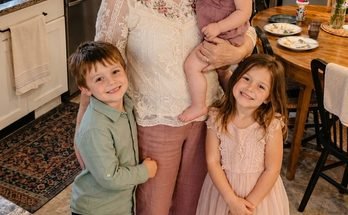
And I didn’t want Madison, Tyler, and June growing up believing that love meant one person always sacrificed while everyone else took.
“I love the kids,” I said. “But the answer is still no.”
Kevin’s voice changed.
The friendly brother disappeared.
“Wow.”
Just one word.
But I knew that tone.
The tone people use when you stop playing the role they assigned you.
“I guess buying a cabin changed you.”
I looked around my small office.
At my worn shoes under the desk.
At the coffee I had forgotten to drink.
At the schedule filled with people who needed something from me.
“No,” I said quietly.
“The cabin didn’t change me.”
I looked at the framed photo on my desk of the empty porch on my property.
“It just gave me a place where I could finally hear myself.”
Kevin didn’t answer.
He hung up a few seconds later.
I thought that was the end.
I was wrong.
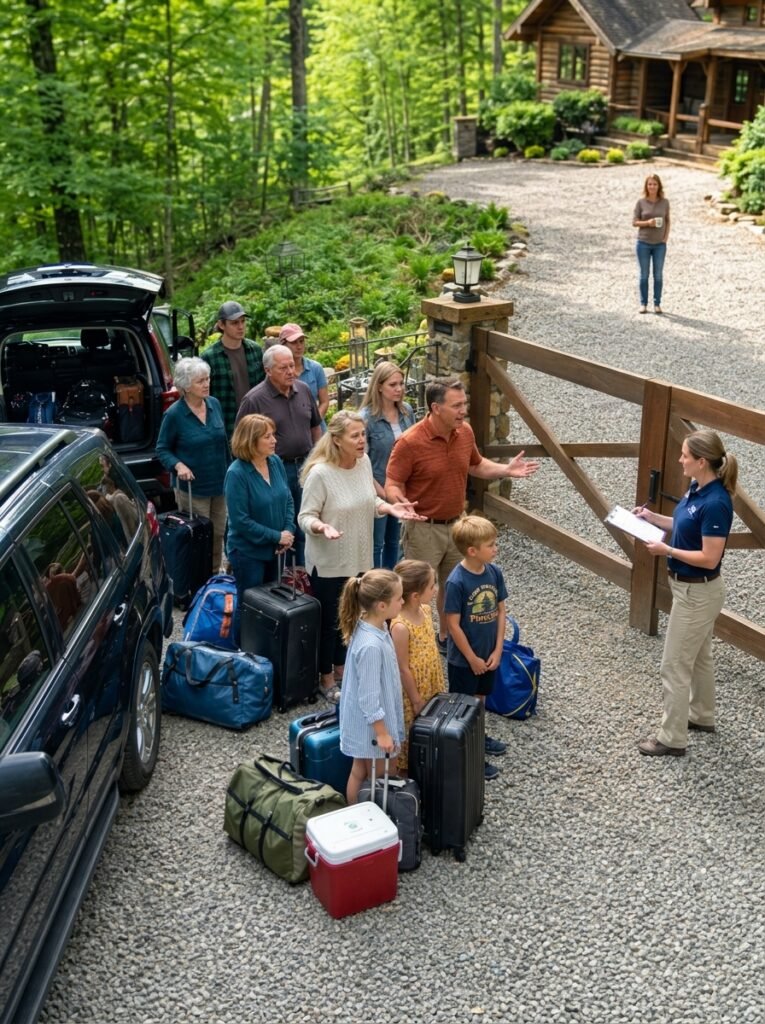
Because two weeks later, on a bright Saturday morning, I was sitting on my porch reading a book when three vehicles appeared at the end of my gravel driveway.
Three.
Not one.
Three.
A large SUV.
A minivan.
And a pickup truck loaded with bags.
My stomach dropped.
Kevin had never asked again.
He had never apologized.
He had simply decided my answer didn’t matter.
The vehicles rolled closer.
Doors opened.
Suitcases came out.
The kids jumped down excitedly.
Patrice stepped onto the gravel wearing sunglasses and a smile.
“Ellie!” she called. “Surprise!”
I didn’t move.
Kevin walked toward me carrying a duffel bag.
“Don’t look so shocked. We figured you’d get over it.”
For a moment, nobody spoke.
The mountains were quiet.
The creek behind the cabin kept moving.
Exactly like it had the first day I arrived.
Then Patrice looked past me toward the cabin.
“So where should we put everyone’s stuff?”
I slowly stood up.
And before I could answer, a white SUV turned onto the driveway.
Everyone looked toward it.
A man stepped out wearing a property manager badge.
He walked calmly toward the gate.
Then he looked at Kevin, Patrice, and the pile of suitcases.
He asked one question.
“Can I see your reservation confirmation?”
Nobody spoke.
And in that moment, for the first time in my family’s history, everyone realized something important.
This cabin was not a family obligation.
It was not a free vacation house.
It was not another thing Eleanor would quietly surrender.
It was mine.
And this time, I had the documents to prove it.
PART 3
The silence lasted so long that I could hear the creek behind the cabin.
Kevin stared at the property manager.
Then he looked at me.
“Reservation confirmation?” he repeated.
The property manager nodded.
“Yes. This property is privately owned and requires a confirmed reservation for any guest staying on the premises.”
Patrice removed her sunglasses.
“Excuse me?”
The man remained polite.
“I’m Marcus Reed. I manage the property on behalf of the owner.”
Patrice pointed toward me.
“She’s the owner.”
Marcus nodded.
“Yes, ma’am.”
“Then why are you asking us for a reservation?”
“Because the owner has not authorized your stay.”
Kevin gave a short laugh.
“That’s ridiculous. We’re family.”
Marcus glanced at him.
“Family status does not constitute authorization.”
I almost smiled.
Almost.
Kevin turned toward me.
“Ellie.”
I said nothing.
“You called someone?”
“I didn’t have to.”
“What does that mean?”
“It means I told Marcus exactly what I wanted when I hired him.”
Kevin’s face tightened.
“You hired a property manager?”
“Yes.”
“Why?”
“Because I own a property.”
He looked genuinely offended.
As though owning something meant I had betrayed him.
Patrice stepped forward.
“Eleanor, this is absurd. We drove four hours.”
“I know.”
“We have three children.”
“I know.”
“We packed for two weeks.”
“I know.”
“Then let us inside.”
I shook my head.
“No.”
Her mouth fell open.
“You’re seriously doing this?”
“Yes.”
Kevin stepped closer.
“You told me you’d think about it.”
“I did.”
“And?”
“I thought about it.”
“And?”
I looked directly at him.
“And I said no.”
His jaw tightened.
“You can’t just leave us standing outside.”
“I didn’t invite you.”
He stared at me.
For years, I had been afraid of that look.
The disappointment.
The anger.
The accusation.
The silent message that I had somehow failed my family.
But standing there on my own porch, I realized something.
His anger wasn’t proof that I was wrong.
It was proof that my boundary had finally reached him.
Patrice folded her arms.
“This is unbelievable.”
“No,” I said quietly.
“What is unbelievable is that I told you no, and you came anyway.”
Nobody answered.
Behind them, Madison stood beside the minivan holding a small backpack.
She looked confused.
Tyler was kicking at the gravel.
Little June was hugging a stuffed rabbit.
I looked at the children and felt my chest tighten.
I walked toward them.
“Hey.”
June looked up.
“Are we staying here?”
I crouched beside her.
“I’m sorry, sweetheart. Not this time.”
Her little face fell.
“But Daddy said this was your house.”
“It is.”
“So why can’t we stay?”
I glanced at Kevin.
Then back at her.
“Because having a house doesn’t mean I have to let everyone stay whenever they want.”
June nodded slowly.
Children understand boundaries much faster than adults who have benefited from their absence.
I stood.
“I booked a hotel in Asheville for tonight.”
Kevin blinked.
“What?”
“I knew you might come anyway.”
“You booked a hotel?”
“Yes.”
“For us?”
“For the children.”
He looked insulted.
“You think we’re going to stay at some hotel after driving all this way?”
“You can make your own decision.”
Marcus handed Kevin a small envelope.
“There’s also a printed list of nearby accommodations, restaurants, and emergency contacts.”
Kevin didn’t take it.
He looked at me.
“You planned all of this?”
“Yes.”
“How long?”
“Since the day you told me you were bringing eleven people.”
His expression changed.
“You knew?”
“I knew you might not respect my answer.”
Patrice laughed bitterly.
“So you set us up.”
“No.”
I shook my head.
“I prepared for the possibility that you would ignore me.”
She opened her mouth.
Nothing came out.
Then Kevin said the sentence I had been expecting.
“You’re becoming selfish.”
I took a slow breath.
Maybe once that word would have broken me.
Not anymore.
“Kevin, do you know what selfish actually means?”
He stared at me.
“It means taking something that isn’t yours simply because you want it.”
His face reddened.
I continued.
“For eleven years, I saved for this place. I worked weekends. I worked holidays. I skipped trips. I bought used furniture. I drove the same car until it sounded like it was going to fall apart.”
I looked around at the cabin.
“And every time I wanted something for myself, someone in this family needed something more.”
My mother used to call.
Kevin needed money.
Patrice needed childcare.
Someone needed a ride.
Someone needed a reservation.
Someone needed a favor.
Someone needed me.
And I had always answered.
“But when I finally bought something for myself,” I said, “you didn’t ask if I was happy.”
Kevin looked away.
“You asked when you could use it.”
The words hung between us.
Marcus quietly stepped back.
Even the children seemed to understand that something important was happening.
Then my mother’s car appeared at the end of the road.
Of course it did.
She had followed them.
The sedan stopped behind the pickup.
My mother stepped out.
She looked at the luggage.
Then at me.
Then at Marcus.
“What is going on?”
Kevin immediately walked toward her.
“Mom, Ellie is refusing to let us stay.”
My mother’s face changed.
She looked at me with the expression she had perfected over forty years.
Not anger.
Disappointment.
Somehow, disappointment always hurt more.
“Eleanor.”
“Mom.”
“What happened to you?”
I almost laughed.
Instead, I answered honestly.
“Nothing happened to me.”
She frowned.
“I raised you better than this.”
“No.”
Her eyes widened.
“You raised me to take care of everyone.”
I swallowed.
“And I learned.”
My voice shook.
“But somewhere along the way, everyone forgot to teach me that I was allowed to take care of myself.”
My mother’s expression softened for half a second.
Then hardened again.
“We are family.”
“I know.”
“Family helps each other.”
“I agree.”
“Then help your brother.”
“I have.”
Kevin looked at her.
She continued.
“He has children.”
“I know.”
“They deserve a vacation.”
“They do.”
“So let them stay.”
I shook my head.
“No.”
My mother stared at me.
“You’re really going to do this?”
“Yes.”
She whispered something under her breath.
Then she said, “Your grandmother would be ashamed.”
That one landed.
My grandmother.
The woman whose money had helped me buy the cabin.
The woman who had once sat beside me at the kitchen table when I was twenty-two and crying because everyone expected me to solve every family problem.
I remembered what she told me.
Eleanor, kindness without boundaries becomes permission.
I looked at my mother.
“You know what Grandma would say?”
My mother went silent.
“She would ask whether I was happy.”
Nobody moved.
“She would tell me that a home is supposed to be a place where your heart can rest.”
I looked at the cabin.
“And she would probably ask why I was letting eleven people stand at my gate trying to take that rest away.”
My mother looked down.
For the first time that morning, she didn’t have an answer.
Then Patrice exploded.
“This is ridiculous! We are not beggars!”
“No,” I said.
“You’re my family.”
“Yes.”
“And you’re treating us like strangers!”
I looked at her.
“That’s because you came here like guests who didn’t need an invitation.”
Silence.
Marcus cleared his throat.
“If everyone is finished, I do need to ask you to leave the private driveway.”
Kevin stared at me.
“You’re actually throwing us out.”
“No.”
I shook my head.
“You threw yourselves out when you decided my answer didn’t matter.”
That ended the argument.
They packed their bags back into the cars.
Madison came over before she left.
She hugged me.
“I’m sorry, Aunt Ellie.”
I hugged her tightly.
“You don’t have anything to apologize for.”
Tyler stood awkwardly beside her.
June held up her stuffed rabbit.
“Can we come back someday?”
I smiled.
“If I invite you.”
She thought about that.
“Okay.”
And somehow, that little word felt like victory.
Not because I had defeated my family.
Because I had finally taught a child the difference between being loved and being entitled.
The cars disappeared down the gravel road.
My mother was the last one to leave.
Before she got into the car, she turned.
“You’ve changed.”
I nodded.
“Yes.”
She looked at the cabin.
“Are you happy?”
I looked at the porch.
At the mountains.
At the creek.
At the quiet.
“Yes.”
She nodded slowly.
Then she got into the car.
For the first time in my life, she didn’t ask me to fix anything.
I watched her drive away.
Marcus came up beside me.
“You okay?”
I laughed softly.
“I don’t know.”
He smiled.
“That’s usually how big changes feel.”
After he left, I went inside.
The cabin was quiet again.
I put my bag down.
Made coffee.
Opened the kitchen window.
And listened.
No shouting.
No children running upstairs.
No arguments about bedrooms.
No one asking what was for dinner.
No one telling me to sleep on the couch.
Just the creek.
That afternoon, I sat on the porch with my grandmother’s old quilt wrapped around my shoulders.
My phone buzzed.
A message from Kevin.
I almost ignored it.
Then I opened it.
I was angry. But I know you were right about one thing.
A second message appeared.
We should have asked.
I stared at the screen.
Then another message.
Can we talk next week? Just me and you?
I thought about it.
Then typed one sentence.
Yes. But we talk as siblings, not as owner and guest.
He replied almost immediately.
Fair.
I put the phone down.
The sun was beginning to disappear behind the mountains.
For years, I had believed saying no meant losing people.
I finally understood the truth.
Sometimes saying no doesn’t make people leave.
It simply reveals why they were staying.
Three months later, Kevin came alone.
He parked at the gate and waited.
He didn’t walk onto the property.
He called me.
“I’m here.”
“I see you.”
“Can I come up?”
I smiled.
“Yes.”
He walked toward the cabin carrying two paper cups of coffee.
No suitcases.
No children.
No demands.
Just coffee.
We sat on the porch for almost two hours.
He apologized.
Not perfectly.
Not dramatically.
But sincerely.
He admitted that he had grown used to thinking of me as the person who would always say yes.
He admitted Patrice had assumed the cabin was available because everyone had always treated my time and money as communal property.
And then he said something I never expected.
“I think I taught my kids that Aunt Ellie will always fix everything.”
I looked at him.
He looked ashamed.
“I don’t want them growing up like that.”
Neither did I.
The next summer, I invited Madison, Tyler, and June for three days.
Three days.
Not two weeks.
I told them the rules before they arrived.
Everyone helped clean.
Everyone washed their own dishes.
Nobody entered my bedroom.
Nobody used anything without asking.
And nobody assumed they could return without an invitation.
They agreed.
When they arrived, June ran onto the porch.
“Aunt Ellie!”
I opened my arms.
She jumped into them.
Behind her, Kevin carried groceries.
Patrice carried blankets.
And for the first time, nobody expected me to do everything.
We cooked together.
We walked beside the creek.
We made pancakes in the morning.
At night, we sat around the fire.
It wasn’t perfect.
It didn’t need to be.
Because this time, I wasn’t disappearing inside the memory.
I was part of it.
Years later, when people asked me about the cabin, I never told them it was the place where I finally learned to say no.
I told them something simpler.
It was the place where I finally learned that love and access were not the same thing.
My family had once believed my cabin was their free vacation home.
They were wrong.
It was my home.
And the most important thing I ever built there wasn’t a porch, a fireplace, or a beautiful view of the Blue Ridge Mountains.
It was a boundary.
One I finally had the courage to keep.