For three years, Gabriel learned to measure his life by machinery.
The ship’s engines never truly stopped, even when he slept, and their low vibration followed him through narrow corridors, metal stairwells, and the small cabin where he kept three photographs taped beside his bunk.
One showed Valeria smiling at the port with wind pushing her hair across her face.
Image
Another showed Mateo at almost one year old, reaching toward the camera with both hands.
The third was a picture Gabriel had taken of an empty lot where he hoped their future house would stand.
He looked at those photographs after double shifts, during storms, and on nights when the ocean seemed too large for any promise to cross.
He was thirty-two and worked as a chief engineer on an international cruise ship, which sounded impressive when relatives said it aloud but felt much less impressive when he was covered in grease at two in the morning, listening to pipes knock behind a steel wall.
The work paid well, but the money came attached to absences.
Gabriel missed birthdays.
He missed holidays.
He missed Mateo’s first clear words, the first fever that kept Valeria awake all night, and the ordinary mornings when a child learns that his father is supposed to be part of the room.
Each missed moment became something Gabriel tried to convert into purpose.
He told himself he was not simply gone.
He was building.
Before he left Mexico, he had promised Valeria that the separation would buy them security, a real home, and the kind of life where she would not have to calculate every grocery purchase before reaching the register.
At the port, she held Mateo against her chest while Gabriel repeated that promise until his boarding call came.
Valeria tried to smile for him, but her eyes stayed wet.
Gabriel kissed his son’s forehead, held his wife for as long as the workers would allow, and walked onto the ship believing sacrifice was the same thing as protection.
He did not understand yet that distance can turn trust into a weapon when the wrong person stands in the middle.
Valeria did not have her own bank account at the time, and she had never managed large transfers.
Gabriel’s older brother, Roberto, had always presented himself as the practical one in the family.
He knew contractors.
He understood paperwork.
He spoke confidently about exchange rates, building costs, materials, and the problems that could happen when money arrived from abroad.
Gabriel had grown up following him through life, so asking Roberto to manage the transfers felt less like a risk than a family duty.
Before boarding, Gabriel met him face-to-face.
“Take care of Valeria and Mateo while I’m gone,” Gabriel said. “I want them comfortable, and I want the rest used for the house.”
Roberto put a hand on his shoulder.
“Your wife and son are my responsibility now,” he said. “Valeria will be treated like a queen.”
The sentence stayed with Gabriel because it sounded generous, loyal, and certain.
Every month after that, Gabriel sent one hundred thousand pesos.
He did it without fail.
Sometimes the transfer went through while he was between shifts.
Sometimes it happened after midnight while the ship crossed a different time zone.
Sometimes he stood in a humming service corridor waiting for confirmation because the cabin connection was too weak.
Each receipt felt like another brick placed in a house he could not see.
Roberto sent updates often enough to keep doubt away.
There were photographs of fresh walls, stacked tile, new windows, and men carrying materials through rooms that seemed to grow larger every month.
There were messages saying Valeria and Mateo were fine.
There were short explanations whenever Gabriel asked why his wife was difficult to reach.
Her phone had problems.
Mateo was sick.
She was tired.
She was visiting relatives.
The excuses never sounded dramatic enough to trigger suspicion, and Gabriel wanted to believe them because belief made the work possible.
When he called Valeria directly, the conversations were often brief and uneven.
Sometimes the line cut out.
Sometimes Roberto answered first and said she was busy.
Sometimes Valeria sounded distracted, but Gabriel blamed exhaustion, childcare, and the pressure of waiting for a husband who lived thousands of miles away.
He asked whether she needed anything.
She usually said no.
He asked whether Mateo remembered him.
She would pause before saying that she showed their son his picture every day.
Gabriel held onto that answer during the worst nights at sea.
The ship moved through violent weather more than once during those three years.
Cabinet doors slammed.
Tools shifted in their drawers.
The metal under Gabriel’s boots pitched and rolled while warning lights flashed across the engine room.
During one storm, he spent nearly sixteen hours working without a real break because a mechanical problem could not be ignored until the weather passed.
When he finally returned to his cabin, soaked in sweat and too tired to remove his work clothes, he opened the latest photograph from Roberto.
It showed a large three-story house with bright fresh paint and a wide garage.
Roberto’s message said the dream was almost finished.
Gabriel stared at the picture until the motion of the ship stopped mattering.
He imagined Valeria choosing curtains.
He imagined Mateo running down a hallway.
He imagined arriving at the front door and hearing his family’s voices inside.
That image became the reward he carried through every shift that followed.
Then his contract ended earlier than expected.
Gabriel received the news with such sudden relief that he read the message twice before believing it.
He could have called Valeria immediately.
He almost did.
Instead, he decided to come home without warning.
After three years of missing every surprise life had given his family, he wanted to create one himself.
He bought expensive perfume for Valeria because he remembered the scent she used to test at store counters but never purchased.
He bought small gold jewelry because she always said practical things mattered more, even when her eyes lingered on pieces behind glass.
For Mateo, he filled a bag with toys chosen by a man trying to guess the interests of a son he barely knew.
There were cars, building blocks, and a stuffed animal soft enough for a child to carry to bed.
The gifts were not meant to replace time.
Gabriel knew nothing could do that.
They were simply objects he hoped would help him cross the first awkward minutes of coming home.
On the flight, he barely slept.
At the airport, the crowd moved too slowly.
During the ride to Zapopan, he checked the address Roberto had sent and looked at the photographs of the house again.
The driver asked whether he was returning from a trip.
Gabriel said he had been away for work.
He did not explain that three years can make home feel like both the closest and farthest place in the world.
When the taxi finally turned onto the street, Gabriel sat forward.
He recognized the house before the driver stopped.
It was larger than it had appeared in the photos.
Three stories rose above a clean front drive.
Fresh paint reflected the outside lights.
A wide garage faced the street, and two brand-new SUVs were parked outside.
Music carried through the walls.
Even from the curb, Gabriel could hear people laughing and glasses striking together.
The scene looked like success.
For a few seconds, he felt proud enough to forget how strange it was that no one had told him about a celebration.
He paid the driver, lifted his bags from the trunk, and stood in front of the house he believed he had built for his family.
His chest filled so quickly it almost hurt.
He thought, I did it.
He thought, They are safe.
He thought every lonely meal, missed holiday, and dangerous shift had finally turned into something real.
The front entrance was bright, and shadows moved behind the windows.
Gabriel could have walked directly inside.
He could have knocked.
He could have called Valeria’s name and let the whole house witness his return.
Instead, he chose the side gate near the kitchen because he wanted to find his wife before anyone ruined the surprise.
He imagined placing his hands over her eyes.
He imagined Mateo staring at him for one uncertain second before Valeria said, “That’s your father.”
He imagined laughter.
The side gate opened with a soft scrape.
Behind the house, the music sounded louder because the wall carried the bass into the narrow yard.
The air smelled of wet concrete, spoiled food, and rain.
Gabriel took a few steps with one suitcase in each hand.
Then something in the dark near the trash bins moved.
At first, his mind refused to understand what he was seeing.
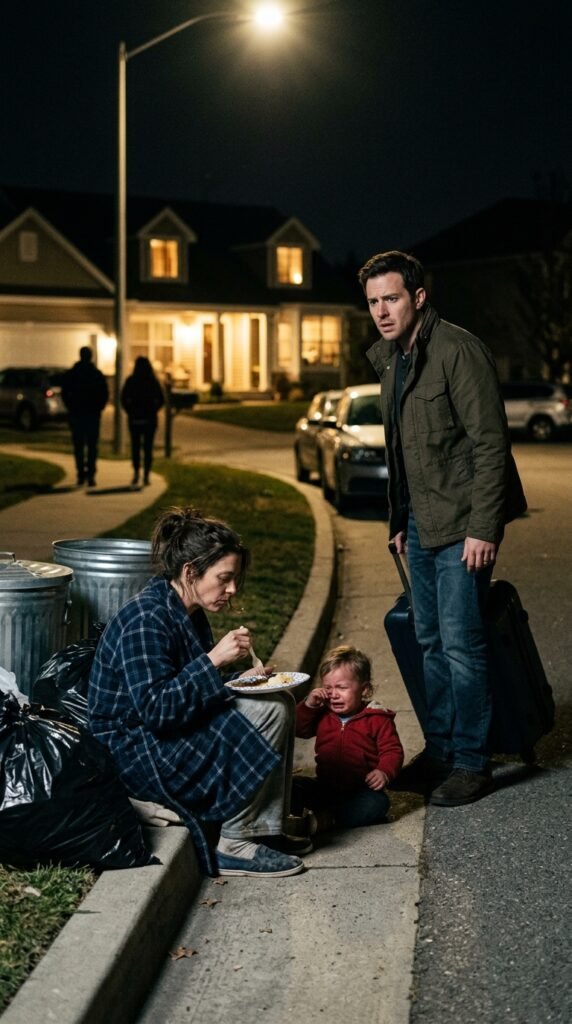
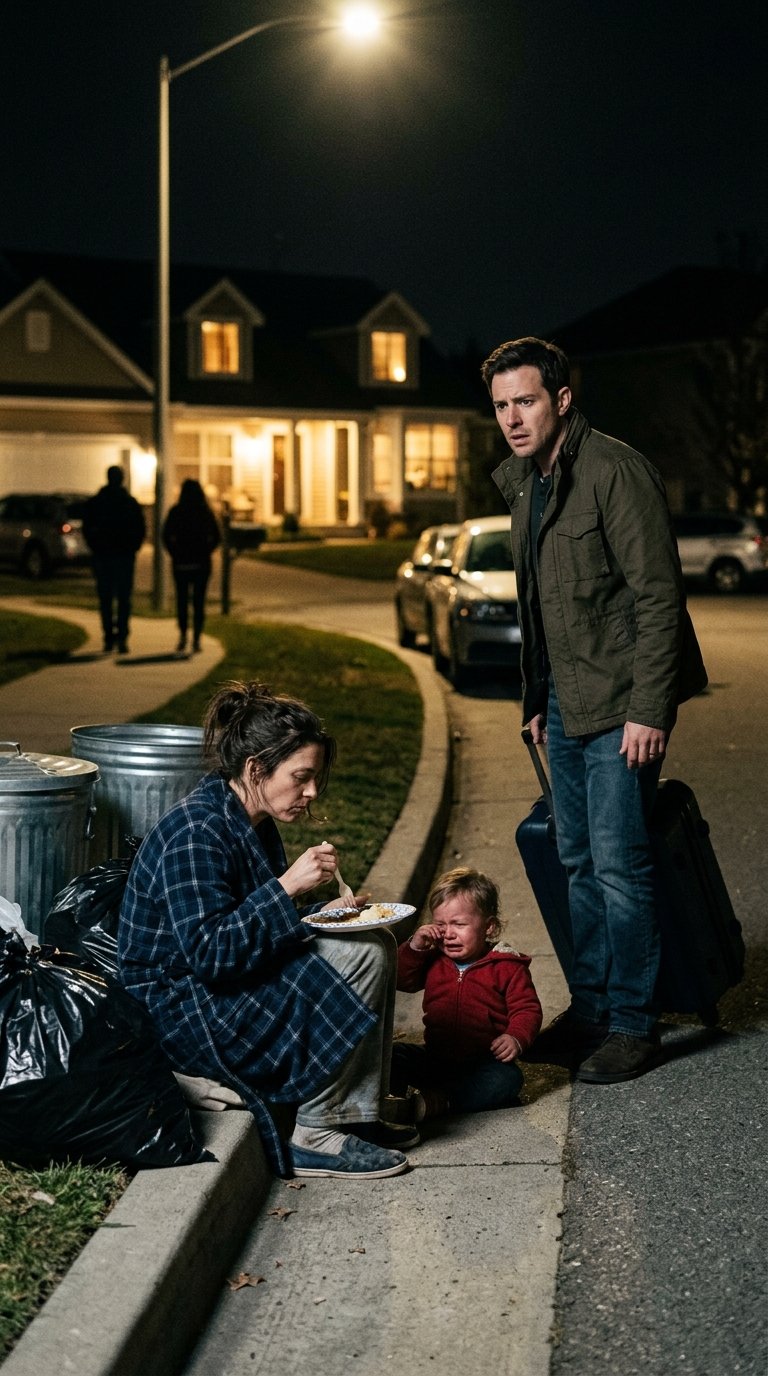
A woman sat on the ground with a child in her arms.
Her robe was faded.
Her hair hung in tangled strands.
One shoulder curved protectively around the small body pressed against her.
Gabriel slowed.
The suitcases slipped from his hands and struck the concrete with a hard double thud.
The woman looked up.
It was Valeria.
He had carried her face across oceans in photographs, but the person in front of him looked as though hunger and fear had erased the woman he remembered one day at a time.
She was painfully thin.
Her cheeks had hollowed.
Her skin looked gray beneath the practical light spilling from the back of the house.
The old robe she wore was torn near the hem and dirty from the wet ground.
Nothing about her matched the updates Roberto had sent.
Nothing about her matched the house.
In Valeria’s arms was Mateo.
Gabriel’s son wore a dirty T-shirt and cried with the weak, exhausted sound of a child who had already used most of his strength.
The boy was older than the baby in Gabriel’s photographs, but smaller than the child Gabriel had imagined running through the finished house.
Valeria held a stained plastic plate in her free hand.
Gabriel’s eyes moved to it because his mind still wanted a simple explanation.
There was no simple explanation.
On the plate were pork bones, clumped rice, and scraps that had clearly been thrown away after the party inside.
Valeria used her fingers to separate the pieces that looked least spoiled.
She wiped one against the edge of the plate and brought it toward Mateo.
“Eat, baby,” she whispered. “I’m sorry. This is all Mama could get. I’ll clean it off. I promise I’ll clean it off.”
Gabriel could not breathe.
The music continued behind the wall.
Someone inside laughed loudly.
Another voice called for a toast.
A glass struck another glass, followed by applause.
The sound traveled through the warm house and reached the cold concrete where Valeria sat trying to turn garbage into dinner.
Gabriel had spent three years believing money could protect his family from suffering.
Now the proof of his failure was in his wife’s hand.
The perfume he had bought was still packed in one suitcase.
The jewelry was wrapped beside it.
Mateo’s toys were in the other bag.
Those gifts suddenly felt obscene next to the stained plate.
Gabriel’s legs gave out.
His knees hit the concrete hard enough to send pain through his body, but the pain barely registered.
“V… Valeria?” he said.
His voice broke on her name.
Valeria stared at him.
Recognition appeared slowly, as though her mind had to cross the same impossible distance his body had crossed.
For one second, Gabriel expected relief.
He expected her to cry out, reach for him, or say his name.
Instead, fear tightened her face.
She pulled Mateo closer.
Her eyes moved past Gabriel toward the glowing back door.
That glance told him more than any explanation could have.
Valeria had not become poor by accident.
She had not simply lost access to money.
She had not chosen to sit behind the house while strangers celebrated inside.
Someone had placed her there, kept her there, and taught her to fear being heard.
Gabriel looked at the luxury house again.
The three stories no longer looked like proof of his sacrifice.
They looked like evidence of theft.
The two new SUVs no longer looked like security.
They looked like answers to questions he had never thought to ask.
Every photograph Roberto had sent rearranged itself in Gabriel’s mind.
The fresh walls.
The confident messages.
The excuses when Valeria could not speak.
The promise that she would be treated like a queen.
Gabriel understood that he had not merely trusted the wrong person with money.
He had trusted the wrong person with access to his wife, his son, and the story they were allowed to hear about him.
Valeria’s lips moved.
At first, Gabriel could not hear her over the music.
He leaned closer.
She whispered one name.
“Roberto.”
The name landed between them like another object thrown onto the concrete.
Gabriel looked toward the house.
Inside, his older brother was celebrating under the roof Gabriel had paid for.
Outside, Valeria was starving with Mateo in her arms.
Gabriel removed his jacket and wrapped it around them.
When he reached toward his son, Mateo turned away and hid his face against Valeria’s chest.
That small movement opened a pain Gabriel had not prepared for.
His own child did not recognize him.
The missed birthdays and first words were no longer abstract losses.
They were present in the way Mateo resisted his touch.
Gabriel forced himself not to react in a way that would frighten the boy.
He kept his hands open.
He lowered his voice.
“Tell me what happened,” he said.
Valeria looked toward the door again before answering.
“He said you stopped sending money,” she whispered. “He said the house belonged to him because he handled everything.”
Gabriel felt the world narrow.
He had sent one hundred thousand pesos every month.
Roberto knew every amount.
Roberto knew every date.
That knowledge had allowed him to make the lie sound complete.
Valeria continued in broken pieces, never speaking loudly.
Whenever she asked questions, Roberto called her ungrateful.
Whenever she tried to challenge him, he used Gabriel’s absence as proof that she had no one else.
The cruelty was not only that Roberto had taken control.
It was that he had used Gabriel’s sacrifice to make Valeria believe she had been abandoned.
Gabriel stood slowly.
He looked down at his wife and son beneath his jacket.
Then he faced the back door.
The music stopped.
The laughter faded.
A shadow crossed the kitchen doorway.
The handle turned.
And Gabriel understood that the nightmare he had walked into was only beginning.