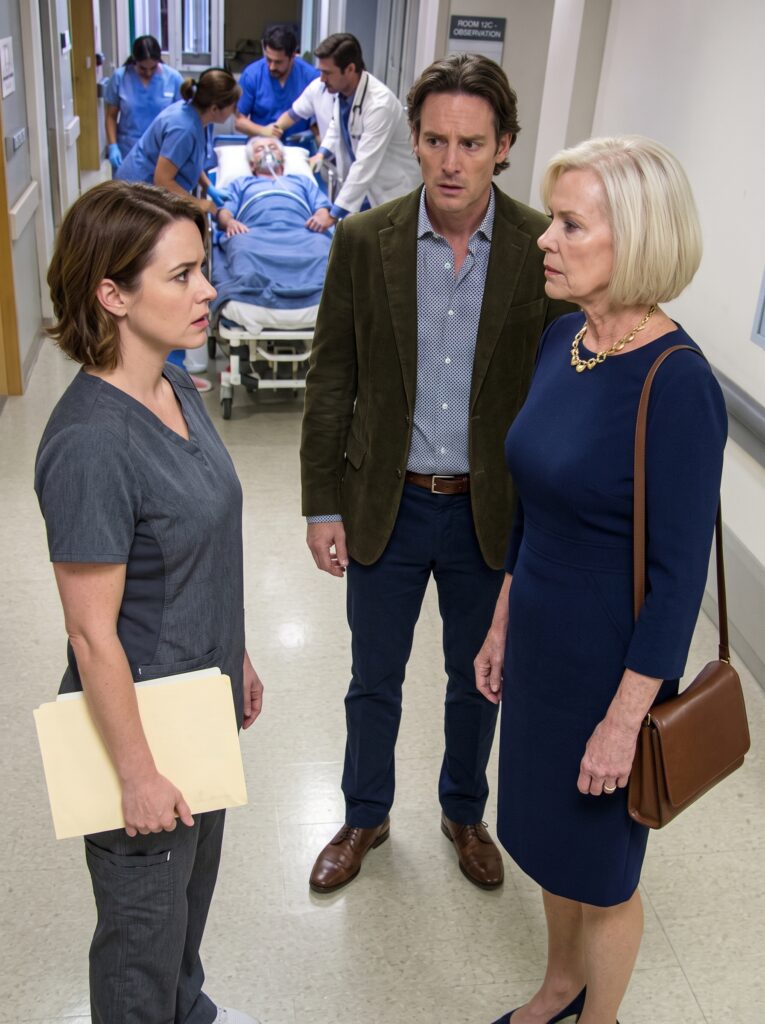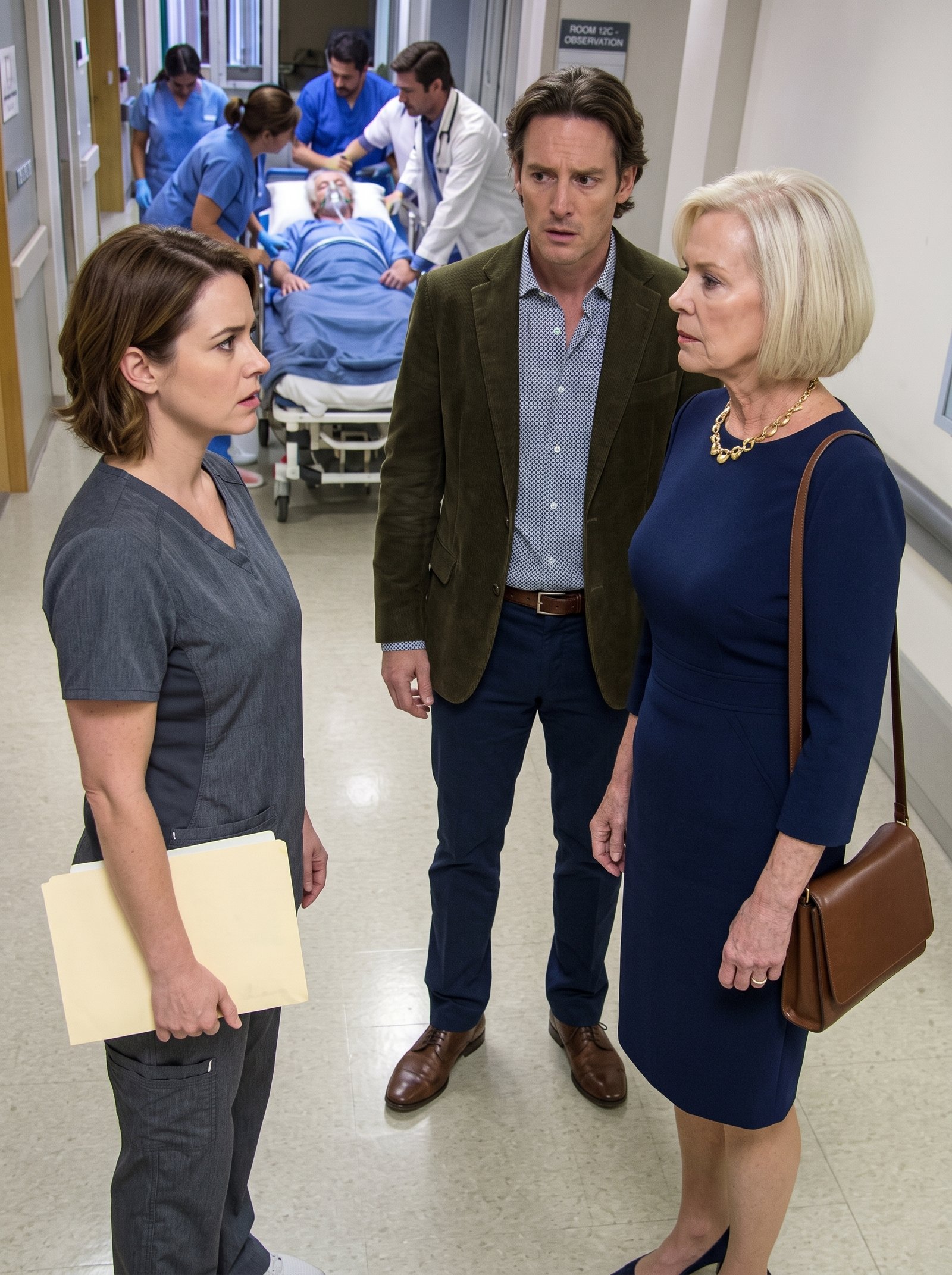
When i met my fiancé’s parents, i told them i was just a regular nurse… even though i was actually the chief surgeon at the most prestigious private hospital in the city. i never expected what happened after i said those words…
Nearly forty relatives sat beneath the polished chandeliers of the Reynolds Country Club, champagne glasses catching the late-morning light, while Barbara rested one hand on my shoulder and announced, “And this is Emily. She’s a nurse.”
There was a pause.
Not a cruel one. Somehow, that made it worse. It was the quiet little drop in interest that happens when people decide they already understand you.
An elderly aunt gave me a kind smile. Someone asked what hospital I worked at. When I said St. Victoria Medical Center, a man across the table brightened.
“I’ve heard they have some excellent surgeons there.”
Barbara laughed softly.
“Oh, they do. I’m sure Emily keeps them organized.”
A few people chuckled.
My fiancé, Daniel, went still beside me.
I didn’t.
I smiled, lifted my coffee cup, and said, “They certainly keep me busy.”
Barbara looked pleased. She thought I had accepted my place.
What she didn’t know was that I had spent almost two years building a life with her son without ever needing her family’s approval, and six weeks quietly watching them decide my worth based on a job title they had never bothered to verify.
Daniel knew the truth.
He had wanted to tell them from the beginning.
I asked him not to.
“If they only respect me after hearing a title,” I had told him one night in our Chicago condo, “then they never respected me at all.”
So when his mother first asked what I did at St. Victoria, I said I worked in surgery.
She interrupted before I could finish.
“Oh, she’s one of the nurses.”
I had been a nurse. I was proud of it.
So I let her believe exactly what she wanted to believe.
From that day on, Barbara found a hundred polished ways to remind me that I was not the woman she had imagined for her son.
At Sunday dinner, she told me becoming a physician “isn’t for everyone.”
At breakfast, she handed me an apron because “nurses are practical people.”
At a charity gala, she seated Daniel at the head table with physicians, executives, and donors, while placing me near the back with volunteers and event staff.
“The head table is for senior leadership,” she explained gently.
I said nothing.
At the engagement brunch, she handed me a beautifully wrapped cookbook titled Easy Family Meals for Busy Beginners.
Inside was a handwritten card.
So Daniel won’t have to live on hospital cafeteria food forever.
Love, Barbara.
Everyone laughed.
I closed the book and thanked her.
Then she leaned toward me and said, “A good meal keeps a marriage healthy.”
I met her eyes.
“So does kindness.”
For the first time, her smile slipped.
Only for a second.
Then my phone vibrated.
The hospital was the only caller allowed to break through my silent setting.
I stepped into the hallway and answered.
There had been a multi-vehicle crash on the freeway. Twelve patients were incoming. Trauma was overwhelmed. They needed me immediately.
When I returned for my purse, Daniel read my face before I said a word.
“I have to go.”
Barbara frowned. “Now?”
“There’s been a major accident.”
She gave a small, almost amused sigh.
“Well, I suppose hospitals are busy on weekends.”
I turned toward the door.
Then she laughed lightly and said, loud enough for several relatives to hear, “I guess someone has to change all those bedpans.”
Daniel’s chair scraped hard across the floor.
“Mom.”
The room went silent.
“That’s enough.”
Barbara blinked as if he had embarrassed her.
“I was joking.”
“No,” he said. “You’ve been insulting Emily since the day you met her.”
I touched his arm before anger could turn the brunch into something neither of us could take back.
“It’s okay.”
He looked at me. “No, Emily. It isn’t.”
I picked up my purse.
“It will be.”
Twenty-eight minutes later, I walked through the staff entrance at St. Victoria.
The automatic doors opened.
A resident hurried toward me. Another held out a tablet loaded with trauma scans. A nurse passed me surgical gloves without slowing down.
Within seconds, the Reynolds family disappeared from my mind.
There were lives to save.
I worked most of the night.
The next morning began quietly.
Rounds. Coffee. Exhausted residents. Three trauma patients stable, one still critical.
Then my pager vibrated.
Emergency consult.
Possible Type A aortic dissection.
I was reviewing the CT scan when the emergency physician handed me the patient chart.
I looked down at the name.
Richard Reynolds.
Daniel’s father.
For one second, every sound in the room seemed to disappear.
Then training took over.
“Prep Operating Room Three.”
I carried the chart under my arm as I headed toward the trauma bay.
That was when I saw Daniel.
He was standing beside his mother in the hospital corridor, pale and terrified.
His eyes found mine.
“Emily…”
Barbara turned.
Confusion crossed her face when she saw me in scrubs.
“What is she doing here?”
Before Daniel could answer, a charge nurse rushed toward me.
“We’re ready.”
Barbara stepped forward, trying to remain composed.
“I’m sorry,” she said. “We’re waiting for the chief surgeon.”
The nurse stopped.
Her eyes moved from Barbara…
to me.
And for the first time since I had met her, Barbara Reynolds’ confident smile began to disappear.
Part 2:
My future mother-in-law looked me straight in the eye, smiled as if she were doing me a favor, and said loudly enough for everyone around the dining table to hear, “A nurse is a respectable job, sweetheart. But I always imagined my son marrying someone who actually became a doctor.”
The room erupted in awkward laughter. Someone coughed into a wine glass. Another guest suddenly found the mashed potatoes fascinating. My fiancé squeezed my hand under the table, silently begging me not to react. He knew something no one else in that room did, including his parents.
I wasn’t just a nurse.
I was the Chief of Cardiothoracic Surgery at the most prestigious private hospital in Chicago.
The irony was almost unbearable. An hour earlier, I had personally led a seven-hour open-heart procedure that saved the life of a man no other hospital believed could survive. Less than two hours later, I was apparently the least impressive person at Sunday dinner.
I looked at Barbara Reynolds, smiled warmly, and answered exactly as I had planned.
“I’ve always been proud to be a nurse.”
She nodded with visible relief. “Oh, that’s good. Knowing your place is such an admirable quality.”
I simply picked up my fork, because sometimes the strongest revenge begins with silence.
My name is Emily Carter. I’m thirty-four years old, and if there’s one lesson life taught me long before I ever wore a white coat, it’s this: people reveal who they really are when they believe you have nothing they need.
That Sunday afternoon was supposed to be the first time I met my fiancé’s parents. Daniel and I had been together for almost two years. He was thirty-six, a corporate attorney in downtown Chicago, thoughtful in a way that seemed almost old-fashioned. He listened more than he talked, remembered little details, and never made promises he couldn’t keep.
When he proposed six months earlier beside Lake Michigan at sunrise, I never imagined the hardest part of our engagement wouldn’t be planning a wedding. It would be earning the approval of his family—or perhaps discovering whether I even wanted it.
The drive to his parents’ home took nearly forty-five minutes from our condo. The Reynolds family lived in an affluent suburb lined with mature oak trees, immaculate lawns, and houses large enough to make even successful professionals feel slightly underdressed.
As Daniel parked the car, he rested both hands on the steering wheel without turning off the engine.
“You still okay with this?” he asked quietly.
“I’m okay,” I told him, though I could feel the familiar tightness settling into my shoulders, the same tension I used to feel walking into rooms full of surgeons who assumed I couldn’t possibly be the one holding the scalpel. “I’ve survived worse than an awkward family dinner, Daniel.”
“That’s not what I’m worried about,” he said, finally cutting the engine. “I’m worried about what my mother’s going to say before you even sit down. She’s been asking pointed questions about your job for weeks.”
“Then let her ask,” I said. “I’m not going to lie about what I do. I’m also not going to correct her assumptions until I’m ready to.”
Daniel studied me for a long moment, something between concern and quiet admiration crossing his face. “You’re planning something.”
“I’m choosing my moment,” I said. “There’s a difference.”
The dinner unfolded exactly as I expected, Barbara’s comment landing with surgical precision of its own, the kind of remark clearly rehearsed in advance, delivered with a smile sharp enough to draw blood while still looking, to any outside observer, like nothing more than a proud mother’s harmless opinion.
I let it sit. I ate my dinner, complimented the roast, asked polite questions about Barbara’s garden club and her husband Richard’s golf handicap, and gave her every opportunity to believe she’d successfully put the nurse in her place.
It wasn’t until dessert that the conversation shifted in a direction I hadn’t planned for, but welcomed all the same.
“Richard had his procedure at Lakeside Memorial last spring,” Barbara mentioned to the table at large, cutting into her pie. “Some cardiac issue. The surgeon who handled it, apparently, was quite renowned. We were terribly lucky to get her.”
My fork paused halfway to my mouth.
“Her?” I asked, keeping my voice light.
“Yes, some young woman, believe it or not,” Barbara said, still cutting her pie without looking up. “Dr. Carter, I believe. Richard said she had the steadiest hands he’d ever seen in an operating room. Saved his life, really. We sent a rather generous donation to the cardiac wing afterward, out of gratitude.”
Daniel’s hand found mine under the table again, this time not squeezing in warning, but in something closer to disbelief, the pieces visibly assembling themselves behind his eyes before I’d said a single word.
“Dr. Emily Carter,” I said quietly. “Chief of Cardiothoracic Surgery at Lakeside Memorial.”
The table went silent in a way it hadn’t after Barbara’s earlier comment, a different kind of silence, heavier, more uncertain.
Barbara’s fork stopped mid-air. “I’m sorry, what did you say?”
“I performed Richard’s surgery,” I said. “Last spring. Seven-hour procedure, if I remember correctly. Coronary bypass with some unexpected complications partway through.”
Richard, who had been quietly nursing his coffee at the head of the table, went very still, studying my face now with the particular intensity of a man trying to place a memory buried under surgical masks and anesthesia haze.
“The steady hands,” he said slowly. “You said your name was Carter. I remember thanking you before they wheeled me into recovery. You told me to rest, that the hardest part was already behind me.”
“I remember that conversation too,” I said. “I’m glad you’re doing well, Richard.”
Barbara’s face had gone through three distinct shades of pale, her earlier confidence completely evaporated, replaced by the particular horror of a woman realizing she’d spent an entire dinner condescending to the surgeon who’d saved her husband’s life less than a year earlier.
“You’re a nurse,” she said, though it came out more like a question now, desperate for the ground beneath her to still be solid.
“I never said I was a nurse,” I said gently. “You assumed that, and I decided not to correct you until it mattered.”
Barbara set her fork down slowly, the clink of silver against china unnaturally loud in the silence that had settled over the table.
“Why would you let me believe you were a nurse?” she asked, her voice tight, embarrassment already curdling into something closer to accusation, as if I had orchestrated her humiliation rather than simply declined to correct her assumptions.
“Because you never actually asked what I do,” I said calmly. “You asked whether I’d become a doctor, in a tone that made it clear you’d already decided the answer, and you followed it with a comment about ‘knowing my place.’ I didn’t feel obligated to interrupt that performance for your comfort.”
“That’s not fair,” Barbara said. “If I’d known—”
“If you’d known, you would have treated me differently,” I said. “That’s exactly the problem, Barbara. My worth as a person, or as your son’s future wife, shouldn’t depend on which title happens to follow my name.”
Richard cleared his throat, setting his coffee cup down with the careful precision of a man trying to defuse something before it detonated further. “Barbara, she saved my life. Whatever this misunderstanding was, that fact hasn’t changed.”
“I’m not disputing that,” Barbara said, though her voice had lost its earlier confidence entirely. “I just… I had no idea.”
“You had an idea,” I said gently. “It just happened to be wrong. And I think, if I’m honest, the version of me you were prepared to dismiss as a nurse deserved exactly the same respect as the version of me who happens to hold a surgical chief position. That’s really what tonight was about, for me.”
Daniel, who had remained quiet through most of the exchange, finally spoke, his hand still resting over mine on the table. “Mom, I told you weeks ago that Emily’s incredible at what she does. You never asked what that actually meant. You just assumed it meant less than what you wanted for me.”
Barbara’s composure, so carefully maintained through decades of dinner parties and garden club luncheons, finally cracked in a way I hadn’t expected, something genuinely humbled breaking through the embarrassment.
“I think,” she said slowly, “I owe you an apology. Not just for tonight. For assuming, before I even gave you a chance, that a title could tell me everything I needed to know about you.”
“I’d appreciate that,” I said. “But Barbara, I need you to understand something. I wasn’t waiting for a moment to embarrass you tonight. I was hoping, honestly, that you’d have treated a nurse with the same respect you’re suddenly finding for a surgeon. That’s the part that matters to me, not the title itself.”
The rest of the table sat in an uncomfortable quiet, guests who had laughed along with Barbara’s earlier comment now visibly reassessing their own complicity in that awkward laughter, the coughs into wine glasses, the sudden fascination with mashed potatoes.
Richard reached across the table, extending his hand toward mine. “Dr. Carter, I don’t think I ever properly thanked you, outside of a hospital gown and an IV line. Thank you. Genuinely.”
I shook his hand, feeling something in the room shift, not fully repaired, not yet, but honestly cracked open in a way that felt more real than the polite tension I’d walked in with.
“You’re welcome, Richard,” I said. “I’m glad I got the chance to do it twice, in a way. Once in the operating room, and once at this table.”
Barbara looked at me for a long moment, something unreadable passing behind her eyes, before she finally spoke again, quieter this time, without the performative edge from earlier.
“I’d like the chance to know you properly,” she said. “Not the nurse. Not the surgeon. Just you, if you’re willing to give me that chance after tonight.”
I considered her for a moment, thinking about the two years of careful diplomacy I’d extended toward a family that had, until this exact moment, given me very little reason to extend it.
“I’m willing to try,” I said. “But Barbara, respect isn’t something you extend once you learn someone’s credentials. It has to come first, or it doesn’t really mean anything at all.”
The months leading up to the wedding became an unexpected test of whether Barbara’s dinner-table apology had been genuine or simply the polite reflex of a woman caught off guard. I watched carefully, the same way I watched a patient’s vitals after a procedure, looking for the small signs that would tell me whether the change was real or just surface-deep.
At first, the shift was clumsy. Barbara would introduce me at social functions with a slight overcorrection, “This is Dr. Emily Carter, Chief of Cardiothoracic Surgery,” delivered with the same performative weight she’d once used to diminish me, just now aimed in the opposite direction. It took a quiet conversation over coffee, just the two of us, for me to finally address it directly.
“You don’t have to announce my title every time you introduce me,” I told her. “That’s not actually respect. That’s just trading one kind of performance for another.”
Barbara was quiet for a moment, turning her cup slowly on its saucer. “I don’t know how to do this the right way,” she admitted. “I spent so many years believing certain things mattered, positions, titles, the right kind of last name at the right kind of dinner party. I don’t know how to just… see people plainly.”
“Start by asking questions instead of assuming answers,” I said. “You never once asked me what my work actually involved, what a day in an OR looks like, why I chose cardiothoracic surgery in the first place. You decided you already knew everything worth knowing about me before I said a word.”
She nodded slowly, and for the first time since that Sunday dinner, I saw something that looked less like damage control and more like genuine reflection.
Over the following weeks, small things began to shift. Barbara asked, tentatively at first, about a difficult case I’d had, actually listening rather than waiting for her turn to speak. She started volunteering at a hospital fundraiser, not for the social optics, but because Richard’s recovery had left her, she admitted, with a genuine curiosity about the work that had saved him. She stopped introducing me by title entirely, simply as “Daniel’s fiancée, Emily,” which felt, oddly, like the most respectful thing she’d done yet.
The wedding itself, held the following spring beside Lake Michigan at the same stretch of shoreline where Daniel had proposed, was smaller and warmer than the grand affair Barbara had originally envisioned for her son. She’d offered, more than once, to help fund something larger, more befitting, in her words, “a surgeon’s wedding,” and each time I gently declined, reminding her that grandeur had never been the thing I was fighting for.
Richard walked me partway down the aisle himself, an unusual gesture he’d requested months earlier, joining Daniel to escort me the final steps, a quiet acknowledgment of the debt he still carried and would, he told me privately beforehand, never fully repay.
At the reception, Barbara stood to give a toast, something she hadn’t been asked to do, something Daniel and I had genuinely worried about beforehand.
“A year ago, I said something at a dinner table that I’m deeply ashamed of,” she said, her voice steady despite the visible nerves beneath it. “I judged my son’s choice before I understood it. I want everyone here to know that Emily didn’t just save my husband’s life in an operating room. She showed me, with far more patience than I deserved, what it actually looks like to earn respect instead of assuming who deserves it.”
She raised her glass toward me, something genuinely warm in her expression now, no performance left in it.
“To Emily,” she said. “Who taught this old woman that the most impressive thing in that room was never a title. It was character. I’m only sorry it took me so long to see it.”
I raised my glass back, thinking about that Sunday dinner, the awkward laughter, the mashed potatoes suddenly fascinating to everyone but me, and the quiet choice I’d made to let silence do the work that anger never could have.
It hadn’t been about revenge. It had been about finally being seen, fully, by people who’d only ever been willing to look as far as a title.
By the end of that night, for the first time since Daniel and I had gotten engaged, I finally felt like I’d been welcomed, not into a family that valued my credentials.
Into one that had finally learned to value me.