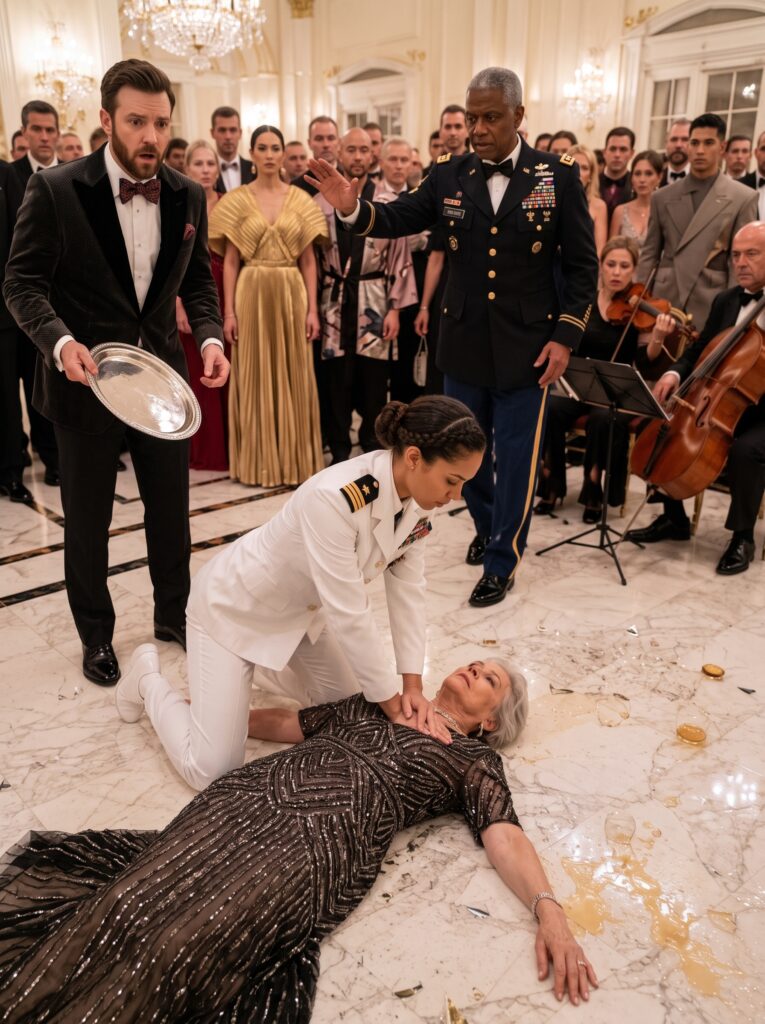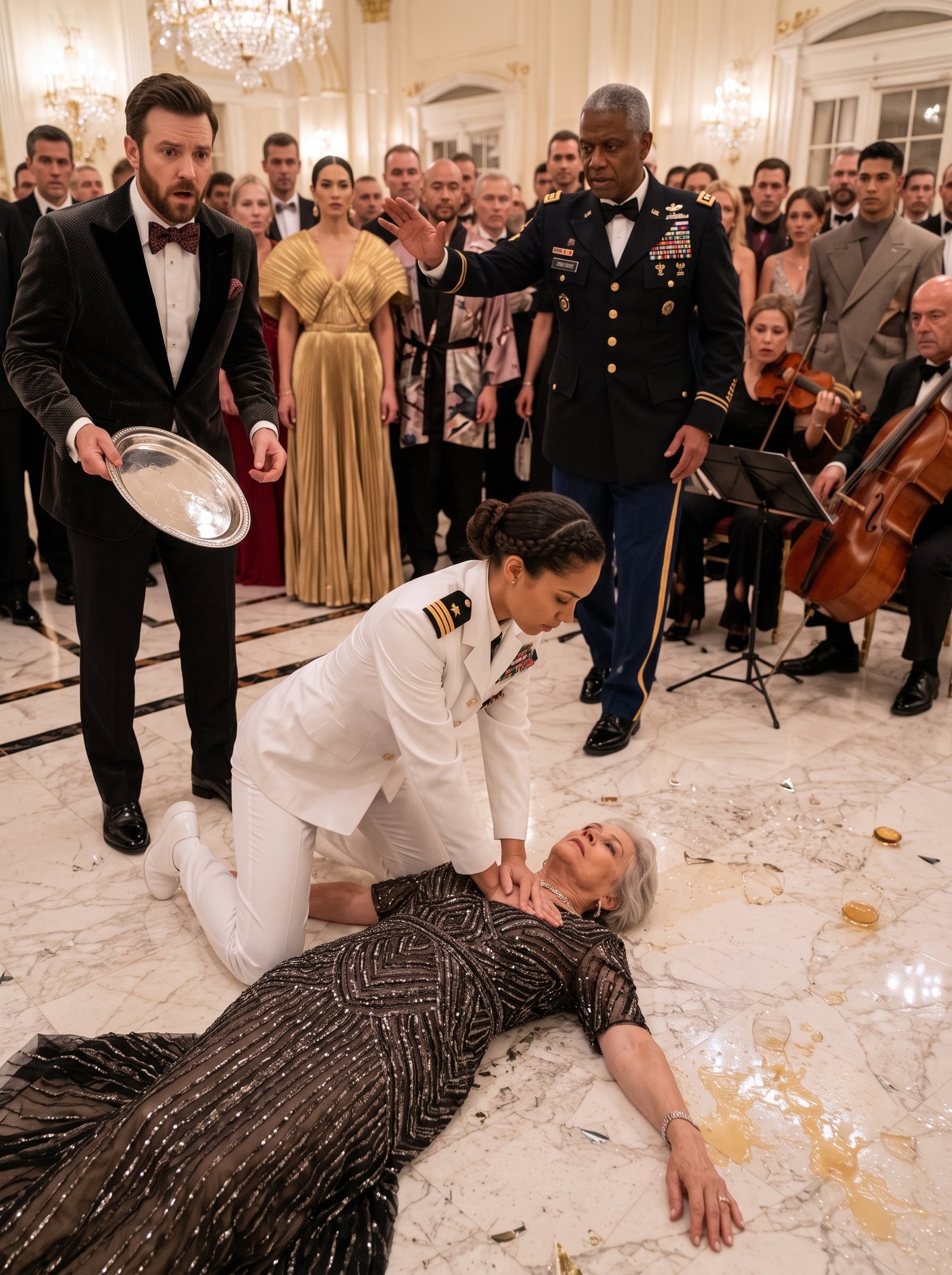
The woman under my hands jerked hard enough to rattle her pearls, then dragged in a wet, broken breath. I felt a pulse at her neck, weak but real, and the entire room let out one stunned, ugly exhale.
I rolled her slightly, kept her airway open, and told her to stay with me. My voice sounded calm. My hands did not.
General Marcus Harris was already beside me on one knee, moving chairs back with one hand and cutting a path through the crowd with the other. He didn’t waste words.
He told someone to open the front doors. He told another guest to get towels and clear the glass. He told everyone else to back up, and they actually listened.
The paramedics came in less than two minutes later, boots striking the marble, red bags thumping against their legs. I gave the report fast: collapse, no pulse, no respirations, compressions started immediately, pulse regained, breathing shallow.
One of them looked at my uniform, then back at me, and gave a short nod. He said I bought her time.
That was enough to make my knees shake.
Her husband dropped beside the stretcher as they got oxygen on her and started leads across her chest. He looked like one of those men who spent his whole life being the loudest voice in any room. In that moment he looked about ten years older and completely lost.
He asked me if she was going to live.
I told him she had a chance, and right then that was the most honest answer I had.
They lifted her onto the stretcher and moved fast toward the doors. As they passed, her hand twitched against the blanket. Her husband grabbed it with both of his and followed so close he nearly tripped over the wheel.
Then they were gone.
The quartet was still frozen by the staircase. One violinist was clutching the bow so hard his fingertips had gone white. Somewhere behind me, champagne kept dripping off an overturned tray onto the marble in slow, neat taps.
That was when I finally stood.
The front of my skirt was cold from the floor. My palms ached. My shoulders felt like they’d been pried apart with a wrench. Broken glass glittered near my shoe, and the whole room smelled like spilled alcohol, furniture polish, and fear.
My father straightened his jacket.
It was such a small movement, but it told me exactly where his mind had gone. Not to the woman who had almost died. Not to me. Not even to the guests still staring at him.
Control. He was reaching for control.
He cleared his throat and said we should give the family privacy and let the evening wind down. His voice almost worked. Almost.
General Harris stood up beside me and said, very quietly, that no one was going anywhere yet.
The room tightened.
My father forced a laugh and said everyone was emotional. He said I had done a good job. He even turned toward me like he was about to drape some polished public praise over the whole thing and call it grace.
I think that might have been the worst part.
Ten minutes earlier he had handed me a tray and called me a glorified medic so his guests could laugh with him. Now he wanted to use the same crowd to make himself sound generous.
General Harris didn’t let him.
He stepped between us just enough to make the line clear. He said he had watched Charles Mercer humiliate his daughter in her uniform, in his own home, in front of a room full of people who would have been helpless without her ten minutes later.
No one moved. No one even reached for a glass.
My father said it was a joke.
That word hit the room and died there.
Because everyone knew what a joke looked like, and everyone knew what that had been.
A woman in silver near the bar dropped her eyes to the floor. The state senator suddenly found the ceiling very interesting. One of the donors near the piano folded his arms and took half a step back from my father like distance could clean his jacket.
My father said I knew how he was. He said families spoke differently in private.
General Harris told him he had made it public the second he put that tray in my hands.
Then he said something that changed the air in the room.
He said my father had spent the last six months asking him to lend his name to a Mercer Foundation initiative for veterans’ trauma readiness in Texas. He said Charles had called it a serious commitment to service members and military families. He said until tonight, he had believed him.
You could hear the click in people’s heads as that landed.
This wasn’t just about manners anymore. It wasn’t just some ugly family scene spilling onto polished floors.
My father had built part of that night around impressing the one man in the room whose respect could open doors he wanted badly. And that man had just made it clear the door was closing.
My father tried to recover. He said one thoughtless line shouldn’t erase years of work. He said emotions were high. He said I was being made into a symbol of something larger than a misunderstanding.
I almost let him keep talking.
Then my mother spoke.
I don’t think anyone in that house had heard Evelyn Mercer interrupt her husband in public in at least twenty years. Maybe longer.
She said it was not one line.
Her voice was soft, but every person in that room heard it. She said he had been cutting me down since the day I enlisted. He mocked boot camp. He mocked my training. He called my work bandages and errands whenever anyone asked what I did.
She looked at me when she said the next part, not him.
She said I had spent years learning how to stay standing in rooms designed to make me feel small.
That one hurt. Not because it was wrong. Because it was exactly right.
My father turned to her like he couldn’t decide which betrayal to address first. He said she was overreacting. He said she knew the pressure he was under tonight. He said none of this was the time.
I told him there had never been a time he liked.
That came out flatter than I expected. Not loud. Not dramatic. Just tired.
I told him he did not get to call me useful only after someone stopped breathing.
I told him he did not get to build speeches about service around men and women like me while treating me like hired help in his own foyer.
And then, because I was done editing myself for his comfort, I said the thing I had probably known for years.
He did not hate what I did. He hated that he could not control what it meant.
That landed harder than shouting would have.
He opened his mouth, then closed it.
For once in his life, charm wasn’t quick enough.
General Harris turned back to the room and thanked me by name. Not daughter. Not young lady. Not some softened version of competence people use when a woman makes them nervous.
By name.
Then he said the only reason there was still hope for Margaret Bell was because I knew what to do before anyone else did.
Her husband’s name hit me then. Bell. As in Daniel Bell, the private hospital donor whose name was on a wing in South Austin and attached to half the city’s charity auctions.
So that was the other shift happening under the surface.
The man my father most wanted to impress had watched me save the wife of another man he likely never wanted to cross.
Daniel Bell came back through the front doors about five minutes later because he had forgotten his phone on a side table near the piano. He looked wrecked. His tie was crooked, his face gray, one cuff stained with something from the ambulance.
He stopped when he realized the room was still gathered.
Then he looked at me.
He walked straight across the marble and took both of my hands before I could react. He said if Margaret made it through the night, it would be because I had not hesitated when everyone else did.
My father started to say Daniel’s name.
Bell didn’t even turn his head.
May be an image of wedding
He said he was not interested in hearing from any man who would humiliate his own daughter and then stand still while she saved his house from becoming the place his wife died.
That did it.
You could feel the balance of the room shift all the way. People who had been hovering around the edges now had permission to decide what they had seen. And once wealthy people decide which side of a public story protects them, they move fast.
One donor excused himself. Another said he would follow up about the hospital pledge later. The senator slipped out without saying goodbye.
The woman in silver who had laughed earlier wouldn’t look at me at all.
My father saw it happening in real time. That was the first moment he looked honestly shaken.
Not when Margaret collapsed.
Not when I hit the floor.
When the room stopped orbiting him.
General Harris asked me if I was all right.
I almost said yes out of habit. Instead I said I would be.
He nodded like that was the right answer.
Then he asked what command I was attached to now, how long I had been in, and whether emergency response was the track I wanted long term. They were practical questions. Respectful ones. The kind that assumed my future existed beyond this house.
I answered, and he listened.
He told me he served with a corpsman years ago who pulled a nineteen-year-old lance corporal out of a burning vehicle after everyone else thought it was too late. He said people who had never needed one loved using words like glorified until their lives depended on hands that knew exactly where to press.
Then he told me he wanted me to call his office the next week.
He was helping shape a statewide training partnership between military medical teams and civilian emergency departments. He said if I was interested, he wanted my perspective in that room.
Not my father’s. Mine.
I didn’t trust myself to say much more than thank you.
By then most of the guests had drifted into smaller, uncomfortable clusters or left outright. Staff were on the floor with towels, blotting champagne out of the marble seams. The bent silver tray still sat near the entry table where my father had dropped it.
I kept looking at it.
Such a stupid object. Twenty minutes earlier it had felt like a leash. Now it looked like proof.
My mother came to stand beside me after General Harris stepped away to take a call. Up close, I could see she had been crying, but she was holding herself differently. Straighter.
She said she was sorry she had asked me to come.
I told her that wasn’t the part that hurt.
The part that hurt was that she already knew what would happen.
She closed her eyes for a second, and when she opened them she didn’t deny it. She said she thought she could keep the peace for one more night. She said women like her got too good at mistaking delay for protection.
I didn’t know what to do with that, mostly because I believed her.
We stood there in the mess of his perfect evening, and for the first time in a long time, neither of us rushed to make him comfortable.
My father was across the room on his phone, talking low and sharp, already trying to contain the fallout. Even then. Even after all of it.
My mother followed my gaze and said he was going to spend the rest of the night trying to save what people thought of him.
I said that sounded exhausting.
She almost smiled.
I left before he could corner me with a private apology shaped like a business memo.
General Harris walked me out to the drive himself. The night air was cooler than I expected, and the sound of the fountain at the front steps suddenly seemed too loud. Valets were pretending not to stare.
At my car, he told me one more thing.
He said dignity was expensive in families like mine because someone was always billing you for it later. He told me not to pay.
I sat in the driver’s seat for a full minute after he walked away.
My hands finally started shaking for real then. Not from the compressions. Not from the scene. From the fact that the night had split something open and I knew I was not putting it back the old way.
At 1:14 a.m., Daniel Bell texted from an unknown number. Margaret was in surgery, but she was alive.
At 6:12 the next morning, I got a second text.
It was from General Harris, and it said we need to talk before your father starts cleaning this up.