Twelve hours into a double shift in the cardiac unit, my phone buzzed beneath a stack of patient charts.
My father had tagged me in the family group chat at 3:07 a.m.
“We’re using Arden’s lake house this weekend. Twenty guests. Friday through Tuesday. Everyone bring towels. Arden, get everything ready.”
I stood at the nurses’ station in Charlotte, exhausted, with the smell of antiseptic still clinging to my hair and monitors blinking around me.
I read the message three times.
The words didn’t change.
My name is Arden Voss. I was thirty-six, single, and the sole owner of a small lake house on Lake Norman that I had purchased after nine years of double shifts, packed lunches, cheap scrubs, and driving an old Honda my family never stopped mocking.
The house belonged to me.
Legally.
Financially.
Every mortgage payment.
Every tax bill.
Every repair.
Every renovation.
All of it had been paid with my own money. I bought that house because I wanted one place where nobody could walk in and immediately start telling me what to do.
Then Mom replied:
“Stock the fridge, sweetheart. Aunt Liora wants fresh flowers in the main bedroom. Don’t make this difficult.”
Thumbs-up reactions appeared almost immediately.
My cousin Hollis wrote:
“Finally. That place could use some real family energy.”
My younger brother Keaton added:
“About time you shared something.”
Then someone asked whether the Wi-Fi password was still the same.
That made me stop.
I had **never** given them the Wi-Fi password.
My charge nurse walked past.
“You okay, Arden?”
“Yes.”
That was my first lie of the morning.
I scrolled backward through the family chat, searching for something I might have missed. Then I found a message from Memorial Day.
Mom had written:
“We’re at Arden’s lake house. She doesn’t know, so nobody post anything yet.”
Forty-three people had seen it. Not one of them had told me.
I stood there staring at the screen as the truth finally settled in. My family had been using my home while I was working. My mother had somehow gotten a key I had never given her. My father had entered a house he had never been invited into. Relatives had slept in rooms I had created for my own peace. They had eaten there. Used my electricity. Connected to my Wi-Fi. And apparently agreed among themselves to keep it all hidden from me.
Now they were planning another five-day vacation as though my home were a free family resort.
I typed one word:
“No.”
No apology. No explanation. Just *no*.
Mom answered almost immediately. Three laughing emojis appeared first, then:
“You actually think you can stop us? Arden, we’re your parents.”
Dad added:
“Don’t start drama at your age.”
By the time I finally reached home that morning, I was too exhausted to be angry anymore. That helped. Angry people make emotional decisions. I wanted mine documented.
So before I went to sleep, I made three phone calls:
The first was to a locksmith.
The second was to the company that monitored the property.
And the third was to someone whose number I had hoped I would never need.
Then I went to bed.
For the next two days, the family group chat exploded with vacation plans. Who was bringing steaks. Who wanted the upstairs bedrooms. Who planned to bring kayaks.
Mom even posted:
“Arden will calm down. She always does.”
I didn’t respond.
Thursday night, Aunt Liora asked whether I had remembered the flowers. Still nothing.
Then Friday morning, at exactly 8:42, my phone started ringing. Dad.
I let it ring twice before answering. He wasn’t speaking normally. He was shouting.
“ARDEN! What did you do to the house?”
I sat up slowly. In the background, I could hear Mom yelling, car doors slamming, and several relatives talking over one another.
“What do you mean?” I asked.
“You **know** what I mean!”
Then someone in the background said something that made Dad suddenly stop yelling. His voice dropped.
“Why is there someone standing on the porch with paperwork?”
That was when I smiled.
“That would be Mr. Vance,” I said, keeping my voice as calm as the still morning water of Lake Norman. “He’s a real estate attorney. The kind that doesn’t mess around.”
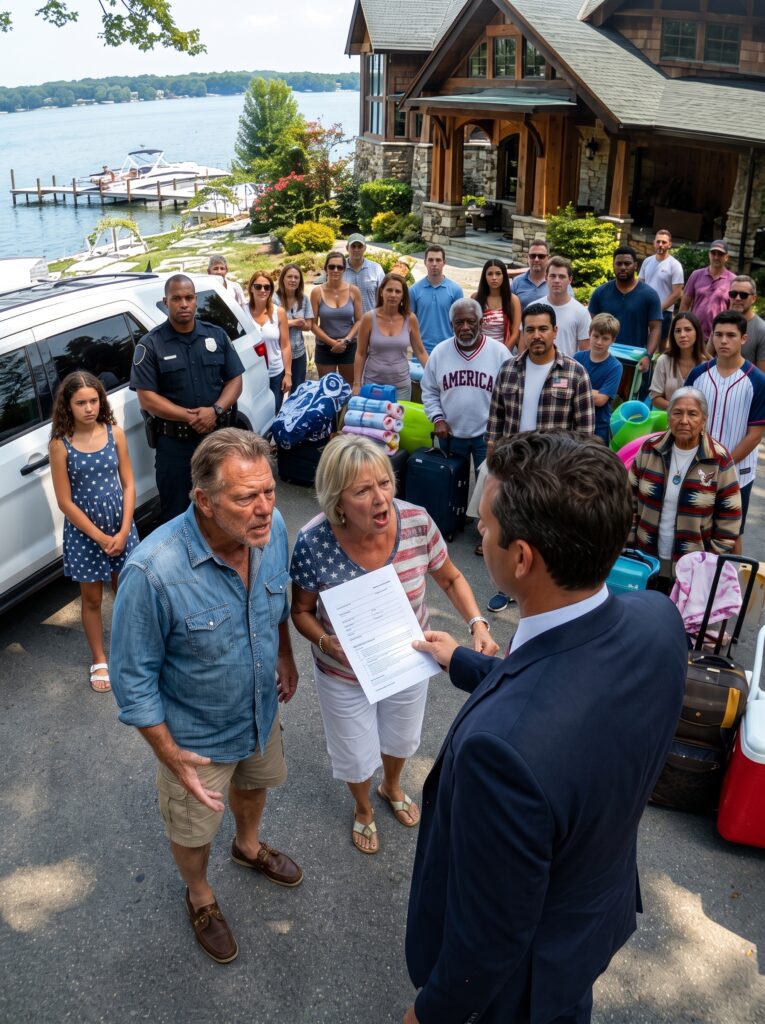
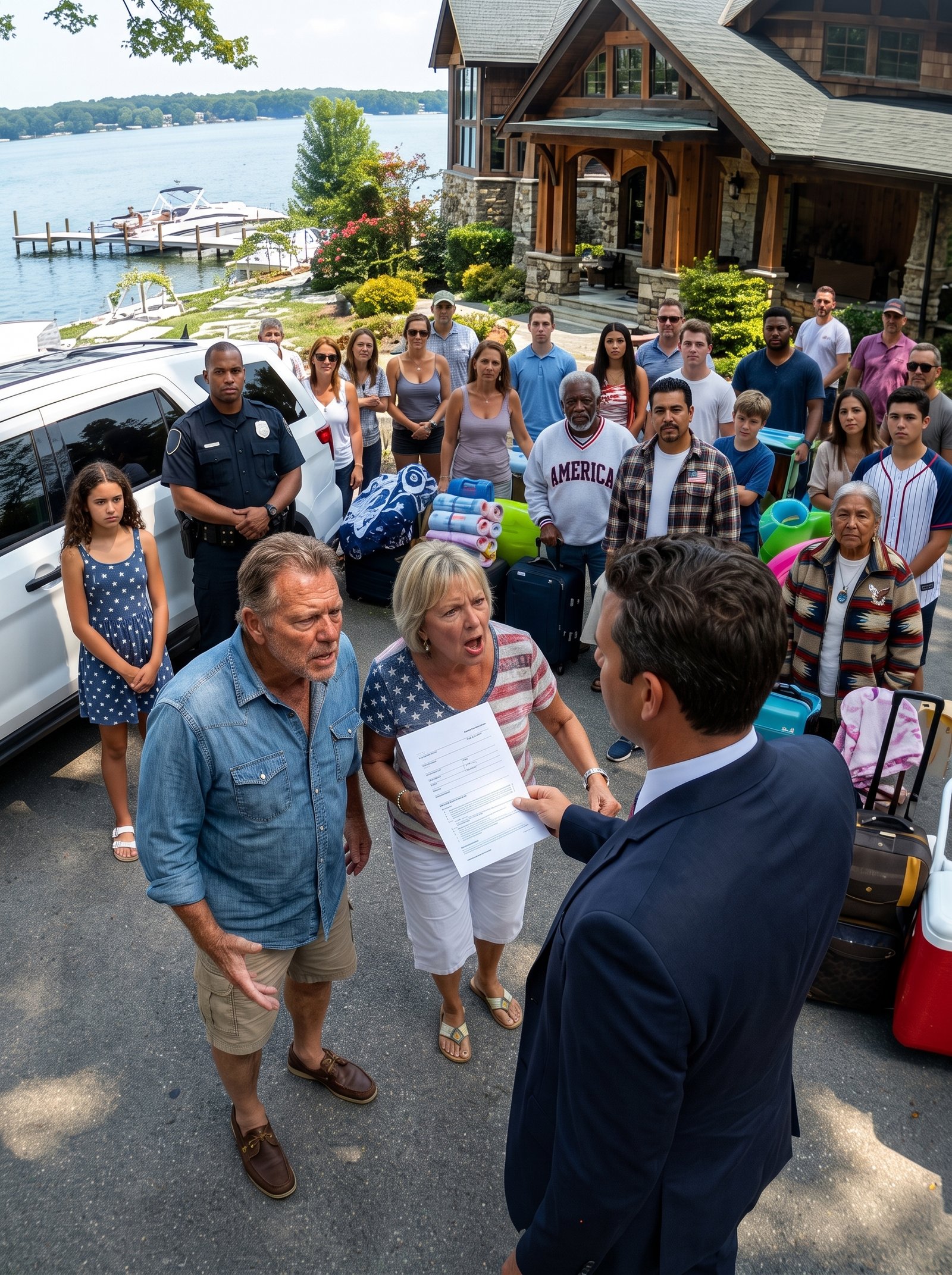
“An attorney?” Dad sputtered, the bravado completely draining from his voice. “Arden, what is wrong with you? We have twenty people out here! Aunt Liora is crying in the driveway because the keypad is disabled and there are metal security shutters on the windows!”
“The keypad is disabled because I had the locks replaced yesterday afternoon. The shutters are compliments of the security team,” I explained, taking a slow sip of my coffee. “As for Mr. Vance, he is there to hand you all formal Cease and Desist orders for criminal trespassing. He also has itemized bills for everyone present.”
“Bills?! Are you insane? We are your family!”
“You’re squatters,” I corrected firmly. “My Wi-Fi logs and utility bills from Memorial Day prove you’ve been unlawfully entering my property. Mom copied a spare key from my purse during her last ‘visit’ to my apartment. That’s breaking and entering. Mr. Vance has the newly installed security footage from yesterday, but he also has the neighborhood gate logs from Memorial Day, complete with timestamps of Hollis throwing up off my private dock and Keaton breaking my patio heater.”
I could hear frantic murmurs in the background. My mother’s voice pierced through the chaos.
“Give me that phone!” she screeched. “Arden Voss, you tell this man in the suit to step aside right now! We drove three hours! We have three coolers full of expensive steaks!”
“Then I suggest you take them to a public park, Mom,” I replied. “Because if any of you step past the property line, Mr. Vance is instructed to signal the two local sheriff’s deputies parked at the end of the cul-de-sac. They have my written authorization to arrest anyone who steps on the grass.”
Dead silence fell over the line. Even the background noise of my twenty entitled relatives completely ceased.
“You wouldn’t dare,” Mom whispered, though the tremor in her voice proved she knew I would. “You’re bluffing.”
“Look to your left, Mom. Down by the mailbox.”
I heard a sharp intake of breath. The deputies weren’t a bluff. That was the other half of Mr. Vance’s hefty retainer fee—arranging a civil standby to ensure my property was protected from a *hostile and documented threat*.
“Arden, please,” Dad’s voice was suddenly weak, pleading. “Hollis drove all the way from Georgia. Keaton promised his new girlfriend a luxury lake weekend. You’re humiliating us in front of everyone.”
“No, Dad,” I said softly, the weight of a lifetime of being their doormat finally lifting off my shoulders. “You humiliated yourselves. You thought I was a free resort. You thought you could mock my life, my job, and my car, while secretly living it up on my dime when I was literally saving lives on a twelve-hour shift. That stops today.”
“But—”
“Mr. Vance is handing you an invoice for the utilities you stole in May, plus the cost of the lock replacements and the deep cleaning fee. You have thirty days to pay it. If you don’t, he files a lawsuit. Have a great weekend.”
I didn’t wait for a response. I hung up the phone.
A moment later, I opened the family group chat. I watched as the typing bubbles appeared and disappeared frantically, paragraphs of outrage being drafted.
With one tap, I left the group.
Then, I went into my settings. I blocked my parents, blocked Keaton, blocked Hollis, and blocked Aunt Liora.
The silence in my apartment was beautiful. It was almost as peaceful as the lake. I set my phone down, pulled the covers back over my shoulders, and for the first time in my life, I slept like a stone.
Three weeks passed before the consequences truly unspooled.
The initial thirty-day payment window for the itemized invoices came and went without a whisper. I expected a flurry of legal maneuvers, or at least a frantic barrage of voicemails from extended relatives threatening small-claims court. Instead, the silence from my family was absolute—a heavy, suffocating quiet that only a deeply fractured clan can manufacture.
Then came the text from my younger sister, Maya—the only member of the immediate family who hadn’t been part of the Lake Norman group chat, primarily because she was living across the country in Seattle completing her residency.
“Mom and Dad are losing the house, Arden. They’re claiming you financially ruined them with your lawyer’s fees and the utility demands. Is any of this true?”
I stared at the screen, a cold numbness washing over me. I called her immediately.
As it turned out, my parents had been quietly leveraging their own home to fund a lavish lifestyle they couldn’t actually afford, assuming they could always lean on my success or use my lake house as a fallback asset. When Mr. Vance’s legal demands hit, followed closely by a formal credit reporting of the unpaid debts, their fragile house of cards collapsed. Their bank had frozen their home equity line of credit, and foreclosure notices were already taped to their front door.
Maya was crying on the other end of the line. “They’re blaming you for everything, Arden. They’re telling the whole extended family that you’re a heartless monster who put your own flesh and blood on the street over a petty weekend dispute.”
“Maya,” I said, my voice steady as I watched the evening rain streak down my apartment window. “They broke into my home. They stole my space, my utilities, and my peace of mind for years while mocking everything I worked for. I didn’t ruin them. I just stopped enabling the lie.”
Two months later, I received a certified letter bearing a messy, unfamiliar handwriting. It wasn’t from my parents. It was a brief, broken note from my father. There was no apology, no admission of guilt, and no request for reconciliation. Just a bitter line stating that the family lake house was being listed for sale to settle their debts, and that my name had somehow been stripped from the primary deed during a refinancing my father had fraudulently forged years prior.
That single sentence made my breath catch. They hadn’t just used my house; they had tried to steal it entirely.
I didn’t panic. I didn’t cry. I simply forwarded the letter straight to Mr. Vance.
By the following week, the fraudulent paperwork was unmasked, the forged signatures were flagged as federal felonies, and the impending foreclosure sale of my lake house was blocked with a permanent injunction. My parents were facing criminal fraud charges, initiated not by a stranger, but by the legal machinery I had set in motion that Friday morning.
The day the title was officially restored entirely to my name, I drove out to Lake Norman alone.
The air was crisp and smelled of pine and damp earth. I unlocked the front door—my door, with the new biometric locks I had personally chosen—and stepped inside. The living room was bathed in the golden light of the late afternoon sun, casting long shadows across the hardwood floors. There were no coolers on the porch, no crying relatives in the driveway, and no lingering echoes of entitlement.
There was only silence. And for the first time in my thirty-six years, that silence belonged entirely to me.