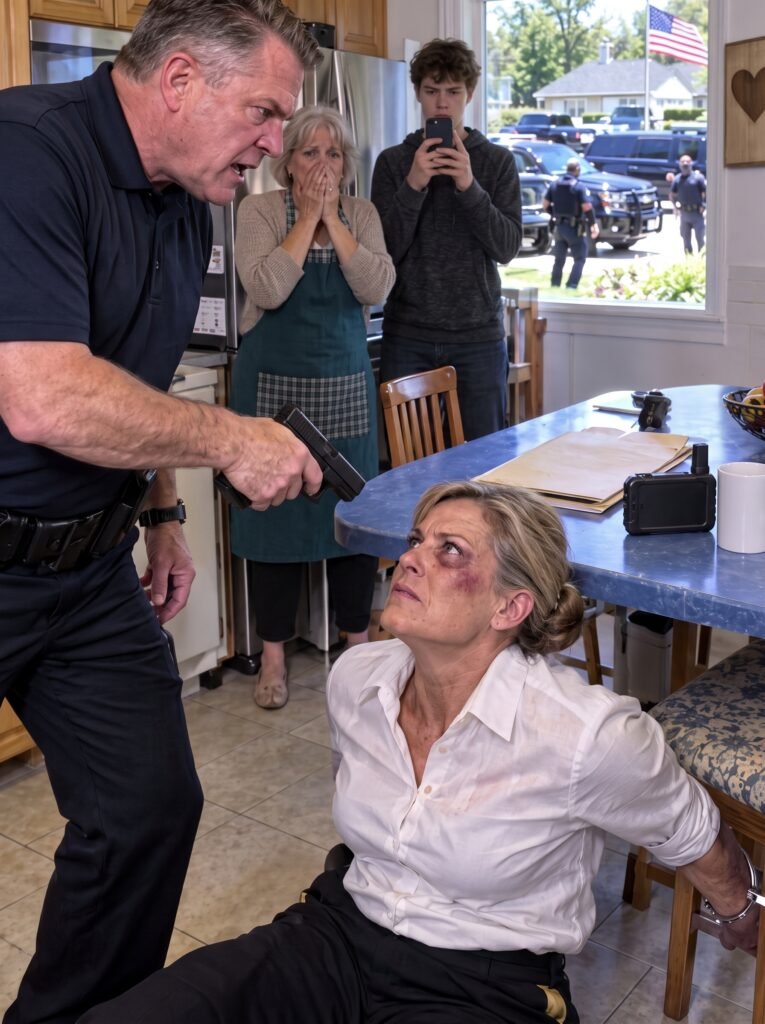
“Not anymore.”
The cuffs came off my wrist.
The pain arrived fully once the metal was gone.
My hand shook, not from fear, but from circulation coming back through bruised skin.
The uniformed man helped me sit up.
I touched my cheek and saw blood on my fingers.
My mother crawled toward me on her knees.
“Sarah,” she whispered.
I had not heard that version of my name from her in years.
Not General.
Not honey.
Sarah.
The name she used when I was eight and sick on the couch.
The name she used when she still believed she could put a cool hand on my forehead and fix the world.
She reached for me, then stopped, as if she no longer knew whether she had the right.
That hurt more than my face.
“Mom,” I said, “I’m okay.”
I was not.
But she needed the sentence.
The man in the suit identified himself only by role, not by drama.
Federal protective response.
Department of Defense coordination.
Secure communication interference.
Potential assault on a military officer during an active classified communication.
Every phrase landed on Michael like another door closing.
He looked smaller with each one.
“I didn’t know,” Michael said.
I laughed once.
It was not a happy sound.
“You were told.”
He looked at my mother.
“Emma, tell them.”
My mother stared at him from the floor.
For ten years, she had softened his edges in public.
She had called his temper stress.
She had called his control concern.
She had called his cruelty old-fashioned.
Now the kitchen had stripped all the gentle names off him.
“Tell them what?” she asked.
Michael blinked.
It was the first time I had ever seen him look afraid of her.
The response team documented the scene.
One photographed the cuffs.
One photographed the service weapon after it had been cleared.
One took the temporary duty order from the table, placed it into a protective sleeve, and noted its position beside the grocery receipt stamped 3:17 p.m.
Tyler surrendered the recording after being told twice not to alter it.
My mother gave her statement at the kitchen table with both hands wrapped around the cold coffee mug she had forgotten to drink.
Michael kept saying the same things.
He thought I was lying.
He thought I was unstable.
He thought he was protecting his home.
His home.
Even then.
Even with the cuffs on the floor and my blood on the tile, he still reached for ownership like it could save him.
The local officers who arrived after the federal team did not know where to look.
They knew Michael.
They had worked under him.
They had heard him call me arrogant at holiday barbecues and difficult in the grocery store parking lot.
They had probably believed him because powerful men are careful to make their private cruelty sound like public concern.
But there was the phone record.
There was the open line.
There was Tyler’s video.
There was my mother’s statement.
There was the temporary duty order.
There was the secure communications log.
Evidence is not emotional.
That is why men like Michael hate it.
By sunset, he was no longer in my mother’s kitchen.
By the next morning, the department had placed him on administrative leave pending outside review.
By the end of that week, my mother had changed the locks.
She did not ask him first.
That mattered, too.
For a few days, she moved through the house like someone learning the dimensions of her own rooms.
She stood in front of the breakfast table and touched the chipped blue tiles.
She folded the yellow apron and put it in a drawer.
She took the small American flag from the porch, washed the dirt from the pole, and put it back up herself.
Tyler called twice.
I did not answer.
My mother did once.
I heard only her side.
“No,” she said.
Then, after a long pause, “Because you laughed.”
That was all.
There were formal processes after that, the kind that move slowly and leave paperwork in their wake.
Statements.
Reviews.
Personnel actions.
A police report that did not use the words family argument.
An internal affairs file that did not use the word misunderstanding.
A federal memorandum that used cleaner language than the kitchen deserved.
Interference.
Assault.
Unlawful restraint.
Weapon drawn.
Open secure line.
I kept copies of what I was allowed to keep.
Not because I wanted revenge.
Because women in families like ours learn that memory gets negotiated when paperwork is absent.
My mother started counseling in a church community room on Tuesday nights.
She said the folding chairs were uncomfortable.
She went anyway.
The first time I visited after Michael was gone, the kitchen smelled like fresh coffee instead of burnt coffee.
The refrigerator still hummed.
The chipped blue table was still there.
But my mother had moved Michael’s chair into the garage.
In its place, she had put a plain wooden chair from the laundry room.
It did not match.
She looked embarrassed when I noticed.
“I know it looks silly,” she said.
“No,” I told her. “It looks like yours.”
She cried then, but not the way she had cried on the kitchen floor.
This time she stayed standing.
Months later, people still asked me what I felt when those SUVs arrived.
They expected me to say relief.
They expected me to say triumph.
The truth was quieter.
I felt the tile under my cheek.
I felt the cuff cutting my wrist.
I felt my mother’s fear filling the room.
And I understood that being powerful in the world does not always protect you from being treated like nothing at the family table.
Sometimes the hardest part is not proving who you are.
Sometimes the hardest part is watching the people who should have known finally see it.
Michael had shouted, “Who do you think you are?”
The answer had been on the line the whole time.
He just hated that it was not his voice saying it.