He sent the résumé.
I did not recommend him personally.
I did not hide his qualifications either.
He completed training, interviews, and background checks like every other participant.
A regional sales company hired him.
That decision did not repair our marriage or erase the custody case.
It gave our children a father with stable work.
That was enough.
Five years passed.
Lily became devoted to painting.
Noah cared about little besides baseball.
Our refrigerator filled with watercolors, school schedules, team photographs, and grocery lists no longer written around an empty account.
The Second Chance Employment Initiative expanded into six states.
On the first morning of every new group, I faced nervous parents and said:
“You may think you are here only because you need a job. You are also here because your future deserves to be judged by more than your hardest season.”
One rainy Monday, I noticed a young woman sitting alone near the elevators.
A diaper bag rested beside her chair.
She repeatedly checked her phone, opened an empty purse, and drank water as though it were breakfast.
I recognized the calculation in her eyes.
I went to the café and returned with a turkey sandwich, an apple, water, and a cookie.
I placed the bag beside her.
“Someone ordered an extra lunch.”
She looked up.
“I can’t pay for this.”
“You don’t need to.”
Tears filled her eyes.
“I haven’t eaten since yesterday.”
“I know.”
“How?”
“Because I once sat exactly where you are.”
She accepted the bag with trembling hands.
“Thank you.”
“When things improve, pass it forward.”
A few weeks later, William invited me to lunch overlooking Lake Michigan.
He was ninety-one and preparing to retire fully from the board.
The newspapers called him a business legend.
To me, he remained the old man who had accepted my sandwich without making me feel foolish.
He handed me another sealed envelope.
I laughed.
“The last one changed my life.”
“I remember.”
Inside was a unanimous board appointment naming me national executive director of the employment initiative.
At the bottom, William had written:
Never forget the sandwich.
“I never could.”
He smiled.
“That is why they chose correctly.”
One month later, Lily and Noah graduated from elementary school.
Ryan stood near the back of the auditorium.
After the ceremony, the twins ran toward him.
He hugged them and then approached me.
“I owe you an apology.”
I waited.
“I blamed you for choices I made. I tried to make your success look dishonest because admitting you had rebuilt without me made me uncomfortable.”
The apology carried no polished charm.
Only regret.
“I hurt the best person who ever believed in me.”
“Thank you for saying it.”
He looked surprised.
“That’s all?”
“I remember what happened. I don’t need to repeat it.”
“I thought you might want me to suffer.”
“I wanted our children to have two parents who could stand in the same room without making them choose sides.”
He nodded slowly.
“I’m trying.”
“Then keep showing up.”
We stood together while Lily displayed her graduation certificate and Noah complained that the ceremony had lasted longer than a baseball game.
We were not friends.
We were no longer enemies.
We were two parents watching the same children.
That was the ending they deserved.
People later asked whether I regretted giving away my lunch.
They usually expected me to say the sandwich produced a miracle.
It did not.
It did not erase my rent debt.
It did not automatically earn the job.
It did not win the custody case.
What it did was remind me who I wanted to remain when life had given me every excuse to become bitter.
When success gave me power, I chose to build opportunities for others.
When Ryan needed help, I chose fairness rather than humiliation.
When another hungry mother entered the building, I recognized her before the world taught her to become invisible.
The greatest victory was never watching the person who hurt me fail.
It was refusing to let his choices determine my character.
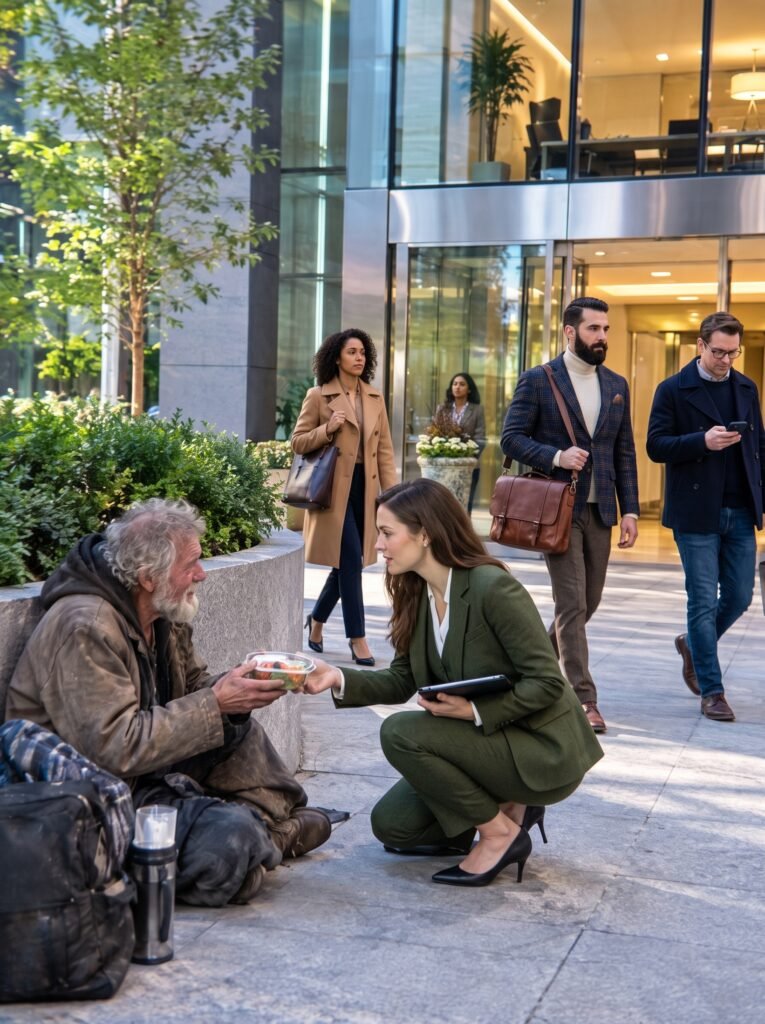
That morning outside Harper Global, I gave away one sandwich because someone was hungry.
Years later, thousands of parents found work because one old man noticed what kindness looked like when no one important was supposed to be watching.