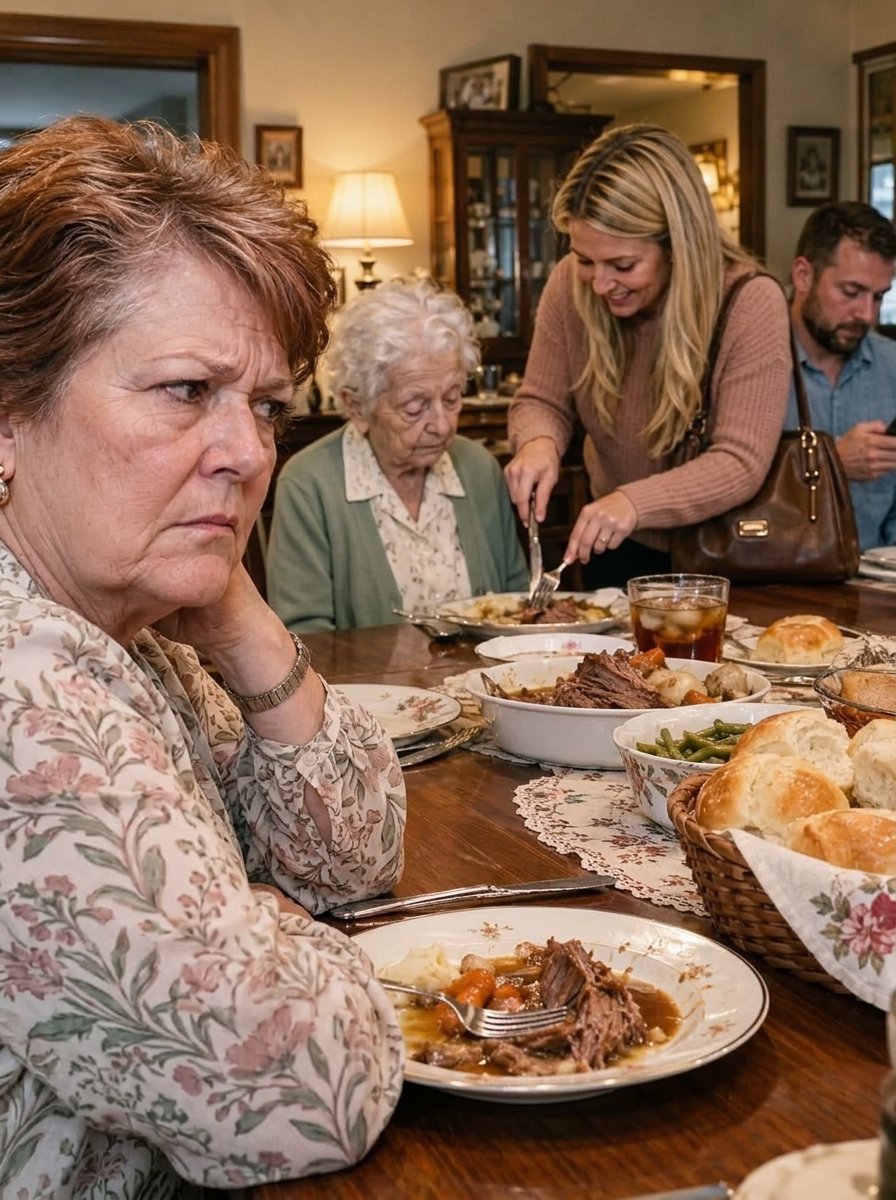
My son’s fiancée brought her grandmother to my house for Sunday dinner. She cut the old woman’s meat, held her purse, and answered every question for her. When I walked her grandmother down my hall to the bathroom, the old woman grabbed my wrist.
“Honey, she got my house,” she whispered. “You’re next.”
For thirty years, I ran a daycare out of my house in Edmond, Oklahoma. More than three hundred children came through my front door. Every one of them called me Miss Myra, and half still do, even the ones with gray in their beards. I know what a child looks like when someone else keeps answering for them. I did not expect to see that look on a ninety-one-year-old woman.
My husband, Russell, died four years ago. His recliner is still in the den, and nobody sits in it. Our son, Brice, is thirty-eight and sells farm insurance. He is a good boy, if a soft one.
He met Kristen Goforth in the spring at a friend’s barbecue. She was thirty-three, pretty as a picture, and worked at a bank in Chickasha. By August, they were engaged.
In September, Brice asked if Kristen could bring her grandmother to dinner.
“Grandma Effie lives with her now, Mom,” he said. “Isn’t that sweet?”
I made pot roast and my good yeast rolls. Effie came in on Kristen’s arm, tiny as a bird, wearing a pink cardigan buttoned wrong.
Kristen carried Effie’s purse over her own shoulder and kept it there throughout dinner.
“Grandma, would you like a roll?” Kristen asked. Then she answered herself. “No, she doesn’t. She’s diabetic.”
When I asked Effie whether she liked living with Kristen, Kristen answered again.
“She’s settled in,” she said. “Grandma sold her farm last year. It was too much for her.”
Effie looked at her plate. I watched Kristen cut her meat, pass her a napkin, and fill every pause before Effie could speak. I tried asking Effie about the farm. Kristen explained that it had been a burden.
At one point Effie began, “I used to, ”
“Grandma gets tired telling those stories,” Kristen said, and turned the conversation back to Brice.
After the peach cobbler, Effie said she needed the restroom. Kristen started to rise, but her phone rang. Work, she said, and stayed at the table.
“I’ll take her, hon,” I said.
I walked Effie slowly down the hall, past the school pictures of the children who had spent their days in my house. Halfway there, she stopped and gripped my wrist. She was thin, but her hold was hard. Her eyes were clear and blue.
“Honey, she got my house. Fifty-two years I lived on that farm.”
“Ma’am?”
“She got me to sign a paper when I was sick with the pneumonia. Said it was for the hospital.”
Effie glanced back toward the dining room.
“Now she’s got everything. She hands me my own money ten dollars at a time. You’re next. Don’t you sign one thing.”
Kristen had appeared at the end of the hall, smiling.
“Everything okay down here? Grandma gets confused and tells stories.”
“We’re just fine,” I said.
Effie let go of my wrist and did not say another word for the rest of the evening. I went back to the table and tried to act as if nothing had happened. Brice asked if I wanted more cobbler. Kristen answered for Effie once more. I kept looking at the old woman’s face.
That night, I called the state elder abuse hotline from my kitchen phone. A tired-sounding woman took down what I told her: what Effie had said, what I had seen at dinner, and that Kristen lived with her.
“Ma’am, if the granddaughter has power of attorney, a lot of that may be legal,” she said. “We’ll send someone, but it could be a few weeks.”
I asked what I should do in the meantime.
“Keep the information you have,” she said. “And don’t sign anything you don’t understand.”
A few weeks. I sat in Russell’s recliner for the first time in four years and stared at the dark television. I kept hearing Effie say, “You’re next.”
Two weeks after the dinner, Kristen came to my house by herself on a Thursday night. She brought a lemon cake and a leather folder. She also brought a notary stamp in a little zipper bag and set it beside my coffee.
“It’s just in case, Miss Myra,” she said sweetly. “Brice worries about you so much.”
She opened the folder. The power of attorney was already typed up, with my name and address. It referred to my house, which had been paid off in 2011, and named Brice as the person in charge.
A little yellow flag marked the place where I was supposed to sign.
“You don’t have to read it all,” Kristen said. “It’s the standard one.”
“Does Brice know you’re here?”
“Of course. It was his idea.”
I looked at the flag. I thought of Effie’s hand around my wrist.
“I’ll think about it, hon. My eyes are tired tonight.”
Kristen’s smile tightened at the corners. “No rush. Brice and I will be back Sunday.”
After she left, I didn’t sleep. I sat at the table until two in the morning, thinking about how quickly a question about a signature could turn into an accusation against my son’s fiancée. If I called Kristen a crook and was wrong, I could lose Brice. If I was right and did nothing, I could lose my house.
At six, I got up and made biscuits. Brice had told me Kristen worked at the bank Monday through Friday. Effie would be alone at Kristen’s little rental house out on the county road. I drove the forty minutes with the biscuits wrapped in a dish towel on the seat beside me.
I knocked. Nothing at first. Then I heard slow shuffling. The door opened a crack on its chain. Effie peered out, recognized me, and unhooked it.
“I knew you’d come,” she said. “You’ve got a daycare face.”
She didn’t even look at the biscuits. She went to a kitchen drawer and pulled out a manila envelope.
“She leaves her work in here,” Effie said. “She thinks I can’t read anymore.”
Inside was a copy of the power of attorney Kristen had brought to my house. It had the same yellow flag and the same typed name for me. But the person named to take charge was not Brice.
The name was Kristen Goforth. Her signature was already on the agent’s line in blue ink.
Effie watched me read it. “That’s the one she keeps,” she said. “She had another one first.”
I held up the page. “The one she showed me has Brice’s name.”
“She changed it,” Effie said. “I saw her do it.”
“Did she tell you why?”
Effie shook her head. “She said it was none of my business.”
I folded the papers back into the envelope. The version Kristen had brought me could be described as help for Brice. This one named Kristen herself. She had carried both versions into Effie’s home, and she had come to my kitchen with a notary stamp.
“Do you want me to tell Brice?” I asked.
“I want him to see it,” Effie said. “I’m tired of people talking over me.”
I took the envelope back to Edmond and called Brice. I did not accuse Kristen over the phone. I told him Effie had shown me a document with Kristen’s name on it, and asked him to come Sunday as planned.
“What document?” he asked.
“A power of attorney with my name on it.”
There was a pause. “Mom, Kristen said it was something I wanted.”
“Did you ask her to bring it?”
“I said we should make sure you were all right. I didn’t tell her to bring papers.”
“I need you to come and look at what Effie found.”
He sounded uneasy. “All right. We’ll be there.”
Sunday afternoon, Brice and Kristen came to my house. I had the two versions on the table. I had also asked Effie if she wanted to come. She did.
Kristen saw the envelope beside the papers and stopped for a beat.
“What’s this?” she asked.
“Effie brought it to me,” I said. “I want us to talk about these together.”
Brice looked from the envelope to the folder Kristen had brought the previous Thursday. “You said this was my idea.”
“It was,” Kristen said quickly. “You said your mom needed help.”
“I said we should talk to her. I didn’t say to put my name on anything.”
“You’ve said you worry about her living alone.”
“I do. That isn’t the same thing.”
Kristen reached toward the papers. “This is all getting turned around. I was trying to make sure there was a plan.”
I kept my hand on the envelope. “Then explain why one copy names Brice and this one names you.”
She looked at the pages but did not pick them up.
“It’s a draft,” she said. “There are different ways to set it up.”
“Why was your name signed on Effie’s copy?” Brice asked.
“It’s my part of the form. That doesn’t mean your mother signed it.”
“It has my name on it,” I said. “And you brought it to me with a yellow flag where I was supposed to sign.”
“I never said you had to sign it that night.”
“No,” I said. “You said I didn’t have to read it all.”
Effie sat quietly beside me. Kristen glanced at her.
“Grandma, you shouldn’t have taken papers out of my drawer.”
“I can read,” Effie said.
“You get confused about what things mean.”
“I remember living on that farm for fifty-two years.”
Kristen started to respond, then stopped. Brice looked at the two forms again, comparing the names.
“You told me you were bringing a standard form for Mom to review,” he said. “You didn’t tell me you’d already filled it out.”
“I was trying to help both of you,” Kristen said. “You make it sound like I was taking something.”
“You told me it was my idea,” Brice said. “It wasn’t.”
She turned to me. “Miss Myra, you know how this looks. But it was paperwork, not a deed. Nothing happened.”
That much was true. I had not signed it. But “nothing happened” did not explain why she had brought a form naming Brice, while Effie had a version naming Kristen, already signed by Kristen.
“Why did your name change?” Brice asked.
Kristen pressed her lips together. “I thought it made more sense.”
“For whom?” I asked.
She did not answer. Then she said, “You both make me sound like some kind of thief. I was the one taking care of Grandma. I was the one trying to get things organized.”
Effie looked down at the table. Brice’s voice got quieter.
“Taking care of Grandma doesn’t mean you get to decide what Mom signs.”
“I never made her sign.”
“You brought a notary stamp to her house.”
“I thought it would save time if she agreed.”
There it was: not an answer about why her name had replaced Brice’s, but an admission that she had arrived ready for a signature.
Brice looked at me. “I didn’t know she was bringing that.”
“I believe you now,” I said.
Kristen shook her head. “You’re making one paper into a whole story.”
“No,” I said. “I’m looking at two papers.”
Brice pushed his chair back. He had always been the one to smooth things over, even when smoothing meant leaving the difficult part for later. He looked at Kristen for a long time.
“I can’t marry someone who tells me one thing and brings my mother another,” he said.
“Brice, don’t do this in front of them.”
“You said I asked for this. I didn’t.”
“You’re choosing your mother over me.”
“I’m choosing not to pretend this is fine.”
Kristen gathered the folder she had brought. She looked at Effie, but Effie did not reach for her. Brice told her the engagement was over and asked her to leave. Kristen said he would regret making a decision over paperwork, then walked out with the folder and the notary stamp.
Brice stayed. He sat with his elbows on his knees, looking at the papers.
“I should’ve asked you directly,” he said.
“Yes.”
“I didn’t think she’d bring something like that.”
“I know you didn’t.”
Effie was still beside me. I did not tell Brice it was all right, because it wasn’t. But he had come, looked at the proof, and stopped defending a story that didn’t fit it.
I called the elder abuse hotline again and told them about the papers Effie had found and what she had said about her farm and money. Effie agreed to speak for herself. She did not want me answering for her, and I understood why.
The power of attorney Kristen had brought to my house never got my signature. I put both versions away with the envelope, and Brice did not ask me to reconsider. The house was still mine.
I was afraid I could lose my son by telling the truth. I nearly let that fear sign for me.