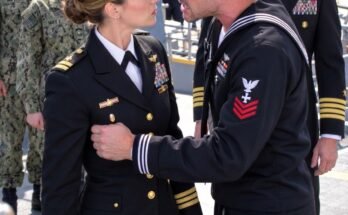
“Make yourself useful,” Captain Richard Whitmore said, pushing his empty wineglass toward me. “Pour the wine. A single mother should be grateful she’s even sitting at this table.”
He said it with a smirk, as if the insult were a harmless joke everyone at the table had agreed to enjoy.
My daughter, Olivia, looked at me. Her face had lost its color, and her hand tightened around mine beneath the table. I kept my expression composed, though I could feel the room waiting to see what I would do.
Richard had spent the evening asking questions about my income, my education and the way I had raised Olivia. He had not asked them because he wanted to know me. He asked them to decide whether I belonged in his family.
I am General Victoria Hayes, fifty-three, a three-star general in the United States Army. I am also Olivia’s mother. That night, I had wanted to be known only as the second of those two things.
I had chosen a plain navy dress, small pearl earrings and the comfortable heels Olivia bought me for Christmas. I did not wear my uniform. I did not mention my rank. Olivia had asked me to meet Ethan’s parents without turning the dinner into a formal occasion, and I agreed because this was about her life, not my position.
We arrived at the Whitmore family’s waterfront estate near Annapolis, Maryland, and Richard greeted us beneath a chandelier that probably cost more than my first home.
Patricia stood beside him, smiling in a way that looked polite until you noticed she was studying my clothes. Their son, Ethan, welcomed Olivia with a kiss and gave me a quick, nervous hug.
Richard looked me over from head to toe.
“So,” he said, “you’re the famous single mother.”
“Just Victoria,” I replied.
He gave a short laugh. “Of course.”
Olivia touched my arm. “Mom, this is Richard. Dad, this is my mother.”
“I know who she is,” Richard said. “She raised you alone, didn’t she?”
“Yes,” Olivia said.
Richard pulled out a chair for himself. “That must have been difficult. Still, people manage when they have no other choice.”
Ethan glanced at him. “Dad.”
“What?” Richard asked. “I’m making conversation.”
Patricia settled into her chair. “Richard, darling, don’t embarrass her. Government clerks are important too.”
I looked at Patricia. “I don’t work as a clerk.”
“Of course not,” she said, in the same tone someone might use to reassure a child. “I only meant that every occupation has value.”
Olivia’s fingers found mine under the table. I squeezed them once and let the comment pass. She had been looking forward to the dinner. She loved Ethan, and I knew how much it mattered to her that our families get along.
The first course came and went with Richard doing most of the talking. He wanted to know whether I owned my home, whether I had saved enough for retirement and whether Olivia had paid her own way through school. He asked about my education, then interrupted before I could answer fully.
“What exactly do you do?” he asked.
“I work for the federal government.”
“Administrative work?”
“Something like that.”
Richard leaned back. “That sounds vague.”
“It is a broad workplace.”
Patricia laughed softly. “Richard has always admired ambition. He worries that Olivia has had to carry too much responsibility because of her upbringing.”
Olivia put down her fork. “I haven’t had to carry anything because of Mom.”
Richard turned to her. “You don’t need to defend her.”
“I wasn’t defending her.”
“Then don’t make a scene.”
Ethan finally looked up. “Dad, can we leave this alone?”
Richard’s eyes moved to him. “You want to marry into a family, you should know what you’re marrying into.”
Olivia’s shoulders tightened. “You know what you’re marrying into?”
He ignored her and turned back to me. “Were you ever married?”
“No.”
“So you raised Olivia as a single mother.”
“Yes.”
“And she still thinks that makes her prepared for marriage?”
The question was not really for me. It was an attack aimed at Olivia, with my life placed between us as evidence against her judgment.
I said, “Olivia knows her own life.”
Richard smiled. “That is a confident answer from someone who has avoided answering mine.”
I could have stopped the dinner then. I should have. Instead, I watched Olivia trying to hold the evening together. She kept asking Ethan small questions about his work. Ethan answered quietly, but each time Richard interrupted, Ethan lowered his eyes again.
That silence stayed with me.
The main course was served. Richard lifted his wineglass, drank, and set it down. A few minutes later, he pushed the empty glass across the table toward me.
“Make yourself useful,” he said. “Pour the wine.”
I looked at the glass, then at him. “Excuse me?”
“You heard me.” He gave a small chuckle. “A single mother? No wonder your daughter doesn’t know what a real family looks like.”
The dining room went quiet.
Olivia’s eyes filled with tears. Ethan stared down at his plate. Patricia did not look surprised. She only reached for her own glass.
I waited for Ethan to say something. He was the man Olivia planned to marry. He was sitting close enough to touch her, and he said nothing.
Richard settled back in his chair, satisfied. “Don’t look so offended. In this family, we respect tradition.”
I placed my napkin beside my plate.
“Olivia,” I said, “get your coat.”
She shook her head once, trying to speak through the tears. “Mom, I’m sorry.”
“You don’t need to apologize.”
Richard’s voice sharpened. “We’re not finished.”
“Yes,” I said, standing. “We are.”
Olivia rose beside me. Ethan pushed his chair back, but Richard stopped him with a look.
At the entrance, Olivia reached for her coat. Richard followed us far enough to keep the argument going.
“Your daughter should learn that marrying into a military family requires discipline!” he called.
I turned to face him.
For the first time that night, I let him see that I was not intimidated.
“Captain Whitmore, I understand military discipline considerably better than you think.”
He laughed. It was loud and dismissive.
Patricia murmured, “What an arrogant little woman.”
I heard her as I walked out with Olivia.
The drive home was quiet at first. Olivia sat beside me with her coat folded in her lap. She had stopped crying, but her face was still wet.
“I should have said something,” she said.
“Yes.”
She looked at me. “You agree?”
“I agree that you should have said something.”
Her mouth tightened. “I was trying to keep things from getting worse.”
“They were already bad.”
“I know.”
We drove another few minutes. Then she said, “Ethan didn’t mean for that to happen.”
“He didn’t make it happen.”
“He was embarrassed.”
“He was quiet.”
Olivia looked down at her hands. “That’s not fair.”
“No,” I said. “It isn’t.”
I did not tell her that Richard’s rank had made no impression on me. I did not tell her that his manner was not military discipline. It was simply bad conduct dressed up as authority. I also did not tell her that I would see him on Monday morning.
That meeting had already been scheduled through ordinary professional channels. Richard was a Navy captain, and I was due to meet him as part of a military discussion involving both services. He knew I worked for the federal government. He did not know which office I held or what my rank was. He had not thought to ask.
Olivia stayed at my home that night. Before going to bed, she stood in the doorway of the guest room and said, “I love Ethan.”
“I know.”
“I don’t know if I can marry him.”
“You don’t have to decide tonight.”
“He didn’t defend you.”
“No.”
She swallowed. “Would you forgive him if he apologized?”
“That depends on whether he understands what he is apologizing for.”
She nodded, though she looked as if she wished I had given her an easier answer.
On Saturday morning, Ethan came to see her. I heard his voice in the other room, low and urgent, while Olivia answered him in short sentences. I stayed out of the conversation until Ethan knocked on the open door of my study.
“General Hayes,” he said.
He had never called me that before. I looked up.
He stood with both hands at his sides. “I’m sorry about Friday.”
“Thank you.”
“I should have stopped my father.”
“Yes.”
He blinked, as if he had expected me to help him past the apology. “I didn’t know what to say.”
“You could have said, ‘Stop.’”
“I know.”
Olivia stood behind him. “Ethan, are you going to talk to your father?”
He looked toward her. “He thinks he was protecting the family.”
“From my mother?”
“He thinks your family is unstable.”
Olivia’s face tightened. “Because she raised me?”
“He has strong opinions.”
“He insulted her.”
“I told him it was wrong.”
“Did you tell him that at dinner?”
Ethan looked away. He rubbed the back of his neck. “No.”
That answer did more damage than another excuse would have.
I said, “Ethan, you need to understand that this is not about whether your father likes me. He is allowed to dislike me. He is not entitled to humiliate me and call it tradition.”
“I understand.”
“Do you?”
He looked at me then. “I should have stood up.”
“Yes.”
He turned to Olivia. “I love you.”
She closed her eyes briefly. “I love you too. That doesn’t fix it.”
Ethan left without asking her to come with him. Olivia watched him go, then sat down across from me.
“I don’t want to become part of that,” she said.
“You are not required to.”
“He says Richard will calm down.”
“Did Richard apologize?”
“No.”
“Then Ethan is asking you to live with the same behavior.”
Olivia was quiet. She had spent her life hearing people describe me as strong. They meant it as praise, but sometimes it had made it easy for them to assume I needed nothing. I had raised her alone, worked, moved through assignments and made decisions that affected other people’s lives. None of that meant I could not be hurt. I had simply learned not to make my hurt someone else’s responsibility.
Olivia looked at me. “Why didn’t you tell them who you were?”
“Because I wanted them to meet your mother.”
“You didn’t think they’d respect you without the uniform?”
“I hoped they would respect a person without needing credentials.”
She let out a breath that was almost a laugh. “That was optimistic.”
“It was.”
On Sunday, Olivia called Ethan and ended the engagement.
I was not in the room for the whole conversation. I heard only the parts that carried through the open doorway.
“No, Ethan. I’m not going to explain this to your father again.”
A pause.
“You keep saying he didn’t mean it. He said exactly what he meant.”
Another pause.
“I believe you love me. I don’t believe you are ready to stand beside me.”
When she came into my study, she had removed her engagement ring.
“He asked me to wait,” she said.
“For what?”
“For my father to get used to you.”
I looked at the ring in her palm. “And what did you say?”
“I said I won’t marry into a family where my mother has to earn basic respect.”
She placed the ring on the desk. “He said I was throwing away our future.”
“Was he right?”
Olivia looked at the ring for a long time. “No.”
Monday morning, Richard Whitmore entered my office with two other officers for the scheduled meeting. He was carrying a folder and speaking to someone beside him when he stepped through the door. Then he saw me behind the desk.
He stopped.
The other officers continued two steps before noticing that he had fallen behind. Richard looked at my uniform, then at the stars on my shoulders. His face changed as he understood what he had missed at dinner.
“General Hayes,” he said.
I stood. “Captain Whitmore.”
For several seconds, neither of us said anything. The people with him had not been at the dinner, but they understood enough from the way Richard was standing.
He looked toward the folder in his hand. “I wasn’t aware.”
“That is clear.”
He closed the folder. “About Friday night, I owe you an apology.”
“You owe Olivia one too.”
“I spoke without knowing your position.”
“That is not the part you should regret.”
His jaw tightened. “I was trying to establish the kind of family environment we expect.”
“You pushed your empty glass toward me and ordered me to pour your wine.”
“I was making a joke.”
“You called my daughter incapable of understanding a real family because I raised her alone.”
Richard looked at the two officers, then back at me. “I had been drinking.”
“That explains the poor judgment. It does not excuse it.”
He shifted his stance. The confidence he had worn at dinner was gone, but the apology still sounded carefully limited.
“I didn’t intend to offend your daughter.”
“You offended her mother in front of her. You insulted her upbringing. You embarrassed your own son. Intent is not a repair.”
He looked down at the folder. “Ethan told me the engagement was over.”
“Yes.”
“I did not tell him to end it.”
“You didn’t have to. You showed him what his marriage would require.”
Richard’s mouth tightened. “This is a family matter.”
“It was a family matter when you used my life to belittle your son’s fiancée. We are here for professional business, and I will keep it there. Your conduct at dinner does not give me grounds to misuse my office, and I will not do that.”
His eyes flickered toward the officers again. He had expected either punishment or a performance of power. I offered him neither.
“I hope you won’t let a misunderstanding affect today’s work,” he said.
“It wasn’t a misunderstanding.”
He started to answer, then stopped. The same two officers remained silent, watching him search for a version of the evening that would not make him look responsible.
Finally, he said, “I was wrong.”
It was the first direct sentence he had offered me.
I nodded once. “Then you can begin by telling Patricia and Ethan that.”
He looked as though he wanted to argue, but there was no useful argument left. He had called it tradition, then a joke, then alcohol, and finally a misunderstanding. None of those descriptions changed what he had done.
The professional meeting continued. Richard spoke when necessary and kept his remarks focused. He did not look at me as if I were hired help. He did not mention my rank again.
Afterward, I called Olivia.
“How did it go?” she asked.
“He apologized.”
“To you?”
“Yes.”
“Did he mean it?”
“He said he was wrong.”
“That isn’t the same thing.”
“No,” I said. “It isn’t.”
She was quiet. Then she said, “Ethan came by while you were gone.”
“What did he want?”
“He said his father had apologized to him and Mom.”
“Did you believe him?”
“I believed he said it.”
That was enough for the moment. She had ended the engagement, and Richard could no longer talk his way around the consequence. Ethan had lost the marriage he expected to keep while asking Olivia to absorb his father’s behavior. Richard had lost the place at the center of their wedding plans, and no rank or family tradition could restore it.
That evening, Olivia came to my office after work. She stood in the doorway, looking at my uniform as if she had not seen it before.
“I’m proud of you,” she said.
“You have always known what I do.”
“I knew your job. I didn’t know what it looked like.”
“It usually looks less dramatic than this.”
She smiled faintly, then became serious. “I’m sorry I asked you to go to that dinner without telling them.”
“You didn’t know what he would do.”
“I knew he could be difficult.”
“So did Ethan.”
She looked down. “That is the part I can’t get past.”
Neither could I. Richard had insulted me, but Ethan’s silence had shown Olivia what he would protect when loyalty became inconvenient. The dinner had not revealed that she was marrying into a military family. It had shown her what kind of family she was being asked to defend.
Olivia picked up the engagement ring from my desk. “I’m going to return this to Ethan tomorrow.”
“Do you want me to come with you?”
She shook her head. “No. I need to do this myself.”
I nodded. “Then do it.”
She closed her fingers around the ring and walked out.
I remained at my desk, still in uniform, with Monday’s work waiting in front of me. Richard Whitmore had thought a plain dress made me small. Olivia had decided she would not build a marriage around that mistake.The next morning, Olivia returned the ring to Ethan and told him the engagement was over. Richard’s apology did not change that, and Ethan could no longer pretend silence had been neutral.
I removed my uniform jacket, placed it over the back of my chair, and went back to work. On my desk, Olivia’s unopened wedding-planning folder stayed beside the ring she had chosen not to wear.