There is a specific kind of silence that infects a home right before the foundation cracks. It isn’t the peaceful quiet of a sleeping household; it’s a strained, pressurized stillness, like the air in a deep-sea submarine right before the hull gives way. For nine years, I lived in that submarine. My name is Sarah, and I built a beautiful, suffocating life in a pristine, middle-class American suburb. Our lawn was manicured, our mortgage was paid on time, and the rot inside the walls of our marriage was painted over with the thick, glossy veneer of “normalcy.”
My husband, David, was the architect of this illusion. To the outside world, he was the affable software engineer, the guy who manned the grill at neighborhood block parties. To me, he was a master illusionist, a man whose primary defense mechanism was to shrink my reality until it fit perfectly into the palm of his hand.
The epicenter of our domestic tension, the ghost haunting our hallways, was always his mother, Brenda. Brenda did not simply visit; she invaded. She brought with her the heavy, cloying scent of cheap gardenia perfume and an arsenal of thinly veiled cruelties she categorized as “old-school discipline.” Her primary target was our eight-year-old daughter, Maya. Maya was a deeply empathetic, sensitive child with a cascade of long, unruly chestnut hair that she loved fiercely. To me, Maya was magic. To Brenda, Maya was a lump of clay that needed to be violently pounded into a more convenient shape.
The night before our lives fractured irreparably, the air in our home was already thick with hostility. Brenda had come over for Sunday dinner. Maya, exhausted from the weekend, was sitting on the rug in the living room, quietly whimpering as I tried to work a plastic comb through a stubborn knot at the nape of her neck.
Brenda stood in the doorway, her arms crossed over her chest, the ice in her scotch glass clinking as she shifted her weight. She watched Maya’s tears with a look of predatory disgust.
“She’s manipulating you, Sarah,” Brenda said, her voice a low, grating drawl. “If you let her cry over a brush, she’s going to be weak. The world eats weak girls alive.”
I kept my voice even, swallowing the familiar spike of adrenaline. “She’s just tired, Brenda. Her scalp is sensitive. I’ve got it handled, thank you. We just need a little space.”
From the hallway, David’s voice boomed, completely stripping away whatever authority I had just tried to claim. “Mom’s right, Sarah. You baby her too much. It’s just a tangle.” He walked past me, placing a heavy, affirming hand on his mother’s shoulder, aligning himself with her against his own wife and weeping child.
I bit the inside of my cheek until I tasted copper. I finished braiding Maya’s hair in silence, kissed her forehead, and tucked her into bed.
Later that night, I went down to the kitchen for a glass of water. The lights were off, save for the amber glow over the stove. Brenda and David were standing by the refrigerator. I stopped in the hallway, concealed by the shadows.
“I’m telling you, it’s ridiculous,” Brenda was hissing, her voice a venomous whisper. “That hair problem is a symptom, David. Sarah is raising a spoiled brat. You need to put a stop to it before she ruins the girl entirely.”
I held my breath, waiting for my husband to defend our daughter. I waited for the man who promised to protect us to draw a line in the sand. Instead, I heard the low, agreeable murmur of David’s voice.
“I know, Mom. I know. It’s out of control.”
I backed away silently and went upstairs. I assumed it was just another passing criticism, a familiar irritation I could manage, just one more compromise in a marriage built on a thousand tiny concessions. I told myself it was just talk.
The next morning, the air was brisk. I had an early meeting, so I was dropping Maya off at Brenda’s house before school. As we walked into Brenda’s kitchen, the sterile, bleached smell of the tile hit me. Maya clung to my hand.
I kissed the top of Maya’s head. “Be good for Grandma. I’ll pick you up at three.”
As I turned to leave, my eyes caught something resting on the granite island counter. It was a pair of heavy, black electric clippers, the cord coiled neatly beside it like a sleeping black snake.
“What are those for?” I asked, a sudden, inexplicable knot tightening in my stomach.
Brenda didn’t look up from pouring her coffee. “Grooming Buster,” she said flatly, referencing her aging Golden Retriever. “His coat is getting matted.”
The explanation was perfectly mundane. I nodded, overriding my gut instinct, desperate to keep the peace. I kissed Maya goodbye, wholly unaware as I walked out the front door that Buster the dog was already outside in the fenced-in yard, barking at a squirrel, his coat perfectly brushed.
The human brain is uniquely equipped to protect us from shock, filtering catastrophic information through a lens of denial before letting the brutal truth settle. When I walked through Brenda’s front door at three o’clock that afternoon, my brain tried desperately to tell me I was looking at an optical illusion.
The house was eerily silent. It was eighty degrees inside, the heater cranked up high, yet on the living room sofa sat a small, trembling mound huddled beneath a heavy, gray fleece blanket.
“Maya?” I called out, dropping my purse.
The mound flinched. I rushed over, pulling back the edge of the fleece.
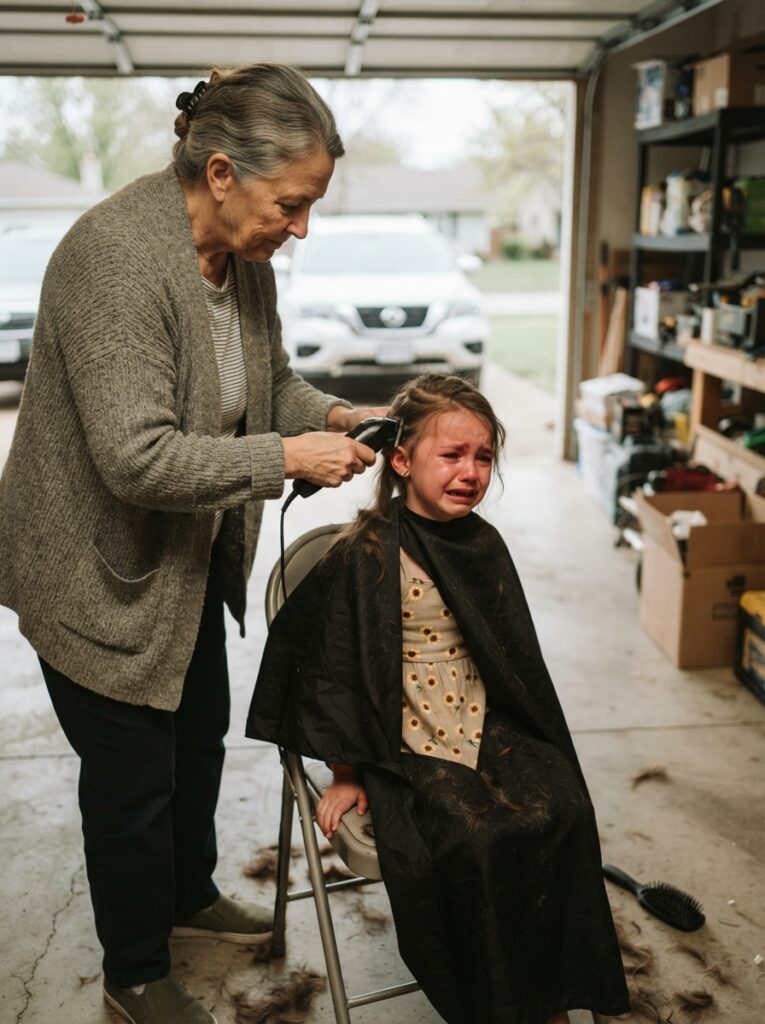
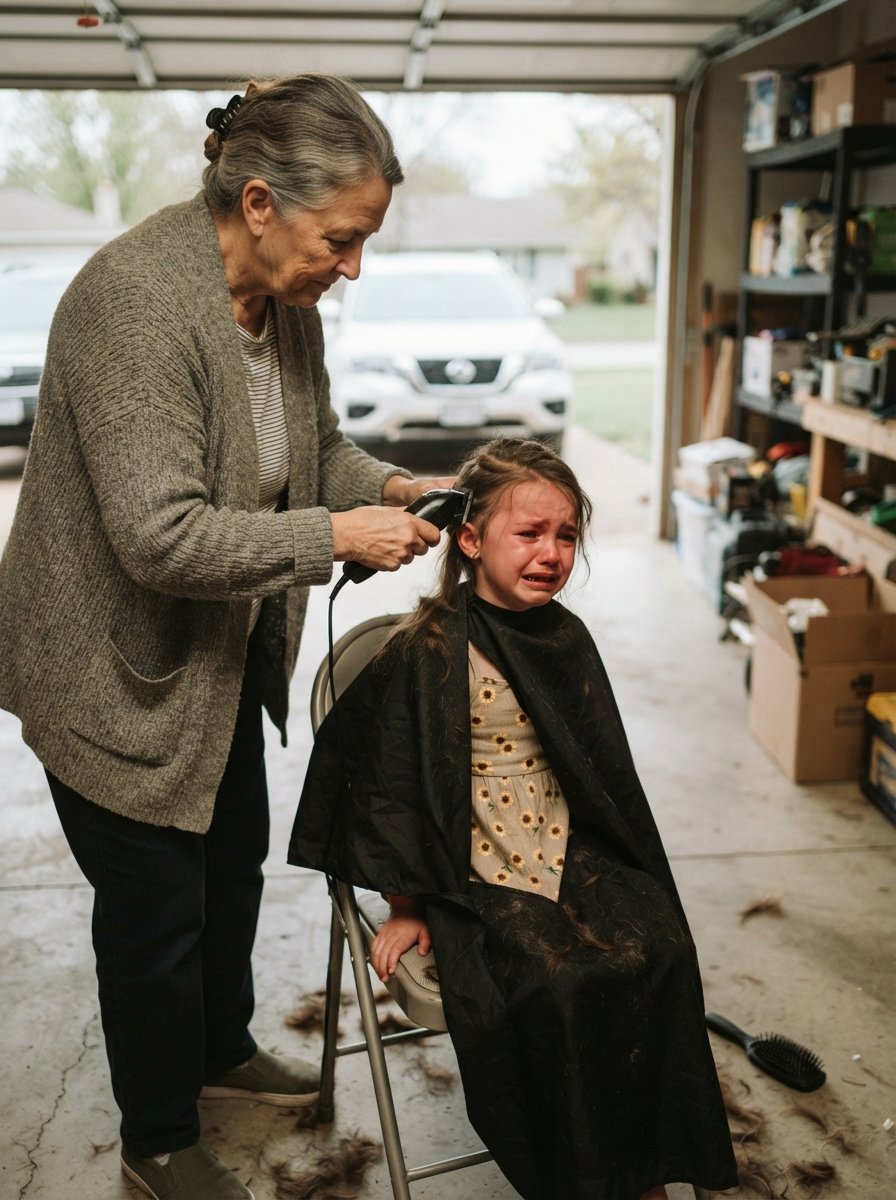
Maya’s eyes were swollen shut from crying, her small face splotchy and pale. But it was her head that made the breath violently leave my lungs. Her beautiful, chestnut hair was gone. In its place was a jagged, raw, uneven buzz cut. The skin on her scalp was pink and irritated, scraped in places where the heavy clippers had bitten too close to the skin. She looked like a prisoner of war.
She didn’t speak. She just pulled the blanket tighter over her head and let out a broken, hollow sob that sounded like it was coming from the bottom of a well.
“What did you do?” I screamed, spinning around.
Brenda was sitting in her reclining chair, working on a crossword puzzle. She didn’t even flinch. “I solved the morning routine problem,” she said, her tone as casual as if she were discussing the weather. “She wouldn’t sit still for a brush. Now she doesn’t need one. It’s practical. She’ll thank me when she’s older.”
I didn’t argue. The sheer, sociopathic detachment in her eyes terrified me. I scooped my sobbing daughter into my arms, wrapped the blanket around her, and ran to my car.
By the time David walked through the front door of our home at six o’clock, Maya had barricaded herself in her closet and refused to come out. I was vibrating with a rage so pure and hot it felt like a physical fever. I met him in the entryway.
David sighed, unbuttoning his work collar, looking at me with sheer exhaustion before I even spoke. “What now?”
“Go look at your daughter,” I demanded, my voice shaking. “Go look at what your mother did to her.”
He barely glanced toward the hallway. He set his briefcase down. “Mom called me,” he said, rolling his eyes. “Hair grows back, Sarah. Stop making this bigger than it is. Mom said she was acting like a brat and making everyone late. It’s just a haircut.”
“A haircut?” I stepped into his path, forcing him to look at me. “She buzzed her to the scalp! Maya looks in the mirror and cries. She’s hiding in the closet. Your mother assaulted her to break her spirit!”
David’s jaw tightened. He deployed the tactic he had perfected over a decade: shifting the blame to my emotional state. “She’s upset because you’re acting like someone died,” he retorted, his voice rising, adopting that patronizing tone that always made me feel like a hysterical child. He walked past me into the kitchen and yanked open the fridge to grab a beer. “You are projecting your own anxiety onto Maya. We are not tearing this family apart over split ends.”
He popped the tab on the beer. Tss-crack.
In that exact fraction of a second, the sound echoing against the tile, something inside me died. It wasn’t a slow, tragic fading of love; it was a violent, instantaneous severing. I looked at the man drinking a beer while his traumatized child hid in a dark closet, and I saw him not as a flawed husband, but as a predator’s accomplice. The illusion was gone. I realized, with a terrifying, icy clarity, that I was entirely alone in protecting my daughter.
Arguing with a gaslighter is like drinking poison and expecting the other person to die. It only feeds their power. It proves you are the crazy one. So, I did something I had never done in nine years of marriage.
I went completely silent.
I didn’t yell. I didn’t cry. I turned on my heel and walked up the stairs. I went into our bedroom, pulled a small duffel bag from under the bed, and packed Maya’s birth certificate, my passport, and a change of clothes for both of us. I quietly texted my boss that I had a family emergency and would be taking the morning off.
I went into Maya’s room, gently coaxed her out of the closet, and wrapped her securely in my coat. I led my shivering daughter out to the car. As I started the engine, David came to the front door, beer in hand, a confused scowl on his face. He mouthed, Where are you going?
I didn’t roll down the window. I put the car in drive. I wasn’t driving to school the next morning. I was driving to a place where David’s words held no power.
The waiting room of the pediatric clinic smelled of sterile alcohol wipes and faint cherry-flavored medicine. I sat holding Maya on my lap, her bald head covered by a soft beanie I had bought at a pharmacy on the way.
Dr. Hayes was a revelation. She was a seasoned pediatrician with kind eyes and a spine of absolute steel. When she walked into Exam Room 3, she didn’t gasp at Maya’s appearance. She didn’t offer pity. She offered a quiet, masterful, trauma-informed presence that instantly commanded the room.
“Well, hello Maya,” Dr. Hayes said softly, pulling up her rolling stool. “That is quite a new look. Do you want to tell me how that happened, or do you want Mom to start?”
Maya looked at her hands. “Grandma did it,” she whispered.
“Did you want Grandma to cut your hair?”
Maya shook her head violently, tears spilling onto her cheeks. “She said if I cried, she would make me look like a boy so everyone would know how ugly I was acting. She held my arms down.”
Dr. Hayes’s pen moved smoothly across her legal pad. She looked up. “Where was your Dad when this happened, sweetheart?”
“He was at work.” Maya sniffled, wiping her nose. Then, she looked up, her blue eyes wide and haunted. “But… but Dad knew she was going to do it.”
I froze. “What do you mean, baby?” I asked, my blood running cold.
“Last night,” Maya said, her voice trembling. “When I went to get water. I heard Grandma talking to Dad in the kitchen. She told Dad she was going to shave my head if I didn’t stop crying over the brush.”
Dr. Hayes leaned in, her voice incredibly gentle. “And what did your Dad say, Maya?”
Maya looked at me, terrified to break the family code of silence. “He said… he said, ‘Good.’”
A wave of nausea hit me so hard the room spun. He knew. It wasn’t just complicity; it was conspiracy.
Before I could speak, the heavy wooden door of the exam room flew open. David burst in, his face red, chest heaving. He was dangling Maya’s bright pink backpack from one finger like a prop of normalcy, an absurd attempt to drag us back into his reality.
“You seriously brought her here over a haircut?” he demanded, glaring at me, ignoring the doctor entirely.
Dr. Hayes didn’t flinch. She kept her pen poised over her reporting forms.
When David stepped forward, Maya physically recoiled. She scrambled backward on the exam table, hiding behind my shoulder, pushing her backpack away from him.
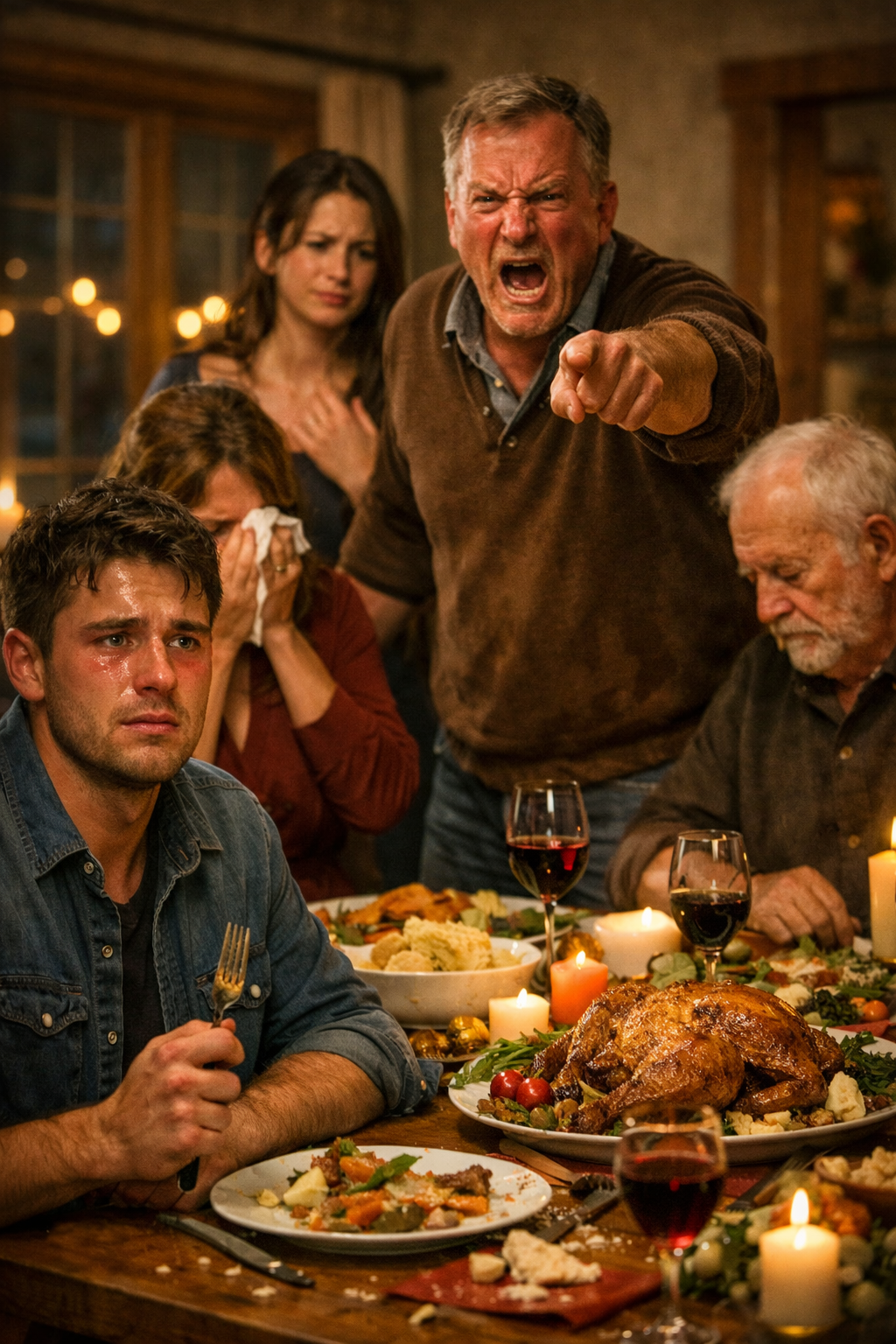
David’s face flushed with a dark, ugly anger. “She’s scared because you’re making her scared, Sarah,” he spit, pointing a thick finger at me. “You are sick. You are manipulating her to hate my mother.”
In the tense silence that followed, a sudden vibration shattered the air. David had slammed his phone down onto the sterile metal counter when he walked in. It buzzed, the screen lighting up.
From where I stood, the preview text on the lock screen was in large, undeniable font. It was from Brenda.
“Don’t let her turn this into abuse. You told me to handle the hair problem.”
The words hung in the air, a glowing, digitized confession.
David saw my eyes lock onto the screen. He lunged for the phone, the white charging cord tangling awkwardly around his fingers. He fumbled, nearly dropping it, his face rapidly draining of color, the arrogant flush replaced by the pale, sickly hue of a cornered animal.
“That’s… that’s not what she means,” he stammers, his voice suddenly an octave higher, desperately trying to construct a lie on the spot. “She meant… the brushing. Handling the brushing.”
I looked at Dr. Hayes. She wasn’t looking at the phone. She was looking at David, and she was already writing the exact words of the text message into the permanent medical record.
Dr. Hayes set her pen down with a sharp click. She looked directly at David, her eyes flat and uncompromising.
“Mr. Davis, I need you to step out into the hallway. Now.”
David puffed up his chest, trying to rally his dominating presence. “I am her father. I have a right to be here. You can’t tell me what to do.”
As he hesitated, Dr. Hayes reached over and picked up the clinic’s black landline phone. She didn’t break eye contact with him.
“Because my next call is to the Department of Children and Family Services,” she said in a chillingly calm voice, “and they will want to know exactly where you are standing.”
The machinery of the state moves with a terrifying, indiscriminate swiftness once it is turned on. Within three hours, a social worker named Ms. Albright was sitting in a small, windowless office at the clinic, gently asking my eight-year-old daughter to describe exactly how her grandmother had held her down. Hearing Maya recount the assault—and her father’s prior approval of it—to a stranger was the most agonizing experience of my life. It was the absolute death of our family unit, documented in triplicate.
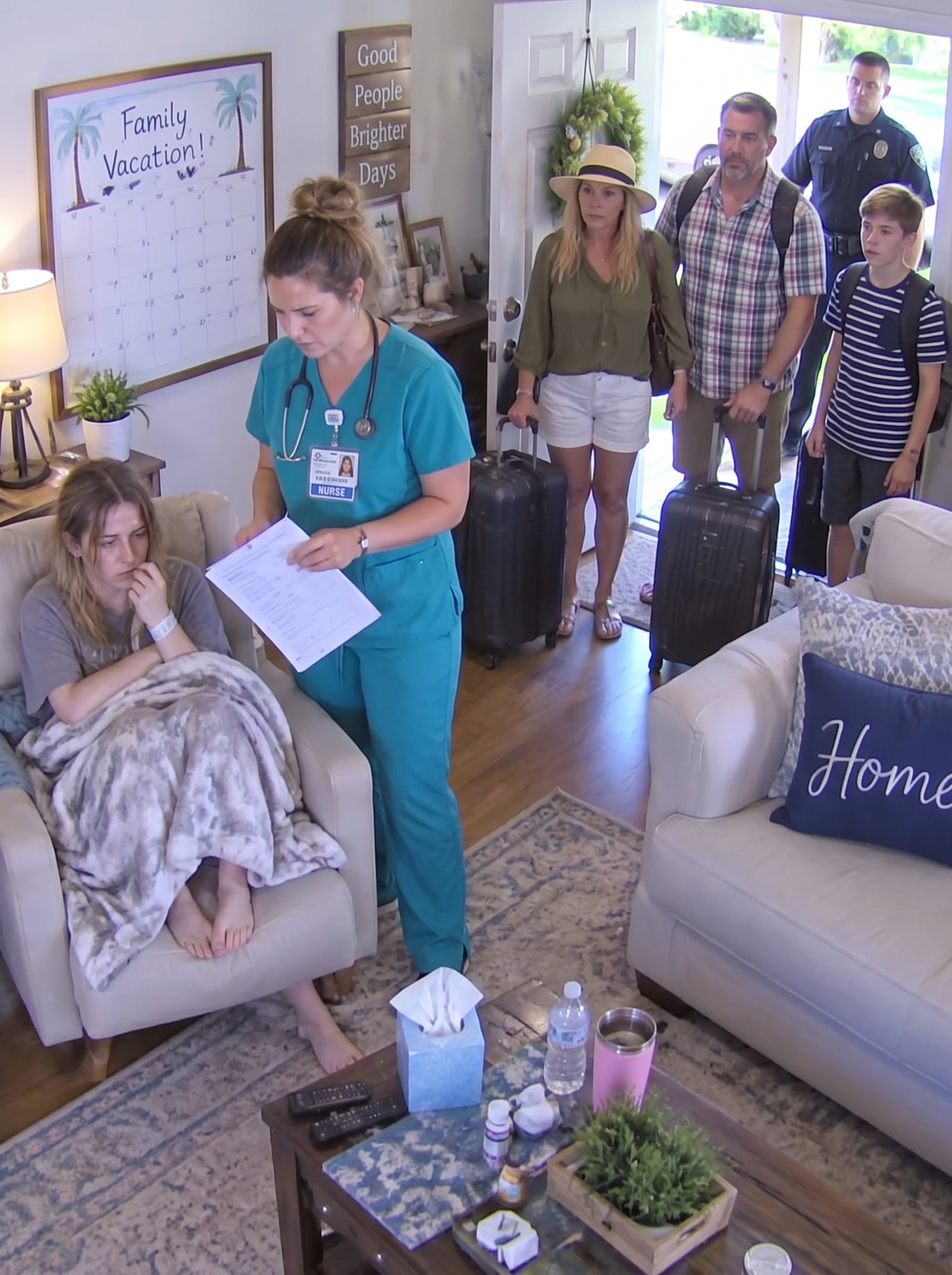
Child Protective Services informed us that an investigation was officially open against Brenda for physical abuse, and against David for failure to protect and potential collusion. They strongly advised that Maya not return to a home where either of them had access.
I didn’t need to be told twice.
While David was trapped in agonizing interviews with the social worker and clinic security, I left. I didn’t go back to our house to pack carefully. I rented a cheap, furnished, month-to-month apartment on the other side of town. The next day, while David was at work, I drove back to our house with a box of heavy-duty black garbage bags. I swept my life and Maya’s life into them—clothes, toys, toothbrushes, the essential flotsam of existence—and hauled them to the trunk of my car. Leaving a nine-year marriage in trash bags is humiliating, but it is deeply, profoundly efficient.
When David realized I was gone and refusing to communicate outside of a newly hired lawyer, his behavior became erratic, escalating from manipulation to sheer malice.
First, the financial abuse began. My debit card was declined at a grocery store. I checked my banking app in the parking lot to find our joint accounts entirely drained, transferred to a private account in his name.
Then came Brenda’s counter-offensive. Stripped of her access to Maya, she weaponized the community. My phone blew up with screenshots from neighbors and PTA mothers. Brenda was posting unhinged manifestos on Facebook, painting herself as a loving grandmother trying to save her granddaughter from a “hysterical, mentally unstable, alienating mother.” She claimed I had shaved Maya’s head in a manic episode and was framing her to get full custody.
The audacity was breathtaking, but I remembered the lesson from the living room: Do not argue with the gaslighter. Let the truth speak. I ignored the messages. I kept my head down. I focused on Maya.
Two days after the clinic visit, David cornered me. I was walking out of Maya’s elementary school after dropping off her homework assignments to her teacher, as she was staying home to heal.
He stepped out from behind a parked SUV. He looked disheveled. The arrogant, polished veneer was gone, replaced by frantic, sweaty panic. The reality of the CPS investigation was destroying his reputation at work and in the neighborhood.
“You’re destroying my life, Sarah!” he hissed, stepping into my personal space. “CPS showed up at my mother’s house with a police escort. Do you know how humiliated she is? Her bridge club saw the cruisers!”
He stepped forward again, looming over me, trying to use his physical size to intimidate me, a tactic that had kept me submissive for nearly a decade. “You are going to call them right now. You are going to say you exaggerated. You’re going to say Maya made it up because she was mad.”
I didn’t step back. I didn’t flinch. I felt a cold, titanium rod fuse perfectly with my spine. I looked at this man—this pathetic, hollow shell of a husband—with eyes utterly devoid of any remaining affection.
“I didn’t say a word to them, David,” I said, my voice dropping to a deadly, quiet register. “Maya did. And she told them exactly what you told your mother to do.”
I watched the wind get knocked out of him. The realization that he could no longer bully me into silence broke his brain for a second.
I turned to get into my car, the victory tasting sweet in my mouth. But as I pulled the handle, my cell phone rang loudly in my purse.
The caller ID said Lincoln Elementary Main Office.
I answered it. “Hello?”
“Sarah?” It was Mrs. Gable, the school principal. Her voice was trembling, tight with suppressed panic. “Sarah, you need to come to the front office immediately. Brenda is here. She is demanding to take Maya early, claiming she has an emergency doctor’s appointment… and Sarah, she brought a pair of scissors.”
I sprinted from the parking lot back into the school. By the time I burst through the double doors of the main office, the school resource officer already had Brenda detained in a plastic waiting chair. The scissors—large, stainless-steel shears—were sitting confiscated on the receptionist’s desk. Brenda was screaming obscenities, claiming she just needed to “even out the hack job” I had done to her granddaughter. She was spiraling into total delusion.
That incident was the final nail in their coffin.
The legal proceedings that followed were swift and brutal. The family court judge, presented with the CPS report, the incident at the school, and Dr. Hayes’s impeccable documentation, did not hesitate. I was granted temporary sole legal and physical custody of Maya, and a permanent, emergency restraining order was issued against Brenda. David, due to his proven complicity and the frozen bank accounts—which the judge forced him to immediately restore with penalties—was granted only supervised visitation.
David, too proud to admit defeat and too broke from legal fees to afford his own place, moved into Brenda’s basement.
The contrast between our lives over the next six months was the closest thing to divine justice I have ever witnessed.
In their claustrophobic house, David and Brenda, stripped of their emotional punching bag, turned their toxicity on each other. Through mutual acquaintances, I heard the stories. The screaming matches. Brenda berating David for being too weak to win in court. David blaming Brenda for ruining his marriage and isolating him from his child. They were two scorpions trapped in a glass jar, stinging each other to death.
Meanwhile, in our small, sunlit apartment, Maya and I were learning how to breathe again.
Healing is not linear. There were nightmares. There were days Maya wore her beanie even inside, terrified of her own reflection. I never pushed her. I created a sanctuary of absolute autonomy. In our home, her body was hers. Her hair was hers. Her choices were hers.
Six months after the incident, on a bright Tuesday morning, I walked out of my bedroom and stopped in the hallway. The bathroom door was open.
Maya was sitting on the edge of the bathtub, facing the large vanity mirror. The thick, gray fleece blanket, which she had carried around like a shield for months, was folded away in the hallway closet. Her hair had grown out into a short, uneven, but undeniably cute pixie cut.
I held my breath in the doorway, my heart pounding, waiting for the tears that usually accompanied mirrors.
Instead, Maya reached onto the counter. Her fingers found a small, sparkly blue headband I had bought her a few weeks prior, which had sat untouched until now. She picked it up, her little hands steady. She slid it into her short hair, pushing the bangs out of her eyes. She adjusted it behind her ears, tilted her head, and offered her own reflection a tentative, brave, beautiful smile.
Tears pricked my eyes, but I smiled back from the doorway. We had won.
But peace, I learned, is fragile when the monsters are still alive.
The quiet of our new life was abruptly interrupted the following week by a thick manila envelope arriving in the mail. It was certified mail from the family court. I tore it open, my hands shaking.
The final, permanent custody hearing had been scheduled. But it was the document attached that made my blood run cold. David had submitted a new, sworn affidavit. In it, he claimed that he had recently uncovered evidence that I suffered from Munchausen syndrome by proxy. He swore under penalty of perjury that I had coached Maya to lie to the pediatrician, that I had cut her hair myself to frame his mother, and he was demanding full custody and my immediate psychiatric evaluation.
He was willing to commit absolute perjury, risking prison, just to take Maya back and feed her to his mother’s ego.
The climax of the court battle was less a dramatic shootout and more a clinical, surgical dismantling of a liar.
David took the stand, weeping crocodile tears, spinning his fabricated tale of my supposed madness. His lawyer painted him as a tragic, alienated father.
But the truth does not need theatrics; it only needs light.
My lawyer called Dr. Hayes to the stand. The pediatrician was unflappable. She walked the judge through her notes, explaining the psychological impossibility of an eight-year-old fabricating the nuances of the trauma she exhibited. Then, the killing blow was delivered. My lawyer projected the screenshot of Brenda’s text message to David—“Don’t let her turn this into abuse. You told me to handle the hair problem.”—onto the screen in the courtroom.
David’s lawyer objected. The judge overruled.
“Mr. Davis,” the judge said, peering over his glasses at a sweating, trembling David. “This text message explicitly references a prior conversation where you authorized this assault. Care to explain how a woman suffering from a psychiatric break magically forced your mother to send this text to your phone?”
David had no answer. He just stared at his hands.
The judge granted me full, permanent sole custody. David was stripped of all visitation rights until he completed a year of intensive batterer intervention counseling, which I knew he would never do. The judge also forwarded David’s affidavit to the district attorney for potential perjury charges.
It was a total, unmitigated victory.
Two years later, the scars of that time are invisible to the naked eye. Sarah and I are at a bustling Saturday farmer’s market in the center of our new city. The air smells of fresh roasted corn and lavender soaps.
Maya, now ten years old, is standing by a fruit stand, laughing uproariously with two girls from her soccer team. Her hair is a magnificent, untamed cascade of chestnut curls falling halfway down her back. She is vibrant, loud, and entirely unapologetic about taking up space in the world.
As I pay for a basket of strawberries, my eyes drift toward the edge of the market, near the overflow parking lot.
My breath hitches, just for a second.
From a distance, I spot David. I almost didn’t recognize him. He looks ten years older. His shoulders are slumped, his hair thinning, carrying a single, sad plastic bag of groceries alone.
He stops walking. He sees us.
He looks at me, and then his eyes drift to Maya. He sees the vibrant, happy, thriving child he abandoned to appease a mother who will never truly love him. I can see the crushing weight of his reality settle over him—the absolute, devastating isolation of the bed he made.
He takes a hesitant half-step forward, his hand twitching at his side.
At that exact moment, Maya turns around, clutching a peach. She spots him. Her laughter stops. Her smile falters, but only for a fraction of a second.
She doesn’t flinch. She doesn’t hide behind me. She doesn’t pull a blanket over her head. She simply looks at the man who broke her trust, her eyes flat and unbothered, and then she turns her back to him, takes a bite of the peach, and continues laughing with her friends.
David lowers his head. He turns around and walks away, shuffling toward his car, a ghost in a life he is no longer permitted to haunt.
Later that night, the house is quiet. The good kind of quiet. The peaceful, settled silence of a home built on safety.
Maya is sitting in front of my vanity mirror, fresh out of the shower. I am standing behind her, gently working a wide-toothed comb through her damp curls.
She watches our reflection in the mirror for a long time.
“Mom?” she asks softly, her voice carrying over the hum of the air conditioner.
“Yes, baby?”
“Do you think he ever misses us?”
I pause. The comb rests gently against my daughter’s strong, relaxed shoulder. I look into her bright, clear eyes in the mirror. I think of the man in the parking lot, and the heavy clippers, and the sterile clinic room.
I smile, kissing the crown of her head. I realize that for the first time in years, the answer to that question no longer matters to either of us.
Our real life has just begun.