Our old dog was dying at the vet when a little girl answered my husband’s phone and said, “Daddy’s in the shower.”
We never had children. Vernon was supposed to be fishing. I kissed our dog goodbye, then found Vernon’s truck at a motel two towns over. By Sunday morning, I was sitting across the parking lot from room 14, waiting to see who would come out.
Vernon and I had been married thirty-nine years. I’ve done taxes for half of Stillwater for twenty years, working out of my dining room. I know what a number looks like when it doesn’t belong where it is.
Duke belonged with us. Vernon found him in a ditch as a puppy and carried him home in his coat. He grew into a big, sweet yellow Lab who followed us around the house and waited by the door when Vernon went fishing.
For seven years, Vernon went fishing every other weekend at a lake an hour east. He always came home without a fish.
“They weren’t biting,” he’d say.
I used to tease him about it. I stopped.
Last Saturday morning, Duke couldn’t get up. I’m proud, maybe too proud. I don’t like asking my sister or the neighbors for help. I got him into the back of my car myself, and it about broke my back.
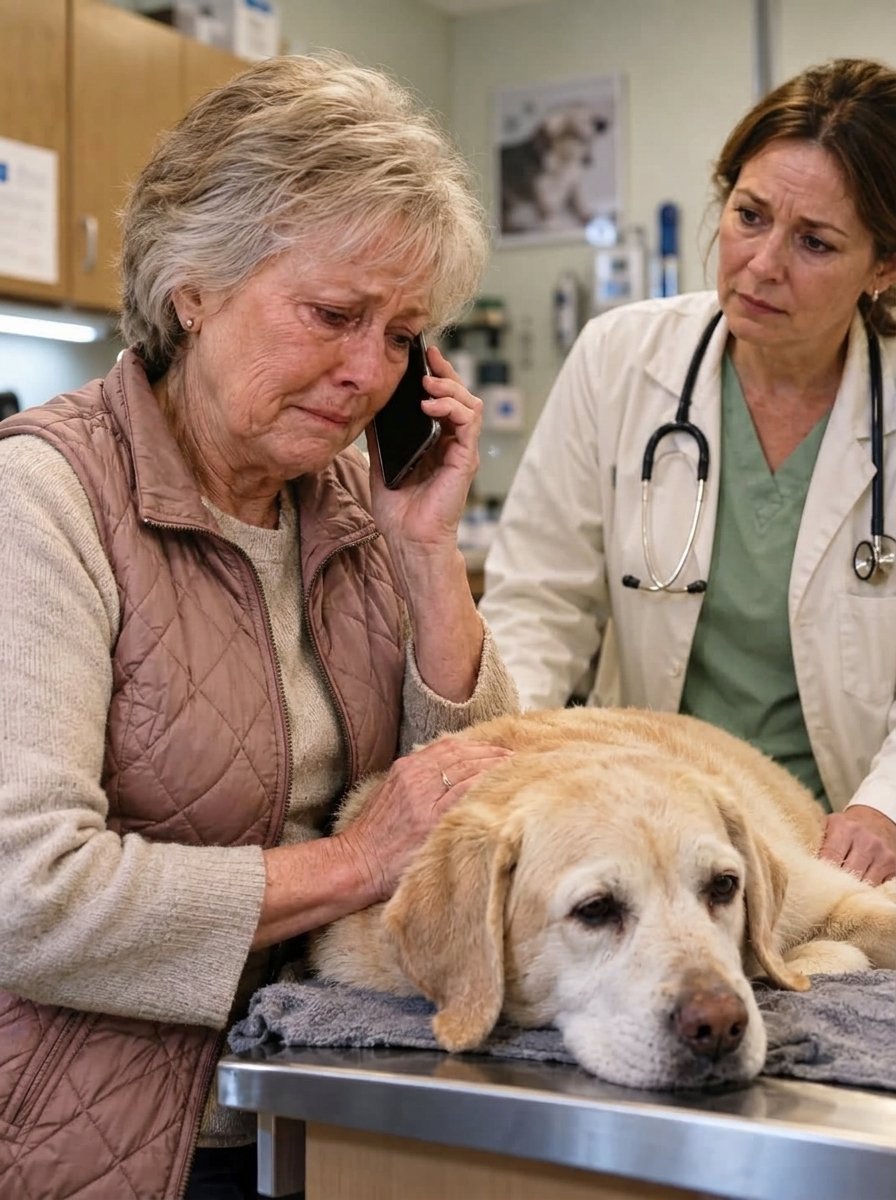
At the vet, the young doctor examined him and shook her head.
“Mrs. Petrie, his kidneys are failing, and it’s time.”
I looked at Duke. He was tired, but he was still watching me.
“Can I call my husband first?”
“Of course,” she said. “Take the time you need.”
I called Vernon. No answer. I called again. And again. Nine times.
On the tenth call, someone picked up.
“Hello?”
It was a little girl. Maybe six.
“Who’s this?” I asked.
“Hadley,” she said. “Who’s this?”
Then I heard a woman in the background.
“Baby, give me Daddy’s phone!”
Hadley came back on the line. “Daddy’s in the shower.”
The call ended.
I stared at the phone. I had been trying to reach my husband, who was supposed to be fishing. A little girl had answered and called him Daddy. We had never had children. There wasn’t a version of those facts that fitted neatly together.
“Mrs. Petrie?” the doctor said. “Do you need a minute?”
I wanted thirty-nine years. I wanted Vernon beside me. I wanted a chance to ask him why a child had his phone and why he wasn’t answering me.
Instead, I went back to Duke.
“I’m here,” I told him. “I’m right here.”
The doctor explained what she was going to do, and I held Duke while he went. He looked at me the whole time. I kissed his old gray head goodbye.
Then I paid the bill, wiped my face, and called the number back.
No one answered.
I didn’t call Vernon again. I sat in the car with Duke’s collar and tried to tell myself I had misunderstood. Maybe the child was a relative. Maybe the woman was a neighbor. Maybe there was a reason he hadn’t answered, and a reason the girl called him Daddy.
That was the story I wanted. I didn’t believe it for long.
I had set up location sharing on our phone account years earlier. Vernon never knew how to turn it off. I opened it on my computer and saw his location at a motel two towns over. There was no lake anywhere near it.
I sat in the vet’s parking lot with the map on the screen and Duke’s empty collar in my lap. The location didn’t explain who Hadley was. It did tell me Vernon had not been where he said he was.
I drove home. I did not sleep much. At two in the morning, I was still thinking about what I had never checked.
Vernon put his paycheck into our joint account. I had never once followed the money after that. I handled the household taxes and trusted the account to be what we said it was: ours.
I got up and pulled the bank statements. Seven years’ worth.
There it was, month after month: $1,700 to a rental company two towns over. I had seen that line plenty of times. Vernon told me it was his truck payment. I had accepted that because we had a truck and because I didn’t think my husband would use our money to hide a second life.
The payments had been going out while he told me the fish weren’t biting.
I laid the statements across the table and looked through them again. I knew how to check a number. I knew the payments were real. I could not tell from the statements who had been living in the room, or what the arrangement was. But I knew the truck wasn’t the explanation.
That morning, I drove to the Lamplighter Motel. It had long-term rooms rented by the week. Vernon’s truck was parked in front of room 14.
A pink bicycle with training wheels leaned against the rail.
I parked across the lot and sat with Duke’s collar in my lap. I thought of the little girl saying, “Daddy’s in the shower.” I thought of the payments. My mind kept trying to separate them, as if they belonged to two different men.
At nine, the door to room 14 opened. A woman came out with a laundry basket on her hip. She was maybe forty, tired, and wearing a Walmart vest.
She looked across the lot and saw me. She put the basket down.
Then she walked straight over to my car.
I rolled the window down.
“He told me you knew,” she said.
“Knew what?”
She looked toward the room, then back at me. “About us. He said you knew about me and Hadley.”
I had expected denial, or confusion. Not that.
“I’ve never heard of you.”
Her mouth tightened. “He said you stayed together for the house. That you both had your own lives.”
“I called him from the vet yesterday. A little girl answered his phone and called him Daddy.”
The woman shut her eyes briefly. “That was Hadley.”
“Is she his daughter?”
“Yes.”
The answer was quiet. It didn’t need anything added to it.
I looked past her at the room. “Is he there?”
“He’s inside.”
“Then ask him to come out.”
She didn’t move right away. “I didn’t know he was still telling you he was fishing.”
“I didn’t know there was a you.”
She glanced down at the laundry basket. “He said you knew.”
“I didn’t.”
The door opened behind her. Vernon stepped out. He saw me, then the woman beside my car. His face changed, but he didn’t turn around and go back inside.
“Vernon,” I said.
“Why are you here?”
“I was at the vet yesterday. I called you ten times.”
He looked at the woman, then at me. “I didn’t hear it.”
“A little girl answered.”
“I know.”
The woman looked at him. “You said she knew.”
Vernon rubbed his forehead. “Not here.”
“Where, then?” I asked. “At the lake?”
He didn’t answer.
I pointed toward the room. “How old is Hadley?”
“Six,” he said.
“And the money?”
He took a step toward me. “Let’s talk at home.”
“No. Answer me here.”
His eyes went to the woman, who stood beside the basket. Hadley had come to the doorway. She held the frame with one hand and watched us. I could see her clearly now. She looked about the age I’d guessed on the phone.
Vernon lowered his voice. “I was going to tell you.”
“When?”
“I don’t know. I thought I could get things settled first.”
“Settled how?”
He glanced at the motel room again. “I didn’t want to wreck everything.”
“You’ve been taking $1,700 a month from our account for seven years. You told me it was for your truck.”
He said nothing.
The woman looked at him. “You told me the money was yours.”
“It came from my paycheck,” he said.
“It came from our account,” I said. “You put your paycheck in with mine.”
“I know how the account works.”
“No,” I said. “You know how you used it.”
For a moment, there were no more explanations. The truck, the room, the pink bicycle and the seven years of payments were all there, in front of us. Vernon had been telling one of us he was fishing and the other that I knew. Neither story left him without a place to sleep.
Hadley shifted behind the door. Her mother turned toward her.
“Go inside, honey,” she said.
The girl didn’t move until Vernon nodded. Then she went back into the room.
I couldn’t make myself hate her. She had done nothing except answer a phone and tell the truth as she understood it.
Vernon came closer to my car. “We can talk about this without them standing here.”
“You’ve had seven years to talk to me.”
“I didn’t know how.”
“You knew how to send the money.”
He looked down. I didn’t feel triumphant. I felt tired, and I was still carrying the fact that Duke had died while Vernon was somewhere else with his daughter.
“I’m going home,” I said. “Don’t come back today.”
“Where am I supposed to go?”
I looked at the room behind him. “You have somewhere.”
He opened his mouth, but the woman had picked up the laundry basket. She went inside without looking at him. Vernon stayed by the truck.
I drove home with Duke’s collar on the seat beside me. I kept thinking that the last time I’d held Duke, Vernon had been close enough to answer his phone. He had chosen not to.
When Vernon came home later, I had the bank statements on the table. I had not asked him to come. He stood by the door and looked at the pages.
“You went through all of them?” he asked.
“I did.”
“I can explain the payments.”
“Then explain them.”
He sat down. He started with the room, saying it was a place to stay when he went fishing. I reminded him the payments had gone out every month, not just on fishing weekends. He said he knew. He said he and Hadley’s mother had been together for years. He said he’d meant to tell me, then kept putting it off.
“You told her I knew,” I said.
“I told her you knew we weren’t close anymore.”
“We were married. We shared a bank account. You had dinner with me and let me believe you were going fishing.”
He rubbed his hands over his face. “I didn’t know what else to do.”
“You could have told the truth.”
“I was afraid you’d leave.”
“I might have.”
He nodded once. “I know.”
That was the first honest thing he had said to me. It didn’t make the rest smaller.
I asked him if Hadley was his daughter.
“Yes.”
“Does she know about me?”
“She knows I’m married.”
“That isn’t what I asked.”
He looked down at the statements. “She knows I have a wife.”
I let that sit between us. I wanted to ask what he had told Hadley about me, what he had told her mother, and which parts of our life he had used to make his version sound reasonable. I didn’t ask. I had learned enough for one day.
“I can’t stay married to you,” I said.
He shook his head. “Thirty-nine years.”
“I know exactly how long.”
“I’m not asking you to forget it.”
“You’re asking me to keep living with the man who hid a daughter and a second home from me.”
“I didn’t think of it as a second home.”
“What did you call it?”
He had no answer.
I told him to stay somewhere else while we figured out the house. He said he didn’t want to leave it. I told him I didn’t want to lose it either. We had paid on it for thirty years. Neither of us could pretend the other had no claim to it.
“I’m not taking it from you,” I said. “But I won’t stay here and act as if nothing happened.”
He asked if we could wait before making a decision.
“We waited seven years,” I said. “I’m done waiting.”
He went back to the motel that night. I called my sister the next day and told her the plain version. I had spent years refusing help because I thought that was the same thing as being strong. It wasn’t. She came over, and I showed her the statements.
Vernon and I spoke again after we had both had time to stop arguing about how the truth had come out. We talked about the house, the account, and the fact that our marriage was over. He didn’t deny Hadley or the payments again. He said he had lied because he wanted to keep both lives. I told him that was not an explanation I could live with.
We agreed to sell the house and divide what remained after it was paid off. It was not the ending I wanted for the home we had spent most of our marriage paying for. But keeping it would have meant staying tied to each other in the same way, and I no longer trusted him with that.
The sale took time. Vernon moved out, and we handled the house without pretending we were going to repair the marriage. The money from those monthly payments was gone. We accounted for it when we settled what we could, but there was no way to turn seven years of lies into a clean balance.
I kept Duke’s collar. It was the one thing from that weekend I wanted to keep.
The marriage ended. I stayed in Stillwater and went back to doing taxes from my dining room. Vernon’s truck was no longer part of my life, and I stopped checking his location.
The last time Duke looked at me, I was beside him. Vernon wasn’t.