There it was on the image, something physical and undeniable where my family had tried to substitute opinion.
Then he moved to another image.
And another.
He pointed out signs of older damage.
Old breaks.
Half-healed injuries.
Evidence that my body had been keeping a more accurate history than the explanations recorded beside those old accidents.
I thought about the papers scattered across the bathroom floor.
Fractured radius.
Cracked ribs.
Severe bruising.
I thought about Sarah standing over them and laughing.
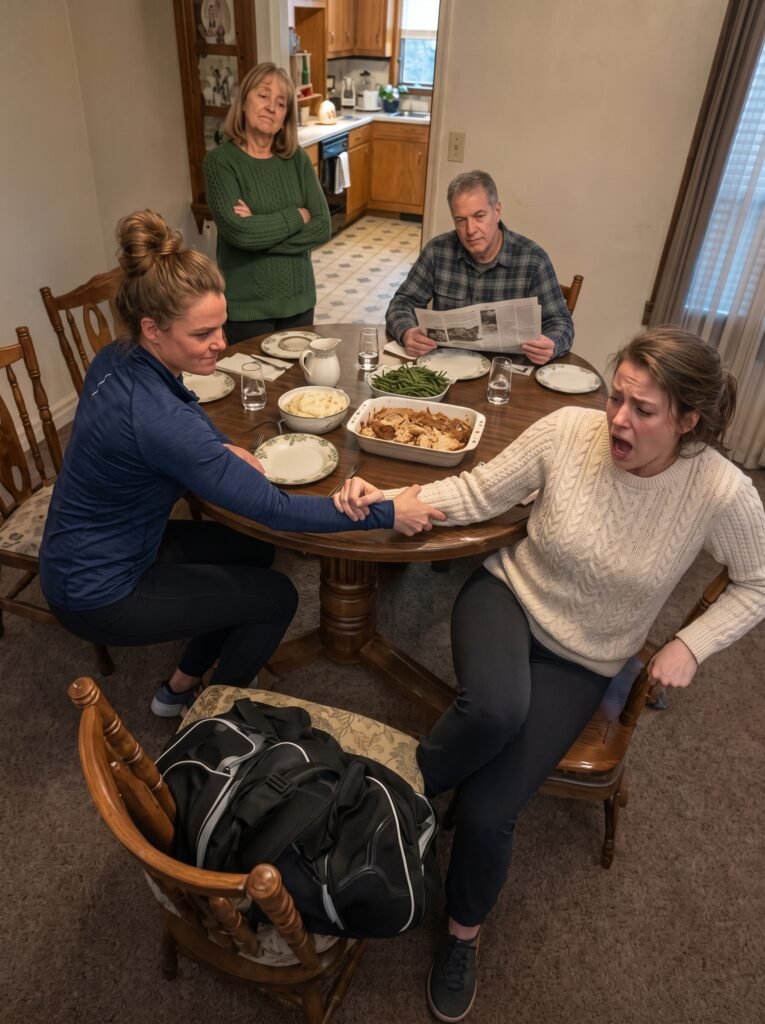
I thought about Dad asking what an emergency room would cost while my fingers changed color.
I thought about Mom looking at the swelling and deciding that my reaction was the real problem.
And I realized how many people had been required to maintain the story I had grown up inside.
Sarah had hurt me.
My parents had minimized it.
I had repeated the explanations.
Then the family had treated those explanations as proof that nothing serious had happened.
The circle protected itself.
Until that night.
Mrs. Chen had interrupted it without making a speech.
She saw my arm and helped me into her car.
The triage nurse interrupted it by treating my condition as urgent instead of inconvenient.
The doctor interrupted it by asking who had caused the injury instead of offering me an excuse for the person who did.
None of them needed Sarah to admit anything before taking what they could see seriously.
That mattered more than I knew how to explain.
For years, I had thought being believed would require the perfect piece of proof: a witness at exactly the right moment, a recording, a confession, something so complete that nobody could argue with it.
But sitting in that hospital, I was looking at something simpler.
My wrist was fractured.
My fingers were purple.
Older injuries appeared on the images.
Medical papers documented years of damage accompanied by explanations I now knew were false.
And I had finally told the truth about the person behind them.
The doctor did not celebrate that admission.
He did not turn the moment into a speech about courage.
He studied the screens with the seriousness of someone whose job was to deal with what was actually in front of him.
Then he looked at me and explained that the pattern he was seeing could not simply remain a private family matter.
It had to be reported.
My first reaction was not relief.
It was fear.
I could already hear Sarah saying I was trying to destroy her reputation.
I could hear Mom accusing me of tearing the family apart.
I could hear Dad bringing up money, embarrassment, consequences, anything except the moment Sarah twisted my wrist after I told her to stop.
That was how our family handled pain: move attention away from the person who caused it and onto the person who refused to hide it.
But the images were still glowing on the screen.
The fracture did not change because Sarah had medals.
The old damage did not disappear because my parents had accepted convenient explanations.
My purple fingers did not become less urgent because an emergency room cost money.
And the truth did not become cruelty simply because people who benefited from my silence would dislike hearing it.
The strangest part was realizing how ordinary the room felt while everything I understood about my family was shifting.
There was no dramatic family confrontation in front of me.
Sarah was not there defending herself.
My parents were not there telling the doctor I was exaggerating.
There was a medical screen, an injured arm, a neighbor who had driven me there, and a doctor doing what he believed the situation required.
That was enough.
For most of my life, Sarah had defined strength as the ability to overpower somebody else and keep going when they asked you to stop.
My parents had reinforced that definition every time they laughed, minimized, changed the subject, or asked me to absorb the consequences quietly.
That night, strength looked much less impressive.
It looked like two words typed with the wrong hand.
Need help.
It looked like walking out the back door.
It looked like allowing Mrs. Chen to take my elbow instead of insisting I was fine.
It looked like answering the doctor’s question without giving Sarah another excuse.
I still did not know what would happen after the call.
I did not know what Sarah would say once someone outside the family asked questions, or whether my parents would finally look at those old records differently.
But those were no longer reasons to rewrite what had happened.
Sarah had twisted my wrist until it fractured.
She had continued after I told her to stop.
My parents had watched the injury worsen and dismissed me.
And the scans suggested that Sunday dinner was not standing alone.
The doctor turned back toward the phone.
I watched him reach for it, and this time I did not invent an explanation for Sarah before he could make the call.
For the first time, the story leaving that room was going to begin with what actually happened.