I held up the phone and dialed a number I hadn’t used in months, my lawyer back in Calgary, who’d handled the paperwork for the workplace injury settlement I’d been quietly pursuing since a metal press accident had crushed two fingers on my left hand eighteen months earlier.
“Daniel,” I said, once he picked up. “The settlement. Has it cleared?”
“This morning, actually,” he said. “One point one million, after legal fees. Congratulations, that’s a life-changing number.”
I hung up and looked at Theresa, whose expression had already shifted the moment she heard the words “million” and “settlement” in the same sentence.
“You got a settlement?” she asked, some old, practiced warmth creeping back into her voice, the same tone she used to use when I was a kid bringing home report cards she wanted to brag about to the neighbors.
“An accident at the shop,” I said. “Lost feeling in two fingers permanently. Compensation finally came through.”
Brianna’s eyes lit up despite the broken wine glass still scattered at her feet. “A million dollars? Nathan, that changes everything. We could finish the upstairs, maybe get a second SUV—”
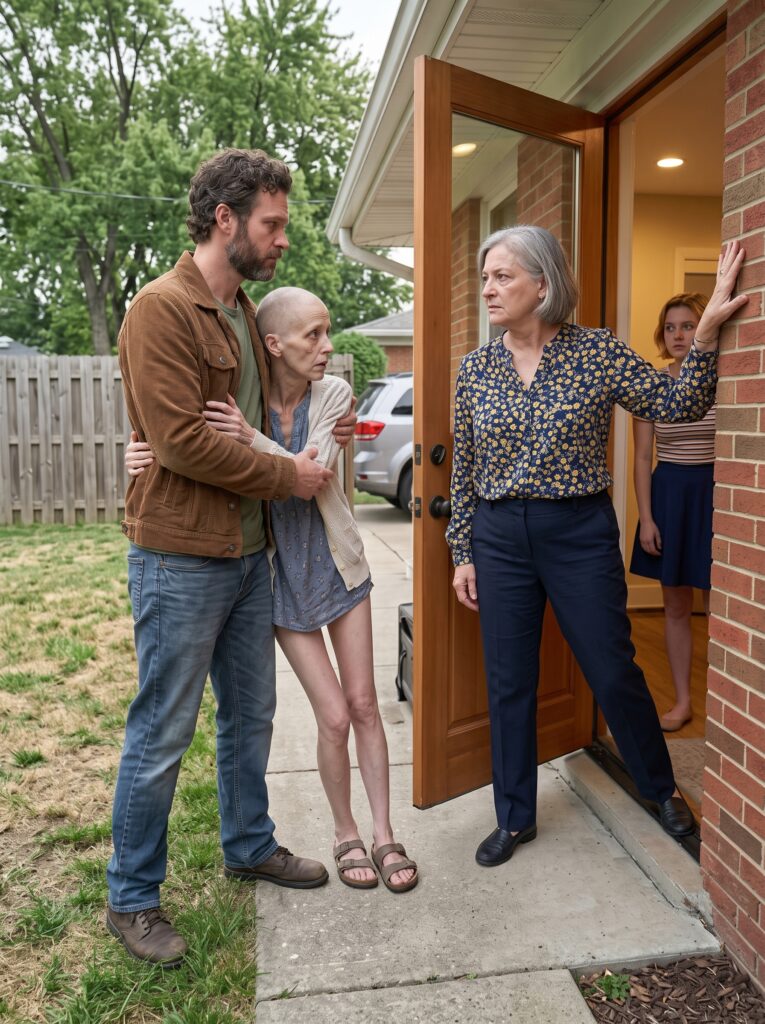
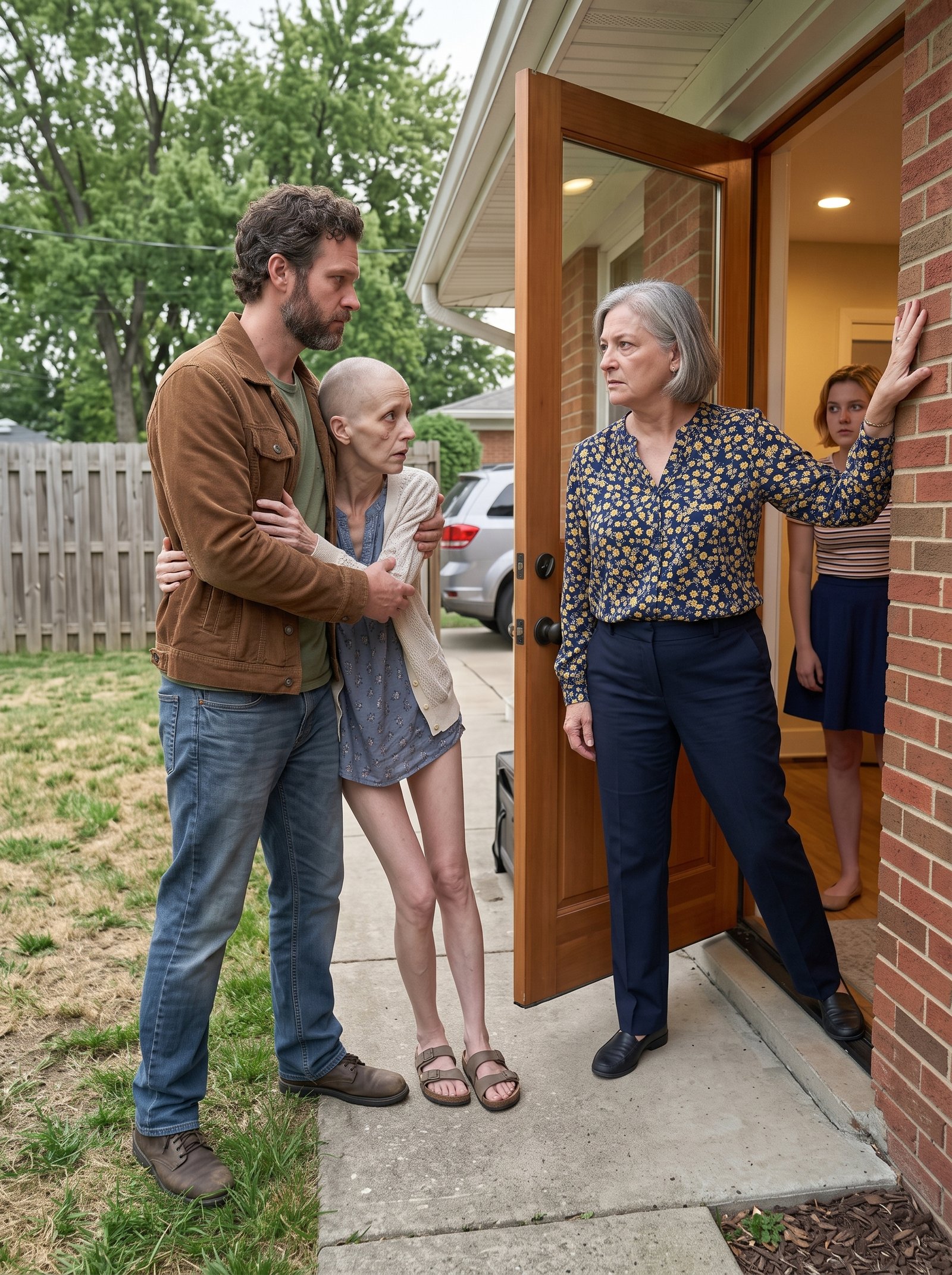
“Brianna,” I said quietly, “my wife has been sleeping in a shed with cancer for eleven months while you got a nail salon membership and a new phone. Do you understand that the only thing changing right now is what happens to you two?”
Theresa recovered quickly, pivoting the way she always did when a plan needed adjusting mid-sentence. “Of course, the first priority is Lucy’s treatment. We’ll figure out the house situation after.”
“There is no ‘we,'” I said. “Lucy and I are leaving for the hospital right now. You two are going to stay exactly here and think very carefully about the last eleven months, because I already know most of what happened, and I intend to find out the rest.”
I helped Lucy to the car, wrapping her in the jacket from my suitcase since she had nothing warm of her own, and drove straight to Foothills Medical Center, calling ahead from the road so an oncology team would be ready when we arrived.
The intake doctor’s face went grim within minutes of reviewing what little documentation Lucy had, two visits’ worth of test results from eleven months earlier, nothing since.
“She should have had continuous treatment starting immediately after this diagnosis,” the doctor said, glancing between the old paperwork and Lucy’s current bloodwork. “Going this long without follow-up care is extremely dangerous. We need to run updated scans right away to see where things stand.”
Lucy gripped my hand while they drew blood, her fingers barely strong enough to hold on.
“I kept thinking if I could just hang on until you came home,” she whispered, “you’d fix it. I didn’t know how, I just believed you would.”
“I am fixing it,” I said. “Starting right now.”
While Lucy went through scans, I sat in the hospital hallway and called Daniel back.
“I need you to look into something else for me,” I said. “Fraud, misuse of funds sent to a family member’s account for a dependent’s care. I sent close to a hundred thousand dollars over four years, specifically understanding it was for household expenses and my wife’s wellbeing. I have reason to believe almost none of it went toward her medical treatment.”
“That’s a serious claim,” Daniel said. “If you can document it, financial exploitation of a vulnerable adult carries real legal weight, especially with a documented illness involved.”
“I can document it,” I said, thinking of the SUV in the driveway, the granite countertops, Brianna’s phone, and my wife’s broken sandals. “I’ve been documenting it since I walked through that gate.”
The scan results came back four hours later. The oncologist sat down across from us with a face that told me the news before she said a word.
“The tumor has grown significantly since the last documented visit,” she said. “We’re looking at a more advanced stage than eleven months ago. It’s not hopeless, but the timeline we lost matters. We need to start an aggressive treatment plan immediately.”
Lucy closed her eyes, and I felt her hand tighten around mine, not in fear this time, but in something steadier, the relief of finally being taken seriously after eleven months of being told she’d brought this on herself.
“Then we start today,” I said. “Whatever it takes.”
Lucy’s treatment began that same week, an aggressive combination of chemotherapy and targeted therapy the oncology team hoped could still turn back the eleven months of ground we’d lost. I moved us into a small extended-stay apartment near the hospital, close enough that I could be there for every infusion, every hard morning, every moment she needed someone who wouldn’t tell her she’d brought this on herself.
While Lucy slept off her first round of chemo, I sat with Daniel in a small meeting room he’d booked at the hospital, going through everything I’d gathered.
“I want you to see this clearly,” Daniel said, spreading bank statements across the table, records he’d subpoenaed once the fraud claim was formally filed. “Over four years, you sent ninety-eight thousand dollars into your mother’s account, all documented with transfer notes referencing household expenses and Lucy’s care. In that same period, there’s a new SUV purchase, financed partly with a lump cash deposit matching one of your bonus transfers almost to the dollar. A nail salon franchise fee under your sister’s name. A full kitchen renovation. And exactly two medical payments to an oncology clinic, both within the first two months after Lucy’s diagnosis.”
“Two visits,” I said. “Out of what should have been continuous treatment.”
“Correct,” Daniel said. “And there’s something else. I pulled the property records on the house. It’s still in your name, correctly, since you’re the one who’s been paying the mortgage. But your mother took out a home equity line of credit against it eight months ago, using forged authorization.”
I stared at him. “Forged how?”
“A signature purporting to be yours, on a document she used to secure additional credit,” he said. “You were in Calgary at the time. There’s no way you signed it.”
That detail changed everything. This wasn’t just neglect or selfish spending anymore. It was fraud, layered on fraud, built on the assumption that a husband working twelve-hour shifts overseas would never look closely enough to catch it.
“I want everything filed,” I said. “The misuse of funds, the forged signature, all of it. And I want to know if there’s a path to make sure Lucy’s treatment is fully protected regardless of what happens to the house or the settlement money.”
“There is,” Daniel said. “Given the fraud, a judge is likely to view the settlement and any remaining assets as needing protection specifically for Lucy’s care and your financial recovery. Your mother and sister’s misuse of funds strengthens your position considerably.”
Back at the house, word had apparently reached Theresa and Brianna faster than I expected. My phone rang three times that afternoon; I let all three go to voicemail, then finally listened to them that evening while Lucy dozed beside me, an IV line taped gently to her arm.
Theresa’s voicemail alternated between tearful apology and defensive justification, the same pattern I remembered from childhood whenever she’d been caught in something she couldn’t talk her way out of cleanly.
“Nathan, please, I know it looks bad, but you have to understand how expensive everything got. We didn’t mean for it to go this far. Please don’t do anything rash with the lawyers.”
Brianna’s voicemail was shorter, and far less apologetic.
“You’re really going to ruin your own family over this? She’s your wife, not your responsibility to guilt-trip us over. Call me back.”
I didn’t call either of them back. Instead, I sat beside Lucy’s hospital bed and read her the transcript of what Daniel had found, the forged signature, the home equity fraud, the two visits out of what should have been eleven months of continuous care.
“I always wondered how she afforded the SUV that fast,” Lucy said quietly, her voice still weak from the chemo. “I thought maybe you’d sent extra without telling me.”
“I sent exactly what I always sent,” I said. “It just never made it to you.”
Two weeks later, formal charges were filed against Theresa for financial exploitation of a vulnerable adult and forgery, with a separate civil claim against both her and Brianna for the misappropriated funds. The house, now under legal review pending the fraud investigation, would eventually need to be sold to satisfy both the fraudulent home equity loan and the restitution owed for years of misdirected support.
Theresa’s calls stopped abruptly once she was formally served. Brianna’s continued for another week, growing increasingly desperate, before finally stopping too, once it became clear no amount of guilt-tripping was going to undo what the paperwork had already made permanent.
Lucy squeezed my hand from her hospital bed as I read her the final update from Daniel.
“They’re really losing the house?” she asked.
“They’re losing the house they never should have had control over in the first place,” I said. “What matters now is you. Everything else is just consequences catching up to where they belonged.”
Lucy’s treatment stretched across the next ten months, a grueling cycle of chemotherapy, a delayed surgery once her body was strong enough to withstand it, and radiation that followed to make sure nothing had been left behind. There were nights she couldn’t keep food down, nights she cried from exhaustion rather than pain, and nights I sat beside her hospital bed doing nothing but holding her hand because it was the only thing left that helped.
I never went back to the shop in Calgary. The settlement, once fully protected through Daniel’s legal work, was enough to cover Lucy’s treatment in full and set aside a stable foundation for whatever came next, without ever touching a dollar of what should have gone toward her care from the start.
The fraud case against Theresa moved slower than the civil claim, working through the court system over several months, but the evidence was airtight: the forged signature, the misused transfers, the home equity loan taken out under false authorization. She was ultimately convicted of financial exploitation of a vulnerable adult and forgery, receiving a suspended sentence contingent on full restitution and several years of probation, along with a permanent record that would follow her for the rest of her life. Brianna, found liable in the civil suit for her share of the misappropriated funds, lost the nail salon investment entirely once the settlement judgment came through, along with the SUV, which was repossessed within months once the fraudulent loan collapsed under scrutiny.
The house sold within the year, the proceeds split between satisfying the fraudulent loan and restitution owed to Lucy and me. Neither Theresa nor Brianna reached out again after the final judgment. I didn’t reach out either. Some bridges, once you see exactly what they were built on, aren’t worth trying to rebuild.
Lucy’s final scan came back clear fourteen months after I first walked through that gate and found her on her knees in the dirt, gathering the pieces of a broken plate with her bare hands.
“No evidence of disease,” the oncologist told us, and I watched twenty-six months of fear finally leave my wife’s body all at once, her shoulders dropping, her breath coming out in something between a sob and a laugh.
We used part of the settlement to buy a small house outside Calgary, nothing extravagant, just enough room for the two of us and the dog Lucy had always wanted but never felt safe enough to bring into a house that wasn’t truly hers. Her hair grew back slowly over that first year, first in soft, uneven patches, then fully, and the first time she ran a brush through hair long enough to need one again, she sat in front of the mirror for nearly twenty minutes, just looking at herself.
“I kept thinking I wouldn’t get to see this again,” she said.
“You don’t have to think that way anymore,” I said, sitting down beside her. “Not about your hair, not about anything.”
Some evenings, we sit on our back porch, the dog curled at our feet, and Lucy will absently touch the hummingbird pendant I bought to replace the one Theresa had taken, a small thing, but one that finally means exactly what it was always supposed to mean: that she was cared for, protected, and never, for one more day, left to gather broken pieces alone.