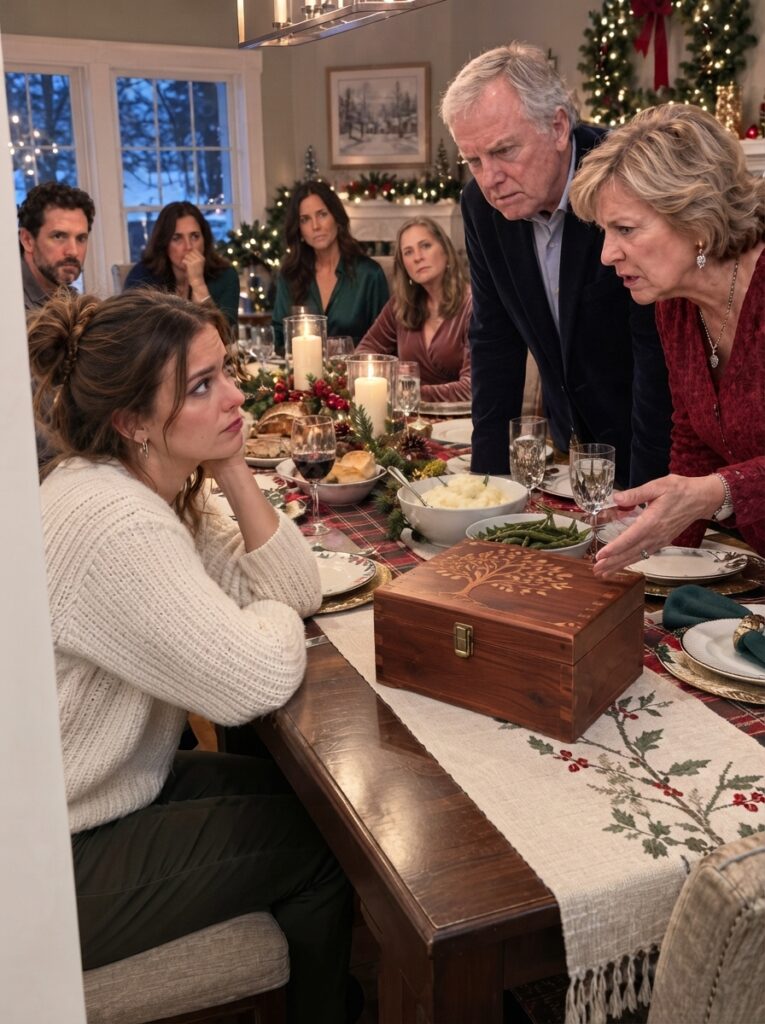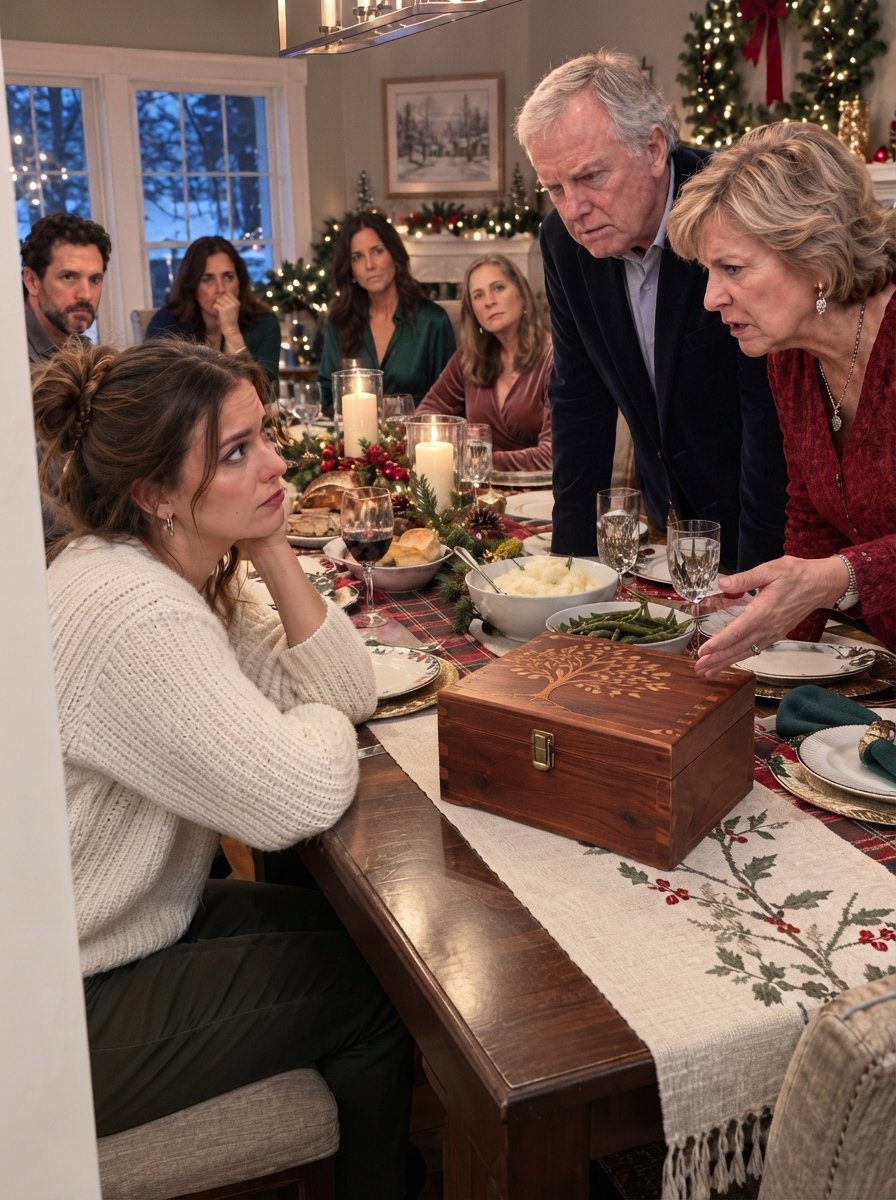
My father made it worse. He picked up the box, pushed it toward me across the cloth, and said, “We do not need your cheap gift. Take it and get out.”
Twenty-three relatives heard him. I did not cry. I did not argue. I laughed. Then I opened the box and told them what was inside.
The whole thing started with a seating chart. That is how family wars usually start if people are honest. Not with one big sentence. With a chair, a plate, a place card, a tiny public reminder of where everybody thinks you belong.
I arrived at my parents’ house at three in the afternoon, two hours before everybody else, because my mother had asked me to help set the table. That had always been my job. Not my older brother Bryce’s. Not his wife Seline’s. Mine.
I parked my old F-150 at the curb. It was eight years old, had a little over 200,000 miles on it, and carried a permanent dusting of concrete and sawdust no vacuum could fully defeat. Bryce’s leased Audi sat in the driveway, washed so clean it looked embarrassed to be near my truck.
My mother opened the front door before I reached the porch. Lorraine Collins was already dressed for dinner, hair pinned, lipstick perfect, gold hoops catching the porch light. She looked at my boots first, then my flannel shirt, then the cedar box in my hands.
“When are you going to stand on your own two feet?” she said. Not hello. Not Merry Christmas. That.
“Good to see you too, Mom.”
She gave the little sigh I had known my whole life, the one that meant she was disappointed but prepared to be noble about it. “Just put that on the sideboard,” she said, waving toward the dining room. “We’ll get to presents later.”
The box was cedar, cut from a board I bought at a lumberyard outside Grove City. My grandfather had taken me to that same yard when I was little, back when he still smelled like iron dust and peppermint. The corners were dovetailed because he taught me that shortcuts show up eventually. The hinges were brass. The lid fit tight. Inside was the reason I had driven four hours on Christmas Eve. My mother did not know that yet.
I carried it through the living room, past the couch nobody sat on because she still cared more about keeping cushions perfect than letting people be comfortable. Then I placed it on the sideboard beside the family photos. Every photo was Bryce. Bryce in his cap and gown. Bryce and Seline at their wedding. Bryce shaking hands with some regional sales director at a conference. Bryce beside the Audi, smiling like he had built the thing. There was one photo of me from middle school, half hidden behind a ceramic angel with a chipped wing.
“I build things for a living, Mom,” I said under my breath. “The boots are intentional.” No one heard me. That was normal.
By five, the house was full. Aunt Camille arrived first. Loud perfume, louder voice, carrying a casserole she described three times before it reached the oven. Uncle Darius came behind her with his wife, who always looked like she was apologizing for taking up air. Then cousins, neighbors who had become family by habit, and my younger cousin Nia. She was twenty-four and the only person in that whole bloodline who texted me back without needing something.
My mother had the dining room set with the good china. Twelve seats at the main table. Cloth napkins. Candles. A centerpiece she had probably spent two days pretending was effortless. At the far end of the room beside the kids’ corner was a metal folding chair with a paper plate.
I did not need to ask. My mother pointed anyway. “Tamara, you’re over there.”
I looked at the folding chair, then at the main table. Bryce and Seline had place cards near my parents. “I’m 33.”
“Freeloaders eat where there is space.” She said it with a short, dry laugh aimed at Aunt Camille. Aunt Camille laughed back because some people treat cruelty like a social cue. Twelve people heard that one. No one corrected her. Uncle Darius studied his wine glass. His wife looked at the floor. One cousin cleared his throat and said something about the cold.
I reached into my coat pocket and ran my thumb along the brass edge of my grandfather’s pocket level. Four inches. Heavy for its size. Worn smooth from forty years in his tool belt. He had given it to me when I was seventeen, the day I told him I wanted to build bridges. “Then build them level,” he said. “And don’t let anybody talk you out of knowing what level is.” That level was warm from my hand now.
Nia appeared beside me with her plate. She dragged a real chair from the hallway and set it beside the folding one. “Guess we’re both demoted,” she said, and sat down.
I almost smiled. “You don’t have to do that.”
“I know.”
Before I could answer, my father tapped his glass. Franklin Collins stood at the head of the table with his chest out and his chin lifted. My father had been in construction sales most of his life, and he could make a rumor sound like a signed contract if the lighting was good.
“Before we eat, I have some news,” he said. The room quieted. “Some of you know I have been talking with a major developer about a package on the Camden River project.” My fork stopped halfway to the plate. “Well, it is looking strong. Real strong.” “Biggest public project this county has seen in more than a decade.” “And Collins Contracting is right in the mix.”
He did not say which package. He did not say whether he had cleared prequalification. He did not say what “in the mix” meant. But I knew the project. Everybody knew the Camden River Bridge and Civic Plaza. Local news had been running segments for months. A new pedestrian bridge, observation deck, and civic plaza connecting downtown to the east bank. Turning an old industrial waterfront into something people could actually use. Cranes. Concrete pours. County press conferences. Architectural renderings on every city website.
My father wanted a subcontractor slot on the finishing work. He had been chasing it since summer. What he did not know was who the structural engineer of record was. Whose firm had won the bid two years earlier against eleven competitors. Whose signature sat on four hundred twelve sheets of structural drawings.
The table clapped. My mother beamed. Bryce raised his glass. “Now that is real work,” my mother said. She looked at me when she said it.
I picked up my fork. “That’s a major project, Dad. I hope the right people are reviewing it.”
He frowned, not sure whether I had complimented him or stepped somewhere he did not understand. “I know how business works,” he said.
“I know.”
Aunt Camille asked about dessert. The moment passed. I ate turkey from the folding chair and watched candlelight flicker over a table I was not allowed to sit at. The cedar box rested on the sideboard untouched. Patient as stone.
In the kitchen, while I refilled my water glass, Aunt Camille cornered me. “Tammy,” she said, because she had never bothered to notice I stopped going by that when I was eighteen. “Still doing the computer thing?”
“Structural engineering.”
“Right. Right. From home sometimes.”
“I also have an office and job sites.”
“Mmm.” That was the sound people make when they are not listening but want credit for politeness.
Seline drifted in behind her for wine. She wore winter white and a bracelet that flashed every time she lifted her hand. “Working from home must save on gas,” Seline said. They laughed together.
I had stopped correcting people three years earlier. The first time I told my mother my firm had won a bridge project, she changed the subject to Bryce’s new car. The second time I showed my father a photo of a medical center in Worthington that my team had completed, he glanced at it and said, “Nice. Pass the salt.” The third time, I tried explaining what structural engineers actually do. My mother cut me off with, “If it’s so important, why are you still renting?” After that, I stopped. Not because I was hiding. Because repeating yourself to people who already filed you under failure is a kind of exhaustion I got tired of buying with my own breath.
My mother appeared in the kitchen doorway. “Tamara, Camille asked you a question.”
“She asked if I work from home.”
“And you can’t even give a straight answer,” my mother said, shaking her head at her sister. “That should tell you something.”
It told them exactly what they wanted to hear. That was the point.
After dinner, while the kids played in the den and the adults settled into the living room with coffee, my mother brought up my divorce. She never said Desmond’s name anymore. She called him “the one who left,” like he was a storm system.
“I saw his mother at the grocery store last week,” she announced. She did not look at me, and somehow made sure everyone knew she meant me. “She says he’s doing well out west. New job, new girlfriend, stable now.” That last word wore lipstick and carried a knife.
The truth about my divorce was almost too ordinary for my mother to respect. Desmond got a job offer in Portland. I had a firm in Ohio. We loved each other enough to admit our lives were splitting. No affair. No screaming. No courtroom war. We signed papers on a Tuesday, and he helped me move a bookcase the following Saturday. But my mother had turned it into evidence. Evidence that I could not hold a life together. Evidence that my work made me cold. Evidence that a good man could not stay with a woman who insisted on being difficult.
“At some point,” she said, stirring her coffee, “you have to ask yourself what the common denominator is.”
The room went still. Secondhand embarrassment has a sound. It is the little cough people make when they wish a wall would open.
Then Bryce said, “Mom, come on. It’s Christmas.” It was the first time all night anyone pushed back. He did not look at me when he said it. But he said it. I filed that away.
I stood at the kitchen sink later, washing a serving dish that was already clean because I needed two minutes alone. Here is the thing about being the family freeloader. It does not matter how much you have built if the people who named you never look up long enough to see it. You become the story they tell. And if they tell it long enough, you can start to feel it pressing on your shoulders even when you know it is false.
I had driven four hours with a cedar box because three weeks earlier I made a decision. I would give my parents one more chance to see me. Not a speech. Not a performance. Just the truth in a box. If they opened it, if they received it, if they let it be what it was, I would know they could still surprise me. If they set it aside, mocked it, or told me to leave, I would know something else. I would know I had been asking the wrong people for permission my entire adult life.
I looked through the doorway. The box still sat on the sideboard. No one had touched it. No one had asked about it. It was invisible in the same way I was.
Nia found me near the hallway. “You okay?”
“I’m fine.”
“You have been staring at that box all night.”
“Just thinking.”
“About what?”
I looked at her. Nia had inherited our grandfather’s stubbornness without the dangerous pride that ruined the rest of us. She was young, but she paid attention. That alone made her older than half the adults in the house.
“About what happens when you stop explaining,” I said, “and just let people choose what to see.”
Bryce held court for the next half hour. He always did. My brother had the gift of sounding important even when he was saying nothing, which my mother treated like a career skill. He talked about fourth-quarter client dinners, the Audi lease he might buy out, and how he and Seline were looking at a boat for summer. “Nothing wild,” he said. “Maybe twenty-six feet.” My mother glowed. “That’s my boy.”
Seline leaned forward with her own announcement. “And we are working on getting everyone into the Camden River dedication gala on New Year’s Eve.” “Black tie, mayor, county people, the whole thing.” “I have a connection.”
Aunt Camille gasped. My father practically vibrated. “Yeah, that gala is invite-only,” he said. “You really have a way in?”
“Working on it,” Seline said, smiling like she had already delivered.
I watched Bryce while everyone watched Seline. His hand shook on his whiskey glass. Not much. Just enough. He switched the glass to his other hand and tucked the first into his pocket. When Seline mentioned the boat, something tightened around his eyes. I knew that look. It was the look of a person whose math did not add up and who could not figure out how to tell the table.
I had seen little signs before. But families are skilled at turning warning signs into manners. Bryce had stopped picking up checks at restaurants, but he still ordered first. He had started arriving late to birthdays, always blaming clients or traffic. But he never stayed long enough for anyone to ask why his phone kept lighting up face-down on the table. Once, at our cousin’s baby shower, I watched him excuse himself three times to take calls in the hallway. When he came back the third time, Seline smiled harder than the occasion required and told my mother they were “just busy being blessed.” That was the family language for debt. Blessed meant stretched. Busy meant scared. Fourth quarter meant do not ask.
I had not pulled on that thread because Bryce’s finances were not my business unless he made them mine. And because I knew what it felt like to have people mistake your private struggle for public entertainment. But sitting there that Christmas, watching his hand shake while our mother held him up like proof that parenting had worked, I understood something sadder than envy. Bryce was not enjoying the pedestal anymore. He was trapped on it. Nobody else saw it. My mother was too busy admiring him. My father was already imagining himself walking into that gala. Aunt Camille was asking what shoes went with black tie.
“Presents next,” my mother said. “Let’s open Bryce’s first.”
The cedar box sat on the sideboard. It had been there five hours. I wondered if it would make six.
Bryce’s gift was a top-of-the-line massage gun. My mother held it up like it was a trophy. My father read the box twice and said, “Now this is useful.” Everyone applauded like Bryce had repaired their spines by proxy.
Then Nia said, “What about Tamara’s?” The room paused. That little pause people make when they remember furniture has a name.
“Oh,” my mother said. She looked at the sideboard. “Right. The little box.” She did not get up. “Tamara, hand it here.”
I walked over and picked it up. I had spent nine hours building it. I had chosen the board, cut the joinery, fitted the hinges, sanded until my fingertips hurt. I set it on the table in front of her. My mother lifted it with both hands, surprised by how little it weighed.
“Light,” she said. She shook it gently. Something shifted inside. Paper. Card stock. A soft sound. “Handmade,” she said. The way someone might say expired. She set it down without opening it. “We’ll get to it later.”
“It’s a gift, Mom. You can open it.”
“Homemade is sweet, honey. It is not a real present.” She pushed it toward the pile of torn wrapping paper. Then she turned to Seline. “Tell me more about this gala.”
The box sat in ribbon scraps and tissue paper. Nobody opened it. Nobody asked what was inside. Nia squeezed my arm hard enough to leave fingerprints.
After presents came the questions. They always came. The part of the evening where my family circled the soft places in my life and pressed until something looked like proof.
“Do you own your place yet?” Aunt Camille asked.
“I rent.”
“Still?” Uncle Darius said.
“It’s a good rental.”
My mother called from across the room. “Do you at least have insurance?”
“Yes.”
“Through who? You don’t have an employer.”
“Through my company.”
“Your company,” she repeated, like I had said my imaginary horse.
Seline leaned against the doorway with her wine. “What is it you actually do again?”
“I design structures.” “Buildings, bridges, civic projects.” “On a computer.”
“On a computer. Also on site.”
“Sounds lonely.”
It was not lonely. It was precise and physical and sometimes beautiful. It was standing on a bridge deck at sunrise while concrete cured and feeling the whole weight of math become something people could walk across. It was wind load and rebar schedules and soil reports and the smell of rain on fresh forms. But I was not going to describe that to a woman who had just called a leased Audi an investment.
Every answer I gave was calm, factual, short. Every answer they heard was evasive. The gap between those two things was my whole family.
My father came from the hallway with bourbon in his hand. “The thing is, Tamara,” he said, “if your work was real, people would know about it.” “Bryce has clients taking him to dinner.” “His name is on things.”
“My name is on things too.”
“On what? Your laptop?”
My mother laughed. My father smiled. Pleased with himself. I let it pass. I was watching them build their case, and I wanted them to finish before I showed them mine.
The television was on in the living room. It was always on at my parents’ house, like a relative nobody liked but everyone kept inviting. During a lull, the local news anchor’s voice cut through. “The Camden River Bridge and Civic Plaza is set to open with a dedication gala on New Year’s Eve.” “The project, the largest public infrastructure investment in the county in more than a decade, has drawn attention for its innovative design and riverfront access.”
The screen showed an aerial rendering. My bridge. The sweeping pedestrian span. The observation platform. The plaza where rusted warehouse fencing used to block the river. The cranes. The concrete pylons. The civic logo with project partners listed along the bottom.
My father pointed. “That right there. That’s the project I have been telling you about.”
“The Camden River thing?” Uncle Darius asked.
“Valor Development is leading it,” my father said. “I’ve been talking to their people since September.” “Finishing package.” “Good money.” “Good exposure.” “It could put Collins Contracting back on the map.”
Back on the map. He said it with the confidence of a man who did not know he was standing in someone else’s drawings.
“Big leagues,” he added, glancing at me. “Nothing a little laptop job would touch.”
The bridge filled the screen. My bridge. Fourteen months of design. Two years of construction support. Three sleepless weeks on a foundation problem after the river survey changed. Four hundred twelve sheets with my professional seal.
I picked up my water glass. “Looks impressive,” I said. I left the sentence hanging there like a fuse.
Ten minutes later, Nia pulled me toward the coat closet. “I need to ask you something.”
“What?”
She held up her phone. On the screen was the Great Lakes Builder annual engineers feature. The cover showed a woman standing on a bridge deck in a hard hat and high-visibility vest with the Camden River behind her. Me.
“That’s you,” Nia whispered.
I reached over and turned her phone face-down against her palm. “Not tonight.”
“Tamara, you are on the cover of a magazine.”
“I know.”
“You’re the engineer on Uncle Franklin’s project.”
“Yes.”
“He doesn’t know.”
“Nobody here knows.”
“But why?”
“Because I want them to find out a specific way.”
Nia searched my face. She was smart enough not to push after that. “Okay,” she said. “Your call.”
“Thank you.”
She started back toward the living room, then stopped. “Can I at least be ready?”
“Ready for what?”
She held up her phone and tapped the camera icon. “In case somebody says something that deserves to be remembered.”
I looked at her for a long second. Nia had spent holidays beside me near kids’ tables and hallway chairs. She knew the shape of the family theater. She also knew what I was capable of because she had bothered to ask.
“Be ready,” I said. She grinned and slipped back into the noise.
I was returning to the dining room when I heard Seline’s voice through the back door. Sharp. Low. Hissing. “Tell them next week.” “Tell them anything.” “Just buy us time.”
Bryce’s answer was muffled, but the tone was pleading. Through the glass pane, I saw them on the porch. Seline had her coat pulled tight. Bryce paced three short steps one way, then back. At one point, he stopped and pressed both palms against his forehead. That posture has a language. It says the numbers do not reconcile.
Seline jabbed a finger toward him. “Fix it, Bryce.”
“I am not telling your mother.”
They came inside separately. Bryce went to the bathroom. Seline poured another glass of wine and smiled so hard it looked painted on.
My mother noticed. “Everything all right?”
“Perfect,” Seline said. “Work stuff. You know how fourth quarter is.”
“I sure do. Bryce works so hard.” My mother said it like a closing argument. I said nothing. The cracks in the family’s favorite story were already showing. I was not holding the chisel.
Later, I would think about those two on the porch, standing on the edge of their own cliff and calling it a view. They were not so different from my parents. Everybody in that house was protecting some version of a story because the truth would cost too much. The difference was that I had stopped pretending three years ago and started pouring concrete.
My mother sent me to the garage for extra folding chairs. The garage was cold and smelled like motor oil, damp cardboard, and the ghost of my grandfather’s workshop. The back half used to be his. Workbench. Pegboard. Coffee can full of bent nails. A little radio that only played old soul and baseball. After he died, my father cleared most of it out. He said he needed storage.
In the corner, behind old tires, sat a metal toolbox with W. Collins stenciled on the lid in faded white paint. Across the top was masking tape in my mother’s handwriting. Throw out.
I knelt and opened the clasps. Inside were pieces of a forty-year career. Chalk line. Cold chisels. Layout markers. Spud wrenches worn smooth at the grips. Tools I had watched Grandpa Walter use when I was small enough to believe all strong things came from hands like his.
There were other things too. A cracked thermos cup with his union local sticker still peeling on one side. A pencil sharpened with a knife, not a sharpener, because he said machines were useful but hands should remember how to solve small problems. A stack of old pay stubs wrapped in a rubber band. Each one folded the same way. Each one proof of a man who had been tired for decades and still came home with peppermint in his pocket.
My father had called it junk. That was what made my throat tighten. Not just that the tools were being thrown out. That the record of a whole working life had been labeled trash because it did not look polished enough for the version of success my parents wanted to display. Grandpa Walter had built things you could stand on. My father sold himself as a man near things being built. The difference had always made him restless.
Under the top tray, taped to the inside of the lid, was a folded piece of yellowed paper. I pulled it free and opened it carefully. His handwriting. Block letters. Steady.
Tamara, girl. Build it level. Build it true. And never beg the people who could not see you.
I read it twice. Then a third time. I could hear his voice in the letters. He had written it before cancer took his appetite, then his hands, then the rest of him. He left it in the one place he knew I would eventually look because he knew me better than anybody upstairs ever had.
I folded the note and put it in my coat pocket beside the brass level. Then I grabbed the folding chairs and started back.
Halfway up the steps, I heard my mother talking in the kitchen. “I worry about her, Camille. I do.” “She is 33, renting, divorced, driving that truck, and she cannot even tell us what she does all day.”
A cabinet opened. Glasses clinked.
“She’ll figure it out,” Aunt Camille said.
“No, she won’t. That is what scares me.” “I grew up with nothing.” “You remember rice for dinner three nights in a row, lights cut off, people pretending not to notice.” “I married Franklin at twenty-two because I was tired of being looked at like a poor girl.” “I know what backwards looks like.”
There was a pause. “So you push her?” Aunt Camille said.
“Of course I push her.” “Love is not soft.” “Soft is how you stay poor.”
And there it was. Not cruelty for sport. Fear. The kind born in empty kitchens and carried into full ones. My mother was not trying to destroy me. She was trying to prevent what she imagined I was becoming. A version of the girl she had been. Broke. Powerless. Invisible. She was wrong about all of it. Standing on those stairs with cheap folding chairs in my hands, I understood her more clearly than I had in years. Understanding did not make the hurt smaller. It made it more specific.
Then she said: “She needs a shock tonight.” “In front of everybody.” “Maybe if she is embarrassed enough, she will finally do something.”
I set the chairs down silently on the top step and waited for my heartbeat to settle. My mother had planned my humiliation as a kindness. That is a particular kind of cold. If you have ever overheard someone you love decide breaking you was for your own good, you know exactly what I mean. A room can feel warm and still teach you to stop reaching for the fire.
I carried the chairs into the dining room like I had not heard a word. I sat back down. And I made a decision. I was not going to expose Bryce’s debt. I was not going to embarrass Seline. I was not going to throw my mother’s fear back in her face or make my father small for needing the Camden River job. I was going to tell the truth about myself once. Calmly. Then leave. If that truth changed the room, if it made the folding chair look different, if it cracked the story they had been telling for a decade, that was not revenge. That was simply what happens when someone stops hiding.
The cedar box still sat in the wrapping-paper pile. It was the most patient thing in the room.
“Nia,” I said quietly. She looked up. “When the time comes, do not stop me.”
“Wouldn’t dream of it.”
“Whatever you’re recording, that’s yours.”
“I won’t ask for it.”
She nodded. Serious now. “Got it.”
I touched the brass level in one pocket and the note in the other. Build it level. Build it true. Okay, Grandpa. Here we go.
Dessert was my mother’s kingdom. Three pies. Pecan. Pumpkin. Cherry. Served with the precision of a general moving troops.
“Bryce, Seline, stay at the main table,” she said. “Everybody else, find your spots.”
The folding chair again. Same corner. Same paper plate. I picked up my fork. Then set it down.
“I’ll sit at the table.”
The room went still. My mother blinked. “There is no room.”
“There are two empty chairs.” I pointed to the far end of the main table. “Those are for display. The table looks better full.” “They are empty chairs, Mom.”
I pulled one out and sat. I did not ask. I did not argue. I moved.
My mother’s face tightened. She looked at my father. He was chewing pie and pretending not to notice the fault line opening under his dining room.
“Tamara.”
“I’m sitting here.”
Aunt Camille found her pecan pie fascinating. Uncle Darius’s wife reached for the cream. The children in the den kept playing because children are lucky enough to miss some disasters.
“Fine,” my mother said, too bright. “Sit wherever you like.” Then she angled her own chair slightly away from me. Another seating chart.
I ate pie at the main table for the first time in six Christmases. The china was heavier than I expected. The napkin was cloth. Small luxuries three feet away for years, offered to everyone except me.
Nia slid into the folding chair I had left behind and propped her phone against her water glass. By eight, she had tried twice to steer the conversation toward the Camden River project.
“Uncle Franklin, did you see they finished the main span last month?” “The engineering is wild.”
“Of course I saw it,” my father said. “I have been following that project closer than anyone.” “That’s my deal.”
“Did you look up the lead engineer?”
I kicked Nia under the table. She winced.
“Some firm out of Columbus,” my father said. “Cornerstone something.” “Does it matter?” “The money is in contracting.”
“Cornerstone Structural Group,” Nia said, staring at me.
“Nia.” My voice was quiet. Final. She closed her mouth. But her hand moved to her phone. I saw the Great Lakes Builder article glow under the table. I shook my head. She put it down.
“Let them see it the right way,” I whispered.
“What’s the right way?” she whispered back.
“When they choose to look.”
“Tamara, they’re never going to choose.”
She was not wrong. But I had carried that box four hours. I had sat in the folding chair. I had listened to my mother rehearse a public shaming and still given the room space to choose decency. If this ended, it would end on my terms.
My father leaned back. “All right,” he said. “Let’s finish presents.” “That wooden box too.” “I guess we might as well get it over with.”
My mother reached for the cedar box. She held it like someone had handed her a strange bag on a bus. Two fingers slightly away from her body. Already deciding it was not worth keeping.
She turned it over. Shook it. Still light. “Open it,” I said.
She wrinkled her nose. “I know what homemade gifts look like, Tamara.” “It is probably a candle or a photo collage.” “It is not a candle.” “It does not matter what it is.”
She paused and looked around the table. My mother always gathered an audience before delivering a verdict. “The point is, you show up every year with nothing to show for yourself.” “No house.” “No husband.” “No career anyone can see.” “Then you hand us a little wooden box like that is supposed to mean something.”
She pushed the box toward the center next to torn wrapping paper and ribbon scraps. The cedar caught the candlelight. The grain glowed. The brass hinges shone softly. Every hour I had spent on it sat visible under her hand. And she still refused to see it.
“Mom,” I said. “Open the box.”
“I do not need to open the box.”
Twenty-three people watched. No one spoke. Only the television murmured from the living room. Nia’s chair creaked faintly as she adjusted her phone.
My mother gestured at me. “Thirty-three years old.” “Renting.” “Divorced.” “Can’t explain her job.” “Drives a truck that looks like it belongs at a work site.”
“It does belong at work sites,” I said.
She ignored that. “And she brings us this arts-and-crafts project and expects applause.” “When is she going to stop living off other people?” “When is she going to stand on her own two feet?” Then louder, so the back of the room could hear: “A freeloader who cannot even live on her own.”
The word landed. Freeloader. Not the first time she had said it. The first time she had planted it publicly in the middle of Christmas dinner like a flag.
No one moved. Aunt Camille looked at the ceiling. Uncle Darius’s wife pressed her lips together. Even Bryce stared down at his plate. Under the table, Nia found my hand and squeezed once.
I let the silence sit. My grandfather used to say silence was structural. It holds weight if you let it. Most people rush to fill it. I did not. Five seconds. Ten.
My mother crossed her arms, satisfied. She thought the quiet was agreement. She did not know it was a foundation. And she was standing on the wrong side.
My father set his bourbon down. He had been quiet through my mother’s speech because Franklin Collins never liked anyone else having the last word. He picked up the cedar box with one hand and pushed it across the table toward me. It slid over the cloth and stopped against my water glass.
“We do not need your cheap gift,” he said. “Take it and get out.”
Eleven words. Flat. No heat. No shouting. Just a man returning a defective product.
Bryce opened his mouth. I saw it for half a second. He looked like he might say something. Object. Deflect. Do what he had done earlier when my mother mentioned Desmond. Then Seline touched his arm. He closed his mouth.
The room held its breath. I looked at the box in front of me. Built in my grandfather’s workshop with tools my parents had taped for disposal. The box that held two things they wanted more than anything in the world. If only they had bothered to open it.
I picked it up. And I laughed. Not bitter. Not cruel. A real laugh, deep from the chest. Because something had become completely clear in the most absurd way possible. Everyone stared. My mother’s arms tightened. My father’s face reddened. Bryce’s hand froze near his glass.
I stood with the box in both hands. When I spoke, my voice was the same voice I used on job sites when a problem appeared and twenty people waited for direction. “Before I go,” I said, “I have one question.” I set the box back on the table.
“Dad, that deal you have been chasing with Valor Development on the Camden River project.” “Did anyone ever tell you who the structural engineer of record is?”
His face went blank. “What?”
“The engineer.” “The person whose firm designed the bridge.” “The one whose office reviews technical submittals and whose seal is on the drawings.” “Did you ask?”
“I do not deal with engineering.”
“Maybe you should have.”
I reached into my pocket and pulled out my grandfather’s brass level. Four inches of solid brass worn smooth by forty years of ironwork. I set it beside the cedar box.
“Grandpa Walter gave me this when I was seventeen,” I said. “He told me to build things.” “So I did.”
Then I opened the box. The room went quiet in a new way. Not embarrassed. Awake.
“You keep saying my job is not real,” I said. “Let’s test that.”
I lifted the first item from the box. A glossy magazine folded open to the cover. My face in a hard hat, standing on the Camden River Bridge deck. Wind lifting the edge of my safety vest. The headline sat beneath me in clean type. I held it up. My father’s glass tipped over. Nobody moved to clean it.
“Great Lakes Builder,” I read aloud. “Principal and founder Tamara Collins of Cornerstone Structural Group, lead structural engineer for Camden River Bridge and Civic Plaza.”
I let the words land. Then I reached into the box and pulled out two heavy envelopes embossed with the Valor Development logo and the county seal. “These are invitations to the dedication gala on New Year’s Eve.” “Two front-row seats.” “Not public.” “Not contractor access.” “Issued through the engineer of record to the people she wants in the room.”
I held them up. “I drove four hours to give these to you.”
My mother stared. The color left her face slowly. My father looked from the magazine to the envelopes to the television in the other room, where the bridge rendering had been looping in a news segment. The math arrived on his face. The project he had been chasing for months. The deal he had bragged about at dinner. The room he wanted into. All of it ran through the work of the daughter he had just told to get out.
Seline reached toward the envelopes. “The gala,” she whispered. “Those are gala tickets.”
I pulled them back. I took out the card I had written by hand and read it aloud. I built the bridge everyone is talking about. I wanted you in the front row.
My mother found her voice first. “That was her gift?” Recovering just enough to move blame. “Why didn’t you tell us?” Her voice cracked. For one second, it almost sounded like hurt. “All this time, Tamara, why would you hide something like this from your family?”
“I did not hide it.” “I told you.”
“No, you didn’t.”
“Three times in four years.” “You changed the subject every time.”
“I would have remembered.”
“You told me to pass the salt.”
“Well, you should have been clearer.”
There it was. A fence. Her final safe place.
“After everything we have done for you,” she said, voice rising, “you let us sit here and look like fools.”
“Dad embarrassed himself,” I said. “I just watched.”
My father’s fist hit the table. Glasses rattled. “Enough,” he said. “You should have told me about Valor.” “I have been working that package for months.” “You could have helped.”
“I should have what?” “Called your bluff?”
“You know what I mean.”
“You told me to take my cheap gift and get out.”
I closed the box. “So I am taking it and getting out.”
“Tamara, you cannot just do this to us,” my mother said.
“I am not doing anything to you.” “I am done hiding so you can stay comfortable.”
Twenty-three sets of eyes watched us. Aunt Camille’s mouth was open. Uncle Darius’s wife had tears on her face. The kids had drifted back into the doorway because children can smell electricity. My father gripped the table edge. My mother shook. And I was calm.
“These tickets were a gift,” I said. “They were my way of saying: Come see what I built.” “Sit in the front row.” “Be proud if you can.” I placed the envelopes back inside and shut the lid. “But you have spent all night telling me who I am.” “A freeloader.” “Someone who cannot stand on her own.” “Someone whose handmade gift is not real because it did not look expensive enough.” “So I will honor that.”
“Wait,” my mother said.
“The seats will go to people who believed in me before there was a bridge to look at.” “Grandpa Walter’s union brothers.” “The men who brought casseroles when Dad was between jobs and never called anybody a freeloader for needing help.”
My grandfather’s name changed the temperature in the room. My father flinched. He had spent the years since Grandpa Walter died slowly erasing the old man’s place in the house. Workshop cleared. Tools boxed up. Stories thinned until they disappeared.
“I’m done auditioning for a family that already cast me,” I said. “I do not need you to understand my work.” “I do not need you to be impressed.” “I just needed to see if you could open a box from your daughter without turning it into a trial.” I lifted the box. “Now I know.”
I turned to Bryce. He stared at his hands. I did not mention the debt. I did not mention Seline’s gala promise. I did not need to.
“Merry Christmas,” I said.
I picked up my coat, put the brass level back in my pocket, and held the cedar box against my chest. Then I walked to the door without rushing.
The folding chair was still by the wall. Empty metal frame. Vinyl seat. Paper plate balanced on the edge of a side table. Six Christmases in that chair. Six years of paper plates while everyone else ate from china. I left it where it was. They could stare at it all night.
Nia was already by the door with her coat on and phone in her hand. She did not say anything. She opened the door and walked out with me.
The cold hit my face like a reset button. December in Ohio. Twenty-two degrees. Wind off the river. The kind of cold that clears your head whether you want it cleared or not.
Halfway to my truck, the front door opened behind us. “Tamara.” My father’s voice sounded smaller than I had ever heard it. “Wait. Let’s talk about this.”
I did not turn around. I opened the truck door and set the cedar box on the passenger seat where it had ridden that morning.
“Please,” he said.
I climbed in and started the engine. Nia sat in her own car at the curb, watching through the windshield with a face that was half pride and half grief. I pulled away. In the rearview mirror, my father stood on the porch in his dress shirt with no coat, arms hanging at his sides. He was still there when I turned the corner.
Forty-eight hours later, my phone started ringing and did not stop for a week.
Nia sent the video the next morning. Not to social media. She was young, not reckless. She sent it to the family group chat. Forty-one members. No caption. Just the trimmed clip. My mother calling me a freeloader. My father pushing the box. Me standing up and opening it. The magazine cover. The invitations. The silence. Me walking out.
A few minutes of footage rewrote the family story in real time.
Aunt Camille called at seven in the morning. “Tamara, baby, I had no idea.” “Your grandfather would be so proud.”
Then Uncle Darius. “We drove by that bridge last week.” “That’s really you?”
Then cousins I had not spoken to in years. Texts. Voicemails. Messages from people who suddenly knew how to spell my name.
The video moved through the extended family like weather. By afternoon, it had reached my father’s old colleagues, church friends, neighbors. Aunt Camille, true to form, shared it with everybody she had ever met. I do not think she meant to punish my parents. She meant to brag. And the story was too good for her to keep. Quiet niece. Big bridge. Family humiliation. Christmas disaster.
From my parents’ side, the worst part was not the video. It was the question everyone asked after watching it. “You kicked out the woman who built the bridge?” That question repeated forty, fifty, sixty times. And it cracked something.
On December 27th, my father received an email from Valor Development. He had been pursuing a subcontractor position for six months. Calls. Bids. Two mixers. A new sport coat he claimed he bought on sale. The Camden River package was supposed to be his comeback.
The email was brief. Thank you for your interest. After review, we have decided to move in another direction for the finishing package. We wish you well.
He called the project office. A procurement manager explained that his application had been flagged at bonding and insurance screening before it ever reached technical review. His liability coverage was below project minimum. His surety bond had lapsed. His references were stale. The bid never got past the first gate.
I found out from Nia two days later. I had not called Valor. I had not whispered against him. I had recused myself from all subcontractor review months earlier when I saw Collins Contracting on the applicant list. Standard practice. Conflict disclosed. Documented. Clean.
I had done nothing. I did not need to. The truth was sharper than revenge. My father’s bid did not fail because his daughter was the engineer. It failed because the paperwork did not hold. He had been relying on personality to close a deal that required documents. Documents are less sentimental than daughters.
Bryce came to my apartment on December 29th. No Audi. He drove Seline’s Honda. He looked like he had not slept in days. I let him in, made coffee, and said nothing. Silence gets to the truth faster than questions when a person is already tired.
He sat at my kitchen table and stared at his hands. “The boat was a lie,” he said.
I waited.
“Fourth quarter was a lie.” “The Audi is behind.” “Seline and I are over two hundred thousand dollars in debt, and the company might fold.”
He looked up. “I clapped for myself so nobody would check the math.” That sentence hurt more than I expected.
“The gala?” I asked.
“Seline told everybody she could get tickets.” “She couldn’t.” “She was hoping Dad’s Valor thing would give her a way in.”
“Which ran through my project?”
“Yeah.”
“Did you know?”
“Not the details,” he said. “But I knew you weren’t a freeloader, Tamara.” “I’ve always known.” “You stayed quiet.” His eyes reddened. “I was drowning.”
There was pain in watching my brother admit his applause had been armor. He was not evil. Not at the center. He was a man handed a script and praised so hard for performing it that he never learned who he was without the spotlight. But he had sat at that table while our mother called me a freeloader. And our father told me to get out. And when it mattered, he closed his mouth.
“I cannot bail you out,” I said.
“I know.”
“I am not your exit.”
“I know.”
“I am your sister.”
He nodded. He finished his coffee and left without asking for money. Which may have been the most honest thing he had done in years.
My mother called seven times on December 30th. I let six go to voicemail.
The first message was angry. “I hope you’re happy.” “Your father has barely eaten.” “The whole family is talking.” “This is what you wanted.”
The second was bargaining. “We can still fix this.” “Just call Valor and say a word for your father.” “That is all we are asking.”
The third came closer to truth. “I was scared for you, Tamara.” “I know I said it wrong.”
By the fourth, she was crying. “Just one ticket.” “I will sit in the back.” “I will not say a word.”
The fifth was my father. “I made a mistake.” “I see that now.” “But you’re our daughter.” “You cannot just cut us off.” “Talk to me.”
The sixth was my mother again. “We are still your family.” “That has to count for something.”
I listened to all of them at my kitchen table with the cedar box in front of me. The box was empty now. I had taken out the magazine, invitations, and handwritten card. It was just cedar and brass. Lighter than before. And somehow heavier too.
On the seventh call, I picked up. “Mom.”
“Tamara, thank God. Listen to me—”
“No.” “I am going to say this once.”
She went quiet.
“I am not angry.” “I am not trying to punish you.” “The tickets are going to Grandpa Walter’s union brothers, Tom Kesler and Henry Dwit.” “They believed in me when it cost them nothing.” “They never asked for proof.”
Silence.
“Your father needs that Valor connection.” “My work stands on its own.” “So do I.”
“What do you want from us?” she asked. Her voice was thin now. No performance left.
“I want you to see me.” “I have been here the whole time.” “I built a company.” “I designed a bridge.” “I made you a gift with my own hands.” “You set it aside because it did not look expensive enough to count.”
“I didn’t know.”
“You didn’t ask.” “That is not the same as not knowing.”
I heard my father murmuring in the background.
“Mom, I am not closing the door.” “But I am done fitting through the one you have been offering.” “No more folding chairs.” “No more paper plates.” “No more explaining myself to people who already decided I am not enough.”
“Tamara—”
“If you want to be part of my life, it starts with respect.” “Real respect.” “Not the kind you give after a magazine cover.” “The kind you give when your daughter shows up with a wooden box and you say thank you.”
She was quiet a long time. “I don’t know how to do this differently,” she said.
“I know.” “That is what makes it hard.”
I set the phone down gently after we hung up. Not slammed. Clarity does not need noise.
I pulled Grandpa Walter’s note from my pocket and read it again. Build it level. Build it true. And never beg the people who could not see you. I had done all three. The bridge was level. The truth was out. And I was finished begging.
The Camden River Bridge opened on New Year’s Eve under a sky so clear the floodlights seemed to hold up the stars. The mayor spoke. The county commissioner cut the ribbon. Three hundred people walked across the bridge for the first time while a jazz quartet played near the observation platform. The river below was black and silver. The concrete pylons stood in it like calm hands.
I gave a short keynote. Six minutes. I talked about my grandfather, who spent his life building things for people he would never meet. I talked about the responsibility of putting your name on a structure that will outlast you. I talked about craft. Patience. And the quiet mercy of doing work right when nobody is clapping yet. I did not talk about my family.
In the front row sat Tom Kesler and Henry Dwit, Grandpa Walter’s old union brothers. Both in borrowed sport coats. Both trying not to cry and failing at different speeds. Tom started before my second sentence. Henry just nodded the way ironworkers do when something is plumb.
Halfway through the speech, I put my hand in my pocket and touched the brass level. It was warm.
There were two empty seats in the second row. I had reserved them under my parents’ names. Just in case. They did not come. I found out later that my mother drove to the bridge that afternoon and sat in the parking lot for an hour before going home.
I did not look at the empty seats during the speech. I looked at the bridge. My bridge. Build it level. Build it true. I did, Grandpa. I did.
My parents and I talk now. But not often. And not easily. We are learning a new language. The kind that does not include folding chairs or paper plates. My mother has not called me a freeloader since Christmas. My father has not mentioned Valor. I left the door open. But on my terms. Respect first. Proof never.
Bryce filed for bankruptcy in February. He sold the Audi. Seline stayed with him, which surprised me. And maybe that is their own bridge to build. He and I meet for coffee sometimes. We do not talk much about money. We talk about Grandpa. We talk about what it feels like to stop performing just long enough to breathe.
The cedar box sits on a shelf in my office now. Sometimes clients ask about it. I tell them, “My grandfather taught me the value of a clean joint and a level line.” That is enough for strangers.
Inside the box, I keep his note. Tamara, girl. Build it level. Build it true. And never beg the people who could not see you.
I do not carry it because I am angry. I carry it because every structure needs a reference point. You do not owe the people who measured you in dollars the proof that you were always worth more. You do not owe the people who seated you in the corner a lifetime of asking for a chair. And when you finally bring them the truth in a box, their choice to open it or reject it tells you everything you need to know.