I just said, “come back tomorrow.” They did—and found an elderly woman holding my baby, the same woman they believed had been dead for 30 years.
“Be reasonable, Mariana. Your sister can give your daughter the life you’ll never be able to give her.”
My mother uttered those words eleven hours after I gave birth.
I was twenty-nine years old, recovering from an emergency C-section, my body still shaking from the anesthesia, holding a six-and-a-half-pound baby girl sleeping in the clear plastic bassinet beside my hospital bed. Lucia had thick black hair, tiny hands clasped against her chest, and a slightly upturned nose that, at the time, I didn’t know who she had inherited from.
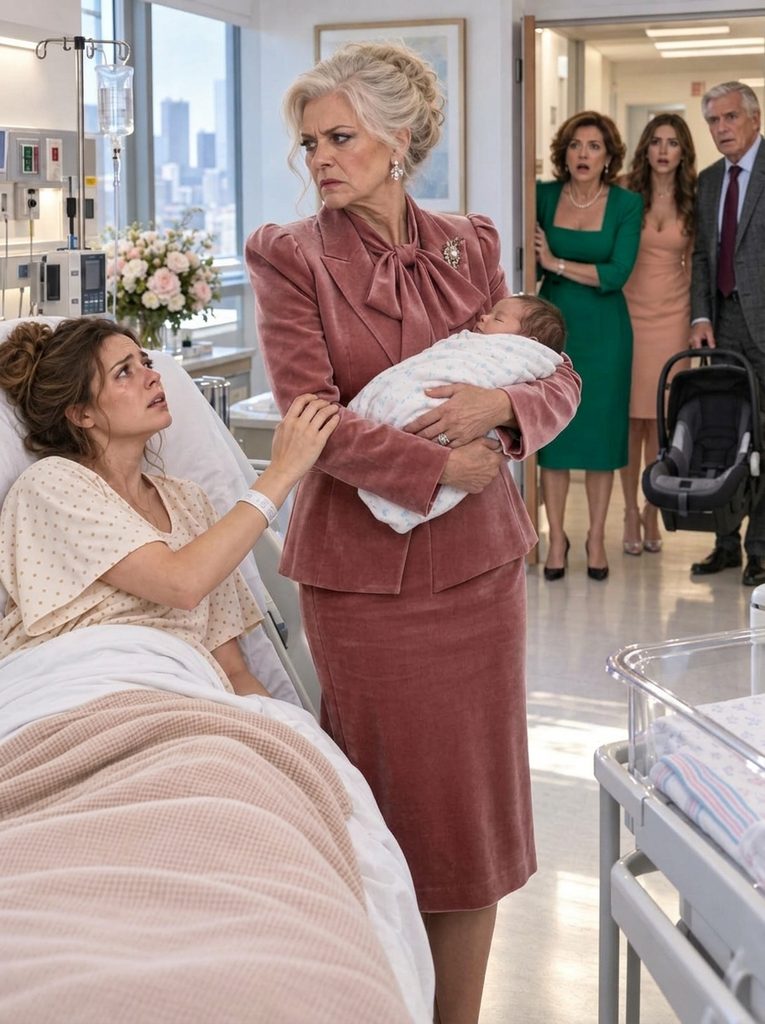
My mother, Teresa, stood in front of me with that exact look she wore whenever she had already made a decision for everyone else.
My father, Roberto, placed a beige manila folder on the bedside table.
“We’ve already talked to the family about it,” he said, aligning the folder perfectly parallel with the edge of the table. “Everyone knows that Daniela and Esteban are going to take the baby. Let’s not make this harder than it needs to be.”
Then my sister Daniela stepped up to the bassinet.
Five years older than me, impeccably styled, carrying a designer handbag that cost more than two months of my rent, she looked at my daughter as if she were already hers.
“You’re not going to lose her,” she assured me with a soft, practiced smile. “You can see her whenever you want. Lucia will grow up knowing you’re her Aunt Mariana.”
Her aunt.
My daughter hadn’t been alive for even half a day, and my own family had already stripped me of the word “Mom.”
Daniela had spent years trying to have children. Fertility treatments, specialists, hormones, two pregnancies that never carried to term. Her pain was real, and I knew it. I had cried with her many times.
But supporting her through her grief was one thing.
Handing over my daughter was something entirely different.
The problem was that in my family, Daniela had always been “the one who deserved more.”
She got ballet lessons, private university tuition, a car at eighteen, and a lavish wedding in a luxury venue. I inherited her hand-me-downs, went to school on financial aid, and learned from a young age that the best way to avoid trouble was to ask for as little as possible.
When I got pregnant, my relationship with Lucia’s father had already ended. He worked long shifts on offshore oil rigs, and we had agreed he would meet his financial responsibilities, but for the first few months, I was going to be doing this largely on my own.
I lived in a small apartment and worked as a middle school librarian.
To me, that meant: I’m going to work hard.
To my mother, it meant: Mariana can’t handle this.
And to Daniela, it meant an opportunity.
“Sign this,” my father said, tapping the folder, “and we can all move forward.”
I looked at my hospital ID wristband, and then at the tiny, identical band around Lucia’s ankle.
The nurse who put them on us hours earlier had joked, “So there’s no doubt about who this baby belongs to.”
A lump caught in my throat.
Then I remembered a promise.
A promise I had made four months earlier to a woman who, according to my family, had been dead for nearly thirty years.
“I need a day,” I said.
My mother frowned. “For what?”
“To think.”
Daniela glanced at my parents, then smiled softly.
They thought I was giving in.
“Of course, sweetheart,” my mother replied, patting my foot through the bedsheet. “We’ll come back tomorrow. Once you’ve rested and calmed down, you’ll realize we’re doing this for Lucia.”
They left, entirely convinced I would sign the papers the next day.
As soon as the door clicked shut, I grabbed my phone with trembling hands.
I pulled up a number no one in my family knew I had.
The woman answered on the third ring.
“Mariana?”
I broke down in tears. “Grandma… they came for my daughter.”
There was a long silence on the other end.
Then I heard a firm, unwavering voice—completely different from the frail elderly woman I had come to know.
“Do not sign a single thing. Listen to me carefully: nothing.”
I told her about the folder, about Daniela, about “everyone already knows,” and about them turning me into an aunt to my own child.
My grandmother was quiet for a moment.
“What time are they coming back tomorrow?”
“At two o’clock.”
“Perfect,” she replied. “Then I’ll get there first.”
My blood ran cold. “But they think you’re dead.”
My grandmother took a deep, steady breath. “After thirty years, I think it’s about time your mother sees just how alive I am.”
And in that moment, I realized that the next day my family wasn’t just going to discover that I wasn’t giving up Lucia.
A ghost was about to walk out of her grave.
And no one could have imagined what was about to come out of that folder.
Six months before Lucia was born, I found the first crack in my family’s story.
I was helping my mother clear out the storage shed at her house when I stumbled upon a damp cardboard box tucked behind old holiday decorations.
Inside were dozens of letters.
All addressed to Teresa.
All signed by a woman named Elena.
And some of them were dated less than five years ago.
That would have been completely normal—except Elena was my maternal grandmother.
The woman who, according to my mother, had passed away before Daniela and I were even born.
I took one letter.
Yes, I knew I shouldn’t have. But I had spent my entire life hearing the exact same line whenever I asked: “My mother died many years ago. I don’t want to talk about it.”
There were no photographs, no grave, no keepsakes, no stories.
Only silence.
The return address belonged to an assisted living facility near Chapala. Working surrounded by books, archives, and research databases, digging up information was second nature to me. Two weeks later, I drove out there.
When I stepped into a bright room filled with African violets, I saw a seventy-nine-year-old woman reading by the window.
She looked up. She froze.
“You’re one of Teresa’s daughters,” she whispered. Then her eyes drifted down to my baby bump, and she began to cry.
Elena had never been dead.
For nearly thirty years, she had sent letters on birthdays, Christmases, anniversaries, and births. My mother had never once replied.
Over the next few months, I visited her in secret. And one day, she finally told me why my mother had erased her.
When my mother was young, her younger sister got pregnant out of wedlock. Teresa decided that her sister lacked the money and stability to raise a child, and she began pressuring her to surrender the baby to wealthier relatives.
Elena intervened. She had worked for over forty years as a legal assistant specializing in family law. She knew the precise legal and ethical difference between helping a vulnerable young mother and taking advantage of one.
“I told Teresa that a baby wasn’t a prize to be handed to whoever had the biggest house,” my grandmother explained to me. “I helped my youngest daughter stop her.”
My mother never forgiven her. She cut off all contact. And as the years went by, she did something even more cruel: she told us her mother had died.
Sitting across from Elena at five months pregnant, I realized something terrifying: my mother had already tried to tear another woman’s baby away from her. And now she was constantly talking about how wonderful it would be if Daniela could “help” me with my baby.
That was why my grandmother made me promise one thing: “If they ever try to put paperwork in front of you, don’t sign anything until you call me.”
Now I knew why.
The morning after the ultimatum in the hospital, Elena arrived around eleven o’clock. She brought a small yellow blanket she had hand-knitted for Lucia. When she saw her great-granddaughter, she cradled her in her arms and kissed her forehead softly.
“Let them come,” she said quietly.
At two o’clock sharp, the door opened.
In walked my mother. Then Daniela.
My father walked in behind them carrying a brand-new infant car seat, the store tags still dangling from the handle. They hadn’t even waited for my answer before buying it.
“Good afternoon, Mariana,” my mother said smoothly. “We brought everything to take home—”
She stopped mid-sentence.
Her eyes landed on the armchair beside my bed.
The color drained entirely from her face. My father stumbled right into her, and the car seat slipped from his hand, clattering onto the floor.
Daniela stared at the old woman, then at my mother. “Who is that?”
My mother gripped my father’s arm tightly. “You told me she was dead!”
My father went pale. “Teresa… you asked me to say that.”
Silence. Thirty years of buried lies shattered in a single sentence.
Elena gently cradled Lucia in her arms. “Hello, daughter,” she said calmly. “I’m sorry to disappoint you, but I’m still very much alive.”
My mother opened her mouth, but no sound came out.
Then my grandmother pointed to the manila folder my father was clutching under his arm. “Now, let’s talk about what really matters. I understand you came to take Mariana’s daughter.”
“That’s not what this is,” Teresa snapped immediately. “We’re helping her.”
Elena gave a joyless smile. “I spent forty years watching families call terrible things ‘help.’”
My father pulled the folder tight against his chest. My grandmother held out her hand. “Let me see those documents, Roberto.”
He hesitated. And that hesitation sparked a fire inside me—because for the first time, I realized that folder contained something far worse than ordinary family pressure.
Elena read the first page. Then the second. Her expression hardened into stone. She slowly raised her eyes to my mother.
“Teresa… where did you get this?”
My sister stopped smiling. My father took a step back. And my mother, for the first time in my memory, looked terrified.
My grandmother held up one of the pages in front of everyone and said, “Mariana, before you hear any explanations, I want you to know something: what they planned to do to you started long before you ever went into labor.”
And what we uncovered over the next few minutes changed forever who could call themselves my family.
My grandmother laid the pages out on my hospital bed.
It wasn’t a legal adoption packet. It couldn’t be.
It was a collection of private legal forms and informal custody waivers designed to trick me into giving Daniela and Esteban legal guardianship, medical authority, and power of attorney over Lucia—setting up a paper trail to make it look as though I had voluntarily relinquished my parental rights.
Some pages were informal letters. Others were template forms printed off the internet.
There was even a drafted statement written in the first person:
“I acknowledge that due to my financial and personal circumstances, I am unable to provide my daughter with adequate care…”
Nausea surged through me. “I never said any of this.”
“Of course you didn’t,” Elena said.
My father refused to look at me. My sister looked completely bewildered.
“Mom told me Mariana agreed to this,” Daniela whispered, her voice cracking.
I turned to her. “What?”
Daniela broke down in tears. “Mom said you two already talked about it! She said you knew how hard it would be to raise a baby alone on your salary, and that you wanted her to grow up with us. She said you were just too embarrassed to say it out loud!”
It felt as though someone had struck me in the chest.
All my anger toward Daniela shifted. It didn’t disappear—she had still walked into that room ready to walk out with my baby, she had bought a car seat, she had agreed to be called “Aunt.” But suddenly I saw the full architecture of my mother’s deception.
My mother had built a customized lie for everyone.
To me, she said everyone else had already decided.
To Daniela, she said I had already agreed.
To my father, she had likely fed another version entirely.
Elena picked up another sheet. “Even if Mariana had wanted an adoption, this is not how the law works. A newborn doesn’t change hands because you printed out forms and signed them in a hospital room. It requires formal state oversight, home evaluations, background checks, and above all, informed, voluntary consent free of coercion.”
She looked directly at my mother. “And there is nothing free or voluntary happening here.”
Teresa tried to regain her old dominance. “We aren’t kidnapping anyone!”
“Then leave the folder and get out,” Elena replied.
My mother clenched her jaw. “I am thinking about my granddaughter!”
“No,” my grandmother said firmly. “You are thinking about Daniela.”
The truth hung heavy in the air.
My mother pointed at me. “Look at her! She lives alone in a tiny apartment! She makes a librarian’s salary! The father is offshore for months at a time! Daniela has a house, a husband, stability, great health insurance, money…”
“And I am her mother,” I interrupted.
Teresa ignored me. “Daniela has been suffering for years! Years! What kind of sister sits by and does nothing when she has the chance to give her sister a family?!”
There it was. The raw, unfiltered truth.
To my mother, Lucia wasn’t a human being. She was a remedy for Daniela’s heartbreak—a gift I was expected to hand over to make up for the unfair hand life had dealt her favorite daughter.
My grandmother stared at her for a long time. “Thirty years,” she said quietly.
Teresa froze. “What?”
“Thirty years, and you haven’t learned a single thing.”
Elena handed the folder back to my father. “You did this exact same thing to your youngest sister.”
Daniela turned to our mother. “What is she talking about?”
Teresa shook her head quickly. “That has nothing to do with this!”
“It has everything to do with this,” Elena countered.
And there, in that hospital room, my grandmother revealed the story my mother had buried for decades.
My aunt Patricia was twenty when she got pregnant. The father walked away before the baby was born. She had no steady income and was living with my grandparents. Teresa, freshly married and convinced she knew best, contacted wealthy relatives who couldn’t have children. She told them about the baby. She told them Patricia “would understand.”
When Patricia refused, Teresa began telling her she was selfish. She convinced the rest of the family that giving up the baby was the only noble choice.
Exactly like she did with me.
“And do you know what the worst part was, Teresa?” Elena asked her daughter. “You told Patricia that ‘everyone already knew’ and that it would be a humiliation to back out now.”
A cold shiver ran down my spine. The exact same words: “Everyone knows.”
Thirty years later, my mother was running the exact same script.
“I stopped you back then,” Elena continued. “I got her legal counsel. I explained her rights. I helped her find a job. Patricia raised her son, and he has a family of his own today.” She looked Teresa in the eye. “And you told me you would never speak to me again.”
“Because you humiliated me in front of everyone!” my mother spat back.
My grandmother looked at her, incredulous. “Is that what you remember? Your humiliation?”
“You made me look like a monster!”
“No, Teresa. I stopped you from acting like one.”
My father closed his eyes in shame. Daniela sank onto the edge of the visitor’s chair. My mother looked ready to explode.
“I just wanted that child to have a better life!” Teresa yelled.
“And thirty years later, you still think ‘better’ just means ‘more money.’” Elena pointed at Lucia. “This baby is not a job opening for Daniela to fill. She is not a family debt. She is not a cure for infertility. She is a person, and she already has a mother.”
Daniela broke down, weeping softly—not the dramatic crying she used at family gatherings, but quiet, broken sobs.
“I bought the crib two months ago,” she confessed, looking at me.
I stared at her. “Two months ago?”
She nodded. “Mom told me you were completely on board. She said you were relieved.”
My heart sank. My mother had been orchestrating this while coming over to my apartment, bringing me soup, touching my belly, and telling me how Lucia was going to be “the light of the family.”
Daniela continued, “We painted the nursery. We bought clothes. Esteban kept asking if I was sure you really wanted this, and I kept telling him yes because Mom said it was all settled.” She covered her face with her hands. “My God, Mariana… I came here thinking you were just scared to say goodbye, not that you were saying no.”
My anger toward Daniela didn’t vanish, but I saw the full scope of the trap. My mother had weaponized Daniela’s deepest grief to turn her into an accomplice.
My father finally spoke up. “Teresa told me Mariana had agreed, too.”
My mother rounded on him. “Don’t you start!”
“You told me these papers were just to formalize what she wanted!”
“Because that’s what she was going to do!”
“No,” I said firmly.
The room fell completely silent.
I sat up as straight as my recovering body would allow. “I was never going to do that.”
I looked at my father. “I never agreed.”
I looked at Daniela. “I never promised you Lucia.”
Finally, I looked at my mother. “And I never gave you permission to offer my daughter to anyone.”
Teresa crossed her arms defensively. “You’re just emotional. You just had major surgery.”
My grandmother let out a dry laugh. “How convenient. When you want her signature, she’s mature enough to give away her child. When she says no, suddenly she’s too emotional to make her own decisions.”
My mother glared at her with pure venom.
Just then, a nurse stepped into the room, having heard the raised voices from the hallway. “Is everything alright in here?”
Before my mother could speak, I said, “No.”
It was the first time in my life I had used that word without softening it.
“I want my mother to leave the room.”
My mother’s eyes widened. “Mariana!”
“I want her out.”
The nurse looked directly at me, ignoring my mother entirely. “Of course, sweetie. Do you want everyone else to leave too?”
I thought for a moment. “My mother and my father need to leave. Daniela can stay for five minutes. My grandmother stays with me.”
My mother took a step toward the bed. “You can’t treat us like this after everything we’ve done for you!”
“It is because of what you just tried to do that I’m asking you to leave.”
“You’re making a huge mistake!”
I looked down at Lucia, fast asleep in Elena’s arms. For the first time in my life, I didn’t feel like the younger sister. I didn’t feel like the low-maintenance daughter. I felt like a mother.
“Maybe,” I replied. “But it will be my mistake. Not yours.”
My mother stormed out in a fury. My father followed closely behind her, carrying the useless manila folder. Before he crossed the threshold, he turned back to me. “I’m sorry, Mariana.”
I didn’t answer. I couldn’t.
Daniela remained seated. The brand-new car seat sat abandoned near the door—a silent monument to how certain they had been.
“Were you going to take her today?” I asked softly.
Daniela lowered her head. “Yes.”
“Eleven hours after she was born, you wanted me to sign. And the next day, you showed up with a car seat.”
“I thought it was what you wanted.”
“But you never asked me.”
Daniela closed her eyes. She had no defense. “You’re right.”
A long, heavy silence stretched between us.
“I hate you a little bit right now,” I admitted.
She nodded through her tears. “I know.”
“And I don’t know when I’m going to stop.”
“I understand.”
“But I’m not going to pretend I don’t know how much you’ve suffered, either.”
Daniela looked up. “My suffering didn’t give me the right to take your child.”
It was the first honest, correct thing she had said since entering the room.
“No, it didn’t.”
“I know that now.” She stood up, walked over to the bassinet, but didn’t touch the baby. She just looked at her. “She’s beautiful.”
“She is.”
“I want to be her aunt.”
A sharp sting hit my throat. “We’ll talk about that someday.”
She didn’t smile. She didn’t ask for forgiveness again. She simply said, “Whenever you’re ready,” and walked out.
Lucia and I left the hospital two days later—not in the car seat Daniela bought, but in one my grandmother and I purchased together. It was simple, gray, and modest, but I still remember watching Elena spend twenty minutes reading the instruction manual to ensure it was installed perfectly.
When the nurse cut off my hospital ID bracelet before discharge, I looked at Lucia’s tiny ankle band. Two matching numbers. Two small strips of plastic that felt like a declaration of independence.
My daughter. My responsibility. My decision.
I framed those two wristbands. I still have them.
The months that followed were hard. My mother stopped speaking to me and began spreading her version of the story—claiming she had only tried to help, and that I had turned cruel because my grandmother had “poisoned my mind.”
Except this time, Elena was alive to set the record straight. And so was my aunt Patricia.
My grandmother called Patricia after we left the hospital. I had never met her because my mother had cut off the entire family connected to that past. Two weeks later, Patricia drove down to see us. When she walked into my apartment and saw Lucia, she wept.
“Your mother almost made me believe that loving my son meant giving him away,” she told me. “Elena was the one who reminded me that needing help doesn’t make you a bad mother.”
The truth spread on its own. I didn’t have to post anything on social media or seek revenge. Uncles asked questions, cousins talked, Daniela revealed what actually happened at the hospital, and my father finally stopped propping up the lie. The perfect facade of Teresa—the woman who always knew what was best for everyone—completely crumbled.
Three months later, my father came to see me alone. He sat at my kitchen table while Lucia napped. He looked like he had aged ten years.
“I was a coward,” he told me.
I said nothing.
“I knew Elena was alive,” he admitted. “Teresa begged me to keep saying she was dead because she didn’t want you girls looking for her. I thought keeping the peace was easier.”
“For thirty years?”
He bowed his head. “Yes.”
“And at the hospital?”
His voice cracked. “I chose the easy way out again.” He explained that my mother had drafted the papers and he had only skimmed them, knowing they weren’t official adoption forms, but went along with it because my mother insisted they would “fix it legally later.”
“I should have stopped her,” he sobbed. “I should have protected you.”
“Yes, you should have.”
He cried. I didn’t.
“I don’t know if you’ll ever forgive me,” he whispered.
“Hearing your apology and trusting you again are two different things, Dad.”
He nodded. “I know.”
Since then, he has been rebuilding our relationship step by step. He visits Lucia some afternoons, always asking in advance, never showing up unannounced, and never bringing up my mother. It doesn’t erase thirty years of cowardice, but at least he stopped pretending it didn’t happen.
Daniela took a harder road. A month later, she came over alone—no gifts, no excuses.
“I want to give you a real apology,” she said. “Not ‘I’m sorry Mom tricked me,’ or ‘I’m sorry I was hurting.’ I’m sorry because I never asked you what you wanted. I saw something I wanted more than anything, and I allowed someone to convince me it could be mine.”
That was the apology I needed to hear.
She and her husband later began the formal process of pursuing adoption through certified public agencies—no shortcuts, no promised babies, no pressured young mothers. Years of infertility didn’t magically disappear, but Daniela went into therapy and began doing the real work.
She told me something I’ll never forget: “I thought I just wanted to be a mother. In that hospital room, I realized I was so desperate for a child that I forgot the very first thing a mother should know: a child doesn’t exist to heal an adult’s pain.”
Today, Daniela is a real part of Lucia’s life—as her aunt. Exactly as it should have been from the start.
As for my mother, our relationship remains broken. Not because I enjoy punishing her, but because she has never truly taken accountability. She still insists her “intentions were good,” and still hints that Daniela could have provided a “better life.”
She still confuses two concepts that were never the same: having more and loving better.
My grandmother Elena moved into an apartment fifteen minutes from mine. She said that after thirty years of being declared dead, she wasn’t going to waste her remaining years living far from her great-granddaughter. Lucia adores her.
By Lucia’s bed, there’s a framed photo of four generations: Elena, myself, Lucia, and Aunt Patricia. Every time I look at it, I think about everything that had to break for that picture to exist.
I also think about what my mother said eleven hours after I gave birth: “Daniela can give her a better life than you can.”
Maybe she was right about one thing: I can’t give Lucia everything. No mother can. I can’t guarantee she’ll never suffer, nor can I buy her every luxury in the world.
But I can give her something my family lacked for decades: the absolute certainty that her worth does not depend on how much money she has, how much she pleases others, or whether someone else thinks they “deserve” her more.
Lucia will never have to earn her place in my home. She will never have to make herself small so someone else can shine. And she will never grow up believing her great-grandmother died thirty years before she was born.
Because Elena is very much alive. She’s eighty years old, has opinions on everything, and shows up at my apartment with sliced fruit even when I tell her she doesn’t need to.
The woman my mother tried to erase became one of the most important people in my daughter’s life.
I gave Lucia the middle name Elena. When I told my grandmother, she went quiet, gently touched the baby’s cheek, and whispered, “So it seems we managed to keep my name in the family after all.”
The two hospital wristbands sit side by side in a small shadow box on the nursery wall—the large one with my number, the tiny one with hers. Beside them rests the yellow blanket Elena knitted while everyone else was secretly preparing a nursery to take my daughter away.
For a long time, I thought I kept those wristbands because they represented the day I almost lost my daughter.
Now I know better.
I keep them because they represent the day I finally found myself.
For twenty-nine years, I was taught that loving meant giving in. That keeping the peace was more important than setting boundaries. That whenever Daniela needed something, I had to step aside.
But my daughter was not an extra space to clear. She was not hand-me-down clothes. She was my child.
And when my mother tried to turn me into “Aunt Mariana” eleven hours after I became a mom, it took a woman declared dead coming back to life to teach me what no one in that house ever had:
A family has no right to destroy you just because they claim to act out of love.
Sometimes loving means helping. Sometimes it means forgiving. And sometimes, loving means looking at the people who raised you and saying the one word they never expected to hear:
No.