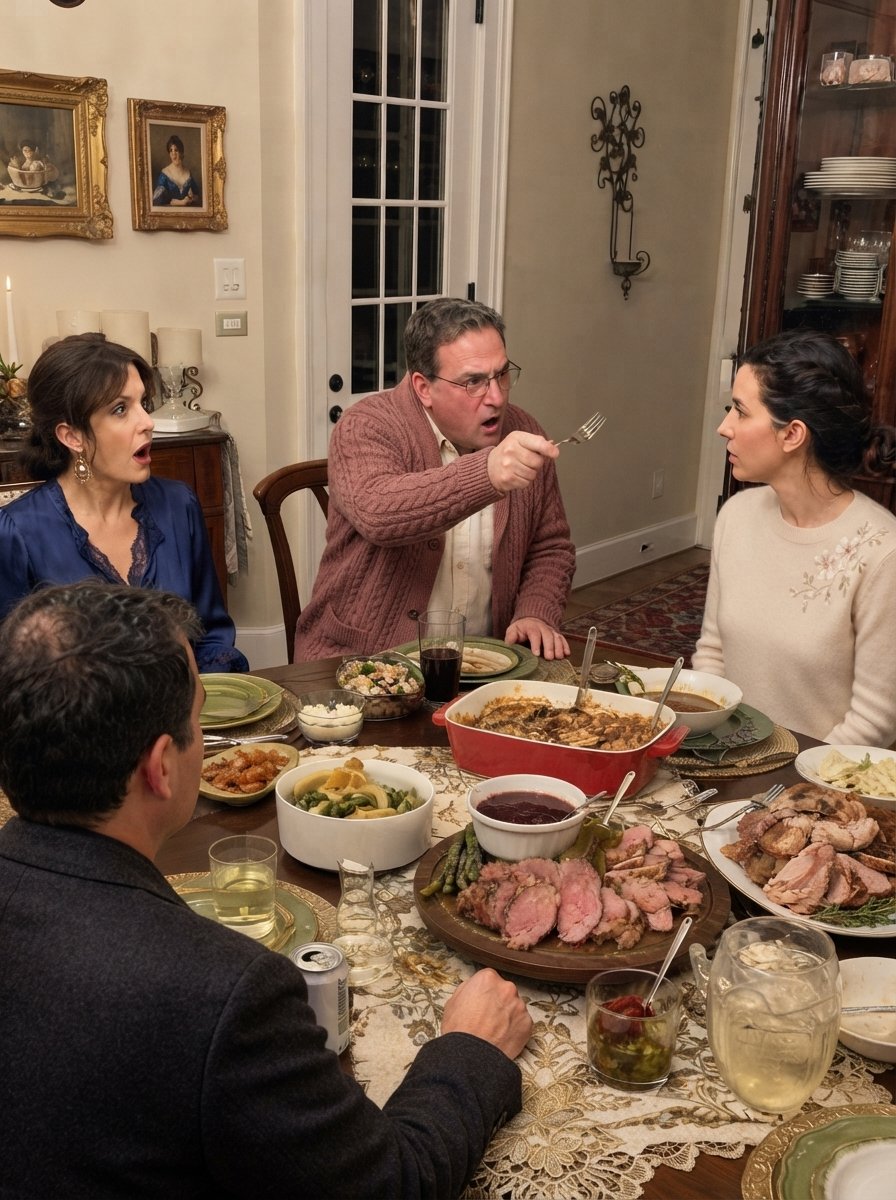
Jennifer, his wife, gave a small laugh without looking up from her plate, her diamond bracelet catching the light as she cut a perfect square of turkey. “You could tell them she makes little videos in her apartment.”
Marcus smiled. “Exactly.”
I kept my eyes on the cranberry sauce, watching the light catch the surface of it, red and glossy and perfectly still, the one thing at that table not asking anything of me.
Mom shifted in her chair. “Alexandra, honey, we’re only worried about you. Thirty-two is still young, but you can’t keep living in that tiny apartment forever.”
Dad finally joined in, setting down his wineglass with the deliberate care of a man about to deliver a verdict. “Your brother owns three properties now. Jennifer’s practice is doing well. They’re building something stable.”
Marcus tapped his fork against his plate, punctuating the word like he was hammering it into the table itself. “That’s the point. Stability.”
I looked up. “I have a stable income.”
Jennifer’s smile widened, the kind of smile that isn’t really a smile at all. “From what? Online videos?”
The room went quiet just long enough for the grandfather clock in the hallway to tick three times, the sound unusually loud in the silence, the way certain sounds get loud only when everything else in a room has gone still and waiting.
“You hear how that sounds, right?” she continued, setting her fork down with a soft, deliberate click. “To actual professionals?”
Marcus let out a breath through his nose like she’d just made the argument for him, saved him the trouble of finishing the thought himself. He wore the same expression he used whenever he talked about one of his real estate closings, chin slightly raised, shoulders loose, certain he was the smartest person at the table and had been since before the appetizers came out.
They saw a seven-year-old Honda Civic parked at the curb. They saw a one-bedroom apartment ten minutes from Burbank, the kind with a parking spot you had to parallel park into and a mailbox that stuck if you didn’t jiggle the key just right. They saw Target blouses, sensible shoes, a phone with a cracked corner on the case I kept meaning to replace and never did. That was enough for them. That was the whole file, the whole assessment, built and closed years ago and never reopened since.
What they never saw were the conference rooms on the ninth floor with the frosted glass walls, the production schedules that ran eighteen months out, the contracts stacked two inches thick that I read every clause of myself before signing, the payroll reports with hundreds of names on them, names of people whose kids I’d met at company picnics, whose health insurance I’d personally fought to expand two years running. I had made a deliberate decision, years earlier, to keep my private life boring, modest, and almost invisible. It had felt, at the time, like the safest way to build something real without the noise of being watched while I built it.
Marcus had mistaken that decision for failure. He’d mistaken it for failure so thoroughly and for so long that the mistake had calcified into something he now treated as settled fact, something he no longer even bothered to verify before repeating it out loud in front of company.
“You want to know what I think?” he said.
Mom’s eyes flicked toward him, a small, practiced warning. “Marcus.”
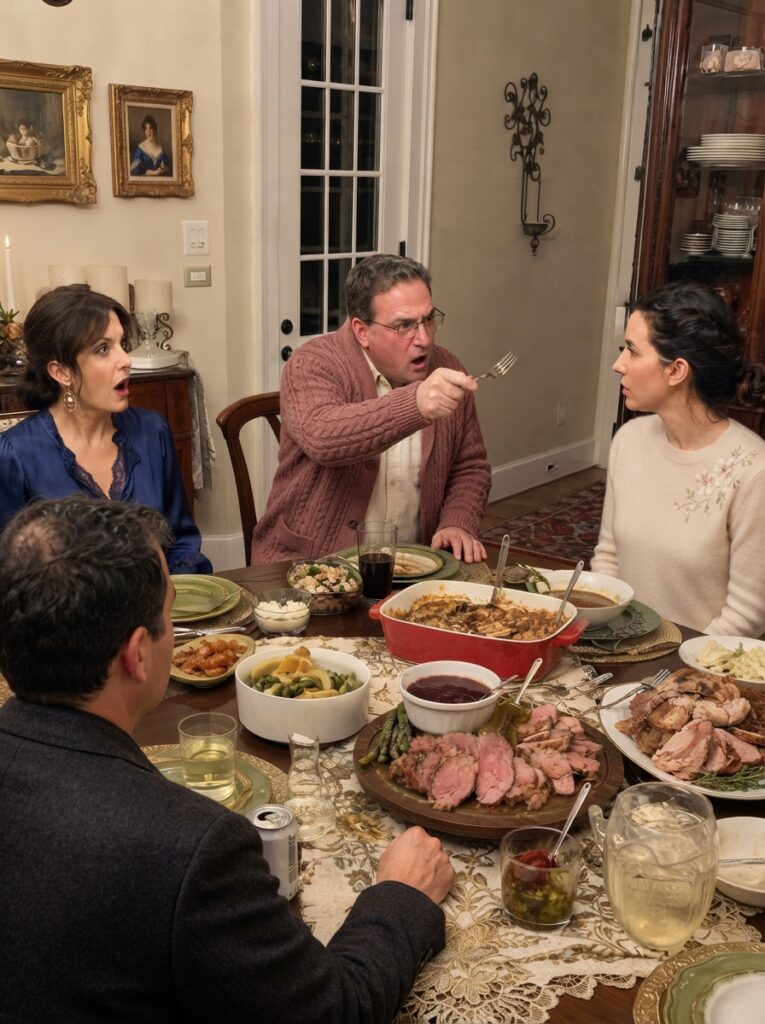
“No, she needs to hear this.” He leaned forward, elbows near the edge of the table, close enough now that I could smell the wine on his breath. “I think you’re afraid of responsibility. You’ve created this little fantasy where you can pretend you’re building something, but you never have to actually grow up.”
I placed my fork beside my plate, lining it up carefully with the edge of the tablecloth, a small motion that gave my hands somewhere to be while the rest of me decided how much of this I was going to absorb quietly.
He pointed his own fork toward me, a small piece of stuffing still clinging to one tine. “Thirty-two. No husband. No kids. No property. No career anyone can even explain. You’re living like a college student, Alexandra. It’s sad.”
Jennifer folded her napkin once and set it beside her plate, a gesture of someone settling in for the satisfying part of a show. “We’re not trying to be cruel.”
“Then you’re doing a strange job of it,” I said.
Her face tightened, just slightly, the kind of tightening that told me the comment had landed even if she’d never admit it out loud.
Dad lowered his wineglass with a soft clink against the tablecloth. “Enough sarcasm. Your brother may be blunt, but he has a point. We’ve been trying to help you for years.”
“Help me do what?”
“Get back on your feet,” Mom said softly, and there was something almost tender in the way she said it, which somehow made it worse, made it harder to be angry at her the way I was angry at Marcus, because I could see she actually believed she was being kind.
That almost made me smile. Marcus saw it, of course he saw it, he’d spent thirty-two years watching my face for exactly that kind of tell.
“There,” he said. “That attitude. Every time someone tries to talk seriously with you, you act like you know something the rest of us don’t.”
I held his gaze, steady, unhurried. “Maybe I do.”
Jennifer gave a short, disbelieving laugh, the kind that’s meant to be heard by everyone at the table except the person it’s aimed at. Dad’s hand flattened against the table, not a slam, just a firm press, the gesture of a man trying to hold the whole conversation still.
“Alexandra.”
“I’m listening.”
Mom took a breath, the kind of breath that meant she’d rehearsed what came next, probably in the car on the way over, probably more than once. “We thought maybe you could move home for a while. Use the guest room. Save some money. Help around the house. Take a few months and figure out what you really want to do.”
Marcus nodded immediately, like they’d coordinated this beforehand, which, I realized watching them, they probably had. “Structure would be good for you.”
I looked around the dining room. The polished mahogany table Mom had refinished herself one summer, sanding it down in the garage over three weekends. The framed family photos marching up the staircase wall, documenting every milestone that belonged to Marcus in triplicate and mine in single, faded copies. The brass chandelier Mom had spent three weeks choosing, driving to four different showrooms before settling on this one. The suburban colonial they were so proud of paying off after thirty years of mortgage payments, the house that represented, to them, the entire shape of a successful life.
They were offering me a guest room because they genuinely believed I couldn’t afford rent. The offer wasn’t cruel in its intention. That was almost the hardest part of it. It came wrapped in real concern, real love even, but built entirely on a picture of me that had never once been checked against reality.
Marcus kept talking, warming to the subject the way he always did once he sensed an audience settling in. “You’d save money, get some accountability, maybe meet with a career counselor. I know people. I could probably get you an entry-level marketing job with one of the developers I work with.”
“Entry level.”
“You have to start somewhere.”
Jennifer reached for her water glass, the ice shifting audibly inside it. “And honestly, Alexandra, denial won’t help. We’ve seen your apartment. We know what you drive. We know where you shop.”
I leaned back slightly, letting the silence stretch half a beat longer than was comfortable. “You’ve certainly done your research.”
“Don’t make this a joke.”
“I’m not,” I said, and the words came out calm enough that Marcus actually paused for half a second, his fork hovering, something flickering across his face that might have been the first small crack of doubt, quickly papered over.
Then he pushed harder, the way he always did whenever a crack like that threatened to show. “This is exactly what I mean. You hide behind that calm act because you don’t want to admit you’re scared. Scared to commit to anything real. Scared to take a risk. Scared to fail.”
“Real,” I repeated.
“Yes. Real. Property. Equity. A career people respect. Something you can point to and say, I built that.”
The irony sat between us like another place setting nobody had cleared, invisible to everyone at the table except me. Mom stared down at her hands, turning her wedding ring slowly around her finger, a nervous habit I recognized from childhood. Dad poured more wine without meeting my eyes, filling the glass a little higher than he needed to. Jennifer looked almost satisfied, like she’d finally won an argument she’d been quietly having with me in her head for years, ever since the first Thanksgiving I’d brought over a store-bought pie because I’d been too buried in a launch to bake one, and she’d made a small comment about effort that I’d let slide at the time.
I could have ended it right then. I could have reached into my bag, pulled up one email on my phone, shown one contract, one cap table, a photograph of the production campus with my name on the building directory, a message from a studio chief who’d been calling me all week about the acquisition timeline. I could have watched every assumption on their faces collapse in under thirty seconds, watched the whole dinner reorganize itself around a fact I could have delivered with a single swipe of my thumb.
Instead I said, “Maybe we should talk about something else.”
Marcus laughed, short and sharp. “No. That’s what you always do. You change the subject the second the truth gets uncomfortable.”
He leaned closer, close enough that I could see the small triumphant set of his jaw. “You’re wasting your life, Alexandra. Your intelligence, your time, your potential. And frankly, you’re wasting ours every time we have to sit here and pretend these little projects are some kind of career.”
The football broadcast in the living room suddenly cut out. A sharp network chime sounded from the television, the kind of tone reserved for weather emergencies and breaking news, the kind of sound that makes a room go quiet before anyone consciously decides to listen. Nobody moved at first. Then an announcer’s voice replaced the game, smooth and urgent at the same time.
“We interrupt this program for a major entertainment industry announcement.”
Jennifer rolled her eyes without looking away from her plate. “Can someone turn that down?”
Marcus kept talking, something about accountability, something about maturity, but I was no longer listening to him. A low, urgent music bed rolled under the announcer’s voice from the other room, the kind of score networks use when they want you to understand, on some instinctive level, that whatever comes next matters.
“In a landmark agreement expected to reshape the streaming industry, a major platform has announced the largest original-content acquisition in its history—”
My fingers went still beside my water glass.
Marcus was saying something about career counseling, about a friend of his who’d turned his life around after a program like the one he was describing. Dad had finally turned his head toward the living room doorway, drawn by something in his own instincts he probably couldn’t have named yet. The announcer continued, unhurried, laying out the story the way anchors do when they know the details themselves are the whole show.
“The exclusive eight-year agreement is valued at three point eight billion dollars—”
Jennifer stopped cutting her turkey, the knife resting motionless against the china. Mom looked toward me for reasons she didn’t understand yet, some instinct pulling her attention across the table before her conscious mind caught up.
Then the announcer said one name.
Marcus’s fork stopped halfway to his mouth, suspended there, forgotten. For three full seconds, nobody moved. The blue-white glow of the television washed faintly into the dining room from the hallway, and the grandfather clock kept ticking behind us, indifferent to what was unfolding, marking time the same way it had marked every ordinary Thanksgiving before this one.
Marcus’s fork hung in the air. Jennifer’s hand froze around her water glass, condensation beading against her fingers. Dad stared toward the living room like he’d misheard something important and was waiting for the sentence to repeat itself so he could be sure.
I calmly cut another piece of turkey, set it on my fork, and ate it.
Jennifer was the first to find her voice, thin and uncertain. “Alexandra. Did they just say your name?”
I looked up. “They did.”
Marcus’s face tightened, confusion sliding fast into something closer to alarm. “No. That’s impossible.”
My phone vibrated against the table. Once, twice, then again in quick succession, the screen lighting up with a stack of missed calls that kept climbing even as I watched. I didn’t touch it.
Mom whispered, her voice barely audible over the television still murmuring from the other room. “What exactly have you been hiding from us?”
I set down my fork and folded my napkin beside my plate, taking my time with the corners the way I always did, a small ritual of composure. “Nothing,” I said. “You just never asked the right question.”
Marcus pushed back his chair so fast it scraped hard against the hardwood floor, the sound sharp enough to make Mom flinch. Then my phone lit up with the one call that made his expression change completely, draining whatever color had been left in his face.
The caller ID displayed a name Marcus knew all too well. Arthur Vance, CEO of Vance Capital, the premier private equity firm Marcus had been desperately trying to pitch his real estate ventures to for the last eighteen months, sending unanswered emails, angling for introductions through mutual contacts, mentioning the firm’s name at every dinner like a talisman he hoped might eventually work. Arthur Vance didn’t take meetings with mid-level developers. He barely returned calls from people three levels above Marcus. Yet his name was currently pulsing across my cracked screen, insistent, for anyone at that table to see clearly.
I didn’t answer it. I simply flipped the phone face down against the tablecloth, and the silence in the room grew heavy enough to suffocate, thick with the particular quiet of people recalculating everything they thought they’d understood five minutes earlier.
“Answer it,” Marcus demanded, his voice cracking slightly, the polished authority he’d been wearing all evening already fraying badly at the edges. “Is this a prank? Did you hire a PR firm to air a fake news bulletin? What the hell is going on, Alexandra?”
“Marcus,” Dad snapped, though his own voice had lost its usual sternness, gone thin and uncertain in a way I’d never heard from him before. He stood up slowly, eyes darting between me and the television in the next room, where my face, pulled from a press photo taken three years earlier at an industry conference I’d almost skipped, now sat beside a graphic reading THREE POINT EIGHT BILLION DOLLAR ACQUISITION: MEDUSA MEDIA GROUP.
“Medusa Media,” Jennifer read off the screen through the doorway, her voice barely above a whisper, like she was afraid saying it too loud might make it more real than she could handle. “That’s the digital infrastructure network. They own the distribution pipelines for all the major independent studios.” She slowly turned her head toward me, eyes wide with something caught between terror and dawning, horrified recognition. “You drive a Civic.”
“Because it gets thirty-five miles to the gallon and nobody looks twice at it in a parking garage,” I said calmly, folding my hands in my lap. “Including corporate spies, press, and family members who only value people based on the size of their mortgage.”
Mom had gone pale, her hands trembling slightly as she adjusted her glasses, pushing them up her nose in a small automatic gesture. “Alexandra. Three point eight billion? Honey, we thought you were writing blogs.”
“I founded Medusa seven years ago,” I said, looking directly at her, keeping my voice level even as something tight and long-buried finally began working its way loose in my chest. “I built the streaming compression architecture in that tiny apartment while you were telling the relatives I was between jobs. I kept my name off the press releases because I wanted to build a company, not a celebrity persona. And I kept it from all of you because every time I tried to talk about my work, Marcus talked over me, and you told me to be more like him.”
Marcus slammed his hand on the table, rattling the crystal glasses hard enough that a little wine sloshed over the rim of Dad’s glass. “This is bullshit. If you had that kind of money, why live like a pauper? Why come here and let us talk to you like—” He cut himself off abruptly, catching the trap he’d just walked straight into, his own words hanging unfinished in the air between us.
“Like I was garbage?” I finished for him, my tone completely devoid of anger, which seemed to unsettle him far more than any amount of shouting would have. “Because I wanted to see if my family loved me for who I actually was, or if your respect was something that had to be bought first, priced out and paid for before it was offered. Now I have my answer.”
The television anchor continued in the background, detailing how I had retained a fifty-two percent controlling stake in the parent entity, making me overnight, according to the graphic scrolling beneath my photo, one of the wealthiest self-made women in the entire media sector.
My phone vibrated again. This time I picked it up, glancing at the screen. “Excuse me,” I said, standing, smoothing the front of my blouse. “I have to take this. It’s the board.”
I walked into the hallway, leaving the four of them frozen at the polished mahogany table like a photograph nobody had asked to have taken. Behind me I heard Marcus’s chair scrape again as he turned to his wife, his voice hushed and frantic, not quite quiet enough that I couldn’t hear it from the hall. “Do you have any idea what this means? If she controls Medusa, she holds the debt structure on my primary lender—”
I took the call in the hallway, standing beneath the row of framed family photos, my own senior portrait tucked somewhere near the bottom of the arrangement, smaller than the others, easy to miss if you weren’t looking for it. I spoke briefly with legal to authorize the press statement, confirmed a follow-up call for the morning, and thanked the board chair for the update. Then I walked back into the dining room.
The whole atmosphere had shifted in the few minutes I’d been gone. Marcus was standing now, his posture defensive but somehow smaller than it had been ten minutes earlier, like the air had gone out of some internal scaffolding he’d been leaning on his whole adult life. Jennifer sat stiffly in her chair, staring down at her plate like she was suddenly ashamed of her perfect square of turkey, of the whole performance of the evening. Mom looked like she was on the verge of tears, one hand pressed flat against her collarbone. Dad stood near the head of the table, looking at me like I was a stranger who’d just walked through the front door uninvited, wearing my face but carrying a life none of them recognized.
“Alexandra,” Dad started, his tone shifting into the warm, patriarch voice he usually reserved for Marcus’s promotions, for the closing of a good deal, for moments he wanted remembered fondly. “We didn’t know. You have to understand, we only wanted the best for you—”
“No, Dad,” I interrupted softly, and something in my own steadiness surprised me even as I said it. “You wanted what was easiest for you. It was easier to file me under struggling daughter so you could feel proud of Marcus’s modest success without any complications, without having to hold two different kinds of pride in your hands at once.”
“Modest?” Marcus winced like the word itself had struck him somewhere tender, somewhere he’d spent years protecting.
I looked at my brother, really looked at him, the way you look at someone when you’ve finally stopped editing yourself for their comfort. “You told me I had no property, no equity, no career anyone could explain. You offered me an entry-level marketing job twenty minutes ago.” I picked up my clutch from the sideboard, feeling the weight of it settle familiar and steady in my hand. “I own forty-eight percent of the commercial district your firm is currently trying to build on, Marcus. My subsidiary is your landlord. Effective next month, we aren’t renewing your lease.”
Marcus turned gray, actually gray, the color draining out of his face in a way I’d never seen happen to a person in real life before, only in movies. “You can’t do that. That’s my primary office.”
“You said it yourself,” I said, pulling my coat over my shoulders, the fabric settling against me like armor I hadn’t realized I’d been missing all evening. “Structure would be good for you.”
Mom stepped forward, hands outstretched, her voice cracking around the edges. “Alexandra, please, it’s Thanksgiving. Don’t leave like this. Sit down, let’s talk about this as a family.”
I paused at the doorway, looking back at the polished mahogany table, the brass chandelier Mom had chosen so carefully, the people who had spent the better part of a decade pitying me over that same table, year after year, holiday after holiday, without once thinking to ask a question that might have complicated the story they preferred.
“We are a family, Mom,” I said gently, and I meant it, even now, even with everything sitting raw and unresolved between us. “But you made your table too small for who I actually am.”
I turned and walked out the front door into the cool November air, the porch light catching the edge of my coat as the door swung shut behind me. As I unlocked my seven-year-old Honda Civic, the same reliable, unremarkable car that had carried me through seven years of building something they’d never bothered to ask about, my phone lit up with a text from Marcus. Please. Can we talk tomorrow?
I didn’t reply. I started the engine, pulled away from the curb, and drove toward Burbank, leaving the suburban house, and their quiet, comfortable assumptions about who I was, far behind in the rearview mirror, growing smaller with every block until the porch light was just one more point of light among all the others.