“Divorce papers,” I said. “Filed two weeks ago. I’ve been carrying them, waiting for the right moment to tell you, understanding I wanted to be fully prepared before I did.”
Genesis’s face drained of color entirely. “You can’t divorce him. He’s your husband. Marriage requires sacrifice, Claire. You need to learn that.”
“I understand sacrifice perfectly well, Genesis,” I said, my voice steady despite the blood still dripping onto my shoulder, staining the pale blue blouse I’d carefully chosen that morning for what I’d naively believed would be an ordinary family dinner. “I’ve sacrificed for four years, funding Jackson’s failed businesses, covering rent when his income disappeared entirely, absorbing insult after insult from this family while being expected to simply endure it silently. Tonight, apparently, sacrifice meant surrendering my own apartment and handing you twelve hundred dollars a month, funded by a salary I earned entirely on my own.”
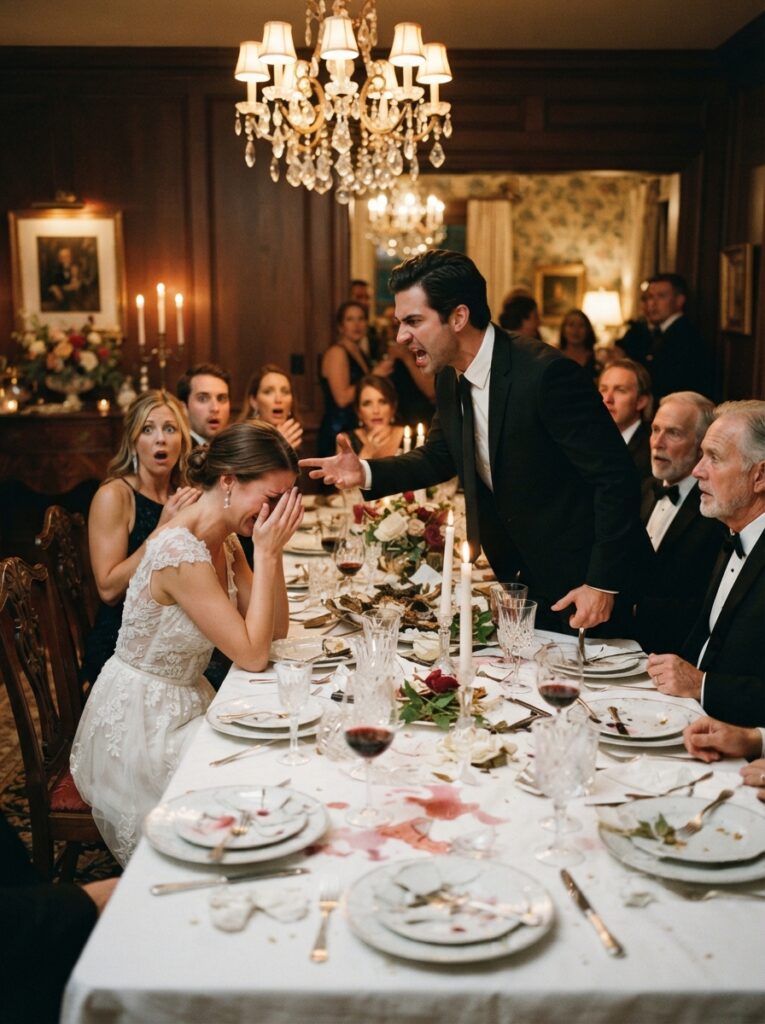
The dispatcher’s voice came through my phone, still connected, calmly confirming officers were en route. I gave the address clearly, understanding twenty witnesses now stood frozen around that dining table, absorbing exactly what they’d just watched unfold, several already pulling out their own phones, though whether to document the scene or simply distract themselves from its severity, I couldn’t fully determine.
“Claire,” Jackson said, his voice suddenly considerably smaller than the fury he’d displayed moments earlier, “we can talk about this. You don’t need to involve the police.”
“You threw a plate at my head,” I said. “In front of your entire family, none of whom moved to help me. I think involving the police is exactly the appropriate response to what just happened.”
His father finally looked up from his plate, understanding, I think, the full gravity of what he’d witnessed and chosen not to address. “Jackson,” he said quietly, “you need to sit down and let this happen properly.”
Jackson’s youngest cousin, a teenager who’d been ushered from the room earlier alongside the other children, apparently returned in the doorway, having heard enough of the commotion to understand something significant had unfolded, her expression carrying a particular horror I understood reflected exactly the reality this family had somehow normalized across years of careful, quiet dysfunction.
The paramedics arrived within eight minutes, working quickly to clean and assess the wound at my temple, understanding, even before they finished their examination, that this constituted more than a minor accident. The lead paramedic, a careful woman named Sonia Ferreira, worked with the particular efficiency of someone who’d handled considerable domestic violence calls throughout her career, documenting the wound’s dimensions and depth with photographs I understood would eventually matter considerably for the case ahead.
“This wound required six stitches,” the lead paramedic told the responding officer, once they’d stabilized me sufficiently to transport me to the hospital. “The impact was significant enough that we’re documenting it as a potential concussion as well, pending further evaluation.”
Officer Patricia Reyes took statements from each family member present, understanding, from years of handling domestic violence calls, exactly how important comprehensive documentation would prove for any subsequent legal proceedings.
“Mrs. Whitfield,” she said, once she’d finished speaking with several relatives who’d witnessed the entire confrontation, “I need to document your account directly. Can you walk me through exactly what happened tonight?”
I explained everything, understanding my voice needed to remain steady despite the pain radiating through my temple and the particular exhaustion of processing genuine trauma while still surrounded by the same family who’d orchestrated the ambush in the first place.
“The demand for your apartment and the monthly payment,” Officer Reyes said, reviewing her notes carefully, “was that communicated to you before tonight, or was this the first time you’d heard these specific terms?”
“Jackson mentioned, vaguely, weeks ago, that his mother might need financial support eventually,” I said. “I never once agreed to specific terms like these. Tonight was the first time I understood exactly what they expected—my apartment, and twelve hundred dollars monthly, treated as though it were already settled rather than something requiring my actual consent.”
“And when you refused those terms,” Officer Reyes said, “your husband threw a plate at your head, in front of twenty witnesses, none of whom intervened to help you.”
“That’s accurate,” I confirmed.
Several relatives, understanding the seriousness of what Officer Reyes was documenting, offered their own corroborating statements, my cousin-in-law Denise, notably, providing a detailed account that matched my own version precisely, understanding, I think, that continued silence would implicate her in something she genuinely hadn’t anticipated witnessing that evening. Denise had always struck me as somewhat reserved during previous family gatherings, careful never to fully align herself against Genesis’s frequently harsh opinions, though that evening, watching her provide clear, unwavering testimony to Officer Reyes, I understood she’d finally decided some situations required genuine courage regardless of family loyalty.
“I’ve never seen Jackson act that violently before,” Denise told Officer Reyes. “I want to be clear about that. But what happened tonight was absolutely assault. I watched the plate hit her directly, watched the blood, watched nobody move to help her except eventually myself, once the shock wore off enough to actually react.”
Jackson was arrested that same evening, understanding the comprehensive witness testimony, combined with my documented injury, provided more than sufficient grounds for immediate action rather than simply a citation requiring later follow-up.
I spent that night in the hospital, my temple properly stitched, a mild concussion confirmed through careful evaluation, understanding I needed genuine medical attention regardless of how the evening’s legal proceedings ultimately unfolded.
My attorney, Diane Castellano, met me the following morning, understanding the assault charges would now run parallel to the divorce proceedings I’d already quietly initiated two weeks earlier.
“I want to walk you through exactly what the divorce filing already established,” Diane said, spreading documentation across my hospital tray table. “Given that your apartment was purchased four years before your marriage, using entirely your own funds, it remains unambiguously separate property, regardless of anything Jackson’s family assumed or demanded.”
“They genuinely believed they could simply take it,” I said, still processing the particular audacity of that ambush. “Move Genesis in, expect me to fund her living expenses, all without any genuine negotiation or consent on my part.”
“Based on what you’ve described,” Diane said, “and based on the financial documentation you’d already begun assembling before tonight’s assault, I believe we have grounds to pursue a settlement considerably more favorable to you than standard proceedings might otherwise produce.”
I’d spent the preceding months, quietly and carefully, documenting exactly how much I’d financially supported Jackson throughout our marriage—covering rent during his repeated business failures, funding considerable startup costs for ventures that never once generated sustainable income, absorbing debt he’d accumulated without fully disclosing to me until collection notices began arriving. I’d started that documentation process nearly a year earlier, understanding, even before this particular ambush, that something within our marriage’s financial dynamic had grown increasingly unsustainable, though I hadn’t yet fully understood exactly how calculated Jackson’s family’s expectations would eventually become.
“The total comes to just over ninety-three thousand dollars,” Diane said, reviewing the comprehensive financial summary I’d assembled. “Combined with tonight’s assault, and the documented pattern of his family’s escalating financial demands, I believe we can pursue considerable restitution alongside the divorce settlement itself.”
“I want my apartment fully protected,” I said. “And I want genuine accountability for tonight, not simply a citation that quietly disappears once the initial outrage fades.”
“Given the comprehensive witness testimony and your documented injury,” Diane said, “I don’t believe this will simply disappear, Claire. The prosecutor’s office takes domestic assault charges with this level of documentation quite seriously, particularly given the number of corroborating witnesses.”
I reviewed the financial documentation with Diane carefully, understanding I needed to fully reckon with exactly how patient and generous I’d been across four years of a marriage that had consistently taken considerably more than it ever offered in return. Three separate business ventures Jackson had launched and abandoned, each one funded substantially through my own salary while he insisted, each time, that success remained genuinely close if only he could secure slightly more capital. Rent covered entirely on my own for nearly eighteen months combined, spread across various periods when Jackson’s income had simply evaporated without adequate warning or explanation.
“I think I convinced myself this was simply what marriage required,” I told Diane. “Patience, sacrifice, believing eventually the balance would even out once Jackson found his footing professionally.”
“That balance rarely evens out on its own,” Diane said gently. “Particularly once a pattern like this becomes normalized within a family system that actively reinforces it, the way Jackson’s mother apparently did throughout your entire marriage.”
The criminal case proceeded over the following months, Jackson’s attorney attempting, throughout preliminary proceedings, to characterize the incident as an isolated loss of temper rather than part of a broader, sustained pattern of financial exploitation and control.
“My client made a serious mistake in a moment of extreme emotional stress,” Jackson’s attorney argued during one hearing I attended, understanding I needed to witness the proceedings directly rather than simply receiving updates secondhand. “This was not a premeditated assault, but rather an unfortunate escalation during a difficult family conversation.”
The prosecutor, a sharp, thorough woman named Rebecca Nkemelu, dismantled that characterization methodically, presenting the witness testimonies, my documented injury, and critically, text messages recovered during the investigation that revealed the confrontation had actually been planned considerably in advance.
“These messages,” Rebecca said, presenting them to the court, “exchanged between the defendant and his mother three days before the incident, explicitly discuss strategy for how to present the demands regarding the apartment and monthly payments. One message from the defendant reads, quote, ‘If she says no, we’ll need to make clear this isn’t actually optional.’ I don’t believe that language supports the defense’s characterization of an unplanned, isolated emotional outburst.”
I sat in that courtroom, absorbing the full scope of what those text messages actually revealed—not simply Jackson’s individual failure of temper, but a coordinated family plan specifically designed to pressure me into surrendering my own property and income, with violence apparently already anticipated as a potential outcome if I refused their initial demands.
Rebecca continued presenting additional messages, each one revealing considerably more calculation than Jackson’s attorney’s characterization allowed. Genesis had apparently researched, weeks in advance, exactly how to structure the monthly payment request to make refusal feel considerably more difficult, understanding, according to one particularly damning message, that “presenting it in front of the whole family will make her less likely to argue.”
“This wasn’t simply poor judgment in a heated moment,” Rebecca told the court. “This was a calculated ambush, deliberately staged in a public setting specifically to pressure the victim into compliance, with contingency planning for exactly the refusal she ultimately gave them.”
Genesis faced her own separate legal scrutiny, given the messages establishing her direct role in planning the confrontation, ultimately resulting in charges for conspiracy to commit coercion, though her attorney successfully negotiated a plea agreement that avoided formal trial. She received probation and a formal order requiring completion of a court-mandated counseling program addressing financial exploitation patterns within families.
Jackson’s case concluded with a conviction on assault charges, resulting in a sentence that included probation, mandatory anger management and financial counseling, and a formal restraining order preventing any future contact with me beyond what divorce proceedings might formally require.
“I never imagined it would actually go this far,” Jackson told me once, during a supervised exchange connected to dividing our remaining shared property. “I just wanted my mother to be comfortable. I let that priority override everything else, including basic respect for you.”
“You let considerably more than priority override everything else,” I said. “You planned to coerce me, and when I refused, you assaulted me in front of twenty witnesses. That’s not simply misguided family loyalty, Jackson. That’s calculated violence, dressed up as devotion to your mother.”
“I’ve been in therapy since the arrest,” he said quietly. “I understand, considerably more clearly now, exactly how my mother’s expectations shaped decisions I never once properly questioned throughout our entire marriage.”
“I appreciate you working on that,” I said, understanding I could acknowledge genuine effort without softening my own boundaries. “But that work doesn’t undo what happened, or restore the trust that violence permanently destroyed.”
The divorce finalized six months after that terrible dinner, the settlement reflecting both the documented financial exploitation throughout our marriage and the assault’s genuine consequences, my attorney securing considerable restitution alongside full, uncontested ownership of my apartment.
I sold that apartment eventually, understanding I had no genuine desire to remain somewhere so thoroughly entangled with the particular trauma of that ambush, using the proceeds instead to purchase a smaller, quieter home entirely my own, free from any shared history requiring careful navigation. I remember walking through my new house for the first time, understanding every wall, every window, every quiet corner belonged entirely to me, protected now by documentation and legal precedent that ensured no family could ever again quietly assume ownership over something I’d built entirely through my own labor.
My physical recovery from the assault took several months, occasional headaches lingering longer than the stitches themselves, a small, permanent scar near my temple serving as a quiet reminder of exactly how far Jackson’s family had been willing to go to secure what they’d apparently already decided belonged to them. I underwent additional neurological evaluation given the documented concussion, understanding, with considerable relief, that my recovery ultimately proved complete despite the initial severity of the injury.
I’ve rebuilt my architecture career considerably since the divorce, taking on more ambitious projects now that I’m no longer quietly funding a marriage that consistently demanded more than it ever offered in return. I received a significant promotion the following year, my firm’s partners noting, during my review, a renewed focus and energy they’d apparently noticed developing steadily since my divorce proceedings concluded.
“I think about that dinner often,” I told my own therapist, nearly a year after the assault, working through the particular trauma of watching an entire room of relatives remain silent while I bled onto their tablecloth. “The silence honestly haunts me more than the actual plate. Twenty people, and not one of them moved to help me until the shock finally wore off.”
“What do you think that silence actually revealed?” she asked.
“That the family had already decided, collectively, that my objection to their demands was somehow the actual problem,” I said. “Not Jackson’s violence. Not Genesis’s manipulation. My refusal to simply comply with an arrangement I’d never once agreed to.”
I don’t maintain contact with any of Jackson’s extended family now, understanding that single dinner revealed considerably more about their collective values than years of previous, more carefully managed interactions ever had. Denise, notably, remains the exception, our friendship rebuilding slowly since her willingness to testify honestly rather than protect the family’s preferred narrative.
“I think about that night too,” Denise told me once, nearly a year later. “I keep wondering what would have happened if I hadn’t finally moved to help you, if everyone had simply continued sitting there in silence.”
“You did move, eventually,” I said. “That matters, Denise, even if it took longer than either of us would have preferred.”
I’ve since started dating again, carefully, understanding exactly what warning signs to watch for after everything that terrible marriage ultimately revealed about how easily quiet financial exploitation can escalate into open violence once someone finally refuses to continue absorbing it silently.
I think about that dining room often, the crack of porcelain against my temple, the particular horror of watching twenty relatives remain frozen rather than intervening on my behalf. I understand now that moment, devastating as it was to survive, ultimately revealed exactly how far I needed to walk away from an entire family system built on quiet, escalating expectation, understanding my own worth had never once depended on their approval, regardless of how confidently they’d once assumed otherwise.
I carry that folder of divorce papers with me still, tucked away now in a drawer rather than my handbag, a quiet reminder of exactly how much careful preparation ultimately protected me, once Jackson’s rage finally, publicly revealed exactly what four years of quiet exploitation had actually been building toward all along.
Years later, I understand that dinner as the exact moment my old life ended and a considerably more honest one began. I don’t regret the marriage entirely, understanding I learned genuine lessons about my own boundaries, my own worth, and exactly how quickly quiet financial exploitation can escalate into open violence once someone finally, firmly refuses to continue absorbing it. I regret only that it took a plate shattering against my temple, twenty silent witnesses, and considerable legal proceedings to finally understand what should have been obvious years earlier.
I built my new home, my new career, and my new understanding of self-worth on that foundation instead, understanding it cost me a marriage but ultimately gave me back a version of myself I’d nearly forgotten existed underneath four years of careful, quiet accommodation.