PART 3 — THE MAN HOLDING MY HOSPITAL BRACELET
The man at the church doors didn’t move.
Neither did I.
For several seconds, the only sound in the corridor was Grandpa Arthur’s cane rolling slowly across the stone floor.
Then it stopped against the wall.
The stranger looked to be in his late sixties. Tall. Broad-shouldered despite his age. Silver hair swept neatly away from a face that carried the kind of lines earned through years of sleepless nights rather than laughter.
And in his right hand—
my hospital bracelet.
The faded plastic strip had yellowed with age, but I could still make out the handwritten words.
EMMA CLAIRE VALE.
October 19, 1996.
Female.
6 lbs. 9 oz.
My heart began pounding so hard it hurt.
Margaret whispered again.
“Jonathan.”
The stranger’s eyes flicked toward her.
“So you do remember me.”
Her face went completely white.
Grandpa finally found his voice.
“You’re supposed to be dead.”
The man gave a tired smile.
“So are a lot of people in this family.”
Daniel stepped in front of me instinctively.
“Who are you?”
The stranger’s gaze shifted to him.
Then back to me.
His expression softened.
“My name is Jonathan Mercer.”
Nothing.
The name meant nothing to me.
But Grandpa closed his eyes.
Samuel Hart swore under his breath.
And Margaret backed away as though the stranger carried a gun.
I looked from face to face.
“Someone needs to start explaining.”
Jonathan took one step inside.
Samuel immediately raised a hand.
“Stay where you are.”
Jonathan stopped.
“You were always cautious, Hart.”
“And you were always difficult to find.”
“That was the point.”
I stared at Samuel.
“You know him too?”
Samuel gave me a grim look.
“I knew his name.”
Grandpa sank back into the chair.
I faced him.
“Who is Jonathan Mercer?”
Grandpa didn’t answer.
Jonathan did.
“I was your grandmother Evelyn’s attorney.”
That was not the answer I had expected.
I looked at Margaret.
She shook her head quickly.
“He was more than that.”
Jonathan’s expression sharpened.
“Careful.”
Margaret laughed hysterically.
“Careful? You walk into my daughter’s wedding after twenty-nine years holding that thing and tell me to be careful?”
I stepped toward her.
“Not your daughter.”
Her mouth snapped shut.
The words hurt both of us.
I could see that.
But I wasn’t taking them back.
Jonathan looked at me again.
“Claire was right. You do have her eyes.”
Something twisted inside my chest.
“Where is she?”
His expression changed.
“I don’t know.”
“You expect me to believe that?”
“Yes.”
“You had my bracelet.”
“Yes.”
“You were connected to my grandmother.”
“Yes.”
“You apparently know my mother.”
“Yes.”
“And you expect me to believe you have no idea where Claire is?”
His jaw tightened.
“I knew where she was until three weeks ago.”
The room froze.
I stepped toward him.
“Three weeks?”
“Yes.”
“You’ve known she was alive all this time?”
“No.”
He looked at Grandpa.
“I found her twelve years ago.”
Grandpa staggered upright.
“Twelve—”
His voice broke.
“You found my daughter twelve years ago and said nothing?”
“I was following her wishes.”
“She was my child!”
“And she was terrified.”
“Of Richard?”
Jonathan hesitated.
“No.”
My skin prickled.
Grandpa whispered, “Then of whom?”
Jonathan looked directly at him.
“You.”
No one moved.
Grandpa’s face crumpled.
“Me?”
“Yes.”
“That’s impossible.”
“Claire believed you had chosen Evelyn’s reputation over her safety.”
Grandpa stared at him.
“I would never—”
“You did.”
Jonathan’s tone wasn’t cruel.
That somehow made it worse.
“Not knowingly. But you did.”
I stepped between them.
“What does Evelyn have to do with this?”
Jonathan looked down at the hospital bracelet.
Then held it toward me.
I didn’t take it immediately.
My whole life seemed contained in that tiny strip of plastic.
Eventually, I reached out.
The moment it touched my palm, my eyes burned.
“Where did you get this?”
“Claire gave it to me.”
“When?”
“October 20, 1996.”
The day after I was born.
Daniel inhaled beside me.
I stared at Jonathan.
“You were at the hospital.”
“Yes.”
Claire’s warning echoed inside my head.
Ask him who was at the hospital the night you were born.
I whispered:
“You’re on Schedule C.”
Jonathan looked at Grandpa.
Grandpa stared at the floor.
Then Jonathan said:
“Yes.”
My knees weakened.
Daniel caught my hand.
I forced myself to ask.
“Are you my father?”
Jonathan’s face changed.
Not guilt.
Pain.
“No.”
I exhaled so violently I almost laughed.
Then why did everyone look terrified?
“Then why is your name on Schedule C?”
“Because I wrote it.”
Grandpa’s head snapped up.
“What?”
Jonathan reached into his coat.
This time Samuel stepped forward.
“What are you taking out?”
“A document.”
Slowly, Jonathan removed a sealed plastic sleeve.
Inside was a folded sheet of paper.
At the top:
SCHEDULE C.
My pulse exploded.
Grandpa stared.
“You had it?”
Jonathan nodded.
“Evelyn gave it to me.”
“Why?”
“Because she didn’t trust you to keep it secret.”
That wounded him visibly.
Jonathan continued before Grandpa could respond.
“She wasn’t protecting herself, Arthur.”
“Then who?”
Jonathan turned to me.
“You.”
I laughed once.
Sharp.
Disbelieving.
“Everybody keeps saying they were protecting me.”
I looked around the room.
“Funny how being protected apparently involved stealing my money, hiding my mother, lying about my parents, forging my signature, and letting me believe I was unwanted.”
Nobody answered.
I pointed at Schedule C.
“Open it.”
Jonathan hesitated.
“Emma—”
“Open it.”
He did.
Inside was a notarized statement.
My biological mother: Claire Elizabeth Vale.
Then a blank space where my father’s legal name should have been.
I stared.
“It’s blank.”
Jonathan shook his head.
“Look closer.”
Below the blank line was a handwritten instruction.
PATERNITY SEALED BY COURT ORDER — RELEASE ONLY TO CHILD AFTER AGE 25 OR UPON DEATH OF E.M.
E.M.
I looked at Jonathan.
“Who is E.M.?”
His face tightened.
“Evelyn Mercer.”
Grandpa stared.
“Mercer?”
Jonathan nodded slowly.
“My mother.”
Silence.
Margaret whispered:
“No.”
Jonathan looked at her.
“You never knew that either.”
Grandpa stood completely still.
I looked at him.
“Grandma Evelyn was Jonathan’s mother?”
“Yes.”
Jonathan’s eyes hardened.
“And Arthur’s wife.”
My brain stopped.
I looked between the two men.
Grandpa whispered:
“Evelyn had a son before we met.”
Jonathan nodded.
“She was seventeen.”
Margaret sat down.
Her mouth hung open.
Jonathan continued.
“Her parents forced her to give me up. I was adopted by the Mercer family. I didn’t learn who she was until I was thirty-seven.”
I tried to follow.
“So you were Grandma Evelyn’s son.”
“Yes.”
“Which makes you…”
“Claire and Margaret’s half-brother.”
Lauren whispered, “Holy God.”
Paige stared at Jonathan.
“We have an uncle?”
Jonathan gave her a sad glance.
“Apparently.”
I looked at the hospital bracelet again.
“Then why were you at my birth?”
“Because Claire called me.”
“Why?”
Jonathan’s face darkened.
“Because she had discovered something Richard had spent years hiding.”
Samuel leaned forward.
“What?”
Jonathan didn’t answer.
Instead, he handed Schedule C to me.
“There’s another page.”
I turned it.
A court case number.
A sealed paternity declaration.
And one set of initials.
R.E.S.
My stomach dropped.
Richard Edward Stone.
No.
I shook my head.
“No.”
Margaret stared at the page.
“What is it?”
I couldn’t speak.
Daniel read over my shoulder.
His face went white.
Grandpa whispered:
“Oh, God.”
I looked at Richard’s initials again.
My father wasn’t Richard.
That had already been established.
But why were his initials—
Jonathan said quietly:
“The initials don’t belong to Richard.”
I looked at him.
“Then who?”
“Robert Elias Stone.”
Margaret stopped breathing.
Grandpa turned away.
And suddenly I knew someone else had existed.
Someone nobody had mentioned.
I asked:
“Who is Robert Stone?”
Margaret answered.
Her voice barely existed.
“Richard’s father.”
I felt the world tip sideways.
Daniel grabbed both my arms.
I couldn’t understand.
“No.”
Jonathan closed his eyes.
“I’m sorry.”
“No.”
I backed away.
“You’re saying Richard’s father was my father?”
“Yes.”
My stomach lurched.
Margaret stood abruptly.
“That’s a lie.”
Jonathan turned toward her.
“It isn’t.”
“Claire would never—”
“She didn’t choose him.”
Silence.
The sentence changed everything.
Margaret’s anger disappeared.
Grandpa made a strangled sound.
I stopped moving.
Jonathan spoke carefully.
“Claire worked briefly for Stone-Vale Holdings after college. Robert was chairman then.”
My fingers went numb.
“She was twenty-two.”
I understood before he finished.
And suddenly I didn’t want him to finish.
But he did.
“Robert Stone assaulted Claire.”
The room seemed to disappear.
There was only the sound of my own heartbeat.
Daniel pulled me against him.
I couldn’t cry.
Not yet.
Some shocks are too deep for tears.
Jonathan continued.
“Claire told Evelyn.”
Grandpa whispered, “No.”
He looked destroyed.
“She told Evelyn?”
“Yes.”
“Why didn’t Evelyn tell me?”
“She believed Robert would destroy Claire publicly. He had lawyers, political contacts, board allies. Claire was terrified.”
Jonathan looked at me.
“And she was pregnant.”
Grandpa pressed both hands against the wall.
“My God.”
“You knew nothing?” I asked.
He shook his head violently.
“Nothing.”
Jonathan’s anger finally surfaced.
“Evelyn decided secrecy was protection.”
I laughed bitterly.
There it was again.
Protection.
Always protection.
Jonathan continued.
“She created Schedule C so Robert could never claim custody or access your trust. Richard was prohibited from adopting you because his father’s legal connection would have created inheritance and guardianship complications.”
I looked at Margaret.
“You knew none of this?”
She shook her head.
Tears filled her eyes.
“I swear.”
For once, I believed her.
Jonathan said, “Richard knew.”
Margaret turned.
“What?”
“He found Robert’s private files after Robert died.”
“When?”
“1997.”
The year Claire disappeared.
Everything snapped into place.
Claire discovered Richard knew.
Richard knew Claire could expose his father.
Claire had documents.
And if the scandal became public, Stone-Vale Holdings would collapse.
Samuel spoke softly.
“So Richard didn’t only have financial motive.”
Jonathan nodded.
“He had a family name to protect.”
I stared toward the empty doorway where Richard had fled.
Margaret whispered:
“He knew what his father did to Claire.”
“Yes.”
“And he still made me hate her.”
Jonathan looked at her.
“You didn’t need much help.”
The words struck like a slap.
Margaret flinched.
But she didn’t argue.
Then my phone rang again.
Unknown number.
I answered instantly.
“Claire?”
Static.
Then her voice.
“Emma.”
Relief nearly dropped me to the floor.
“Where are you?”
“I got away.”
“From who?”
Claire was breathing hard.
Then she said:
“Jonathan.”
Every eye turned toward him.
My blood froze.
He didn’t move.
Claire screamed through the phone:
“GET AWAY FROM JONATHAN!”
And the line went dead.
PART 4 — THE BROTHER WHO CAME BACK FROM THE DEAD
Daniel moved before anyone else.
He shoved me behind him.
Samuel stepped toward Jonathan.
“Hands where I can see them.”
Jonathan’s face didn’t change.
“That wasn’t Claire.”
I stared at him.
“What?”
“The woman on that call wasn’t Claire.”
“You just heard her.”
“I heard a voice.”
“It was her.”
“How would you know?”
That stopped me.
Because I didn’t.
I had never heard Claire’s adult voice before today.
All I knew was the recording from 1997 and the caller from an hour ago.
Samuel frowned.
Jonathan continued.
“The first call may have been Claire. The second wasn’t.”
“How can you be sure?” Daniel asked.
Jonathan looked at me.
“Because Claire doesn’t know I’m here.”
I almost laughed.
“So now I’m supposed to trust you?”
“No.”
His answer surprised me.
“You shouldn’t trust anyone today.”
He nodded toward Schedule C.
“Trust documents. Dates. Records. Evidence.”
For a man surrounded by accusations, it was a strangely sensible answer.
My phone vibrated.
A text.
Unknown number.
A photograph loaded.
Claire.
Or Catherine.
She was sitting in a chair in a dark room.
Her hands appeared tied.
Across the bottom:
COME ALONE OR SHE DIES.
Then another text.
ASK JONATHAN WHAT HAPPENED AT MASON ROAD.
I showed Samuel.
His jaw tightened.
Jonathan closed his eyes.
“What happened at Mason Road?” I demanded.
He didn’t answer.
“Jonathan.”
“I was there.”
Grandpa whispered, “What?”
Jonathan looked at him.
“I arrived after Margaret and Richard.”
Margaret stood.
“You?”
“Yes.”
“I never saw you.”
“You had already left.”
Her face twisted.
“I left because Richard told me Claire had run into the woods.”
“She did.”
“Then what?”
Jonathan stared at me.
“I found her.”
Alive.
The word didn’t need saying.
I felt it anyway.
“She was injured. Terrified. She had left you hidden inside her Volvo.”
Margaret covered her mouth.
Jonathan continued.
“Richard had gone after her. I got Claire into my car.”
“What about me?”
“Claire begged me to take you too.”
“Why didn’t you?”
Pain crossed his face.
“Because by the time I went back, you were gone.”
Margaret whispered, “Richard took her.”
Jonathan nodded.
“He took Emma and Claire’s car.”
Then everything made sense.
The Volvo that supposedly crashed.
Richard had driven it.
Or arranged for it to be driven.
“What happened next?” I asked.
“I took Claire to a private clinic.”
“Why not police?”
“She wouldn’t go.”
“Because of Robert?”
“Because Richard had shown her what his family could do.”
Samuel said, “And you helped stage her disappearance?”
Jonathan nodded.
“Yes.”
Grandpa crossed the room and punched him.
At eighty-one, the punch wasn’t elegant.
But it landed.
Jonathan staggered.
Grandpa shouted:
“YOU LET ME BURY MY DAUGHTER WITHOUT A BODY!”
Jonathan wiped blood from his lip.
“She begged me not to tell you.”
“You should have told me anyway!”
“She believed Richard was watching you.”
“I was her father!”
“And she believed you would go straight to the police, which would expose where she was.”
Grandpa trembled with rage.
“You stole twenty-nine years.”
Jonathan’s eyes filled.
“So did I.”
That silenced him.
I stepped forward.
“What happened to Claire after that?”
“She lived under different names. Moved constantly. For years, Richard hired investigators.”
“Why?”
“To find the copies Claire took.”
“The evidence about Robert?”
“And financial records connecting Richard to trust theft.”
I looked at Margaret.
She slowly sat down.
The full extent of Richard’s deception was breaking her apart piece by piece.
Samuel examined the text.
“Whoever sent this wants Emma alone.”
Jonathan nodded.
“Which means Emma absolutely does not go alone.”
I stared at the photo.
“If that is Claire, I’m going.”
Daniel shook his head immediately.
“No.”
“She might die.”
“And you might.”
I turned to him.
“Daniel.”
“No.”
His voice shook.
“I have supported every impossible decision you’ve made today, but I will not smile while you walk into a kidnapping.”
I looked at Samuel.
He was already dialing.
“We involve police.”
The next text arrived.
NO POLICE.
Then:
YOU HAVE 45 MINUTES.
An address followed.
Abandoned warehouse.
South industrial district.
Samuel read it.
“I know that building.”
Jonathan did too.
His face changed.
“That belonged to Stone-Vale.”
Of course it did.
Thirty-five minutes later, police surrounded the warehouse from three blocks away.
I was furious.
Samuel didn’t care.
“You asked for truth, Emma, not stupidity.”
Daniel stayed beside me in an unmarked SUV.
Jonathan sat in another vehicle with Grandpa.
Margaret insisted on coming.
So did Paige and Lauren.
For the first time in our lives, the five women Richard Stone had controlled were all sitting on the same side of the battlefield.
A detective handed me a vest.
“You stay behind us.”
“I’m the one they requested.”
“You’re also unarmed and emotionally involved.”
Fair.
The tactical team entered.
Five minutes.
Ten.
Then a voice came over the radio.
“Building clear.”
My stomach dropped.
Clear?
“No hostage?”
“Negative.”
We entered.
One chair sat beneath a hanging bulb.
Rope on the floor.
Fresh blood on one armrest.
And a laptop.
The screen lit automatically.
Richard appeared.
Recorded video.
He looked calm.
“Hello, Emma.”
I moved toward the screen.
Daniel caught my arm.
Richard continued.
“If you’re watching this, then Samuel ignored instructions and brought police.”
Samuel muttered, “Glad he remembers me.”
Richard smiled into the camera.
“You always were predictable.”
Then his expression hardened.
“Claire is alive.”
My heart stopped.
“She has been alive for twenty-nine years.”
He leaned toward the camera.
“And despite what everyone will tell you, I am the reason she stayed alive.”
Margaret whispered, “Liar.”
Richard continued.
“My father hurt Claire. I learned the truth only after his death.”
Jonathan’s eyes narrowed.
“I helped her disappear.”
I turned toward Jonathan.
His face remained unreadable.
Richard said:
“Jonathan assisted. But he is not the hero he pretends to be.”
Jonathan whispered, “Richard…”
“He took Claire because Evelyn told him to.”
Grandpa frowned.
“Evelyn was dead.”
Richard smiled.
“That’s what Arthur believes.”
The room froze.
Grandpa stumbled.
“What?”
Richard continued:
“Evelyn Vale did not die when you think she did.”
Paige whispered, “What the hell is happening?”
My grandmother had supposedly died in 1994.
Two years before I was born.
Richard said:
“Evelyn’s reported death was part of a legal arrangement designed to protect assets from Robert Stone.”
Jonathan closed his eyes.
Grandpa stared at him.
“You knew?”
Jonathan whispered, “Yes.”
“You told me my wife was dead.”
“She made me promise.”
Grandpa looked ready to collapse.
Richard continued.
“She lived another eleven years.”
My mouth fell open.
Grandma Evelyn had been alive until I was nine.
“She knew Emma,” Richard said.
I felt dizzy.
“She watched from a distance. She funded Claire’s new identities. She controlled the trust through Jonathan.”
Jonathan shouted at the screen.
“You twisted everything!”
But Richard couldn’t hear him.
The recording went on.
“And when Evelyn actually died, Jonathan gained access to something none of you know exists.”
He smiled.
“The original Vale reserve.”
Jonathan went completely still.
That reaction told me Richard had finally reached the real secret.
I faced him.
“What reserve?”
He didn’t answer.
The video did.
“A private fund established eighty years ago. Not eight million dollars.”
Richard smiled.
“Eight hundred million.”
Paige actually sat on the warehouse floor.
Lauren whispered, “Eight hundred…”
Grandpa stared at Jonathan.
“You knew?”
“Yes.”
“What is he talking about?”
Jonathan looked at me.
“Your grandmother’s family owned land that later became commercial property, mineral rights, and private equity holdings.”
I barely processed the number.
Richard continued:
“Under Evelyn’s final legal structure, the reserve passes to Claire’s surviving child.”
Me.
Of course.
Suddenly this wasn’t about a stolen college fund.
It was hundreds of millions of dollars.
Richard said:
“But only if Emma proves the identity of her biological father and proves she was born of violence.”
I felt sick.
Even in death, Robert Stone had left fingerprints on my life.
Richard’s smile vanished.
“Claire refused to let you know because she didn’t want your identity built around what happened to her.”
For the first time, something he said sounded human.
Then came the knife.
“Jonathan wanted the reserve released.”
Jonathan shook his head.
“No.”
“He needed Claire alive long enough to complete the claim.”
“No!”
The screen went black.
Then one final message appeared:
ASK JONATHAN WHY CLAIRE RAN FROM HIM THREE WEEKS AGO.
Everyone turned.
Jonathan’s face looked suddenly very old.
I asked:
“Why?”
His silence was answer enough.
“Why did my mother run from you?”
Jonathan finally whispered:
“Because I told her it was time to tell you everything.”
That seemed too simple.
“What else?”
He looked away.
“What else?”
“Claire found out I had hired someone to locate Richard.”
Samuel frowned.
“Who?”
Jonathan swallowed.
“A private investigator.”
“What name?”
Before he answered, one of the detectives shouted from the far corner.
“Sir!”
We turned.
A hidden door had been found behind stacked pallets.
Beyond it—
a narrow room.
A mattress.
Medical supplies.
A bloody bandage.
And a photograph.
Claire and Richard.
Taken yesterday.
They were standing together.
Not fighting.
Not kidnapping.
Talking.
On the back, someone had written:
THEY ARE WORKING TOGETHER.
PART 5 — MY DEAD MOTHER WALKED INTO THE ROOM
Nobody slept that night.
My wedding reception became an impromptu police interview center.
The cake remained untouched.
Flowers wilted.
Champagne sat unopened.
At 3:17 a.m., I sat in my wedding dress on a hotel sofa, staring at the photograph of Claire and Richard.
Daniel returned carrying two coffees.
“You need to change clothes.”
“I know.”
“You said that four hours ago.”
“I got married in this dress.”
He sat beside me.
“You also discovered your mother is alive, your aunt stole your inheritance, your grandfather was lied to by his supposedly dead wife, and your father figure fled police.”
I looked at him.
“When you summarize it like that, changing clothes does seem manageable.”
He smiled.
I laughed.
For perhaps five seconds, we were newlyweds again.
Then someone knocked.
Samuel entered.
“We found Richard’s sedan.”
I stood.
“Where?”
“Airport parking structure.”
My stomach dropped.
“He flew out?”
“No.”
“The car had been there since noon.”
“So someone else drove it.”
“Likely.”
Daniel frowned.
“What about the black sedan Emma saw?”
“Stolen plates.”
Samuel handed me a photograph.
Security footage showed Richard entering another vehicle.
Passenger seat.
The driver’s face couldn’t be seen.
But a woman sat in the rear.
Silver hair.
Claire.
My mother wasn’t Richard’s prisoner.
She was traveling with him.
“Why?”
Samuel sat opposite me.
“There’s another possibility.”
“What?”
“Claire and Richard may not be enemies.”
My entire body rejected it.
“He helped destroy her life.”
“Maybe.”
“Maybe?”
“We know what recordings and documents suggest. We don’t know what happened during twenty-nine years off the record.”
At breakfast, Margaret finally told us something useful.
Richard had received strange letters for years.
No return address.
Every September.
He always burned them.
“What did they say?” I asked.
“I only saw one.”
“What did it say?”
Her face tightened.
“One sentence.”
She looked at me.
“She still believes you saved her.”
I stared.
Claire believed Richard saved her?
Jonathan shook his head.
“He didn’t.”
Margaret turned toward him.
“How do you know?”
“Because I did.”
Samuel interrupted.
“Maybe neither of you knows the whole story.”
At 9:42 a.m., the elevator opened.
A woman stepped into the lobby.
Silver hair.
Dark coat.
Scar above her left eyebrow.
Everything inside me stopped.
She looked exactly like the recent photograph.
Except real.
Older.
Tired.
Terrified.
She saw me.
Dropped her bag.
And whispered:
“Emma.”
I couldn’t move.
Twenty-nine years.
Twenty-nine years of imaginary conversations.
Twenty-nine years of wondering whether my biological mother would have loved me.
Twenty-nine years collapsed into six feet of hotel carpet.
Claire covered her mouth.
“I’m sorry.”
I walked toward her.
Then stopped.
“Are you actually Claire?”
Pain crossed her face.
“Yes.”
“Prove it.”
She nodded immediately.
“When you were born, you had a heart-shaped red birthmark behind your right knee.”
My breath caught.
Nobody knew about that except Daniel and doctors.
She continued.
“You hated being swaddled. You would kick until one foot came out.”
Tears filled her eyes.
“I called you Birdie because your mouth opened whenever you heard my voice.”
My knees gave way.
She caught me.
For the first time in twenty-nine years—
my mother held me.
I buried my face against her coat.
She smelled like rain and peppermint.
Not memory.
Not fantasy.
A real person.
She whispered over and over:
“My baby.”
I cried so hard I couldn’t breathe.
Behind us, Grandpa made a sound.
Claire looked up.
“Dad.”
Arthur Vale collapsed into her arms.
I had never seen an old man become young before.
But in that moment he did.
He held her face between trembling hands.
“Claire.”
She sobbed.
“I’m sorry.”
“I don’t care.”
“I should have called.”
“I don’t care.”
“I left you.”
“I don’t care.”
He kissed her forehead.
“You’re alive.”
Margaret stood several feet away.
Claire saw her.
Everything changed.
The warmth vanished.
Margaret whispered:
“Claire.”
My mother’s expression hardened.
“You.”
Margaret began crying.
“I’m sorry.”
Claire laughed bitterly.
“For which part?”
“All of it.”
“You stole from me.”
“Yes.”
“You threatened to take my baby.”
“Yes.”
“You told Emma I was dead.”
Margaret looked down.
“Yes.”
“You called her your greatest regret.”
Silence.
Claire looked at me.
Something dark passed across her face.
She stepped toward Margaret.
For one second, I thought she might hit her.
Instead she said:
“Emma was the only good thing to come from the worst thing that ever happened to me.”
Margaret broke.
“I know.”
“No. You don’t.”
Claire’s voice shook.
“You got to watch her grow.”
Margaret looked at her.
“And I wasted it.”
That silenced everyone.
Not redeemed.
Not forgiven.
Just truth.
Claire turned toward Jonathan.
Her face changed again.
“You shouldn’t be here.”
He stood.
“Neither should you.”
She gave him a bitter smile.
“You always did think you got to decide that.”
“Claire—”
“No.”
She turned to Samuel.
“Richard didn’t kidnap me.”
“I assumed as much.”
“He came to warn me.”
“About what?”
Claire looked at Jonathan.
“My brother.”
Jonathan went still.
Grandpa stared between them.
“Claire, what did Jonathan do?”
She reached into her coat.
Pulled out a flash drive.
“Evelyn didn’t create the eight-hundred-million-dollar reserve for Emma.”
Jonathan whispered:
“Stop.”
Claire continued.
“She created it for victims.”
I frowned.
“What victims?”
“My mother discovered Robert Stone had assaulted more than one woman.”
The room fell silent.
“Many more.”
Jonathan closed his eyes.
Claire handed me the drive.
“Twenty-three women.”
My stomach turned.
“Evelyn quietly collected evidence.”
Grandpa whispered, “Why didn’t she expose him?”
“Because some women refused public testimony. Others had families. Robert threatened them.”
Claire looked at me.
“The reserve was supposed to become a compensation foundation after his death.”
Jonathan said sharply:
“That was never finalized.”
“Yes, it was.”
“No.”
Claire looked at him.
“You destroyed the amendment.”
Grandpa stared.
Jonathan’s face hardened.
“I protected Evelyn’s estate.”
“You protected eight hundred million dollars.”
My breath caught.
Jonathan had seemed helpful.
Secretive, yes.
But helpful.
Claire continued:
“He wanted the money preserved within the Vale bloodline.”
Jonathan snapped:
“That money was Evelyn’s family legacy!”
“And she wanted it used to repair what Robert destroyed!”
“It would have been consumed by lawsuits!”
“So?”
Claire’s voice cracked.
“Women’s lives were consumed.”
Jonathan’s mask finally slipped.
He shouted:
“You think money fixes that?”
“No.”
Claire stepped closer.
“But Evelyn believed acknowledgment mattered.”
Samuel moved toward Jonathan.
He backed away.
I looked at him.
“Did you send the black envelopes?”
No answer.
“Did you send Grandpa Claire’s letter?”
“Yes.”
“Why?”
“To force the truth out.”
“Why now?”
His eyes moved to me.
“Because you turned thirty this year.”
“I’m twenty-nine.”
He smiled faintly.
“Legally, the reserve unlocks at the end of the calendar year in which the beneficiary reaches thirty.”
I understood.
He needed me.
Not Claire.
Not truth.
Me.
“Was the kidnapping photo fake?”
Claire answered.
“Yes.”
I looked at Jonathan.
“The blood?”
“Stored medical blood.”
Samuel stepped toward him.
“You staged a crime scene?”
Jonathan said nothing.
Claire continued:
“He wanted you frightened enough to sign emergency control documents.”
Daniel swore.
I remembered.
At the warehouse there had been a laptop.
If I had arrived alone, maybe documents would have appeared.
Jonathan looked at me.
“I was trying to preserve the fund.”
“For yourself?”
“For the family.”
I laughed.
There it was.
The phrase that had justified everything.
For the family.
Margaret stealing.
Richard lying.
Evelyn disappearing.
Jonathan manipulating.
I walked toward him.
“No.”
He stared at me.
“You all keep using that phrase.”
I held up the flash drive.
“Family isn’t where money stays.”
I looked around.
“Family is where truth is safe.”
Jonathan’s face hardened.
“You have no idea what you’re about to give away.”
“Maybe.”
I smiled.
“But for the first time in my life, it’ll actually be my decision.”
Police arrested Jonathan that afternoon for evidence tampering, attempted fraud, and obstruction.
But before they put him into the car, he turned toward Claire.
“You still don’t know what Richard did.”
Claire’s face went pale.
“What?”
Jonathan smiled.
“He didn’t warn you about me because he suddenly developed a conscience.”
“Then why?”
Jonathan looked at me.
“Ask where the missing trust money really went.”
The door closed.
I turned toward Margaret.
Millions had vanished.
We thought they funded houses, weddings, cars.
But those expenses accounted for only a portion.
I opened my laptop.
Forensic accounting had finally become personal.
Six hours later, I found it.
A recurring transfer.
For twenty-eight years.
Different shell companies.
Different banks.
Same ultimate recipient.
A medical nonprofit in Maine.
Claire stared at the screen.
“I know that place.”
“What is it?”
She began crying.
“The clinic that helped me disappear.”
The total Richard had secretly sent over twenty-eight years:
$6.3 million.
Margaret whispered:
“He wasn’t stealing all of it.”
Claire looked stunned.
“No.”
I stared at the transactions.
Richard had taken money from my trust.
That remained wrong.
But much of it—
had funded Claire’s survival.
Then Samuel entered.
“We found Richard.”
I stood.
“Where?”
He handed me his phone.
A live hospital intake record.
Richard Stone.
Gunshot wound.
Critical condition.
And beside Emergency Contact:
EMMA VALE.
PART 6 — THE MAN I CALLED DAD FINALLY TOLD THE TRUTH
Richard survived surgery.
Barely.
When I entered the ICU, he looked twenty years older.
No tailored suit.
No controlled smile.
No family patriarch.
Just a frightened man attached to machines.
He saw me.
“Emma.”
I sat beside him.
“You listed me as your emergency contact.”
“You always handled emergencies better than everyone else.”
I almost smiled.
Almost.
“Who shot you?”
“Jonathan’s investigator.”
“Why?”
“I found him following Claire.”
“So you really did go to Portland.”
“Yes.”
“You lied.”
“Yes.”
“You ran from the church.”
“Yes.”
“Why?”
“Because I knew Samuel would hand me to police before I could find Claire.”
“That would have been reasonable.”
He gave a weak laugh.
“Yes.”
I stared at him.
“Why did you protect Claire?”
His smile disappeared.
He looked toward the ceiling.
“When my father died, I found his files.”
“The assault records.”
“Yes.”
“I hated Claire before that.”
The honesty shocked me.
“Why?”
“Because Margaret hated her. Because my father called her unstable. Because I believed what made my life convenient.”
He swallowed.
“Then I read what he did.”
His eyes filled.
“I realized Claire had been trapped inside a family full of people who preferred comfort over truth.”
I thought of myself.
“So you helped her disappear.”
“Yes.”
“After threatening her.”
“Yes.”
“After stealing from her.”
“Yes.”
“Why?”
“Because I was a coward before I became useful.”
He looked at me.
“I can’t rewrite that.”
No excuses.
For once.
“What happened at Mason Road?”
“Margaret and I confronted Claire.”
“About the trust?”
“Yes. And the files.”
“You chased her.”
“Yes.”
“She fell down an embankment.”
My chest tightened.
“I thought she was badly injured.”
“Jonathan found her?”
“Yes.”
“And you took me.”
“I found you crying in the car.”
His voice broke.
“I didn’t know what to do.”
“So you staged the crash.”
He closed his eyes.
“Yes.”
“Why?”
“To make my father’s old allies stop searching for Claire.”
I frowned.
“Your father was dead.”
“His allies weren’t.”
That explained why Claire kept hiding.
Richard continued.
“I contacted Jonathan six months later through a lawyer.”
“The fifty thousand dollars.”
“Yes.”
“That funded Claire?”
“Yes.”
“Why didn’t you tell Margaret?”
His face tightened.
“Margaret would have found Claire.”
“And?”
“I didn’t trust what she would do.”
That hit hard.
He continued.
“She hated her sister more than she loved the truth.”
I looked away.
“Why did you treat me like you hated me?”
For the first time, Richard couldn’t look at me.
The question mattered more than millions.
More than Schedule C.
More than corporate shares.
“Why?”
His eyes filled.
“Because you looked like her.”
Claire.
“Every time I saw you, I remembered what my family had done.”
“So you punished me?”
“Yes.”
The answer was unbearable.
“I was a child.”
“I know.”
“No. Say it.”
His face crumpled.
“You were a child.”
“And you made me feel guilty for existing.”
“Yes.”
I stood.
“I don’t forgive you.”
He nodded.
“I know.”
“I may never.”
“I know.”
“But I want the records.”
“All of them.”
“Every account.”
“Yes.”
“Every shell company.”
“Yes.”
“Every person who helped you.”
“Yes.”
“And you’ll testify.”
He closed his eyes.
“Yes.”
I turned toward the door.
“Emma.”
I stopped.
He whispered:
“For what it’s worth…”
I looked back.
He was crying.
“I never regretted taking you from that car.”
My throat tightened.
He continued.
“I regretted almost everything I did afterward.”
I left before he could see me cry.
Three days later, Richard gave investigators everything.
Bank records.
Corporate ledgers.
Private settlements.
Files on Robert Stone.
Documents from Evelyn.
Proof Margaret had forged my signatures.
Proof Richard had assisted.
Proof Jonathan had destroyed amendments.
And one final file.
VICTIM TRUST — EVELYN’S INTENT.
It contained letters from twenty-three women.
Some were dead.
Some alive.
Some had never told their families.
I read none beyond what was legally necessary.
Their stories belonged to them.
But Evelyn’s final handwritten note was simple:
If wealth was preserved by silence, let that wealth finally serve those silence harmed.
I sat with Claire beside me when I read it.
“She knew,” I whispered.
Claire nodded.
“She carried enormous guilt.”
“Did you forgive her?”
My mother looked out the window.
“Some days.”
I understood.
Forgiveness wasn’t a door.
It was weather.
Sometimes it arrived.
Sometimes it didn’t.
A week later, the board of Stone-Vale Holdings removed Richard and Margaret.
Grandpa voluntarily stepped down.
“Why?” I asked.
He smiled sadly.
“Because old men who confuse protection with secrecy should know when to stop making decisions for young women.”
I hugged him.
Paige dissolved her jewelry company.
Lauren sold her second home.
Together, they repaid every dollar they could trace to my trust.
I told them they didn’t have to.
Paige shook her head.
“We benefited.”
“We didn’t know.”
“No.”
She looked at me.
“But now we do.”
That was the first grown-up thing I had ever heard her say.
Margaret was charged with fraud, forgery, breach of fiduciary duty, and conspiracy.
She accepted a plea.
Before sentencing, she asked to see me.
I went.
She sat across from me without jewelry.
Without makeup.
Without control.
“You look like Claire.”
“I know.”
“I hated that.”
“I know.”
She swallowed.
“But sometimes you looked like me too.”
I said nothing.
She looked down.
“When you were six, you had chickenpox.”
I remembered vaguely.
“You wouldn’t sleep unless I sat beside you.”
My throat tightened.
“I remember.”
“You held my finger all night.”
She began crying.
“I loved you that night.”
I stared at her.
Only that night?
She realized how it sounded.
“No. That isn’t what I mean.”
“What do you mean?”
“I think I loved you many times.”
Her voice broke.
“I just hated myself every time I did.”
There it was.
The ugliest truth of all.
Margaret had projected everything she hated—Claire, guilt, jealousy, failure—onto a child.
Me.
“I hope you get better,” I said.
Her eyes lifted hopefully.
“But I won’t be the person who makes you better.”
The hope disappeared.
Still, she nodded.
“I understand.”
I stood.
“Emma?”
I turned.
She whispered:
“I was wrong.”
About what?
There were too many possibilities.
She answered anyway.
“You were never my greatest regret.”
Tears filled her eyes.
“How I treated you was.”
I left without forgiving her.
But I didn’t leave angry.
That was new.
Outside, Claire waited.
So did Daniel.
So did Grandpa.
My strange, damaged, rebuilding family.
We were walking toward the car when Samuel called.
His voice was urgent.
“Emma.”
“What?”
“We opened the final safe-deposit box from Evelyn’s estate.”
My heart sank.
“What now?”
“There’s a birth certificate.”
I almost laughed.
“I already know who my parents are.”
Samuel was silent.
Then said:
“No.”
My smile vanished.
“What do you mean?”
“The certificate isn’t yours.”
“Whose is it?”
“Daniel’s.”
I stopped walking.
My husband looked at me.
Samuel continued.
“And Emma…”
“Yes?”
“Evelyn Vale is listed as his grandmother.”
PART 7 — THE LAST SECRET WAS SITTING BESIDE ME
For several seconds, I couldn’t speak.
Daniel stared at my face.
“What happened?”
I lowered the phone.
“Samuel found your birth certificate.”
He laughed nervously.
“My what?”
“Inside Evelyn’s safe-deposit box.”
His smile disappeared.
Claire went still.
Grandpa whispered:
“No.”
Daniel looked between us.
“Why does everyone keep saying no today?”
I forced the words out.
“Evelyn is listed as your grandmother.”
Daniel stepped backward.
“That’s impossible.”
Samuel joined us twenty minutes later.
The certificate belonged to Daniel James Reed.
Mother: Helen Marie Reed.
Father: Unknown.
Attached was a handwritten letter.
From Evelyn.
Daniel unfolded it.
His hands began shaking.
My dearest Helen,
If you are reading this, then the secret has already survived too long.
Your father was my son, Jonathan Mercer.
Daniel stopped.
Jonathan was his grandfather.
Which meant—
Daniel’s mother was Jonathan’s daughter.
Daniel looked at me.
“We’re related.”
My stomach dropped.
Claire took the document.
“Wait.”
She read rapidly.
Then looked up.
“Not by blood.”
We all stared.
“What?”
She turned the page.
Jonathan had adopted Helen.
Helen was not his biological daughter.
Daniel closed his eyes.
“Oh, thank God.”
For perhaps the first time in human history, a complicated adoption record produced celebration.
I laughed so hard I started crying.
Daniel grabbed me.
“Do you know what I was thinking?”
“That our marriage had lasted less than two weeks because we accidentally married cousins?”
“Exactly.”
Grandpa muttered, “At this point I’d believe anything.”
But the letter contained more.
Evelyn had helped Helen escape an abusive marriage decades earlier.
Jonathan adopted her as an adult for legal protection tied to inheritance.
Daniel had grown up never knowing because Helen died when he was young.
Then another sentence changed everything.
Daniel read aloud:
“I chose Helen because she reminded me what family should mean—not blood, not ownership, but protection without possession.”
I looked at Grandpa.
He nodded slowly.
“Evelyn learned eventually.”
Claire smiled sadly.
“Too late for some of us.”
Samuel cleared his throat.
“There’s also a codicil.”
Of course there was.
We all groaned.
Even Samuel laughed.
The codicil dealt with the reserve.
Evelyn had anticipated disputes.
If her descendants fought over the money, ownership transferred automatically into an independent foundation.
No individual heir could ever personally receive the full eight hundred million.
Jonathan had spent decades trying to circumvent a structure that made his greed pointless.
I stared at the page.
“So I was never going to inherit eight hundred million?”
“Not personally,” Samuel said.
I started laughing.
Daniel joined me.
Then Claire.
Then Grandpa.
Soon all of us were laughing like people who had survived a hurricane only to discover the treasure everyone fought over had been legally untouchable the entire time.
Jonathan had manipulated everyone over money he could never possess.
Richard had protected secrets partly to preserve a corporation that would soon be restructured.
Margaret had stolen millions from a trust while obsessing over wealth far beyond her reach.
The joke was cosmic.
But there was still a decision.
The foundation required a living family representative.
Grandpa refused.
Claire refused.
Paige and Lauren refused.
That left me.
I stared at the documents.
“I don’t want it.”
Claire smiled.
“You don’t have to want the money.”
“What do I have to want?”
“To decide what it does.”
That changed everything.
Six months later, the Evelyn Vale Restoration Foundation officially opened.
Its first purpose was not charity galas.
Not donor photographs.
Not naming rights.
It provided confidential legal aid, trauma services, relocation assistance, education funds, and financial restitution for survivors of abuse whose lives had been damaged by powerful institutions.
We contacted every surviving woman connected to Robert Stone’s files privately.
No press.
No forced statements.
No public exposure.
Some accepted help.
Some refused.
Both answers were honored.
Stone-Vale Holdings was restructured.
Grandpa insisted the Vale name remain—not out of vanity, but because history should not be edited for convenience.
Paige became surprisingly useful.
She had always been socially ruthless.
Now she used that ruthlessness against attorneys trying to minimize settlements.
Lauren handled outreach.
She was gentle in ways I had never noticed because we had spent our lives competing for Margaret’s approval.
One afternoon, while we were sorting old files, Lauren looked at me.
“I was awful to you.”
“Yes.”
She blinked.
“I expected you to say it wasn’t that bad.”
“It was.”
She laughed.
Then cried.
“I’m sorry.”
I looked at her.
“I believe you.”
“Do you forgive me?”
“Mostly.”
“Mostly?”
“You did call my mascara cheap on my wedding day.”
She covered her face.
“Oh my God.”
“It was waterproof, by the way.”
We both laughed.
Paige entered.
“What are you laughing about?”
“Your personality,” I said.
She rolled her eyes.
Progress had limits.
Grandpa moved into a small house near Claire.
They had breakfast every Sunday.
Sometimes they talked for hours.
Sometimes they sat silently.
Twenty-nine missing years could not be replaced.
But they could stop increasing.
Richard accepted a plea agreement requiring prison time, restitution, and testimony against other people involved in decades of fraud.
I visited him once.
He looked thinner.
“You look happy,” he said.
“I am.”
He smiled.
“Good.”
No dramatic forgiveness.
No reconciliation montage.
Some relationships did not need restoration.
They needed truth and distance.
Margaret wrote letters.
I read some.
Not all.
She was receiving therapy in prison.
She never asked me to call her Mom again.
I appreciated that.
Jonathan went to trial.
During testimony, his attorney tried to portray him as a protector carrying out Evelyn’s wishes.
Then Claire testified.
She looked directly at her half-brother.
“You helped me escape one cage.”
The courtroom went silent.
“Then spent twenty-nine years building another one from secrets.”
Jonathan lowered his head.
He was convicted.
When we left court, reporters swarmed.
“Emma! How does it feel to control an eight-hundred-million-dollar fortune?”
I stopped.
Daniel squeezed my hand.
I looked into the cameras.
“I don’t.”
They shouted questions.
I continued.
“No person should.”
That quote made headlines.
I hated it.
Grandpa framed it.
Eight months after my wedding, Daniel and I finally took a honeymoon.
A tiny cottage on the Maine coast.
No private island.
No luxury resort.
Just ocean, coffee, and absolutely no relatives with hidden documents.
On our third morning, Daniel walked onto the porch holding an envelope.
I groaned.
“No.”
He laughed.
“What?”
“Burn it.”
“It has your name.”
“Especially burn it.”
But I opened it.
Inside was a photograph.
Me as a baby.
Claire holding me.
And behind her—
Richard.
Young.
Smiling.
Not his usual controlled smile.
A genuine one.
On the back, Claire had written decades earlier:
Richard promised Emma will never know what Robert did.
Underneath, Richard had written:
I promise she will only know she was wanted.
I stared at those words for a long time.
He had failed.
Spectacularly.
But perhaps once, before guilt curdled into cruelty, he had meant them.
Daniel sat beside me.
“You okay?”
“Yes.”
And for once, I meant it.
Then I noticed something in the corner of the photograph.
A woman standing beside Claire.
Dark hair.
Young.
Holding a newborn.
I recognized her.
Not because I had seen her before.
Because she looked exactly like Daniel.
I turned the photo over.
Another name had been written beneath the edge.
Helen.
Daniel’s mother.
He stared.
“My mom knew Claire?”
Claire had never mentioned it.
When we called her, she went silent.
Then whispered:
“I was wondering when you’d find that.”
I frowned.
“Find what?”
Claire sighed.
“Helen wasn’t just someone Evelyn helped.”
“What was she?”
“Daniel should hear this.”
I put the phone on speaker.
Claire said:
“Helen was the nurse who delivered you.”
Daniel’s mouth fell open.
My skin prickled.
“She saved your life, Emma.”
I stopped breathing.
“What?”
“You weren’t breathing when you were born.”
Daniel grabbed my hand.
Claire continued.
“Helen revived you.”
Tears filled Daniel’s eyes.
His mother had saved my life before Daniel and I ever met.
Claire whispered:
“She told me something that night.”
“What?”
“That one day, after all the terrible things powerful families had done to us…”
Claire began crying softly.
“…maybe our children would meet in a kinder world.”
Daniel looked at me.
I cried.
We had thought our story began when we met at twenty-six.
It had begun the night I was born.
But even that wasn’t the final surprise.
Two months later, Claire called.
“Come to Grandpa’s house.”
“Why?”
“He found something in the garden shed.”
I laughed.
“If it’s another legal document, I’m moving countries.”
“It isn’t.”
We arrived at sunset.
Grandpa sat on the porch holding a small wooden box.
“What is it?”
He smiled.
“Your grandmother’s.”
Inside were dozens of letters.
Evelyn’s letters.
To me.
One for every birthday.
Age one.
Age two.
Age three.
Up to age nine.
The years she had secretly been alive.
My hands shook.
“She wrote to me?”
Grandpa nodded.
“Apparently.”
I opened the final letter.
My ninth birthday.
Dear Emma,
You may never know me.
That is the price I chose when I mistook disappearance for protection.
If one day you discover the secrets we kept, I hope you will do something none of us were brave enough to do:
Stop inheriting our fear.
I cried before reaching the end.
The last sentence read:
Family secrets survive only when the next generation agrees to carry them. Put ours down.
I closed the letter.
And I did.
Or at least—
I thought I did.
Because one week later, my doctor called.
And the secret she revealed would change our family one final time.
PART 8 — THE GREATEST REGRET BECAME THE GREATEST GIFT
I stared at the pregnancy test.
Daniel stared at me.
I stared back at the test.
He whispered:
“Is that…”
“Yes.”
“You’re…”
“Yes.”
“We’re…”
“Yes.”
Then he screamed.
Not metaphorically.
My husband actually screamed.
Grandpa came running from the kitchen with his cane raised like a weapon.
“What happened?”
Daniel pointed at me.
“BABY.”
Grandpa blinked.
“Whose?”
The room went silent.
Then Claire laughed so hard she fell onto the sofa.
I stared at Grandpa.
“Seriously?”
He immediately realized what he had said.
“I meant—obviously yours—I just meant—after this family, you can understand why I asked.”
Even I started laughing.
It spread.
Daniel.
Claire.
Grandpa.
Paige and Lauren when we called them.
Months earlier, pregnancy would have terrified me.
What did I know about motherhood?
My biological mother had vanished.
My aunt had raised me while resenting me.
My grandmother had written letters from hiding.
The women in my family seemed to pass trauma between generations like heirloom jewelry.
That night, Claire found me alone on the porch.
“You’re scared.”
“Yes.”
“Good.”
I looked at her.
“That’s reassuring.”
She smiled.
“Bad parents are often very certain they’re right.”
I laughed softly.
“What if I become Margaret?”
“You won’t.”
“How do you know?”
“Because you’re asking.”
She sat beside me.
“You won’t be perfect.”
“I know.”
“You’ll say the wrong thing.”
“I know.”
“You’ll lose your patience.”
“I know.”
“You might even hurt your child accidentally.”
I swallowed.
“Then what’s different?”
Claire looked at me.
“You’ll apologize.”
Simple.
That simple thing had been almost nonexistent in my childhood.
A real apology.
No justification.
No “but.”
No “after everything I’ve done for you.”
Just:
I was wrong.
I’m sorry.
Six months later, the foundation held its first anniversary gathering.
Small.
Private.
No press.
Grandpa hated speeches but gave one anyway.
“I spent most of my life believing love meant protecting people from painful truth.”
He looked at me.
“I was wrong.”
Then Claire spoke.
She didn’t discuss Robert.
Didn’t discuss Richard.
Didn’t discuss survival.
She simply said:
“My daughter found me.”
I cried.
Paige cried.
Lauren cried.
Daniel cried harder than all of us and denied it immediately.
Margaret was allowed to watch a recording from prison.
Weeks later, I received a letter.
Emma,
For years I believed Claire’s existence diminished mine.
Then I believed yours did.
Jealousy made me treat love like a limited resource.
If someone else received it, I thought there must be less for me.
I understand now that I did not lose love to you.
I refused it.
I cannot repair your childhood.
I cannot return the years I poisoned.
But I can finally stop asking you to carry my shame.
When your baby is born, please do not tell them I was your mother.
Tell them the truth.
I was your aunt.
I was someone who failed you.
And eventually, I became someone who admitted it.
Margaret.
I folded the letter.
Claire asked:
“How do you feel?”
“Sad.”
“For her?”
“For what could have been.”
Claire nodded.
That was the thing about healing.
It didn’t erase grief.
It made room beside it.
Three weeks before my due date, Richard suffered a heart attack in prison.
He survived.
His lawyer called asking if I wanted to visit.
I almost said no.
Then I went.
He was sitting in the infirmary.
He looked smaller.
“Emma.”
“Richard.”
He flinched slightly.
Not Dad.
He noticed.
I sat.
“I’m pregnant.”
His face changed instantly.
A smile.
Real.
“Congratulations.”
“Thank you.”
“A boy or girl?”
“Girl.”
His eyes filled.
“Name?”
“We haven’t decided.”
He nodded.
Then reached beside his bed.
“I have something.”
Of course.
There was always something.
He handed me a tiny wooden music box.
I recognized it.
It had sat on the highest shelf in our house throughout my childhood.
Margaret never let me touch it.
“It was Claire’s,” Richard said.
I stared.
“She left it in the Volvo.”
“Why did you keep it?”
“I don’t know.”
He smiled sadly.
“Maybe because part of me always knew I would have to return everything eventually.”
I opened it.
A tiny melody played.
Claire’s face appeared in my memory—not a real memory, but one built from photographs and new experiences.
“I’m not giving this to my daughter.”
Richard looked surprised.
“Why?”
“Because she doesn’t need heirlooms full of secrets.”
I closed the box.
“I’ll keep it.”
He nodded.
“Fair.”
As I stood to leave, he said:
“Emma.”
I turned.
“Do you remember when you were seven and wanted a telescope?”
I did.
“You told me it was stupid.”
“I know.”
“You bought Paige a horse that year.”
He laughed painfully.
“Yes.”
“What about it?”
“I bought the telescope too.”
I frowned.
“It’s still in storage.”
“Why didn’t you give it to me?”
He stared at his hands.
“Because you had spent weeks excited about becoming an astronomer.”
“And?”
“My father wanted to be an astronomer when he was young.”
The realization hit me.
Richard had spent his life seeing Robert’s shadow everywhere.
Even where it didn’t belong.
“In me.”
“Yes.”
I shook my head.
“I wasn’t him.”
“I know that now.”
“You should have known then.”
“Yes.”
I left.
I never visited again.
But two weeks later, a telescope arrived at my house.
No note.
I placed it in the nursery.
Not because Richard deserved forgiveness.
Because my daughter deserved stars.
The baby arrived during a thunderstorm.
Of course she did.
Nothing in our family happened quietly.
Daniel nearly fainted.
Claire threatened to throw him out of the delivery room.
Grandpa waited outside with Paige and Lauren.
After fourteen hours, the doctor placed a tiny screaming baby on my chest.
Everything stopped.
Her fists were furious.
Her face red.
Her hair dark.
Daniel cried openly.
I looked at my daughter.
And suddenly understood something that had haunted me for years.
When Margaret called me her greatest regret, the words had cut so deeply because children—even adult children—want to believe their existence brought someone joy.
I looked at my baby.
No regret.
No debt.
No burden.
Only wonder.
Daniel whispered:
“What do we call her?”
We had debated dozens of names.
But suddenly I knew.
“Evelyn?”
He looked surprised.
I shook my head.
“No.”
Too much history.
“Claire?”
My mother, standing near the door, burst into tears.
But I shook my head again.
“No.”
The baby opened her eyes.
I smiled.
“Hope.”
Daniel started crying harder.
“Hope Vale Reed.”
I nodded.
Grandpa entered twenty minutes later.
He held his great-granddaughter like she was made of sunlight.
“Hello, Hope.”
Claire stood beside him.
Three generations that were never supposed to share a room.
Four, if you counted me.
Paige arrived carrying flowers larger than the baby.
Lauren brought six blankets.
“You know hospitals have blankets?” I asked.
“Not these blankets.”
Some things never changed.
Then a nurse entered.
“There’s someone here asking for Emma.”
Daniel tensed.
“So help me God, if somebody has another envelope—”
The nurse laughed.
“It’s an elderly woman.”
I frowned.
“Who?”
“She says her name is Beatrice Shaw.”
Claire went still.
“Beatrice?”
She rushed into the hallway.
Seconds later, I heard her cry out.
Not fear.
Joy.
Claire returned holding the hand of a woman in her late eighties.
Grandpa stood.
“Bea?”
The woman smiled.
“Hello, Arthur.”
I stared.
“Who is she?”
Claire looked at me.
“One of Robert Stone’s victims.”
Beatrice’s eyes filled.
“And Evelyn’s best friend.”
She had received compensation from the foundation.
But that wasn’t why she came.
She carried one final letter.
Unlike every other letter in the story, this one contained no secret capable of destroying a life.
It was simply from Evelyn.
Written before her true death.
For Claire.
Beatrice had promised to deliver it only when Claire was safe.
Claire opened it beside my hospital bed.
My darling girl,
I cannot undo my mistakes.
I confused secrecy with safety and silence with strength.
If Emma ever has a child, tell her something I should have told both of you:
A family is not made honorable by having no shame.
It is made honorable by refusing to hide what caused it.
Love her openly.
Tell the truth early.
And if you ever wonder whether our family deserves another chance—
look at the child.
Claire couldn’t finish.
I took the letter.
The last line read:
Every generation is allowed to begin again.
I looked at Hope sleeping against my chest.
And for the first time, my family history didn’t feel like a chain.
It felt finished.
Not erased.
Finished.
A year later, we gathered again at St. Matthew’s.
The same church where Grandpa had stopped halfway down the aisle.
The same aisle where my mother—my aunt—had called me her greatest regret.
This time there was no wedding.
No scandal.
No secret recording.
We were there for Grandpa Arthur’s eighty-third birthday.
Hope toddled down the aisle holding his finger.
People laughed when Grandpa pretended she was pulling him too quickly.
Claire walked behind them.
Paige and Lauren followed.
Daniel held my hand.
At the halfway point, Grandpa stopped.
My heart jumped.
“Grandpa.”
He turned toward me.
For one irrational second, I expected another bombshell.
Instead, he smiled.
“You remember what I said here?”
Of course.
She was never your daughter to regret, Margaret.
“I remember.”
He looked at Hope.
Then at Claire.
Then me.
“I spent years thinking that was the bravest thing I ever said.”
“What changed?”
He smiled.
“I realized saying it was easy.”
His eyes filled.
“Living differently afterward was the brave part.”
I hugged him.
At dinner, Paige raised a glass.
“To Emma.”
I groaned.
“No speeches.”
She ignored me.
“To the sister we spent years treating like she didn’t belong.”
Lauren lifted her glass.
“And who somehow ended up being the person who put this family back together.”
I shook my head.
“I didn’t.”
They looked at me.
“I stopped putting it back together.”
Paige frowned.
I continued.
“I let the broken parts stay broken.”
Richard and I would never have a father-daughter relationship.
Margaret might never be part of my daily life.
Jonathan was gone from us.
Evelyn and Robert were dead.
Nothing could restore my lost childhood or Claire’s missing decades.
“But we built something else.”
Daniel squeezed my hand.
Claire smiled.
Grandpa looked at Hope.
Exactly.
We had spent generations trying to preserve one family.
The respectable family.
The wealthy family.
The family in photographs.
The family everyone admired.
It had almost destroyed us.
So we stopped preserving it.
And built a real one.
Years later, when Hope was old enough to ask why there were photographs of Aunt Paige and Aunt Lauren but almost none of Grandma Margaret, I didn’t lie.
I didn’t tell her everything.
Children deserve truth appropriate to their age, not every burden adults carry.
I said:
“Margaret raised me, but she hurt me too.”
Hope frowned.
“Did she say sorry?”
“Yes.”
“Did that fix it?”
I smiled.
“No.”
She thought about that.
“What fixed it?”
I looked through the window.
Outside, Claire and Grandpa were arguing about whether Grandpa was too old to climb a ladder.
Daniel was burning dinner.
Paige was criticizing his cooking.
Lauren was helping Hope’s little brother build a cardboard spaceship.
Life.
Loud.
Imperfect.
Safe.
I answered:
“Nothing fixed the past.”
Hope looked confused.
So I kissed her forehead.
“We just stopped letting the past choose what happened next.”
That answer seemed good enough.
She ran outside.
I watched her go.
On the bookshelf sat Claire’s old music box.
Beside it—
Evelyn’s letters.
And beside those—
my wedding photograph.
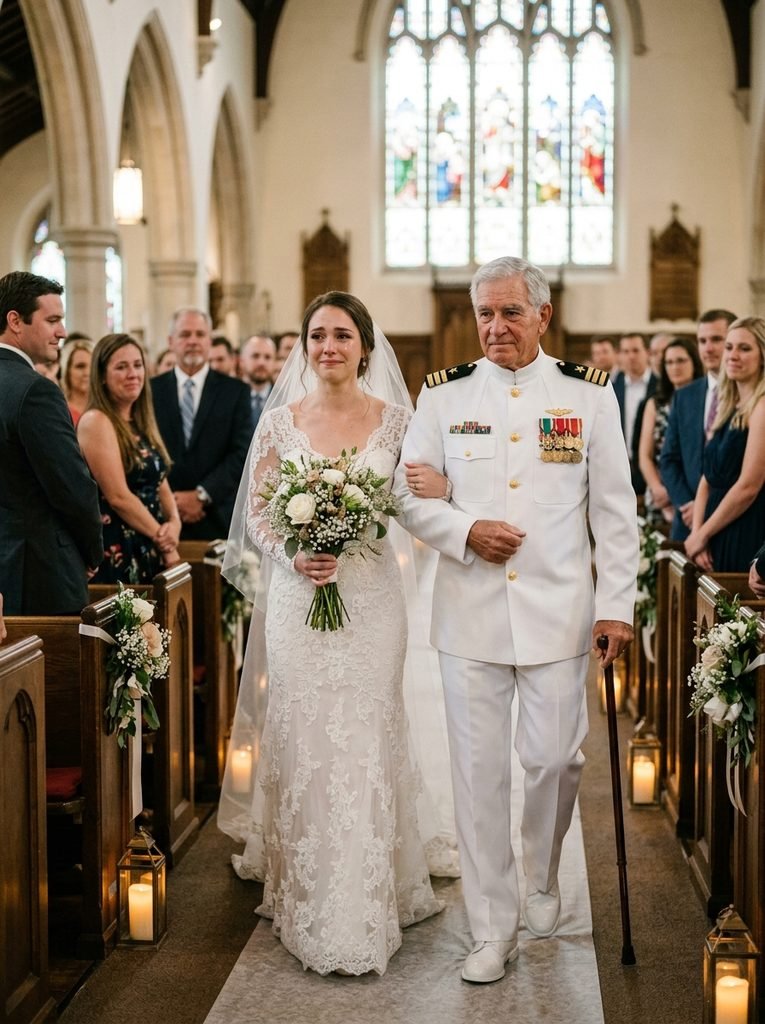
In it, Grandpa was walking me down the aisle.
Daniel waited at the altar.
Margaret stood frozen in the front row.
At first, I hated that she appeared in the picture.
Eventually, I stopped wishing she didn’t.
Because removing her would have been another kind of lie.
She was there.
It happened.
All of it happened.
And I survived it.
The stolen trust.
The forged signatures.
Claire’s disappearance.
Robert’s crime.
Richard’s deception.
Jonathan’s manipulation.
Margaret’s cruelty.
Grandpa’s silence.
Evelyn’s mistakes.
None of those truths became less true because our ending became happy.
Maybe that was what my family had never understood.
A happy ending didn’t require pretending nothing terrible happened.
It required refusing to let terrible things have the final word.
On our tenth wedding anniversary, Daniel and I returned to St. Matthew’s alone.
We stood at the same doors.
“You know,” he said, “most people remember their wedding because of cake and dancing.”
“We had cake.”
“No one ate it.”
“We eventually froze it.”
“It tasted like drywall.”
I laughed.
He offered his arm.
“Walk?”
I took it.
We moved slowly down the aisle.
At the halfway point, Daniel stopped.
I stared at him.
“No.”
He looked innocent.
“What?”
“Do not reveal another family secret.”
He laughed.
“I was going to tell you your shoe is untied.”
I looked down.
It wasn’t.
“You’re terrible.”
“I know.”
He kissed me.
And standing there, I thought of Grandpa.
Eighty-one years old.
Cane striking stone.
Stopping halfway down the aisle because he could no longer watch silence disguise itself as family loyalty.
Eight words.
She was never your daughter to regret, Margaret.
Those words destroyed the family I thought I had.
And gave me the one I should have had all along.
Claire got to know her grandchildren.
Grandpa lived until ninety-two and remained stubborn until his final morning.
Paige married again—this time without allowing anyone to pay for the wedding.
Lauren became a counselor for families dealing with financial abuse.
Richard completed his sentence and lived quietly afterward.
He never asked me to call him Dad again.
Margaret was released years later.
She and Claire eventually met in a small café.
I wasn’t there.
Claire told me afterward that they talked for four hours.
“Did you forgive her?” I asked.
Claire thought about it.
“Some of her.”
That answer made perfect sense.
Margaret never became my mother again.
But near the end of her life, she became something unexpected.
My aunt.
Not a good aunt.
Not an easy one.
But an honest one.
When she died, she left me no money.
At my request.
Instead, she left a handwritten note.
Emma,
When you were born, I thought you represented everything Claire had that I didn’t.
When you grew up, I punished you for proving you could become someone without my approval.
I spent most of my life thinking my greatest regret was taking responsibility for you.
I was wrong.
My greatest regret was having the privilege of watching you grow and being too jealous to enjoy it.
Thank you for refusing to inherit me at my worst.
Margaret.
I kept that letter too.
Not because it healed anything.
Because it was true.
And truth, finally, was the only inheritance I wanted.
When Hope eventually married, she asked me to walk her down the aisle.
I smiled.
“I will.”
Then she surprised me.
“I want Dad on the other side.”
Daniel cried for two weeks before the ceremony.
And when the day came, we stood outside another set of church doors.
Hope looked beautiful.
Confident.
Loved.
She squeezed both our hands.
“Nervous?” I asked.
“No.”
Daniel whispered:
“I am.”
Hope rolled her eyes.
The doors opened.
We started walking.
Halfway down the aisle, Hope suddenly stopped.
My heart almost exploded.
She turned toward me.
Everyone stared.
Then she smiled.
“Mom?”
“Yes?”
“Thank you for not making me carry your childhood.”
I couldn’t speak.
Daniel started crying immediately.
Of course.
Hope kissed my cheek.
Then whispered:
“I know everything that happened made you strong.”
She shook her head.
“But I’m glad you never made me suffer just to become strong too.”
That was the moment I understood the real ending to our story.
Not the recovered money.
Not Jonathan’s conviction.
Not Richard’s confession.
Not Claire coming home.
Not even Margaret finally admitting what she had done.
The real victory was that my daughter had nothing to recover from.
She did not grow up earning affection.
She did not study people’s moods before entering rooms.
She did not mistake criticism for love.
She did not apologize for existing.
She did not inherit our fear.
Hope walked the rest of the aisle laughing.
And I watched her go.
No secrets hidden in her dress.
No stolen trust waiting for discovery.
No mother refusing to walk beside her.
Just a woman moving confidently toward the life she had chosen.
Grandpa Arthur had once told me:
“She belongs to herself.”
Years later, standing behind my daughter, I finally understood how radical those words had been in a family obsessed with ownership.
Money could belong to someone.
Companies could belong to someone.
Property could belong to someone.
But people—
never.
Claire never belonged to Robert.
I never belonged to Margaret.
Margaret never belonged to her jealousy.
Richard did not have to belong to his father’s sins.
Hope did not belong to mine.
And love was not possession.
It was the freedom to tell someone the truth and still let them choose what happened next.
At the reception, Daniel found me staring at an empty chair.
Grandpa’s chair.
He had been gone three years.
“You miss him.”
“Every day.”
Daniel sat beside me.
“He would have loved this.”
“He would have complained about the music.”
“He definitely would have complained about the music.”
I smiled.
Then I imagined him as I remembered him best.
Navy suit.
White hair.
Black cane.
Eyes sharp enough to silence a church.
He had not saved me.
No one person had.
Grandpa told the truth.
Claire came back.
Daniel stayed.
My sisters changed.
Margaret admitted what she had done.
Richard testified.
I did the rest.
And perhaps that was the final truth.
We spend years waiting for someone to rescue us from the people who hurt us.
Sometimes rescue is smaller.
Someone tells you one truth.
Someone opens one door.
Someone believes your question.
Someone stands beside you.
And eventually—
you walk yourself out.
That night, after everyone left, I found Hope’s bouquet on a table.
One white rose had fallen loose.
I picked it up.
Daniel came behind me.
“Ready?”
I looked around the empty room.
At the flowers.
The chairs.
The remnants of celebration.
Thirty-nine years earlier, my own wedding had begun with someone telling me I was a regret.
Tonight, my daughter’s wedding ended with her telling me she had grown up free.
I took Daniel’s hand.
“Ready.”
We walked outside.
No cameras.
No revelations.
No strangers holding hospital bracelets.
Just cool night air.
Daniel opened the car door.
I stopped.
“What?”
I looked back at the church.
For one final second, I saw all of us.
Grandpa halfway down the aisle.
Claire hidden somewhere in Maine.
Margaret furious in the front row.
Richard guarding secrets.
Paige and Lauren smirking.
Daniel waiting.
And me—
twenty-nine years old in a white dress.
Thinking the worst thing that could happen that day was my mother refusing to walk me down the aisle.
If I could have spoken to that version of myself, I would not have warned her.
I would not have told her about Claire.
Or Robert.
Or the money.
Or the lies.
I would have told her only one thing.
Keep walking.
Because sometimes the person who refuses to walk beside you is making room for the person who should.
Sometimes the insult meant to break you becomes the first crack in a lie.
Sometimes losing the family you believed you had is the beginning of finding the people willing to love you without conditions.
And sometimes—
the child called a regret becomes the woman who ends generations of regret.
I smiled.
Then got into the car.
Behind us, the church lights went dark one by one.
Nothing chased us home.
No secrets remained waiting at the door.
And for the first time in generations, the women in my family did not need to disappear in order to be free.
We simply lived.
THE END