Then she handed me a note she had discovered hidden inside her teddy bear. The moment I recognized my husband’s handwriting, my hands started trembling. I knew whatever was written on that note could change everything I thought I knew about the night he died.
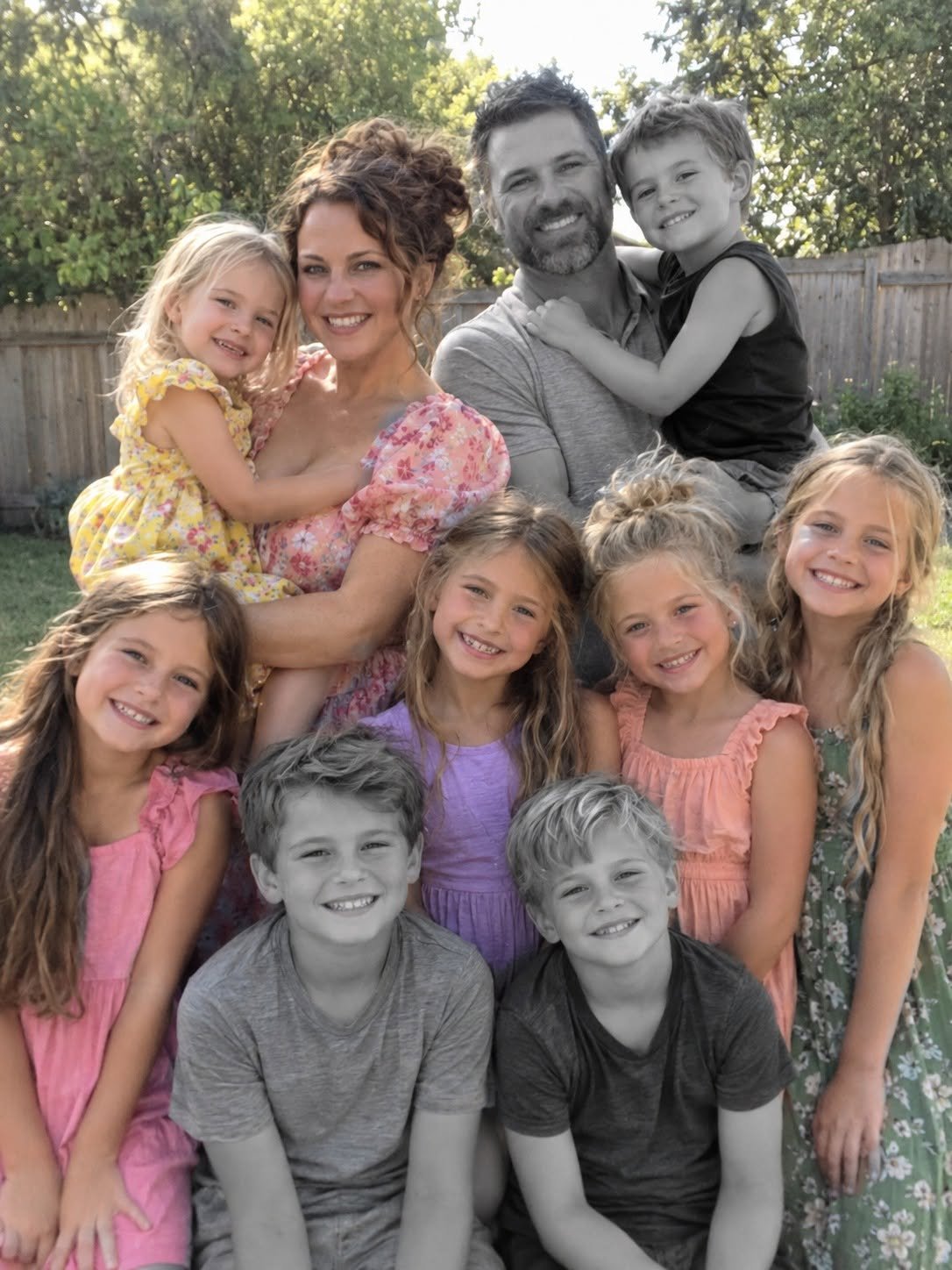
My husband, Wesley, and I had 8 children: 5 daughters and 3 sons. Our home was always noisy and chaotic, but I loved every moment of it.
When our boys were old enough, Wesley started taking them on father-and-son weekends to an old family cabin in the woods. It became their favorite tradition.
But 5 years ago, Wesley took our 3 sons on one of those trips, and none of them ever came home.
A violent storm swept through the mountains that evening. According to the police, Wesley lost control of his SUV on a slippery road, sending it down an embankment.
No one survived.
I was devastated. But something about the accident never made sense to me.
Wesley knew those mountain roads better than almost anyone. He was an extremely careful driver, especially when our children were in the car. He always checked the weather before leaving.
How could he have made such a terrible mistake?
Our close family friend, Officer Heath Dalton, was among the first officers at the scene. He assured me that the storm, poor visibility, and excessive speed had caused the crash.
He told me there was nothing suspicious.
I wanted to believe him.
After the funeral, Heath became my family’s greatest source of support. He helped with paperwork, checked on my daughters, and was always there whenever I needed someone.
Over the years, we grew closer. Eventually, our friendship turned into a relationship.
For the first time since losing Wesley, I thought I might finally be learning how to live again.
But my youngest daughter, Josie, never stopped asking questions.
She was only 6 when her father and brothers died. Now 11, she wanted to understand what had really happened that night.
Every time she asked, I struggled to answer. The memories were still too painful.
Then, last night, Josie appeared beside my bed, clutching the teddy bear she’d had since she was little.
Mom, wake up. I found something.
I sat up, startled.
Sweetheart, what’s wrong?
Her face was pale, and her hands were trembling.
My teddy bear ripped open under his arm. I was trying to fix him when I felt something inside.
She held out a small, folded piece of paper.
It was hidden in the stuffing, Mom. I think Dad put it there.
My heart began pounding.
Why would you think that?
Because I recognize his handwriting.
I took the paper from her and unfolded it carefully.
She was right.
It was Wesley’s handwriting.
And when I saw the first few words, I felt a chill run through my entire body.
Josie looked at me with tears in her eyes.
Mom, does this mean Dad knew something was going to happen?
I couldn’t answer.
Because whatever Wesley had been trying to tell me, he’d hidden it where he knew only someone in our family would find it.
And after 5 years of believing his death was a tragic accident, I was suddenly terrified to read the rest.
PART 2
For several seconds, neither Josie nor I moved.
The bedroom seemed to hold its breath around us. Rain tapped softly against the window, and the old house creaked in the darkness. Somewhere downstairs, the refrigerator hummed, steady and ordinary, as if the world had not just shifted beneath my feet.
I looked down at the paper again.
The handwriting was unmistakable.
Wesley’s letters had always leaned slightly to the right, as though they were hurrying to keep up with his thoughts. He crossed his t’s with long, confident strokes and pressed hard enough that the words often left impressions on the page beneath them.
The note was only a few lines long.
Dana,
If you are reading this, then something happened before I could come home…
He had written the note in a hurry, and it was only a few lines long.
Dana,
If you are reading this, then something happened before I could come home.
Don’t tell Heath. Not because I know he did anything, but because I’ve found out what he’s been signing his name to, and I can’t prove it yet. The proof is in the unit at Harlan Self Storage, number 114. The key is taped inside the lining of this bear. Take it to someone outside the county.
I’m taking the boys to the cabin this weekend so I can think. If I’m wrong about all of this, laugh at me and burn this note.
Tell the kids I love them. Tell Josie I’m sorry about her bear.
Wes
I read it three times. The last line was what finally broke me. He had cut open her teddy bear, pushed a note into the stuffing, and stitched it shut again with clumsy, uneven thread. Josie had always said Daddy fixed him wrong.
“Mom?” Josie whispered. “Is Heath in trouble?”
I folded the paper and held it against my chest. Heath had sat at my kitchen table the night before, eating the dinner I’d cooked, asking Josie about her science project.
“I don’t know yet, baby,” I said. “But I need you to do something hard. I need you not to tell anyone about this. Not your sisters, not anyone. Not until I understand it.”
She nodded. Her chin was shaking, but she did it.
I did not sleep. At dawn I found the tiny key in the lining of the bear, wrapped in a strip of masking tape, exactly where the note said it would be. Then I did what Wesley had asked. I looked for someone outside the county.
My sister Marian’s husband, Roy, had worked in the state attorney general’s office for twenty years. I called him from the car while my daughters were at school and told him everything in a flat voice that scared even me.
“Don’t open that unit alone,” Roy said. “And don’t touch anything in it. I’m going to bring an investigator, and we’re going to do this the boring way, with a record of every step.”
“That could take weeks.”
“Dana, if Wes was right, the boring way is the only way that holds up.”
I hated that he was right.
Unit 114 was opened four days later in front of a state investigator named Bettina Okafor, Roy, an attorney named Lowell Pruitt, and a camera. It was a ten-by-ten room that smelled of dust and cardboard. Wesley had rented it eighteen months before he died, under the name of his own small surveying company, and paid a year in advance.
Inside were three banker’s boxes and a laptop in a zippered case.
Wesley had been a licensed county road and bridge inspector before he went into private consulting. Part of his contract work involved auditing repairs on guardrails, drainage, and slope stabilization along the mountain highways. The state paid for those repairs. A contractor named Garrison Voss was billing for them.
What Wesley found, and documented over a year, was that several of those repairs had never been finished. Some guardrail sections existed only on paper. Drainage work along a stretch of Route 9 had been invoiced three times for crews that logged no hours. And the inspection sign-offs that cleared the payments were co-signed by the sheriff’s department’s liaison for road safety.
Heath Dalton.
He hadn’t just been a family friend. For years he had been a paid signature on fraudulent safety certifications.
“These are copies,” Bettina said quietly, flipping through a folder. “Photographs, dates, GPS coordinates, the original invoices. He built this carefully.” She looked up at me. “Mrs. Reyes…”
“Please don’t call me that,” I said. “I stopped using that name for no reason except that it hurt.” I had gone back to my maiden name after the funeral, and Heath had never once asked why. “Call me Dana.”
“Dana. This is serious evidence of fraud. It doesn’t prove what happened on the road.”
“I know.”
“I need you to understand the difference before you hope for more.”
I did. I had understood it for five years, in the dark, every time I asked myself how a careful man had gone off a mountain road in a storm.
The laptop held the rest.
There was a spreadsheet, a log, and a file named only DANA. It was a video, three minutes long, recorded in our garage in the weeks before the cabin trip.
Wesley sat on an overturned bucket with the camera propped on a workbench. He looked tired and older than his years, and he had a smear of grease on one cheek.
“Dana, I’m recording this because I don’t know if I’m paranoid.” He rubbed his face. “I told Heath last week that I’d found irregularities on Route 9. I thought I was giving a friend a chance to explain. He laughed it off. He said I’d misread the numbers. Then Garrison Voss called me, which he has never done, and asked me to ‘be reasonable.’”
He looked straight into the lens.
“I’m not saying anyone’s going to hurt me. I’m saying that if the people I’ve been auditing find out how much I’ve kept, I don’t know what they’ll do. So I’m leaving copies. I’ll take everything to the state in three weeks, after the cabin weekend. I want one more look at the Route 9 slope before I walk in with it. If I’m being a fool, I’ll tell you about it over breakfast and we’ll laugh.”
He smiled a little, and I saw the dimple I had loved for nineteen years.
“I love you. Please take care of the kids. They’re going to need you to be braver than I’ve ever seen you be, and I know you can.”
The video ended. I sat with my hand over my mouth.
Roy put a hand on my shoulder. Nobody spoke for a long time.
I want to be honest about what happened next, because it wasn’t what I wanted.
The state reopened the investigation, but it was slow. The SUV had been released to a salvage yard within two weeks of the crash and crushed at Heath’s recommendation. The scene photographs had been taken by Heath’s own department. The report attributing the crash to speed and weather had been written and signed by Heath.
So the fraud case moved first, because the fraud case had paper. Within three months, Garrison Voss’s offices were searched. A bookkeeper who had been quietly terrified for years agreed to cooperate. The payments to Heath came out in a ledger he had never thought anyone would read: monthly deposits, carefully rounded, disguised as consulting fees.
Heath was arrested on a Wednesday morning, at the sheriff’s substation, in front of people he’d worked beside for twenty years.
I did not go. I stayed home with Josie and made grilled cheese.
But that night, Bettina called me.
“He’s asked to speak with you.”
“No.”
“I understand.”
“What does he want?”
“He says he wants to explain what happened the night of the storm.”
I stood in my kitchen for a long time, the phone against my ear.
“Dana,” Bettina said carefully, “I can’t promise this is wise. But I can tell you that whatever he says will be on the record. And his attorney has advised him against it.”
“Then why is he talking?”
“I think,” she said, “he hasn’t slept in five years.”
I met him in a county interview room with Bettina and an attorney present. He looked like a man who had aged ten years since breakfast. He was thinner than I remembered, and his hands were folded so tightly the knuckles had gone white.
“I loved Wes,” he said.
“Don’t.”
“I did. That’s the worst part.” He swallowed. “I never meant for the boys to be in the car.”
The room went very still.
He told it in short, broken pieces, and I made myself hold still for all of it. Voss had panicked when Wesley told them what he’d found. Heath had called Wesley that Friday and learned he was leaving for the cabin. Voss’s son, who worked on a tow crew, had gone up Route 9 that evening to wait near the unfinished stretch of guardrail Wesley had been planning to inspect. Heath said he’d been told it would be a “conversation.” Something went wrong in the storm, on a road with no barrier and a wet shoulder. The SUV left the road.
“Did you see it happen?” I asked.
“No. I got there after. I was the first one there.” His voice cracked. “I saw the car and I knew. And I made a choice. I wrote it as an accident, because if I didn’t, everything I’d done for ten years would come apart, and…”
“And my sons were dead,” I said. “And you wrote it as an accident.”
“Yes.”
He did not cry. I think he had cried it all out somewhere years earlier, alone, in the same house he’d later walked out of to come and eat my dinner.
“You came to my table for five years,” I said. “You helped me with my daughters.”
“I was trying to make up for it.”
“You were trying to watch me.”
His silence was an answer.
I stood up. My legs were steadier than I’d expected.
“I’m not going to forgive you, Heath. I want that to be very clear. Not today, and maybe not ever. But I’m glad you finally told the truth, because my daughter deserves it.”
I walked out without looking back.
The legal part took almost two years.
Heath pleaded guilty to bribery, falsifying official records, obstruction, and conspiracy. His statement, along with the ledger and physical evidence recovered from Voss’s son’s truck, supported more serious charges against the Voss family. Garrison Voss was convicted at trial of fraud and conspiracy. His son took a plea and testified. Heath received a long prison sentence, and a judge read aloud the names of my husband and my three sons before sentencing.
Gideon. Rowan. Jasper.
I sat in the second row of the courtroom with my five daughters beside me. Tamsin, my oldest, was twenty-two by then and holding my hand so hard it hurt. When the judge said the boys’ names, Josie leaned her head against my arm and whispered, “They said them right.”
Nobody tells you what it means to hear your children’s names said right, after five years of hearing them whispered or avoided.
We scattered nothing and buried nothing new. The graves were already there, four of them in a row, and the grass had grown in soft and even.
But afterward I took my daughters to the cabin.
I had not been there once in five years. The porch had settled, and the windows were fogged, and the woods around it were so quiet I could hear my own pulse. Inside, there was a dartboard on the wall with three darts still stuck near the bullseye, and on the mantel a row of pinecones the boys had lined up by size.
Piper, my fourth, picked one up and turned it over in her hand. “They were so serious about these,” she said, and laughed through tears.
Willa found the old comic books under the bench. Rhea cried in the doorway. Tamsin stood on the porch for a long time, looking at the trees.
And Josie sat on the floor in the middle of the living room, holding the teddy bear I had mended with proper thread.
“Mom,” she said. “Dad wasn’t wrong. He wasn’t paranoid.”
“No, baby. He wasn’t.”
“He was brave.”
“He was.” I sat down beside her. “And so were you. You found the note. You told me. A lot of people would’ve been too scared.”
She leaned against me. “I was scared.”
“That’s what brave is.”
We stayed until dusk, all of us on that floor, telling stories about the boys. Gideon, who talked to every dog he met. Rowan, who could never finish a sentence without a joke. Jasper, only eight, who had slept with a flashlight every night and insisted it was for “emergencies.”
People ask me sometimes whether I regret all those years of not knowing, of letting Heath into my house, of leaning on him.
I do, in a quiet way that doesn’t go away.
But I’ve also come to understand something. Wesley left that note where only his family would find it, because he trusted us to be strong enough to carry it. And in the end, the one who found it was the smallest, the one who had been six years old on the worst night of our lives.
She never stopped asking questions.
Five years later, she asked the right one.
That evening, as we drove home down the mountain, the sun was dropping behind the ridge and the road was dry and clear. I kept both hands on the wheel, and in the rearview mirror I could see my five daughters, tired and quiet and alive.
“Mom,” Josie said from the back seat. “Can we come back next summer?”
I thought about the porch, the pinecones, the three darts still stuck in the board.
“Yes,” I said. “Every summer.”
Because Wesley had been right about one more thing, in the video he never expected me to see.
I was braver than I knew.
THE END.