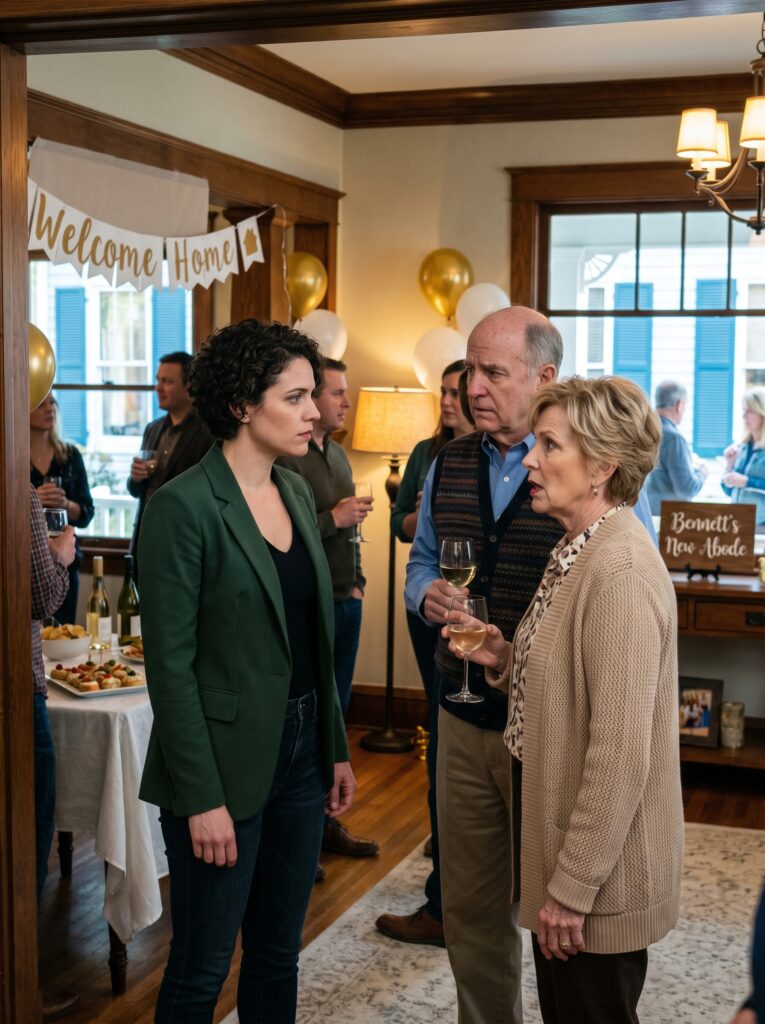
My parents did not invite me to their housewarming party, which would have hurt less if the house had not belonged to me.
My name was Caroline Bennett, thirty-five years old, a commercial insurance broker in Atlanta, and the legal owner of a two-story craftsman home in Decatur with blue shutters, a wraparound porch, and a mortgage payment that came out of my bank account every month. I had bought it three years earlier when my parents, Martin and Elise Bennett, were drowning in rent increases and telling everyone they were “too old to start over.”
Back then, Mom cried at my kitchen table and said, “We don’t want charity, honey. Just a place to breathe until we get back on our feet.”
Dad promised they would contribute toward utilities, keep the place clean, and save for something smaller. I believed them because children are sometimes the last people to realize their parents can be selfish.
For three years, I paid the mortgage, property taxes, insurance, repairs, and even the new water heater Dad insisted was “an emergency.” My parents paid nothing except compliments when relatives were watching.
Then my cousin Maya sent me a photo by mistake.
It showed my parents standing in front of the house with a silver balloon arch over the porch.
Welcome Home, Martin & Elise!
Under it, Maya had written: See you Saturday! So excited to celebrate their new place.
Their new place.
I stared at the message until the words blurred.
No one had told me. No one had asked. No one had even pretended I belonged at the party being held in a house I owned.
So on Saturday evening, I drove over in a cream blouse, black trousers, and the calmest expression I could manage. Cars lined the street. Music drifted through the open windows. Inside, relatives laughed over trays of barbecue sliders and champagne punch while my mother led guests from room to room like a proud owner giving a tour.
I stepped quietly onto the back patio and heard my father’s voice through the kitchen window.
“Well, what’s done is done,” he said. “Caroline bought it, but it’s ours now.”
My mother laughed softly. “She won’t do anything. She hates conflict.”
Aunt Paula asked, “But is her name still on the deed?”
Dad answered with complete confidence. “For now. Once she gets married someday, she’ll forget about this place. Besides, what kind of daughter throws her own parents out?”
I stood there with my hand on the patio door, feeling something inside me go still.
Then I walked in.
The room went quiet one face at a time.
Mom’s smile collapsed.
Dad turned pale.
I lifted the folder in my hand and smiled politely.
“Surprise,” I said. “Since everyone’s celebrating my house, I thought we should make the ownership clear.”
My mother recovered first, because she had spent her whole life believing that embarrassment could be managed if she spoke quickly enough.
“Caroline,” she said, forcing a bright laugh as she crossed the kitchen, “what a wonderful surprise. We were going to call you, sweetheart, but everything came together so last minute.”
I looked past her at the dessert table, where someone had placed a sheet cake with Forever Home written in blue frosting.
“Last minute?” I asked. “The balloon arch has your names printed on it.”
Several relatives looked away.
Dad set down his drink and stepped between me and the guests, lowering his voice as if that would make this private. “This is not the time.”
“That’s funny,” I said, holding up the folder, “because it became the time when you told people my house was yours.”
Mom’s cheeks flushed. “Don’t humiliate us in front of family.”
I almost laughed, because humiliation was apparently only a problem when it reached them.
“You held a housewarming party in a house you don’t own, didn’t invite the person paying for it, and told everyone I wouldn’t do anything because I hate conflict. I’m not humiliating you, Mom. I’m correcting the invitation.”
Aunt Paula slowly put her champagne cup down. “Elise, is this true?”
Mom’s lips tightened. “Caroline bought the house for us.”
“No,” I said. “I bought the house so my parents would have a stable place to live while they recovered financially. I did not gift it, transfer it, or agree to be erased from it.”
Dad’s voice sharpened. “You’re being dramatic. We’re your parents.”
“And I’m your daughter, not your landlord you can manipulate and your bank you can ignore.”
The room became heavy with the kind of silence that arrives when people realize the story they were told has holes big enough to fall through.
I opened the folder and placed copies of the deed, mortgage statement, insurance policy, and tax bill on the dessert table beside the cake.
“My name is on every document,” I said. “My money paid every bill. I also brought something else.”
Dad’s eyes narrowed. “What did you do?”
“I listed the house.”
Mom froze. “You what?”
“I listed the house for sale two weeks ago, after I found out about this party. I accepted an offer yesterday from a young family who can close in thirty days.”
The silence broke all at once.
Mom gasped. Dad cursed under his breath. Aunt Paula whispered, “Oh my God.” My cousin Maya stared at me with wide eyes, clearly realizing that her accidental text had exposed everything.
Dad took a step toward me. “You had no right.”
I met his eyes. “I had every legal right.”
“We live here.”
“You were allowed to live here because I trusted you.”
Mom grabbed my wrist, her voice suddenly shaking. “Where are we supposed to go?”
I gently pulled my hand away.
“That’s the first question you should have asked before telling everyone this house was yours.”
Dad looked around the kitchen, searching for someone to defend him, but the relatives who had arrived with gifts and congratulations were now studying the documents beside the cake.
For the first time in three years, my parents were standing in my house without control of the story.
And they hated it.
The party ended within twenty minutes, not because I asked anyone to leave, but because nobody knew how to keep eating cake beside proof of a lie.
Guests slipped out with awkward hugs, unfinished drinks, and gift bags that suddenly looked ridiculous in their hands. Aunt Paula stayed longest, standing near the front door with her purse pressed against her chest as she looked from my mother to me with disappointment she did not bother hiding.
“Elise,” she said quietly, “you told us Caroline surprised you with this house.”
Mom’s eyes filled instantly. “She did. She bought it for us.”
Aunt Paula shook her head. “There’s a difference between helping you and disappearing her.”
That sentence landed harder than anything I had said, perhaps because it came from someone my mother could not accuse of being an ungrateful child.
After the last car pulled away, the house looked strangely bare, as if the decorations had been holding up the lie. Balloons sagged in the hallway. The cake sat untouched on the table. My father stood by the fireplace with his arms crossed, still trying to look like the man in charge even though every document in the room proved otherwise.
“You’re going to regret this,” he said.
“No, Dad. I already regret waiting this long.”
Mom sat at the dining table, crying into a napkin. “We’re in our sixties. You’re really going to make us move?”
“I’m going to sell the house I own,” I said. “What happens next depends on whether you make a plan or keep pretending consequences are cruelty.”
Dad scoffed. “You sound heartless.”
For a moment, the old Caroline stirred inside me, the one who would have rushed to soften the room, explain herself gently, or promise that of course she did not mean it that way. But that woman had paid a mortgage for three years while being excluded from a party on her own porch, and I owed her more loyalty than I owed their comfort.
“I’m not heartless,” I said. “I’m finished being useful only when you need me and invisible when you don’t.”
The buyer’s inspection took place the following week. My parents were icy and dramatic, but they did not sabotage it because my attorney had sent a letter reminding them that they were occupants, not owners, and that any damage to the property would be documented and pursued. Dad blustered for two days, then started looking for apartments. Mom called relatives, hoping someone would shame me into changing my mind, but after Aunt Paula told the truth about the deed, the party, and the “Forever Home” cake, sympathy became harder to collect.
That was the part my parents had never expected. They had built their confidence on the belief that nobody would question them because parents were supposed to be respected, especially by daughters who had been trained to keep the peace. But respect is not the same as surrender, and love is not a legal transfer.
Thirty days later, the sale closed.
The buyers were a young couple named Nora and James Ellis, with a toddler who ran across the empty living room in squeaking shoes while his parents apologized for his excitement. I told them not to apologize. A house should be filled with people who were grateful to belong there.
My parents moved into a smaller rental fifteen minutes away from my brother’s apartment. It was not elegant, but it was safe, affordable, and theirs to pay for. Dad complained that I had “downgraded” them, as if their previous lifestyle had not been funded by my quiet exhaustion. Mom did not speak to me for two months, which felt less like punishment than rest.
When she finally called, her voice was smaller than I remembered.
“I was embarrassed,” she said.
“I know.”
“I wanted people to think we had made it.”
“You let them think you made it by erasing me.”
She cried then, but I did not fill the silence for her.
“I’m sorry,” she whispered, and although the apology was late and incomplete, it was the first one that did not arrive with a request attached.
My father took longer. He sent a stiff email after six months, saying he had been wrong to speak as if the house belonged to him. He did not mention the party, the cake, or the way he had assumed I would be too afraid of conflict to defend myself, but he wrote one sentence that mattered enough for me to save it.
You were generous, and I acted entitled.
I did not invite them back into my finances, and I never bought another property “for family.” Instead, I used the sale proceeds to purchase a smaller townhouse closer to my office, a place with sunlight in the kitchen, a balcony full of herbs, and a front door that nobody else could claim for a party I was not invited to.
The following Thanksgiving, I hosted dinner for the first time.
Aunt Paula came, Maya came with flowers and another apology for the accidental text that had started everything, and my parents came too, nervous and unusually polite. No one called my home theirs. No one joked about what I owed. When Mom complimented the dining room, she added, “You’ve made it beautiful, Caroline,” and for once, she did not try to stand inside my accomplishment as if it belonged to her.
After everyone left, I cleaned the kitchen slowly, enjoying the quiet scrape of plates, the smell of cinnamon, and the soft glow of the porch light outside.
A house can hold many things. It can hold laughter, secrets, unpaid bills, false pride, and the heavy silence of people who mistake generosity for weakness.
Mine held something better now.
Truth.
And this time, everyone invited knew exactly whose home it was.