Part 2: The Quiet After
Three weeks passed before I heard from my family again.
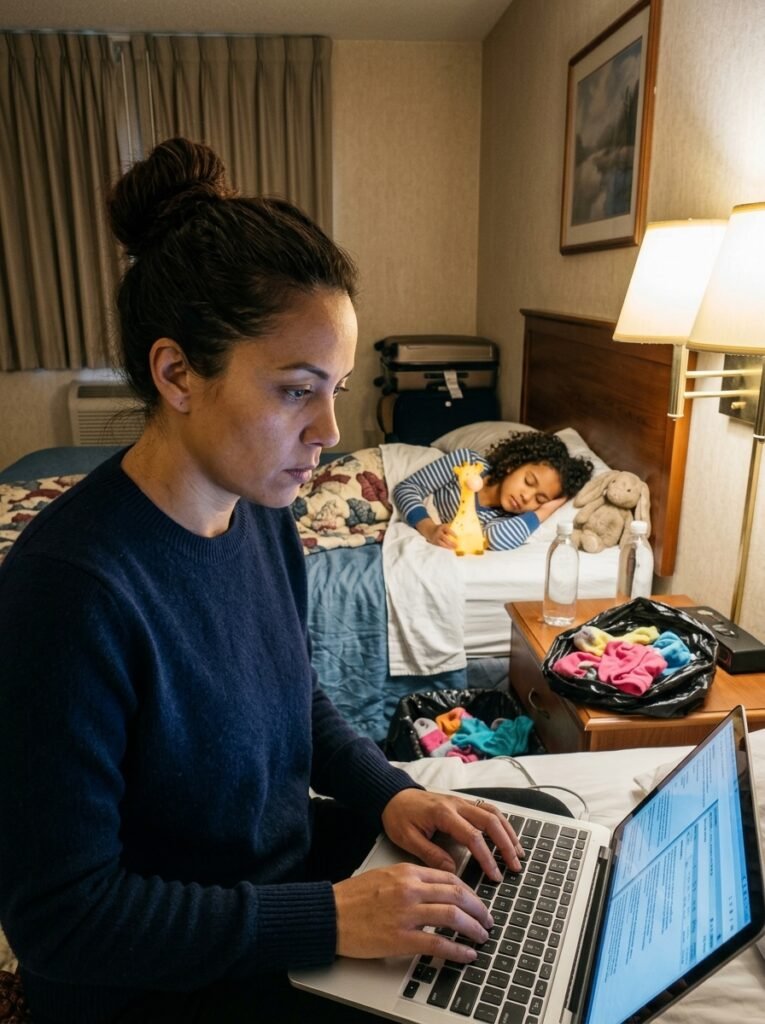
I’d settled into a rhythm I hadn’t realized I was starving for. Mornings meant making Liliana’s lunch in a kitchen that was mine, no one commenting on how I cut the sandwiches or complaining that I used too much butter. Evenings meant her giraffe lamp glowing on her own nightstand, in her own room, with a door that locked from the inside because I’d installed a child-safe latch the first weekend, just so she’d know, in her bones, that no one could walk in and take it apart while she slept.
She’d started sleeping through the night again. I hadn’t realized how much the cot and the sewing room had unsettled her until the nightmares stopped.
Then, on a Tuesday afternoon, my phone rang from a number I didn’t recognize.
“Ariana? It’s Ranata.”
My fourteen-year-old niece. I hadn’t spoken to her since the night everything fell apart. Her voice was thin and a little shaky, the voice of a teenager trying to sound like an adult.
“Hi, sweetheart. Are you okay?”
“Not really.” A pause. “Can I talk to you? Not about the lawsuit stuff. About… everything.”
I told her yes, and she talked for forty minutes. She told me she hadn’t asked for Liliana’s room. She’d told her grandmother she didn’t want to take it, that it felt wrong, but Grandma had already moved her things in “as a surprise” before she came home from school that day. She said she’d cried when she saw the giraffe lamp sitting crooked on the garage floor, because she remembered when I’d bought it for Liliana’s birthday.
“Mom’s furious at Grandma,” Ranata said. “We’re staying at the Comfort Inn on Route 9. It’s been three weeks. Mom says Grandma won’t apologize, so we can’t go back.”
“Is your mom okay?”
“She’s stressed. She keeps saying she doesn’t know how this became her problem, since she didn’t do anything.” A bitter little laugh, older than fourteen. “I told her she didn’t do anything, which is kind of the problem.”
I felt something in my chest that surprised me. Not vindication. Just tired sadness for a girl who’d been used as a pretext and was now paying rent at a Comfort Inn for a decision she never made.
“Ranata,” I said carefully, “I’m not upset with you. None of this was your fault.”
“I know. I just…” Her voice cracked. “I miss how things used to be. Before all this. Before Grandma decided everyone’s rooms were up for negotiation.”
I told her she could call anytime. I meant it.
My sister Denise called two days later. I almost didn’t answer, but something in me wanted to hear what she’d say without a lawyer scripting it.
“You could have warned me,” she said, no hello, no preamble.
“Warned you about what?”
“That Mom would use my daughter as the reason and then leave me holding the bag when it blew up! We’ve been in a motel for three weeks, Ariana. Do you know what that’s doing to Ranata? To my marriage?”
“Denise, I didn’t put Ranata in that room. Mom did. I didn’t know anything about it until I walked in and found my six-year-old on a cot.”
Silence. Then, quieter: “I know. I know that. I’m just…” A long exhale. “I’m angry, and you’re the only one who did anything about it, so I guess some of it’s landing on you.”
“That’s not fair to either of us.”
“No,” she admitted. “It’s not.” A pause. “For what it’s worth, I told Mom this was insane the second she did it. She told me to mind my business, that it was ‘temporary,’ that you’d ‘understand once you saw how much Ranata needed the space.’ I should have called you in Colorado. I didn’t, because I didn’t want to be the one who ruined your work trip.” Her voice thinned. “I’ve thought about that every day since.”
I closed my eyes. “You should have called.”
“I know.”
We sat in that silence for a moment, two sisters who had both been managed by the same woman for most of their lives, just in different rooms of the same house.
“I’m not coming after you or Ranata,” I said finally. “None of this was about punishing you. It was about the fact that nobody in that house treated my daughter like a person whose things mattered. I’m done being someone people can rearrange without asking.”
“I hear you,” Denise said. “I do. I just wish it hadn’t cost me a hotel room and my kid’s sense of home.”
“That’s between you and Mom,” I said. “I can’t fix that part.”
The custody of the story, if you could call it that, kept circling back to my mother, who apparently could not simply let it be over.
A month after the settlement, a letter arrived, actual paper, in her looping cursive, forwarded through Dana’s office because I’d blocked every direct line she had to me.
Ariana,
I have had time to think, and I want you to know that what you did to this family was cruel. You turned a misunderstanding about bedrooms into a legal circus. You embarrassed your father in front of men he’s known for thirty years. You cost us thousands of dollars we had saved for retirement. And for what? A child’s bedroom that could have been resolved with a conversation.
I raised five children in that house and never once needed a lawyer to settle a disagreement. I don’t know when you became a person who sues her own mother, but I hope, for Liliana’s sake, that you learn there is a difference between defending your child and destroying your family.
The door is still open, if you ever want to come home and talk like adults.
Mom
I read it twice. Then I read it a third time, waiting to feel the old pull, the automatic reflex to explain myself, to soften it, to find the version of the story where I was somehow still the unreasonable one.
It didn’t come.
I wrote back exactly one line, and I mailed it myself instead of going through Dana, because some things deserved to come from me directly.
Mom, a conversation would have started with you asking Liliana where she wanted to sleep, not with trash bags in the garage. The door was open the whole time. You just never walked through it before you locked mine.
I didn’t send anything else.
Six weeks after we moved in, Liliana’s school held a family night, the kind with cupcakes and a hallway of finger-painted self-portraits taped to a bulletin board. I stood in front of hers, a small girl with an enormous, lopsided smile and too much yellow paint, and read the caption she’d dictated to her teacher.
“My favorite place is my room, because it’s mine and nobody can take it.”
I had to step into the hallway for a minute.
When I came back, Liliana was showing her painting to a woman I didn’t recognize, a kindergarten aide who crouched down to admire it. “Tell me about your room,” the aide said.
“It has a giraffe lamp,” Liliana announced, with the gravity of someone delivering very important news. “And a window seat. And my mom says nobody’s ever gonna take it away, not even for a cousin.”
The aide glanced up at me with a small, knowing smile, the kind adults give each other over the heads of children who’ve said more than they know.
“Sounds like a good room,” she said.
“It’s the best room,” Liliana said, and went back to explaining the yellow paint.
I watched her, and I thought about the cot in the sewing room, and the trash bags in the garage, and the three hours of sleep I’d allowed myself the night I drafted that notice at 4:15 in the morning. I thought about how easy it would have been to stay quiet, to accept the roof over our heads as a kindness instead of recognizing it as leverage.
I hadn’t shouted in that kitchen. I hadn’t needed to.
Some doors, once you close them properly, stay closed. And some, once you open them for your own child, stay open for good.
That night, I tucked Liliana into her own bed, in her own room, under the yellow moon comforter that had followed us from a garage floor to a hotel nightstand to here.
“Goodnight, Mom,” she murmured, already half asleep. “Tell me about Colorado again?”
“Tomorrow,” I said, and kissed her forehead. “Tonight, just sleep. You’re safe. This room is yours.”
She was already dreaming before I turned off the light.
Part 3: The Audit
Four months after the settlement, my phone rang at 8 a.m. on a Saturday. Dana’s name flashed on the screen, and something in my stomach dropped, because Dana never called on weekends unless it mattered.
“Ariana, I need you to sit down.”
“I’m sitting. What’s wrong?”
“Nothing’s wrong for you,” she said. “But your father called my office yesterday afternoon, and this time he wasn’t yelling. He sounded scared.”
I frowned. “Scared how?”
“He got a letter from the IRS. An audit notice, going back three years, flagged specifically for unreported rental income.” Dana let that sit a beat. “Remember when I asked him, back in the settlement call, whether he’d reported your rent checks on his taxes?”
“You said it to rattle him.”
“I said it because it was a real question, and apparently somebody at the Department of Revenue thought it was a real question too, once the settlement agreement got filed with the county as part of the tenant dispute record. Settlement agreements involving landlord-tenant claims sometimes get cross-referenced for tax compliance. That’s not something I did. That’s just what happens when you sign a legal document admitting, in writing, that you accepted forty-eight hundred dollars a year in rent and never once declared it.”
I sat down slowly at my kitchen table. “He’s being audited because of the settlement.”
“He’s being audited because he took rent for six months, on top of Denise and Ranata’s arrangement, which it turns out has been going on for two years, and none of it ever appeared on a tax return.” Dana’s voice was carefully neutral, the tone she used when she wanted me to hear the facts without her opinion baked in. “He wants to know if you’ll write a letter on his behalf, explaining that the money was a ‘family contribution’ and not really rent.”
“But it was rent. You have the agreement. He signed it.”
“That’s exactly the problem for him,” Dana said. “He can’t have it both ways. He signed a document with your lawyer calling it rent to get out of a lockout lawsuit, and now he wants you to tell the IRS it wasn’t rent so he doesn’t owe back taxes and penalties on it. That’s not just inconsistent. Depending on how it’s framed, it edges toward fraud.”
I sat with that for a long moment, looking out my kitchen window at Liliana’s swing set in the courtyard, at the oak tree dropping its first autumn leaves.
“What do you think I should do?”
“I think,” Dana said carefully, “that this isn’t your fight to fix. You didn’t create this exposure. He did, the day he decided renting out a room in his house to his own daughter and granddaughter for years was fine as long as it stayed off the books. I’m not going to tell you to help bury that or to help expose it further. I’m only going to tell you the truth: don’t sign anything he sends you, however sympathetic it sounds. If you want to write him a factual letter, stick strictly to what actually happened, no interpretation, and run it by me first.”
I thanked her and hung up.
My father called me directly that evening. It was the first time he’d tried to reach me since the settlement, bypassing Dana entirely, which told me how frightened he really was.
I almost didn’t answer. Then I thought of him behind his newspaper the night I’d stood in that kitchen, silent while my daughter’s bed disappeared, and some old, stubborn curiosity made me pick up.
“Ariana.” His voice sounded smaller than I remembered. “I need your help.”
“I heard. Dana told me about the audit.”
“It’s a nightmare. Your mother is beside herself. They’re talking about penalties, interest, possibly worse. I need you to write something. Explain it was family money, not a formal lease.”
“Dad, you signed a document with Dana calling it rent. You said, under oath essentially, that it was rent, so you could avoid the treble damages.”
“That was for the lawsuit! This is different!”
“It’s not different,” I said. “It’s the same money. You don’t get to call it rent when it protects you and a gift when it protects you. That’s not how truth works.”
He was quiet for a long time. When he spoke again, his voice had dropped the demanding edge and gone hollow instead.
“We’re going to lose the house, Ariana. If the penalties are what they’re estimating, we can’t cover it without selling.”
I closed my eyes. Some small, old part of me, the part that used to flinch at the sound of a newspaper page turning, wanted to feel nothing but satisfaction. But mostly what I felt was a tired, complicated grief, for a version of my father who used to take me fishing, who existed somewhere underneath the man who hadn’t looked up from his paper while my six-year-old’s bed disappeared.
“Dad,” I said, “I’m not going to lie to a federal agency for you. I won’t do that, not for you, not for anyone. But I will tell you the truth, plainly, if they ask me. I paid eight hundred dollars a month for six months for exclusive use of a bedroom under a signed agreement. That’s a fact. What you did with that information afterward isn’t something I can testify to.”
“So you won’t help us.”
“I already told you the only kind of help I’m willing to give. Honesty. That’s it.”
He hung up without saying goodbye.
Two weeks later, Denise called, this time not angry, just exhausted.
“They’re selling the house,” she said. “Mom’s telling everyone it’s ‘downsizing.’ It’s not downsizing. It’s the IRS.”
“I’m sorry, Denise. I mean that.”
“I believe you.” A pause. “You know what’s strange? I keep waiting to be angry at you again, and I can’t get there. I sat with it for weeks, and the more I think about it, the more I realize none of this started with you standing in a kitchen saying ‘alright.’ It started decades ago, with Mom treating every room in that house like something she could hand out or take back depending on her mood. You just finally made her deal with consequences instead of feelings.”
“That’s generous of you.”
“It’s not generous. It’s just true, and I was too tired to keep pretending otherwise.” She exhaled. “Ranata wants to see her cousin. Would that be okay? Just the girls, maybe a park, nothing complicated.”
“I’d like that,” I said, and meant it.
The house sold in November, a modest colonial with a For Sale sign that stayed up exactly eleven days before an offer came in above asking. My mother sent one more email, forwarded through Dana’s office because I still hadn’t unblocked her number.
We’re moving into a condo. Smaller, but it’s ours, free and clear once this settles. I won’t pretend I understand everything that happened this year, but your father says you were the only one honest with us through the whole mess, even when it would have been easier to lie. I don’t know how to say thank you for that without also saying I’m sorry, so I suppose I’m saying both, badly.
I don’t expect anything back. I just wanted you to know I read Liliana’s name in that legal folder Dana sent over, and I thought about her giraffe lamp sitting crooked on the garage floor, and I have not been able to stop thinking about it since. I hope she’s happy in her room. I hope, someday, she might let her grandmother see it.
I read it three times, same as the last letter, except this time something in my chest loosened instead of hardening.
I didn’t write back right away. I let it sit for a week, the way you let a hot pan cool before you decide whether to pick it up.
Then, one Sunday, I sat down with Liliana at our kitchen table, where she was coloring a picture of a snowman even though it was seventy degrees outside, because that’s what six-year-olds do with memories.
“Hey, bug,” I said. “Would you ever want to see Grandma again? Not to live with her. Just to visit, maybe, if you wanted to.”
Liliana considered this with the seriousness she brought to all major decisions, crayon paused mid-stroke.
“Would she try to take my room again?”
“No. You don’t live there anymore. This is your room, and it’s staying yours no matter what.”
She thought a little longer. “Can I bring my giraffe lamp to show her? So she knows it’s okay now?”
I felt my throat tighten. “If you want to. That’s completely up to you.”
“Okay,” she said, decisively, and went back to her snowman. “But she has to say sorry first. Like you taught me. Sorry means you don’t do it again, not just sorry words.”
“That’s exactly right,” I said.
I picked up my phone and, for the first time in seven months, unblocked one number. Not my father’s. Just hers.
Me: Liliana said she’d consider a visit. She wants you to know that sorry means you don’t do it again, not just sorry words. If you can meet that, we can talk about a Saturday.
The reply came within a minute, three dots appearing and disappearing twice before the message finally landed.
Mom: I understand. I’ll meet it. Thank you for letting me try.
I set the phone down and watched my daughter finish her snowman, humming to herself, safe in a house nobody could rearrange behind her back.
It wasn’t forgiveness, not yet. But it was a door, opened carefully, on my terms, with a lock I controlled.
That felt like enough for now.
Part 4: The Ending
Saturday came three weeks later, cold and bright, the kind of late-autumn day where the light turns everything gold around the edges. I’d suggested a park, neutral ground, plenty of exits, nothing that could feel like a summons back into old patterns.
My mother arrived first. I watched her from the parking lot before we got out of the car, and for a moment I barely recognized her. She’d always dressed sharp, precise, armor-like. Today she wore a plain cardigan and stood alone on a bench with her hands folded in her lap, looking smaller than the woman who had once filled a kettle while explaining away a six-year-old’s missing bed.
“There’s Grandma,” I said carefully, watching Liliana’s face in the rearview mirror.
Liliana clutched the giraffe lamp in her lap, unplugged, cord wound neatly around the base, the way she’d insisted on carrying it the whole ride. “Okay,” she said. “I’m ready.”
We walked over together, my hand loosely at Liliana’s back, not pushing, just present. My mother stood when she saw us, and for the first time in my adult life, I watched her visibly restrain herself from reaching out first. She waited. She let Liliana set the pace.
“Hi, Grandma,” Liliana said, holding up the lamp like evidence. “This is my giraffe. He lived on the garage floor for one night, but now he lives in my room. My real room. Nobody can take it.”
My mother’s composure cracked in a way I had genuinely never witnessed. Her chin trembled, and she crouched down slowly, joints protesting, to be at eye level with her granddaughter.
“He’s very handsome,” she said. “I’m glad he has a good home now.” She paused, and I could see her gathering the words like something fragile. “Liliana, I made a very big mistake. I moved your things without asking you, and I put you somewhere that wasn’t comfortable, and that was wrong. Not because your mom got mad. Because it was wrong to do to any little girl, and it was wrong to do to you.”
Liliana studied her with the merciless honesty only children have. “Are you gonna do it again?”
“No,” my mother said. “I promise. And if I ever forget that promise, your mom has every right to remind me, loudly, with paperwork if she has to.”
That last part startled a laugh out of me, sharp and unexpected. My mother glanced up, and something passed between us, not quite reconciliation, but the first real crack in six months of frozen ground.
Liliana considered the apology with the gravity of a judge. Then she nodded once. “Okay. You can hold him if you want. But be careful, the cord’s a little loose.”
She placed the giraffe lamp in my mother’s hands like she was passing over something sacred, and my mother held it as if it were exactly that.
We sat on a park bench for an hour while Liliana ran off to the swings, occasionally shouting for us to watch her, and my mother and I existed in the strange, careful space of two people rebuilding something without a blueprint.
“The condo’s smaller,” she said. “Two bedrooms. Your father’s taken up woodworking in the garage, if you can believe it. Says it clears his head.”
“That’s good,” I said, and meant it, even though I still felt the old wariness sitting just under my ribs.
“I’m not asking to come back into your life the way I was,” she said, watching Liliana pump her legs higher on the swing. “I know that’s gone. I did that. I’m asking if there’s a smaller door I could fit through. Birthdays. A Sunday call. Something.”
“I can do birthdays,” I said. “And calls, sometimes, if they’re actually calls and not corrections dressed up as concern.”
She flinched slightly, but nodded. “That’s fair. I’ve had a lot of time this year to hear how I sound when I think I’m being helpful.” She wrapped both hands around the lamp in her lap. “The audit, by the way. It’s settled. Payment plan, five years. Your father’s furious at himself, not at you, for what it’s worth. He finally said it out loud, that he should have stopped you at the stairs that night instead of sitting behind his newspaper.”
“That would have changed things,” I said quietly. “Not everything. But that.”
“I know.” She was quiet for a while. “Denise told me what Ranata said, about sorry meaning you don’t do it again. I’ve thought about that more than almost anything else this year. It’s a child’s definition, and it’s the most accurate one I’ve ever heard.”
Liliana ran back over, breathless, cheeks pink from the cold. “Grandma, push me!”
My mother looked at me, silently asking permission for the smallest possible thing. I nodded.
She rose slowly, lamp set carefully on the bench beside me, and walked to the swing set to push her granddaughter, gentle and steady, the same rhythm you’d use for anyone whose trust you were trying, carefully, to earn back one push at a time.
I watched them, and thought about the cot in the sewing room, and the trash bags splitting open on cold concrete, and the four trips up and down the stairs while my parents stayed inside pretending nothing had happened. I thought about the letter I’d printed at 4:15 in the morning, exhausted and shaking, certain of only one thing: that I would not let anyone teach my daughter that love came with an eviction clause.
None of that erased itself in an afternoon at a park. It wasn’t supposed to. But watching my mother push my daughter on a swing, asking permission with her whole body before every touch, I understood that some repairs don’t happen in grand gestures. They happen in small, boring, repeated proofs. A Sunday call that stays a call. A birthday that doesn’t come with strings. A woman who learns, slowly, what it costs to earn back a door she slammed shut herself.
That evening, after we’d dropped my mother back at her car and driven home under a sky gone the color of a bruise healing, Liliana fell asleep in her booster seat before we even reached the highway. I glanced at her in the mirror, giraffe lamp cradled in her lap where she’d insisted on holding it the whole way home, “so he doesn’t get lonely,” and felt something in my chest finally, fully unclench.
I thought about the version of that night eight months ago when I’d stood in my parents’ kitchen and said, simply, “Alright.” How my mother had expected tears, or fury, or the version of me who had spent thirty years shrinking to keep the peace. Instead she’d gotten silence, and then a certified letter, and then a summons on her doorstep before lunch.
I had not raised my voice once in that entire fight. Not in the kitchen. Not on the phone with Dana. Not in the texts I sent back with the same cold, borrowed sentence my mother had handed me: be grateful you still have a roof over your head. I had simply, finally, stopped absorbing consequences that weren’t mine to carry, and let the people who created the mess live inside it until they were ready to clean it up honestly.
That was the lesson I most wanted Liliana to carry forward, more than the giraffe lamp, more than the window seat, more than any of it. Not that families should be punished. But that love without respect isn’t actually love, it’s just leverage wearing a kind face, and a person is allowed to close a door on that, gently or otherwise, and build a new one that locks from the inside.
I pulled into our driveway, our real driveway, under the oak tree that was already losing its last leaves for the year. I carried Liliana inside, still fast asleep, the giraffe lamp tucked against her chest, and laid her down in the room that had been hers since the day we moved in, and would go on being hers for as long as she needed it to be.
I plugged in the lamp. It flickered on, casting a soft golden giraffe-shaped shadow across her ceiling, the same shadow that used to fall across a cot in a sewing room, except now it fell across a bed nobody could take away, in a room with a lock she controlled, in a life we had built entirely on our own terms.
I stood in the doorway for a long moment, watching her sleep.
“Goodnight, bug,” I whispered. “This room is yours. It’s always going to be yours.”
She didn’t stir. She didn’t need to. She already knew.
I turned off the hallway light and went to bed myself, in the house that was mine, with a daughter who was safe, and a mother who was, slowly, carefully, learning what it meant to knock before entering a life she no longer had the keys to.
Outside, the wind moved through the last leaves of the oak tree, and somewhere three towns over, in a smaller condo with a garage full of half-finished woodworking projects, an old man sat with his daughter’s forgiveness weighing less than he expected, and a woman folded a cardigan she’d worn to make herself small enough to be let back in, one careful visit at a time.
Some stories end with everyone reconciled and everyone healed. This one didn’t, not entirely, and I stopped needing it to. What we had instead was truer than that: boundaries that held, a little girl who slept soundly, and a family slowly relearning, from the outside in, what it actually meant to earn a place at someone’s table.
It was enough. It was more than enough.
It was ours.
The End.