Part 2: The Guest Bedroom
Evelyn’s guest bedroom smelled like lavender and clean linen. The bed was turned down, and on the nightstand sat an ice pack wrapped in a dish towel, a glass of water, and a bottle of red wine with two glasses beside it.
“Elevate that leg,” Evelyn said, stacking pillows beneath my cast with the efficiency of a woman who had raised a child and buried a husband. “Then we’ll talk. Or we won’t. Your choice.”
I sank into the mattress and finally let myself cry. It wasn’t pretty. It was the ugly, shuddering kind of crying that comes after twelve hours of holding everything in. Evelyn didn’t say a word. She sat on the edge of the bed, handed me tissues, and rubbed slow circles on my back.
When I could breathe again, I pulled the wad of cash from my pocket. Fourteen hundred dollars, mostly hundreds, some crumpled twenties.
“Keep it,” Evelyn said. “You earned every cent. Consider it back pay.”
“Evelyn, why did you…” I struggled for the words. “The tickets. That was fifteen thousand dollars.”
She poured the wine, a small glass for me and a larger one for herself. “It was fifteen thousand dollars to reward a man I no longer recognize. I’ve been watching him for years, Claire. The way he talks to you. The way he says ‘you’re not going to die’ like your pain is a punchline. I told myself it was a phase. That he’d grow out of it.” She stared into her glass. “His father was the same way, God rest him. I put up with it for thirty-one years, and I taught my son that it was normal by staying quiet. Today I stopped being quiet.”
My phone buzzed on the nightstand. Then again. Then a third time.
Donald: Where are you??
Donald: Mom is being insane. Come home and we’ll talk about this.
Donald: The guests left. Do you know how embarrassing this is???
I stared at the screen. Not one message asked whether my leg was okay.
“Don’t answer that tonight,” Evelyn said quietly, reading my face. “Tonight, you sleep.”
I woke at 9:00 a.m., the longest I’d slept in weeks. Sunlight slanted through the curtains. Downstairs, I could hear a low murmur of voices, and one of them was male, familiar, and pleading.
I found my crutches and made my way to the top of the stairs, keeping to the shadows.
Donald stood in the foyer, wearing yesterday’s swim trunks under a wrinkled t-shirt. His eyes were swollen. He looked like he hadn’t slept at all.
“Mom, please. Just let me talk to her. She’s overreacting. It was one party!”
“One party,” Evelyn repeated, arms folded. “Donald, tell me what day your wife broke her leg.”
He blinked. “What?”
“The date. Tell me the date.”
Silence. His mouth opened and closed.
“Three weeks ago,” I said from the stairs.
Both of them looked up. Donald’s face lit with relief, like a man who’d just spotted a lifeguard.
“Claire! Babe, thank God. Come home. I’ll clean the kitchen, I swear, we’ll just forget this whole…”
“You didn’t ask if I made it through the night,” I said.
“What?”
“Not once. Not in your texts. Not right now. You asked where I was, and you told me how embarrassing it was for you.” I gripped the railing. “You have not asked about my leg.”
Donald’s jaw tightened, and I watched the old defensiveness come rushing back. “Because you were fine! You did all that cooking, so obviously you could handle it…”
“I did it because you gave me no choice.”
“I gave you a choice! I said hire a caterer or…” He stopped. Even he heard it.
“Or cook it myself,” I finished. “That wasn’t a choice, Donald. That was an ultimatum with a smile on it.”
Evelyn didn’t say anything. She only stood beside me, one hand steady on my elbow.
Donald’s eyes filled again. “So what, you’re leaving me? Over a party?”
“Not over a party.” I said it gently, because I finally understood it myself. “Over every time I didn’t say no. And every time you counted on me not saying it.”
That afternoon, Evelyn drove me to my orthopedic follow-up, which I had almost skipped because of the party prep. The doctor examined my X-rays and frowned.
“You’ve set your healing back,” she said. “Not catastrophically, but standing on it that long, the swelling, the stress on the fracture site… Claire, did you overdo it?”
“Thirty guests,” I said. “Yesterday.”
She looked at me for a long moment, then at Evelyn, then wrote something on my chart. “I’m adding two more weeks to your recovery. And I’m going to ask you something as your doctor, not your friend: is someone at home able to help you?”
“She’s staying with me,” Evelyn said firmly, before I could answer.
In the parking lot, my phone buzzed again. This time it wasn’t Donald. It was Mark, his best friend, the first to hand me a hundred-dollar bill.
Mark: Claire, I need to tell you something. Can I call you? It’s about Donald. And it’s not good.
I looked at Evelyn. She raised one eyebrow.
“Well,” she said, starting the car, “it seems the party wasn’t the only thing he was hiding.”
I stared at the screen as the three dots appeared, disappeared, and appeared again.
Then Mark’s next message came through.
Mark: Did you know he told everyone at the party you were “faking” the injury for attention? That’s what he’s been saying for weeks. And there’s something else. Something about the joint account.
My blood ran cold.
The joint account. The one that held our savings. The one Donald had said, just last month, he’d “take care of” while I was recovering.
I dialed Mark’s number with shaking fingers.
Part 3: The Joint Account
Mark picked up on the first ring.
“Claire. Thank you for calling. I almost didn’t send that.”
“Tell me,” I said. Evelyn had pulled the car over into the shade of a maple tree and put it in park. She didn’t pretend not to listen.
Mark exhaled. “Two months ago, Donald asked me to lend him eight thousand dollars. Said it was short-term, that he’d have it back by the end of the quarter. I said no. But then he told me something that stuck with me.” He hesitated. “He said he’d already ‘moved some things around’ from the joint account, and he just needed a bridge until he could put it back before you noticed.”
The air in the car seemed to thin.
“How much did he move?”
“I don’t know. He wouldn’t say. But Claire, the party wasn’t cheap. The pool rental, the speaker system, the alcohol for thirty people. He told everyone he was ‘saving money’ by making you cook, but he was spending like a man who had something to hide.”
“Why are you telling me this now?”
“Because I watched you stand there yesterday with a broken leg and a stack of my friends’ cash, and I felt sick.” His voice cracked slightly. “I’ve known him twenty years. I should have said something sooner about a lot of things.”
I thanked him, hung up, and sat very still.
“Do you have online access to the account?” Evelyn asked.
“Donald set it up. He said he’d handle it. He always handled it.” I heard how it sounded as the words left my mouth. “Oh, God. I don’t even know the password.”
“Then we’ll do this the proper way.” Evelyn reached into her handbag and pulled out a small leather notebook. She flipped to a page and copied a name and number onto a slip of paper. “This is Patricia Vance. She handled my husband’s estate. She’s ruthless, she’s fair, and she owes me a favor.”
“Evelyn, I can’t afford…”
“You’re holding fourteen hundred dollars in party cash, and I’m not asking you to pay tonight.” She pressed the paper into my hand. “Call her. Tomorrow, first thing.”
Patricia Vance’s office was on the fourth floor of a brick building downtown, with a waiting room that smelled of coffee and old books. She was a small woman in her sixties with silver hair, reading glasses on a chain, and a stare that made me feel like she’d already read my whole file.
She listened to everything without interrupting. The party, the texts, the leg, Mark’s call. When I finished, she folded her hands.
“First, I’m sorry. Second, here is what we do, and here is what we do not do.” She held up one finger. “We do not confront him. We do not warn him. And we do not touch, move, or withdraw anything from that account in a panic, because that can hurt you legally.”
“What do we do?”
“As a joint account holder, you have every right to request statements directly from the bank. Today. In person, with your ID.” She slid a form across the desk. “Ask for twelve months of history. Then bring it to me.”
I looked at the form. “And if there’s nothing there?”
Patricia’s expression didn’t change. “Then I’ll be delighted to be wrong.”
The bank branch was quiet. A young teller named Marcus looked at my crutches with sympathy and my ID with polite efficiency. When I asked for twelve months of statements on the joint savings account, he typed for a moment, and then his face shifted.
“Ma’am, one moment. I’d like to get my manager.”
My stomach dropped.
The manager, a tired-eyed woman named Ms. Okafor, led me to a small glass-walled office. She printed the pages herself and slid them across the desk facing me, as if she wanted me to see them before she said a word.
The savings balance was forty-one thousand dollars lower than it should have been.
I read the line items twice. Transfers, sixteen of them, none larger than four thousand, spread across seven months. Each one went to the same account, routed under a name I didn’t recognize.
Transfer to: R. HALE HOLDINGS LLC
“Ms. Okafor,” I said, and my voice sounded very far away. “Do you know who that is?”
She glanced at the door, then back at me. “I can’t speak to that, Mrs. Whitfield. But I can tell you the account is registered to a residential address, not a business one.” She turned the last page over. “And I can tell you that the most recent transfer was three days ago. Right before your husband’s birthday.”
Three days ago. The pool. The speaker system. The thirty guests.
He hadn’t been saving money. He had been spending mine.
I flipped to the address printed beside the LLC name. It was a street I knew, because I had driven past it a hundred times. A townhouse complex twenty minutes from our home.
My phone buzzed in my hand.
Donald: I know you went to the bank.
I froze.
Donald: We need to talk. NOW. Before you do something you’ll regret.
How did he know? I hadn’t told anyone but Evelyn, Mark, and Patricia. And the bank had only just printed the statements.
Then a second message appeared, and my whole body went cold.
Part 4: The Ending
I did not go to that address.
I sat in Ms. Okafor’s glass office with the statements in my lap and Donald’s messages glowing on my screen, and I did the hardest thing I had done in three weeks. I stayed put and did nothing impulsive.
“Mrs. Whitfield?” Ms. Okafor said. “Are you all right?”
“How does my husband know I’m here?”
She paused, then gave a small, weary sigh. “Joint account holders can set up activity alerts. When a statement request is filed, the primary contact gets a notification. That’s usually Mr. Whitfield’s phone.”
Of course it was. Donald handled everything, and I had let him.
I photographed every page. I thanked her, and I meant it. Then I walked out on my crutches into the afternoon glare and called Patricia Vance.
“Don’t reply to him,” she said before I finished my sentence. “Don’t go anywhere near that address. Come straight to my office.”
“He said I don’t understand who lives there.”
“Then let’s find out who does, the proper way.”
Patricia read the statements the way some people read poetry, slowly, with small nods. Evelyn sat beside me, her handbag on her knees like a shield. Patricia’s paralegal, a serious young man named Devin, sat at a laptop, typing.
“R. Hale Holdings LLC,” Patricia said. “Registered eight months ago. Agent listed as Raymond Hale. Devin?”
“Raymond Hale,” Devin said, scrolling. “No business history. But there’s a civil judgment from three years ago, and a couple of complaints filed with the state about unlicensed lending.”
“A loan shark,” Patricia said, without a flicker. “A small-time one, but the type who keeps his books in a spiral notebook and his friends in the sheriff’s golf foursome.”
I looked at Evelyn. She had gone very still.
“Sixteen transfers over seven months,” Patricia went on. “Round-ish numbers, regular timing. That isn’t an affair, Claire. It’s payments. Your husband was paying a debt.”
“A debt for what?”
“Only Donald can answer that,” she said. “But I suspect I know.”
The answer came from the least expected place. Evelyn opened her handbag and took out her phone.
“I wondered,” she said quietly. “Last spring he asked me for money, and I said no. He was so angry. He said I’d regret it.” She scrolled and turned the screen toward us. It was an old photo of Donald at a casino resort, grinning, holding a fan of chips. “His cousin posted this. I told myself it was one weekend.”
The room was quiet.
“So the golf trip,” I said slowly. “The fifteen thousand dollars you burned…”
“Would have gone straight to Raymond Hale within a month,” Evelyn said. “I know that now. I only knew that I couldn’t stand to reward him. I didn’t know I’d lit a match under his whole plan.”
I let out something between a laugh and a sob. Patricia allowed a very small smile.
“Then his mother may have accidentally done us a favor,” she said. “A desperate man makes mistakes. Let’s make sure he makes several.”
Patricia’s plan was patient, and I hated how much I loved it.
She filed for divorce that afternoon and had Donald served at his office, not our home, so that he couldn’t claim I had ambushed him. With it came a notice of preservation, a legal demand that he not move, hide, or destroy any financial record. Devin prepared a formal request for the bank to flag the accounts. And Patricia explained a term I had never heard: marital waste.
“It means spending shared money for purposes that have nothing to do with the marriage. Gambling. Hidden debts. Secret payments.” She tapped the statements. “Forty-one thousand dollars, drained in secret. A judge will not be fond of that.”
“Will I get it back?”
“Some of it, very likely. All of it, possibly. But you’ll get something more important.” She looked at me over her glasses. “You will get the truth on the record.”
Two days later, Donald called. Then he called twelve more times. On the thirteenth, I answered, with Patricia’s paralegal listening in the next room and a legal pad in front of me.
“Claire,” he said. His voice was hoarse. “Please. I’m begging you. Drop the papers. I can explain.”
“Then explain.”
Silence. Then, in a rush: “It started as a bet with the guys. Just fun. Then Ray’s game, it got bigger, and I owed him, and I thought I’d win it back. I always thought I’d win it back.” He was crying again. I noticed, distantly, that I felt nothing. Three weeks ago that sound would have had me apologizing. “I didn’t want you to worry, Claire. I was protecting you.”
“You told your friends I was faking my broken leg.”
“I was stressed! I said stupid things!”
“You made me cook for thirty people so you could look rich to a room of men while you were bleeding our savings dry.”
“That’s not…” He stopped. When he spoke again, the whine was gone, and what was underneath was worse. Flat. Cold. “You’re going to ruin me. You know that? You’ll ruin me, and I’ll never forgive you.”
“Donald,” I said, “I didn’t do this. You did. I just stopped covering for it.”
I hung up.
Devin, standing in the doorway, silently held up the pad. He had written on it, in neat block letters, Recorded with consent under state law. Every word. I had told Donald nothing about it, and I felt, for one dizzy moment, like a woman in someone else’s better story.
Raymond Hale turned out to be much smaller than his reputation. Patricia’s investigator, a retired detective named Walt who wore the same brown windbreaker every day, spent one afternoon with him. Afterward, Walt reported that Mr. Hale had become extremely cooperative once someone mentioned that the state attorney general’s office was quietly interested in unlicensed lenders.
He produced records of every payment, every marker, every debt. Donald had owed him nearly sixty thousand dollars in total. The forty-one thousand from our savings had been the bulk of it. The rest Donald had covered with a credit card I had never known existed, in my name, opened with my Social Security number.
That last piece was the one that made Patricia put down her pen.
“That,” she said, “is not marital waste. That is fraud.” She looked at me. “It’s your decision, Claire. I’ll support you either way. But I want you to understand what you’re holding.”
I thought about it for a long time. Not out of mercy. Out of a strange, clear exhaustion.
“I want the money back,” I said finally. “I want the card closed and cleared from my credit. I want my name off everything he touches. And I want him to sign a settlement that says exactly what he did, in plain words.”
“And if he refuses?”
“Then I want the judge to read every line of it.”
Patricia nodded. “Good. That is how you win.”
Donald signed eleven days later.
Faced with the recordings, the bank records, Raymond Hale’s documentation and a fraud referral he could not talk his way out of, he had run out of stories. His attorney, a nervous man in a too-shiny suit, negotiated for an hour and lost every point. The settlement was almost boring in its clarity. Donald would repay the forty-one thousand dollars in full, with the first half coming from the sale of the pool house and his golf equipment, and the second from his wages over three years. He would close the fraudulent card at his own expense. He would leave the house, which was mine, in my name, from my grandmother.
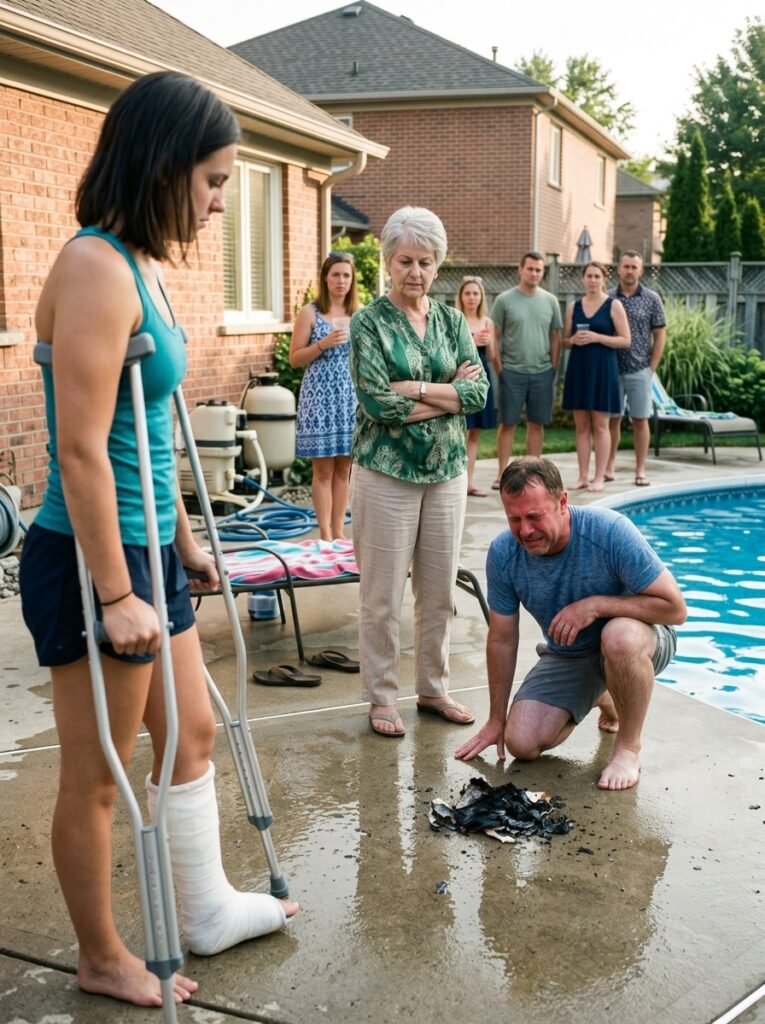
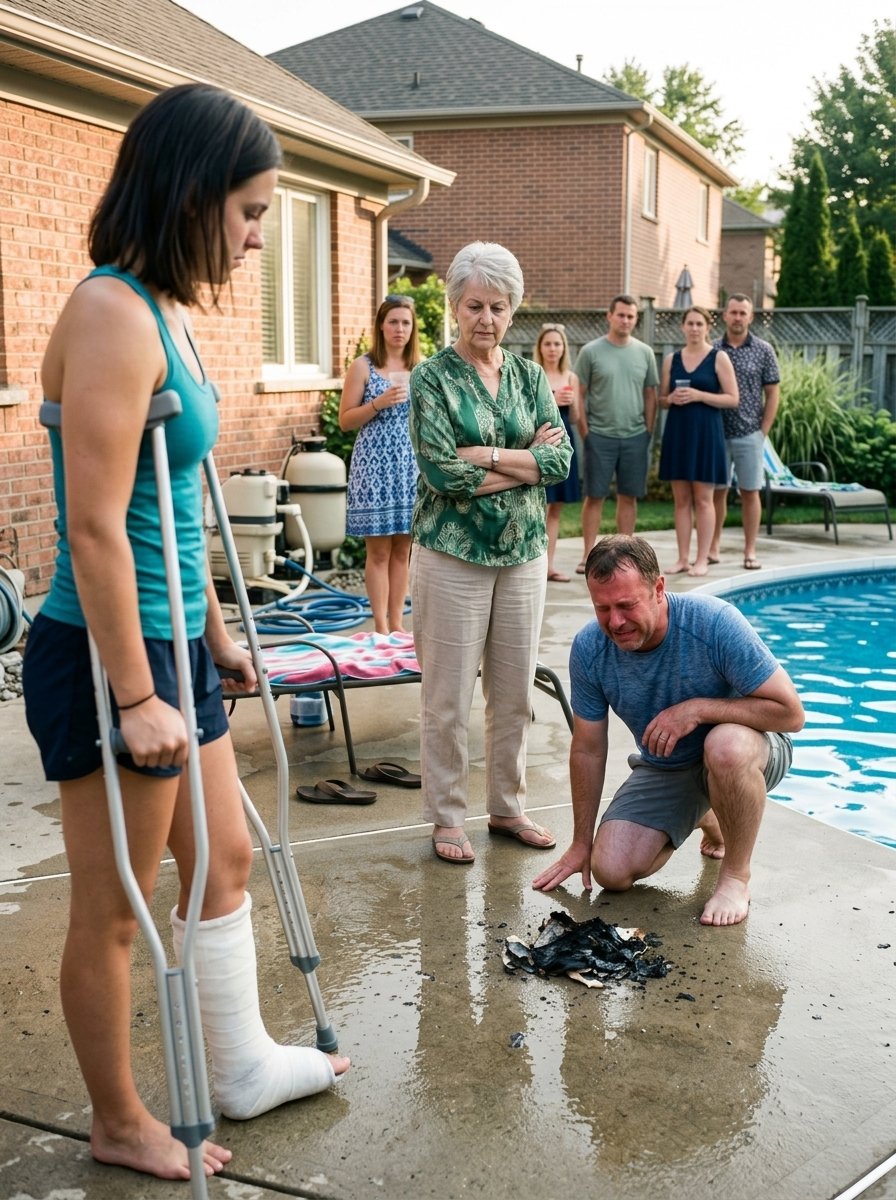
He didn’t look at me when he signed. Mark told me later that Donald had been telling people I’d “gone crazy” and “been turned against him.” Nobody believed it. Twenty people had watched his mother burn fifteen thousand dollars on a patio. Nobody had to be told what kind of man he was.
The only time he spoke to me was in the hallway afterward. He stood with his coat over his arm, and for a moment he looked like the boy Evelyn must have once loved.
“I really was going to pay it all back,” he said.
“I know you believed that,” I said. “That was always the problem.”
Two months later, the cast came off.
Evelyn drove me to the appointment, and we ate lunch afterward at the small café where she’d once told me she stopped for a coffee every week after her husband died, just to prove to herself she could go somewhere alone. My leg felt strange and thin and new. I walked to the table without crutches, slowly, with one hand on the chairs.
“Look at you,” Evelyn said, and her voice wobbled.
“You gave me the guest room for two months,” I said. “You did my laundry. You cooked for me, and you refused to let me cook for you.”
“I owe you more than that.” She stirred her coffee and didn’t look up. “I let my son become what he became. I let you marry into it, Claire. I should have said something years ago.”
“You did say something,” I said. “You said it when it counted.”
She finally looked at me. Her eyes were bright.
“The money from that party,” she said. “Fourteen hundred dollars, and Patricia said you never touched it.”
“I didn’t want it.”
“What do you want to do with it?”
I had thought about it many nights, lying awake in the lavender-scented guest room, listening to the house settle. “There’s a physical therapy program at the hospital for people who can’t afford the full course of treatment. I looked into it. I thought I’d donate it in his name.”
Evelyn stared at me, and then, unexpectedly, she laughed. It was a full laugh, warm and startled, the first I’d heard from her in all the months I’d known her. “In his name,” she repeated. “Donald Whitfield Memorial Recovery Fund. Oh, that is perfect.”
“Is that too cruel?”
“Sweetheart,” Evelyn said, wiping her eyes, “it is the kindest thing anyone has ever done with that man’s name.”
That spring, I planted tomatoes in the backyard of my grandmother’s house, the house that was mine. Mark came by sometimes, awkward and grateful, to help with the heavy lifting. Patricia sent a card. Walt sent a box of chocolate-covered pretzels with a note that read Don’t let them steal your peace.
The pool was gone. Donald’s repayments arrived on time, the way they do when there’s a judge at the other end. I never wrote him back. I never needed to.
On the anniversary of the party, I stood in my own kitchen, on two strong legs, in the morning light. I made pancakes for one, exactly the way I like them, with too many blueberries and no one to tell me it was too much.
Evelyn came by at nine with a bottle of wine under her arm and a paper bag from the bakery.
“It’s a little early for wine,” I said.
“It’s a special occasion.” She set it on the counter. “One year ago today, a very brave woman was standing in a kitchen on a broken leg, and she thought her life was over.”
I looked around at the sunlight, and the pancakes, and my mother-in-law who had become something better than family.
“It wasn’t over,” I said. “It was just finally starting.”
Evelyn poured two glasses, handed me one, and raised hers.
“To the guest bedroom,” she said.
“To the guest bedroom,” I said. “And to no more buffets.”
We drank, and we laughed, and in the yard my tomatoes leaned toward the light.
The End.