My husband handed me divorce papers in the infusion room with the IV still in my arm. He said his mother “needs him more right now.” I asked for the pen and signed.
“It’s not personal, Jill. I can’t do a sick wife and Mom’s hip at the same time.”
“I understand.”
“Mom says you can stay through the end of your treatments. She’s being generous.”
“She is,” I said.
My name is Jill. I am forty-seven. Two years ago my father died and left me the money that paid off the house we live in. My lawyer put it in a trust with my name on it. My husband signed the papers at the closing without reading them, because he never reads anything, because “that’s what I have you for.”
For nine years I read for him.
I read the mortgage. I read his mother’s Medicare forms. I read the letter from his boss about the “pattern of absences.” I read his sister’s texts when he asked me to “handle it.”
I endured “you’re the smart one.”
I endured his mother telling the church that her son “carries that whole household.”
I endured “I can’t do a sick wife.”
The nurse’s name is Deb. She has done infusions for nineteen years and she saw the envelope.
“Honey. Is that what I think it is?”
“It is.”
“In my chair?”
“In your chair.”
Deb put her hand on my shoulder for one second and took it off.
“You want me to note the time?”
“Note the time,” I said.
She wrote it down. I do not know what she wrote or where it went, but I am glad someone else saw it. I am glad there is a record.
Tuesday his mother came to the house with a box of trash bags and her walker. She let herself in with the key Todd gave her years ago, the one I asked him not to give her.
“I’m just going to start with the guest room. For when Todd needs space.”
“Todd has space.”
“He’ll need more.” She looked at the living room, at the built-in bookshelves my father installed, at the window seat I reupholstered myself. “This will show beautifully.”
“Show?”
“To buyers, dear. After.”
“After what?”
She smiled at me the way you smile at a child who is going to cry. She opened a trash bag and shook it out. The sound filled the whole room.
I went upstairs. I heard her opening drawers in the guest room. I heard hangers sliding on the rod. I sat on the edge of my bed and I did not go back down.
Wednesday I got a call from a realtor I have never spoken to.
“Mrs. Harmon? Just confirming Thursday’s walkthrough. Your husband said noon works.”
“Which husband is that?”
Quiet.
“Todd Harmon? He said the property’s going on the market in sixty days.”
“Did he say who owns it?”
“He said, ” I heard papers moving. “He said it’s a marital asset.”
“Come Thursday at noon,” I said. “Bring whatever he signed.”
I hung up before he could answer.
Wednesday night Todd came home and put his phone face-down on the counter. He does that when he does not want me to see it light up.
“Mom says you were rude to her.”
“I asked what ‘after’ meant.”
“She’s trying to help. She’s thinking ahead.”
“Ahead to what?”
He opened the refrigerator and stood there looking at nothing. “You know what. Don’t make this harder.”
“I’m not making anything.”
He closed the refrigerator without taking anything out. “You’re on chemo. You’re not thinking straight.”
“I’m thinking very straight,” I said. “Straighter than I have in years.”
He looked at me then, really looked, and I saw something I had not seen before. He was afraid of me.
“This is all going to work out,” he said. “Mom has it figured out.”
“I’m sure she does.”
He went upstairs. I heard the guest room door close.
Thursday morning, before the realtor, I went out to Todd’s truck to get the registration from the glove box. The insurance company needed it. I found the registration. I also found something else.
Hospital parking receipts. Not from my hospital. A different hospital, three towns over. Dated every Tuesday for the last eight weeks, two to four in the afternoon.
Tuesdays two to four is my infusion. Todd has told me every Tuesday that he sits in the parking lot because he “can’t watch.”
He does not sit in my parking lot.
I held the receipts in my hand. I thought about asking. I thought about all the ways he would explain it, all the ways his mother would explain it for him, all the reasons I would be wrong for asking.
I put the receipts back where I found them.
I do not know who is in that other hospital. I have not asked. I do not think I will.
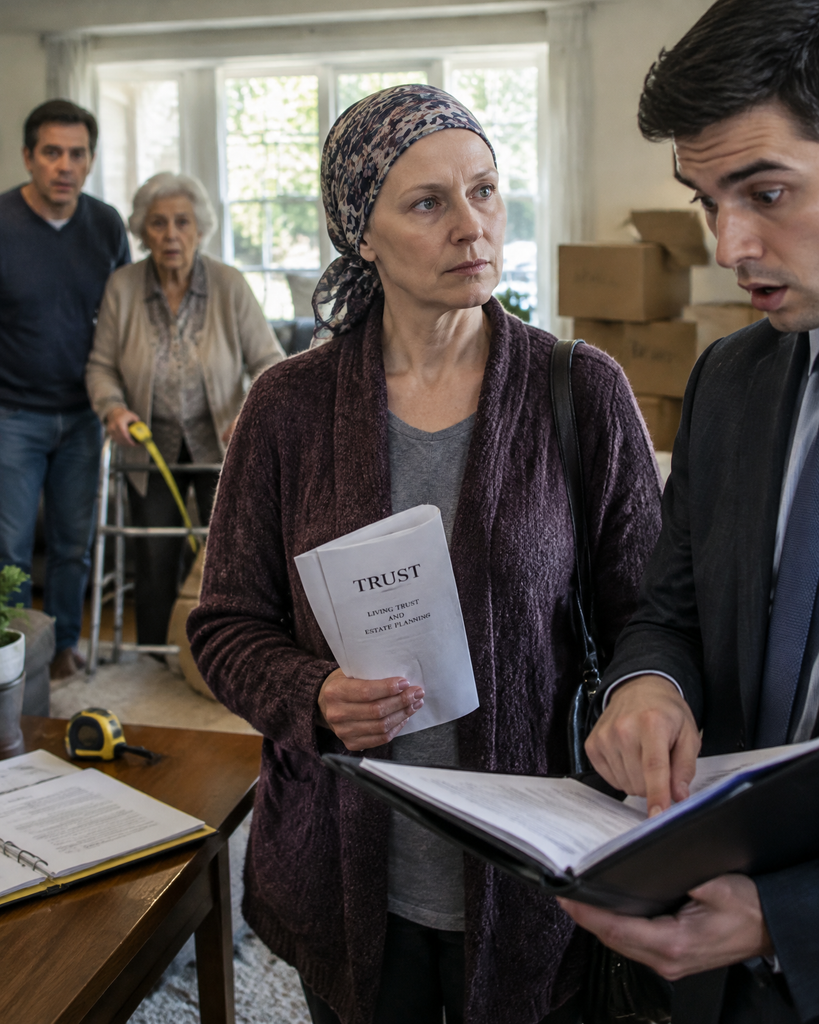
At noon the realtor came. A young man, nervous, with a leather folder and a tablet. Todd was already there, standing in the living room like he was showing the place to a friend. His mother was there too, on the walker, with a measuring tape hanging from the basket attachment.
“So,” the realtor said, looking at his tablet, “I’ll just need the owner’s signature on the listing agreement, and we can get the photos scheduled for next week.”
Todd reached for the pen.
“Before he signs that,” I said, “I’d like you to read out loud who the county says owns this house. It’s on page one of your own packet. You pulled it. I know you did, because it’s the first thing they teach you.”
The realtor looked at me. He looked at Todd. His face went a particular shade of pale.
“Just sign it, Todd,” his mother said.
“What’s she talking about?” Todd said.
“Read the line,” I said.
The realtor opened the folder. His hand was shaking slightly. He cleared his throat.
“Owner of record, the Whitfield Family Trust, trustee Jill Marie Whitfield Harmon.” He looked up. “Sir, I’m sorry, the trustee listed here is not you.”
The room went very quiet.
Todd looked at the paper. He looked at me. “That’s a mistake.”
“It’s not a mistake,” I said.
“You put the house in your name?”
“My father’s money paid for it. My lawyer set up the trust. You signed the papers at closing. You didn’t read them.”
His mother made a small noise. “Todd, she’s lying.”
“I’m not lying. Call the county recorder. Call the lawyer. His name is Donald Pevnik. He’s in the file cabinet under P.”
Todd’s face had gone red. “You tricked me.”
“I gave you papers to read. You didn’t read them.”
“Because you always read them!”
“I did,” I said. “That’s how I know what they say.”
The realtor closed his folder. “I think I should go.”
“That’s probably best,” I said.
He left. Fast. The door clicked shut behind him and the sound seemed very loud.
Todd’s mother was gripping the walker so hard her knuckles were white. “This is illegal. You can’t just take a house.”
“I didn’t take it. I bought it. With my inheritance.”
“He’s your husband. It’s marital property.”
“The trust was set up before the purchase. It’s separate property. Mr. Pevnik made sure of that.”
Todd was pacing now, back and forth in front of the bookshelf. “This is insane. You’re sick. You’re not well enough to own a house.”
“I’m well enough to sign my name. I did that on Tuesday.”
He stopped pacing. “What?”
“The divorce papers. I signed them. In the infusion room. You were there.”
His mother stepped forward, the walker scraping on the floor. “You can’t stay here.”
“I can. It’s my house.”
“Todd needs this house.”
“Todd,” I said, “can stay with you.”
I watched his face. I watched him understand.
“We can fight this,” his mother said. She was looking at Todd, not at me. “We’ll get a lawyer. A real lawyer.”
“Mr. Pevnik is a real lawyer,” I said. “He’ll be happy to speak with yours.”
Todd had gone very still. He was looking at the living room like he had never seen it before, like he was trying to find something he recognized.
“I gave you nine years,” I said. I had not meant to say it. It came out anyway. “I read everything for you. I managed everything. I carried it.”
“That’s what you were supposed to do.”
“No,” I said. “That’s what I chose to do. And I chose to stop.”
His mother opened her mouth. I held up one hand.
“You told the church Todd carries this household. You told the family he’s keeping the house. You told me I could stay through treatment like it was mercy.” I looked at Todd. “You told me your mother needs you more than I do.”
“She does.”
“Then go to her.”
He stared at me. I had never spoken to him that way. I had never spoken to anyone that way.
“Get out of my house,” I said.
His mother made a sound like she’d been slapped. Todd looked at her, then at me, then at the door.
“You’ll regret this,” he said.
“Maybe,” I said. “But not today.”
They left. Todd first, his mother behind him, the walker bumping down the porch steps. I watched through the window until his truck pulled away.
I sat down on the couch. The house was very quiet. I could hear the refrigerator humming in the kitchen. I could hear a dog barking two houses down.
I have three more infusions. Deb says I am doing well. She asks about Todd and I tell her he is staying with his mother. She nods and does not ask anything else.
The lawyer called yesterday. Todd’s signature is on the divorce papers. It will be final in sixty days.
I do not know who was at that other hospital. I have thought about it. I have decided it does not matter now.
The guest room still has trash bags in it. I will deal with them when I am stronger.
For now I am sitting in the living room my father helped me paint, in the house my father’s money bought, in the space that is mine.
I read the trust. I knew what it said.
That is what I had him for.