Twenty-seven relatives watched my son cry—never realizing the quiet soldier beside me had a sealed deed in his coat pocket that could tear their empire apart.
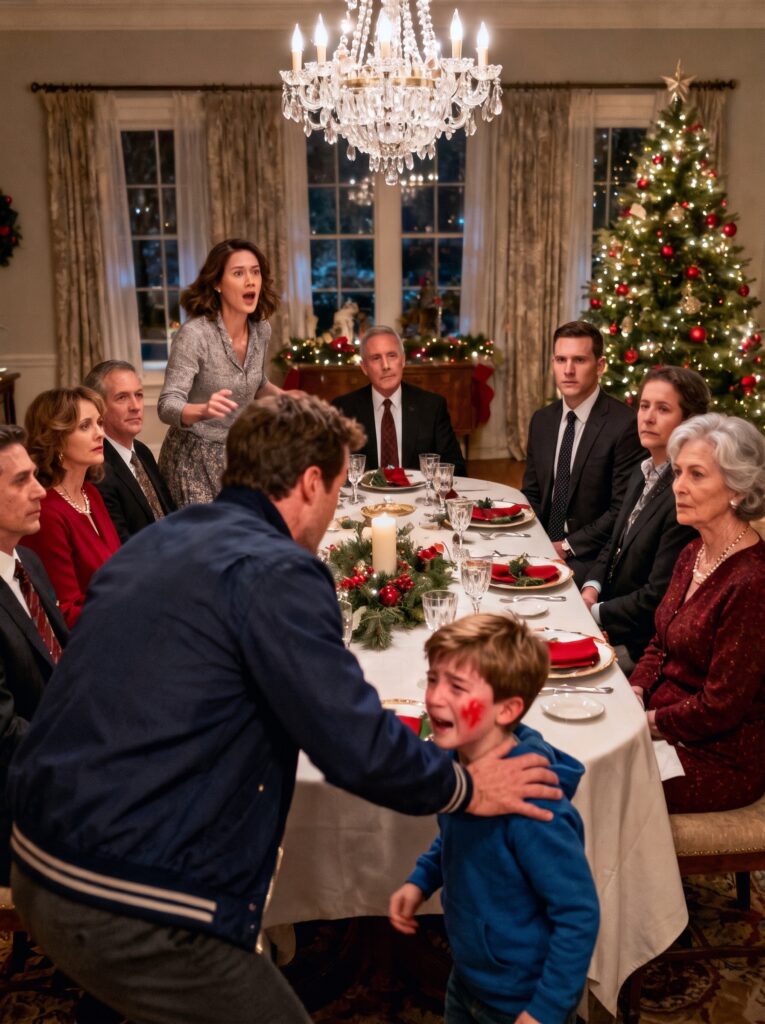
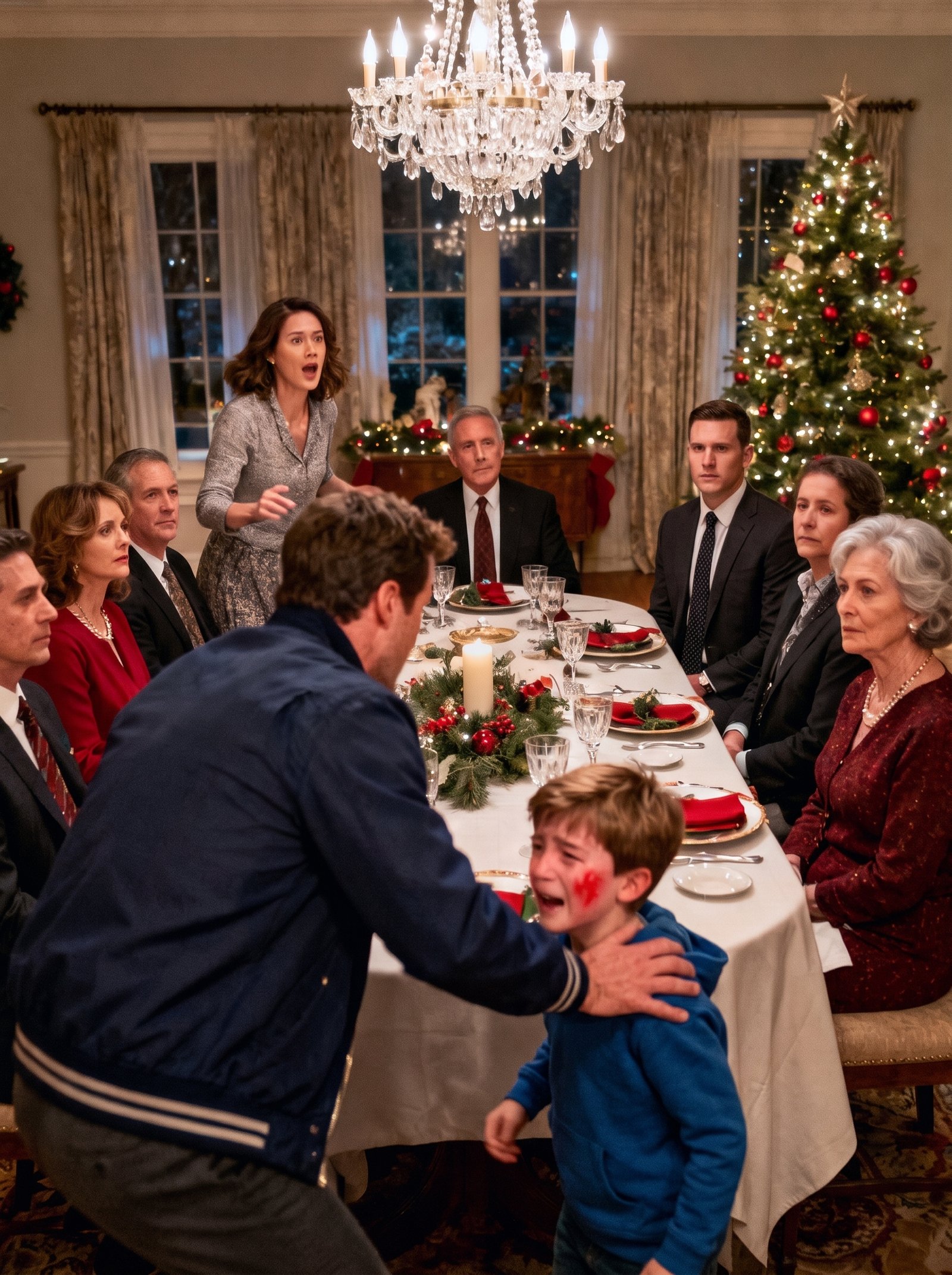
The slap was so hard the crystal chandelier above my parents’ table seemed to tremble.
Caleb stumbled backward, one small hand pressed to his cheek. A red mark spread across his pale skin as his blue eyes searched the room for someone to protect him.
“Mommy?” he whispered.
My chair scraped back, but my older brother Brent straightened his navy designer jacket as if he had merely brushed away a stain.
“He spilled water on me,” Brent said. “Since Emily refuses to raise him properly, somebody has to.”
The water had come from a crystal glass Caleb accidentally knocked over while reaching across the table to show his father a Christmas drawing.
That was his crime.
My six-year-old had been excited because Captain Nathan Hayes—his father—had returned from a nine-month deployment only four days earlier.
Caleb had slept with Nathan’s old Army sweatshirt beneath his pillow. He had counted down every night on a paper chain taped beside his bed. He had drawn our family holding hands under one enormous yellow moon because Nathan once told him they could always look at the same one.
Brent knew all of that.
He hit him anyway.
I looked toward my mother, still foolish enough to expect a grandmother’s outrage.
Evelyn Ashford dabbed her mouth with a linen napkin.
“Brent may have been a little firm,” she said, “but Caleb has been restless all evening.”
My father gave a low chuckle over his bourbon.
Aunt Diane clapped once.
“Good for you, Brent. Children these days are never told no.”
The room relaxed after that. Cousins exchanged smirks. Brent’s wife, Marissa, whispered something that made her sister laugh. My relatives looked at me as though my son’s tears were the embarrassing part.
They had always treated me that way.
I was the daughter who left the Ashford real estate empire, married a military officer, and chose a modest home over marble floors and private drivers. At family gatherings, my parents spoke about Nathan’s salary with pity and my life with carefully disguised contempt.
Nathan had endured every insult that evening.
Brent joked that taxpayers funded our groceries. Marissa asked whether deployment made me feel like a single mother. My father told Nathan he might understand “real responsibility” after managing something larger than a platoon.
Nathan had answered each insult with quiet restraint.
Then Brent hit our son.
A chair moved slowly across the polished floor.
Nathan stood.
He did not raise his voice. He did not clench his fists. He simply looked at the mark on Caleb’s cheek, then at my brother.
“Get out.”
Brent laughed, but the sound cracked halfway through.
“Don’t go all soldier on us. The kid spilled water.”
Nathan stepped around the table.
“You have sixty seconds to leave before I remove you from this room.”
My father rose halfway from his chair. “This is my house, Captain.”
Nathan finally turned toward him.
“Tonight, it became the place where a grown man assaulted my child while his grandparents laughed.”
My mother’s face went white.
Brent looked around for support. He was accustomed to assistants lowering their eyes, contractors begging for his approval, and relatives reshaping the truth to keep him comfortable.
Nobody had ever made him feel small inside the Ashford mansion.
Nathan did it without moving another inch.
“I am not leaving my own family’s home,” Brent snapped.
Nathan glanced at his watch.
“Forty-eight seconds.”
Brent grabbed his jacket and shoved past two cousins. At the doorway, he pointed at Nathan.
“You just destroyed your life. I know judges, officers, board members. By tomorrow, everyone will know a violent soldier threatened me in my parents’ home.”
Nathan’s expression did not change.
“Make the call.”
For the first time, Brent hesitated.
Nathan lifted Caleb into his arms. Our son buried his face against his father’s neck, still shaking.
I followed them toward the foyer.
“Emily, don’t you dare leave like this,” my mother called.
I turned back.
She sat beneath the chandelier wearing pearls my grandmother had once owned, surrounded by people who had watched her grandson be struck and chosen their place at the table over him.
“You laughed,” I said.
Her mouth opened, but no words came.
Outside, snow drifted across the long driveway. Nathan buckled Caleb into his car seat with hands gentle enough to make my chest ache.
Caleb sniffed. “Did I ruin Christmas?”
Nathan crouched in the snow beside him.
“No, buddy. You showed us who needed to leave our lives.”
My phone began vibrating before we reached the main road.
My mother demanded an apology. My father warned me that Nathan’s career could be damaged. Marissa claimed Brent had acted in self-defense against an “out-of-control child.” Three relatives posted vague messages about unstable veterans and ungrateful daughters.
Then Brent sent a photograph of a legal complaint.
He was accusing Nathan of assault, intimidation, and making threats against an executive of Ashford Properties.
Beneath it, he wrote, “By morning, your husband will wish he stayed overseas.”
I showed Nathan.
He read the message at a red light, then reached inside his coat.
He placed a thick cream envelope on the center console.
A law firm’s seal was stamped across the flap. Inside was an original deed, a copy of my grandmother’s trust, and a handwritten letter bearing a signature I had not seen since her funeral.
My name appeared on the first page.
“What is this?” I whispered.
Nathan looked toward the glowing windows of my parents’ mansion shrinking behind us.
“The reason your brother should never have threatened our family.”
The next morning, Brent summoned us to an emergency meeting at Ashford Properties. He expected Nathan to arrive frightened and apologetic.
Instead, we entered the boardroom with my grandmother’s former attorney.
My father sat at the head of the table. My mother was beside him. Brent stood near the windows with two corporate lawyers and a police officer waiting in the hall.
He smiled when he saw us.
Then the attorney placed the original deed on the table.
“Before you threaten Captain Hayes again, Mr. Ashford,” she said, opening the sealed folder, “you should look very carefully at the name your grandmother put here.”
She turned the document toward him.
Brent’s smile disappeared.
Brent reached for the deed, but the attorney covered it with one hand.
“This is fake,” he snapped. “Emily signed away her inheritance years ago.”
“That is what your father told the probate court,” she replied.
My father’s bourbon-reddened face tightened. My mother stared at the document as if it had begun breathing.
The attorney slid a second page from the folder. It listed eleven Ashford developments, including the downtown tower Brent called his greatest achievement.
“The company owns the buildings,” she said. “It does not own the land beneath them.”
Brent laughed too loudly. “Then who does?”
She looked at me.
My father suddenly ordered the police officer into the room, but Nathan did not move. Neither did I.
The attorney placed a notarized waiver beside the original trust.
“There is one more problem,” she said. “Emily’s signature is not the signature being investigated.”
Then the boardroom door opened, and the woman who had notarized the waiver walked in.
PART 2
The notary public, a woman with silver-streaked hair and immaculate posture named Mrs. Vance, walked to the head of the table. She placed a second, older ledger between my father and Brent.
“Mr. Ashford senior,” Mrs. Vance said, her voice cutting through the heavy silence of the boardroom like a scalpel. “Twenty-two years ago, you filed a succession amendment for the estate. You claimed your daughter signed away her equity voluntarily when she married. You swore an oath before the state of New York.”
My father’s jaw twitched. “This is a private family matter. Officer, remove these people.”
The police officer lingered by the door, glancing at the notarized seal and the heavy legal insignia of the district attorney’s office, which had quietly accompanied Mrs. Vance into the building. He stayed put.
“It stopped being a family matter the moment forgery was entered into public record,” the attorney stated calmly. She slid the ledger open to a page dated the exact week of my grandmother’s death. “Margaret Ashford knew her son’s ambitions. She knew he would strip his sister of everything the moment she married outside his approved social circle. So, three days before she passed away, she did not just secure Emily’s trust. She quietly transferred the underlying ground leases for every major asset Ashford Properties currently operates.”
Brent slammed his hand onto the mahogany table. The coffee cups rattled.
“You’re bluffing! Emily has been living in a rented house! She has nothing!”
“She chose a modest home because she wanted a life free of your conditional affection,” Nathan said, his voice quiet, steady, and utterly terrifying in its absolute calm. He stepped forward, placing his hands flat on the polished table, leaning over it toward my brother. “You thought her absence meant weakness. You thought hitting my son meant there were no consequences because you controlled the room. But you forgot one fundamental rule, Brent: empires built on stolen ground will always collapse the moment the true owner demands rent.”
Mrs. Vance turned another page, revealing a series of certified checks and default notices.
“By midnight last night, every primary commercial tenant in the Ashford Tower received notice that their leaseholder—Brent Ashford—is operating on expired ground rights. The rent checks they thought were going to your corporate account have been legally redirected to Emily’s private trust.”
My mother let out a sharp gasp, clutching her pearls as if they were choking her. “Evelyn, tell them to stop this! We raised her! We gave her everything!”
“You gave me a life where my son was expected to sit quietly while you judged us,” I said, stepping past Nathan. For the first time in my life, I looked straight into my mother’s eyes without shrinking. “You watched Brent strike a six-year-old child and you smiled because it reinforced your hierarchy. That hierarchy is over.”
My father’s face drained of its habitual flush, turning a sickly, mottled gray. He looked at Brent, searching his golden-boy son for a solution, a clever corporate pivot, a way out. But Brent was staring at the paper, his hands trembling as he realized what the ground leases actually meant. Without the land beneath them, the downtown tower, the luxury plazas, and the residential developments were empty liabilities facing immediate demolition or foreclosure suits from the city.
“You can’t do this,” Brent whispered, his voice cracking. “We’re family.”
“That word lost its meaning in the foyer of your house last night,” Nathan replied. He reached into his coat pocket once more, pulling out the official criminal complaint Brent had filed just hours earlier. He dropped it onto the table beside the deed. “Now, about that assault charge you leveled against me. My commanding officer and three military attorneys were already copied on your initial filing. They viewed it as a formal provocation against an active-duty servicemember. The military police are currently auditing your corporate defense contracts with the Department of Defense. Let’s see how long Ashford Properties survives a federal fraud investigation once they realize your primary real estate portfolio is built on a forged probate document.”
The room went utterly dead. Even the air conditioner seemed to stop humming.
My father slowly lowered his head into his hands, the bourbon-fueled arrogance of a lifetime evaporating in seconds. Marissa, who had just rushed into the boardroom after hearing rumors downstairs, stared in horror at her husband.
“Brent, what did you do?” she breathed.
Brent didn’t answer. He was staring at me, his eyes wide with a desperate, pathetic realization. The little sister he had bullied, dismissed, and cast out for a decade wasn’t just standing in front of him—she held the keys to lock his entire world away.
“We are leaving now,” I said, looking around the room at the people who had traded their humanity for marble floors. “And by sunset, your legal team will receive the official eviction notice for this very building. You have thirty days to clear your desks.”
We turned toward the door.
As we walked out into the corridor, the morning sunlight hit the glass of the high-rise windows, bright and blinding. Caleb was waiting for us in the lobby, sitting on a velvet bench, swinging his small legs. When he saw us, he jumped down and ran over, grabbing his father’s hand.
“Did we win, Daddy?” Caleb asked, looking up with wide, clear blue eyes.
Nathan scooped him up into his arms, kissing the fading red mark gently on his cheek.
“We won, buddy,” Nathan smiled, looking down at me as we walked out into the crisp winter air together. “Time to go home.”