I had no idea what she meant.
A few days later, my sister called from the other side of the world, screaming my name.
My name is Kesha. I’m thirty-four, a data analyst in Atlanta, and a single mother. Friday mornings are usually boring in the safest way — coffee first, laptop open, rent paid, groceries ordered before my first Zoom meeting.
That routine was the thin line keeping my life steady.
Until the payment screen flashed red.
The grocery charge failed.
Then the backup card failed too.
I refreshed the page. Logged out. Logged back in. Told myself it had to be a glitch.
It wasn’t.
Checking: a few hundred dollars.
Savings — my grandmother’s inheritance, our emergency cushion, Maya’s future college money: $28.14.
My hands were shaking when I called the bank. The representative went quiet, and it was the kind of silence that tells you the answer is going to hurt.
“Ms. Vance,” she said carefully, “there was a transfer last night for one hundred fifty thousand dollars to an overseas account in Dubai. It was authorized by a secondary user… Monique Vance.”
My sister.
The same sister who had stood in my Atlanta kitchen three months earlier, crying into a dish towel, promising she only needed to be listed temporarily on my account so she could “look stable” for a lender.
“I would never touch your money, Kiki,” she had sworn. “I swear.”
Now her phone was already turned off.
So I did what I had been raised to do.
I called my parents.
“Dad,” I said, forcing my voice not to break, “Monique drained my account and ran off to Dubai.”
He didn’t even pause.
“Stop exaggerating,” he snapped. “She borrowed it. You’re responsible for your own choices. You’ll figure it out. We’ll send her more if she needs help — don’t embarrass your sister.”
My mother repeated the same line I had heard my entire life.
“She explained the opportunity. Chad sounds smart. Money comes and goes. Family is forever.”
Apparently, even when family steals everything.
Ten minutes later, my phone buzzed again.
A photo from Monique.
Champagne glasses.
A man I didn’t recognize smiling behind her.
Caption:
Kiki, I’m sorry, but this is a once-in-a-lifetime opportunity. I’ll pay you back eventually. Please don’t call — international minutes are expensive. Love you.
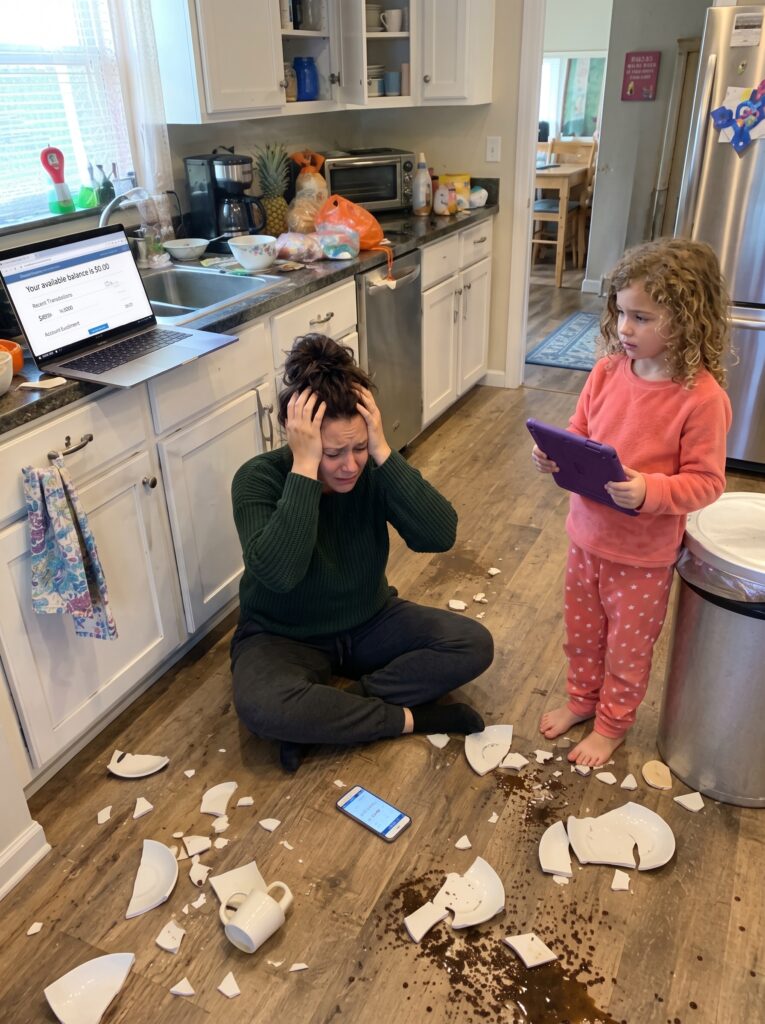
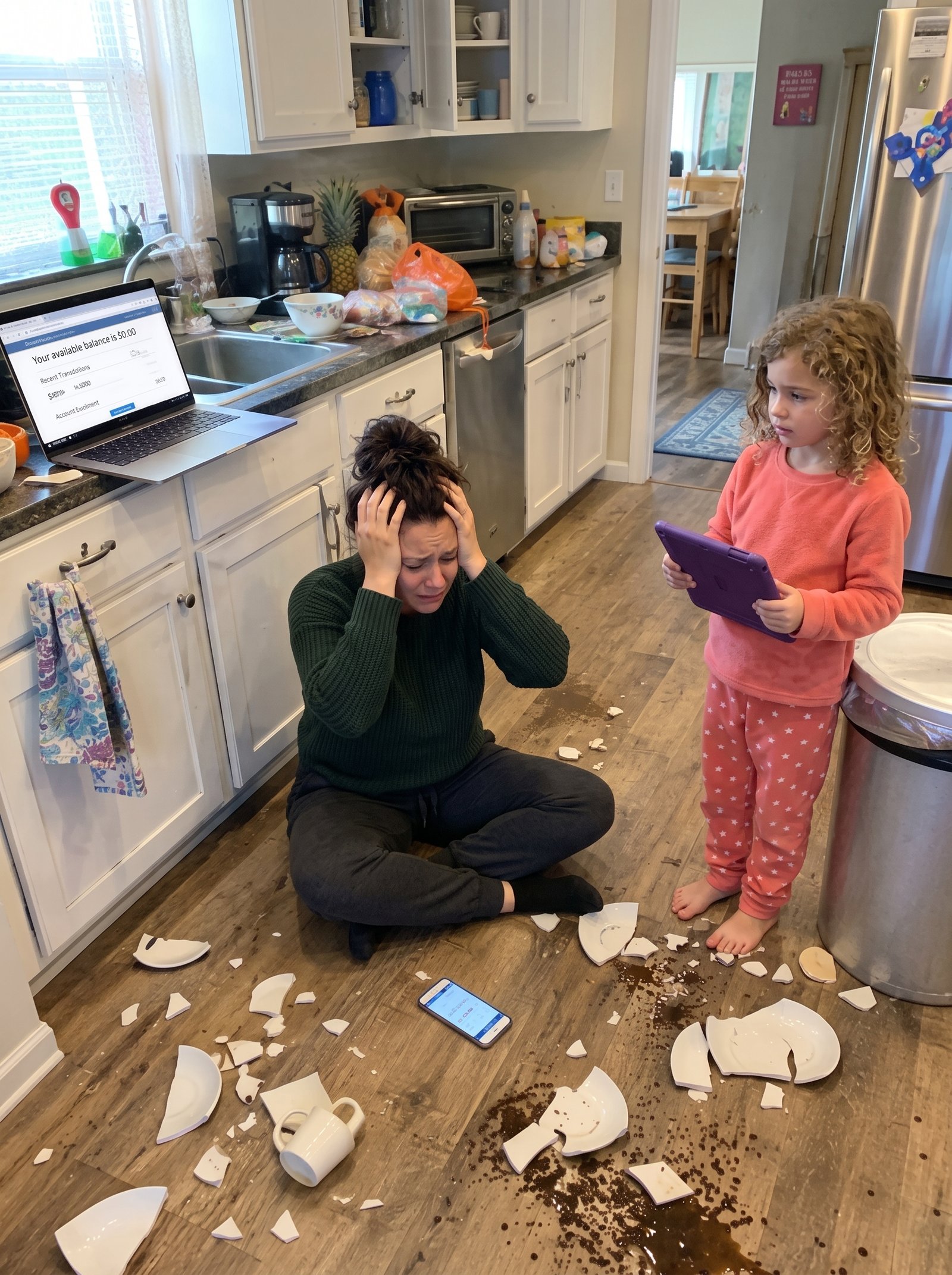
I placed the phone on the counter and slid down to the kitchen floor.
Coffee spilled.
A plate shattered.
Rent was due.
Maya’s school tuition was late.
My savings were gone.
And somehow, I was the one being blamed for reacting.
That was when Maya’s bedroom door opened.
She stepped out in her pajamas, tablet tucked under one arm, taking in the broken glass, the bank app glowing on my laptop, and her mother sitting on the floor.
“Aunt Monique did something bad,” I whispered. “She took everything. The rent. Your school money.”
Maya didn’t cry.
She didn’t panic.
She only tilted her head, those dark eyes far too focused for a nine-year-old, walked over, patted my shoulder, and said in a voice much calmer than mine:
“Don’t worry, Mom. I’ll handle it.”
I thought it was just one of those things children say when adults fall apart in front of them.
I shut myself in my room and spent the next few days staring at loan options, unanswered emails, late notices, and every worst-case scenario I could imagine.
What I didn’t know was that while I was spiraling, my quiet little girl in our tiny Atlanta apartment was already fixing everything.
And I definitely did not expect the first sign of it to come through a frantic WhatsApp call from Dubai — my sister on the line, hysterical, screaming my name like I had just taken something precious from her.
You won’t believe what happened next…
I picked up the phone with shaking hands, half-expecting another guilt-laced apology, another “please don’t call” recording disguised as an explanation. Instead, Monique’s voice came through in a panicked, high-pitched rush I’d never heard from her before.
“Kesha! What did you do? They froze everything! The account, the hotel reservation, Chad’s card, all of it! We’re stuck at the airport with nothing!”
I sat up slowly, coffee still drying in a sticky puddle on the kitchen floor.
“I didn’t do anything,” I said. “I’ve been sitting here for three days trying to figure out how to make rent.”
“Then who reported the transfer as fraud?” she demanded. “The bank froze the receiving account. Interpol flagged it as a suspected international fraud case. Chad’s furious. He thinks I set him up.”
I had no answer for her, because I genuinely had none. I hadn’t filed a fraud report beyond the initial call to my own bank, hadn’t contacted any international authority, hadn’t done anything beyond spiral quietly in my bedroom for three days while pretending, for Maya’s sake, that I had some kind of plan.
Then I remembered the tablet.
“Maya,” I called out, my voice tight. “Can you come here for a second?”
She padded into the kitchen in her socks, tablet still tucked under her arm the way it had been three days earlier, and looked at me with the same calm, focused expression she’d worn when she’d promised to “handle it.”
“Baby,” I said carefully, phone still pressed to my ear with Monique’s frantic voice audible even from a distance, “did you do something with Aunt Monique’s account?”
Maya considered the question the way she considered her math homework, thoughtfully, without a trace of guilt.
“I sent an email,” she said. “To the bank’s fraud department. And I filled out the form on the FTC website. And I used your bank login to flag the transfer as unauthorized, since you said it was unauthorized when you were talking to Grandma on the phone.”
I stared at her. “You used my banking password?”
“You use the same one for everything,” she said, matter-of-fact. “Maya2015Rent. I’ve seen you type it a hundred times.”
Monique’s voice was still shrieking faintly from the phone against my ear, but I found myself momentarily speechless, staring at my nine-year-old daughter, who had apparently spent three days quietly dismantling an international wire fraud while I sat in my bedroom refreshing loan calculator websites.
“The fraud department form,” I said slowly. “How did you even know that existed?”
“I searched ‘what to do if someone steals your bank account,'” she said, shrugging. “It came up first. It asked for the account details and the transfer information, so I used the screenshot you left open on your laptop.”
I put Monique on speaker, mostly because I no longer had the mental bandwidth to hold the phone and process what my daughter had just told me at the same time.
“Kesha, are you even listening to me?” Monique’s voice crackled through, more frantic now. “You need to fix this. Chad says if the funds aren’t released by tomorrow, the deal falls through completely, and he’s going to blame me!”
I looked at Maya, who was now calmly pouring herself a glass of orange juice like she hadn’t just single-handedly triggered an international fraud investigation from her bedroom.
“Monique,” I said, finally finding my voice again, steadier than I expected. “You stole one hundred fifty thousand dollars from your niece’s college fund and flew to Dubai with a man neither of us has ever met. I didn’t do anything to stop your little opportunity.”
I glanced at Maya one more time.
“My nine-year-old did.”
Monique went silent on the other end of the line for a long moment, the kind of silence that told me she was recalculating everything she thought she understood about how her plan had unraveled.
“Your daughter,” she finally said, disbelief cracking through the panic. “A nine-year-old flagged an international wire transfer.”
“Apparently,” I said, watching Maya calmly sip her orange juice at the kitchen table, utterly unbothered by the chaos she’d set into motion. “You should probably be more careful about which accounts you drain, Monique. Turns out this family has more than one person capable of handling a crisis.”
“This isn’t funny, Kesha. Chad thinks I orchestrated this to steal his cut. He’s threatening to go to the authorities about the whole arrangement, which means I could be implicated in whatever he’s actually involved in over here.”
For the first time since the payment screen had flashed red three days earlier, I felt something other than panic settle into my chest. Not satisfaction, exactly, but something close to it.
“Then I’d start cooperating with the fraud investigation instead of screaming at me,” I said. “Because right now, my daughter’s paperwork has already flagged this as suspected fraud on your end, which means the authorities are going to want to know exactly who Chad is and why he had you wiring six figures into an account tied to whatever business he’s running out there.”
Monique’s voice dropped, suddenly quieter, the bravado gone. “You don’t understand. If this gets investigated properly, I could go to prison, Kesha.”
“You should have thought about that before you used my daughter’s college fund to fund your once-in-a-lifetime opportunity,” I said, and hung up before she could respond.
I called my bank’s fraud department directly afterward, formally confirming everything Maya had already initiated, providing my own identification and account verification to solidify the case. The representative, a patient woman named Carol, walked me through what came next.
“Your daughter actually did you an enormous favor,” Carol said. “Because she flagged this within seventy-two hours and used the correct channels, most of the funds are recoverable. The receiving bank in Dubai has already frozen the account pending investigation, and given the amount involved, this is likely to trigger cooperation from international regulators.”
“How much of it can actually come back?” I asked, almost afraid to hope.
“Based on the freeze timing, we’re looking at potentially the full amount, minus processing fees, once the investigation confirms the unauthorized nature of the transfer,” Carol said. “It’ll take a few weeks, but Ms. Vance, this is a very good outcome, especially this quickly.”
I hung up the phone and sat back down at the kitchen table across from Maya, who had moved on to homework, seemingly having already mentally filed away the crisis she’d resolved.
“Baby,” I said. “You might have just saved your entire college fund.”
“I know,” she said, not looking up from her worksheet. “I told you I’d handle it.”
That evening, my parents called again, my father’s voice carrying the same dismissive tone from days earlier.
“We heard Monique’s having some trouble overseas,” he said. “You didn’t call the police on your own sister, did you?”
“I didn’t call anyone,” I said. “My daughter filed a fraud report through the proper channels because someone stole her college fund. If Monique’s in trouble now, that’s a consequence of what she did, not something I did to her.”
“Family doesn’t turn on family,” my father said. “You could have handled this privately.”
“I tried handling it privately for three days,” I said. “You told me to stop exaggerating. Mom told me family is forever, even when family steals everything. I’m done being the only person in this family who’s expected to absorb the consequences of everyone else’s choices quietly.”
My father started to respond, but I cut him off, calmer than I’d felt in days.
“The money’s likely coming back,” I said. “Not because either of you helped. Because my nine-year-old did what neither of you were willing to do, actually protect me instead of protecting Monique’s comfort.”
I hung up before he could offer another excuse.
The investigation moved faster than Carol had originally estimated. Within three weeks, the bank confirmed the full amount, minus a small processing fee, had been recovered and returned to my account. The Dubai authorities, it turned out, had already been quietly investigating Chad for a string of similar schemes targeting women he’d met online, promising investment “opportunities” that were, in reality, funded entirely by their own stolen or borrowed money. Monique wasn’t his first target. She was simply the most recent one dramatic enough to end up flagged by a nine-year-old’s fraud report.
Monique called again once she made it back to the States, her flight home paid for, she admitted bitterly, by a wire transfer from our parents, the same parents who’d told me to stop exaggerating three weeks earlier.
“I’m sorry,” she said, though it came out flat, more exhausted than remorseful. “I really thought it was going to work out.”
“I believe that you believed it,” I said. “That’s actually the saddest part of all this, Monique. You didn’t even steal that money maliciously. You just decided my daughter’s college fund was an acceptable risk for your own gamble.”
“I’ll pay you back,” she said. “Eventually.”
“The bank already got it back,” I said. “You don’t get credit for restitution you didn’t provide.”
She didn’t have a response for that, and for the first time in longer than I could remember, I didn’t feel obligated to fill the silence with reassurance or forgiveness she hadn’t actually earned.
My relationship with my parents took longer to settle into anything resembling normal, and even then, “normal” looked different than it used to. I stopped calling first. I stopped absorbing blame for reactions they’d trained me my whole life to apologize for. When my mother called a month later, testing the waters with her usual refrain about family being forever, I finally said the thing I’d swallowed for thirty-four years.
“Family being forever doesn’t mean I have to keep paying the price for everyone else’s choices,” I said. “I love Monique. I’m glad she’s safe. But I’m not going to pretend what she did was a small mistake, and I’m not going to keep absorbing the consequences quietly just because it makes things easier for you two.”
My mother was quiet for a long moment, something shifting slightly in the silence, though I wasn’t naive enough to think decades of family patterns would undo themselves over one conversation.
“I hear you,” she finally said. It wasn’t an apology. But it was, for the first time, an acknowledgment.
Maya, through all of it, remained remarkably unbothered by the scale of what she’d done, more interested in whether her recovered college fund meant she could still get the telescope she wanted for her birthday than in any recognition for saving it in the first place.
“You know,” I told her one evening, tucking her into bed, “most adults wouldn’t have known how to do what you did. Filing that report, finding the right forms, flagging the transfer correctly.”
She shrugged against her pillow. “You were too upset to do it. Somebody had to.”
I sat with her for a while longer that night, thinking about the calm, steady way she’d walked into that kitchen three days after everything fell apart and simply decided to fix what the adults around her couldn’t, or wouldn’t.
I used part of the recovered funds to open a proper investment account in her name, separate from the college fund, one she’d eventually learn to manage herself, because if there was one lesson worth teaching a daughter capable of untangling international wire fraud at nine years old, it was that her instincts, her calm under pressure, and her refusal to simply accept a crisis as unsolvable were worth protecting and cultivating, not just admiring after the fact.
Monique eventually paid back a portion of what the recovery hadn’t covered in fees, slowly, in small installments over the following year, a quiet, ongoing reminder that consequences, even delayed ones, eventually do catch up.
And every time Maya glanced up at the sky through the telescope she got for her birthday, I thought about how much steadier she’d been, at nine years old, than the entire rest of our family combined.