“Beth Harper,” Dustin said.
The courtroom went still.
For a second, I genuinely thought I had misheard him.
My own lawyer blinked. “Excuse me?”
Dustin straightened in his seat with the same calm expression he used when discussing weather or grocery lists.
“My wife is emotionally unstable,” he said. “She has anger issues, paranoia, and a history of overreacting to harmless situations.”
Harmless.
The word rang in my skull so loudly I barely heard the rest.
Judith sat behind him wearing cream-colored pearls and the expression of a grieving saint. Every now and then she dabbed beneath her eyes with a tissue, careful not to smudge her mascara.
Meadow sat beside my attorney clutching a stuffed rabbit against her chest.
She would not look at me.
That hurt more than anything.
Dustin’s lawyer stood and began sliding papers toward the judge.
Photographs.
Printouts.
Therapy notes from years earlier after my miscarriage. Private journal entries Dustin had promised he never read. Text messages where I admitted feeling overwhelmed, exhausted, angry.
Evidence.
Not of abuse.
Of humanity.
“Healing from trauma can manifest unpredictably,” the attorney said smoothly. “Mrs. Harper has projected her unresolved childhood issues onto innocent family interactions.”
I felt physically cold.
Not because they were entirely lying.
But because they had taken pieces of my pain and rearranged them into a weapon.
The judge turned toward me. “Mrs. Harper, did you threaten to keep your daughter away from her grandmother permanently?”
“Yes,” I whispered.
“And did you scream at your husband in front of the child?”
My mouth opened.
Closed.
“Yes.”
Dustin lowered his eyes at exactly the right moment, like a wounded man embarrassed by conflict.
I suddenly understood why people stay trapped in abusive families for decades.
Because cruelty rarely looks cruel from the outside.
Sometimes it looks patient.
Reasonable.
Concerned.
By the time the hearing ended, temporary shared custody had been granted until further investigation.
Judith smiled at me in the parking lot.
Actually smiled.
“You should’ve calmed down before making accusations,” she said softly as she walked past.
I wanted to hit her.
God help me, I wanted to.
Instead, I got into my car and shook so violently I could barely fit the key into the ignition.
That night, Meadow returned from Dustin’s apartment unusually quiet.
I made macaroni because it was normally her favorite. She pushed noodles around the bowl without eating.
Finally she asked, “Are you crazy?”
The fork slipped from my hand.
“What?”
“Grandma says crazy people don’t know they’re crazy.”
My lungs forgot how to work.
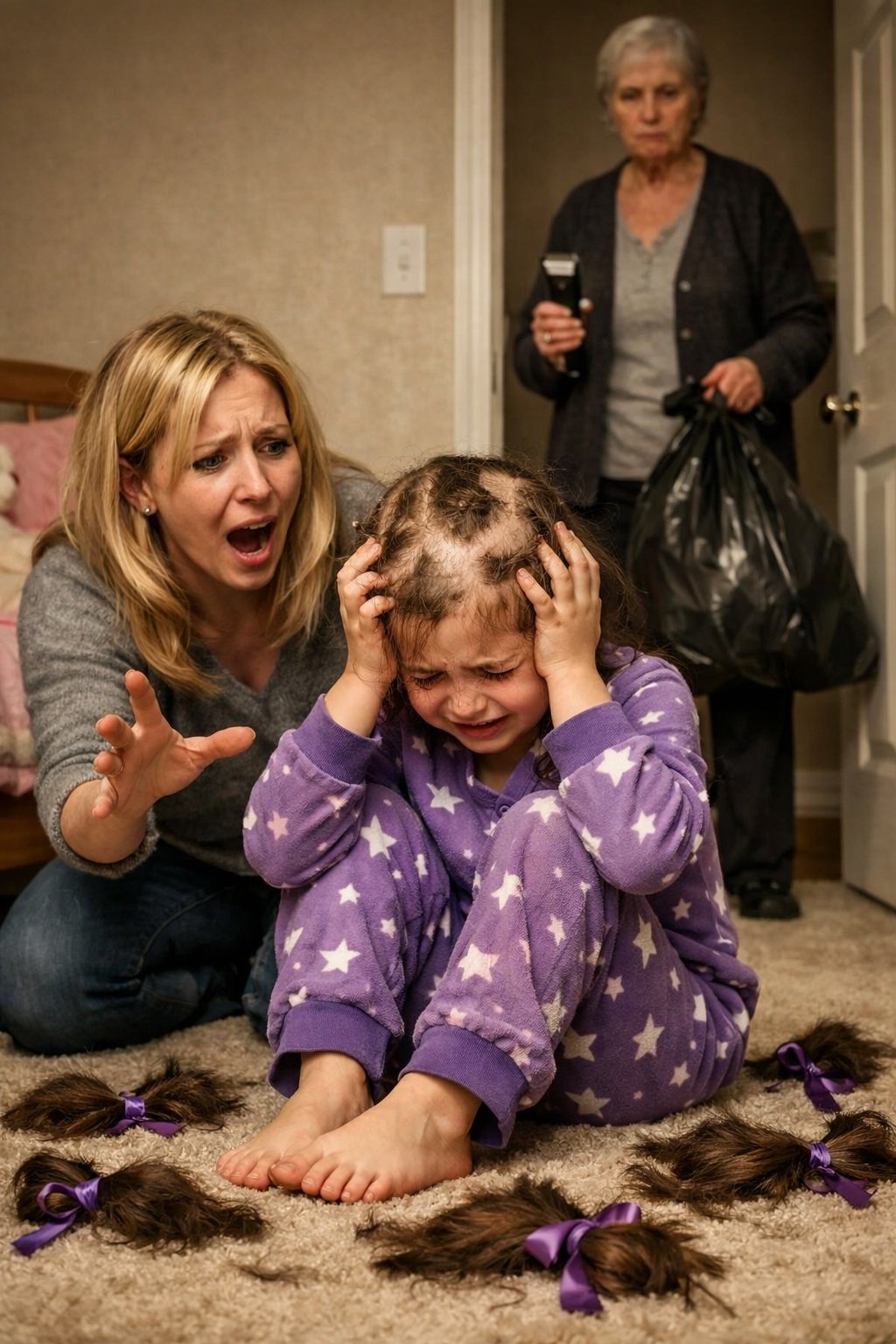
I looked at my daughter—my tiny little girl with uneven hair and frightened eyes—and realized they had already begun teaching her not to trust herself.
The same poison.
A different generation.
I knelt beside her chair.
“Listen to me carefully, Meadow.”
She stared down at the table.
“Has Mommy ever hurt you on purpose?”
A long silence.
Then a tiny shake of the head.
“Has Mommy ever made you feel ugly for being yourself?”
Another shake.
Tears slid quietly down her cheeks.
“She said you lie because you hate Grandma.”
I closed my eyes.
Not because I was surprised.
Because part of me still was.
How many times had Judith done this before? To Dustin? To herself? How many years had she spent rewriting reality until everyone else doubted their own memories?
Suddenly, I saw Dustin differently.
Not innocent.
But trained.
Raised inside the same emotional maze where love was conditional and obedience mistaken for loyalty.
That realization should have softened me toward him.
Instead, it made me furious.
Because he had recognized the damage enough to survive it…
…and still handed our daughter over to it willingly.
Over the following weeks, the custody battle became uglier.
Judith’s attorney painted me as unstable. Emotional. Vindictive.
Words people use when women stop absorbing pain quietly.
Dustin testified that I was “overprotective” and “prone to emotional exaggeration.”
Meanwhile Meadow stopped drawing.
Stopped singing.
Stopped asking for bedtime stories.
One evening I found her standing on a stool in the bathroom staring into the mirror, rubbing her scalp as tiny new hairs began growing back.
“What are you doing, sweetheart?”
She looked ashamed.
“Trying to see if I look bad.”
My heart cracked so sharply it felt physical.
I walked over and lifted her gently off the stool.
“Who told you beauty decides whether you deserve love?”
She shrugged.
Nobody had to answer.
Children build beliefs from repetition.
Just like I did.
That night after she fell asleep, I opened my laptop and began documenting everything.
Every comment.
Every bruise.
Every manipulation.
Every witness.
And buried deep among old family photo albums I found something unexpected.
A video.
Ten years old. Grainy quality. Christmas morning.
Dustin filming while Judith moved around the living room.
At first it looked ordinary.
Then little eight-year-old Dustin walked into frame holding a handmade ornament.
“I made it at school,” he said proudly.
Judith looked directly at it and laughed.
“Oh honey,” she said, “let’s maybe not hang that where guests can see.”
Tiny Dustin’s smile disappeared instantly.
The camera tilted downward for a second.
And from behind it, adult Dustin’s voice whispered quietly:
“She always does that.”
I replayed those four words over and over.
Not because they proved Judith was cruel.
I already knew that.
But because they proved something else.
Dustin knew too.
He had always known.
And suddenly the fear that had been choking me for months transformed into something harder.
Clearer.
Because if Dustin remembered the pain…
then one day Meadow would remember too.
And when that day came, I refused to let her remember a mother who stayed silent while everyone taught her she was small.